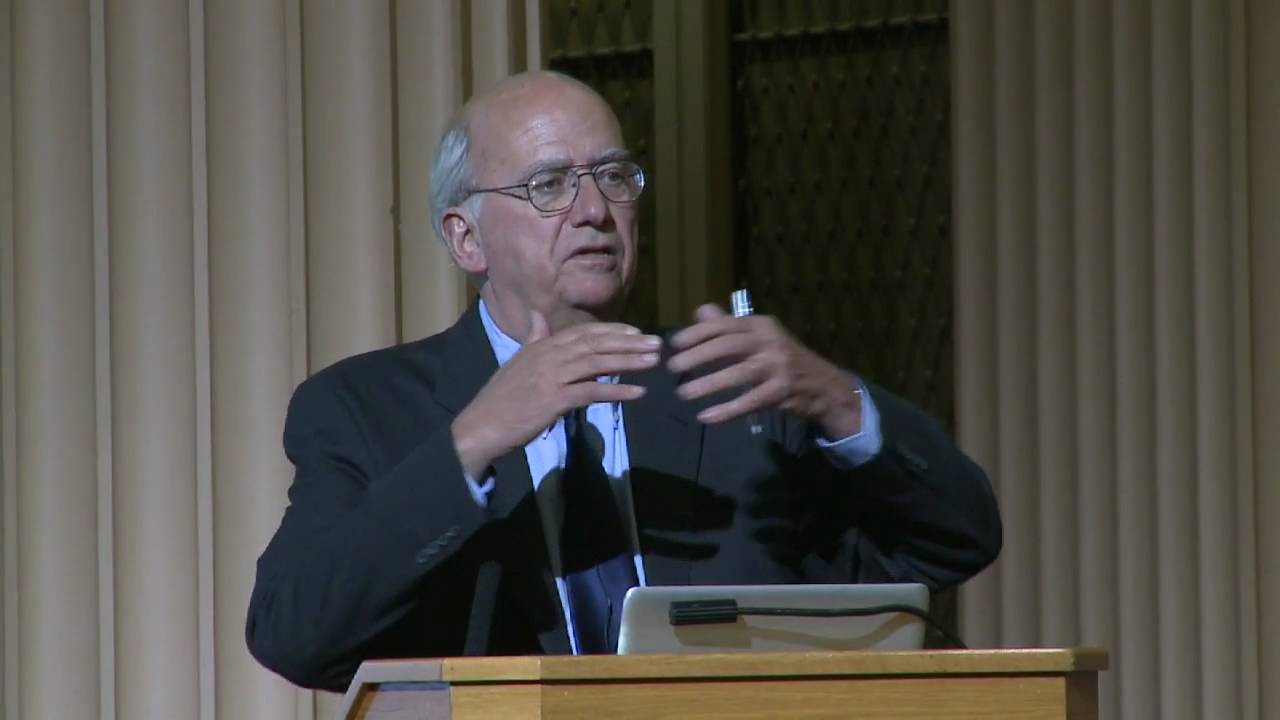
Tonight's lecture is entitled introduction and overview what we are and we'll explore the built-in complexity that enables us to discover the keys to how ultimately the mind constrains the brain Professor gazan could I now invite you to present the first of your gford [Music] lectures thank you Professor Brown and to the gford committee for this honor uh I'm full of gratitude and uh and uh I hope I can live up to the standards I'm sure many of you have read indeed studied previous gford lectures their El over the past 100 years or so is uh
is extraordinary and if you have truly sampled him then it may be the case that you are hear this evening out of curiosity what on Earth could this year's lecture possibly say that is new we all know Lord gford wanted to explore Natural theology we know some of the greatest minds of the western world have delivered their their ideas precipitated major battles and spelled out among other things the vastness of the universe at this point Podium some have decried the failure of the secular world to provide a hopeful message about the meaning of life and
others have plain out rejected theology natural or otherwise as a worthwhile topic for grown-ups others have used this forum to Discover and to discuss their religious devotion and to analyze it with great sensitivity intelligence and feeling it has all been said and all of it has been stated with such Clarity that I almost withdrew from this assignment but I'm here tonight for the same reason you are here there is an insatiable desire to know more about the human situation we are all students of this topic in a way we are are stupified by our interests
because we already know A great deal and even though we sometimes have a hard time accepting secular views most of us believe the implication of our modern knowledge we are big animals clever and smart as we can be frequently using reason to a fault and yet we all tend to wonder is that it I think we all recognize that a certain belief is palpably dominant in the scientific Community there are Physical laws that govern the happenings in the physical world and we are part of that physical world as a consequence there are laws that govern
our behavior and even our conscious self determinism Reigns in science and we are asked to accept it get over it and move on over the years many gford lecturers have approached this issue from many different perspective some physicists have said not so fast there is wiggle room on this idea of determinism ever Since quantum mechanics replace the Newtonian view of matter there is uncertainty at the atomic and molecular level and this fact means you can you are free to choose the Boston cream pie over the berries the next time the dessert tray is passed around
at the same time others have argue that the atom the atomic uncertainties are not relevant to the workings of the nervous system and how It ultimately produces the human mind Nonetheless the dominant idea in modern Neuroscience remains that a full understanding of the brain will reveal in an upwardly causal way all that is needed to be known about how the brain enables mind but what if it's not that simple what if modern Neuroscience is not in fact urging what amounts to wholesale fundamentalism with respect to determinism what if the mind which is generated by the
the brain constrains The brain and what on Earth is meant by that in a time when we all can agree that causal forces are sometime are the only way to uh understand our physical world which is to say the world we live in how could that idea work indeed what if something like the big bang happened when mind emerged from the brain the idea of emergence with all of its implies for seeking an explanation at the right level becomes front and center and crucial just as traffic emerges from Determined and mechanistic cars traffic does ultimately
constrain cars so does the Mind constrain the brain that generated it even though it is still part of it like trying to sink a cork in water this issue no matter who addresses it keeps popping back up to the surface in the gford lectures whether it was SE Cloyd Morgan Michael palany jayzed Young Donald McKai or Sir John Eckles the centrality of the point for Understanding what we humans are experiencing as sensient forward-looking and meaning seeking animals cannot be overstated I wish to continue in this tradition and to outline the progress of understanding the framework
on how mind constrains the brain It's tricky because the nothing I say in these lectures suggests the mind is separate from the brain my duty here as I see it is to review some Modern human knowledge from the brain and cognitive scientists that Many of the great minds of the past simply did not know it hopefully adds to our understanding and the review reflects of course my own synthesis from my research as well the research of many many others in the end it is a perspective laced with scientific truths of diso Discovery many of you
will recognize and even interpret uh differently I can only hope you will find it interesting and engaging and in the end I hope you will see that a Modern secular view of humans is promising affirming and put simply dazzling so let's go to work and perhaps with some whim Whimsy and humor as we humbly remind ourselves that we're in one Galaxy and there are roughly 500 billion of them and each with 200 billion stars and what may be an infinite number of universes when preparing for these gford lectures I came across William James remark our
heirs are surely not awfully solemn Things in a world where there are so certain to incur them in spite of all our caution a certain lightness of heart seems healthier than this excess excessive nervousness on their behalf I took that to heart preparing this and I instructing you to do the same do they laugh in Scotland I guess that okay here we go it's our man the human's interest in in in what we are and who we are obviously is as old as history and when we see that the at the Temple of adelfi the
uh the airism of know thyself we know that man has always been intrigued and wanted to know what is the nature of the of the mind and self and what is it the human condition mean and in modern Neuroscience terms that in our generation of students and students of this topic and students who who feel this question that means exploring the brain by poking it by recording from it by stimulating it by an analyzing it by doing it Comparatively in animals and humans and all the rest and it is that perspective that I will bring
to you with the freshness of uh what is modernly known but every time you think you're coming up with something new you pick up a history book and you re that realize that everybody's already said it and so here's hypocrates in the fifth century BC man ought to know that from the brain and from the brain only arise our Pleasures joys laughters and justest as Well as our sorrows pains griefs and tears it is the same thing which makes us mad or Delirious inspires us with Dread and fear these things that we suffer all come
from the brain so the idea has been around for a long time and when Lord gford uh directed and and put forth his will to study natural theology he says I wish the lect lectures to treat their subject as strictly Natural Science the greatest of all possible Sciences without reference to or Reliance upon any special supposed special exceptional or soall miraculous Revelations I wish it considered just as astronomy or chemistry is the lecture should be under no constraint whatever in their treatment of their theme and finally I am persuaded that nothing but good can come
from free discussions that remains to be seen so the number of people who have been at this Podium as you know range in Their fields from physics with Neils bore ver Heisenberg philosophy Alfred North Whitehead Albert schwitzer and of course Hannah erant William James and Max Muller the theologist there has been a deep deep and profound history of people representing the ideas about the nature of man from these perspectives there have been three GF lecturers who have really come from the perspective of brain research as I come from Sir Charles cherington and his gford Lecturers
man on his nature Sir John Eckles uh and of course Donald McKai I had the privilege in my life to know both Sir John Eckles and uh don McKai both of them featured uh in their gford lectures uh surprisingly enough research I'd carried out 30 years ago uh and they they were problemed by it and as these lectures unfold we will be addressing those issues and how I would represent that information uh differently than they did but they were they were both Phenomenal science and Donald McKai actually just as a side bit of History was
a dear friend uh whose wife a wonderful wife valie saved my daughter's life so there you go so uh there are other views though on the brain that creep into the gford lectures and one of them came from uh Carl San the great cosmologist and it's important to point out because it it it represents a by many a popular view of how the brain instantiates mind and how Evolution occurred and it's just flat out wrong uh so in his book he uh he heralded the work of a famous neurologist Paul MC mle and who had
a theory of the Triune brain and basically the idea was that as we evolv we just kept adding things much like uh you were just had a car on a train and so I call it the train theory of evolution uh but in fact U what we are what we're evolving to trying to understand is something quite different As we look at from how we came uh from uh uh lesser uh primates we find that we have to talk about is an evolved brain but through that Evolution the the brain becomes restructured and just a
completely different thing I'm going to try and make that argument in a convincing way so as uh Sherlock Holmes said the difficulty is to detach the framework of fact of absolute undeniable fact from the embellishment of theorists and Reporters than having establish ourselves upon the sound basis that is our duty to see what inferences may be drawn and what are the special points upon which the whole mystery turns so I will start this by taking you to my alma Moder Dart college and to uh a a discussion between two of America and can Canada's Great
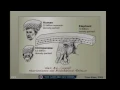
psychologists Carl Lashley as you see here on the left and Donald Hebb on the right and uh these people were uh these Great scientists were were colleagues uh they were postdoctoral fellows together and they basically argued over the following point is the brain a blank slate and largely plastic that's sort of the view of of came to be of Carl Lashley or does the brain come with constraints and somewhat determined by its structure and that grew out of HEB he didn't quite put it that way but that grew out of Hebb into a series of
people such as Roger sper my mentor so lashly Had the view that the brain could basically be anything from a series of elegant experiments he did on the rat where he tried to see which parts of the brains were critically involved in learning Visual discriminations and he bladed the rat's brain he sliced the rat brain he disconnected this part of the brain from that part of brain nothing seemed to work and so he came up with the key principle of mass action the action of the brain as a whole Determines its function that the their
brain each part of the brain was equal potential any part of the brain could perform anything there were no specializations and um and lashly it turns out was a good friend of uh the famous psychologist John B Watson who came to psychology from Madison Avenue and was really one of the fathers of American behaviorism and as you know this famous quote from Watson uh is born in part Because he thought the neuroscientists of the time had shown that there are no specializations and specificity so he said give me a dozen healthy infants well formed in
my own specified world to bring them up in and I'll guarantee to take anyone at random and train them to become any type of specialist I might select doctor lawyer artist Merchant Chief and yes even beggar man and Thief regardless of his talents pensions Tendencies abilities vocations and race Of his ancestors this was the total package that we can take any organism and by the contingencies of the social World make them into anything and the great uh first uh one of the original uh developmental neurobiologist Paul Weiss then at the University of Chicago and later
on at Rockefeller University Paul Weiss was also a believer in this sort of General notion that the that U the brain was not that specific in its development and he had the famous phrase Function precedes form and he came to that by taking NES and grafting onto them a third uh limb and the question was would the nerves grow out to the limb specifically or did the nerves grow out randomly then by use of the limb they became adapted to be limb neurons sort of thinking well that idea uh as was summarized by my mentor
Roger sper was the called the growth of synaptic connections was conceived to be completely non-selective diffuse and Universal in other words anything went in the nervous system there wasn't a structured system that we were dealing with and so we had we had Lashley starting this we had the behaviorism of America pushing this and we had the greatest zoologist of the time Paul W saying yes I think that's the way it's work it works and then uh Hebb broke away from this a little bit Hebb began to think that connections were very important connections between neurons
Increase efficacy in proportion to the degree of correlation between their pre and post synaptic use that's so two neurons uh begin to fire together as it came out they wired together and here's an illustration from Donald hebb's thesis and it just simply points out that if these neurons here begin to fire together they become the dominant pathway and it breaks off from uh the other pathway so the brain the brain be becomes to take on a specificity of Functions that specific connections are important but the real serious uh so this this gave rise to this
this phrase that is still with us what fires together wires together but the real the real fundamental work that uh became the backbone of modern Neuroscience in in in the story of neuros specificity and the importance of neuros specificity was really work done by Weiss's student Roger Sperry who was my mentor so there's the historic connection and sper Did some unbelievably clever and classic experiments very simple in nature and then later but more more intricate and more and profoundly important but a simple experiment is that he would take a frog and simply surgically turn the
eye upside down and what that means is that when the Frog was uh shown a fly and would try to stick its tongue out to catch it it would go in the opposite direction and then the question is the Frog was allowed to this new Arrangement Sort of upside down goggles if you were uh for for months and the Frog never changed there was a specificity to the system began to emerge began to think and then sper went on to do experiments where he took the Goldfish and he would leion parts of the retina and
then as the nerves regenerated where watch where they would grow into the optic tectum and when they would grow very specifically if they were in the dors in the ventral part of the retina they Would go to the dorsal part of the tectum they would do this very specifically and he did all the controls he would Le in the uh the dorsal part and see the grow back ventrally and so on and so what happened was Barry came up with a view that there as neurons grow out to find their connections in the brain they
sit out send out little pseudopodia and they kind of test the waters and see which way to go and then because of a chemical gradient in the Overall brain structure they would find their way to a specific place this is the fundamental ideas that led up to the whole strong notion that still prevalent in Neuroscience today of nerve specificity but overall it's been altered and changed and there subtle adjustments to it of course uh but the overall idea has been represented by many people uh in recent terms the the work of John C and Leo
kitzer show that the overall schema of the organization Of the brain throughout the vertebrae kingdom is the same it gets smushed around as they say a little bit but the relationship between the sensory Fields is it has the same overall plan so the idea is that well the the the genetic structure develops the overall context of the brain and how it develops but there may be individual adjustments uh uh on the specifics and this is a simple slide that shows you how they did it so so we came up so we we come up with
this View there's there's a a hardwired and genetic view where the where the differentiation migration and axon guidance is under very tight control and let me just show you an example of that I don't know if you'll be able to see this but it's a fascinating example from work out of Cambridge you will see a neuron going specifically to a particular place you have my my objective here as we get into the larger questions toward the inell electure Series is first give you a feeling for what this brain is and and you have to have
that under your belt as you as we talk about the other issues so you can see the basis upon which other claims are made so let's see what if you can see this in the embryonic brain of the Frog zenopus neurons extend axons from the eye to connect to appropriate target cells in the midbrain early in embryogenesis these Connections have to be made properly growth cones at the tips of the elongating axons guide cells in the right direction growth cones elongate towards their targets by extending and retracting thin processes called filopodia in this way the
growth cones probe their environment for guidance in this case they cross paths as cues lead them on uniring courses towards their targets after entering the appropriate Part of the midbrain the optic tectum the axons slow down and send out branches which can sample numerous Target neurons and establish synaptic connections these two axons took 6 hours to grow to their targets less than a millimeter away that's unbelievable and now there's this concept of activity dependence that once the neurons get to a particular point the actual activity of the neuron influenced by input from The environment does
the final adjustments so while there's great the notion that and the these are enormous battles in Neuroscience but I'm summarizing them there in terms of the larger points once the neuron is directed to Edinburgh then depending on which B Pub sells beer more cheaply people tend to go to that Pub versus the other I don't know that doesn't work but you you get the idea there's activity Dependent uh final uh input to the connections that as we build this nervous system and this is done this is seen from this work of of Kurt hos uh
uh in in this slide here so so okay so that's that is is this Dynamic brain developing how how does it get shaped how does it actually come to be what it what we are what an animal is what what are the forces in the large picture of of evolution that guide this thing to to a final State and uh since this is a General audience U I wanted to to just give a little snippet to show you the power of of uh natural selection methods uh mechanisms because it is so powerful is so simple
and it is so pervasive and so here's an example of what happens to a praying mantis almost striking [Music] examples take a look at this mantis here this thing is almost perfectly disguised as a leaf I mean but you can see if you Look at the underside that it's it's a pray mantis just like you'd find in a garden in North America but this one is highly modified it's it's thorax is flattened out to look like a leaf and its wings are modified to look like leaves you can even see the veins if you imagined
a population of mantises and some looked more like leaves than others uh those ones that look like leaves May tend to survive and Reproduce more than others and so uh a series of modifications could build up over time to result in a in an almost perfectly leaflike mantis but if you put it on a background you know on which it doesn't belong I mean it just sticks out like s THB and almost certainly where you going so so we we come back to this issue of that goes throughout all of biology and it's constantly coming
up and being batted down to demonstrate that the complexity Is built into the organism that it gets there through natural selection and we see it time and time again and in 1968 Neil jery uh the famous immunologist Swiss immunologist made a startling proposal to those of us in Neuroscience as to how uh all of this may apply to understanding the brain and how it gets its job done and in the 68 paper entitled U selection versus instruction simply enough uh he said look he says the brain is built like the immune System and uh it
it where the complexity is built in and he went on to explain this which I I'm about to but he said then made the startling suggestion that uh learning the learning that you and I experience actually may be the process by where we're sorting through pre-existing capacities that we possess to apply to a particular uh challenge that we're faced with at a moment in time and so y taking so the idea again complexity is built into the brain we've Seen the specificity is there actual complexity built into the brain is that what comes along with
all the specificity that we saw in the first bit and uh so J uses I said the metaphor of the immune system where he looks at lymphocytes and as they differentiate of course they all take on a different uh slightly different character on their surface and for the natural cells of the body where this is happening they cancel each other out and the ones left over That aren't canceled by the own cells are the antibodies that you and I have that's it we're born with them and we have them and then these are the antibodies
that protect us against future challenges and disease so Ernie proposed that same simple mechanism maybe as I said true for the brain let's see how that plays out the idea again being selection from pre-existing capacity selection from pre-existing capacity is a major idea uh That comes out of uh out of this work so y goes through and makes wanted to make the point the strongest possible way to the Neuroscience Community about how pervasive this idea is all in biology and takes the idea from population uh biology where the famous chaff venes of the Galapagos where
there were large and small beak chaffinches there was a drought all the small beak chaffinches died off and the large be chaffes survive because they Could crack open the nuts the few nuts that were around and then they proliferated and became the dominant bird well was that was that instruction people actually some people thought it was instruction uh but in fact it's not it's selection from a a pre-existing complexity that in this case is in the population uh Peter maror in his famous works on how the young bird uh learns uh to its song The
Young maale bird learns its courting song learns it from the Father and uh Peter maror this is an example from the White Crown Sparrow where the white CR Sparrow has to be exposed to the father's song at a particular time and so forth for and uh and it learns The Pongal if it learns uh if it is exposed to the father of a White Crown Sparrow in the next Hill over it's a slight dialect from this one the bird also learns the song okay but if the bird is raised in the presence of a a
house sparrow where the song pattern Is just a little more different a little little different procity to it the young bird never learns the song just doesn't learn and yet you and I would be listening to this these recordings oh if I can learn that why can't I learn this but but these things are and this level of the nervous system development are very tight and and this remarkable Discovery was made so pre-existing neural constraints and then you move this up Into humans and you say well you know what are some of the things that
we come in early with what what what are some of the factory builtins that we have and the work of Renee baller own it's striking and we'll be hearing a lot about this later on but very simply Renee showed how simple physics seems to be part of us she takes very young babies and they're sitting on a table and there's a ball sitting on the table and then she raises a shield between the Baby and the ball and then she sneaks in and takes the ball away okay and then the baby either sees the screen
go flat down or at an angle such that it would represent that the ball is still there if the screen goes flat down the babies are shocked because they already understand physics and they understand Mass cannot pass through mass and so what happened there and they're puzzled so babies astonished at The Impossible baby is bored with a possible intuitive Physics is built in and these studies go on in six we old babies again where we're driving towards here is how many things we come with how many things are built in and you now go into
the level of human perception and you can see again how there are many automatic processes that are built in that have been selected out over time and here is the the the necessary uh uh features of how we adjust to local cues to to figure out what if two things have a particular Kind of brightness and because of the way this picture is set up it looks like of course there would be a shadow here and this this square is brighter than that one but if you follow this is the exact same picture we take
away all the cues this is done automatically for you you can't you don't think about this this is built-in automatic part of your brain but we cover up everything and you see those two cubes are actually the exact same col color so um a a bring This all the way up to a current example that comes out of modern brain Imaging and I'm suggesting this as a possibility IL uh and not by any by any means a a fact there's a there's a task called the verb generation task and this is a task you can
give somebody when they're in one of these fancy brain Imaging devices that you read about so commonly and a a verb generation task would be I give you the word scissors and you got to think of a verb that goes with it so you think Of after a while you get good at this you think of cut well when you first start this game you're very slow to respond and you see in your reaction times uh a slow response and then as you get better and better and better better better better you go down and
you become very fast until we change the game on you and then you got to start over well if you so that's just the behavior if you now look inside the brain you see that in the unpracticed condition where You're just learning how to do this you see parts of your left frontal low becoming highly activated and also the right cerebell there's a whole another story there but the the point is that you see tremendous activation and then as you become practic you see it disappear it's like when you don't know what you're doing you
have all of these strategies come up to the four to sort out and that all takes brain energy which is detected and picked up by the Scanner and then it's finally the right one uh is developed to apply to this problem away goes the need for that large energy so taking stock where where are we at this Point well the instructional view the the early depiction of the brain promoted by Lashley and Watson and Weiss featured the brain as an undifferentiated Mass ready to learn any brain could learn anything it was the ultimate instructional system
and the Hardwired view of Heaven Spar and others challenged this the conception arguing instead that the brain is built in a very specific way we came largely pre-wired the current view is a combination in a way the large scale brain plan is genetic but specific connections at the local level are act actively dependent and function on epigenetic factors and experience now think about that epigenetic factors and experience that Is really setting the stage for The Human Condition what is it why is that so important when we think about the development of the human and and
and how we got to be uh what we are so uh that's a jumping off point for bringing this into the human sphere and to point out that when we start to think about a humans lots of things happened at once one thing didn't happen that control everything there wasn't simply that there was bipedalism there wasn't simply That the brains began to get bigger there was all kinds of things an interaction of those two things uh inventiveness there was the ability to change your Niche the cognitive nature of your Niche and by changing in the
cognitive nature of the dit Niche changing your environment such that then selection pressures varied on the kinds of of of of humans that would survive it's a very complex interaction so it is not simply going from uh U uh to to Bipedalism and which happened around U uh oh 5 million years ago and then just recently last month the the work of 10 white pointed out that they finally have found an intermediate animal that shows the foot around 4.4 million years ago intermediate between the uh the chimp foot and the human foot and then as
you know uh uh the famous footprints found in in Le toi Africa 3 and a half million and of course Lucy found 3.2 million years ago all of this came together into Into this incredible story that we now have to think about the brain changing with the environment and how does that work well we're going to launch ourselves into the cognitive Niche and this is very important so we have the many neural circuits crafted by neural development we have complexity built into the system and activity dependent processes like I said the specific connection we have
strategies and Capacities for learning but not the learning itself all of that is coming along but now the big one staying plastic to adapt to the everchanging cogni Niche this is what the human brain can do and in fact is built to do it so if you look at U at the young baby and you look at the comparing the newborn baby to the newborn chimp uh you see of course everybody knows that the young human brain is hardly formed from its out Outer skull to its inner brain Parts Uh we know that the excuse
me that the that the human brain is four times the size of the chimpanzee brain but what we don't commonly appreciate is the fact that when the Chimpanzee is born they're pretty fully developed and when the human is born it's really born with half its brain size and it takes 12 14 years before it fully develops there's all kinds of refinement and influences going on in this plastic period uh in in the young child's brain and uh and so with That what what is that mean for us what what does this big brain uh say
and how is it different from how are we truly different from other animals well as you know Charles Darwin and Thomas Huxley thought that the only difference was size the difference between the brains of humans and our nearest primary was only one of size as they put it it is one of degree rather than than kind and as you uh citizens in Edinburgh know Charles dar and is honored here for his Two years at the medical school so um so people have made a lot of this and uh and you you you take you take
this you take this notion of similarities and some people just that's it you know we it's just gradualism from that and there's no there's no big change and uh there's there's a lot of there's a lot of support for that idea we're made up of the many molecular andell your building blocks have evolved by the same PR principles anant of of all kinds are Common to us and other animals and uh and then you can take little Clips like this they see when someone sees the potential tool making saying the chimp that's another evidence that
there's just a little uh quantitative difference there's no qualitative change between us and our relatives good tool use there for ever saw it and in fact as this video goes on uh uh there's evidence that the the mother There was teaching the the baby how to crack a net so then you then you have tool use in the parrot this becomes a good uh scratch massager and so forth anyway uh it's it's impressive it is impressive what you can get animals to do but as they say uh in California give me a break I mean
you know you want motor [Music] Skill there's nothing in the animal kingdom that has that kind of visual motor complexity there's nothing in the animal kingdom that can do this the road not taken two roads diverged in a yellow wood and sorry I could not travel both and be one you get the idea he's a Dartmouth man too it's another reason to push it so so how do how do you explain this well David primac puts it nicely animal abilities are adaptations Restrict Ed to a single goal animal abilities do not generalize and species possess
an extremely limited set so sure the crows can are adapted to solve a particular problem on how to obtain food the uh scrub J is adapted to solve a particular way of cashing foods for future food Use the uh uh mircat is adapted to solve a particular way to eat scorpions without getting bitten those are all terrific but none of them can generalize on and take that a particular Skill and adapt it across many domains so the core constituents of human abilities also evolved to specific adaptations we have thousands of them as William James pointed
out we have millions of them compared to most animal humans possess an unrivaled number of Highly refined abilities that evolve in this fashion but it's the combination of these abilities give rise to additional abilities that solve General problems leading to domain General abilities That's a fancy way of saying we can do anything we can do anything and so this is important because what the modern neuro anatomist and evolutionist say as you climb the primate scale into humans it's not the Chuchu Theory I told you about how as we evolve and build an animal has more
skills of one kind or another they just add something what happens if you follow through this diagram is that the whole brain is getting rearranged throughout it's not Just a simple addition at one point everything is getting adjusted it's like a mobile you youjust one part you put a little heavier weight here everything everything switches and this is what's emerging from the Neuroscience lab and it seems utterly uh to be clear from just looking at the behavioral data now it does have this little problem uh this cartoon says I think you should be more explicit
here in step two where uh you're going from one one you can't see This it says here then a miracle occurs and so how you get to this to This Magnificent ability that humans has what actually is it how do you capture it of course is one of the deep questions and still Unsolved Mysteries but the first thing you want to do is say well is the human brain different and is it only different by degree or is it qualitatively different do we have different stuff do we process information differently is there any way We
can show that circuits of a particular kind are different projections in this and the answer to all those things is yes I think there is growing evidence for that although I would still rank it as a minority view first the argument against big brains uh neanderthals had bigger brains than we did and there's no evidence that they were smarter uh than we are uh and over history um um uh it's also interesting that any Species that becomes domesticated there's a 10% drop in their brain size so uh and then in my from my own research
we'll talk about later in the lecture Series in split brain patients the left brain remains just as intelligent as the whole brain despite the fact that one is disconnected half the brain from the other if this brain uh quantity was such a big thing you would think that there would be some intrusion on the capacity of the left Hemisphere to think as as it is it does that's its function to problem solve to hypothesize and so forth you would think it be an effect by disconnecting 600 G of it from the other 600 G there's
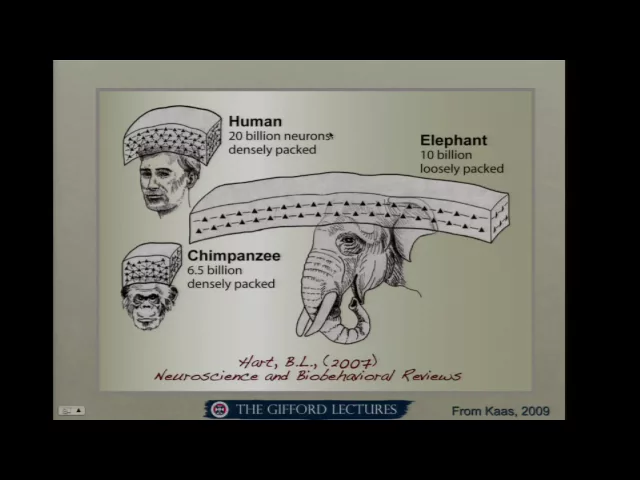
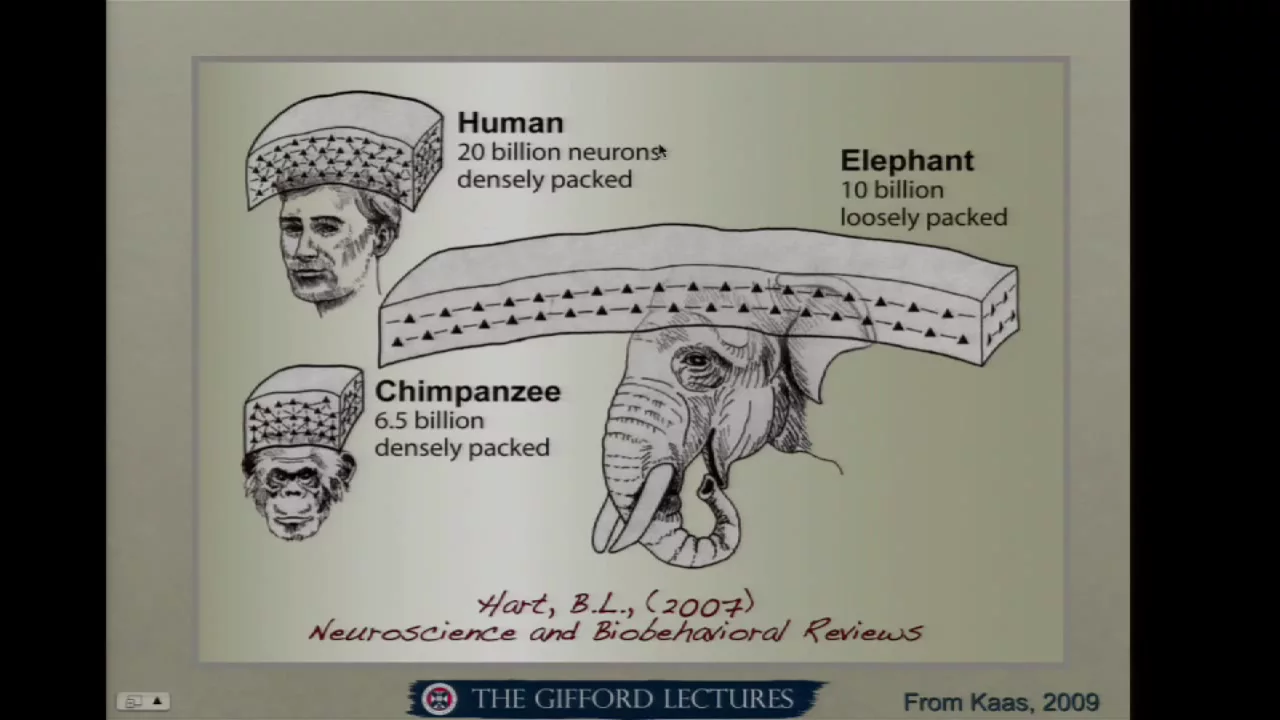
none so what do you make about that so um and this whole idea that more neurons are the answer to explaining all kinds of things uh is a dangerous game to play the chimpanzee has 6 and A5 billion neurons there's ways of actually counting this I Mean there's a whole science associated with I won't go into but 6 and a half densely pack neurons the elephant little bigger animal has 10 billion neurons more neurons bigger body surface represent but they're very Loosely packed and then you get to the human uh where uh the human cortex
that we're talking about cortex the human cortex has 20 billion neurons densely packed but now notice this in modern studies very recent Studies in fact just completed this year the human brain has 89 billion neurons all of us have 89 billion neurons on a good day 69 billion of those neurons 69 billion are in your cerebellum this little thing at the bottom of your brain that helps you with fine motor control there are only 20 billion in the cortex okay this is the thing that we think is responsible for things like Human thought University culture
and we think that the frontal loes and the prefrontal regions are the main purveyors of that capacity that we humans possess but new Studies have shown that in fact the number of neurons in the frontal loes the part that is doing this heavy lifting as we've thought about it are vastly fewer than the part that are in the visual areas and the other sensory areas what is larger and this is the clue and why I'm Setting it up what is larger is the arborization of the neurons the possibility for connections is vastly greater the arbor
arborization of these dries is vastly greater than the frontal loes and prefrontal areas then you go back into these these ttin so it's giving us a clue as to what to look for if we want to look for differences in the human and so U so are these human could the could the neuron itself the human neuron behave differently act Differently than it does in in other species and I put this question just for the fun of it the two leading neuroscientists and U which actually to a number of them and and my favorite comes
from this distinguished guy and he just doesn't buy it he says a cell is a cell is a Cell It's a universal unit of processing that only scales in size between the bee and the human if you scaleo appropriately amount monkey or Human Primal cell you won't be able to see the difference even if you had pathea to help you all right and then you have U the other view all neurons are not alike and types of neurons may be found only in primates or humans moreover a given type of neuron May exhibit unique properties
in a given species now as I said the former view here is the majority view but this new view is coming on in the last 10 years that there are unique capacities in the Human neur neuronal system that are important it must be considered in this debate uh uh the work of Todd price is of of interest uh here here is a a stain that you can look at particular types of cells here are a series of primates up to the human and I won't let see is this the slide where yeah if you look
at this particular layer four in the visual cortex of the human an unlikely place to look for it you see the local organization is completely different Than in the chimp which is different in the Pongo and different than the Mak and so forth and uh so the different way the brain has organized itself at the local level in the human is completely obtainable seeable detectable quantifiable at this time and that's just another slide saying the same thing the work of Gordon Shephard where he takes cells out of human brains during the course of EP epileptic
surgery someone a patient has to go in for Epileptic surgery that uh excuse me to to go in for to remove a tumor and on the weight of the tumor they have to go through good cortex he gets a few of those cells puts them in a tissue culture and can record for them and he does the same thing to a guinea pig and he makes the startling observation that the way the dendrites respond is simply different between the two species now these are all peripheral cues but they're all coming About at a new time
in neuroscience and they're all I think extremely important here's a paper that came out in 2003 by John Alman at Caltech where he notes the difference that humans have this special neuron called the vonic conal neuron that has a particular or organization and you see it uh very clearly in the frontal insular and anterior singulate regions you see it very clearly in the human you see it only suggestively so in the Chimpanzee and he then U wh excuse me he then uh does counts where the average ape has about 7,000 of these neurons the average
newborn human has about 28,000 and then the adult human uh uh human child has 184,000 adult 193,000 L and this neuron simply isn't found in any numbers in the in the chimp what are these neurons doing turns out that this particular set of neurons seem to be absent uh in some forms of autism is this the ingredient that's gone wrong is This are these cells organizing information in such a way that allows for different processing and and so forth and you you you see the idea and then just quickly uh pashco Rish has found yet
another uh kind of neuron that's in the plexiform layer of the primordial plexiform layer of of of of the thalmus all of this new all of this suggesting that there may be uh lots of ways of thinking about the differences between the human and the gy and so how We're going to think about these is through the connections the the way neurons interact maybe the actual processing capacity of the neurons as I said but also at the level of their connections which has been a theme of the talk and we can see this from the
work of other ring and enzel as you go from the squirrel monkey to the human the size of the thing that connects the two parts of the brain together this thing called the Corpus colossum Decreases in size decreases so the brain is becoming less hooked up as we evolve towards the Human Condition and more information is getting processed locally locally so as you just saw that in the previous slide of PR where all of a sudden there's local changes in the difference of of in a processing stream in the sensory world so so one last
example and then we'll wrap it up for tonight which is that U I want to give you an example of how dramatically Different uh and very simple and this is one I can test to because it's it's my research uh and that is that if you compare the this little commer right here it's called the anterior commer and this is the big commer called the Corpus colossum and this is a monkey brain okay okay so if you split the monkey brain but which means to cut this Corpus colossum there's no effect on the animal's visual
World none whatsoever in order to have an effect you have to cut This little thing called the anterior comater okay that's just the way it is those are the facts thousands of experiments and so forth now we go over to the human if you leave this anterior commer you're intact as you might have done as I did in the mon if you leave the interior chere intact it has no effect if you have cut the Corpus colossum and the human there is no connection a vision between the two hemispheres none and that's with this Thing
intact this large commer here intact and the monkey that has to be cut so at the level of the system of the organization of the visual system you can see dramatic uh differences between species uh in new work coming out of something called diffusion tensor Imaging which allows for the first time to not just draw and hope that this is the way the brain is organized but to actually see it in the human and we're going to look at something called the Aru fasiculus uh this projection from the temporal to the frontal loes that's the
that's the classic drawing and using this new technique you can actually track the nerve fibers that are present in brains uh of not only humans but as you will see here in uh the reesus monkey and the chimp and this aru fulus is completely differently organized in the monkey where it is coming to the frontal loads from this ventral route and it's a very weak projection whereas In the chimp you see it flips over it starts going the dorsal route and in human the connection between the temporal lobe and the language areas of the frontal
lob are profound and large and and and follow the root seemingly paved by by the chimp so when we say what are these differences between the human what are these differences between the chimp uh I think we're hardpressed to Simply say it's a quantitative difference anymore it seems To be that there are organizational differences that when we truly come to understand them will help us understand what makes us so so differ so where does all this lead well we have this wildly developing brain that's under tremendous genetic uh uh control that's being refined In The
End by epigenetic factors and by uh uh the activity that that I show showed you about the activity dependent learning and what we know and I'm just jumping ahead to give a preview Of where we're going with this what we know as we look at the human brain is that we have all these cognitive abilities that are separated and spatially represented in different parts of the brain just sort of indicated here these all have different neural networks different systems we seem to have what they is commonly called a parallel and distributed system throughout the brain
and uh the work of U of uh Mark Rael and Steve Peterson and Mike Posner pointed This out several years ago where we take just the simple Act of hearing words and you get particular parts of the brain to react seeing words you get still different parts of the brain and the the ACT speaking words different parts of the brain react generating verbs different parts of the brain react and this can all be going on in the same task so these things are going on in parallel and distributed throughout the system throughout uh the brain
and the Question then is um does it matter what do what does this mean what does it mean that complexities built into the brain our functionality automatic our brains are structured complexity not random natural sele selection has left humans both with innumerable skill sets and a general capacity and as we will get to our personal narrative is computed by an embodied and embodied in the brain not outside mental forces compelling the brain and most importantly our brains Have multiple Control Systems not just one now what does what what does that mean knowing this how does
that make us feel so to understand what we are and how we got here to wonder if we're all freely choosing moral agents to wonder how it all works to grasp why we feel psychologically unified and free no matter what is learned and no certainly no matter what I just said uh why do we feel this overwhelming sense there's someone in there pulling the levers There's someone making those decisions that is the homuncular problem that is the problem that we can't seem to shake we believe in it even though we don't we live with the
data people like me that it's got to work a different way we strongly we believe in that we're going to talk about all those things uh uh in the days ahead but U I wanted to leave you with the fact that now that we understand we have this complex plane parallel distributed there's lots of Control systems in there and all that kind of stuff we can't get rid of this amular problem and I wanted to leave you on the happy thought that neither can Hollywood look at this what the hell is [Music] that must to
prevent God you get the idea thank [Applause] You thank you just to get this going could I ask a question you um when you were identifying what you took to be the differences or at least some of the differences between non-human and Human animals you spoke in terms terms of the human capacity for generalization uh and that was the point at which you Illustrated the uh the piano playing and saying there was no counterpart of that in among non-human Animals and um just I mean I suppose this notion of generalization itself perhaps could be disambiguated
there's two there more than one kind of generalization so one I suppose and I took it this was perhaps what you have in mind which is where you might get a creature that could project an ability into novel kinds of circumstances so it could engage in a kind of analogical deployment of that capacity it takes you know a capacity to pick something up but Uses it in an entirely different kind of context but that I mean that's one kind and I suppose if we had to say what kind kind of Faculty is in play there
it would be natural to reach out for something like imagination or a capacity to see things you know so on but there's a different kind of generalization that one might think was characteristic of human intelligence which is uh generalization I mean moving from the perceptual to the Conceptual as it were I mean seeing things under new kinds of descriptions not just perceptual descriptions here or behavioral routine descriptions but as things of certain sorts and such like so and now we might think of this not so much as a capacity for imagination as for intellectual engagement
with the world um what I so I suppose one question then is just as do you is do you accept that second more of generalization as being distinctive of The human and the more general question is this I'm not and no doubt this is going to be addressed in the subsequent lectures I mean you've drawn a parallelism as you see it between the discontinuity at the level of expressed behavior and thought and the part of the human and the discontinuity at the level of the brain and the part of human brains and non-human animal brains
so this is a not merely quantitative but a qualitative difference but what begins To be the kind of story that would bring those two sorts of nonquantitative differences together that's a great question uh the I guess what I'm trying to do is to to to get away from the idea that what will explain it is simply more computational capacity that's simply raw uh amount of computational skill that what we have to understand are is The trick that takes us from all these specialized adaptation to this General skill as they say then a miracle happens in
the cartoon uh that that Miracle is there that we generalize across domains is the fact on the ground the mechanisms by which that is to be uh understood and recognized I think has to come from the fact that we will not find that uh answer in a comparative anatomical or uh behavioral study it is going to be a unique problem of the way the human Brain is organized therefore we have to study the human brain to gain that insight into that generalizable capacity are there several generalizable capacities sure I think there are I think they
they go across me many domains but that's the trick is we become domain General and from domain specific and I don't have the answer to how that works I'm just saying we now have to look at it knowing that the brain is probably just Simply Organized differently take that into account these are for the people who are trying to go after that from a from a neurobiologic perspective and by the way professor Brown made an error believe it or not in his introduction he said I was a philosopher and I do not have that honor
so I came out of biology and shows not at all not at All um the question may be rather out of date but our professor of neur anatomy who' spent a lot of time I'm uh chasing neurons in the spinal cord of a cat I believe uh he wondered if something as complicated as the brain could ever understand itself well um that's it's it's what's the line uh uh us understanding the brain is like a dog or a nematode trying to figure out a dog uh that problem is there Uh it I just don't accept
it I we're if you look my my example is that if you look at 1954 DNA genetic material for rity was articulated defined revealed and 50 years 50 years we now have molecular knowledge of the intricacies of the cell which are every bit as in as complic ated as the intricacies of a nervous system we have insights that are simply breathtaking no one would have imagined It 50 years ago so I'm holding out the belief that uh that there will be fundamental Neuroscience axioms develop in the next years that will bust things open I actually
to kind of think we're in a little bit of a rut right now uh and in the in that um we need new tools we know we're going to explore this in one of the lectures we know the limitations the current limitations of Neuroscience ability to explain some things we thought we could understand we could explain turns out I don't think we can but that for a minute doesn't mean to me that uh the solutions won't come along by creative people thinking of new ways of tackling the problem so I uh I wouldn't accept the
the concern as much as a lot of people do so hi so I'm I'm sure you're going to get to this it's just a flag something that looks like it might be in the end Some kind of tension so there's sort of two pictures here one of them is the kind of conservation of a a sort of global plan in some way and the is that you know as things change everything changes you so you have these sort of two pictures and of course um the danger would be that if it's really the case that
everything changes as things change then the value of as it were conserving the global plan becomes less clear to see yeah um so I just quick comment on That no that's right and and there are certainly going to be conserved areas of the brain we know they're conserved areas of the brain but in this cortical Manel there seems to be this ability now I mean there there seems to be this incredible variation that was not recognized 15 years ago and it's going to be recognized U with uh with great speed now because of these new
Imaging Technologies the diffusion tensor imaging technology in particular so for Uh up until 5 years ago it was basically impossible to do what's called long trck anatomy in the brain uh uh you would have to go to postmortem you would you would you would see a nerve uh bundle start as one part of the cortex and then you wanted to know where that went well it immediately became lost in what's it called the internal capsule and you didn't know and so long track Anatomy simply wasn't that well done in the uh large human brain well
you can now take Your favorite undergraduate put him in a brain scanning machine run this particular kind of program and begin to follow their neurons begin to see how they may vary from their partner who may score differently on a reading test there's all kinds of things going on that uh that that are going to inform us and as I showed in that one uh brand new study there of the aru fulus you can see the difference comparatively in the animals So it see it seems to be big differences in the cortex uh and that
mobile metaphor may be a cortical metaphor and and not and not uh and not be as although I don't know I think it's an open question actually I think you put your finger on a very important very important Point thank you um there seems to be a lot of focus on the uniqueness of the human brain um but why couldn't you necessarily study say why a sheep brain Makes it sheepy or a cow brain makes a Coy why are we particularly interested in just humans cuz I mean every species is specific and they've got their
own kind of brain oh well uh I would say that uh that the the bulk of the history of Neuroscience has done that and uh and the attention to to maybe how the human brain works is a relatively recent phenomenon because of the Breakthrough and Technologies of being able to study The human brain without interfering in any way morally or ethically with the human brain so so if you can study the human brain trust me people are want you to do it and of course it has the side benefit that things are being learned that
may well help and and disease and all that kind of stuff but if you're just plain old interested in the intellectual question uh the human brain can be studied today in ways that it simply could not be studied 10 years ago Sometimes 5 years ago so that's that's the excitement that's called to a large extent this field of of cognitive Neuroscience great stuff thank [Applause] you this production is copyright the University of Edinburgh