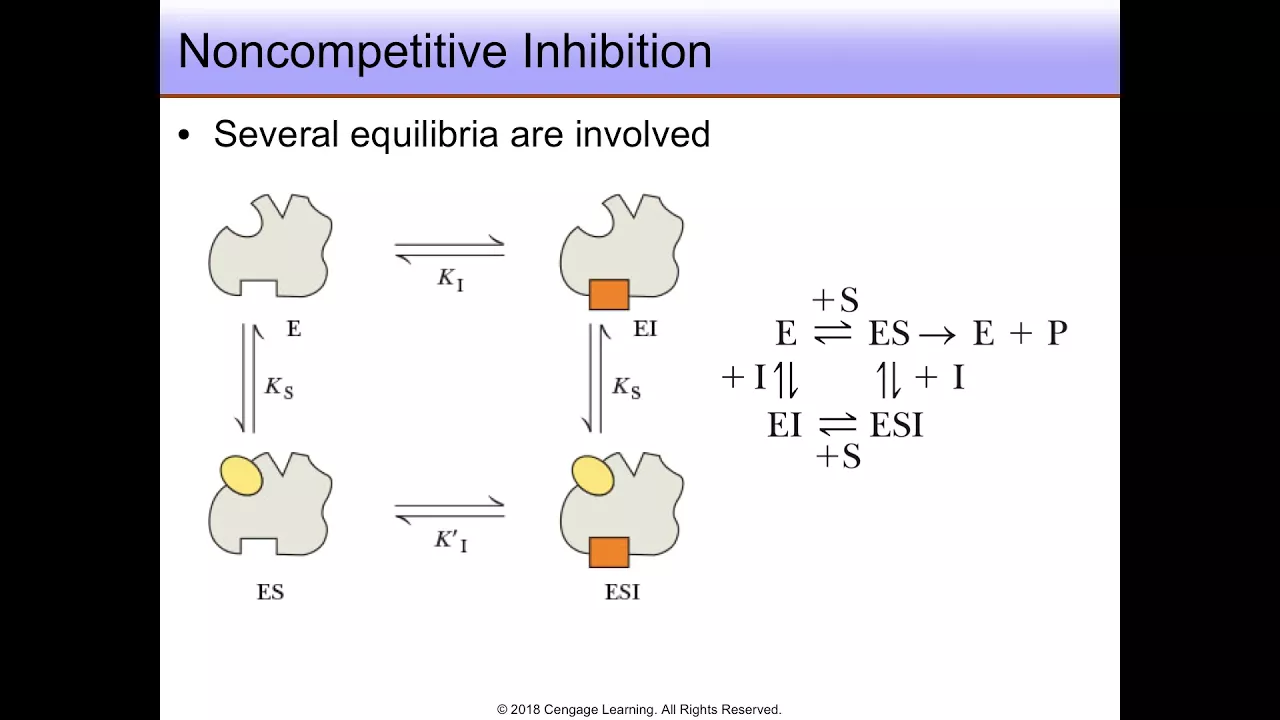
let's consider our second class of reversible inhibitors non-competitive and see how it compares to competitive inhibitors first keep in mind that we're still discussing reversible inhibitors that can have only a temporary effect on enzyme activity the term non-competitive literally means not competitive so we might expect it to give results different from that of a competitive inhibitor and indeed it does first it binds to the enzyme in a location separate from the active site so indeed the binding is not competitive since it binds separate from the active site then it can bind to the enzyme whether
the substrate is bound or not this is represented by the figure here the substrate is the yellow oval and binds at the active site the inhibitor is the orange Square and binds elsewhere in this case we have two different equilibrium dissociation constants ki represents the affinity with which the free enzyme binds the inhibitor and the ki prime value represents the affinity of binding to the es complex this means that there are several equilibria involved represented in the expression on the right a true non-competitive inhibitor has no effect on substrate binding which means that it does
not alter the value of KM however it does prevent formation of product while bound even if substrate is present the enzyme can still make product once the inhibitor is released but not at the same rate as in its absence this means that v-max will decrease hopefully you can see the appropriateness of the term non-competitive a competitive inhibitor lowers substrate affinity but has no impact on v-max this is not the case for a non-competitive inhibitor instead it leaves km unaltered and lowers fee max in this case since there is no competition with the substrate we cannot
out-compete the inhibitor we've seen that v-max is decreased in the presence of a non-competitive inhibitor by how much has it changed it is altered by the same factor as the competitive inhibitor the factor alpha alpha has the same significance here but in this case it is the v-max that changes in other words the v-max and the presence of the non-competitive inhibitor the VI max is the true V Max divided by alpha in this case the ki value within the expression for alpha is the dissociation constant for the enzyme inhibitor complex now let's see what happens
to the lineweaver-burk equation since v-max is decreased by alpha then 1 over v-max would be increased by alpha we need to include the alpha term in both the y-intercept and the slope since the term 1 over v-max is in both this alteration of the lineweaver-burk equation tells us that both the slope and y-intercept will increase as we look at the lineweaver-burk plot we can see it is just as we predicted in the presence of a non-competitive inhibitor both the slope and y-intercept are increased notice however that the x-intercept does not change since the value of
km is the same in the presence of a non-competitive inhibitor as you can see a non-competitive inhibitor is in many ways distinct from a competitive inhibitor







![I Replaced ALL my ADOBE APPS with these [free or cheaper] Alternatives!](https://img.youtube.com/vi/5EfqHg49kMk/maxresdefault.jpg)