okay good afternoon uh everyone welcome to uh again ocp Regional Summit AT Lisbon we're really happy to be here I'm Andy Gil um from Rell I have responsibility for hyperscale counts on the commercial engineering side and I have my colleague with me Steve Moore who's um one of our account managers but also the uh co-chair um and co-lead of racking power within the ocp community so for the next 15 minutes or so we're going to talk about the uh AI adoption and the challenges to develop scale real world Hardware U we've been developing hardware for
decades now and we're pretty experienced at it we'll to give you some of our experiences of it and what our plans going forward in terms of AI are in terms of developing particularly on the cooling side first of all just a one slideer on who we are with ril we're a company that's been founded in the early 60s so a pretty old company by now 10,000 employees and we're truly International um we have subsidiaries throughout the world um including 12 production facilities um located in all continents of the world just to give some round numbers
currently we're producing over 200,000 cooling units every year and around 15,000 enclosures a day not not a year a day not working okay so to Steve so here we just wanted to give you um a brief overview of what we're seeing the reasons for the growth in AR right now um couple of examples are driverless Vehicles as we were all aware of that has the potential to revolutionize the truck industry we also have pop generated music from AI which could potentially revolutionize the music industry and also just basic human tasks in any work in day
life that could eventually be revolutional by a so AI so these are a few examples of why we're seeing the growth we're seeing obviously everybody's very aware of the growth that we're seeing in AI this is just one example of that growth in this graph as you can see here um and it's it's tremendous so along with this growth there's obviously the challenge of scalability and the technology required to do so he as just like this Summit is trying to produce we're trying to get collaboration so that we can develop the cooling the infrastructure and
Hardware required to be able to support that growth some challenges with that so one challenge would be the technical side so that's the technical ability of of engineering groups to come together and be able to develop the infrastructure and Technology of equipment to be able to support this growth another is the people so as many of you be will be aware we have a labor market that's very squeezed right now and that's across the board that is not just the technical White Collar work of people that are developing these products but also the labor required
to build that so this is industrywide and it's a broad Pro challenge for many we also have the supply chain so the supply chain that everybody needs to develop in terms of components and and the technology within that supply chain to be able to support the growth and scalability of supply for the end products that we're now using today to to contribute to the AI growth this is another example of the growth that we're seeing um driven by the Silicon developments of of key companies such as Nvidia um Nvidia right now as many of you
are aware of the leader of that with their most recent launch of the Blackwell chip um these there's many other companies such as AMD and Intel that are also driving this growth and they have obviously help facilitate the the abilities of AI and the growth we're seeing today another part of this is the amount of power required to run the AI infrastructure that's required and then obviously the the heat that is therefore produced with these chips that needs to be removed and hence the cooling the the explosion of cooling technology we see it shows like
today next we wanted to show you how Ral is supporting this explosion so in terms of infrastructure and hardware and equipment that we can provide and we do provide today that is supporting this growth so R has Decades of experience of manufacturing hyperscale volume racks for many customers worldwide here we wanted to show you an example of the ocp products that we have developed and are developing currently to support both General infrastructure but also the AI boom in 2015 we started with the develop of ORV 2 which many of you will be familiar with and
then later on in 2019 we began the lead development of rv3 which many of you will be familiar from the racks you will see throughout the show today the racks that we are now developing are directly linked to the AI boom that everybody is experiencing one example is the networking rack the nov3 variant which helps support the networking required to communicate for the AI another is the high power or3 rack this is a rack that can support 140 Kow of power to help directly support the AI infrastructure that's required today and then finally we have
a product available rv3 Nvidia rack which is specifically designed to support their architecture um so directly for their products thank you yeah thanks thanks Steve so to to to back what Steve said up in terms of scalability um showing where we are you know in the top there you see in red we have our our manufacturing facilities based throughout the world uh Us in Ohio UK Plymouth where myself and Steve are based in Shanghai in China and and we've been shipping hyperscale volumes out of those facilities for 30 30 plus years so a huge amount
of experience in doing it and we're still proud of the fact that through covid when all the supply chains were in chaos everywhere you know we never let our customers down once during that whole period and then we have our cooling facilities and I'll go a little bit more detail about that in the coming slid so we have a fairly large facility in Italy and and a large facility in India and also shank High supports a lot of the cooling so the purpose of this is to show that um as we're scaling um most most
of the suppliers most of the um uh manufacturers around the world are also scaling we already have we already have factories in place this is an example of one in Italy 16,000 squ meter facility that produces in a region of 200,000 cooling units every year um with over 400 people in place really state-ofthe-art and these guys have been duing cooling solutions for since the 1970s to give a little bit around um our other facilities we have a China facility which produces over 35,000 cooling units and I'll describe what those cooling units are in a second
uh and Italy's coming up and scaling this year at over 15,000 cooling units so what type of type of cooling units do we produce well at the moment uh around 80% is compressor based so everything from a couple of kilowatts upwards uh 160,000 of these per year we're producing at the moment compressor based DX Solutions and then the other 20% is the waterbased so the traditional water-based um chilled water cooling solutions in different form factors you know rearo hex in line in row Etc so our approach going forward in terms of AI and supporting it
um and you'll see some of our products here at the moment is around our standardized architecture you know we recognize as as as most end users do that if you can scale a standardized architecture you minimize risk you improve cost through you improve price through scalability um but equally important you improve your supply chain and risk mitigations um around the world and that's that's even more critical than ever to have standardized Solutions where we can and our approach is a a system architecture approach a complete solution based around the rack the rv3 product as you
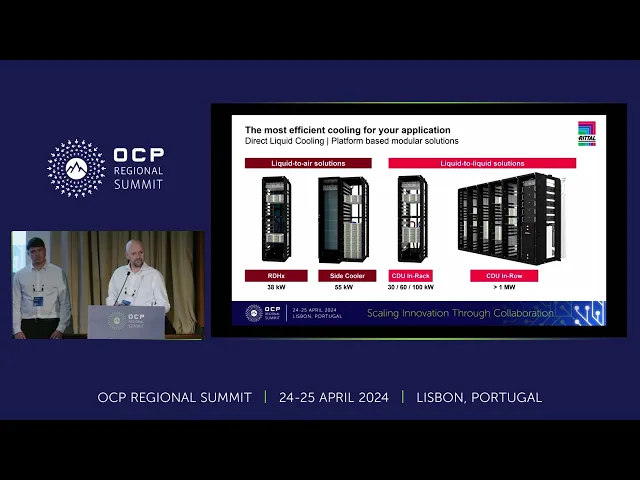
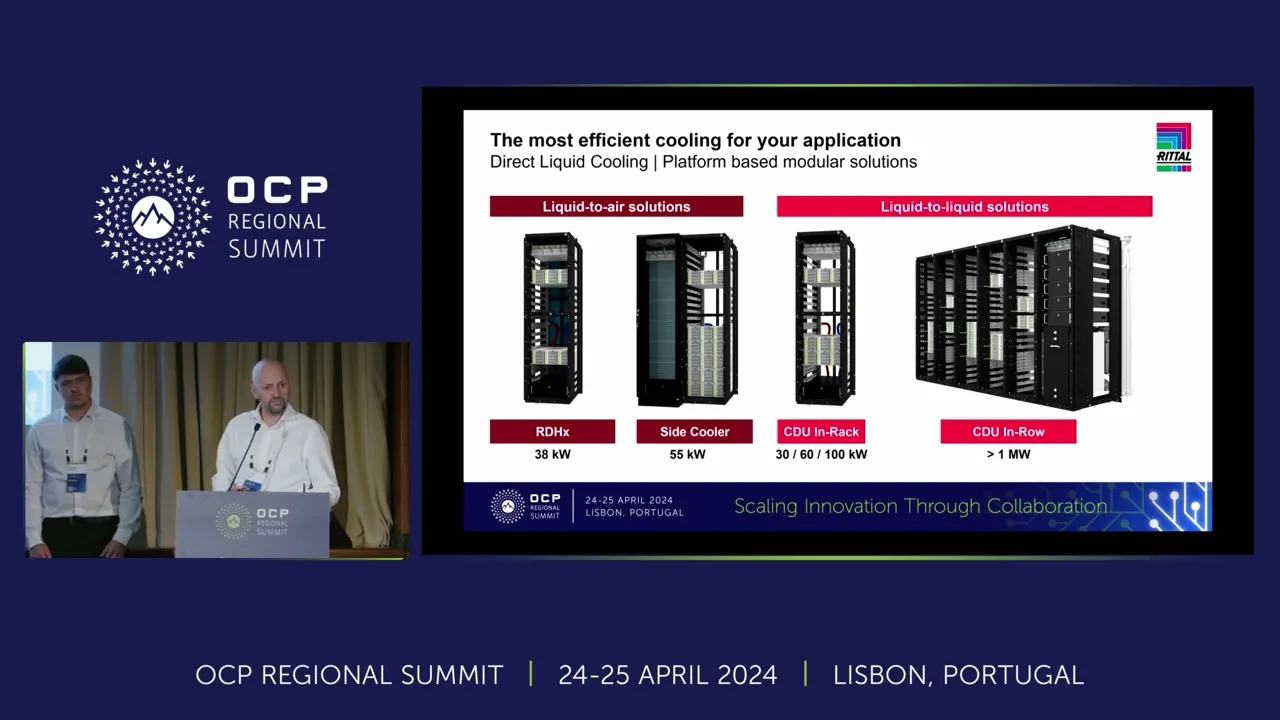
can see in most of these shows all 19in for for some of the more Legacy equipment out there through to full um cooling solutions cdus ipus uh manifolds rearo hexes the monitoring the controlling Etc and the power buzzbar all run off 48 volt DC buzzar of different of different um Power everything from 13 kilow as Steve's already mentioned to the 100 plus kilowatt all off the same interface point at 48 volt DC so to dive on that a little bit deeper and more specifically um we're developing liquid to Air and liquid to liquid solutions so
the liquid to air different form factors again reor hex 38 Kow side coolers 55 kilowatt but then the liquid to liquid which is obviously the demand um going forward and and pretty urgently is around CDU inra and again if you go to our booth either downstairs um as you comeing through the lobby that one is a CDU INR and you'll see our CDU in rack at the booth upstairs at A2 30 60 Kow 100 Kow in a 40u space as an inra solution right the way through to a full in R solution of um 1
megawatt so that particular Solution that's the one you'll see downstairs with all the nice stainless piping on the back you know some of the features around this is around modular design each of the units you see downstairs has a capability of around 250 Kow of of cooling giving an N plus1 redundancy on this it's all H swappable you can have downtime you can pull unit out while continue in the up time on on all of your equipment without having to shut anything down whatsoever um everything's hot swappable within the rack and it's based around the
form factor of ocp so it's in an rv3 rack all the controllers the modules the power um the actual cooling units ccus which are the the pumping units inside are all based around 48 volt DC and the same form factor is ocp so in less than 1 M square of space there you've got over a megawatt of cooling in row and it also means if you've also deployed ocp racks recently and whether it's in hypers scalos or the colos there's no need to reconfigure too much it can pull out and slide straight back into that
space um and some of the technical data what I will do is I'll show a video which is running on some of our screens so I watch this for two minutes I don't think the sound is going to play because I don't have a jet connector on this one but we'll show the video we'll show some of the things and we'll take questions and hopefully this one runs perfectly fine try again that one yeah there we go yeah there we go there would be a nice soundtrack behind this if I could run it so you
can you can see the module sliding in each of those 250 Kow of cooling with up to one megawatt for four of them with n plus one redundancy with all the battery backups the power shelves which are agnostic it could be supplied by any type of vendor and hot swappable controller all of it completely hot swappable it's the main heat exchangers goinging at the bottom and all the flexible connections for the CCU you can see the primary and secondary supplies going in the primary on the right out to the chilled water secondary on the left
a lot of the leakless dripless quick connector cup couplings all compliant with um a lot of the ocp standards top and bottom connections so you can deploy this um either top or bottom depending on the architecture within the data center and obviously the shut off FES and a lot of redundancy around it already as we've already said and if you look at the main unit down stad is has redundancy at a at a at a at a pump level a CCU level if you look at the one in the in R solution out in the
Hall that's got a redundancy within its own 4ou unit where it's got three pumps in there with redundancy of of N plus2 and some of the key features of it obviously I've mentioned a lot of these in terms of modular Design 1 kilowatt etc etc okay so we're so we're pleased to show that one downstairs a lot of our technical team are here over the next day or two um please meet up with them with ourselves myself Steve and and some of the team around us at the moment if you got any questions on this
if you want a more detailed Deep dive and you're not here uh physically at the show and you're listening in live then please contact UM contact one of us within Rell and we'll do a live demo via whatever needed teams WhatsApp Facebook Etc so thank you very much or any questions for the for the Rell team no all clear excellent okay thank you very much