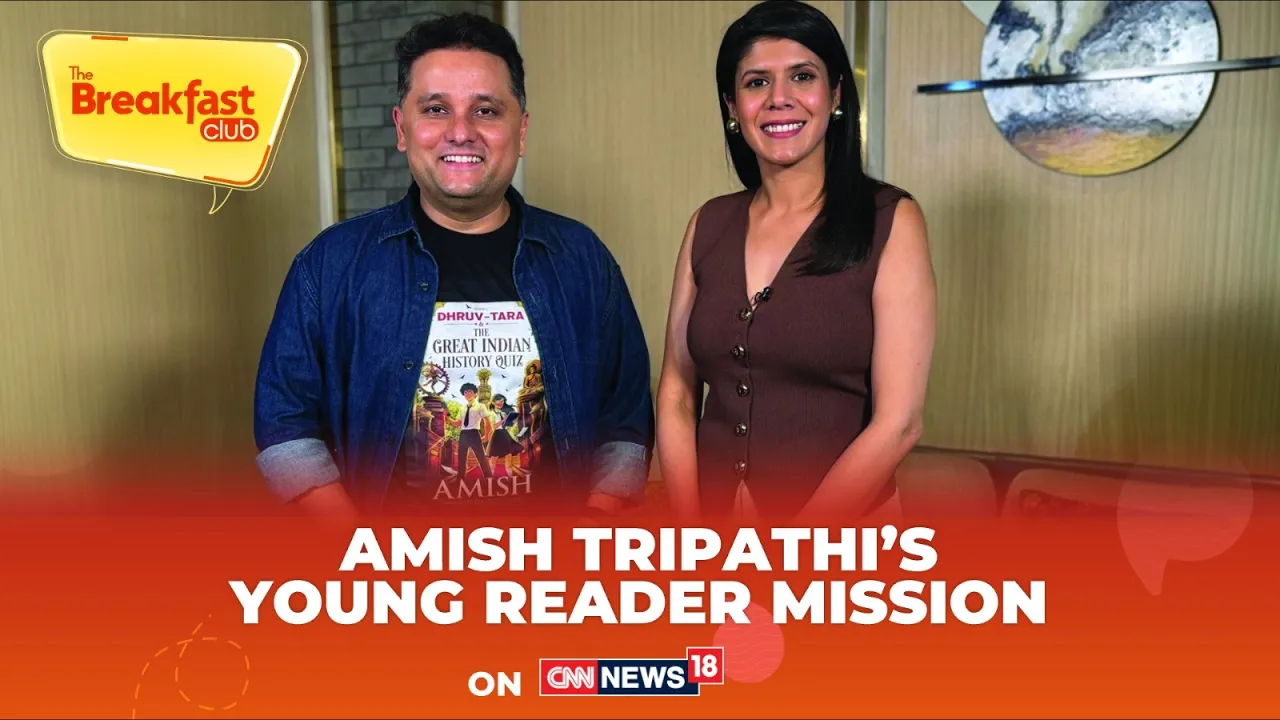
Well, he's the man who's made millions of Indians fall in love with Indian mythology, with Indian civilization. And we've seen some of those bestsellers come up one after the other. But today he comes with this new adventure.
And today we're going to focus on the author in him because Dhu Tara is here, the great Indian history quiz, Amishraati. Thank you. Yes, don't miss it.
You can't miss it. No such thing as too much marketing. Um, yeah, Kuwin, thank you for having me.
This is my first uh children's book. Uh you know in all my books uh they begin with some philosophy some idea that I want to convey and the story is essentially a rapper for it. So Ramchandra series the philosophy at the heart of it is what is an ideal society.
Shiva trilogy the philosophy at the heart of it is what is evil and the story is a rapper to convey that. So what is what are the ideas that I want to explore through Dhutara. This is the first actually of a seven book series.
This is the first of a seven book series. Um, and among the things that strikes me, which is what I want to convey through this book, through an adventure around those core core ideas. First, I think the way our history is taught to modern Indian kids in our education system and the books that are available as well, it still hasn't been sufficiently decolonized.
It's still the colonial version, the British Raj era version uh of history. and post 1947 we didn't really update it that much frankly that's the first thing that can we teach them things uh which are outside of the British impression of India second and in my opinion equally importantly uh our historians who wrote our textbooks and many of the things post 947 um made a damn good subject really boring okay uh and I don't know but any classroom lecture for that matter has been boring. You don't want to be confined to those four walls for a learning experience.
And I don't know what it was like for you in school, but I know many kids are history, list of dates, you know, list. But that's not the way to teach history, right? Uh history has to be made engaging.
You have to and it can't be just like linear narrative like this. You have to uh like okay this happened. This was the impact of that.
You have to give them those aha moments. Right? That's what I'm trying to address through this these two aspects.
but in the garb of a story. Right? So, it's an adventure of two 11year-old kids, Duv and Tara.
Uh they are classmates in school. They hate each other because they're both competing for the number one position. Uh and there's a quiz, the great Indian history quiz, a national contest that comes out and both of them are put into the same team to represent the school.
So, they have to somehow so that's part of the adventure. So, they so enemies turn into teammates. Yeah.
and and they have to somehow figure out okay how do we work together they hate each other but you know that's the fun of it right uh also the challenges they face on the way it's not going to be easy man they have tough competitors from from other schools and it's a national level competition various other challenges but through this they also learn stuff about Indian history uh stuff that they wouldn't have learned in our uh in our normal uh you know traditional history books where India was the greatest trade leading power of the ancient world. That's not talked to us, right, in our in our history book. So, you've essentially taken the story beyond textbooks.
You've taken it to a living experience. You've spoken of these museum visits, these conversations through a fun adventure. You get to learn stuff about history, you know, and unknown parts of history.
Uh, understand your culture, understand your land a lot deeper. Uh, and have fun at the same time. It's not going to be boring.
Correct. So a lot of students get to you know quickly go through their historical facts through this book. But Amish where and again this this this one's for you because when we when we read your books one is left wondering where does storytelling stop?
Where does fiction begin? Where are historical interpretations to be taken seriously? you know, you're so carried away with the magnanimity of the entire story that it's very difficult to segregate.
How are you doing that in this book? I think so. So, you can leave that challenge to adults, but you can't leave that to children, right?
I think you're sort of giving me a compliment that the story is [laughter] so good that you Of course it is. Thank you. Um, look, uh, in this book, I can certainly say that every single historical fact put in there is referenced.
Okay. Uh and at the end of the book there's a long list of references for every chapter and we put credible references. It's not like someone's blog spot or something right uh like either primary sources or scholarly books uh as references.
So every historical fact put in out there there are references right now where the fiction is is in the story storytelling right uh is in the relationship between Dhuv Tara the school they in obviously that's all fictional right or the Indian history uh the great Indian history quiz all that is fictional but I think this merger is what actually makes the subject less boring you know and our ancestors did that repeatedly like I don't know what you thought of maths did you like maths I like maths I love maths Yeah. Okay. I did my BSc in mathematics.
I used to score well, but I never liked it. I loved [laughter] it. I did my BSE in mathematics.
My grandfather was a maths teacher. Our entire family is like a bunch of math lovers. The I'm a literature student after having studied commerce.
So, it's a weird combination. Let's not get that. The No, no.
The point I'm trying to make on that subject is the problem was the way it was taught. The subject is actually damn interesting, right? But there's this text called Lawati, okay?
which was written a thousand years ago by an Indian dishi called Bascaria. Okay, he loved maths like some of us do, right? And to his dismay, his daughter hated maths.
Okay, so he wrote this book Lilati in the form of Sanskrit poetry, Sanskrit lessons. And while reading a poetry, you learn a maths principle, right? Such a creative, beautiful way to do it.
His daughter's name was Leila. So he named the text in her honor, right? Now, isn't this a great way to learn a subject rather than theorem?
Come on, you're not a lot of us ran away from arts because of the same boredom, right? I signed up for commerce because I was like, who's going to go through those long chapters and I ended up pursuing literature? The problem is the way it is taught.
It is just so boring, right? And that's essentially what I'm trying to do with this book. So, I'll just repeat.
Every historical fact in there is referenced. Okay? Uh but there's another challenge story around it but that's what is is fiction but today's children and today's day and age and the kind of digital exposure they have how did you navigate through that challenge in ensuring that you know once they start reading they're not able to put the book away because today's children want to just consume YouTube like might as well watch a chapter on YouTube that's the other issue I'm not anti uh the phone or smartphone or social media it's an attention span And just that is not good man.
You're just doom scrolling through life right. Uh and what reading does unlike audio visual whether you're on social media or movie or a movie or series anything those are all passive mediums you just and there've been brain studies like your brain just kind of shuts down. You're just just absorbing what is being told to you.
Whereas reading is an active medium. You actually engage with it. Your imagination rises.
You in effect exercise your brain. Right now we can either keep complaining about it that our kids aren't reading but look I mean I have readers 15 and above right and I can manage to get them read to read and luckily enough that I live my life out of it. I get a nice check every 6 months.
Yeah. Why can't that be done for younger than 15 and so did you have that's what I essentially 15 plus people come and tell you that we want you to write for our children too. We love what you've written.
We need them to read something on similar. I had many who grew up reading my books and they're saying they've come to me they have kids now listen Amish you need to write something for kids as well right and this book is targeted at 8 to 15 right that that age group many elders could also read it yeah there books which start as for young adults but elders end up reading it I think it's written in a fun way so maybe the elders will also like it but the main target is is that which is why the illustrations everything is look but does your creative process also change do to change the way you write when you're writing for children because you've chosen children as protagonist. That's number one.
So obviously children are, you know, in all likelihood going to get swayed. They're going to be able to relate to each of these unforgiving unlike adults who will be polite. Like I don't know if you've ever done an event with with a kid.
If the kid starts getting bored, they're going to start yawning. Uh they'll walk out or scrolling. Yeah.
And they they are unforgiving, right? Yeah. So I I think the only way to prepare for this is just read as much as I read a lot in any case.
I read five to six books per month but I mainly read non-fiction but since I was writing a children's book uh I read as many children's book as I as I could. I'm 51 so last time I read a children's book was a long time back. uh but I read as you know a lot of children's book uh children's books you know and among the things that struck me is actually very few good children's books in India set on Indian subjects or modern Indian narrative mainly kids end up reading either western stuff or stuff in our on our piranhas which is also good I mean I supply books on that side but stuff which is set in the modern day which is according to the kids lived reality but is set in India is aspirational is cool there aren't too many of those books.
That's the place where I'm trying to be. Why read a western book? Yeah.
Why? They're Malaysian books, man. Or Japanese books.
They're not No, you don't find enough Indian books. So, learning history beyond those four walls through museum trips. They're inspired by your childhood.
Yeah. And your personal life. My my parents, we came from a humble background, but they did a lot to kind of just open our minds, right?
uh I think the best thing an education system or parents or teachers can do is make your mind capable of constantly learning rather than just hammering knowledge uh into you and that's what one is trying to do with this book and a large part of it is also I think the quality of thinking that goes into the story and the illustrations you can't just have that chalah attitude remember kids these days are on the phone they're seeing the best content from across the world so if you're if you're writing a book in India your benchmark cannot be other Indian books. Your benchmark has to be the global best, right? So, I think the story is fast-paced.
I mean, we've we've run it through a few tens of hours kids. Well, they all liked it. But even the illustrations, we just haven't put random illustrations in there.
Every illustration is thought through like the cover for example has India and of I think the cover looks good. It's really cool. But besides that like small like you know kind of Easter eggs or you know like India is written in seven languages and seven scripts it's just hidden in here.
Have fun discovering it. Oh wow. Right.
Uh or that's a lot of homework. Yeah. [laughter] No just just just essentially make think through have it deep uh put the absolute best quality even our illustrations the blackboards at the back behind the kids.
It's not random. There'll be a nested theorem out there. uh you know just have fun with it.
Do remember when you were young, you'd read those mad comics and there were illustrations on the side just like you'd just think man these guys think so much you know uh before we read those even when we'd grown up so and the kind of why can't we have that quality in an Indian book man you know like if you notice even like the author name mine on the pages it's in a square root right like even the page numbers we actually debated what kind of so we put a lot of thought into it it's a high quality uh children's book and I I and there are six more parts coming everyone's way so six more parts okay great so there's lots to look forward to Amish very quickly you know now the constant emphasis on Indian history our roots our civilization given like I said you're you're someone who wears many hats you know we've seen you as a diplomat we've seen you through that journey u you've you know been spearheading this documentary there is so much to your producer do all these roads lead to one destination alone. Yeah, they're all different renditions of um is the end goal the same if I can just put it because they're all different renditions, different interpretations, different paths uh to the same destination which is uh India. I uh I love our culture.
I I'm not saying there are things that shouldn't be improved. There are many things that need to be improved. No culture is perfect, right?
Every culture has areas of improvement. Uh but we are the oldest surviving culture on earth. The only pre- bronze age culture that is still alive.
Uh there's so many beautiful aspects of India. Uh in every not just in history like in every other way. Um and we ourselves haven't discovered enough about it, researched enough about it.
Forget about others, you know, foreigners discovering it. All I want to do is just explore this more and more and share it. Um, and what would you tell parents?
So, parents expect their children to go through these books, you know, high on history. There's a little bit of teaching associated uh or attached with the book. That's what parents want.
But a lot of times there's a lot of convincing that goes into it which parents are incapable of doing because children these days are also difficult to deal with. I'll tell you what the thing is. Yeah, children question a lot which is a damn good thing.
In the traditional Indian way, you're supposed to question everyone including the gods. That is our way. We are not like hurry, you have to follow.
So the father figure is not going to agree. Okay. Like traditional traditional father figure of the family.
Look at Yayati. Yeah. Yeah.
Yadu didn't listen to him. Correct. So that was our tradition.
We didn't have the concept of blasphemy. These are foreign concepts. We didn't have a word for it.
Everyone was we could question anything anyone. Right? That was our our way of life.
I think our kids are being more Indian by being questioning rather than less Indian. But look, we have as parents have to have the ability to answer their questions. I always say children don't listen, they watch, right?
If parents tell them to do something, they're not necessarily going to do it. But if they see their parents doing something, then they'll follow it. Right?
So if you want your boys growing up at home respecting girls, well the father has to respect the mother at home. Yeah. Right.
Then for the boy that's natural, right? Uh if you want a positive relationship between your girl and whatever boyfriend or husband she gets, then she has to see that at home as well. Otherwise you have that pune type case.
Yeah. Correct. Yeah.
Children watch rather than listen. You want your children to read. the parent should be reading, right?
You want your children to not uh spend so much time on the phone. Well, the parents shouldn't spend so much time on the phone. They imitate.
They don't listen. They imitate. So, the challenge then is to the parents.
Uh you want to answer their questions? Read my books. [laughter] Read my books.
Watch my documents. And now there's a lot of interesting games also possibly coming [laughter] your way. Speaking of which, you know, now that you're also a gaming entrepreneur, how are we likely to see and I'm sure we can't rule out the possibility of a duftara game maybe, you know, that's a good idea.
Touring through some of these museums while maybe I will consider that and give you the credit for. So, what's the vision there? You know, when you're trying your uh you're experimenting with so many mediums, the end goal is to just ensure that the final product reaches as many people, right?
The medium is not as important. Look, I'm I'm not a businessman, you know, who figures out, okay, how do I make more money? I'm essentially an artist, but I have to figure out how to make money.
Otherwise, my art will not remain poor. I'll be forced to sell out, right? I'm lucky my books make enough money, documentaries make enough money that I don't have to sell out to any I do what I feel is right.
Right? Um, so I'm primarily an artist. So, the way I work is I make my core creative, right?
So there's a game that's coming out age of bharat tammitab bachanji nudi nabur and I we've co-ounded a game there the co-creative is the AAA game then that's going to get extended into the discussions already for movies and music and you know all that that's a separate thing but the co-creative is the game right like you know so in that in in a similar way in duvara the co-creative is the book right and the series of seven books where all it'll go I don't know right but since I'm not a business guy I something from the outside in that there's a strategy I want so therefore I'll start with this book I'm essentially an artist so I start with the core creative because I'm inspired now I have to figure out okay how do I make money from this so I can keep this book then so we can do many of those ideas but that's making money is one but there's also a lot of pressure you know once you've given so many bestsellers once you have the kind of fan following you do have does that not build up more pressure does it ease pressure you know it's instills more confidence it can put whatever I've always wanted to ask you. People can put whatever pressure they want. You feel it as an artist only if you're willing to take it.
Right. No. And when it comes to the marketing phase like with my publisher, gaming partner, all of them comes to the marketing phase, I'll I'm completely focused.
I'll do everything to promote uh the art the product. But when I'm creating the art, sorry, I don't listen to the market. I don't listen.
I'll do what I feel is right. Right. Because I could have been a banker only.
If you're an artist, then your main objective in life is not to make money. It's to give voice to your soul and then earn money from it. I mean, I'm not saying money is not important.
Of course, it is. And good money ensures that your art remains pure. You you're not forced to sell out to pay the bills, right?
But it starts with the art. And when I'm like when I'm writing this book, I didn't think at all whether it's going to do well or not. I I was going to write what feels right to me, right?
It's so much easier, especially in this age of social media. You can just have a spiral to the bottom. Write something absolutely nonsensical and you know it'll make money, right?
I'm not going to do that, man. Uh I want to I I actually want to have all the historical stuff in there. I want to communicate that.
That's what gives me pleasure. I have to figure out how to sell it, right? Which means a lot more research, a lot more time, a lot more effort.
So you But look, the art has to has to give you pleasure. Otherwise, then you're not an artist. You're a businessman then.
Well, banking is easier then. Yeah, banking is easier. I don't know if you you'd [laughter] say that now after this entire journey that you've had as an author.
Okay. Uh but very quickly you spoke of you know your creative process and your calling and you you follow your soul. So whatever calling you get you're simply at it.
H have you at any point thought that you want to switch genres or you want to experiment with these are different ones children's books this completely different from what I've till now I've written either epic fiction Shiva trilogy Ramchandra series or historical fiction Shuh Dave Chola Tigers this is this is a completely different genre children's book and it's all it's set in the modern day uh the writing style is different was that challenging yeah it was but it was fun actually just reading children's book because it's refreshing. Yeah, it's it's see your brain is also a muscle, right? If you exercise a different part, it actually grows.
I had to use Jenzi language. So, I had to learn what Jenzi language was. No idea.
So, you had to go all like what is this? Yeah. [laughter] I have no idea.
Right. Um and there's there's a book I'm you know I'm working on right now which is crime. So, this book also has Gen Z terminology.
Yeah. Oh, wow. So, so the kids when they talk to each other, they're 11 year olds, man.
Yeah. So obviously they'll use some Jenzi terms. I didn't overdo it because [laughter] sound like it's too much.
But sometimes when they speak to their when they speak to their teacher, they'll use a Jenzi term and the teacher say what what do you say? Yeah. You know, so and so in a way it's a bit like a conversation between me and my son.
He says something I don't [laughter] understand. Right. Uh yeah, but that's but that's what makes it fun.
If you could share with us any story that comes to your mind because you've also inspired a whole new generation of young artists, writers who have realized that why are we not focusing enough on our civilization, on our mythology. Do you have a compelling story to share with us? Somebody who's reached out to you or someone's journey that you've tracked that they got inspired by you to the extent that they've actually followed that path.
I don't know about anyone inspired by me. I'm just a small author. But but do you see that shift because we suddenly do see a lot of youngsters take interest in and I'm seeing that in so many areas.
You know my wife Shivani and I we'd gone to this concert uh recently in in Mumbai. We were invited for that uh just a few days back. Uh and it was it was like a bajan concert.
Yeah. Bajan clubing. Yeah.
and uh you know Shankar Mahavana he's a friend Anandam he and there were so many top singers and they were taking traditional hymns and you know and putting it in modern uh uh music modern style wonderful graphics and man I mean there were it was a huge crowd and Nala was like the the who's of Mumbai were there they were all you know deeply immersed into it was so wonderful to see and most of them were youngsters. Yeah. And uh they had uh uh you know Hindu hymns, Jen uh uh you know hymns, the Shabbad, Sikh Shabbad, so many things.
It was beautiful. Right. So does that take away for you take away from the very essence of a bhajan or do you think this this is the way forward?
The way I see it, our culture has always had this approach of keeping the soul of the old but bringing in something of the new. It refreshes it right. Yeah.
Uh like Ram Leela the plays the way we see it today. Uh it looks traditional to us. 150 years ago it was new.
Ramlas weren't performed that way. Right. Uh but someone came up with it and it actually refreshed it.
Uh Gowami Tuli GI wrote the Ramayan in 16th century Aadi Ramcharit Manas. It was new but it actually refreshed it. We've always had this tradition.
Yeah. the number of versions of Ramaya and Mahabharat we've had over and over again. I know look you know I I come from a pundit tradition.
My grandfather was a pundit. some you know relatives, some people I have in you know and I tell them at least they are getting attracted right and every generation has its own way of absorbing our culture. There's nothing wrong with it as long as there is respect at the core, right?
Which was there even in budan clubbing. They don't come in seeking to insult but they're doing it with their own way you know uh I find it beautiful. Lovely.
So we don't have too much time Amish but very quickly if you were to just look into the camera talk to parents and children children maybe more important to address children here and tell them why they must in no time gra and go for it dufara this book you're going to have great fun reading it like kind of remind you of the school that you are in right now and the adventures that are there but at the same time you'll discover history is a really fun subject. It's not as boring as your textbooks make it out to be and you'll learn the greatest story ever told the story of India, our motherland and it might just be a better learning experience than YouTube, your foods [laughter] etc. So possibly.
Thank you. It's been wonderful chatting with you. Thank you and all the very best.
Thank you. Thank you.