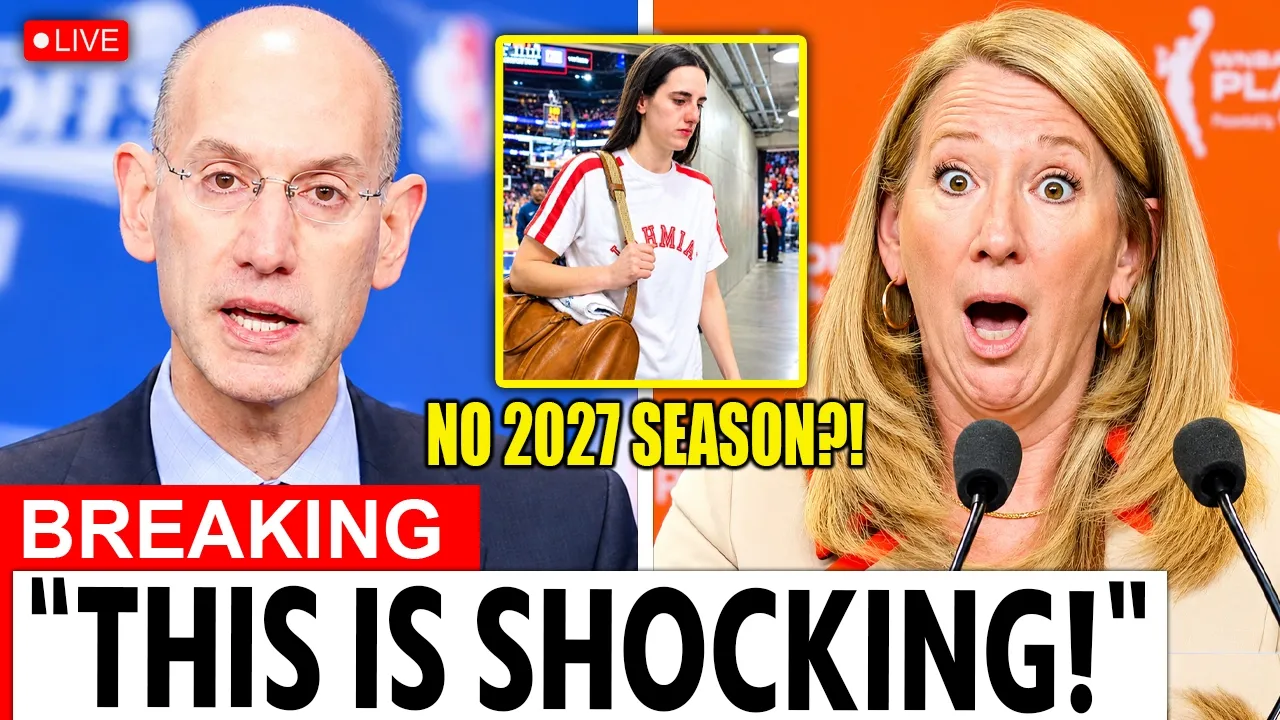
Now, Adam Silver has caused quite a stir in WNBA world because he just went on the Today Show and he was talking about the WNBA CBA and here's what he had to say. He said, "I think share isn't the right way to look at it because there's so much more revenue in the NBA. " All right, WNBA fans, welcome back to the Clark update.
Today, we're diving into the shocking claims about Adam Silver, a reported $40 million loss, and Caitlyn Clark's playoff exit. Did the WNBA really cancel its 2027 season? Let's separate facts from rumors.
[music] Like, subscribe, and let's get straight into it. Officially, the WNBA is in disarray. There are rumors that NBA CEO Adam Silver and Commissioner Kathy Angelberg are at odds.
The players are upset, owners are in a frenzy, and Caitlyn Clark could be the key to the league's future. Indeed, [music] the irony hurts. The league may be tearing itself apart because of the same player who saved it, who then is truly losing control in this situation.
Although there has always been tension between Kathy Angelberg and Adam Silver, it is currently boiling in public. The worst possible business plan for the WNBA playoffs would have sounded exactly like what the league just done if you had entered a television network boardroom last week. [music] Consider the tremendous anticipation for this postseason.
You have the largest financial attraction in women's basketball history. You have a rookie who broke every viewership, attendance, and retail record the league has ever set over the course of the summer. No matter what day of the week it is or what other sports are on the other networks, your national television audience has demonstrated that they will tune in.
The 40ame regular season schedule was difficult for the Indiana Fever. Millions of casual sports fans followed them as they gradually became a cohesive playoff squad while enduring harsh fowls and intense media criticism. For 5 months, everyone in the sports world waited for Caitlyn Clark to enter the postseason and then it was over in an instant.
The WNBA's most lucrative and much-awaited rookie season did not conclude with an exhausting multi-week championship battle. In front of a boisterous home crowd, it did not conclude with a spectacular buzzer beater. It ended suddenly, silently, and completely on the road.
The entire duration of Indiana's postseason run was less than a week. On a Sunday, they tipped off. The Indiana Fever were preparing for the off season by Wednesday night.
In less than 96 hours, 40 regular season games of sweat equity, soldout stadiums, and unparalleled momentum were totally destroyed. In just a few days, the WNBA's biggest box office hit was ousted from the tournament. You had to watch exactly what was happening on television when Indiana was eliminated from the tournament in order to get how utterly ridiculous this is from a business standpoint.
The audience did not give up on the fever. The demand was actually more than it had been over the entire season. [music] ESPN made time in its prime time schedule to air the second game of their first round series against the Connecticut Sun.
It wasn't a leisurely Sunday afternoon. The National Football League, the undisputed titan of American television, was directly up against this weekn night show. For television viewers, competing with the NFL is typically a death sentence.
To avoid competing with Thursday or Monday Night Football, entire leagues modify their schedules. Caitlyn Clark accomplished more than simply make it through the NFL. She displayed numbers that are typically only seen by network executives during the NBA Finals seventh game.
An average of 2. 54 million people watched the second game against Connecticut. However, the math becomes rather crazy near the pinnacle.
3. 4 million people watched the Indiana Fever Battle for a postseason birth at its peak. While professional football aired on another station, [music] 3.
4 4 million people watched a women's basketball game. That high goes beyond simply outperforming NBA regular season games on ESPN. It outperforms important NHL playoff games.
[music] It is a high-end premium television asset. Now imagine yourself as an executive at Amazon, NBC, or ESPN. You are sitting at your office staring at a spreadsheet displaying 3.
4 million concurrent viewers. You are witnessing a player create audience engagement on par with that of the National Football League. You are considering the inventory of commercial advertisements for games three, four, and five.
You're doing the arithmetic on how much income this one player is going to earn for your network over the next 3 weeks of the postseason. When you glance at the WNBA rule book, you're horrified to see that after just two games, the league's playoff concept has forced your biggest cash cow off the television screen. The crowd was hungry.
The demand was unprecedented. The airtime was fully cleared and prepared for use by the networks. But the league's own rulebook essentially urged everyone to pack away the cameras and go home.
It wasn't simply bad luck that caused the WNBA's ratings to plummet after Caitlyn Clark left. [music] It was more than simply a difficult break on the basketball floor. It was a mathematically required catastrophe brought on by one of the most archaic and stupid playoff regulations in contemporary professional sports.
Let's examine how this regulation functions in detail and why it seems like a holdover from a different era. Unlike the NBA or NHL, the WNBA does not use a best of seven series for the first round of the playoffs. It's not even a best of five.
[music] The WNBA uses a very punishing best of three system. the first team to win two games advances. A best of three series is not a reliable indicator of a team's capability or overall skill in professional basketball.
The fluke factor is maximized during this sprint. Your entire season is immediately on the verge of elimination. If your team has one poor shooting night, your best player falls into early foul trouble, or a few 50/50 calls go against you on the road.
There isn't enough time to make significant tactical changes over the course of a twoe chess battle. There is no time to watch film and gradually counter the opponent's defensive rotations. You are in a win or go home situation when you blink twice.
However, a best of three series extreme brevity is just one aspect of the issue. The scheduling of those three games is where the WNBA rules ultimate foolishness lies. The league employs a twoin-one format.
The team with a higher seat gets to host games one and two in their home building under this arrangement. If a third game is even required, the lower seated team won't get a home game until the third. The Indiana Fever were paired with Connecticut, the third seed, on Sunday since they ended the regular season as the sixth seed.
For the first game, Indiana would have to travel to Connecticut. They had to remain in Connecticut to play an elimination game two in front of a hostile road crowd after losing that game. According to the rules, they were never able to return to Indianapolis to reorganize.
They were never able to capitalize on the fervor of their own thunderous supporters. The reality of the WNBA's playoff structure slapped the sports industry square in the face as the game two final buzzer sounded and Connecticut won the two to0 series sweep. The most viewed rookie in sports history and the most well-liked squad in the league.
The team that revolutionized women's basketball television ratings on its own. They didn't play a single game on their home court before being eliminated from the playoffs. Why does a league that recently inked a $2.
2 billion television rights contract behave this way? Because the WNBA is attempting to employ a rulebook created for a specialized startup league in the late 1990s to manage a contemporary dynamic sports market. A two-in-one playoff structure made practical sense decades ago when teams were flying commercial and the league was fighting for survival.
The league's travel expenses were reduced as a result. It eliminated the need for teams to travel across the nation for a brief preliminary round. It was a survival strategy created for a time when the WNBA was merely attempting to survive.
However, players are now traveling on charter flights. Multinational television companies are placing billion-dollar bids for the rights to broadcast. Against the NFL, a rookie is drawing 3.
4 million viewers. The days of traveling for the playoffs on a tight budget are over. However, the league administration continued to cling tenaciously to this antiquated framework, treating a billion-dollar entertainment product like a tournament for weekend amusement.
They let the lifespan of their most precious asset be determined by a severely faulty, extremely rushed playoff structure. They allowed months of unheard of momentum to be erased by the coincidence of a two-game road trip. But when you actually sit down and figure out how much money the WNBA lost by maintaining this best of three model, the speed of elimination is only half the catastrophe.
The level of business ineptitude is astounding. [music] Let's truly calculate what transpired in Connecticut when the last beep went off. This year, every Indiana Fever home game at Cambridge Fieldhouse during the regular season was more than just a basketball game.
It was a huge economic event for the entire city. Every night, an arena is packed with more than 17,000 yelling spectators. We are discussing parking income, merchandising lineups that completely round the concourse, and snack stands that run out of food before the third quarter begins.
The fever produced the kind of local economic impact that mayors envision throughout the regular season. For a typical Tuesday night game, the secondary ticket market frequently matched the cost of a premium seat at the NBA finals. Imagine the financial impact of a playoff game in the same building after that regular season excitement.
Consider the skyrocketing cost of tickets. Imagine the atmosphere on television. It would have been one of the best grossing single nights in the league's history and the most profitable live event in the Indiana franchise's history.
A postseason weekend benefits more than just the team owners. It powers the entire downtown area, bringing thousands of touring fans to local eeries, pubs, and lodging facilities. That night never occurred due to the WNBA's 2in1 playoff structure.
The world's top box office draw brought in exactly 0 from home playoff gate sales due to the league's obstinate refusal to amend its regulations. There were no tickets sold, no jerseys bought inside the arena, and no opulent suites hired to wealthy corporate sponsors. An entire city's multi-million dollar weekend was destroyed by the WNBA.
During the most crucial week of the season, Gambridge Fieldhouse, which had been the unquestioned center of the basketball world for 5 months, was silent and entirely empty. You must comprehend the original purpose of the twoin-one format in order to completely appreciate the ridiculousness of this. The WNBA adopted this particular timetable decades ago in order to reduce the cost of flying on commercial airlines by making the lowest seed play the first two games away from home.
A typical 111 schedule would force teams to travel back and forth several times. The league kept travel expenses to a minimum. It was a lowcost airline approach created for a league that was having financial difficulties.
It is financial malpractice to apply the same lowcost airline model to the Caitlyn Clark era. In order to comply with a travel policy that was established before some of its current players were even born, the league forfeited tens of millions of dollars in guaranteed revenue. However, the loss of ticket sales is only a small localized harm.
You must examine the national television partners in order to comprehend the actual catastrophic scope of this corporate catastrophe. Sports are not televised by networks like ESPN, ABC, and USA Network out of altruism. They work in the very competitive commercial advertising industry.
The only thing keeping the traditional television bundle together is live sports. The cost of a 30-second commercial space skyrockets during a playoff game with an average of 2. 54 million viewers.
Advertisers will pay a huge premium rate to get their brand in front of that particular highly engaged live audience. These high stakes, high viewership events serve as the foundation for television executives whole quarterly revenue forecasts. A first round series between Indiana and Connecticut would ensure the broadcasting network at least four prime time games.
If the WNBA used a traditional best of seven playoff format, the series might go to five, six, or a thrilling winner take all game seven if it was competitive. That's enough premium television inventory for four to seven nights. This equates to hundreds of expensive advertising slots, dozens of commercial breaks, and millions upon millions of dollars in guaranteed ad revenue.
[music] In order to control weekly ratings, and advertise their other programs, networks depend on long playoff series. Rather, [music] the WNBA used a best of three format that resulted in a quick twoame sweep for its television partners. ESPN schedule was cleared.
They persistently advertised the series with almost 3 million peak viewers tuning in while a professional football game was taking place on another station. They were able to capture true lightning in a bottle. The network was then unexpectedly informed that the show had ended.
Up to five additional prime time broadcasts of the world's most popular player were missed by ESPN. The whole marketing plan falls apart when a series concludes in two games. Because the WNBA won't play additional basketball, those lost broadcasts amount to an enormous sum of money that just vanished into thin air.
Commercials for a game that the league won't schedule can't be sold. Naturally, the rest of the playoff broadcast suffers when your biggest draw is forced off the screen in less than a week. The networks received a short film in exchange for paying for a featurelength blockbuster.
Advertisers that purchased pricey commercial packages in anticipation of a lengthy playoff run are now witnessing their commercial show during later series that only attract a small portion of that record-breaking viewership. That is precisely how a league harms its connections with media executives and large business sponsors. At this point, the scenario changes from a poor front office choice to an obvious unpleasant contradiction about the league's future.
The players themselves are aggressively requesting more money while the WNBA is busy squandering millions of dollars in potential gate and television income by playing short series. By formally opting out of the existing collective bargaining agreement, the WNBA Players Association just took a significant step. The participants want an entirely new economic paradigm.
[music] They want greater benefits, bigger base pay, and above all, a real revenue sharing arrangement that is similar to how the NBA divides its earnings between players and owners. Because they believe they are not being appropriately compensated for the league's tremendous, unparalleled growth over the past year, they are drawing a strong line in the sand and preparing for a big labor clash. The harsh, indisputable irony of that requirement is as follows.
A larger share of the financial pie is what the players desire. However, they compete in a league where the amount of the pie is mathematically reduced each year due to the playoff process. When your league declines to produce broadcast inventory at the NBA level, you cannot seek revenue sharing at the NBA level.
High stakes contests broadcast on national television are what provide value to professional sports. The [snorts] ultimate financial multiplier is said to be the playoffs. A strong postseason run in the NBA can generate a sizable portion of a team's yearly operating income.
That multiplier is severely limited by the WNBA. Although the league's antiquated rules deliberately prevent those revenues from being made in the first place, the union is lobbying for a bigger share of the income. Television revenue that the owners refuse to collect cannot be shared.
This produces the season's most striking contrast. Throughout the summer, the Indiana Fever played in front of unprecedented audiences. From Los Angeles to New York, they sold out enormous arenas while touring.
They created unheard of wealth in every city they visited, making them the uncontested kings of the sports box office. However, the WNBA's strict, unflexible rule book mandated that they would sell exactly zero home playoff tickets when the stakes were at their highest and everyone in the nation was paying attention and prepared to spend money. In front of the devoted supporters who helped them create their historic season, they played zero minutes of postseason basketball.
It is a massive self-inflicted financial damage caused by a total inability to adjust to a shifting market. You don't need to search far to see how genuinely strange this corporate approach is. You only need to take a look at the league that provides funding for the WNBA to see how they resolved the identical multi-million dollar error more than 20 years ago.
[music] The severe instability of short playoff series was a problem NBA commissioner David Stern confronted 23 years ago and he used the brutal business efficiency that characterized his tenure to overcome it. The NBA's opening round of the playoffs was played on a best of five format until 2003. However, Stern was the only person in sports with a deeper understanding of the television industry.
When he examined the best of five framework, he saw that it was a huge financial risk. Too many fluke upsets were possible in short series. Before the postseason even really started, they gave lower seated teams the opportunity to steal a single away game, [music] quickly reverse the flow, and eliminate the league's most marketable players.
Variance is the biggest threat to the better, more successful team in professional basketball. Four two nights in a row, a weaker opponent can just get extremely hot from the three-point line. In a demanding best of seven series, a referee may blow the whistle during a pivotal fourth quarter.
The genuine talent and depth of a team will ultimately determine the result when that volatility finally levels out. However, variation is crucial in a highly compressed rapid firing series. One uncharacteristically poor shooting performance, one unfriendly road crowd, or one rolled ankle can send huge box office draw straight into the off season.
The NBA wasted weeks of expensive television inventory if Shaquille O'Neal or Kobe Bryant had one poor week in a condensed format. David Stern changed the opening round to a best of seven series in 2003, doing away with a best of five format completely. He didn't do this to wear out the players.
He just did this to safeguard the top seeds, increase television inventory, and increase ticket sales for the team owners. The league's most prized assets are safeguarded by a seven-game series. It guarantees that the more well-liked, highly regarded franchises continue to air on television for longer.
As of right now, the WNBA is 23 years behind the commercial rationale of the league that founded it. They don't have to create a whole new economic plan or employ pricey consulting firms. All they have to do is glance at the NBA headquarters across the hall to see that short playoff series intentionally waste money.
Nevertheless, they obstinately maintain a best of three structure that is much riskier and more erratic than the one David Stern abandoned more than 20 years ago. Sports radio is no longer only frustrated by this resistance to modernization. It is a huge impending contractual obligation.
The pressure is coming straight from those who write the checks and the stakes are going to change significantly. A historic and significant new media rights agreement was just struck by the WNBA. A major new broadcasting contract that is reportedly worth $2.
2 billion over 11 years will begin soon. [music] Corporate media titans are the partners who are willing to contribute that enormous sum of money. We are discussing Amazon Prime Video, Disney, and NBC.
These are ruthless, profit-driven TV networks that purchase high-end live sports programming to boost monthly subscriptions, control prime time viewership, and sell expensive commercial ads. They are not nonprofits contributing to the expansion of women's basketball. They anticipate a huge observable return on their multi-billion dollar investment.
Network executives at NBC and Amazon have very clear expectations about how a professional sports league should function when they plan their broadcasting schedules. They anticipate lengthy, deep postseason runs with the best names in the game. To broadcast Caitlyn Clark, Oza Wilson, and Sabrina Ionescu in highstakes prime time television conflicts, they are spending premium billions.
[music] Paying $2. 2 billion to see the WNBA artificially restrict its top talents to a maximum of three playoff games is something they will not put up with. When a television network discovers that the league's rulebook permits the most well-known women's basketball player on the planet to be removed from the screen in less than a week, just picture the utter fear in the boardroom.
[music] Imagine the annoyance of an executive who recently purchased the playoff rights only to learn that due to an odd twoin-one scheduling arrangement, the league's top box office attraction might not even be able to host a single home playoff game. Broadcasting partners who are used to airing the NBA finals on Sunday Night Football will not be interested in a best of three weekend sprint. The vacant days on the calendar will be examined by the television partners.
They will seek a quick structural reform after observing the sharp decline in viewership that occurred as soon as Indiana was gone. Kathy Inglebert, the commissioner of the WNBA, is now under intense pressure in professional sports. This season has seen an unprecedented rise in popularity and she has done an amazing job navigating it, but this is the final test of executive leadership.
You can't only rejoice about the increasing number of viewers. You need to construct a system that can capture it. A major American professional sports league cannot be managed like a weekend getgether.
You must safeguard your stock of televisions. You must keep your broadcasting partners safe. It is imperative that you make sure your most lucrative teams are able to open their arenas during the postseason.
There will be tremendous and inevitable pressure from the networks. The discussions between the television executives and the league office behind closed doors will no longer be courteous recommendations about minor format adjustments. There will be ultimatums.
The WNBA will be forced by the broadcast partners to extend the first round to at least a best of five series because they will never again permit this league to carelessly waste their enormous financial commitment. And this is when the network's rage and the gamers frustration are exactly in sync. This type of systemic failure is directly addressed by the WNBA Players Association's decision to opt out of the collective bargaining agreement.
The players are pointing out the situation's indisputable reality while staring at the league office. There is a great deal of interest in the athletes. Millions of people watch the athletes on television due to their refusal to update their rulebook.
The league office is leaving money on the table while the athletes fill the enormous arenas. The owner's use of a playoff system purposefully prohibits that cash from being generated during the most profitable weeks of the year. Despite the players desire for meaningful revenue sharing, you are left with a really harsh, merciless business reality.
When you take away the emotions of the games, the hard fouls, the rivalries, and the emotional press conferences, it wasn't an inevitable accident that dominated the sports news cycle following the first round. It wasn't merely a result of a youthful club dropping a few difficult away basketball games. It was required by mathematics.
The league set their golden goose squarely on top of a structural trapdo that they had constructed. They lost owners, players, and networks tens of millions of dollars by enforcing an antiquated and stupid playoff rule that penalized the league for its own extraordinary success. After pleading for a huge worldwide audience for 28 years, the WNBA finally received it.
The league's own rule book instructed the crowd to leave when they eventually turned out to see the playoffs. Do you believe that in the upcoming season, the WNBA will finally wake up and extend the first round to a series of five or seven games? And that's where things stand.
WNBA fans. Caitlyn Clark's impact continues to spark major conversations about the league's future, but the claims about a $40 million loss and the cancellation of the 2027 season still need official confirmation. Now, we want to hear from you.
[music] What do you think about Caitlyn Clark's influence on the WNBA? Drp your thoughts in the comments below. Don't forget to like this video, subscribe to the Clark Update, and turn on notifications so you never miss the latest WNBA news.
Thanks for watching, and we'll see you in the next update.