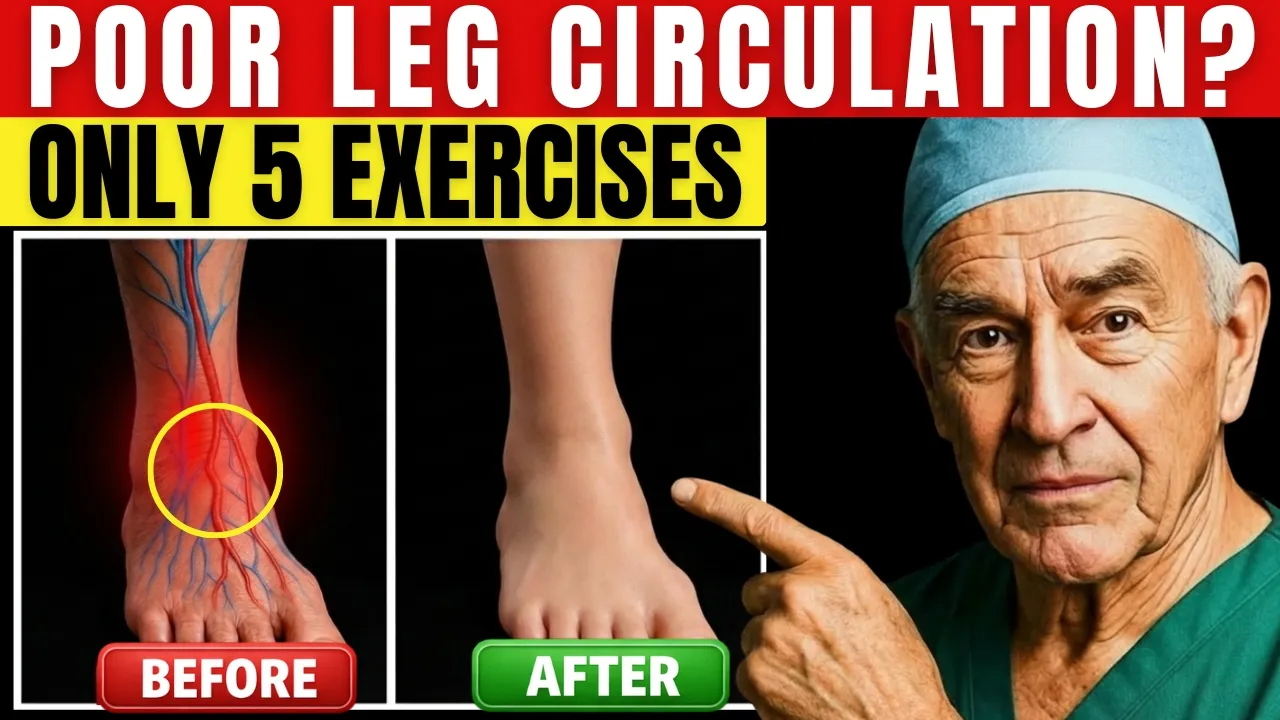
Poor circulation after 60 can quietly make your legs feel older, weaker, and less reliable than they really are. And as many orthopedic surgeons explain, the first signs often do not show up as a dramatic medical problem. They show up in small everyday moments.
Your legs feel heavy after sitting. Your calves feel tight by late afternoon. It takes a few steps before your body feels normal in the morning.
Most people assume that is just aging. But what most people never get told is that this is not only about your joints, and it is not only about your knees. Very often, it begins lower down in the feet, ankles, and calves, where movement slows, muscles work less, and blood does not move as efficiently as it should.
Cleveland Clinic explains that the muscles in your lower legs act like a powerful pump, shock and sometimes called the second heart, helping push blood back upward each time you move. And the CDC says adults 65 and older need at least 150 minutes of weekly activity, plus muscle strengthening work. Because movement is not optional after 60, it is part of how the body keeps working well.
That may sound simple, but in everyday life, this shows up when you stand from a chair and your legs feel slow. When you walk to the mailbox and feel more unsteady than you used to. When your lower legs feel full, tired, or oddly weak by the end of the day.
So, in this video, I'm going to walk you through five exercises designed to do two things at the same time. Improve blood flow and help build stronger legs after 60. Each one starts where circulation often slows the most, then moves upward through the muscles that support your strength, steadiness, and confidence.
And stay with me until the final exercise, because that last one is the movement that ties everything together. If you are over 60, tell me your age and where you are watching from. And if this topic matters to you or someone you love, stay with me.
Exercise number one, ankle pumps. This is where the work should begin, because poor circulation usually makes itself known first in the lowest part of the legs. After 60, many people notice it without realizing what they are feeling.
The feet feel dull after sitting. The ankles feel stiff when they first stand. The lower legs seem heavy, almost as if they need a few moments to wake up.
That may sound minor, but this is often where the whole story starts. Ankle pumps are simple. You sit tall in a chair or lie back comfortably, then slowly pull your toes towards you and press them away from you.
That is all. But what looks small can be very useful. Cleveland Clinic notes that foot and ankle flexing exercises can help blood flow better in the leg veins, and MedlinePlus even recommends ankle pumps every 2 hours during bed recovery, because this kind of motion helps keep blood moving in the legs.
That matters because the body often responds better to frequent gentle movement than to one hard effort at the end of the day. In everyday life, this shows up when you have been watching television, sitting at the kitchen table, or riding in the car too long. Before the legs feel strong again, they usually need to feel mobile again.
And that is exactly why this first movement matters. It is not about straining the muscles. It is about reminding the lower legs to start pumping again.
Do the movement slowly for about 20 to 30 repetitions, or for 30 to 45 seconds on each side. Breathe normally. Do not snap the ankle or force the toes.
A smooth rhythm is better than a hard one. Many older adults notice that by the end of this first exercise, the feet already feel warmer and the legs feel a little less dull. And once blood flow begins waking up at the ankle, the next place to target becomes even more important, because the calf is where circulation starts getting real support.
Exercise number two, calf raises. Once the ankles begin to wake up, the next place to focus is the calf. This is where circulation starts getting real support.
An orthopedic surgeon would tell you that the calf is not just another leg muscle. It is one of the body's most important natural pumping systems. Cleveland Clinic explains that each time you take a step, your calf muscle squeezes and helps push blood back up toward your heart.
That is why the calf muscle pump is often called the body's second heart. And one vascular review notes that venous return from the lower extremities depends heavily on the foot, calf, and thigh muscle pumps, with about 90% tied to that system. In everyday life, this matters more than most people realize.
When the calves are not working enough, the lower legs can begin to feel full, heavy, or tired by the end of the day. Many older adults notice it after sitting too long, standing in the kitchen, or walking less than they used to. That heavy leg feeling is not always about weakness alone.
Sometimes it is a sign that the pumping action in the lower leg is simply not being used often enough. To do this movement, stand tall behind a sturdy chair or near a counter for support. Keep your feet about hip width apart.
Slowly rise up onto your toes as high as feels comfortable, then lower your heels back down with control. Do not rush. Think of it as a smooth lift and a smooth return.
The American Academy of Orthopedic Surgeons includes calf raises in its foot and ankle conditioning program, and suggests two sets of 10 done 6 to 7 days a week, with the gastrocnemius-soleus complex as the main muscles working. That may sound simple, but simple is exactly what works after 60. You do not need to bounce.
You do not need to strain. You just need to let the calves start doing their job again. For many older adults, she did this is the point where the legs begin to feel more alive, less sluggish, and a little more dependable.
And once the lower legs are pumping better, the next step is to move higher, because stronger circulation alone is not enough. The muscles in the front of the thighs also need to come back online. Exercise number three, seated leg extensions.
Once circulation starts waking up in the ankles and calves, the next step is to move higher into the front of the thighs. This matters more than many older adults realize, because the quadriceps help support how steady and dependable the legs feel when you stand, walk, and change direction. The National Institute on Aging says older adults should include muscle strengthening activity at least 2 days a week, and the CDC says those activities should work the major muscle groups, including the legs.
That is one reason a simple chair-based movement like this makes so much sense after 60. In everyday life, this is the part of the leg that often shows up when you try to straighten your knee after sitting, step forward with confidence, or rise from a chair without feeling like your legs have to negotiate with you first. The American Academy of Orthopedic Surgeons notes that strengthening the muscles that support the knee helps reduce stress on the knee joint, and AAOS specifically highlights the quadriceps as one of the key muscle groups that need proper conditioning around the knee.
That may sound simple, but when the front of the thigh gets neglected, the legs can start to feel less reliable even before they feel truly weak. To do this movement, sit tall near the front of a sturdy chair with both feet flat on the floor. Slowly straighten one leg until it feels comfortably long in front of you, then lower it back down with control.
Switch sides. Do 10 repetitions on each side for three sets. The goal is not to snap the knee straight or force the leg up high.
The goal is to wake the muscle up. Keep the motion smooth. Keep your shoulders relaxed.
Let the front of the thigh do the work. For many older adults, this is where the legs begin to feel not just warmer, but more supported. And once the front of the thigh starts coming back online, the next place becomes even more important, because the back of the leg has to join the story, too.
Exercise number four, standing hamstring curls. Once the front of the thigh begins doing its job again, the back of the leg has to come back into the picture, too. This is the part many older adults overlook.
They think about the knees, or they think about their calves, but they rarely think about the hamstrings. And yet these muscles at the back of the thigh play an important role in helping the legs feel steady, supported, and more complete as a system. The American Academy of Orthopaedic Surgeons includes hamstring curls in its knee conditioning program and lists the hamstrings as the main muscle worked with a starting guide of three sets of 10 done four to five days a week.
In everyday life, this shows up in quiet ways. It shows up when you are standing at the sink, turning to take a few steps, or trying to feel more stable as you move through the house. When the back of the thighs are not doing enough, the legs can start to feel incomplete.
Almost as if one side is working and the other side is only following along. That may sound simple, but stronger legs are not built from one muscle alone. They are built from balance between the front and the back.
To do this movement, stand tall behind a sturdy chair or near a wall. Hold on lightly for support. Then bend one knee and slowly bring your heel up toward the ceiling only as far as feels comfortable.
Pause for a moment. Then lower the foot back down with control. Keep your knees close together.
Do not swing the leg. Do not rush the lift. Do 10 repetitions on each side for three sets.
AAOS also notes that this movement should be done without pain with the foot flexed and the motion controlled rather than thrown upward. For many older adults, this is where the leg starts feeling more connected. The lower leg has already been woken up.
The calf has already started pumping better. The front of the thigh has already joined in. Now the back of the thigh adds the support that makes the whole leg feel more dependable.
And once both the front and back of the thigh are working again, the final step becomes the most important of all because now it is time to bring everything together in one movement your body uses every single day. Exercise number five. Sit-to-stand.
This is the movement that brings the whole story together. By the time you reach this point, the ankles have started waking up. The calves have begun pumping better.
And the muscles in the front and back of the thighs are no longer sitting on the sidelines. Now all of those parts have to work as one. And that is exactly why this final exercise matters so much.
It does not train just one section of the leg. It teaches the entire lower body to work together again in a way that feels useful in real life. In everyday life, this is the movement behind getting up from the kitchen chair, standing from the sofa, rising after breakfast, or getting out of bed and feeling steady instead of slow.
The CDC uses the 30-second chair stand as a way to assess leg strength and endurance. And the National Institute on Aging includes practicing standing from a sitting position as one of the balance supporting activities older adults can use to stay independent. That matters because after 60, stronger legs are not only about muscle.
They are about confidence, steadiness, and being able to trust your body in small daily moments. To do the movement, sit toward the front of a sturdy chair with your feet flat on the floor about shoulder width apart. Keep your back long, your chest gently forward, and your hands on the chair only as much as you need.
Then lean slightly over your feet and slowly stand up. Pause for a breath. Then lower yourself back down with control.
The CDC's chair rise instructions emphasize slow control, feet flat, tucked away, and using the hands as little as possible. If needed, start with just a few repetitions and make the movement smooth rather than forceful. That may sound simple, but this is often the moment older adults feel the difference between exercise and real function.
The ankles help stabilize. The calves help push. The front of the thighs help lift.
The back of the thighs help support and control the return. And suddenly, the goal is no longer just better circulation or stronger muscles on paper. The goal becomes something much more personal.
It becomes standing up with less hesitation, walking with a little more certainty, feeling that your legs still belong to you. And now you can see why no single movement works alone. Better blood flow helps the muscles.
Stronger muscles help movement. And better movement helps blood keep flowing. That is where the real change begins.
What most people never get told is that legs rarely start feeling old all at once. It usually begins in smaller, quieter ways. Blood does not move as well after long periods of sitting.
The feet and ankles feel slow to wake up. The calves stop helping as much as they should. The thighs begin doing less than they once did.
And little by little, the legs can start to feel heavier, less steady, and less dependable than they used to. That is why this matters. The goal is not just to exercise for the sake of exercise.
The goal is to help the blood move better, help the muscles work again, and help the legs feel like they belong to you when you stand up, walk across the room, step into the kitchen, or head out the front door. The National Institute on Aging says physical activity is beneficial at any stage of life. And older adults are encouraged to include aerobic, muscle strengthening, and balance activities each week.
That is exactly why gentle, consistent movement matters so much after 60. And the good news is that you do not need anything extreme to benefit from this. You do not need punishing workouts.
You do not need to force your body. You just need to give your legs a reason to keep showing up for you. One small movement helps wake up the ankles.
Another helps the calves start pumping again. Another brings the thighs back into the story. And the final movement turns all of that into something real and useful in everyday life.
For many older adults, this is where confidence starts coming back. Not all at once, but step by step. Which of these five exercises do you think your legs need most right now?
Let me know in the comments. If this helped you, give it a like, share it with someone who may need this encouragement, and subscribe for more gentle guidance to help you stay strong, steady, and independent after 60.