Hello, I'm Terry Fisher. This is the seventh of 12 lectures on copyright. We're just past the halfway point of this lecture series.
By now, you should be familiar with the rules governing what types of creative works are subject to copyright protection, who owns the copyrights in those things, and how one secures and transfers a copyright. In addition, you should feel comfortable with three of the four major theories of copyright-- specifically, the fairness theory, the personhood theory, and the utilitarian or welfare theory. We arrive, finally, at the heart of copyright law.
In the next three lectures, we'll examine the principal rights that a copyright owner enjoys and the corresponding limitations upon those rights, designed to accommodate the interests of the public at large. Here's how my presentation will be organized. In this lecture and the next one, I'll be examining the economic rights enjoyed by a copyright owner.
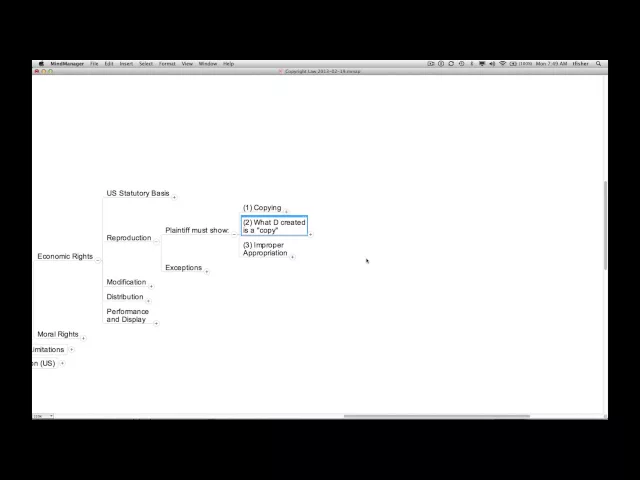
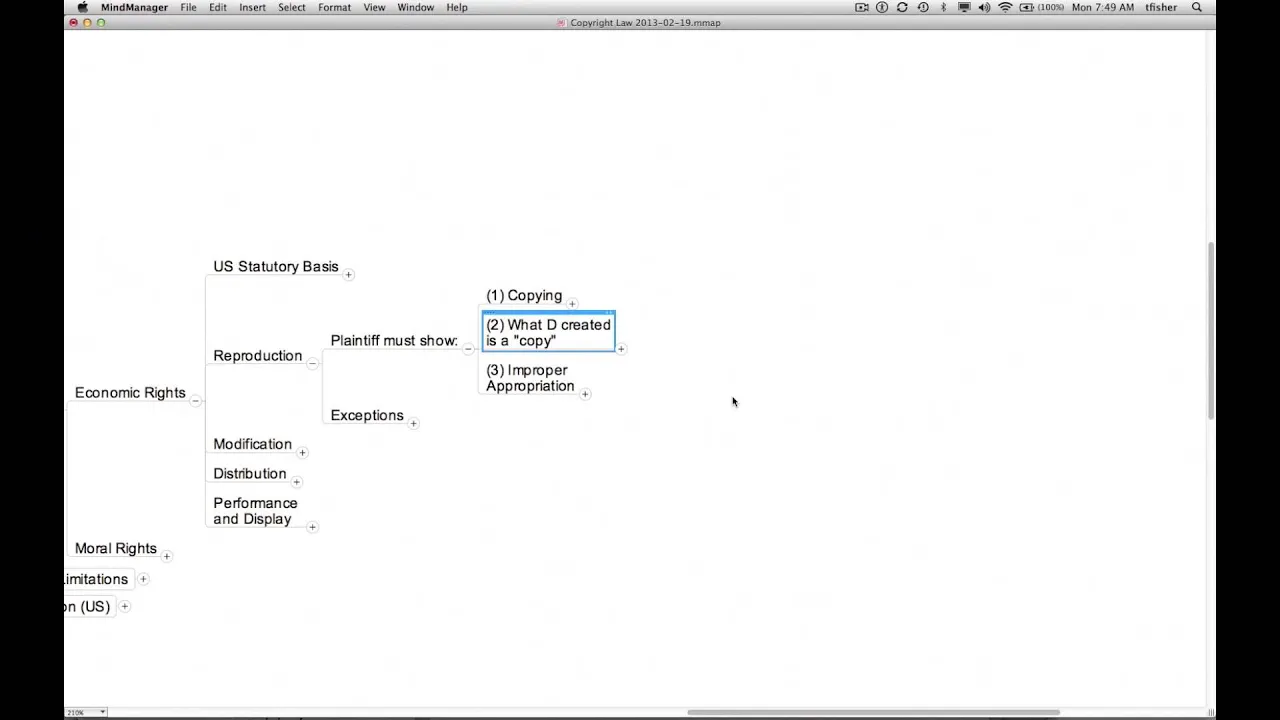
As you'll see, there are four clusters of such rights-- first, the copyright owner's exclusive right to reproduce the copyrighted work; second, the exclusive right to make modifications of the copyrighted work, commonly known as the right to make derivative works; third, the right to control the distribution, exportation, and importation of copies of the work; and fourth, the right to control public performances or public displays of the work. Today, I'll be examining the first two of those rights-- the right of reproduction and the right of modification. Next week, I'll take up the third and fourth of the rights.
And the week after that, I'll discuss the major exceptions and limitations that copyright law imposes upon these exclusive rights. During this tour, I will focus, as I did during the first half of the course, primarily on the law in the United States. But I will also identify some respects in which the law in other countries parallels or differs from US law.
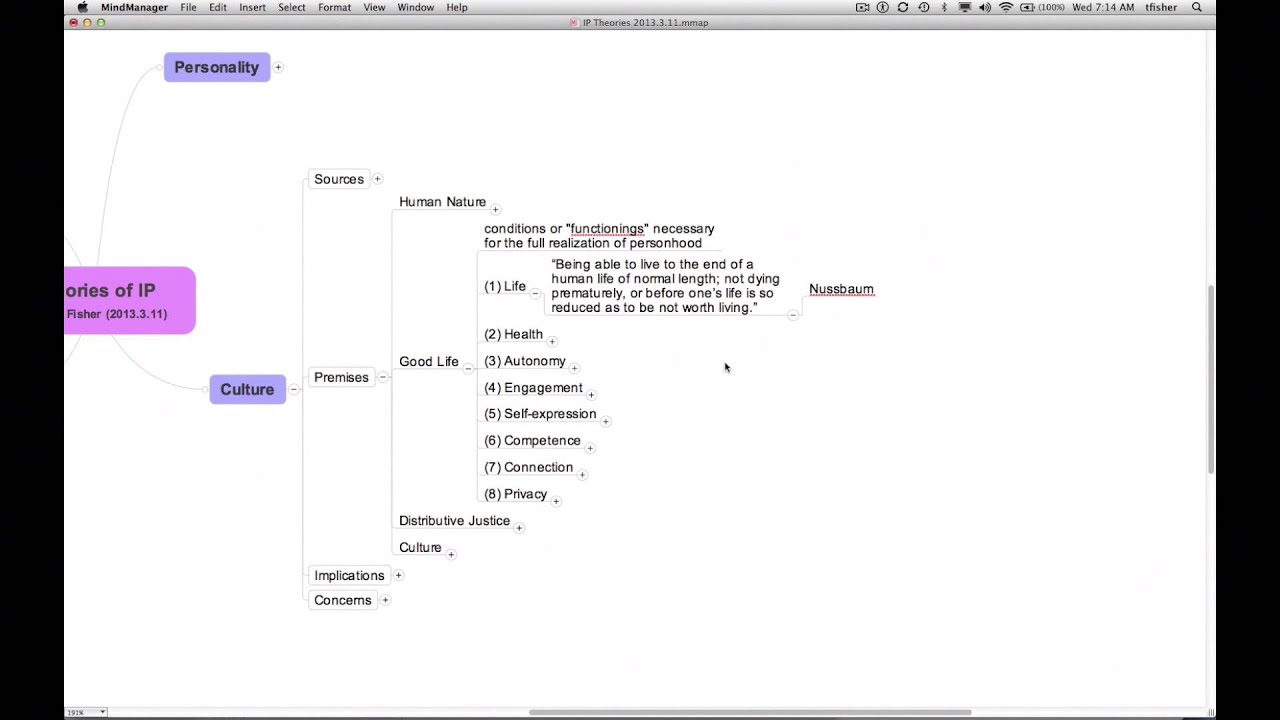
As usual, I'll be supplementing my presentation with various audiovisual materials, one of which is in front of you-- a map of copyright law, the current version of which is available on my homepage, tfisher. org. So let's begin.
Section 106 of the US Copyright Statute confers on copyright owners a broad and seemingly unqualified set of rights. Here they are. Section 107 through 122 then carve out of those rights a long list of exceptions.
Some of those exceptions are very specific and narrow. Others are broader. The broadest of all is the fair use doctrine, embodied in Section 107, which we'll discuss in two weeks.
As you can see, the introductory clause of Section 106 makes the rights it creates, quote, "subject to" end quote-- in other words, qualified by-- Sections 107 through 122. The result of this structure is that, to get an accurate sense of the scope of a copyright owner's exclusive rights, you must oscillate between the generous grants contained in Section 106 and the myriad exceptions contained in the following provisions. And that's what we'll be doing.
The first and simplest of the rights conferred on a copyright owner by Section 106 is the right to reproduce-- in other words, to copy-- the copyrighted work in copies or phonorecords. This entitlement is commonly considered the core of copyright. The name of this entire field suggests as much.
The heart of copyright is the exclusive right to copy. As it's used in the law, the term "reproduction" has three independent dimensions. To prevail, a plaintiff must satisfy all three.
The first pertains to the way in which the defendant generated the allegedly infringing things. Only if he did so by copying is the defendant liable. The second pertains to the character of the allegedly infringing things.
Only if they constitute, quote, "copies," close quote, is the defendant liable. And the third pertains to the nature and amount of the material the defendant took from the plaintiff. Only if it rises to the level of, quote, "improper appropriation," close quote, is the defendant liable.
We'll consider them in that order. In patent law, as some of you know, independent invention is no excuse. A defendant cannot escape liability by showing that he dreamed up, on his own, an invention that happens to match the plaintiff's patent.
Not so in copyright law. There, independent creation is an excuse. Suppose, for example, I write a poem.
Later, you, never having seen mine, write and publish exactly the same poem. I have no claim against you. You infringe my copyright in my poem only if you copy mine.
So what exactly does that mean? The clearest type of copying is mechanical reproduction. If you make a photocopy of the piece of paper upon which my poem is written, you have copied it.
If you rip a CD containing a sound recording, which, in turn, embodies a musical composition, you have copied, specifically in a phonorecord, both the composition and the sound recording. If you replicate a CD-ROM containing a software program, you infringe the copyright in the program. None of this should be surprising.
But as used in the law, the term "copying" is not limited to mechanical reproduction. It also includes having the copyright work in mind when making a substantially similar embodiment. So if you read and memorize my poem and then write it down, you have copied it.
If you listen to a performance of my musical composition and then record your own rendition of my composition, you have copied it. If you watch a movie and then write a short story containing an identical plot, you have copied the audiovisual work embodied in the film, and so forth. The most intriguing cases in this area involve situations in which the defendant is exposed to the plaintiff's work and then, sometime later, creates a very similar work without being aware that it mimics the plaintiff's work.
In other words, the defendant believes he is being original, but he's not. The law governing such situations is harsh. In the 1924 case of Fred Fisher versus Dillingham, Judge Learned Hand summarized the relevant rule as follows.
Quote, "Everything registers somewhere in our memories, and no one can tell what may evoke it. Once it appears that another has, in fact, used the copyright as the source of this production, he has invaded the author's right. It is no excuse that, in so doing, his memory has played him a trick.
" Close quote. The most famous case of this general sort involved the following facts. In 1963, The Chiffons, a popular quartet in the United States, released a recording of "He's So Fine," a song that had been composed by Ronald Mack.
Here's a brief excerpt. [MUSIC - THE CHIFFONS, "HE'S SO FINE"] The Chiffons' recording was a hit in both the United States and in England. George Harrison heard the song, but forgot it.
Six years later, he composed and performed "My Sweet Lord. " Here's an excerpt. [MUSIC GEORGE HARRISON, "MY SWEET LORD"] Bright Tunes Music, the assignee of Mack's copyright, brought an infringement suit against Harrison and prevailed.
Both the trial court and the Court of Appeals credited Harrison's testimony that he was unaware of The Chiffons' recording when he made his own song. However, they ruled, Harrison could not escape on this basis. Here's the key passage in the appellate court's opinion.
Quote, "It's not new law in this circuit that, when a defendant's work is copied from the plaintiff's, but the defendant, in good faith, has forgotten that the plaintiff's work was the source of his own, such innocent copying can nevertheless constitute an infringement. It's settled that intention to infringe is not essential under the Copyright Act. " The court then went on to suggest a possible policy basis for this seemingly unforgiving rule.
Quote, "As a practical matter, the problems of proof inherent in a rule that would permit innocent intent as a defense to copyright infringement could substantially undermine the protections Congress intended to afford copyright owners. We therefore see no reason to retreat from this Circuit's prior position that copyright infringement can be subconscious. " The rule announced and applied by the court in this case bears emphasis.
Innocent copying is still infringement. In this special sense, copyright infringement is a strict liability offense. The final, perhaps non-obvious, aspect of the scope of copying is that it encompasses translation of the plaintiff's work into a different medium.
So for example, an unauthorized motion picture version of a novel, a doll that mimics a cartoon character, a still photograph of a ballet are all covered. So to summarize, a plaintiff, to establish that a defendant has violated the plaintiff's exclusive right of reproduction, first must show that the defendant, quote, "copied" the plaintiff's work, which means either that the defendant mechanically reproduced it or had the plaintiff's work in mind, even subconsciously, when making his own product. How, then, does a plaintiff prove copying in this sense?
There are four techniques listed in the map in front of you. First, the plaintiff can introduce direct evidence of copying. Surprisingly often, evidence survives of a defendant's conscious intentional use of the plaintiff's work during the course of his own creative processes, and that evidence turns up in discovery.
Second, the plaintiff can show that the defendant had access to his work and that the defendant's work and the plaintiff's work are sufficiently similar to raise an inference of copying. For example, the plaintiff may be able to show that the defendant had the plaintiff's book on his bookshelf or received the plaintiff's screenplay in the mail. More commonly, the plaintiff may be able to show that his work-- say, a song or a movie-- was widely performed in areas and at times that would make it highly likely that the defendant heard or watched it.
So for example, few people, at least in the Western hemisphere, can plausibly contend that they've never heard a Beatles song or watched a James Bond movie. When the plaintiff can demonstrate access of this sort, all he then needs to demonstrate is sufficient similarity between the defendant's and the plaintiff's work to make plagiarism more likely than independent creation. The character and amount of similarity that's necessary for this purpose is sometimes called probative similarity.
It's different from the kind of similarity that we will discuss in a minute, under the heading of "Improper Appropriation," because its function is different. Its role, to repeat, is to support an inference that the way the defendant created his work was wrong, not that the amount he took was too much. The courts, unfortunately, sometimes conflate these two types of similarity, but you should not.
What if the plaintiff has no evidence that the defendant had access to his work, but can show that the defendant's work is extremely similar to his? Is that enough to show copying? US courts use to disagree on this point.
Some Courts of Appeals said yes; others said no. All of the Courts of Appeals now seem to agree that sufficiently, quote, "striking," close quote, similarity between unusual aspects of the two works can suffice. However, the inference of copying that arises in such circumstances can be overcome if the defendant demonstrates that he did not have access to the plaintiff's work or that both the plaintiff's work and the defendant's work could have been copied from something in the public domain.
Finally, an especially powerful way of showing copying is to demonstrate that the same errors can be found in both the plaintiff's and the defendant's works. Sometimes, such errors are deliberate. The writers of travel guides, for example, often insert fictitious entries in their lists of hotels and restaurants precisely in order to enable them to detect copying of their material by the publishers of other guides to the same cities or countries.
This is a very effective way of ferreting out copying, although it can be inconvenient for the readers who visit the non-existent sites. At other times, the errors are inadvertent. Paul Goldstein, for example, points to one case in which a legal publisher, as part of an infringement suit against another publisher, admitted that, in 50 pages of the plaintiff's treatise, there were 138 inaccurate citations, and the same mis-citations appeared in the defendant's text-- embarrassing, but convincing, evidence of copying.
Assuming that the plaintiff can surmount this first hurdle, the second of the three things the plaintiff must show is that the thing the defendant made through copying is sufficiently concrete and stable to be called a copy. In the overwhelming majority of cases, this is easy. But occasionally, a plaintiff falters here.
The statutory definition the plaintiff must satisfy is shown on your screen. From this language, the courts have extracted the requirements that the thing produced by the defendant be tangible-- in other words, a material object-- fixed, and intelligible. The most slippery of these requirements is fixation.
You'll recall, I hope, that fixation is a precondition of copyright protection under US law, although not under the law of most countries. Here, we encounter a second, closely related manifestation of the laws concerned with fixation. Not only must the plaintiff's work be fixed in order to enjoy copyright protection; the defendant's work must also be fixed in order to violate the plaintiff's copyright, at least under Section 106(1).
Recently, the Second Circuit Court of Appeals decided a complicated and important case in which this fixation requirement proved critical. Because the case implicated several other legal rules, as well, I'm going to describe the facts in some detail. Then, I'll discuss one of the issues raised by those facts today and come back to other dimensions of the case next week.
Cablevision is a small cable TV system based in New York City. Like all cable companies, it aggregates audiovisual programming from several sources. For example, Warner Brothers may produce a movie, license it to NBC, and then Cablevision picks up NBC's signal.
Cartoon Network and HBO provide programming directly to Cablevision, and so forth. As you might expect, Cablevision pays for the right to broadcast this material either according to the terms of voluntary licenses or through a compulsory license. Those licenses are important and complex.
We'll touch on them briefly at the end of the next lecture. For present purposes, all you need to know is that these licenses do not give Cablevision the right to make copies of the TV shows or movies in question, only to publicly perform them. So to return to the narrative, Cablevision combines these various streams of programs into a single, composite, encoded signal, which it sends via cable, of course, to its customers.
Each customer receives the composite signal through a set-top box, which decodes it, relays it to a television, which, in turn, displays it to the subscriber sitting on his couch. If, as is likely, the subscriber doesn't want to watch all shows at the times they are broadcast, he's likely to employ a device to record them. Once upon a time, the device would have been a VCR.
Today, it's likely to be a digital video recorder, commonly known as a DVR. Then, when the subscriber wants to watch a given show, he plays the copy stored on the DVR. So this pattern should be entirely familiar to most of you.
But if you've been following this course of letters from the beginning, it should make you uneasy. There's no question that the DVR recording, represented by the blue dot on this slide, is a copy of the television shows in question. The subscriber who makes those copies does not have a license from Warner Brothers or Cartoon Networks to do so.
Is the subscriber then violating section 106(1) of the copyright statute? The answer is yes, but that violation, as we'll see, is excused under the fair use doctrine. When and how that crucial principle was established we'll discuss in a few weeks.
For now, it's enough to recognize that the subscriber can slip the noose by pleading fair use. Now, back to our story. In 2006, Cablevision had an idea.
What if, instead of relying on individual subscribers to make copies of shows on their home DVRs, it offered to make copies for them using a cloud-based technology? This would be more efficient and convenient than the home devices, sufficiently so, that the subscribers would be willing to pay a premium for it. So Cablevision created, though it did not immediately implement, what it called a remote storage DVR, or RS-DVR system.
Its main features, in the language of the court eventually called upon to review the system, looked like this. Quote, "Under the new RS-DVR, this single stream of data is split into two streams. The first is routed immediately to customers, as before.
The second stream flows into a device, called the broadband media router-- BMR-- which buffers the data stream, reformats it, and sends it to the Arroyo server, which consists, in relevant part, of two data buffers and a number of high-capacity hard disks. The entire stream of data moves to the first buffer, the primary ingest buffer, at which point the server automatically inquires as to whether any customers might want to record any of that programming. If a customer has requested a particular program, the data for that program move from the primary buffer into a secondary buffer and then into a portion of one of the hard disks allocated to that customer.
As new data flow into the primary buffer, they overwrite a corresponding quantity of data already on the buffer. The primary ingest buffer holds no more than 0. 1 seconds of each channel's programming at any moment.
Thus, every tenth of a second, the data residing on this buffer are automatically erased and replaced. The data buffer in the BMR holds no more than 1. 2 seconds of programming at any time.
While buffering occurs at other points in the operation of the RS-DVR, only the BMR buffer and the primary ingest buffers are utilized absent any request from the individual subscriber. To the customer, however, the processes of recording and playback on the RS-DVR are similar to that of a standard set-top DVR. Using a remote control, the customer can record programming by selecting a program in advance or by pressing the Record button while playing a given program.
To begin playback, the customer selects the show from an on-screen menu of previously recorded programs. The principal difference in operation is that, instead of sending signals from the remote to an on-set box, the viewer sends signals from the remote through the cable to the Arroyo server at Cablevision's central facility, which then delivers the program to the subscriber's home. In this respect, RS-DVR more closely resembles a video-on-demand service, whereby a cable subscriber uses his remote and cable box to request transmission of content, such as a movie, stored on computers at the cable company's facility.
But unlike a video-on-demand service, RS-DVR users can only play content that they previously requested to be recorded. " So those are the facts. You can guess what happened next.
Cartoon Network and the owners of the copyrights in the other shows that would be delivered to subscribers through the system initiated a lawsuit against Cablevision, not because they thought this was a bad idea, but because they wanted Cablevision to pay them additional license fees to deploy this new feature, which Cablevision was unwilling to do. The plaintiffs contended that the RS-DVR system would violate their copyrights in not just one, but three, separate ways. First, they argued that buffering an audiovisual work, specifically for 1.
2 seconds in the BMR and for a tenth of a second in the primary ingest buffer of the Arroyo server, creates a series of replicated pieces of the work, which, although each one is stored only briefly, gives rise in the aggregate to a copy of that work and thus violates Section 106(1) of the Copyright Act. Second, they argued that making the much more durable copies of their shows on the Arroyo server hard drives gives rise to a second violation of Section 106(1). Third, they argued that the delivery of the programming from the Arroyo server to the subscriber at the subscriber's request would constitute an unauthorized, quote, "public performance," close quote, in violation of Section 106(4).
We'll discuss the second and third of those claims in future lectures. For present purposes, we're concerned only with the first one. The district court agreed with the plaintiffs that the buffer triggered a violation of section 106(1).
But the Court of Appeals reversed. Here's the crucial language in the appellate court's opinion. "Copies, as defined in the Copyright Act, are material objects in which a work is fixed by any method and from which the work can be reproduced.
The act also provides that a work is fixed in a tangible medium and expression when its embodiment is sufficiently permanent or stable to permit it to be reproduced for a period of more than transitory duration. We believe that this language plainly imposes two distinct, but related, requirements-- the work must be embodied in a medium, i. e.
, placed in a medium such that it can be perceived, reproduced, et cetera, from that medium; and it must remain thus embodied," quote, "for a period of more than transitory duration. Unless both requirements are met, the work is not fixed in the buffer. And as a result, the buffer data is not a copy of the original work whose data is buffered.
" Because the data being channeled toward the Arroyo server reside in no buffer for more than 1. 2 seconds before being automatically overwritten, the court concluded that the duration requirement had not been satisfied and thus that the defendant's technology did not result in the creation of any copies. For reasons we'll explore later, the Court of Appeals also rejected the second and third of the plaintiff's claims.
As we'll see, the bases of those rulings were also highly technical, and thus arguably a bit counterintuitive. The net result was that Cablevision was permitted to deploy its new service. This decision, which the Supreme Court declined to review, has facilitated the emergence of many analogous cloud-based services, which, in turn, have had huge economic implications.
As Josh Lerner discovered, quote, "VC investment in cloud computing firms increased significantly in the United States relative to the EU after the Cablevision decision. " The decision, it appears, led to additional incremental investment in US cloud computing firms that ranged from $728 million to approximately $1. 3 billion over the two and a half years after the decision.
When paired with the findings of enhanced effects of VC investment relative to corporate investment, this may be the equivalent of $2 billion to $5 billion in traditional R&D investment. An essential step in the ruling that catalyzed this investment was, as we've seen, the court's judgment that the fixation requirement had not been satisfied by the buffer copies. So let's take a break at this point.
When we resume, we'll consider the third and arguably most important component of the cause of action under Section 106(1), the requirement of, quote, "improper appropriation.