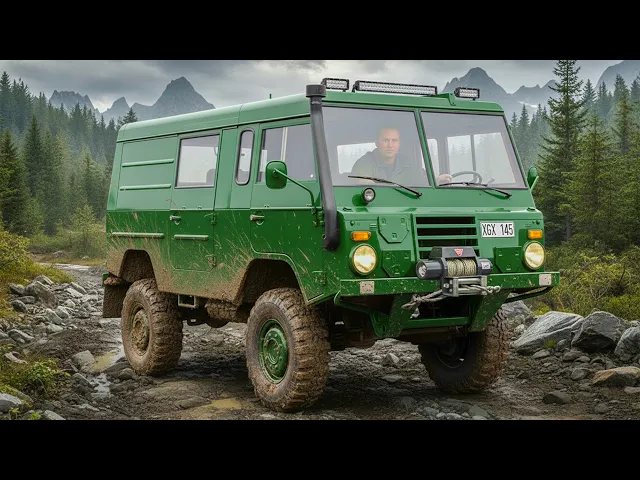
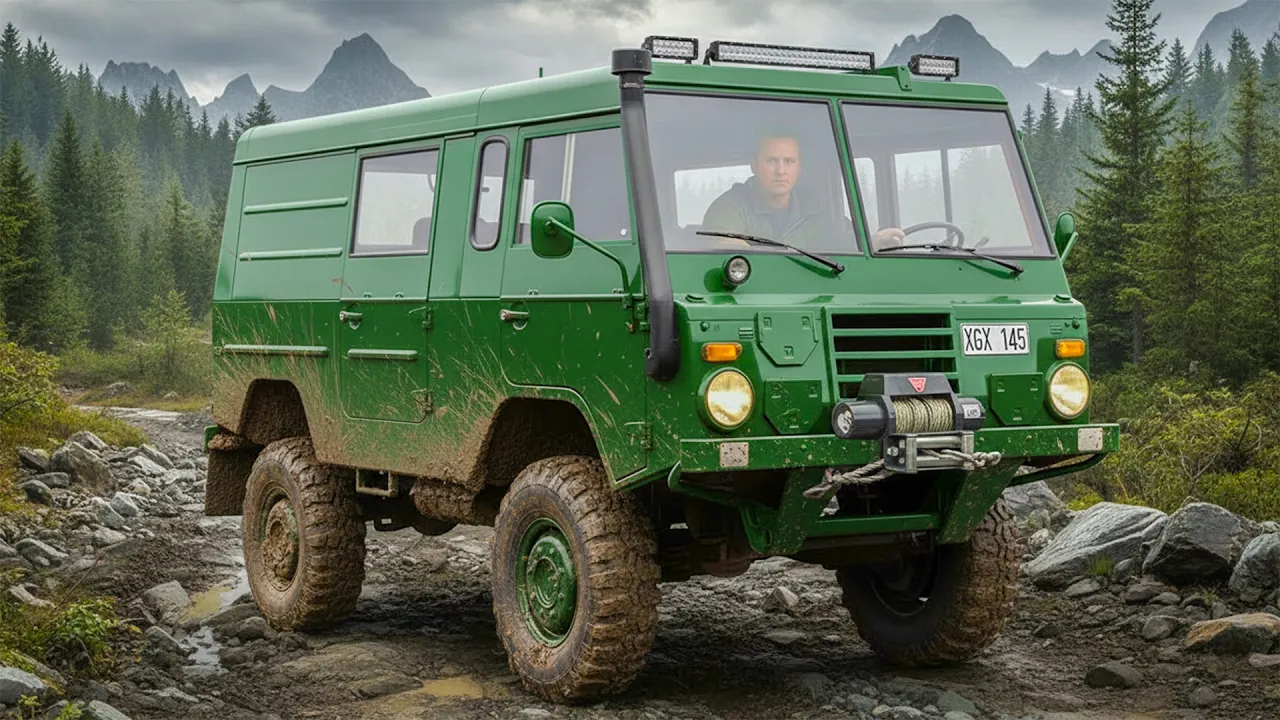
Forget everything you think you know about off-roaders. 99% of today's pickups are absolute garbage compared to these monsters. We are talking about the 10 most insane powerful machines to ever roll on Earth that few dare to mention.
From immortal Soviet iron to disguised [music] tanks that can float on water and climb vertical walls. These are the trucks you will beg to own when the world [music] collapses. Do not take your eyes off the screen because the final vehicle on this list possesses terrifying [music] power capable of pulling down an entire building.
Are you ready to witness pure mechanical dominance? Smash that subscribe button now because we are starting. Let's find out which mechanical beast reigns supreme as the ultimate king of the off-road.
We kick off our list with the Staroo Hofflinger, a vehicle that proves massive size isn't required for dominance. Produced in Austria between 1959 and 1974, this machine is shockingly small, weighing in at only about 1320 lb. It is so lightweight that a standard crew of four soldiers could literally pick it up and move it if it ever got stuck.
While it lacks raw speed, topping out at around 45 muring pina, its true weapon is agility. It was designed to navigate narrow mountain paths that would force a modern Ford F-150 to turn back immediately. The mechanical engineering packed [music] into this tiny footprint is absolutely brilliant.
The Halflinger features portal axles on both the front and rear, which raises the axle tube above the wheel hub. This gives the little truck incredible ground clearance relative to its small tires. Combined with independent swing axle suspension and locking differentials on both ends, it creates [music] a traction monster.
It is powered by a small air cooled two-cylinder [music] boxer engine mounted in the rear. While it doesn't produce much horsepower, the gearing is reduced so low that it can crawl up steep rocky slopes without breaking a sweat. Today, the Halflinger possesses a cult following because it represents a philosophy that modern truck makers have largely forgotten.
Lightness is a capability. [music] While contemporary trucks try to conquer terrain with 500 horsepower and massive tires, the Halflinger does it with pure geometry and finesse. It is the ultimate example of minimum vehicle maximum capability.
If you want a survival truck that can fit in the bed of a full-size American pickup, but outclimb it on a technical trail, this is the machine. It remains a masterclass in efficient off-road engineering. Next up, we travel to the rugged expanse of Russia to meet a living fossil, the UA's 452.
Russians affectionately call it the Bukanka, which translates to the loaf because it looks exactly like a loaf of bread on [music] wheels. This vehicle has been in continuous production since 1965 with almost zero changes to its exterior design. Why change it?
In the freezing Siberian wilderness, you don't need heated seats or touchscreens. You need a vehicle that simply refuses to [music] die. It is a four or four van that thinks it is a tank built to endure the harshest environments on Earth.
The Bukanka is built on a primitive ladder frame chassis with solid axles and leaf [music] springs, a setup as old as the hills it climbs. Uniquely, the engine is placed right between the driver and the passenger inside the cabin. This layout keeps the interior warm in freezing Russian winters, but makes it incredibly loud and hot during the summer.
Its off-road capability is legendary due to high ground clearance and acute approach angles. The UAZ 452 can traverse mud, deep snow, and swamps that would swallow a modern crossover hole, relying on mechanical grip rather than computer aids. There is a famous saying among UAZ owners.
It is always broken but never completely broken. If a sensor fails on a modern American truck, you have to call a tow truck. If something breaks on a bukanka, you fix it with basic tools, some wire, and a sledgehammer.
It is the ultimate survivalist platform because of this simplicity. While it lacks safety features, comfort or aerodynamics, it offers an unfiltered driving experience. It is a symbol of Soviet endurance.
And amazingly, you can still buy a brand new one today for a very low price. Staying in the former Soviet block, we move up in weight class to the Gaz 66, known by its nickname, Shishiga. If the UAZ is a van, the Gazi 66 is the quintessential Soviet military 404 truck.
Produced for over 30 years with over a million units made, it was the backbone of the Red Army. It features a cabover engine design, meaning the driver sits directly on top of the front wheels. This gives the driver incredible visibility for obstacles, but makes the ride extremely bouncy.
You are effectively the first shock absorber to feel every bump on the trail. The engineering under the shisha is genuinely impressive for its time and purpose. It features a central tire inflation system, allowing the driver to lower the tire pressure directly from the cabin to float over sand or deep snow.
Crucially, it comes equipped with self-locking differentials on both front and rear axles. This is a gamecher off-road. When one wheel loses traction in the mud, the truck automatically sends power to the wheel with grip.
It also has a near-perfect 50/50 weight distribution which prevents the heavy nose from diving into deep mud pits. However, driving a G6 requires acrobatic skills and distinct patience. Because the massive V8 engine is located directly under the cab, the gear shift lever is positioned behind the driver's right shoulder.
Shifting gears requires a strange backward reaching motion that takes weeks to master comfortably. The cabin is so tight that it famously includes a hammock for the driver to sleep in, strung across the interior above the seats. Despite its ergonomic nightmares, the Gazi 66 is revered for its ability to go absolutely anywhere.
It is a brutal, honest machine that demands respect. Let's head over to Western Europe. When people think of European military trucks, they usually think of the German Unimog, but the French army had their own answer, and it is a hidden gem, the Renault TRM 2000.
Introduced in the 1980s, this is a compact tactical truck designed to punch way above its weight class. It was engineered to carry over 4,400 lb of cargo over any terrain the battlefield could throw at it. While it looks like a standard truck, the technology underneath makes it one of the most capable light trucks in history.
Like the Unimog, the secret sauce of the TRM 2000 is its portal axles. This design gives the Renault massive clearance under the differentials, allowing it to straddle large boulders and tree stumps without getting hung up. It runs on a reliable 3.
6 L turbo diesel engine producing about 117 horsepower. It is not a speed demon, but the gearing is low enough to pull a house. The suspension is incredibly flexible, allowing the wheels to articulate over deep ruts while keeping the cab relatively level, ensuring stability on uneven ground.
What makes the TRM 2000 so interesting today is its growing popularity in the global overland community. It is small enough to fit down narrow European streets or tight forest trails, yet strong enough to carry a massive camper habitation box on the back. It bridges the gap between a heavyduty pickup truck and a full-size expedition rig.
With selectable four-wheel drive and differential locks, it offers a perfect balance of utility and size. It represents French utilitarian design at its best. Simple, rugged, and highly effective for adventure travel.
Returning to Austria, we find the big brother of the tiny halflinger, the Styuk Pinskower. Named after a tough breed of Austrian draft horse, the Pinskower is arguably one of the most capable off-road vehicles ever conceived. Available in both Forester 4, the 7 Nome, and 6X6 configurations, this machine looks like a simple box on wheels, but the engineering underneath is radical.
Unlike traditional trucks that use a ladder frame, the Pinsgower uses a central tube chassis. The drive shaft runs inside this sealed tube, completely protecting it from rocks, mud, and damage. The suspension utilizes swing [music] axles, meaning each wheel pivots independently from the central tube.
This allows for insane suspension articulation, keeping the tires planted on the ground in the most uneven terrain. Like the halflinger, it uses portal axles for clearance and has fully locking differentials that can be engaged on the fly hydraulically. This means you can lock the axles while moving without stopping.
[music] Power comes from an air cooled 2. 5 L engine designed specifically to operate at extreme angles without suffering from oil starvation, ensuring reliability on steep grades. The Pinscower was the standard transport for the Swiss and Austrian armies for decades because it simply works everywhere.
[music] It is loud, it is slow, cruising at maybe 60 meosh if you are brave, and the engine sits right between the front seats screaming [music] in your ear. However, there is almost nowhere on Earth a Pinskower cannot drive. Whether tilting 45° sideways or climbing a 100% grade, the Pinscower keeps moving.
It is a machine that sacrifices all comfort for absolute undeniable dominance over the terrain. If you mention portal axles to any hardcore Jeep enthusiast in America, they immediately think of Volvo portals. The Volvo C303, also known as the Terraring Bill 11, is the Swedish military's answer to the pin scour.
Developed in the 1970s, it features a distinctive boxy body and is powered by the reliable Volvo B30 inline 6 gasoline engine. This is essentially the same engine found [music] in their luxury sedans of the time, just tuned for torque. It produces enough power to keep the wheels turning through deep Scandinavian snow and thick mud.
The C303 is legendary for its axles. In fact, many C303s today are bought and scrapped just so rock crawlers can steal the axles to put under their modified [music] Jeeps. These axles are incredibly strong and offer magical ground clearance.
The Volvo also features vacuum operated locking [music] differentials which are robust and reliable. The design is purely utilitarian. The approach angle is nearly vertical, meaning you can drive up a wall until gravity takes over.
It sits high and looks awkward, but its center of gravity is lower than it appears. But the C303 isn't just a slow crawler. It has a surprising pedigree in racing.
It was used as a support vehicle in the grueling Paris to car rally, proving it could handle high-speed punishment across the desert sands. With a roof hatch for a gunner and a waiting depth that allows it to cross rivers easily, the C303 is a versatile warrior. It is ugly to some, beautiful to others, but undeniably effective.
It remains one of the most sought-after vintage Forak 4s for collectors who want something unique and unstoppable. Moving to Switzerland, we encounter a vehicle that looks like a modern armored car, the Bucher Duro. The name Duro stands for durable and robust, and the Swiss engineers weren't lying.
Entering service in the 1990s, this is a more modern take on the highmobility tactical truck. Compared to the others on this list, it was later acquired by General Dynamics and served as the basis for the Eagle armored vehicle. It represents a shift towards vehicles that can protect the crew from mines while still traversing impossible terrain.
The most unique feature of the Booker Duro is its DDion suspension system [music] combined with a Watt linkage. This is a highly complex setup rarely seen on trucks, which allows for massive wheel travel and stability. The chassis also has a unique ability to twist significantly to keep wheels on the ground, acting almost like a second suspension system.
It is modular, meaning the rear body can be swapped out rapidly for different missions, ambulance, troop transport, or command center, making it incredibly versatile for military logistics. Powered by a Cumins turbo diesel and typically mated to an Allison automatic transmission in later models, the Duro is much easier to drive than the older Soviet trucks. It feels more like a heavyduty American pickup, but with the capability of a light tank.
It can cruise at highway speeds of 6A mops comfortably. It represents the evolution of the off-road military truck, combining extreme capability with driver ergonomics and modularity. If you want a do-it-all vehicle that won't break your back on a long journey, the Duro is [music] the choice.
Now, for something completely different from the United Kingdom comes the Alvis Stalwart, affectionately known as the Staly. This isn't just a truck. It is a full six gek 6 amphibious vehicle.
That's right. You can drive this straight off a muddy bank into a deep river, engage two water jet drives, and cruise at seven mammal on water. It was designed to resupply troops by crossing any obstacle, land or water.
With a payload of 5 tons, it could carry ammunition directly from a ship to the front lines without stopping. The Staly's drivetrain is fascinating and slightly terrifying. [music] It uses an H drive system where there are no differentials between the wheels on either side.
This acts like a tank. All wheels on the left are locked together and all on the right are locked together. [music] This provides immense traction in mud, but on tarmac it causes transmission windup, which can literally shatter the gearboxes if driven improperly.
Drvers had to take it off-road frequently just to let the wheels slip and relieve the tension in the drive line. Under the cargo bed sits a Rolls-Royce B81 8cylinder gasoline engine, a thirsty beast derived from fire engines. Drving a stalwart is a physical workout and requires constant attention to maintenance, particularly the dozens of grease points that need attention after every swim.
But the sight of this massive six- wheeled hull climbing out of a river and tearing up a muddy bank is one of the most impressive spectacles in military history. It is flawed, complex, maintenanceheavy, but absolutely magnificent to witness in [music] action. We return to Russia for a heavyweight contender, the Zil 131.
While the Gaz 66 is a light 4x4, the Zil 131 is the standard sixbel 6 generalpurpose truck of the Soviet army. Introduced in the late60s, it is an icon of the Cold War, recognizable by its aggressive grill and purposeful stance. The heart of the ZIL 131 is a massive 6.
0 L V8 gasoline [music] engine. You might ask, why gas and not diesel for a heavy truck? In the Soviet Arctic, diesel fuel gels up in extreme cold, rendering trucks useless.
Gasoline stays liquid. However, this engine measures fuel economy in gall rather than miles per gallon. It is incredibly thirsty, often achieving only about 3 to 4 m per gallon.
but it produces sufficient power to drag this 6K6 beast through mud that is waste deep. The ZIL 131 features a tire pressure control system that is routed internally through the hubs, protecting the airlines from tearing off in the woods. Its suspension is simple leaf springs, but the chassis flex allows it to twist over obstacles, keeping all six wheels driving forward.
The truck is famous for its reliability and simplicity. There are no computers, no complex electronics, and very few plastic parts. It [music] is built to be fixed by conscript soldiers with minimal training in the middle of nowhere.
[music] Parts are still available everywhere in Eastern Europe because thousands of them are still working daily in forestry and mining. It is the kind of truck that will still be running when modern EVs have long since failed due to software bugs. It is a smoky, loud, and unstoppable piece of history.
Finally, we arrive at the king. The number one spot belongs to the Czechoslovakian monster, the Tatra 8113 Coloss, which translates to Colossus. This is an 888 heavy utility truck that redefes what is possible on wheels.
If you have played the game Snowrunner, you know this truck is essentially a cheat code. The Tatra 8113 uses a unique backbone tube chassis. Unlike a ladder frame that twists, the Tatra uses a giant rigid central tube.
The axles are independent swing half axles that move freely, allowing the truck to practically walk over rough terrain. And then there is the engine. It is powered by a massive 17.
6 L air cooled V12 diesel engine. Yes, an air cooled V12. It sounds like a thunderstorm when it starts and is nearly indestructible.
It was designed to tow artillery, pull tanks, and serve as a bridge layer. The Coloss can tow up to 220,000 lb. It has a central tire inflation system and a massive winch that could pull a building down.
Because of the independent suspension, an 808 Tatra can drive over a ditch and every single wheel will maintain contact. The Tatra 8113 isn't just a truck, it is a conqueror of terrain. It stands as the ultimate example of extreme off-road engineering unmatched by almost anything else on wheels.
It represents the pinnacle of Eastern block engineering where fuel efficiency was ignored in favor of sheer power and durability. Watching a Colossiculate over massive mounds of dirt is hypnotic. It is the rightful king of this list.
A machine that doesn't just drive over obstacles, it flattens them into submission. From the tiny halflinger to the massive Tatracolos, these machines remind us of a time when durability mattered more than gadgets, they are loud and dangerous, but unstoppable. Now, I want to hear from you.
Which of [music] these beasts would you choose for a zombie apocalypse? The Bukanka or the Tatra? Let me know in [music] the comments.
If you enjoyed this mechanical madness, hit like and subscribe for more deep dives into heavy metal history. Thanks for watching.