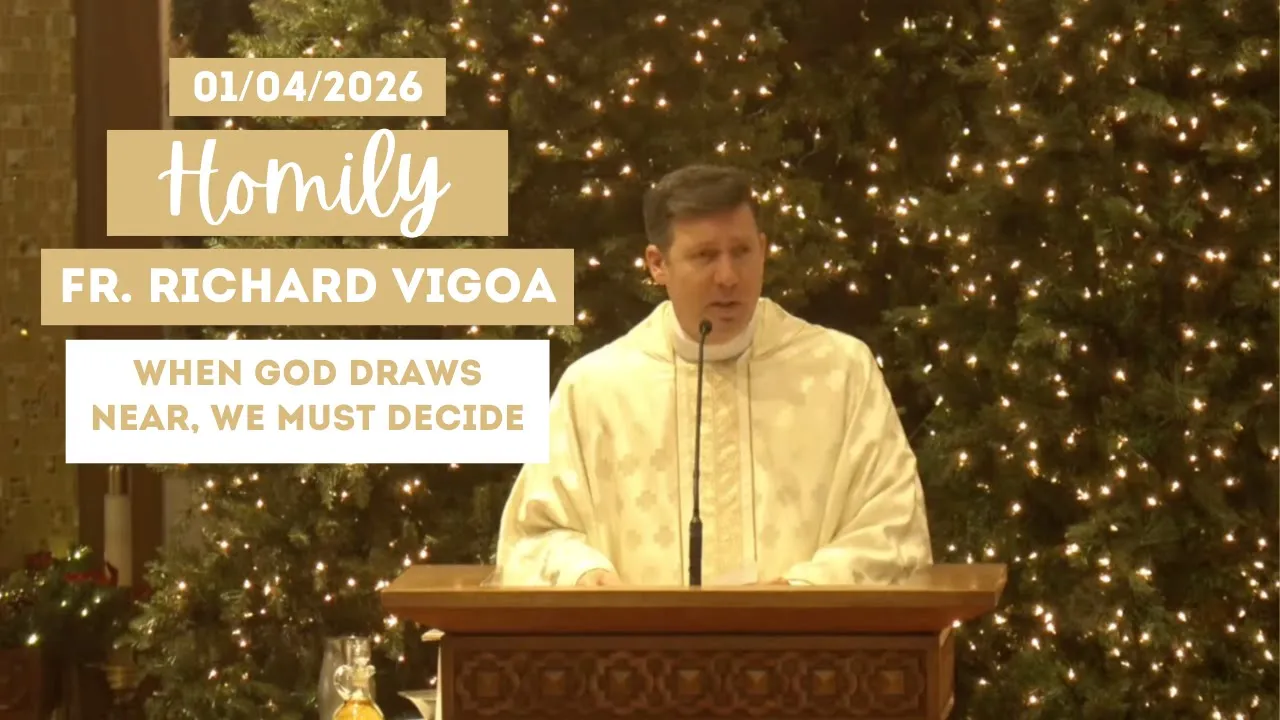
The feast of the Epiphany is not simply about a star, three mysterious figures, or a charming scene that completes Christmas. The feast of the Epiphany is about revelation, about what happens when God makes himself known and how the human heart is forced to decide what will it do when it realizes that God is no longer distant, no longer abstract, that God is there, near enough to change everything. The gospel today places before us two very different responses to the same revelation.
The Magi and King Herod both hear the news that a child has been born who is to be called a king. Both receive the same information. Both live within the reach of Bethlehem.
Yet only one group seeks out to find him. This is not accidental. The gospel is deliberately inviting us to see ourselves somewhere in the story.
The magi are not accidental visitors. They are scholars, observers of the heavens, men trained to see signs and patterns. But scripture is careful to tell us that knowledge alone does not bring them to Christ.
What moved them was desire, a desire of the heart. They allowed what they saw to unsettle them. They allowed a question to arise in their hearts.
What if what does this mean? What if this means something? What if God is acting now in our time?
So they leave. They set forth. They travel.
They risk misunderstanding, inconvenience, and danger. They cross borders, geographical, cultural, and religious. And when the star finally stops, it does not lead them to a palace, but to a child being held by his mother.
And scripture says something extraordinary. It tells us that they rejoice exceedingly with great joy. Not because everything made sense, but because they had found the one that they were seeking.
Their gifts tell us everything about their faith. Gold for a king, frankincense for a priest, myrr for the one who will suffer and die. They do not offer him what is easy.
They offer him what is costly. And then quietly but decisively, they go back to their country by a different way. Herod, on the other hand, never leaves Jerusalem.
He has scripture. He has scholars. He has proximity.
He knows exactly where the Messiah is to be born. If you've ever been to Jerusalem, Bethlehem is only a few miles away. And yet, he does not go.
Why? Well, because for Herod, God's nearness is not good news. It is a threat.
arrival and in interruption. Christ does not frighten Herod because he is powerful, but because he's asking Herod something he refuses to give up, and that is surrender. Herod represents a temptation that never disappears from human history or from the church.
the temptation to prefer control over conversion, security over truth, familiarity over worship. He's not hostile to religion. He is hostile to transformation.
And that distinction matters. I remember the archbishop used to say when he goes when he would go around talking, people are opposed to change and transformation because if they were if they were against change and transformation, they'd still have eight track tapes in their cars. What people fear most is losing control.
The Epiphany reveals something uncomfortable. It is possible to know about Christ without ever kneeling before the Christ. It is possible to be close to holy things and yet remain unchanged.
It's possible to hear the gospel and still refuse to journey with the Lord. This is why the Epiphany is not a feast about them. It's a feast about us.
Because the real question this feast places before us is not do I believe in Jesus Christ. Do I believe that Christ exists? That's not the question.
The question is am I willing to seek him when it costs me something. The magi teach us that faith is not passive. Faith moves.
Faith searches. Faith risks. Faith does not wait for perfect clarity before it begins the journey.
It follows the light it has. And even when that means surrendering control, ordering one's life with discipline, letting go of what of whatever it is that does not lead you to God, trusting that he will give more along the way. Herod teaches us the opposite lesson.
That fear can masquerade as prudence, that delay can disguise as resistance, and that the greatest danger to faith is not outright rejection, but quiet refusal. And this brings us to the heart of the epiphany. Christ reveals himself, but he never forces himself.
The light shines, but it must be followed. That light still shines today. Not as a star in the sky, but in quieter, more demanding ways.
Shines in the eukarist, in the word of God, in the voice of a of a conscience, in the call to repentance, in an invitation to prayer, in the witness of a faithful follower, in the summons to reorder our lives around him. So the question still remains the same. Which path will we take?
We live in a world saturated with distractions, noise that dulls our desire, comforts that keep us stationary, routines that make movement feel unnecessary. It's easy to admire the magi and condone Herod. It's harder to admit how often we resemble him.
Postponing conversion, protecting habits we know that are unhealthy, staying spiritually near to Christ without actually going before him and kneeling and giving ourselves completely over to him. Epiphany doesn't ask for perfection. It asks for movement.
It asks us to follow the light we have to take one real concrete step towards Christ. To pray when it would be easier not to. To return to the sacraments with intention, with full attention to simplify what clutters our hearts to offer Christ not what's left over but something real.
Because the gospel ends with a detail that matters. It says they returned home by way of another route. Not because the road was closed, but because encounter changes direction.
I remember reading how Archbishop Fulton Sheen was talking about this gospel and how he observed that no one ever comes to Christ and goes back the same way they came. No one who truly meets Christ goes back unchanged. No one who kneels before him can live as if nothing happened.
Change happens. Transformation occurs. And that's the grace of Epiphany.
God reveals himself not to impress us but to transform us. Not to confirm our plans but to redirect them. not to threaten what is good but to free us from what is too small.
So my brothers and sisters today we pray for the courage of the magi, the humility to kneel before the Christ, to let go of what is not of God, the generosity to offer our gifts and not to just to give oh here Jesus I'll give you whatever is left over and the wisdom to choose another way. May the light that led them lead us. May the Christ that adored claim our hearts.
And may this epiphany mark the beginnings of a deeper journey with Jesus Christ. Amen.