Studying English alone is not an easy feat. While all the information we have available nowadays can be a gift, it can also be a curse. If you are feeling totally lost when it comes to coming up with your own study routine in English, don't worry.
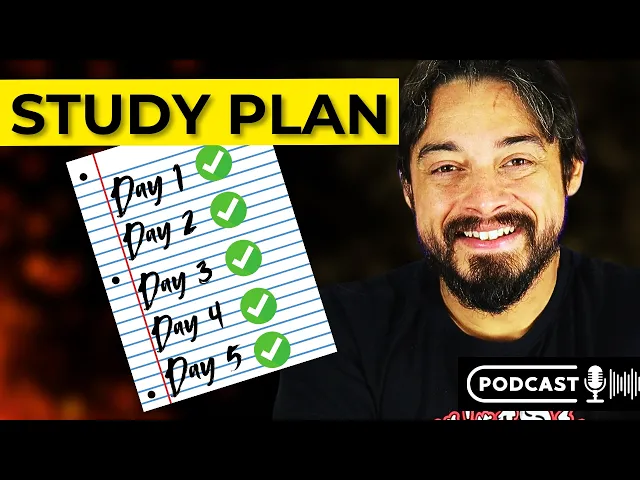
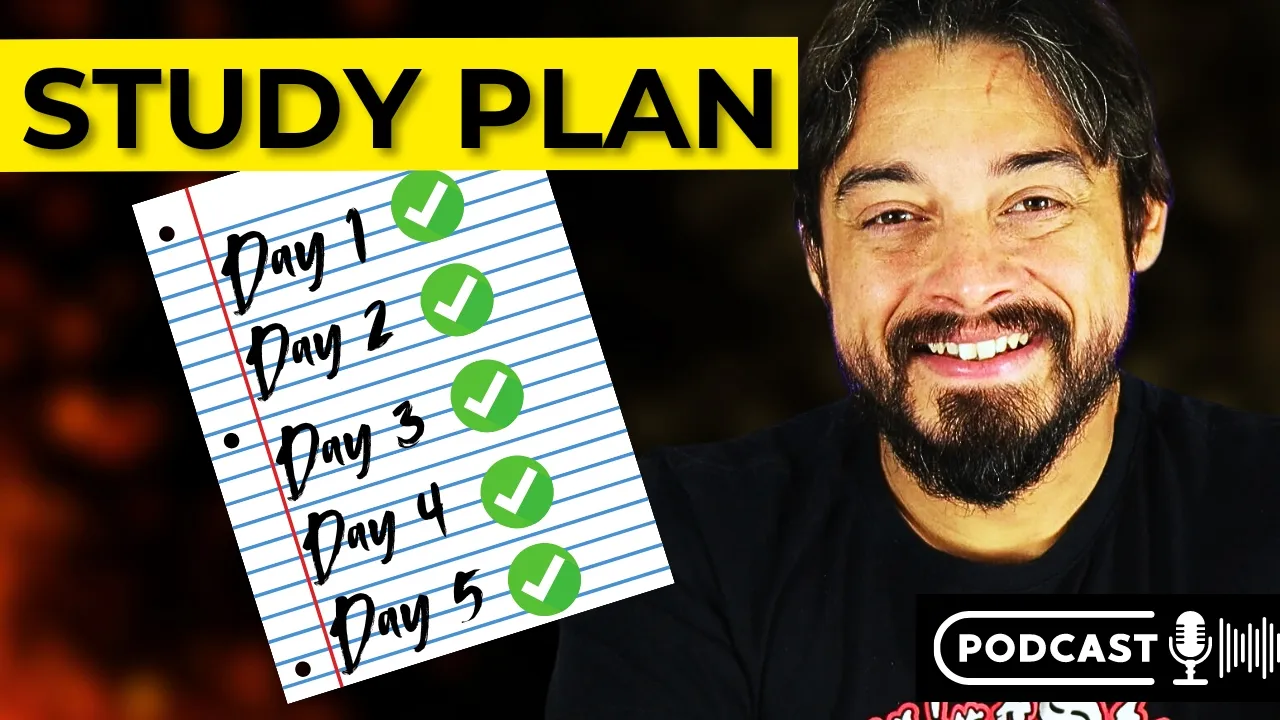
In this episode, I want to give you very simple study plan you can follow and you can use it as a starting point to study English more deliberately. Let's get started. Hey there!
How's it going? Thiago here and welcome to another episode of the podcast. This podcast is intended to help intermediate and advanced learners of English communicate with more confidence, more accuracy, more clarity and more awareness.
So if you are new here, subscribe to the channel here on YouTube or if you are on Spotify or Apple podcasts, follow the show because that way you're not going to miss a single new episode. Also, before I start talking about the study plan with you, I have a special gift for you. I have created a PDF file with the study plan that I'm gonna recommend you follow in this episode and also with a second page of a template that you can print and you can use it to plan your own study routine in English.
This is my free gift to you. download the copy, it's free. The link is here in the description of the video.
In the pinned comment below, you're gonna see that it's the first link here. And also is the first link in the show notes if you are listening on Spotify or Apple podcasts. OK, my personal gift to you.
Make good use of it. So I want to start by talking about what a study plan is not. A study plan doesn't mean.
Consume content in English every day. If I just came up here and told you, okay, here's what to do. On Monday, you listen to a podcast in English.
On Tuesday, you read a little bit of a book in English. On Wednesday, you watch an episode of a TV show. This is not a study plan, guys.
This is a fancy way, even a sneaky way of telling you to consume content in English every day. Okay? A study plan is a series of practical steps.
that you take with one specific goal in mind. OK, so as I present the study plan to you today, I am coming from a place where I presume you already consume content in English every day. I presume that you already listen to podcasts in English every week.
You already watch movies and series you read already. So my point with this episode is provided that you have been already doing this, what else can you do on top of that to add a little bit more of deliberate practice to your learning? Because while I believe input is great, consuming content in English is great, you also need to complement that with deliberate practice moments throughout the week.
So that's the purpose of this study plan here. to give you a structure to follow that is more deliberate, more intentional, to really encourage you to pay attention to the language and not simply consume it passively. Okay?
How much time should you spend on the study plan per day? It depends on you. It depends on your routine, on your life circumstances in the moment.
But I would say at least 10 minutes a day. 30 minutes a day tops. Why 30 minutes a day tops?
Because I am thinking here about the professional adult who has a job and who works full time, maybe an adult who has a family as well. So I think it will be very unrealistic for me to come up here and tell you to study one hour a day. OK, so I would say between 10 and 30 minutes a day is already great.
Now, if you have more time because of recurrent circumstances, maybe you live alone or maybe you don't have kids or maybe you live with your parents still. Maybe you are younger. You are a student.
You don't work yet. If you have more time and if you can do one hour a day, no problem. Do one hour a day.
But I wouldn't recommend more than one hour a day. OK, you don't want to burn yourself out. So for the average adult who is working and who has other responsibilities.
During the week, I would say between 10 and 30 minutes a day. If you are a person who has more time available, try to extend it up to an hour. Okay?
So that's what I would say in terms of time. Another point is have a place for your notes because throughout the process here, you will see that the study plan involves a lot of writing and a lot of note taking. So you wanna have a place for you to store your notes.
I recommend a physical notebook with a good old pen and pencil. I've already talked about the benefits of writing longhand here in a previous episode, but if you prefer, you can also use a Google Doc or another note-taking app like Notion, whatever you have there. Okay?
But have a place for you to write things down. So let's jump right into it and talk about day one, Monday. What can you do on Monday, day one?
You can pick a short clip of a piece of media. It could be a movie, a TV show or a podcast that has subtitles. Or if it's a podcast that has the transcript.
OK, so you need the words available to you for this to work. Then you're going to listen to the clip without subtitles first, without subtitles. As you listen the first time, take notes of key points you understand.
The purpose of this first moment here is for you to check how much you can understand without any help, without any visual aid. So without subtitles, without the transcript, how much am I able to understand out of this clip? So do that test first, run that test first.
consume the content and take notes of some things you hear, some key points. After doing that, you're gonna listen to the clip again, now with the subtitles or looking at the transcript. As you listen to the clip, compare the points that you see in the subtitles in the transcript with your notes.
See if you're able to get the same points, see if there were other points that you didn't get. Okay? So now you are kind of checking, you kind of checking how much you really understood of the clip the first time around.
After listening to the second time like this, you're gonna listen to the clip again, a third time, listen or watch it, but again without subtitles. When you do this process of watching it without subtitles, taking notes, and then watching it again with subtitles but now comparing with your notes and then watching it the third time without subtitles usually by the third time you feel more comfortable with the clip you feel like you are able to understand much more than when you heard it the first time around. Okay.
So that's why you are listening to the same clip three times. After having completed this you can write short summary of what you just heard of what you just watched in that clip. It'll be a short paragraph.
What is this clip about? What are the main points being made here? Okay?
And then what you can do to add a little bit of speaking practice to it, you can then record yourself reading the summary that you just wrote out loud. Pick up your phone. start recording it, and then you read out loud your summary.
Just to add a little bit of speaking practice to it. If you have more time, a bonus step you could take is also watching the clip a fourth time, but now shadowing and mimicking the clip. You know, you can pause, you can repeat what you hear, trying to imitate the speaker there.
You can try to shadow at the same time. So if you have a little bit more time, you can also do that. But at least the first steps of consuming the clip three times, writing the summary and then recording yourself reading the summary out loud is already a great exercise here.
Notice that on this first day you are practicing writing, you are practicing listening and you are practicing speaking as well. And a little bit of reading. Yeah, because you're reading the transcript, the subtitles and also reading your Summary after you wrote it.
So you're a kind of practicing a little bit of the four skills here, which is great All right, and that's it now again, long you're going to spend on this depends on How much time you have available? If you only have 10 minutes Available for this I will recommend picking a very very short clip of media. Maybe a 30 second clip or a one minute clip.
And then with 30 seconds or one minute, you can do this process of listening to it three times, taking notes, writing the summary, and then reading it out loud. So the length of the clip will vary according to how much time your session is. If it is a 10 minute session, maybe you can work with a two minute clip.
If it is a half an hour session that you have, maybe you can work with a five minute clip or even a 10 minute clip. Got it? So make sure you have this feeling when it comes to planning the time in the clip.
Moving on to day two, that's a Tuesday. Now we're to work with reading specifically. You're going to read a short article that you can pick online or you can read one page of a book in English.
It's one page. So you're going to start by reading this text. either the article or the book page.
The first time you read it, ignore every single unknown word. You don't want to stop the flow of a reading every time you encounter a word you don't know. So the first time you read it, just read it and don't worry about words that you don't understand or that you don't know.
This first time that you are reading it, Your main focus is reading for gist, reading for understanding. What is the main idea of this piece of text? OK.
After that, you're going to write a short summary of what you just read. Again, it could be a one paragraph summary or even a two paragraph summary of the key points that you understood from that piece of text. After writing that summary, You're going to read the article or the page of the book again.
But this time, you're not going to focus so much on the understanding of the text, but on specific vocabulary that is unknown. And I recommend picking just one or two words that you don't So out of a short article that you read or out of a single page of a book that you read, I would recommend just selecting one or two words. that catch your attention and that you don't know the meaning of.
Just one or two. Work with quality, not quantity. Okay, don't obsess over learning five new words in the same session.
Ten new words in the same session. This is unrealistic. Okay, focus on quality, not quantity.
So one to two words only. Alright, when you are reading like this for the second time and looking for these one or two words that are unknown, your focus is a little bit different. You are reading for more specific information.
You are more focused on finding that one or two words that will catch your attention, that will stand out to you on the page or on the screen. And that makes you go, huh, that's an interesting word. I don't know what that means.
Let me write it down. Like, I've never seen that word before. Let me write it down.
Or even, I recognize this word, but I forgot what he meant or what he means. Let me write it down. OK, so one to two words like that.
After that, you're going to look up the word, write down the meaning and the example sentence the dictionary gives you. If you use a good dictionary like Cambridge, Oxford, Longman, Merriam-Webster. Aside from giving you the definition of the word, these websites also give you example sentences.
At least one example sentence. So make sure you write on a notebook, for example, the word, the definition, and the example sentence the dictionary gives you. You can use the dictionary or you can even ask ChatGPT, Google Gemini, or any other AI model.
After that, you're going to come up with an extra sentence as example by yourself. So you're going to write down the example sentence the dictionary gives you with that word. And then you're going to try to come up with a sentence on your own using that word.
This is practicing using the word that you're trying to learn actively. OK. Now, if you want to practice a little bit of listening here, because, we are mainly working with reading and writing here, you know what you can do?
You can maybe pick up a portion of this text, maybe one paragraph or two paragraphs only. Nothing, doesn't even have to be the whole page or the whole article. Just one or two paragraphs.
You can copy that, paste it into an AI model like ChatGPT or Google Gemini. And then at the end you ask, read these paragraphs or read this text aloud. And then, If you are using one of these models, they have the audio feature there.
You can just click on the audio icon and the AI voice will start reading that text to you out loud. And then you can listen to that text being read by the AI voice. It's a nice way for you to practice a little bit of the listening skill there.
And then to add a little bit of speaking practice here, you can record yourself. reading the article again, but now out loud. You see how interesting because what we are doing here is we are picking the same piece of content and we are working with the same piece of content in different ways and with different goals.
The first time you read the text, for example, you are focusing on getting the gist, getting the understanding of the main idea here. The second time you are reading and looking for that one or two unknown words to add to your vocabulary list. And the third time you can listen to an AI model reading that text to you.
And you can finally record yourself reading that text out loud and practicing the speaking portion. You see? This is studying with media.
And These same steps were also applied the day before on Monday. So it's not just about consuming the content or reading the content passively and thinking that you're going to pick up the language by osmosis like that. Yes, you can pick up a lot of stuff like that passively through osmosis.
But in my experience, very successful language learners are more proactive. They have this attention to the language. and they consume the content multiple times in various ways and with different goals for each session for each exercise like I'm trying to present to you right now.
Okay these are all principles these are all principles of successful self-studying okay when it comes to language learning. So let's talk about day three now, Wednesday. Now day three, I'm going to give you a rest day.
A rest day on Wednesday. Yes, a rest day. So I would recommend not worrying about doing something or studying again like we just did on Monday and Tuesday on Wednesdays.
And I'll just give herself a break. Have a little bit of rest there. What you can do on Wednesday is you can listen to Monday's clip again, or you can watch Monday's clip again just one time, you know, just to remember that information that you consumed on Monday.
And also you can read Tuesday's article again, but very casually, just one time, you know, that's it. Why is that important to add a little bit of a rest day there in the middle? I find that successful learning also happen when you space out the learning.
Okay. So give your brain a little bit of room to breathe to relax and also to process what you have just studied consumed the two previous days. Okay.
So that's why I am recommending having Wednesday as a day off. Let's yes listen to the article listen to the clip again read the article again. But that said you're not going to have that study session.
the same way you did on Monday and Tuesday. Got it? Give your brain a little break.
Then on Thursday, that's day four. I recommend and here's the part where, you know, you might love this study plan or you might hate this study plan, but I'm going to tell you what I would tell my students and also what I would tell myself, what I would do myself if I were to learn a third language nowadays. OK, study a grammar topic on day four on Thursday.
Pick a grammar topic. Any grammar topic that interests you, that you struggle with. Let's say present perfect or third conditional as a voice, whatever it is, jarvans, infinitives, pick a grammar topic and study it for 10 minutes, for 20 minutes, 30 minutes, depending on how much time you have available that day.
How can you study this topic? You can use a good old grammar book. If you have a grammar book at home, you can use it.
You know, you can read the explanation there and then you can read the do the exercises and then you can look at the back of the book and check the answer key to see how many exercises you got correct. You can do that or you can also use free resources online for this. One great website you can use is called perfectenglishgrammar.
com. Perfectenglishgrammar. com.
In this website you find a lot of explanations on various grammar topics. And also a lot of online exercises all for free. Most of the stuff there is free.
So perfectenglishgrammar. com is a great website, is a great resource online for you to use when it comes to studying that grammar topic on Thursdays. There are some online platforms that you can also use.
These are paid, you know, but you don't have to do that. You can just go to perfectenglishgrammar. com or grab your Grab a book from home and study with that.
And of course, YouTube videos. OK. The wonderful thing about YouTube is that there are a bunch of teachers here teaching all kinds of stuff about English learning.
So I'm sure that if you go to YouTube and type in the topic passive voice lesson, phrasal verbs lesson, you know, or actually phrasal verbs is not really grammar. Excuse me. That's more in the vocabulary domain here.
So let me backtrack a little bit. Passive voice lesson or present perfect lesson, reported speech lesson. You will find a lot of video lessons.
So watch one of those. It's free. so.
Regardless, you want to devote some time in your week, at least once a week, to study one specific grammar topic. OK, if you choose to watch the YouTube video, maybe you can watch the YouTube lesson first. of that topic and then you can head to perfectenglishgrammar.
com or to your grammar book and do some exercises on that topic so you can practice a little bit and consolidate that lesson. Okay. Why is that important?
Because well, successful language learning happens when you are able to pay attention actively and deliberately to language patterns, the structure of the language, You know, so this could be a moment in your week for you to be deliberate with that, for you to focus on the structures of English, how the English language is structured. This will help you make fewer mistakes when you write, when you speak, and it will help you have a better understanding of the language. Okay?
In the process of studying this grammar topic, of course, always take notes. If you are watching a YouTube video explaining a certain topic, if you are reading the explanation on your grammar book, take notes at the same time of some key points related to that structure you are trying to study that day. Okay, so take notes.
Taking notes adds a personal touch to the learning process, especially if you are taking longhand notes. You'll feel closer to the process. Your brain is more engaged.
Therefore, it's much easier to learn as well. This is studying. Okay.
Again, between 10 and 30 minutes, that should suffice. Now, day five, Friday, here's something interesting. Know what you can do on Friday?
A suggestion. You can prepare a mini presentation summarizing everything you learned or consumed throughout the week, more specifically, on days one, two and four. So go back to the movie clip or the podcast clip you worked on or you worked with on Monday and then go back to the text, the article, the book that you read a little bit about on Tuesday and then go back to the grammar topic you studied on Thursday and prepare a mini presentation summarizing maybe some of your key learnings, you know.
some of the things that you remember from those days that you learned. OK. You can create slides.
You know for this like a real presentation maybe PowerPoint slides or Google slides. You can check your notes. That's why it's important for you to have a place to store your notes.
can check your notes going back on the days and review what you took notes off. Then after having this presentation, this summary done, you can record yourself summarizing the topics of the week, sharing what you learned or sharing what you remembered. OK, something it could be like a voice memo, you know, you can do it on audio in audio or you can do it in video format as well.
Something like, OK, this is the first week of my study plan and this week. I watched this clip and it was really interesting because of this, this and that. I learned this word while watching that clip.
And then on Tuesday, I read this article about this and that was something that caught my attention because of blah, blah, blah, you know? So you go on like that just for maybe for five or 10 minutes, recording a voice memo or a video memo. Like it's like you are reminding yourself of the things you did that week.
OK. If you live with a person, you can also present your summary, maybe to your spouse, you know, your husband, wife, boyfriend, girlfriend, your partner. If you have a good friend, you can present the summary to your friend like, hey, you have like five minutes or 10 minutes.
I want to present to you a summary of my English studies this week, what I did and what I learned and what I think about these things, you know, the new practice that way you see. Then we head to the weekend. Saturday, day six.
Are you going to study? Of course not. Come on, You see, another break.
Another rest day. So you already had a rest day on Wednesday. OK, now you can have another rest day on Saturday.
Give your brain a break. Now, here's a suggestion on Saturday. If you want, you can watch a movie in English that you want to watch for fun.
Or you can watch a TV show, but for fun. OK, watch it in English or don't do anything. Forget about English that day if you want, you know, Saturday, you know, just OK, I don't want to deal with English today.
I just want to give my brain a break. That's fine. OK, so Saturday is your last day.
Now on Sunday, day seven. I want to recommend doing a weekly review. Let's say Sunday evening.
I don't know for you guys, but for me, Sunday evenings are pretty much very boring moments of Sunday for me, you know, because, you know, by Sunday evening, guys, you have already done everything you were supposed to do for the weekend. You have already attended the parties, the events you had. And Sunday evening is usually that moment where we start we start getting ready for the week ahead.
Right. So. On Sunday evening, maybe at 6 p.
m. or 7 p. m.
reserve about 30 minutes of your time there or even one hour if you have more time, but at least 30 minutes, you know, sit down and go back to your notes of the week. Go back to the presentation that you created the summary, you know, from Friday. Review those notes and then do a little bit of self-reflection.
Here are some questions that you can answer every Sunday evening. about your previous week to encourage you with this reflection. What did I learn this week?
Write it down. Are there any topics I need to practice more or review? Maybe on Thursday, for example, you started learning about reported speech, but then you realize that, yeah, reported speech is not a very easy or simple grammar topic.
think I need more practice or I need to study this more. So I'm going to keep, you know, working on reporting speech this coming week. You see, so.
If you feel like there is a topic that you need to practice more on review, just carry on, carry that same topic on onto the next week, the coming week. If that's not the case, if you feel very comfortable and confident with that topic, then you come up with another one for next week. You see, but you have to determine this for yourself.
You might need to spend maybe a couple of weeks or even a month on the same topic until you really get it and internalize it. Another question. How can I get help with these topics that I'm struggling with the most?
How can I get help? Maybe I can do a Google search about that. Maybe I can use an AI model and ask it some questions.
I can ask it to explain this stuff for me and I will chat GPT. Google Gemini. If you have an English teacher, talk to your teacher, send him a message, send him an audio message, say, hey, how's it going?
I've been studying this topic this week and there are some things about this topic that are not so clear to me yet. Do you think maybe we can talk about it in next class or can I send you some questions about this topic and you can answer? Talk to your teacher if you have one, okay?
Another question that you can ask yourself in this reflection. What worked for me this week in terms of studying? What worked?
What didn't work? Maybe the clip you chose wasn't so cool, or maybe the lens of the clip was too long or too short, or the article was not so engaging. So what worked?
What didn't work? Another question, how can I improve my study plan? Is there anything else I could start doing or implementing next week?
Can I add anything else to this plan? Again, should I add something to the plan or should I cut out something from the plan as well? Maybe you do a week and then you realize that there are some things there that could be changed or replaced, you know?
So. Reflection. Keep in mind that self monitoring is key.
know, self monitoring is the ability to monitor yourself, monitor your own learning. And this is also related to self awareness and awareness in general. I've already done an episode here about this, about the importance of being aware as a learner.
Yeah, I believe it's the most important trait successful language learners have. So It's not just about doing things or studying. You also need that moment to reflect and self monitor your progress.
OK. Here's a bonus thing you can do also on Sundays during this weekly review, this reflection moment that you have, can pre select already the materials you will be working with in the following week. You know, OK, so tomorrow is Monday.
Let me search for a movie clip here that I want to work with for this coming week. Could be a movie that you enjoy watching. Could be one of your favorite movie clips or a TV show or a podcast clip.
So you can already select, OK, I'm going to work with this tomorrow. Choose the article for Tuesday already. OK, for Tuesday, I think I'm going to read and study with this article here or I'm going to continue with this book.
Yeah, but I'm going to read page two. OK. And you can also choose already the grammar topic for Thursday.
OK, it could be a brand new topic or it could be the same topic if you feel like you need more reinforcement and revision. OK. That's it, guys.
Let me give you now some final words about this. Look. This is just a suggestion.
It's just a suggestion for a study plan, because the truth is. There is no ultimate study plan. There is no best study plan.
There is only the study plan that works for you. OK. So if you are lost and have no idea how to begin creating a study plan for yourself, pick this template, this model that I'm presenting to you today and maybe I try for a week and then start tweaking it.
You know, this is not a setting stone. You know, start tweaking it and adapting it to your needs, your reality, your preferences. OK, but the principles here remain the same.
If you have a teacher, you can talk to your teacher as well. You can ask for a teacher's feedback on this study plan. You can go, hey, I have this study plan here to follow.
Take a look. What do you think? You think I should add anything here or should I cut out anything?
What do you think? Get feedback. OK.
So what matters here is not so much. Which study plan you follow, but. Key principles that you always have to have in mind.
OK, what are the principles here? Principle one. You need to have a moment of deliberate practice.
built in your week. That's principle one. If you are if you have just been consuming content in English passively, if you have just been, you know, going from video to video on YouTube, from podcast to podcast on Spotify, you know, movie to movie, this is not studying.
I'm sorry to tell you this, but it's just the truth. This is not studying. This is just consuming content in English.
This is absolutely important. You know, it's great for input. But remember, this is a given.
On top of that, you must have a moment of deliberate, intentional practice built in your week. And that's the purpose of this study plan that I'm presenting to you today, is to give you that moment of deliberate practice. So that's principle number one.
Regardless of which study plan you follow, Is it providing you with a deliberate practice moment in a week? That's the first one. The second one, the principle.
Studying English is not the same as consuming content for fun or for entertainment. OK. You know, you might think, why can't I improve my English?
You know. I watch so many movies in English. I listen to so many podcasts.
Why can't I speak well? Because, probably you haven't been deliberate enough. You have been more passive in your consumption.
Okay? True learning is deliberate. You need attention.
OK. It's also more detail oriented. You pay attention to nuances, to details when it comes to the language.
OK. And the third principle to keep in mind here is you should have a holistic approach to your learning. What I mean by a holistic approach is try to balance out the four skills.
OK. Reading, writing, speaking and listening. Alright, so it's important that you practice the four skills.
Weak in, weak out. Alright, because they complement each other. Alright, do you want to be a better speaker of English?
Guess what? Being a better writer and reader can totally help you with that. Being a better reader and a better writer in English will help you become a better speaker of English as well.
Okay. The skills complement each other. Yeah.
Do you want to be fluent in English? Great. You have to listen and understand well.
I fluency is not just about speaking. It's also about listening and understanding what you hear so you can respond verbally accordingly. Right.
You see. So have more of a holistic approach to your learning. That's why in this study plan you see that.
Aside from the grammar, Thursday, especially Monday and Tuesday, you are trying to work with everything there. There's a speaking moment, there's a reading moment, there's a writing moment. Okay?
So these are the basic principles, the three basic principles. Yeah, so as long as you are following these principles, you can tweak, you can adapt your study plan so that it works for you. Okay?
And I want to remind you to download the study planning PDF. You can download this study plan that I laid out today. And also there's a second page there with a blank template in high resolution that you can print out.
can print it out and then you can create your own weekly study plans. All right. So make sure you download it.
It's absolutely free. Look at the description, the pinned comment and also in the show notes. But before we wrap up today's episode.
It's time for the learner's corner. And for the learner's corner today, I have here an email from Dimitri. Dimitri Alexiv.
Forgive me if I'm mispronouncing your name, Dimitri. But let's read here what Dimitri says. Hi, Thiago.
I greatly appreciate your invaluable contribution to our English learning progress. Each podcast episode has provided me with numerous insights. You have emphasized the importance of consuming English in various forms, such as reading, listening to podcasts and music, and watching TV series.
However, I personally don't find watching films and series appealing, as it seems to consume a lot of time with little to no information. For this reason, I have gotten rid of my TV. Wow!
Very drastic decision there, but I imagine you could still watch things with your computer or cell phone, But yeah, quite drastic. I prefer watching informative YouTube videos on interesting topics that are full of useful information. Unfortunately, these videos often lack casual conversations, dialogues between different characters or real-life situations.
They typically consist of interviews or monologues by a single person, similar to the videos you publish. Would you recommend spending some quality time watching movies instead of just watching interviews? How much am I missing out on by not watching films and series?
Thank you sincerely, Dimitri. Okay, Dimitri, first of all, I have to say that you have very good writing skills. I really like the way you write.
You write in a very clear way. You have a sense of opening, closing, an email, body paragraphs. You really have a good sense of writing and that's awesome.
I wonder how your speaking skills are, but in terms of writing, the vocabulary you use here, your email here was mostly accurate, grammatically speaking, so it's awesome. Now about your question. Look, I'm going to give you my personal opinion, OK?
In my personal opinion, yes, I believe that you are definitely missing out on all the benefits movies and TV series can give you and provide you with. It's just like what you said. mean, podcasts are great.
Ted Talks are great. But usually they are. more formal types of content and they lack this casual conversation, dialogues between different characters, real life situations that you mentioned.
know, I believe that movies and TV shows are a great way for you to simulate a little bit of the experience of living abroad, because when you go and live in an English speaking country, That's what you see in our day-to-day life. You see native speakers using the English language in casual situations, informal situations, in all situations. And that's what contributes to your learning.
Now, when you watch a movie or TV show, you can kind of have the simulation. You get to see native speakers of English using the language in various contexts, not just in a lesson context or in a podcast context. And let me tell you something else.
Podcasts, for example, and chat talks. These are more, let's say, formal types of media, you know, and the audio quality is very good. mean, pick a podcast, for example.
Podcasters use very good microphones that are up close their mouth. So usually the audio quality of a podcast is crystal clear. It's great.
for listening practice and for English learning. But you also want to practice your listening skills when maybe it's not so easy to understand audibly what the person is saying. In movies and TV shows, you have more of that simulation because there are usually explosions and noises and sounds and music.
also, I think that movies and series, they challenge your listening a little bit more, I would say, than podcasts. because podcasts have crystal clear audio for dialogues. know?
And I don't know. I think that if you give it a chance, if you give it a shot, you're going to have fun. You're going to enjoy movies and TV series.
Believe me, it's not a waste of time. You know, I know you might be feeling like, man, sitting down for two hours to watch a movie. That's a waste of time.
I could be watching a podcast about self-development or psychology or whatever it is. Look, self-development, useful information, education is important, but entertainment, having more of a relaxing type of moment is also important for your learning. Yeah, I just said in this episode that you need to space out your learning.
There are days when you are a little bit more intense with your studies and days where, days where you are a little bit more chill. You give your brain, you give yourself a rest. So movies and TV shows can provide you with that.
They can provide you with that moment in your week where you're not really studying English or you're not really learning something new for your personal development per se. But you are still in touch with the spoken language and you are having fun. You are enjoying yourself, you know?
And One final tip about this, OK, I don't know how old you are, Dimitri. OK, I don't know if you are older than me or younger, you know. But again, in my opinion, and you know, you might not agree with this, guys, but this is my honest opinion.
OK, in my opinion, most movies nowadays, they just suck. They suck, you know, most movies and even most TV series nowadays, they're not that good, you know. It's just it's one movie here, one TV show there that is actually good.
You know, so I recommend maybe maybe you find maybe you feel that watching movies and series is a waste of time because most movies and series nowadays, they kind of suck. You know, so go back, go back 30, 40 years and, you know, pick some movies from the 80s, some movies from the 90s. some older TV shows like Breaking Bad, example, Breaking Bad is amazing.
You know, it's a character study. Breaking Bad is a character study of how much a man can transform, can go from very passive, very nice to very bad in the span of two years. know, so pick good stuff to watch.
Yeah, go back and watch older stuff. I mean, the older movies, they're the best. You know, great dialogue, great story.
It's movies that make you think, you know. Some examples here, Dad Poet Society with Robin Williams, Dad Poet Society with Robin Williams from 1989. I guarantee if you watch this movie, you're not going to think it's a waste of time.
You know, you're to go like, man, this movie makes me think. This movie presented me with ideas that I never thought about. or ideas that are intriguing.
And in my experience, I am a movie lover. In my experience, older movies had more of that. They had more of that message, that intrinsic message to give you.
It wasn't just entertainment for entertainment's sake. That's what I'm trying to say here. So go back, watch stuff from the 70s, the 80s, the 90s.
You will learn a lot of nice vocabulary and English as a whole. And I guarantee that you will find some movies that will just blow your mind in terms of story and life lessons. OK, maybe I went a little bit on a tangent here and I went on a little bit of a rant here about today's movies and series, but I hope I answered your question.
So, Definitely. Set aside some time in a week to sit down and relax, watch a nice movie. a nice TV series and that's it.
But yeah, don't miss out on that type of media. It's awesome. It's just awesome.
Okay, guys, if you want to send me a message to be featured on the podcast, you can do it in audio format. Go to speakpipe. com slash English with Tiago and you can record a short 90 second message to send me and I can feature your message here in the show.
You can also do it just like Dimitri and you can Send me an email at hello. teachertiago. gmail.
com. I'm looking forward to receiving your messages and featuring them here on the podcast. Don't forget to download the free PDF with the template and the study plan related to this episode.
And guys, a free way for you to support this show, this channel is by subscribing to the channel here on YouTube, leaving a like here on the video. Leave in a comment. Let me know what you thought about today's topic.
Let me know maybe about your study plan. If you have a study plan that you have been following, how is that working for you? So share your thoughts and ideas about this topic here in the comment section below.
Also, share this episode with a friend or with another person that you know who might benefit from this information. And finally, if you are on Spotify or Apple podcasts, You can also leave a five star review on those platforms. All right, guys, I'm Chado.
I'm signing off. Thank you so much for listening to today's episode. I'll be talking to you very soon in the upcoming video and episode.
Bye bye.