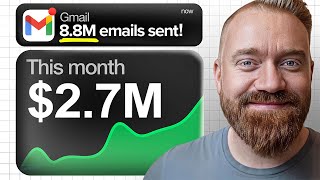
So far this year, we've peaked at sending over 12 and a half million cold emails per month on behalf of all of our clients. And with our campaigns, uh, one of our clients, RB2B, is printing over 130 grand per month in lifetime value. For another one of our clients, Fixer AI, we peaked at sending over 8.
8 million emails per month and helped them grow from 1 million to $10 million in annual recurring revenue in only 5 months. And our machine was signing up 9 65 users per week. So, if you think cold email is dead, I've got receipts that say otherwise.
But one thing is true. If you're using the tactics that worked only a couple years ago, you'll see no results today. And that's why in this video, I'm breaking out exactly what works to print cash with cold email right now.
Strategies that go completely against everything uh you've have probably been taught. So, let's dive in. So, first, stop segmenting and start emailing your entire list.
Everyone tells you to segment your list, build complex sequences, and nurture leads over time. And there's a time and a place for that, but our strategy is completely different. Here's what we actually do.
We like to send one email to everybody in your total addressable market once, every one, but usually once every two months is the sweet spot. We don't bother doing multi-step sequences. So that means no fancy follow-ups.
We just like to send one simple email to everybody. And here is why I think this works better for us is too many people are trying to get results right now instead of building long-term and profitable machines. Most people focus on the 3% of the market that's ready to buy.
I mean, you'll hear people, marketing people say this, oh, only 3% of the market is in a position to buy right now. But there's a whole other 97%. And 97% is a much much bigger number.
And so if we don't spam them, if we don't bug them, if we don't send them an annoying message, we won't burn through them all. And this is important because we deeply care about our clients brand image. It anybody can make money today, but we're interested in can we build a long-term profitable channel for our clients 2 3 4 5 years from now.
One email with your best offer every 2 months. keeps you top of mind without annoying anybody and having them mark you as spam because that's the worst thing for your brand. Plus, someone who wasn't ready to buy two months ago might be ready to buy right now and they didn't just get seven emails from you annoying the hell out of them.
And so, that's why I really think this strategy can beat everything else and we have proof of it. uh for RB2B, we ran this exact strategy for them and it's a really good example is that we helped RB2B launch in March of 2024. They were a brand new tool on the market, the first one to come to market with we will identify individuals, not companies, but individuals on your website, let them know you're on their website.
We'll send you their profiles in Slack. It's completely free. It was a and is just a great offer that just prints cash for them.
We've been running campaigns for them uh since March of 2024. We ran them for about uh six or so months. And then Adam, their founder, approached me and he was like, "Hey, I really need to retool my entire product.
I need to reconfigure things. I don't want to be doing marketing right now. Can we pause and can we come back to this later after I fix my product?
" And I was like, "Absolutely, man. " And so he came back after about like uh 5 6 months or so and we started doing campaigns again. And here's what's crazy is we ran the exact same campaigns that we ran.
We didn't change any copy. It wasn't um any different domains. Everything was exactly the same.
And I thought that results would go down, right? The market has aged. It's a year later.
Nope. Launch campaigns and all campaigns, same copy, same everything, were slapping just as good as they were before. And for them, they're really good.
For every 250 emails we send for them, we get one person to sign up. For every 10 people who uh reply to our emails, 30% of them are positive and want the link to sign up. And double that number actually sign up.
So most people about 60% of the people who reply to our emails, they don't even reply at all. They just love the offer so much they just go to the website and sign up. And this is once again a whole year later, a whole year and a half later that we've been working with them.
And so this is why I like the strategy because these strategies will make your company money a year 2 3 hopefully 4 years down the road. And all it took was a bunch of work at the beginning of them to find that perfect message market fit. And then we like to hit that entire total addressable market.
everyone that could buy RB2B's thing, we want to talk to them every two months. By the way, if you want to implement this strategy for your business and reach 100% of your total adjustable market every 30 to 60 days, just so you can turn cold email into a money printer, just like RB2B, click the first link in the description and book an intro call with us right away. Now, back to the video.
Deliverability first, offer second. This is one of our core philosophies, and we do it better than anyone else in the world. And here's really what it means to me is first, we make sure that deliverability is as perfect as possible and that we're getting emails into the inbox, not spam, and that they're getting read by real humans, not bots or AI or anything like that.
And once we have the right infrastructure in place, then we know that emails are going to be landing. That's when we start worrying about the offer and the message. And here is truly why this is crucial, right?
is that most businesses will blame the offer when maybe deliverability is broken or blame deliverability when maybe it's the offer sucks and they don't isolate the variables and so we scientifically approach it. We just hardcore go scientific method one control in place let's know the exact answer to what moves the needle or not. So we lock in deliverability first so that way we can know if the data is telling us that our client's offer is the problem.
There's no more guessing. Is it an SPF record or is it even inboxing? Are we like doing everything right?
Is it the right list? It's none of that matters if deliverability isn't there. And now we can actually gauge those things.
And here's the thing. How can you even gauge the efficacy of your offer when nobody is reading it in the first place? By definition, it becomes impossible to read your data about your offer if your data is completely muddled up.
So, here's how we actually do this in practice. And fun fact, everybody else in the entire cold email industry has been copying these practices, these precedents that we have been setting throughout this entire year. It's it's crazy.
I keep hopping on calls with people and they're like, "Yeah, you've determined that everybody in the industry now does this thing because you found this stuff out. " And we're just we're honored to be able to help everybody out in that way. But what we do is we like to set up multiple infrastructure sets.
Uh one set we like to call odd, another even, and a third one called burner. And each set is uh completely independent, fully diversified between Gmail, Outlook, and sometimes SMTP, although those can be troublesome. Sometimes they're good, sometimes they're bad.
Right now, they're not that good. I'm not seeing anything there. So, it's primarily Gmail and Outlook, but sometimes SMTP.
We set up enough so they can handle the full sending volume. The next thing we do is we rotate infrastructure sets. So odds run on the first half of the month, evens run on the second half of the month, and burners stay warmed just as an emergency backup in case odd and even both burn due to other cataclysmic events.
We track reply rates, spam placement, and inbox deliverability across all campaigns. And if we aren't consistently hitting the primary inbox with good reply rates, we know deliverability isn't locked in. And that's our responsibility.
There's times we turn to clients and go, "Hey, it's not the offer right now. It's deliverability. Let us do our jobs and let us fix us.
" and our best clients let us do our thing. It's why they pay us. It's why they want us here.
It's to maintain this whole channel for them. And so only then once deliverability is locked in do we scale up volume and start testing different angles, offers and messaging, right? And so those things have now become standard practice uh because we started talking about them.
But let me tell you some of the crazy that no one else does. So one, we log into each account manually, human, not automated bot. We log into each account with a fingerprintless browser hooked up to residential proxies.
Okay? So when we log in, Google and Microsoft see that we're logging in from a residential home. And on that first login, we send a manual email from each account so that way the account looks human.
I mean, I got this tip right from Viab, the founder of Smartle. Got it right from Viab himself. Awesome dude.
And we love Smartle. And then when we have to log into the account again to reconnect it, just like your work account, you need to log in to LinkedIn every so often to refresh the cookie or whatever, you need to log into these accounts. And we have over a 100,000 email accounts we currently manage.
And so when you need to log into the account again, we log into the same browser, has the same cookie session, has the same IP address as when we first logged in, and so it looks significantly more human than what everyone else is doing. It's really easy for Google to tell uh when people are automating the whole thing. And so we have systems like that that automatically monitor all the deliverability across our tens of thousands of domains.
And if it gets added to a legit spam list, we immediately queue up a replacement. We monitor the bounce logs. And we we get too many that were like, "This was blocked for spam.
" We queued up for replacements. I mean, we even done this. The sequencers for some reason, they just tell you your bounce rate is X.
But there's different types of bounces. There's invalid bounces because the email address you tried to email is invalid. There's soft bounces which you can basically ignore because it's just like, oh, it's just a server error and that's that's just going to happen.
And then there's hard bounces where it's like, nope, you were blocked for spam. So, we've built a private in-house tool that we use to analyze all of our block logs so that way we can accurately know exactly what's going on with our infrastructure. And the other thing is if reply rates dip too much, we task the team with running tests on that inbox.
If the positive reply rates dip too much, we ceue up another task. And everything we can possibly do to make placement odds as high as possible, it'll never be 100%. Anybody that's like, "Oh, we guarantee deliverability.
We know exactly how many are getting blocked to spam, they're lying. Google doesn't report that data. " So, it's huge.
The next big tactic that I think I could give you is match your inbox type to your targets inbox type, to your leads inbox type. Tools that you can use like this for email guard, but it's a very powerful tactic that few people uh talk about. And what we've discovered through our testing is that if you use a Gmail inbox on something like SAS Mail, uh, which is our own proprietary tech, it's email bison with a bunch of enterprise features that we've built on top of it, you can sometimes two and sometimes 4x your reply rates based on who you're talking to.
So I know I can set up a certain configuration. It's 20 times more expensive, but it gets me a 4x multiplier on reply rates just to enterprise inboxes just by using Gmail and SAS mail and some of our and once again SAM has some of our private stuff. But if you don't have SAS mail, email bison should be able to get you most of the way there.
It's just by changing your configuration. And so here's what works right now. If the lead is on Gmail, we use Gmail with SAS mail or Outlook with Smart Lead.
If they're on Outlook, we use an Outlook inbox from Scaled Mail and we combine that on SAS Mail. If they're an enterprise lead, we use Gmail on SAS mail. And these things change constantly.
One month it'll be these are the best, the next month it'll be these other combinations are the best, which is why we monitor all this stuff. And this is also why, you know, we test this in real time for sure every month, but we almost have analytics into a place where we're testing it in real time every single day. And in fact, I just spent 64 grand, $64,000 completing the largest public cold email deliverability test we had ever done.
It was a quarter million email sends across 120 campaigns, three sequencers, three vendors, four warm-up networks, and some configurations delivered 16 times better on reply rates than others. And that's the difference that these types of things uh can make. Here's the next thing that no one else is going to tell you is that to me warm-up networks are almost useless.
Or rather, warm-up networks are not what you think they are. I think they are named incorrectly. Everyone in the cold email space swears by warm-up networks.
Instantly has the warm-up network. Smartle does. There's Warmly.
Email Bison has their own and dozens of others. And they're great. We use warm-up, okay?
But it doesn't do what you think it does. The conventional wisdom is you must warm up your domains or you'll land in spam. Our recent deliverability test said otherwise.
Campaigns without warm-up did better than those with it. But there is with all things there's nuance here because across almost every single vertical the non-warmedup campaigns outperformed. So Gmail, Outlook, custom S&TPs, it didn't matter.
The warm-up didn't impact the deliverability. But here's the thing is that one of my buddies did and I trust him. One of my buddies did a large test.
He did 3 million email sends in one bucket and 3 million email sends in the other bucket. And each bucket was exactly the same except for one had warm-up activated right away. And the other one they waited 2 weeks on warm-up then started sending emails.
Right? So one it was just like cool we're going to see if warm-up affects deliverability at all. So they start warming up and sending emails right away.
The other one they warm up and then they start sending at 2 weeks. By the end of 3 months over 3 million emails were sent over a long time horizon. The batch that didn't warm up was 0.
03%. 03% better in reply rate, which basically meant nothing. But here's the kicker.
In month four, the ones that didn't warm up, all of the infrastructure burnt completely to the ground. And so warm-up doesn't actually warm up your inboxes. I found you can actually skip a lot of warm-up time frames.
And it does depend on the infrastructure, and some are more sensitive than others. But just from what we've seen, we can go much faster without having to warm up these things. And warm-up is simply just to maintain your email accounts long term.
And that's what it's really helpful for. So, why do I think this is why why do I think this happens? Is that there's new uh things popping up in uh the cold email space, right?
Warm-up networks uh create artificial engagement patterns that spam filters can absolutely detect, right? They send emails back and forth between warm-up accounts, which also looks suspicious. They because they can see the pools that are only emailing each other, not emailing normal people.
And modern AI spam filters from Google and Microsoft are getting smarter at identifying those patterns. So, what that means is they're identifying those networks already. But then the other part of it is that they're also just reading your emails and categorizing them with AI in real time for their users.
And so even just how you write the message and the copy you use and the certain words you use will dictate if you go into spam or not. It's getting very complicated. When you do warm up, you're essentially training your domains to look like a bot talking to other bots, right?
And so here's what to do instead is you should focus on your actual infrastructure setup, the the inbox matching type uh we talked about earlier, but most importantly, your copy has to be really on point. And so make sure you're using multiple infrastructure sets so you have backups because you are just going to burn through these. It in the cold email game, it's just going to happen.
You aren't going to hire me to make sure that inboxes never burn and that domains never burn. They are going to burn and you're hiring me to manage that burn, right? And so you need to test your deliverability with real campaigns in real time in small batches.
You need to let human engagement be your warm-up. And this is a signal that the spam filters trust. So you need really good copy.
you need really good offers, which is why RB2B has a 30% positive reply rate that helps our deliverability so much with them. I think you should keep your copy short, punchy, and link-free. And our best performing copies almost always, they're incredibly simple and direct.
And here's kind of my quick frameworks. I could talk about this for literally hours, but here's some quick frameworks when thinking about copy is keep it clear and concise. Spell out the value immediately.
Absolutely no links, especially on the first email. Ask for replies and spell out your domains with brackets. So do RB2B parenthesy spell out dot t and parenthesy com.
Right? Instead of doing rb2b. com it's the same effect.
They can look you up but one of them is a link, one of them is not and it'll inbox you way better than doing it otherwise. A couple things to avoid. Don't use AI to overpersonalize.
The right way is to use AI and dropping in something that like references their job title or their industry and to like kind of infer knowledge about them. So, I have a video that talks about exactly how we think about AI right here. So, for example, here's what we do with RB2B is when someone replies that they're interested, we use AI to read the replies and categorize them.
And if they're interested and when you reply, you can do the link because they replied uh back to you. So, here's the link to sign up. If you need support, they're inside of the app.
This inbox is not monitored for further replies, right? And we see no drop off with this approach. In fact, we see an uplift.
We see a multiplier on it cuz for every one reply we get for RB2B, we get one and a half people to sign up. So, for those of our clients that are SAS companies, these are the best tactics to help them generate signups. It it works great.
The next thing is do need to test relentlessly. We start every client with a 3-month pilot where our goal is find the best possible message market fit as fast as possible and let the marketplace tell us what our best ideas are. And we follow a pretty systematic approach for testing.
Right? For month one, the very first two weeks, we're not doing anything too crazy. We like to start a little bit general with our vibes.
We want to try a bunch of like very uh different types of messaging or value propositions. We go very scattershot because the main thing we're actually looking at for the first two weeks is we're not going to read too much into the copy or the results yet. We're just going to we're just trying to establish good deliverability over that first two week period to make sure there's nothing weird.
Once it looks good, then we have enough volume to actually analyze those things and we go, cool, which general type of vibe seems to vibrate the most with these types of buyers for this particular client, right? And so usually that first month we're launching 15 about 30 different variants of campaigns all at once. Usually we're trying to test maybe three different core value offers uh 3 to five different copy angles, different industries, different seniorities.
And what we do is we analyze all the replies that we get and all the positive replies and we heat map those to go cool what industries what demographics of companies are resonating to the message? Which one has the best efficacy at getting the most people? Right?
And every variant of a campaign gets at least a thousand emails before we make uh any decisions because we need uh volume in order to make sure that there's a good enough statistical analysis there. And so we track everything. We track reply rates, positive reply rates, the most and most importantly actual signups or meetings booked, which we have all of our clients stream to us so we can actually know what's driving results uh for them at the end of the day.
You might be thinking, how do we narrow down the winners? After about two weeks, we kill anything that's clearly not working, which is usually 60 to 70% of our campaigns. Most of our ideas are going to be bad.
You're going to work with us and you're going to go, "Wow, I thought this was going to be the campaign that was going to slap. " And it's not going to be that one almost every single time. We slim it down.
We keep the top five to 10 performers. And then we continue to go, "Cool. How can we turn this into 30?
How can we add different variables to continue to see which ones go? " Like I mentioned earlier, we also pipe uh live signup data into a leaderboard inside of our campaigns. So we can see exactly in real time which campaigns are actually driving signups, meetings booked, or revenue generation for each one of our clients, not just focusing on replies.
And so ideally by month two, we're optimizing the winners, testing slight copy tweaks, different list sources, timing variations. This we do experiment with like, hey, does a follow-up email, is it worth it? And we have a lot of uh cool ideas that we do for follow-up emails.
Ideally, by month three, we know exactly what works and we scale it hard. And more importantly, we also know exactly what doesn't work because there will be clients where we get to the end of the month three, we go, listen, cold email does not work for you. And I'm telling you, as a founder, it's good to know.
I would rather work with an agency and know this just this whole channel doesn't my marketplace does not care to be communicated through this channel versus work with somebody for 3 or 4 months and be like, I don't know if cold email worked or if it was the agency or not. That's why we like to deliverability first, offer, second. That's why we like to make sure that there's complete clarity around this so clients can sleep well at the end of the 3 months if it's good or if it's bad.
So here's an example I can give you is we just started working with a client by the name of Hawken. We've been working with them for about a month and the first week or so we were building up infrastructure, understanding what everything they're doing. We launch campaigns after 1 week.
The first two weeks we were just concerned about deliverability and we had some positive replies come in. He was great at giving us some feedback and being like, "Hey, like these positive replies aren't people who like run ads. " And I was like, "Listen, man.
It's totally okay. We're just doing deliverability. We don't really care too much.
It's like we know people who are running ads are in this list without a doubt, but we we don't care too too much about this. We're following our process, establishing deliverability, all of that kind of stuff. " And he was great and was and trusted us just like most of our clients do.
And uh he goes, "Cool. I'll trust the process. Sounds great.
" So, sure enough, we finished the two weeks. Uh that two week mark was just last Thursday and on Thursday because we then rolled in new lists we updated all of our configurations based on what was working and boom he gets nine positive replies in a single day. The next day gets six and as of today by noon he has two already and so it's great.
He even left us a testimonial yesterday after I asked him. I was like hey man a lot of our clients can struggle with this at that like one month mark the testing phase and all of that kind of stuff there. So here's what Sam said right?
I'd highly recommend working with Taylor to help you do with your cold email infrastructure setup. Hands down, he knows more than anyone else in the world in this space. I've personally worked with four other companies and I've tried to set up our own internal email campaign.
No one even comes close to Taylor. Uh we've decided to work with him after seeing his case study videos on LinkedIn. He's just a good guide, honest about his wins, his losses, how he learns from the losses, and how they benefit all of his clients.
I felt that was real. There were some unexpected delays with getting things off the ground on his own merit. He even gave us a credit when we didn't ask for one, but a nice gesture that an actual partner would do, not just some random uh vendor.
And during the warm-up process, we were actually getting positive replies, but it didn't exactly match my criteria. We just sat back and trusted Taylor's process as they focused on watertight deliverability first and the offer second. We're at an early stage where we have nailed uh deliverability and are now starting to see the quality we envisioned.
And I think on our first day, we got 10 leads uh which which was a pleasant surprise, right? And it's one of those things where clients like this who understand our frameworks and how we operate, they just I love them. I love clients like they just trust us to do the thing that they hired us to do, right?
If you want to turn cold emails into a reliable acquisition channel for your business, go to the first link below, book a free call with us. We'll launch your campaigns in as little as one week and we'll help you reach 100% of your total digital market every 30 to 60 days. So you can see a steady flow of signups and meetings uh into your business.
And so we handle everything for you from the infrastructure to strategy to testing to scaling to management, the whole nine. So just click the first link below to book your intro call with us. And if you want to see how I personalized millions of emails with AI, then click here.