in this lesson we want to consider two enzymes and see the pattern of their kinetics they represent the two main types of observed enzyme kinetics we briefly referred to chymotrypsin in relation to protein digestion to peptide fragments this enzyme hydrolyzes peptide bonds on the carboxyl side of aromatic residues like phenylalanine and tyrosine it can also hydrolyze an ester bond to release the acid and alcohol products as shown here to study the kinetics of chymotrypsin we use the artificial substrate para Nitra phenol ester the structures pictured on the lower left chymotrypsin will break the ester bond
in this molecule to release the products acetic acid and para nitro phenol late due to the resonance of its Nitro phenyl ring para nitro phenyl 8 absorbs light in the visible range and gives a yellow color the intensity of the color can be used as a measure of product concentration if we plot the reaction velocity as a function of reagent concentration we get a hyperbolic plot as shown here this tells us the enzyme follows the michaelis-menten model that it obeys Michaelis Menten kinetics the second enzyme we'll consider is a sparked a transcarbamylase or a TCAs
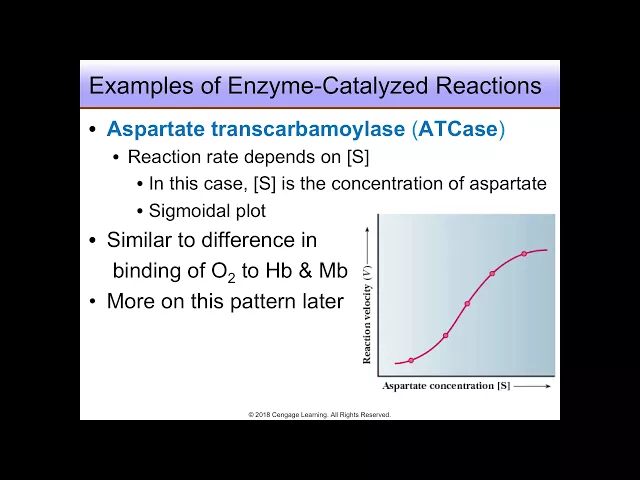
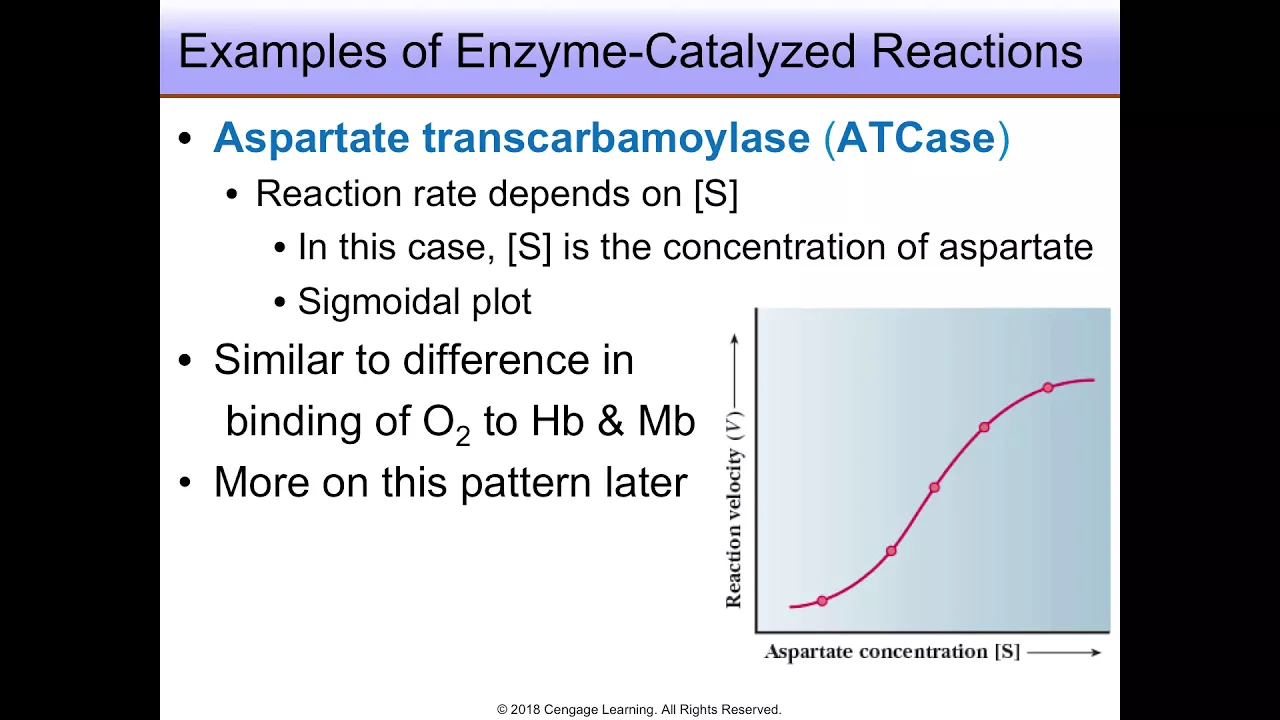
it catalyzes the formation of carbamoyl aspartate from carbamoyl phosphate and aspartate with the release of phosphate an early step in the biosynthesis of perimeters a TC ace is an excellent example of an allosteric enzyme you may recall the distinction between the oxygen binding plots of myoglobin and hemoglobin myoglobin gave a hyperbolic plot whereas hemoglobin produced a sigmoidal plot thus exhibiting cooperativity or allosteric we see this latter type of behavior in the substrate saturation plot of a TCAs we hold the concentration of carbon oil phosphate constant and vary the concentration of a smart ape when we
do so a sigmoidal plot results as shown here this means it is an allosteric enzyme and the spine substrate in a cooperative fashion we'll look at this more thoroughly in the next chapter for now just realize that chymotrypsin and 80 CAS are representative of the two general classes of enzymes those that are Michaelis Menten enzymes and those that are allosteric