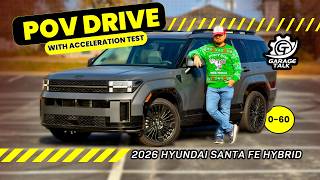
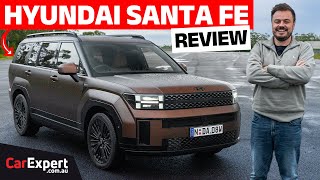
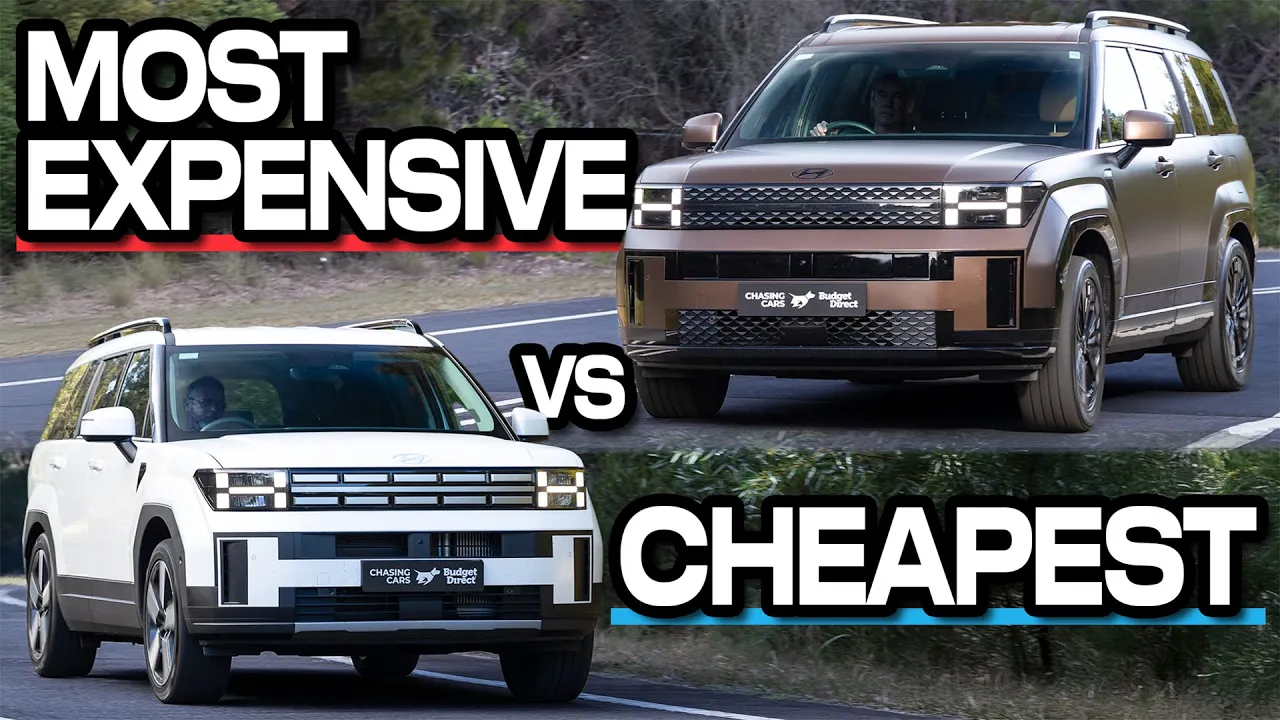
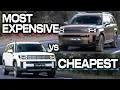
I'm Kurt Depra. This is Chasing Cars and regular viewers will recognize this as Santa, my Hindi Santa Fe calligraphy hybrid long-termer. We've had it in the Chasing Cars garage now for almost 6 months and have traveled almost 10,000 ks in it.
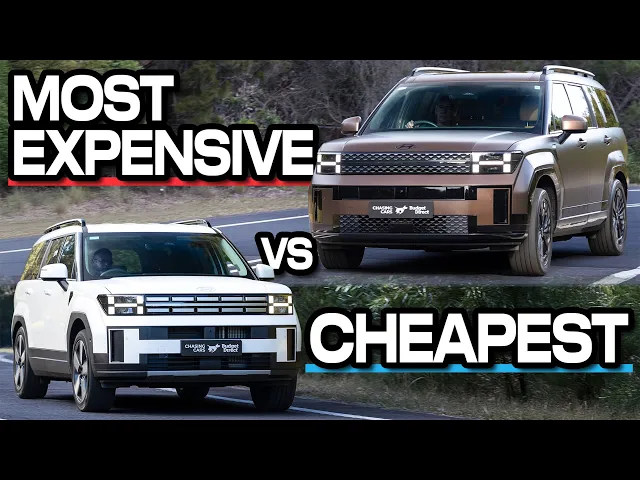
So, we know it really well. It also happens to be our 2025 Chasing Cars car of the year. This is also a Hyundai Santa Fe and it's also our car of the year and we've been driving it for a sum total of 6 days.
But old no name here is a base front drive turbo petrol. And it's easy to presume that there's not a lot in common between these two because this one is $25,000 cheaper. As twin test goes, this is a bit of a no-brainer because it answers some fundamental questions that we have about the Santa Fe breed.
Like for example, what do you get for your 25 grand splurge if you're paying around 85 grand for the calligraphy onroad? And of course, with that established, what do you miss out on when you do opt for the cheapest Santa Fe configuration that money can buy? While we're at it, we'll find out how the turbo petrol engine compares with the hybrid and [clears throat] do you really need all-wheel drive?
And we will decide whether or not we would like to stump up the extra for the calligraphy or go for the base version and pocket that 25 grand extra for a family holiday overseas. So, let's find out. Starting with the most familiar of this pair, Santa >> Chasing Cars, honest reviews of your next car, >> brought to you by Direct.
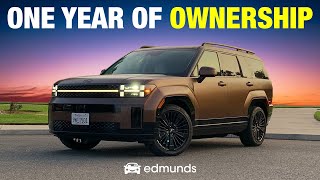
>> Now, both of our examples are my 25 and at the time of filming, they're about to be updated by my brings small changes and we will address those as we go along. Santa lobbed into the Chasing Cars garage at $76,500, but that has gone up $650 for the MI26. And in calligraphy, you get black 20-in wheels and a lot of satin black detailing and dual projector LEDs, which are of a higher grade than what you get on the base variant.
We do like this satin paint, and it is easy to maintain, but do we think it's going to age well over time? Well, that's debatable. And do we think the calligraphy looks 25 grand more expensive than the base version?
No, we don't. In fact, personally, I do prefer the design of the 20-in wheels of the base car. So, let's check that one out next.
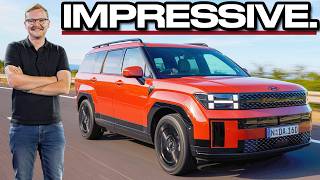
The base car is priced from 53,250 in MI25, guys, and it has gone up 400 bucks for my 26. This car here is around 58 and change on road. Outside, this my 25 version fits very fetching 20-in alloys.
However, these are getting downgraded to 18 in for my 26. Boo. The base car gets silver highlights, dusk sensing LED headlights, and this creamy white paintwork is no cost.
You also get nice stuff like heated power folding mirrors and a kick sensor rear electric tailgate. And it fits Hyundai's full smart suite safety bundle. Because it fits most of the same features on the outside as the calligraphy, you could hardly call this a poverty pack.
And as we said earlier, we don't think it looks any cheaper than the calligraphy spec. But how about you comment below? But how does the base car stack up on the inside?
Climb inside and there's certainly nothing poverty pack about the variant that Hino calls just Santa Fe. And case in point is the dual 12. 3 in curved screens which are exactly the same as those that you do find further up the range.
You get this neat new look leather trim wheel which is exactly the same as the one that you get in a calligraphy. and it frames the 12. 3 in driver screen which does get the blind spot view monitor system that you do find elsewhere in the range.
Nor did Hyundai skimp with the touchscreen media because you do get the same 360° camera system as the rest of the variants. This is the base version. You also get wireless Apple CarPlay and Android Auto and the functionality is basically identical to what you'll find elsewhere.
However, you only get one inductive charge pad whereas in the calligraphy you get two. Elsewhere, you get conspicuous stuff like the dual zone climate control as well as stuff that you can't see like 10 airbag full coverage in the cabin. And no matter where you look, there's not a lot of conspicuous penny pinching.
Yes, the seats are cloth, but the driver seat is 10-way electric. And both front seats do get seat heating. I even like the black and gray tweed trim.
The whole theme in here is quite timeless and classy, and that extends to this nice woven headlining. Right, let's check out row two. I'll save you the full blowby-blow of the second and third rows in the Santa Fe, but I will show you what it's not missing.
And it starts with the fact that you've got slide and tilt adjustment for the rear seats. You also get the nifty USBC outlets in the backs of the front seats and clever details like dual cup holders in the doors and air vents on the B-pillars. Access to the third row is the same right across the Santa Fe range.
And row three does have enough room for two fulls size adults. And boot space for the petrol versions is 642 lers, which is 14 liters up than what you get in the hybrids. Plus, even the base car fits a fulls size spare.
Right, let's check out the calligraphy. Now, I'm not going to run down every single detail of the calligraphy interior because a that would be boring, and b there's really not that much difference. So, I'm going to do something a little bit different.
I'm going to point out the features that I really don't want and I haven't really used over the last 6 months. Now, this interior scheme, which is called pecan brown, is definitely more vibrant than what you'll find in the blacked out base car. And like the matte paint on the outside, you can't get this particular option in the base spec.
Now, having lived for 6 months now with this space food stick interior and these Brady Bunchlike plastic fake wood inlays, I don't think it's going to age particularly well over time. Now, the calligraphy hurdles over the regular leather of the Elite Midspec and gets this Nappa leather interior. And it does look fancy and bring a fine sense of occasion.
But is it necessarily that much comfier than the cloth trim? Not really. And I also doubt that this particular color is going to wear particularly well with family wear and tear over time.
And then there's the general design. Now, doesn't matter whether it's the tech or the materials that are used in the cabin. There's not a lot here that separates this from the base car.
But how about some of those flagship features? Well, starting with the sunroof, I must say I haven't really uncovered it any time in the last 6 months. Natural voice control, never used it.
Communications with the rearmost passenger using an intercom system, never tried it. The digital rear view mirror, well, I still think that's an answer to a question nobody asked. And then you get the Bose 12 speaker audio, which is pretty good, but not exactly raveworthy.
Do I really need 14 ways of driver seat adjustment when the base car does perfectly well with 10? No, I don't. While the color head-up display is neat, it's not exactly essential when you've got this big 12.
3 in driver screen. You do get serverbased navigation with a smart cruise control. Though I do find that the regular Google maps in my phone works perfectly fine as it is.
The stuff that I do like like seat ventilation and the second inductive charge pad aren't really worth a small fraction of that 25 grand upcharge. In fact, all the important stuff like the big screen goodness, the dual zone climate control, and the 10 airbag coverage is all available back down on the base version. There's no added space or storage in the calligraphy.
And I must say, it's not exactly any more comforting or welcoming in here. The big difference, well, you cannot get the six seat configuration with the rear captain's chairs in anything else other than the calligraphy spec. But given that both of these are seven seaters, that's really null and void as there's no realistic difference in third row accommodation.
And the boot space again is only different by 2%. So really is much of a muchness at its core between these two Santa Fe competitors. But that might change when we hit the road.
So let's go there next. Let's get one thing straight with Santa Fe. When you change powertrain types, you change all kinds of specifications under the skin.
Much like the interior, I don't want to labor this narrative by mentioning every single spec. What's important here is how these two SUVs broadly compare. So, once again, I've clocked up 10,000 KS in this hybrid, and here's what I found.
The turbo petrol hybrid powertrain is fine enough and it doesn't matter if you're driving around town or out on the open road where it really gets an average of around 6. 5 L per 100. It outputs 172 kW and 367 new m combined and generally it's more refined than the naturally aspirated hybrid systems you do find in Toyota competitors.
But when that 1. 6 6 L turbo clocks on for duty. It can make quite a ruckus trying to haul along 2.
1 tons of SUV, and that's not counting up to half a ton of occupants. The six-speed auto is fine, and this topsp spec calligraphy is only available with ondemand all-wheel drive. And it does pay traction dividends in slippery conditions and a worthy upgrade for regional buyers.
But as the porkiest variant in the Santa Fe lineup, this does feel a bit ponderous on the road. and Santa here, which showed up in the chasing car's garage with 15,000 km on the odometer, has never been a shining example of the breed. The steering is a bit aloof, and the chassis has never really felt all that planted, and it's been a little bit noisy, be that suspension or some cabin trim squeaks.
It's certainly not as tired as what I remember from the three examples that we did have at Car of the Year that took out the top gong. Let's see how the base variant fares cuz we did name check that that 2. 5 L turbo engine was a key highlight of the car of the year win.
Right off the bat, this base Santa Fe feels quite different to drive. Part of it is weight, and that's because the base front drive petrol weighs in at 1,835 kilos or a/4 ton lighter than the all-wheel drive hybrid calligraphy. Add the superior 206 kW and 422 Nm of the 2.
5 L turbo petrol car and that equals superior performance at least by the seat of the pants. The throttle response is sharper than the hybrid as well, so you don't need as much right foot input to drum up similar pace. The upshot is that the turbo engine doesn't work quite as hard, so it is quieter under acceleration, and that is probably the biggest surprise on road.
Better yet, the 8-speed dual clutch is a smooth shifter, so it does feel more refined all round. It's not all plotted. The turbo front driver does have more noticeable torque steer than what you find in the hybrid all-wheel drive and wheel spin when you give it the berries, particularly when you got it in sport mode, but in general, it just doesn't feel as ponderous as our hybrid long tur.
The steering system, which feels a little bit crisper as well, is different because this gets column-mounted power steering, whereas the hybrid gets a rack mounted design. So, it feels sharper and more light through the corners. And there's certainly more to it than the fact that at 10,000 ks, this is a fresher example than our long turmer.
Regardless, mileage shouldn't affect the on-road feel. The base Santa Fe does ride a little bit firm, so it'll be interesting to see how that change to the 18-in wheels does affect the ride. Still, our hybrid calligraphy doesn't ride any better.
And perhaps for that 25 grand upcharge, the flagship deserves some adaptive dampers. Yes, the turbo petrol is thirstier, but I much prefer this combination to drive. So, the combined 8 L consumption of the turbo petrol car that can scale up towards 10 L around town will hit the hip pocket a little harder than the mid sixes of the hybrid, but the difference isn't as big as what we were expecting.
And both of these cars are happy to run with cheapy 91 rod fuel in their 67 liter tanks. But I do know from experience that only one of these, which is that one, will make the Sydney to Melbourne Jaunt on one fill with about 900 ks of range. On the flip side though, if you do want to tow something, it's the turbo petrol that has the 2-tonon brake towing, whereas the hybrid is less at 1650 kilos.
Servicing? Well, it's $2,439 for the turbo petrol and only $16 more for the hybrid across 5 years. And whichever powertrain you decide to choose, the service intervals are 12 months and every 10,000 km.
And of course, whichever you choose comes with a 7-year unlimited kilometer warranty. Before I hand down the verdict, let's recap what the agenda is with our long-term reviews. Regular reviews and comparisons are really what we think you should buy.
Whereas long-term reviews are what we think about the car and whether or not we would buy it. After almost 6 months and almost 10,000 ks under the wheels of Santa, it's been plenty of opportunity to come up with some concrete conclusions. But I can tell you that after just 6 days under the wheels of the base car, it is absolutely my preferred choice.
It's the base car that demonstrates the most how much of a fine vehicle the Santa Fe is. Why? Because it demonstrates that no matter how hard you try to pull out frills and features, the inherent goodness still remains, but it's no stripper.
This H Higho manages to fit a lot of standard kit that some rivals do struggle to put in its high-spec variance. And in doing so, this base car absolutely creams the calligraphy in value for money. That this lighter front driver packs more punch and more performance brings me to my hot take.
If both of these cars were the same price, I'd still take the base car. However, I would possibly stump up the extra three grand to get it in all-wheel drive. So, while both of these cars are our reigning car of the year, it's a simple case of the fact that the base car is mort car of the year.
And further, the 25 grand that I will be saving is a nice month-long holiday in Croatia for the Mr. and I. That's what I think, but how about you?
Put your thoughts in the comments below. Don't forget to subscribe while you're at it and [music] stay tuned for our final wrap on the calligraphy where we do our final hits, misses, and verdict.