Okay everybody, day two of Cyber Cab. I want to test a few things. We are at the domain in North Austin.
It's about call it 20 or so minutes away from downtown. Let me go ahead and type in my uh destination in the robo taxi app. Uh I want to show you what that actually looks like.
So this is the root taxi app in case you're not familiar. Uh this is the geoence. We're right here.
You can see we're at the north tip of the geoence. going to go ahead and type in the location uh which is UT going to type in neuroscience. So UT department of neuroscience about 8 miles away.
I'm going to click on it. Uh this says that a ride can arrive in 7 minutes if I choose a Model Y. But now I have this option to choose a cyber cab.
And the cyber cab wait time is actually 30 minutes. Uh which is significantly longer than the Model Y. Uh the cyber cab cost $14.
87. The Model Y costs $1968. So, I'm going to go ahead and select the Cyber Cab.
And then while we wait for that to come, I'll click book ride. Uh, while we wait for that to come, I'll go ahead and I'll see what Uber looks like uh on the other side. Okay.
So, I'm going to do the same thing on Uber. The UT Austin Department of Neuroscience. I'll go ahead and I'll click on that and the options will come up.
So, Premiere is 56 bucks, but of course, um, that's more of the more expensive ones. But if I want comfort, which is usually what uh people choose, or Uber X, Uber X is 25 bucks and comfort is 32 bucks. Uh comfort will be here in 1 minute.
Uber X will be here in 2 minutes. Uh so as you can see, the wait times for Uber are are shorter. Um it is more expensive.
Uh but it is uh shorter. With the Robo Taxi app, you can you saw that the Model Y took about 7 minutes, which is not bad. 7 minutes is not terrible wait time.
It's longer than 1 or 2 minutes. Uh, but Cybercap was the longest wait time. Now, I'm assuming that's because there's a lot of people right now.
This is there's sort of exclusive access to a bunch of content creators. I'm sure all the psychos myself are downtown hauling freaking cyber cabs. So, um, that makes perfect sense.
But after 5:00 today, which is Friday, September 4th, they're supposed to open it up to the broader public so that everybody can sort of hail it. Um, of course that wait time is going to remain higher if Tesla doesn't add more cyber caps to the fleet. Uh, but that the solution there for them to reduce that time is going to be adding uh cyber caps to the fleet which obviously they should do uh to reduce the wait time half the price versus Uber significantly longer wait time especially as of now.
But what's interesting is that it does Cyber Cap did launch in the entire geoence. So we are like you saw on the map from earlier, we are at the edge of the geoence. Um and and so when they first launched Robo Taxi, what was interesting is that they only did a very small portion in downtown Austin into the southern part of um of the the city, like a very small piece of the city.
But now with Cyber Cab, they just went uh everywhere, which kind of signals a couple things that are really interesting to think about. Uh the first one is that it with this brand new vehicle, they were basically able to take the same technology from the Model Y that was doing the robot taxi and plop it in this new car and be able to do the whole city which is uh or the whole geoence rather I should say which is super exciting. And then they launched with I believe 40 cyber cabs um in the geoence whereas in the initial launch with the robotex I think there was like 10 or 12 model wise it was very excuse me very very small and remember we [snorts] had to like wait forever to get something.
So clearly they're they have a much bigger geoence now. If I wanted a robotex I could get it in 7 minutes but uh cyber cap obviously is going to be a wait. So we'll wait for it to come um and then once it comes I'll pick it back up.
Okay, everyone. So, our Cyber Cap is finally here after a little bit of a wait. As you can see, it's trying to merge in.
I'm going to guess it's going to come right into this parking lot here at the Chase, and it's got a green bar, uh, which shows up on the app as well. Now, it's super glary out here right now, so it's probably going to be tough to see the um the screen on my phone, but I'll show I'll try to show you on the phone what it looks like. Um, so it's going to go pull over over there.
Is there a way to have it stop somewhere? No. Oh, yeah.
I guess it says stop now. I could have pressed. I don't know if it's hard to see, but it gives you an arrow.
It's like, hey, here's our cyber cabin. It gives you a nice little glow of the color of the uh interior and the light bar. As you can see, the screen is uh was green in there.
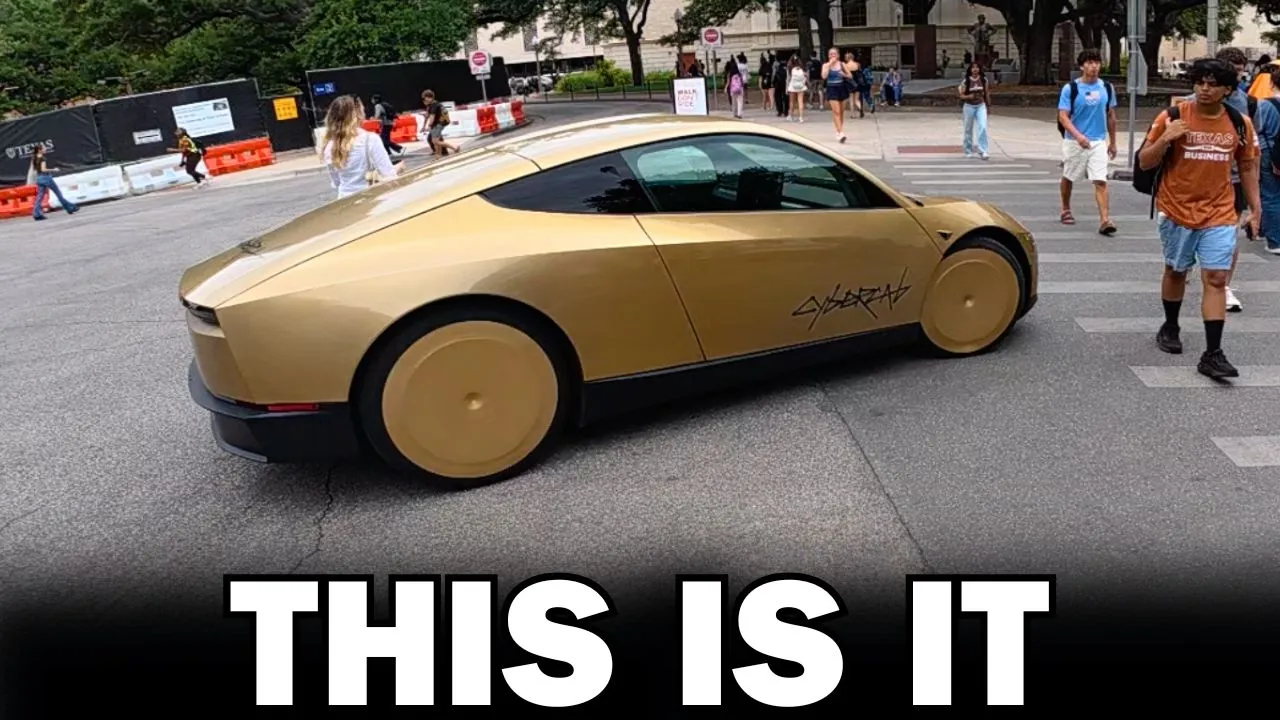
And the doors automatically open. You can see it has this butterfly style door. Um, look at these rims.
They're so crazy. I'm going to go ahead and sit in the in the driver's seat so you can kind of see what the experience is like in case you're not familiar. And that's what the app looks like after I get into the car.
I can actually close the door from the app. There it goes. Or I could have closed it from the screen as well.
Uh I'm going to go ahead and get myself set up in here. Try to come up with a good camera angle. And now that we've got the camera set up, I'm going to go ahead and press start [music] ride.
and we kind of hang out and uh go on our drive down to UT Austin. So, yeah, a lot a lot to talk about. I think one of the key things I really want to hit on this video, there's four.
I want to talk about Tesla versus Uber, which is a very interesting thing that's starting to sort of show up now. Um especially after we looked at the pricing difference that we just saw uh from the apps. There's the rollout strategy, uh, which I'm very curious to see how Tesla's going to handle this as far as like what regions are going to get cyber cabs and what regions aren't.
Um, I want to talk about the ownership model. So, basically, you know, how are people going to are people going to be able to buy this car? Is Tesla going to own the whole stack?
What's going on? There's a lot of like, you know, we don't really know what's going on there. Uh, the ramp of vehicles, how that's going to impact the company.
and then what whatever else comes up as I as we're on this ride. So, the first thing I want to hit is is Tesla versus Uber. So, he here's the here's a very interesting piece that that is starting to show up is that now that Cyber Cap is live, by the way, this is like this is now my second day in this, it just it's so comfortable.
[laughter] It really is so comfortable. The key thing here to think about with uh Tesla versus Uber is that Uber obviously has been around for a really long time. Uber's got a really big network.
Um they are a company that has attracted a ton of drivers as you can see and depending where you are wait times are very low because they have permeated the market uh and they have a ton of people that are willing to drive for the service. Now, the problem with Uber in respect to to Tesla is that their pricing, we're getting some early glimpses of this, right? Again, this is just one city right now.
I want to I want to highlight that. But Uber's pricing, you can already see, is significantly more expensive than uh Tesla is right now in this city at least. And some could argue it's like, oh, that's because, you know, Tesla's trying to, you know, attract more um riders.
They're trying to attract more people to come on the network. But the reality is is that it's it's going to be like that long term. And the reason why is if you really think about the economics of self-driving cars.
So for example, this car that doesn't even have a steering wheel and pedal. Okay, the economics of this car is that the cost per mile. So the amount it's going to cost to haul me from from here to UT uh University of Texas, it's going to be a fraction of what it would be if I hauled an Uber.
Cuz if I hauled an Uber, obviously a person's going to pick me up in their car, right? A person's going to pick me up in their car. And I love the way this handled the pedestrian there.
Um like why is she walking? There's like Oh, I guess she has no way to go on the sidewalk. Okay, fair enough.
Um the person on the Uber has to pay for their car. They have to pay for the maintenance. They have to pay for gas.
Then they have to pay for their time. Right? So their time is basically taking the job actually wanting to go and and and drive for Uber.
And the way Uber attracts those drivers is by giving them a a cut of the drive that is worth their time. And that's what creates this like you know the pricing dynamic of Uber of going up and down where you know sometimes oh sorry guys the camera got all jacked up there. You know sometimes they'll have search pricing where the price goes up like crazy.
Sometimes it's like a lower price like it is right nowish, you know, 25 bucks or whatever it was to get to to UT. But the reason why it's that price is because that's the price that the market has dictated from a from a supply perspective, a driver perspective that will actually make it worth it for people to go and hail a an Uber. So, there's drivers out there that actually would want to take the drive, right?
In this case with with a self-driving car, forget if it's even a Tesla, any self-driving car that doesn't require a driver like this one. And this one doesn't require a driver. It can't even be driven.
This version of this car cannot be driven physically in in its current configuration. The costs associated to getting me down to UT is significantly lower than Uber because there's I'm not paying for someone's time. And in addition to that, cars like these which are hyper optimized to be driverless, right?
This vehicle is optimized to be driverless. The cost per mile as it pertains to energy to power the vehicle, maintenance to ensure that the car doesn't break and all this stuff and making it, you know, very reliable. All these other costs are optimized so that this car can have a really cost per really low cost per mile.
And if if you really think about it long term, when the safety profile gets really good, when the driving behavior gets really good, uh to the point where this thing can drive itself literally anywhere under any situation, under any weather condition, under any lighting condition, etc. , etc. , any road condition in any city, you're going to get to a point where the cost per mile for a car like this is going to be sub40 cents per mile.
And that's a that's a giant deal. probably much closer to 20 cents in the long long term depending how many people are overseeing the system. You know, how many supervisors you have at the headquarters um overseeing the fleet.
But what that allows you to do in this configuration is that you can have a really low cost per mile relative to Uber sub40. And so in that world, how can a company like Uber ever ever compete with a company like Tesla outside of actually being able to also provide self-driving cars like this, right? That's that's the next topic that comes up.
It's like, well, okay, yeah, that that's true. Uber can't be competitive if they have human drivers, but they'll just put self-driving cars on their network. I'm like, okay, that's that's a very logical conclusion.
Let's walk through that. Okay. So, Tesla has already said that they will not allow other companies to operate their vehicles on their fleet on their fleet.
So, they're not they're not going to allow a company like Uber to put cyber cabs on Uber where you hail the cyber cab on Uber. You have to go through Tesla's network. That's why it's called Robo Taxi.
That's why it has its own app because robot tax is basically Uber but for self-driving vehicles manufactured by Tesla, right? So that's that's one. So they can't get people like Tesla on the network.
So they have to get it from other companies. So say they get it from like Whimo and BU and Gily like these are all the manufacturers but whoever like all these other companies start saying Uber we're going to go in your marketplace. We're going to go in your market marketplace.
Great. Okay. Let's assume Uber is able to um match Tesla's ability to get self-driving cars on the road through Whimo and whatever as Tesla ramps the cyber cab up to, you know, 10,000, 100,000, a million, 2 million, 5 million units per year over time.
Let's say Uber can match that. Okay, as Uber is adding driverless cars to their fleet and and they inevitably have to compete with Tesla on price because why would anybody go on Uber and pay a premium for a self-driving car, meaning a higher uh per mile than than Tesla? Why would they do that when they can go on Tesla's network and get the same exact experience, which is a private self-driving car like this one for a higher price?
It makes no sense, right? So Uber has to lower their prices. They have to lower their prices.
What happens when Uber lowers their prices so that people can hail a self-driving car? People that were getting paid on Uber to drive now have less incentive to go on Uber to drive because they're not going to get paid as much. Obviously, right?
If I'm somebody who's making, I don't know, 10 bucks a drive and all of a sudden I'm making eight bucks a drive or seven bucks a drive or six bucks a drive, that eats into my ability to to live a decent life because now the money that I was making to actually, you know, on top of paying for gas and maintenance and insurance for the vehicle to actually go out and have a life, that money goes away. that money essentially goes away. So it eats into my profit margin as a driver.
My margin goes down. Okay? And so what that's going to do, it's going to reduce the number of people by default that are willing to take those jobs because they're just not it's not going to be worth their time.
So, the the the weird spot that Uber is in is that as they add more self-driving cars to their network that are lower priced by default to be able to compete with a company like Tesla, which will in essence pass on the savings of not having a driver to the to the customer. Okay. As they do that, their network effect goes down.
And the network effect is basically the ability to have a a you know a network of people like uh being able to have enough drivers on the network so your weight times are are low. So the the the weird thing that's going to happen by default this is just supply and demand. Okay?
This is just what happens when they add more self-driving cars to the network that are lower cost. The the number of cars they're going to have on the network is going to go down. It's just going to go down unless unless Uber is able to add as many cars to the network at once that are self-driving, okay, that are able to match Tesla's price at the same time as the drivers are going away.
But what they require there is scale from the manufacturer. The scale has to match Tesla's ability to dump let's say in Austin right now they have I think close to 120 robo taxis right let's say Tesla gets significantly better at rolling these out and they're able to match their manufacturing process which is roughly 2 million cars per year and they're taking a bigger percentage of that manufacturing process and utilizing that to dump self-driving cars on the network. Okay.
Now you're going to have to have all these other suppliers of which I don't know where they are. There's there's multiple of there's Zuks, there's Whimo and all the other car car companies, but they're not making nearly as many cars per year as Tesla is able to. But let's say they're able to do that.
Let's say they're magically able to do that. What's the problem that Uber is going to now run into? By default, their price is going to be higher than Tesla's.
Why? Because not only do they have to pay for the price of the vehicle from these suppliers like Zuks and Whimo and Gilly and BU and all these other Chinese automakers, which is basically the only place that can get these things. Even Whimo, their their cars are Chinese now.
[laughter] Okay? Cuz the American automakers and European automakers don't know how to make a good electric car. All right?
By default, Uber's price is going to be higher than Tesla's because Uber needs to make money. So they're paying the effective cost per mile for these Chinese manufacturers, right? And then on top of that, Uber has to put in a markup.
They have to raise the price on top of that so that Uber makes money. And so when you have that and you compare it to a company like a Tesla, and I'm using Tesla as an example because they're the more visible, but what I I really want you to think about here is like how does Uber compete with a company that owns the entire stack? They own the manufacturing of the vehicles.
They own the network. They own the distribution, the app. If they control all those costs, Tesla doesn't have to add another markup on top of the car because the car is the network, the car is a distribution.
The brand is the distribution. Whereas Uber has to pay for the car and then has to pay itself. They have two costs going on.
And so for Uber by default to stay competitive on price with Tesla by default, they would have to lose money because then Uber effectively would not be able to pay itself because they're already paying for the car. Hope that makes sense. Okay.
So, so what does that mean? The only way for Uber to survive in this situation, the only way to survive in this situation is to give the population a logical reason to pay a premium to pay a premium to Uber to ride a self-driving car. That's the only way this works.
Cuz when you charge a premium, you can actually pay yourself. A premium meaning you're you're asking customers to pay more for your self-driving service. Okay.
So now the question becomes, how can you get people to actually pay you a premium? How can you get people to actually say, you know what, instead of paying, let's say, for example, the this $15 ride that we're doing down to UT instead of paying $15 for this Cyber Cab experience, which is for for one or two people, it is super comfortable. It's quiet.
The screen is huge. The sound system is incredible, you know. Let's listen to some good right here.
[music] Here's some uh uh heavy metal for you guys. Big heavy metal fans. This uh Embrace the World.
Is it? Yeah, that's a banger. Um so why would you like Okay, this experience is great [laughter] is what I'm trying to convey.
What else can you do on top of this that people would want to pay a premium for? Okay, maybe you'll have a desk. I don't know.
Maybe you'll have a desk or something we can play. Maybe, you know, with enough time we'll have a sleeper cabin in here. We can kind of take a nap, you know, or we can just like sleep or whatever.
Now, in theory, I could do this here, too, cuz I can, you know, lean this basically like 60° back and I can probably get a really solid nap in here, honestly. Probably not the most, you know, I wouldn't call this like a a sleeper cab in any sense of the word, but like it's going to be comfortable. It's It's more than comfortable, right?
Great sound system. I can talk to Grock. Uh, let's let's Hey, Grock.
What's the weather forecast in Austin, Texas for the weekend? Saturday looks hot with a high around 96 and low of 78. Partly cloudy with just a slight chance of afternoon storm.
Thanks, Grock. Uh, what uh can you play me some um Sad but True by Metallica and turn up the volume? Playing Sad But True by Metallica on Spotify.
Enjoy the ride. There. There you go.
I I guess I put it on mute before. There you go. So, I can turn this on.
Hello. See? There you go.
You suck. [laughter] Why isn't this working? Oh, there we go.
That's a weird bug. There you go. So, we'll smooth out the bugs.
Tesla, if you're watching this, that's weird. Please fix it. But anyway, you get my point.
Like what else do you need on top of this that would allow you to charge a premium? And where my head goes is like you need something like that's super unique like literally like an RV or like a like a like a movable office or a freaking hot tub in here or a you know like a limo. Very specialized situations, right?
But when you have those specialized situations by default your network is going to collapse. it's going to collapse because drivers are not going to be on there. Okay?
Right. So, so and this is why Uber is starting to partner with these um with with the drivers unions of the United States because now Uber's only real like it's it's just so obvious Uber's only way to get out of this very precarious place that they are in to no fault of their own. kind of they should have went harder on making their own electric uh you know autonomous vehicles which they which they tried and they weren't able to because it's hard.
The only way to do this is by government capture right is by lobbying with unions to slow this down to slow this down as much as possible. Now I am extremely sympathetic to the idea that this is going to impact a lot of people's jobs. Obviously it is.
And and this is not this is this sucks. This is this is one of the this is one of the quote unquote dark sides of this technology which is that this is so disruptive, right? We've been in here for what 17 minutes or whatever it's been.
We're just hanging out, you guys. We're just talking. The cyber cap's driving me around.
We're having a grand old time, but it's very disruptive to humans with jobs. So, I am very very sympathetic to the idea, you know, let's let's give Uber the benefit of the doubt and say, you know what, Uber, you guys are right. You guys should partner with the drivers unions and try to slow this down as much as humanly possible because this is going to put a lot of people out of work.
And Jason Calcanis' point from the All-In podcast, love the pod, world's greatest moderator, was very unfair to me on X. I'll put that out there. Still, I respect the guy.
He's he's uh allowed to have his own opinion even though I think he's way out of line. It is what it is. His point is, hey, listen, with data centers, with data centers, you are already have this mass of people that are upset about regulation, that are upset about um as regulation, they're upset about artificial intelligence.
So, what happens when uh autonomous vehicles start putting out of work? They're going to have, you know, they're going to start bombing Whimos. They're going to start bombing Teslas.
Like, okay, you know what? I I see the point that this is very disruptive. But you you know government capture to keep Uber alive to keep drivers on their on their payroll is not the right approach to this.
You know what the right approach is? create a a AI dividend fund in the government and then pay give these people money to become fleet operators or give them money so that they can transition to the new economy instead of instead of keeping them in a job that they're going to lose anyway and then they are tied their time is tied up in a job that's going away. That is crazy to me.
And so the reality is, you know, who that the only person that benefits is the shareholders. It doesn't actually benefit the people. It doesn't actually benefit the drivers because this whole time you're just capturing them in that job where their earnings is going to go down over time anyway as Uber is going to try to replace their their fleet with autonomous vehicles because they have to, right?
And then they're going to lose their job anyway. How does that make any sense? It doesn't make any sense.
It is illogical. It is capture. Very obviously it's capture.
Okay. In my opinion, I could be wrong. My opinion is that it's capture.
Okay. And you already see this like they're partnering with the drivers union and in in I forget which state it is, but I don't know. They were doing something in New Jersey.
But this is so obvious. Uber has to do this. They have to like they they they have no other choice.
This is too disruptive. Now, the only side of the other side of this is like, hey, maybe this technology is a lot harder than it seems and they're going to, you know, Tesla's going to take forever. You know, Elon himself said, hey, like this is going to be um we want to be very careful with uh with accidents, so we want to take our time.
It's going to be very slow. And it could be listen, it could be that Jason's 100% right is like, listen guys, like there's too much risk out here. There's too much risk out here.
But like logically speaking, that makes no sense. is that what the ideal scenario should be is that if if if the obvious outcome is that drivers are going to start losing their jobs very obviously starting in Austin, starting in Austin, we should help them transition to the new economy instead of capturing their job that they're going to lose anyway. That makes no sense.
That's you're just forcing people essentially to work because let's let's face it, people that that are the shareholders and the owners of these companies, the people like that are that are let's say it higher in the hierarchy of of earnings, okay, that is benefiting the owners of the company is not benefiting the people actually working for the company. That's just a fact. And then we shouldn't be surprised if we have this like socialist revolution against that because that's not actually looking out for the people.
You're just capturing them in a job that they're going to lose anyway. My opinion. So, wow, that was a rant.
We got 8 minutes left. What were the other topics I have on here? You guys let me know if you guys like this style of video.
I'm like freaking going crazy. Okay, roll out strategy. Yeah, roll out strategy.
the the the big thing that Tesla's going to have to figure out how to do now is as the cyber cab line ramps and they're able to make more and more cyber cabs. I love that I don't hear the blinker, by the way. Like it I can see the blinker light on but it doesn't like it doesn't um say anything like I I can't hear it.
Um as a Cyber Cap line ramps up, Tesla's going to have to figure out where to dump where to dump these cars. They can dump them here in Austin. they can dump them, you know, somewhere else uh in in all the other geo fences that they have going on.
But at some point the the places where they can dump these cars, especially if Jason is right and they're not able to put these in areas because let's say Uber is successful in slowing down AV adoption and government does forcefully slow this down. Tesla's cyber cab line is going to be artificially slowed down. Which means that now Tesla is going to have to fight with suppliers who I'm sure they have some kind of contract that says, "Hey, send us this many units, right?
send us this many uh parts for us to be able to build this many cyber caps. all of a sudden be like they're going to be like you know what no we we don't need that many so we're not going to buy them and then the supplier is going to be like what the hell like you signed a contract for this many now now you're going to do it and Tesla's going to be like well you know regulators are slowing us down so we're going to have to reneg or whatever we're going to have to change the contract et that creates a mess for the supply chain cuz you can't you can no longer plan for your production so it makes it much harder for Tesla to actually be able to have a fluid line a fluid production line if Jason is right by default by default right and so Tesla's going to have to figure out, their decision is going to be, okay, do we just really not have a line running? Do we just sit on this line doing nothing or running at 10% 5% of the production or or do we run at a full tilt either with this car?
I know a lot of people in the Tesla community, the psychos like to, you know, make fun of me for this idea, but it's it's completely logical. We already know the test units for this car have steering wheels and pedals. make some modification to this chassis if you're not happy with the two-seater configuration, whatever.
This car is able to be driven with steering wheels and pedals. Sell it to the public with steering wheels and pedals. And then that way you can have your uh entire line running 24/7.
Becomes pretty obvious right now. So, that's going to be a nice interesting thing that Tesla's going to have to fight through. Then they came out with another thing where they're talking about uh people being able to become fleet operators, owning a fleet of of these vehicles.
The signal there is pretty obvious, which is that Tesla doesn't want to be the sole maintainer, cleaner, fleet um manager of Cyber Cap. They want others to do that, which makes perfect sense because that allows Tesla to just run the factory at full tilt. They don't have to worry about doing all the other minutia of doing a cyber cab.
They'll just have other people take care of it, which makes perfect sense. Which goes back to my original point around, hey, these drivers start transitioning. A percentage of them will transition to fleet operators and for them will be better cuz they're not they're not sitting in a car all day.
They'll probably make a lot more money. Okay? And it gives them a lot more time and it's it's a much more interesting job, right?
In theory, it should be significantly more interesting. So that that's a very interesting signal, right? So, it's like, okay, now we're working with fleet operators.
We're working with uh people that are going to manage our fleets. And then the way Tesla makes money is obviously by selling the car to their fleet provider. So, they offload the vehicles on someone else.
They no longer have to keep all those cars on their balance sheet on their financials. They give it to somebody else. They make money from that transaction.
And then all those fleet operators have to put their cars on the robo taxi network, right? Because obviously Tesla said they're not going to let you operate this anywhere else. is going to operate another robo taxi network.
So then Tesla's going to make a cut from that transaction and then another party will make the rest. You know, Tesla might take a 30% cut and then the fleet operator takes a 70% cut, whatever that split might be. And that way Tesla doesn't have to manage the fleet and you got people that make money actually operating this thing.
Okay? And that becomes a new industry. Now you have um you know like you have fleet operators start to pop up everywhere.
And then the question becomes is like, okay, how much, you know, like are these fleet operators going to be in charge of like supervision and getting the cars out of trouble? Is that going to all be handled by headquarters? Like how how is all that all that going to be managed?
Right? But that becomes a question for another day as as Tesla figures out how to scale this process up, right? But as you can see, like we drove through an urban environment, suburban environment.
These cars can't go through highways yet. Hopefully that they change that soon. I take my Cybert truck on FSD on highways all the time and it performs excellently.
So I don't know, you know, I don't know how much farther away that is from where we are. But I this this is going to work. It works.
[laughter] It already works. So now Tesla's job is going to be which is a hard thing. I don't want to trivialize it.
Go ahead. Yeah. I'm like waving him along like I can control the car.
[laughter] [gasps] Oh, that's excellent. But see, this is what I'm talking about. Like, the car is great.
I mean, I'm in the middle of UT campus. Like, you know, there's students going over the place. I think the Who are they playing next tomorrow?
I don't know who they're playing tomorrow, but I know next week they're playing Ohio State. That's a big game. Um, huge game.
And I think they're playing here. I think they play here if I remember correctly. Um, yeah, it's just it it works.
It obviously works great, you know. So now the question becomes how many other uh companies are going to be able to compete with Tesla in this realm? How many other companies are going to be able to uh you know stay um keep their pace up with uh Yeah.
I don't know. I can't control the car. This is so weird.
This is what's weird about this car. I'm in the driver's seat and I just don't know. I don't know what to do.
Like like do I wave people on? What do I do? Do I do I say no?
Stop. The car drives itself. [laughter] Very strange.
It's a new world. It's a new world. So, yeah.
I'm uh I'm just so fascinated by what's going on. I really am so fascinated by what's going on. So, I'll um I'm going to let this thing do its thing.
We'll park it. Been talking for too long already. And uh yeah, I hope you enjoyed this video.
If you want to learn more about these technologies, I have two books on Amazon, AB, Abundance or Collapse and Master Plan. Obviously, subscribe to the channel if you want to learn more about Cyber Cab AI technology like this. And yeah, we'll see you on the next one.
I'll show you guys how this thing uh offloads uh so you guys can see what that looks like. So, we're here. Says, "Please exit safely.
" So, you can see it gives us a camera view of the rear and the side view mirrors, which is very helpful so I don't get myself killed coming out. Go ahead and take off my um thing. Very good.
And then we can go ahead and uh open the door by clicking this button. There it is. And I'll show you guys how this thing goes away.
All right, we're out. And the door will close itself. There it goes.
And then we'll actually we'll follow it and see how it this is a very trafficicky a lot of pedestrians there. We'll see how this handles it. We'll do like an outside view little bonus content.
Now this is one thing I wish like come on let's go. You know there's nobody around. I guess there's nobody around.
There's no big deal. But maybe if I wave it on. Go ahead.
No reason to wait this long. There we go. [laughter] And maybe like I have thought about this like maybe I don't know like is it a oh maybe he forgot something in the trunk kind of thing.
So it's like a little courtesy weight if there's nobody around there. So there's got people walking across the crosswalk. See how it handles this.
As you can see there's nobody in the car cuz I just got out of there. There's no steering wheel and pedals. Let's see.
It should go hereish. It's very polite. Very, very polite.
Let's see how it does here. It's going to start creeping. Nope.
Somebody's coming behind. There he goes. starting to enter the intersection.
Look at this. Go around here. Look at that.
Great. Well handled. Oh, a very good test.
You didn't hit it. There it is. That was fun.
All right.