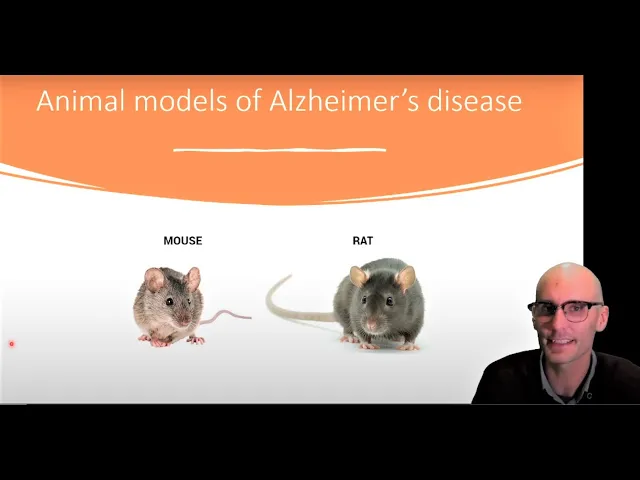
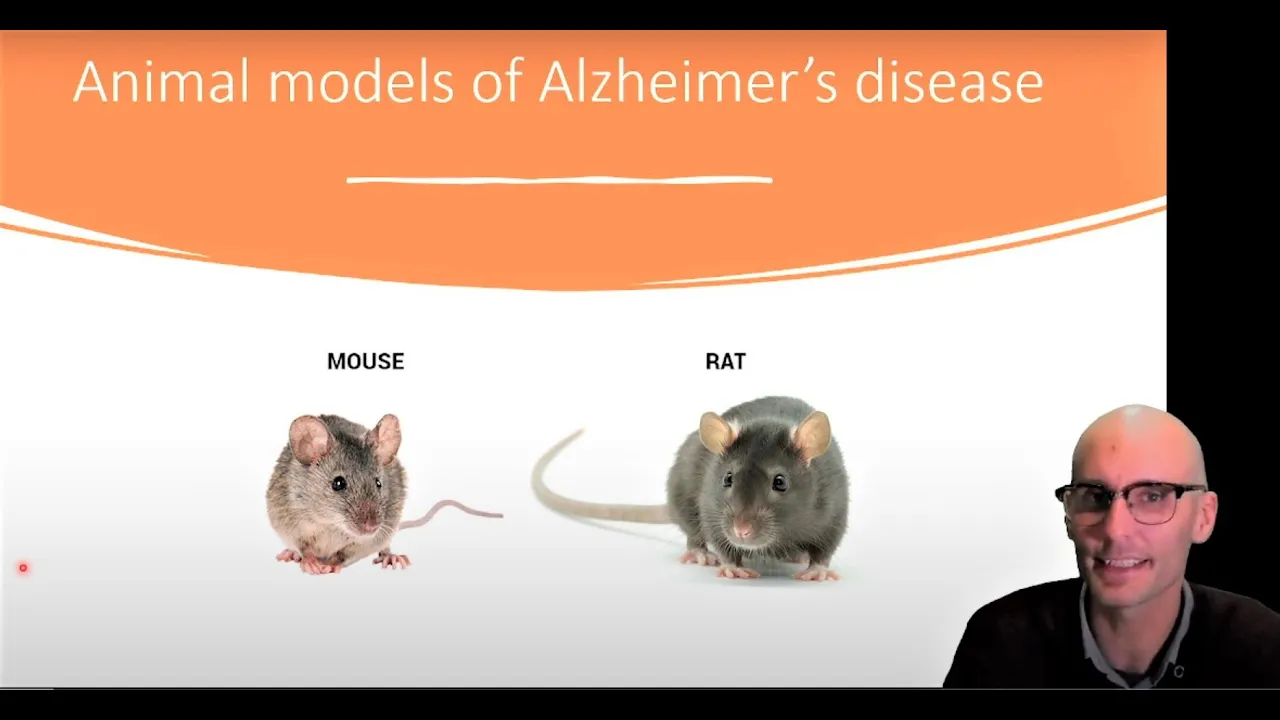
hey everyone Dr J Cordy and in the previous few videos I've been covering Alzheimer's disease some of the pathophysiology of Alzheimer's disease now I'm going to discuss one of the tools of Alzheimer's disease and that is animal models of Alzheimer's disease now there are actually a range of animal models across from fish to sheep there are models of Alzheimer's disease but in this one I'm just going to be covering the rodent models because they are by far the most popular models used for Alzheimer's disease research so we're going to be looking at The Mouse and
the rat now just a little refresher there are mutations in the human genome that can guarantee you to get Alzheimer's disease these are called familial Alzheimer's disease mutations and most of them lie in the amyloid precursor protein and they promote the production of the a b to 42 product uh product or cleavage product of the a PP the amyloid precursor protein so here's a range of mutations over here that can lead to gamma secretes cleavage to generate the ab to 42 fragment and here's a mutation over here that increases the beta secrete Haze cleavage to
promote the amyloid beta-42 fragment production now there are also mutations in the gamma secretes which is the enzyme that cleaves the amyloid precursor protein and they promote the ab to 42 cleavage site these mutations and they can cause the increase in amyloid B to 42 production in the brain so what we want to do obviously to get a good animal model you can see that these familiar Alzheimer's genes are going to be an excellent opportunity to create an Alzheimer's Mouse model so for it we take a a single embryo a single celled embryo so sort
of just a fertilized egg right there as I go if you will and we need to insert the DNA that we want we need to put in a piece of DNA that contains that familial Alzheimer's disease mutation then when the mouse grows up typically they'll be heterozygous for that Gene and sometimes we want to make them homozygous and we do that through breeding um uh and we have various reporters and checks to make sure that the gene that we tried to insert has been inserted now we used to use old technology and Technology like Talon
to do this but if we were to do this right now in some of the newer models coming out we would definitely use crispr genius thing technology which is a very powerful technique that maybe I'll do a video on later because I haven't yet covered crispr but it's an amazing genetic engineering technology so to understand what they're inserting into the mouse genome we first need to have a little talk about promoters now promoters are a little piece of DNA that's Upstream from a gene that regulate the function of the Gene and so here we have
a little setup now um what promoters are doing they do lots of things but what they are doing is what you have to imagine is that your skin cells and your neurons contain the same DNA they contain the same set of instructions so how could they possibly turn into different cells well one piece of this puzzle is promoted so as other pieces like epigenetics blah blah but one big piece of the puzzle is promoters so promoters are a small segment of DNA Upstream from the Gene and they mount a promoter protein okay so this might
be how it works here we have a piece of DNA down the bottom we've got a neuronal gene here and a neuronal promoter and we've got a skin Gene here and a skin promoter and then a neuronal promoter region and a neuronal gene and a skin promoter region and then you're a skin Gene and so on and so forth now because the cell is in the skin it will be getting signals from the extracellular environment to certain receptors that it is in the skin location of the body now these will activate certain skin signaling receptors
that will then activate certain skin promoters these are proteins that will bind to the skin promoter regions on the DNA so these skin promoters then Mount the RNA polymerase and then uh James Cameron eat your heart out look at that animation technique right there so they will then promote the production of skin Gene RNA which will then turn into skin proteins and so then you end up with skin proteins regulating the function of your skin cells so you might have keratin which is a protein important for your skin being produced through this promoter region mechanism
now if you're a neuron you can have neuron signaling molecules binding to neuronal promoter regions and causing the production of neuronal RNA and neuronal proteins like synapse proteins there's no point in the skin cell producing a synapse protein so it needs to be on a different promoter so the important thing there is when editing the Genome of the mouse we can dictate where the gene is going to be expressed by based on what promoter region we put in front of our Gene so when we are inserting these familial Alzheimer's genes into the mice we need
to put a mouse neuronal promoter at the front of that Gene now that's very important because the gene we're inserting is human it's a human app Gene a human amyloid precursor protein Gene so we need to put a mouse neuronal promoter at the front of that that will mount a a promoter region that will Mound a neuronal promoter and cause the expression of this Gene only in the brain we don't want the amyloid mutated amyloid being expressed in the liver or in the bone marrow or the kidney what we want to do is express it
in the brain so that's an important thing when we insert a gene into a mouse we need to insert the appropriate promoter so our Gene will be expressed in the correct organ so in this case we have a mouse neuronal promoter and a familial Alzheimer's disease Gene now one of the most common Alzheimer's Mouse models is called the app PS1 Gene insertion now for that they use a asked neuronal promoter and they actually insert two different genes one is for a familial Alzheimer's disease Gene in the app protein this is called the Swedish mutation and
it promotes beta secretase activity so this will cause the app protein to be cleaved excessively by the beta secretes enzyme the other Gene that we put in is we actually put in a mutated um gamma secretes that promotes the cleavage at the other end at the at side on the app promoter to promote their 42 production so we're putting in two genes on a mouse neuronal promoter one in the app Gene one in the gamma secretes to really guarantee that this mouse will get familial Alzheimer's disease and so that's the app PS1 and now there
when it comes to promoters there are actually different strengths of promoters you can imagine that some neuronal genes need to be expressed a lot maybe a synapse Gene needs to be expressed a lot and some neuronal genes maybe don't need to be expressed as much I don't know but maybe a lower important Protein that's in lower abundance um so when we're choosing our promoter we can actually choose a strong promoter or a weak promoter I'm actually one of the strongest promoters you can use as a viral promoter but that will be expressed everywhere and loads
on it because we stole the promoter region from a virus um but what we do in the Alzheimer's model is we normally put a strong neuronal promoter in and an important thing is we're actually inserting a gene so that means that the mouse still has their own app and Gamma security days so what that means is we've kind of doubled the amount of app and Gamma secretes that they've got there and because we put on a strong promoter we're probably more than doubled because we'll put it on a really strong promoter to get a lot
of protein expression so we're going to end up with over expression we've got the mouse app we've got the human app we've got it on a strong promoter region we've got all that kind of stuff so we're going to end up with a lot so here is a picture of an Alzheimer's brain 12 months into development so the 12 months old relatively old for a mouse not super old but relatively old and we can see that their brain is absolutely packed to the top with plaques now this is would be very very very late stage
Alzheimer's disease I don't know if we've even seen this amount of plaques in a human this is a tremendous amount of plaques I've seen worse in animal mouse models and a rap model holy moly I've seen a lot with but that is a lot of plaque and that's because it's a very aggressive model it's over expression um so we can actually see cognitive deficits at like depending on your tier six to nine months with these mice which is a lot when you consider to that 18 months you know two years is a very old mouse
so it's kind of you know maybe a third of the way through their life we can start to pick up cognitive deficits and if you put that onto the human time span which isn't a great thing to do you can see that it's a very aggressive model now what's least aggressive is we can do a knock in now a knock in model is when we so here we have the actual Mouse app Gene so this is the mouse amyloid precursor protein Gene it's on its normal promoter this is the normal app promoter that it would
have from motor region and what we do is we knock out the Gene and we put in the human uh mutated Gene but we keep the actual regular Mouse promoter region there intact so at the knock end we're knocking out the mouse Gene and we're knocking in the human editor Gene so what we can do and one of the most common and really great models of this it's called the app NF Dash F knock in Insertion I know that's a mouthful model but basically it describes what mutations have been Incorporated and it's an ABP Gene
that actually contains two familial mutations that occur in app uh this in-l substitution here that promotes beta uh secretes cleavage that's called the Swedish mutation it's a very powerful mutation it's one of the first familial Alzheimer's disease mutations were discovered and another mutation over here at the other end of the amyloid fragment that promotes gamma secretes so you can see why um uh you can see where its name comes from here based on the mutations that have been caused in here so this is the name of the mouse uh and um there's some serious advantages
to this model it has a natural app promoter so it's not over expressing it it's expressing it where and at the levels you would expect so there's no over expression and there's expression in the right locations if you put an artificial neuronal promoter in there there's not a normally associated with the app protein it's going to be expressed in different locations and you kind of notice this with the mouse you get a lot of cortical plaques before you get hippocampal plaques depending on the model and that's not really what happens in the human um and
here is a 12-month image of the plaques in this Mass model so bright orange we've got a picture of where the plaques are in this mouse model at the same age you can see it's much less aggressive and perhaps more realistic to the human it allows the Aging component of the mouse to interact with the plaques rather than inducing strong plaques in young mice we're now getting an old mice we can leave these mice to get much older and see the interaction between aging and the plaques which is what we would see in The Human
Condition so if I just put those side by side those are the same aged Mouse just two different Mouse models one's an insertion and one's a knock in lots of advantages to the knock in now they have made rat models as well and rad models have some distinct advantages so they've made an app PS1 Mouse which is the first insertion that I talked about they've also made an app PS1 red which is an insertion same as the mouse so what do we get in the mouse we do get cognitive decline we do get amyloid plaques
we do get inflammation we do get phosphorylated towel and that is actually that phosphorylated Tower is actually essential to neuronal decline but we don't get neuronal Tangles or neuronal death there's no um tangling of the hotel obviously it doesn't get up to a level enough that can cause tingling and we don't get any neuronal death and rats we get cognitive decline amylo plaques inflammation phosphorylated towel and we get neurofibular rectangles and we get neuronal death we get atrophy of the neurons atrophy of the brain which is not what we get in the mouth now why
do we get this given that I've got the same insertions the same thing happened with the knock-in situation rats seem to have a different pathology to the mouth well the answer might be time the Reds are living longer often we evaluate these rats and 26 months for example and you would never even get an Alzheimer's mouth that's 26 months old so perhaps the amyloid to inflammation to Tau pathology to neuronal fibulatory Tangles actually takes a certain amount of time and if you don't have that time you can't get that neuronal death going on so perhaps
that's why rats are actually a better model Reds are more expensive they're bigger they take longer again most phds are only three years or four years so how are you going to do a model where it takes two and a half years to get the rats into the cognitively declined severe Alzheimer's disease zone so they're a slow model it's easier to genetically engineer a mouse so there's a lot of pros and cons to these models so how do we know that this cognitive decline I just want to take you through a couple of Behavioral tasks
here here we have the Morris water maze um and this is a task where basically we train a mouse or a rat to find a hidden platform now I've got an arrow there saying a platform they can't see and that's because it's below the surface of the water we also put a white paint in the water to help prevent the mouse from or rat looking through the paint in down into the platform now um the mount the mouse or rat will just swim around and around and around they don't like being in that water really
so they want to get out so they're going to hunt for it so here we can see this rat is just hunting for it right this is definitely a rat they sometimes like to just float and here we go the rat has found the platform now we important thing to know is we don't let the mice or rats swim for too long for mice it's typically a minute and for rats maybe 90 seconds now mice and rats can actually swim for hours but we just put them in there because we don't want to stress them
out and we actually warm the water because we don't want them to get cold so we want to try and make it a very nice experience for the animals and not too long now what we do is we keep doing that so we do that over days um here we can see this is probably rats and you can see that they're Max time they haven't gone above a 80 or 90 seconds there so on day one they do very poorly that you you actually do four trials in a day you try space them out to
let them dry up and warm up and you do four trials in a day normally and then you do it over several days four to five days and you can see here the rodent is learning where their platform is so this is the time it takes for them to get to the platform over days and you can see that the rodents get really really good at finding the platform and actually they just stop on the platform and then they look at where you're going to come from you've got to be hidden because mice and Ransom
swim team Wards you if you've gentle them like you've got to play with your rodents to de-stress them get them to trust you you start to trust them you really like your rodents that you're normally doing an experiment on and so normally by the end of the experiment they'll get on the platform and they'll look to the doorway that you're going to come from and then you come in and normally in this my mice because I like to really get to know my mice because I don't want stress to be a component I want it
all to be about memory and not about stress my minds are so chill that I can just lower my hand down and they'll just hop onto my hand and then I pick them up I give them a little Pat I wrap them in a towel and then I put them in a little warm chamber to warm up so maybe an hour before the next time they go uh into the bath and they do that four times a day and they get way way better and then on the fifth day on the sixth day we do
what's called a probe trial we remove the platform and then we track where the road and swim so here the rodent started down here and it's from swam swam swam and you can see it's swimming around that platform a lot this is a top view of the Maze and we're just tracking the mouse using tracking software or rats we can see this right spending huge amount of time near their platform so it has remembered where the platform is right so we have confirmed that this rodent has a great memory because it's remember where their platform
is and it's swimming around and around now there's a wild type Mouse AKA a normal mouth now here we have the app PS1 mice you can see it hasn't learned anything over the last five days it is just swimming around and around in circles looking for a platform it has no specific memory about the location of their platform so it's forgotten so here we have good evidence that there is memory decline in these animals now I actually prefer to do a different test it's called the novel object test there's also a normal smell teeth I
think the novel smell test is really really good as well and it relies on the natural exploratory behavior of the mice and what they like to do mice and rats like to do this so it doesn't have that stress component of the water which is why I prefer this model over the water model so in this model we put the mice in an arena with objects now on day one we put them in the arena with two identical objects that's actually all done on the same day normally so I put them in there with two
identical objects or if I'm doing novel smell two identical smells two vanillas for example then I do that for eight minutes then I take them out I clean the cage I clean the mouth um I I reset and then I put in uh an object that they've already seen before and a new object and this one might be a blue object and it's all going to be different shapes because mice have very different sites so you're going to rely on shapes textures sizes stark contrast things like black and white stripes versus block colors because mice
have really poor eyesight so I put in a new object that would actually be much more different than what I'm displaying right there and then the mouth because they're curious animals mice and rats will spend more time near the new object I've seen the brown one so they don't want to spend any time with that so they're going to spend time with this new funky blue object right but here's the catch and Alzheimer's mice has forgotten the brown object so the next time you show it it's like ah two new objects let's explore them equally
so what you do is you time how long the mouse or rat is spinning around each object and based on that you can tell whether it remembered being around the other object and the brown object in this case so this is called novel object or novel smell so you may go from vanilla to vanilla and strawberry and see if they spend more time around the strawberry because they've already smelled the vanilla and mites are naturally and reds are naturally smelling animals so I actually think that's probably a better test I like the normal smell test
and there's no stress component here they're actually enjoying themselves and exploring new objects for fun so I kind of prefer this one a little bit um and to do a lot of this we use tracking software although sometimes we just use a blinded Observer because whether a mouse is looking at an object or looking above the object it's hard to tell from a top-down camera like this image right here awesome but certainly for the Morris automates we use tracking software that can track the head and the body of the animal just like that awesome thank
you very much so that's animal models of Alzheimer's disease if you have any questions uh flick me a message either down there or you know via email however you want and I'm always Keen to chat about research