[MUSIC PLAYING] In small everyday ways, the work and play that caring adults engage children in are the building blocks of community. With the words we use, the presence we hold, and the feelings that we give space for, we all play an important role in helping children explore their feelings and building a strong foundation of emotional well-being with everyone in the neighborhood. But how can we ensure our children remember their power and their place in shared settings? Today, we're excited to explore the answers to that question and more by looking at the components of community and
the ways that creating social connections can help us address the mental health that everyone has so that we can all be healthy in mind, body, and heart, and thrive in every way. After a quick introduction from today's conversation panelists, we'll discuss some fascinating data from a recent partnership with Sesame shared with the Harris Poll that shed light on the state of well-being in America, and then dive into some of our newest resources that outline strategies that providers and caregivers can use to leverage the power of the Muppet to foster resilience In young children while celebrating
the power of connection. And then we'll close with a quick recap. So, friends, my name is Antonio Freitas and as the senior director of educational experiences here at the Sesame Workshop, I get to build out much of the family-centered trauma-informed context for domestic topics with a focus on adult learning opportunities for both caregivers and providers. And joining me in today's conversation, I'm honored to welcome Dr. Julie Radlauer, a leading expert on the social influences of mental health. In her work, Dr. Julie uses her experience to create impact within communities, systems, organizations, and individuals. Her approach
is collaborative, creative, and curious as she strives to create and educate, utilizing unique avenues like media, stage production, videos, podcasting, and writing. And with over 25 years in the field, we are honored to welcome Dr. Julie in today's conversation to guide us in this talk. Dr. Julie, how are you doing today? Oh, thank you for asking how I'm doing today. I'm really excited to be here, and just I couldn't be more enthused and a little nervous, to be honest with you, because I'm such a big fan of Sesame. So I'm so grateful to just share
this time with you and share my research. We are excited to connect with you, Julie, and hopefully help shape the road and understand the ways that our roles and connection with children, caregivers, and providers can all contribute to a growing community. And I know that you know a little bit about this, and especially the data that started this whole conversation With Elmo and the Harris Poll. Absolutely. Well, first of all, I want to say thank you for asking me how I'm doing today in true Elmo form because when this went out, when this post went
out, I was so ecstatic. And then I couldn't even imagine the response. Elmo was just checking in, how are you doing today? And he gave so many people the words to ask that question. And though, for me, in my space, focusing on social connections, I honed in on a different aspect of this post. And that was the response by his friends. And so I love that here we can show some of those responses. Ernie then turned it back on Elmo and said that he loves making other people smile. And Bert then also said, I'm a
shoulder to lean on, and I would love to make us a warm cup of tea together. And so both of those responses really just spoke to me as somebody who's an expert in the social connection space. So I'm really excited to share my research as well as the research that you guys have pulled together from the Harris Poll with people today to use this information as we move forward. Yeah, great framing, Dr. Julie. And again, the ways that you mentioned, not only Elmo's initial viral tweet, but those reactions from some of his Muppet friends around
the neighborhood really reflected the growing conversations happening across America that Sesame Street partnering with the Harris Poll was able to dive a little bit deeper into as it explored this index on the state of well-being in America. And so I know that you're going to help us dive into that conversation, and we're going to match up some of those lessons learned with some of the resources to address the ways that we keep everybody In the neighborhood happy, healthy, and connected. We all know that when children are in distress, asking them the best way that we
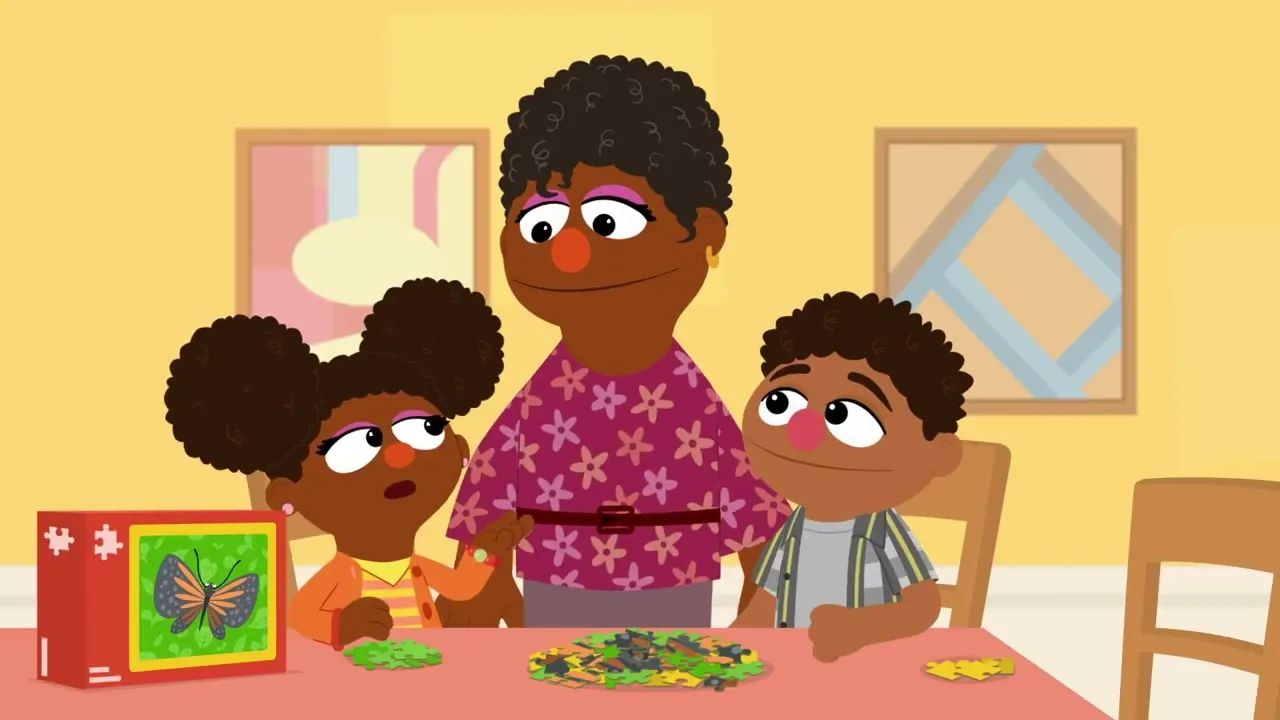
can offer support can be a powerful strategy. Saying things like, do you want me to help you, hear you, or hug you? is a powerful invitation. And so to capitalize on this, we created a quick animated video to show a little bit more about what this looks like in real time with some of our friends, including Grandma Nell. Let's take a look together. [VIDEO PLAYBACK] - Thanks for helping me, Tamir. - Of course, Gabrielle. It's easiest to start with the straight pieces like this one. - Eh, no, Tamir, we have to put it together by
color. That's the easiest, green first. - Ah, straight pieces first. That's the easiest. - No, all green pieces first. - Hi there, sugar plums. How's the puzzle going? [SIGHS] Uh-huh, well, that's a big sigh that I hear. And I see you're sitting far apart, not looking at each other. It looks like you're feeling-- - Frustrated. - I see. Well, when I'm feeling frustrated, I take a slow, deep belly breath. Want to do one with me? - OK. - Sure. [INHALE] [EXHALE] - Now, how do you feel? - A little better. - A little better. -
All right, good. Now, let's work on figuring out this problem. There are three things that I'm going to do here. We did one already. I helped you with those big feelings. Now, I want to hear what happened. - Well, I wanted Tamir to help put together green pieces in my puzzle first. - Tamir? - And I wanted to start with the straight pieces first. - OK, Gabrielle, can I hear why you wanted to start with the green pieces? - I like putting the parts of a puzzle together by color. - Tamir, why would you like
to start with the straight pieces first? - So we can make the border around the puzzle and then fill it in. - Oh. - I just heard you both give great reasons for doing the puzzle the way you each want to do it. Maybe there's a way you could work together? - Mm, I know. I can put together the green pieces, and Tamir can do the straight pieces. - Yeah, we can both do our own parts, and then, boom! put them together. - Ha, ha, I knew you could figure this out. - Yeah, thank you
for helping us, Grandma Nell. - And thank you for listening. - Of course. [CHUCKLES] - Hey, Grandma Nell, you said you were going to do three things. You helped. You heard. - Yeah, what's the third one? - Ooh, this pot is my favorite. Does anybody want a hug? - Me, me, me! - I do! I do! - Come here. [AUDIO LOGO] [END PLAYBACK] So, Julie, I love how in that video Grandma Nell was able to reflect those three big H's that we joke about here at the Sesame Workshop by validating the ways that children want
help solving a concrete problem by acknowledging the help that she can provide, by giving just that ear to give a chance for people to listen, to be heard, to vent and to talk through what's going on, and again, that powerful physical reminder of her presence with a hug. But all three of those helping, hearing, and hugging strategies are things that we see adults really giving to children that create spaces and opportunities to remember The power of connection. I absolutely love That, And you're right. So the children are connected, and then grandma is also connected. And
I think that that's something that we're going to be talking about, the power of connection, and how you can get through difficult times when you have people that will help you navigate that process. Let's talk a little bit about some of the data. Yeah. OK, so this data, it's brought to us by Jonathan Haidt with information from CDC. And what we're talking about here is how we as a society have really decreased the amount of time that we spend with people, with others in human form. And so when you look at the graph on the
left-hand side, you notice that all of the numbers are really going down. This is average time spent with friends in minutes. And from 2003 all the way to 2021, you see that our numbers are decreasing steadily. And this is all age groups. So it's children, it's adults, it's elderly. Anybody who's watching this can see their own age here on this graph. And another thing that's really interesting is that if you recognize that there's a line around 2012. And so that's where you see-- that's where you begin to see this steady decline. And if you think--
and the research demonstrates, when you go back to 2012, it makes you go, hmm, I wonder what was happening in 2012 that made our numbers decline. And if you think about it, most people will say, oh, social media. Close. It's not exactly social media. It's actually the smartphone and carrying the smartphone around with us where now we have access to pictures and online media and texting and our calendar and everything in one small place is one of the reasons, not the only reason, but one of the significant reasons why we are decreasing the time that
we spend with other humans. And so really understanding that decline, part of it is changes in technology. Part of it is many people moved into a virtual world as our technology has emerged through the years. Also, there's a drop in close friendships. Research demonstrates that in the 1990s, We had anywhere from three to four close ties or good friends. And now we're closer hovering around two close ties. And then simultaneously, maybe our friendships have changed a little bit. Perhaps we're not attending faith affiliations in person. Older generations spent more time in person in their faith
communities. And even pre-COVID, the participation in person had declined in faith communities. But then COVID really changed that. And now people will say, I'll just log on for the sermon and not have that human interaction. And then also, we have decrease in civic organizations. And then we live in a world today where there is extreme polarization. And so because of governments and what's happening in our world, and not to say that something is right or wrong, it's just that we don't have conversations with people because we're afraid that we might say the wrong thing. So
if don't know your affiliation, I'm going to tiptoe through a conversation or not even have the conversation. Or if I think you have a different affiliation, I might avoid you altogether. And so all of that really is contributing to a lack of connection, and that connection is impacting our mental health. So it sounds like it's not only impacting one specific group, but everyone in the neighborhood is both gathering information from all of these new places that we're getting information that we've never had before, but also maybe in the context of being overwhelmed or just not
knowing where to start, minimizing the ways that we actually engage with each other on a day-to-day basis. Exactly, in human form, because don't need to talk to you. I can just look on my phone, scroll on something, and find out the information that I needed rather than having the conversation. I don't know how many times you've been in a conversation with somebody when they say, well, I don't know the answer, but just Google it. Yeah. And it's like in the past, we might have had dialogue about that and tried to figure it out together, and
now we don't do that. So recognizing both the opportunities and the pushbacks and the advantages of living in a space that Has all these different innovations and opportunities moving forward and recognizing that media technology is neither good nor bad, it is here. That is the reality. What can we do forward, moving together in a place that ensures that we can reconnect? Well, that's a difficult question. I think a lot of it is recognizing what are the ways that we can each individually, as well as at our familial level and our community level, lean in to
support each other when things are difficult. And there are many instances where we can do things, Like learn some additional skills, be intentional about practicing social connections, being there and supporting each other. You heard Bert say, I'm a shoulder, and I'll make you a cup of tea. So that concrete support, all of those things, and we call those protective factors. And to focus on those protective factors and be intentional about learning and using those protective factors, we have the ability to make an impact and support each other through difficult times. And so some of those
protective factors are focusing on resilience, which is really the ability to recover when life is difficult. It happens to all of us, as you mentioned. So we're stronger because of the things that we go through. But in ways that we can support young people, as well as families, is really to demonstrate that people are valued or honor people's race and their culture or their religion or their history and help parents learn how to manage stress so that they can be there for their children and be supportive. Another protective factor is social connections, which we're going
to spend some time talking about resilience and social connections today. But social connections is really about the positive connection. It's that social interaction with somebody who is there for you, who cares for you when you need a little bit of support. And having these relationships in our lives, it really decreases stress. And so some of the things that we can do are create more inclusive environments or create opportunities for support and reciprocity. And then even to help create connections. When my son-- I have three boys. And one of my sons, when he was in third
grade, they switched schools. And he loved school prior to being in third grade. Then all of a sudden, he's in this new school, and he doesn't know anybody. And all the kids in that school, they had been together since kindergarten, and he was the new child that-- nobody really connected with him. It was really hard for him. And so after about a week, he said, I hate school. I don't want to go to school anymore. And so I reached out to the teacher, and I said, he's feeling really isolated. He doesn't really know anybody. And
she says, ah, I didn't even think about it. All these children know each other for so long. Let me connect him with one child who I think is a leader in the class. And all she did was put them on a group project together, and the rest is history. So it just took me reaching out but really the teacher being intuitive about how do I help this child feel part of the group? And then it was fantastic. Yeah, it's so much that it sounds like really heavily relies on both the awareness of all those caring
grownups and also the ability, the willingness, and the want to engage with each other to problem solve around that shared treasure, the child to make sure that they get what they need both in school, out of school, and through the spaces in between. Absolutely, and it made all the difference in the world for him. Yeah. Another important protective factor is focusing on what we call concrete supports in times of need. And that really is just I need help in a particular time. It could be something as simple as my car is broken down and I
need a ride. It could be I don't have food, or I'm at risk of eviction or something like that. So it could be a big need. It could be a little need. But we, as helping professionals when we hear of a need, even if it's outside of what we consider our purview to be, that's when we need to lean in for families because if I don't have food, I'm not going to be showing up to learn. And so recognizing when there's a crisis and being there to support and manage a crisis, helping people know that
they can turn to for help or where they can go to get the help. And then, of course, it always comes down to access to resources and information. At the end of the day, that's what people really Need when they're looking for concrete supports in times of need. Another is knowledge of parenting and child development. And I think this one, particularly in the mental health space, is really important because I think parents sometimes get concerned that their children are not doing what they're supposed to be doing. But in reality, that's the typical four-year-old behavior. And
it's frustrating for parents when you don't have the knowledge of what that typical four-year-old behavior is, And maybe you have different expectations. So helping parents learn what's appropriate, model developmentally-appropriate interactions with children, provide space for them to practice new strategies when we share new strategies with them. And the last protective factor is social-emotional competence, which is really the interactions that support our ability, the ability for children to communicate, articulate, recognize their emotions, and even have relationships when they're frustrated, as you saw in the video that you just Shared with Gabby and Tamir. So role modeling,
nurturing help for parents so that they can discuss emotional challenges. A lot of the parents never talked about their emotions with their parents. And now here they are trying to educate their children about it. So giving them homework to teach them how to do it, those are all helpful ways to build those protective factors. These are huge opportunities, Dr. Julie. And I think one thing that, as you were naming them, reminded me of the power of connection between a caring adult and a caring provider And that parent-teacher or that parent-caregiver provider dynamic was really thinking
about it almost as cash in the bank, right, that when we have regular conversations with families as providers working in spaces that are shared with children and their families, we have the opportunity to, as much as possible, communicate all of the good that we see, from conversations that are had, from experiences that are shared, from words that are said. That's cash in the bank so that if there are times further down the road when difficult conversations need To happen connected to behavior or opportunities to refine something for the support of a child, we know there
has been honest, cooperative, delicate communication so that everyone is invested in the well-being of the child moving forward. And I think the protective factors that you've named really underscore that idea, that when we know all of the power that we as adults have with children, we can gift those same opportunities and powers to the children themselves as they grow into those roles of leadership across our communities. Absolutely love that. I love that, too, because it's difficult to be a parent. And so knowing that your child's teacher is on your side and you guys are a
team, I think that's an amazing social connection that, as you said, cash in the bank. I know that I can count on that person. So that's lovely. Yeah. So friends, with a greater now awareness of all of those different ways that Julie has walked us through, both some stats from the Harris Poll and also what is happening within all Of our own brains, our communities, and our conversations with children and the caring grownups in their lives, let's turn a little bit more into the resources connected to resilience and the ways we can share them with
children and families in our care. And I want to underscore this by learning a little bit more from you, Julie, about the ways that the Harris Poll reflected how Americans understand resilience in our current state. Absolutely. So teaching resilience really begins with being encouraging and honest And helping the children to learn some of the skills that they need. And so they can do this through support from adults, through being taught resilience, and then through resources and opportunities. And so some of the information that the poll really revealed is that adults around them, like parents and
teachers, encouraging children and believing in their abilities builds resilience. And ensuring that all children have equal learning opportunities builds resilience for all. Teaching children to work through rather than just pretend That they're not having these negative feelings, that builds resilience. And helping them learn how to find solutions and challenges, like again, the video when Grandma is showing them how they can compromise and work together to solve a problem. And so when adults around them are honest about their own feelings about being happy or sad or angry, it teaches children it's OK to talk about their
own feelings. And then helping create support networks for parents. Parents can support each other. I remember when my children were young going to the park And being around other parents who were in the same exact situation was the most important aspect of-- it was the way that got me through what was a really difficult time. I had three children under the age of three at the same time. And so being able to be with other parents and be like, this is really stressful, was amazing. And then teaching children that mind-body connection. When we model for
children the way to process their emotions, then we're giving them the tools that they need in order to get through difficult times. Yeah, I think what you said, especially About that last third part, I think that's related to resources and opportunities, is from an equity perspective when we think about the ability and opportunity for children to bounce back from challenging situations, we don't want to give them hard things. The world is sometimes difficult enough to process and to navigate. But what we learned from a Sesame perspective in our conversations with advisors and subject matter experts
related to children, development, and family caregivers is this idea that everyone in every family Has routines. And those routines are great spaces to practice resiliency, where children can bounce back from challenging situations because they know what to anticipate. They know the end goal, and they play a pivotal role in that process. And so as we started to build resources connected to resiliency across the Sesame Workshop, we tried to use those daily rituals that happen in every family as the jumping off point where families could really practice this in real time With children in their care.
Absolutely love that. I think it's also important to recognize that children are-- they're the cornerstone of our families and actually of our communities. And so building resilience in children, really, it spreads strength throughout communities. And I love the fact that the Harris Poll really pointed this out. Fostering resilience in children has this ripple effect of spreading strength and even courage through communities. And 90% of adults think that, which I think Is absolutely fantastic. And then 88% of adults feel that the well-being of children would improve if they had the tools to be more resilient. So
that comes down to educators and parents teaching our children how to become more resilient and get through difficult times. Our youth these days are really struggling. And part of that is because of what's happening in our world. And part of it is because parents are also struggling. And so we as those in the education field, we have to figure out how can we support people to help them get through difficult times. Yeah, I think also a really important connection to that is that sometimes, I know that in conversations with other early child care providers and
caregivers, conversations really have to deal with dispelling misconceptions about what it takes to build resiliency. And it's sometimes forgetting that we have so many of the tools already built into who we are as humans. It's taking big belly breaths. It's thinking about things that we can do to calm ourselves down and then thinking about the ways that we can share those resources and gently remind others in our care. And so, to that end, we at Sesame Street built a quick video to show you this idea that spreading strength and courage across communities can be as
easy as taking a quick butterfly breath. So in this video, you'll see Alan and Abby doing that, thinking I would encourage you a little bit more about how this could be reflected in your own work and play with children and families. Let's take a look together. [VIDEO PLAYBACK] - Like that, and then I-- - Did you get-- wait, what? - No, I-- I-- I-- - I can't get this. - It's supposed to-- ah, Alan, my pinwheel isn't turning out right. It doesn't look like the finished one that came with the kit. - Neither does mine.
I was so excited to make these pinwheels, but the instructions are so confusing. - I know. It's making me feel so-- So-- so-- - Yeah, me too, Abby. - Ah. - When something is bothering us or making us uncomfortable, we can feel irritated. - Yeah, well, I'm feeling irritated. - I am, too. - Ah. - You know what? I have an idea. - Huh? - All right, why don't we take a break, all right, And try some butterfly breathing? - Butterfly breathing? - We are going to pretend to breathe like a butterfly because it's an
exercise we can do to help us feel less irritated. Do you want to try it? - Yes, I definitely do. - OK, great. So the first thing we do, we put our arms out, and we pretend to be beautiful butterfly wings. - Wait-- [LAUGHTER] Alan, you know I'm a fairy, right? I don't have to pretend to have wings. - That's true. - But I can pretend to have butterfly wings. - OK, let's do it. All right? Arms out? - Yeah. - Great. And then we're going to raise our wings high above our head as we
slowly breathe in through our nose like this. [INHALE] And then you lower your butterfly wings as you slowly breathe out through your mouth like this. [EXHALE] All right, you want to try it with me? - Yes, so wings. - All right, wings high above your head. Breathe in through your nose. [INHALE] And then wings down. Breathe out through your mouth. [EXHALE] One more time. Up. [INHALE] And down. [EXHALE] Good. - Ah. - Now, how are you feeling? - Well, I'm feeling less irritated. I think I might be ready to try this pinwheel again. - You
know what? Me too. Hey, Abby? - Yeah? - You know what butterfly breathing is also good for? - What? - Watch this. [MUSIC PLAYING] [LAUGHTER] Pretty good, right? - Yeah. [AUDIO LOGO] [END PLAYBACK] However, that video underscores the importance of not only mind-body connection, Of just the ways that when we realize what we need to make sure that we are the best of ourselves, we can readily connect with other people really working to do the same thing. I love that. It's so funny because I do a lot of training. And when I talk about difficult
topics, I usually start the training with talking about butterfly hugs, which is so similar, but it's for adults. And basically, it's a tapping technique that's used in trauma to teach people how to regulate their nervous system when they feel Their stress is increasing. So very similar. So that was adorable. It's a timeless video. And you can use it for everybody in the neighborhood, right? Exactly. So friends, with regards to both that video and all of the assets that we've been creating connected to resilience and emotional well-being, before Sesame Street and the members of our Muppet
team begin to build out all of these beautiful resources, we think a little bit and gather data and evidence from subject matter experts From around the United States. And in conversations with that advisory panel, we understood that a child's circle of care or those trusted adults in a child's life really play a role in building the resilience children have. And so what we do when we think about that is try to explore a little bit more, as I mentioned before, the ways that daily interactions, routines, and opportunities to share and to listen can really expand
a child's emotional literacy so they can both understand what it is they're feeling and articulate that out loud to other people. And what we recognize and in doing that is that we provide for both children and their families the blueprint to bounce back, right? When we're able to recognize resilience in early childhood, we can help children learn. We know that trial and error provides for kids the routine of a process with varying degrees and responses to achieve a goal. And for kids, being helpful in trying to identify what course of action needs to happen can
help them try to figure out how to do it better again and again. We also know that resiliency shifts mindsets. A child's ability to move from this idea of not being able to do something to not being able to do something yet is a big growth mind shift, and that changes and encourages children to think about not only their capacity to do more but their capacity to continue to revisit challenging situations in curious, excitable ways. We also know that resiliency really sets the stage for mental health, that building resilience in children helps them overcome obstacles
more easily and reduces the chances of them suffering From anxiety or other stress-related disorders. And finally, as has been pointed out by Dr. Julie, it is the cornerstone of lifelong learning. Executive functions like attention, problem solving, decision making contribute to greater resilience being the most efficient means of overcoming adversity. And so then when adults support children in strategies that celebrate persistence, that cultivate confidence, and that communicate needs and wants, we all provide children with the tools they need to be successful in school, in life. And Dr. Julie, that idea of connection is, I know, integral
to the work that you do and to the conversations that we're going to be talking through today. And we recognize the power of communicating and connecting from one person to another, but we also know that it's important to think about what that connection looks like, not only between two people, but within our own minds, bodies, and hearts. Before children are able to engage in healthy ways to the places and faces around them, providers and caregivers working with children can help show the connections between a child's own mind, Body, and heart. Together, these three elements fuel
growth and learning, helping kids develop healthy relationships, not only with themselves, but build healthy connections with others. And in this article from Dr. Amy Shriver, a pediatrician at Blank Children's Hospital in Des Moines, helps children define the foundational components of child wellness as having healthy minds, healthy bodies, and healthy hearts. She explores in the article the idea of healthy minds, and this idea that caring for a young child Means stimulating their brains by having positive, playful interactions, things like singing, talking, playing games, and reading. And then, with regards to healthy bodies, she goes on to
explain that by eating and offering nutritious food, making sure that kids get the recommended hours of sleep, and ensuring that they move every single day with things like those butterfly movements for breathing, all of those physical, healthy habits support children's developing brains and emotional wellness. And finally, with regards to healthy hearts, we know that equally important part of caregiving Is addressing a young child's emotional needs, their hearts. A healthy inner life helps children understand and manage their feelings, connect with parents, caregivers, and peers, as well as being a good friend to themselves. And I'm interested,
Dr. Julie, as you think about the connection between who a child is and how they're feeling on the inside and how the child shows up and connects with others on the outside, what are some strategies that you have seen worked for caring grownups working with children to make them get attuned to how they're feeling on the inside? I love that question. When you were talking about resilience before and now it's following through into this connection space, when children are frustrated or they're sad or they're angry or even if they're happy, being able to articulate what
they're feeling like, whether it was a good response or not such a great response, just being able to talk about it I think is really important. I also think it's also-- and I loved how you said that they haven't learned that skill yet because if I'm with an adult and I'm frustrated with something And that adult teaches me something but does it in a way that it makes me feel valued and that I just haven't learned it yet and that I will do it better next time, I can walk away from a mistake or a
tantrum or something like that knowing that I've learned something new. And for me, processing that, what was the lesson that you learned here with the child, I think is so valuable. So it's not so much about teaching the skill, which of course, is important. But then it's the circle back that brings us forward with what's inside versus what's outside to be able to say, So I learned that I can get sad or frustrated. And I can take a deep breath. So next time I get sad or frustrated I will take a deep breath. And then
to be grateful for the person that taught that to you. And all of that was in the video. And they were like, Grandma, thank you so much teaching that skill. But it's the processing that I think is the most important part. Yeah, and I think that with that processing is the pivotal role that an adult plays in ensuring that a child knows that they're Seen, feels recognized, has the space to be heard, validated, and then moving beyond that. And we know to that point, that when we take quiet moments to connect with kids when they
need it most, everybody benefits. Those close, loving moments helping kids manage big feelings, remind them that we all care about their feelings, too. We're going to take this moment and ground this in a conversation in a short video with two of my Muppet friends here at Sesame Street, Wes and Eli. Let's take a quick moment and see how they stay connected. [VIDEO PLAYBACK] - Wes! Hey, Wes. Wes? - Oh, oh, hey, dad. - Oh, you're all shaky, son. Here, ah, ugh, ah. You want to tell me how you're feeling? - Well, dad, I'm excited for
my steel drum performance at school later today, but my tummy feels kind of funny. - Well, I'm glad you're listening to your body, son. - Oh, yeah. - If I know my son, which I do, I'd say you're feeling a little nervous. - Yeah. - Oh, here, let's try this. Here, give me a hug. - OK. [SIGH] - A nice long hug with someone you love is one good way to slow down and help you pay attention to your feelings. - Yeah, I love playing my steel drum, but what if I mess up? - Well,
it's OK to make mistakes and mess up sometimes. It happens. But I think you're going to do great. - Ah. [CHUCKLES] [SIGHS] - Hey, you hear my heartbeat? [HEARTBEAT] - I hear it. Boom-boom, boom-boom, boom-boom. [LAUGHTER] - So how are you feeling now? - Well, I'm still a little nervous, but I am excited for my steel drum performance. - That's what I like to hear. - Yeah. - You know, I was feeling a little nervous at work, too, earlier. - You get nervous, too? - Oh, yeah, but I'm feeling a lot better now after our
hug. [LAUGHTER] I'm proud of both of us for taking care of our feelings, Wes. - Yeah, me too, dad. Come here. [MUSIC PLAYING] [AUDIO LOGO] [END PLAYBACK] So, Dr. Julie, following this video, I'm interested in learning a little bit more about what bubbled up for you in the context of co-regulation? We talked at the beginning about recognizing that we know that when we soothe children, it also benefits us. It's thinking about how we notice our emotions and can handle them while also mirroring that for a child. But what struck you in that video? Absolutely loved
the fact that dad was able to say, hey, I was nervous, too. I think that that made it OK for Wes to be nervous and uncomfortable. He was surprised that dad felt that way. And then the fact that they could share a hug and relax into each other's space, do you feel my heartbeat? And that was a distraction for sure. So maybe, Wes is being distracted by dad. And also, though, they were able to both share something together. I think that that builds connection and support. And so being there for your children when they're struggling
and then also children being able to be there for their parents is teaching that I can be supportive of adults. And it is a reciprocal relationship, which we're going to talk about. Yeah. I know, for me, when we first started this, you asked me how I was doing in Elmo, and I was like, I'm really excited, and I'm a little nervous, too. And for me, being able to reframe that nervous feeling is because this is important. And so I always love to, again, circle back to that processing of the emotion is like that nervous feeling
you're feeling is because this is really important. For me, it's important to share my research with young children and with people who work with young children. And so for Wes it's important to play the drums because that's something that he really values. And so it's OK to be nervous because that shows that you really care about something. Yeah, yeah, and also this idea of simultaneously giving a help, a heart, and a hug all at once Is a powerful technique to see both in a Muppet or also in a moment. But also, when we talk about
emotions, sometimes there's negative connotations associated with them. And so often with children, particularly with big feelings, we want to walk away from this idea that there are no such things as bad feelings. There's big feelings, and there's feelings like all feelings that can come and go. And so we want to give children the language and the recognition to understand that we can all have sunny days and stormy days And cloudy days. But when we name them, we have a better sense of how to get through them together. And I think you really articulated that we
were able to capture it in that video. Absolutely, I love it. And so we talked a little bit about all of the benefits that come from connectedness. But tell us a little bit more about how that feels to us on a human level. Yes, when we talk about social connections, most people think that it's an emotional connection Or a mental connection or something that's around your feelings and the support that you get. I love to share with people that it actually impacts our body, too. And connection is not just about your mind and your emotions
and the support that you receive. It's also about that when you have connections in your life you actually live longer. And the research demonstrates that you live almost 3.67 years longer when you have strong connections in your life. That's amazing. Also, we know that when you have connections it decreases stress because if I'm frustrated and I can share with you that I'm frustrated, I feel better. So that conversation that we have, that decreases my stress. But then physiologically, when you have connections in your life, you have better cardiovascular health. And you actually have a reduced
risk of cardiovascular disease. And people don't realize that. Even something as though-- having a connection increases your immunity. And these are all research projects Where people were looking at the physical, physiological impacts of having connection. We would expect that there would be a decreased risk of substance use or decreased risk of mental health conditions with connections. But did you know that you actually think faster when you have connections in your life? And so, for me, I just love being able to talk about the physical aspects because if I didn't really-- if I wasn't valuing connections
as much as I should have been, once I hear these, it's like, well, wait a second. If that's the secret sauce, I want it. If I can have all these health benefits just from being connected, then I'm in. Yeah, yeah, and I think that what you're really teasing out is this idea that we know and have all of those different ingredients, as you said, the secret sauce for happiness and for connectedness. And it lies with each other and how we understand our connectedness to each other. Absolutely, absolutely, and I'm so excited to share with you
this piece of information, Which is really about science-based elements of connection and support. Most of the work that I do is around research, and I really appreciate the opportunity to share my research. So these are nine different aspects that build connection and support. And when we have them in our lives, we have a greater likelihood of experiencing happiness. And so I think most people think like, well, maybe I don't have friends, but I don't know how to create those friends. Or parents feel like I'm not-- I don't feel like I have a support group, and
so I'm going to be lonely and depressed by myself. And so what I'm trying to share with people is that you do actually have the ability to create connection and support in your life, and that by using some of these science-based elements it's easy to do. So I'll just walk us through some of them quickly. Talking about intentionality, which really speaks to that we're able to focus on and create connection, anything we put our attention to we can create. And so maybe talking to children, young children about thinking before they do something, when you don't
think before you do something, it decreases your chance of having connections because people might be frustrated with you or you've hurt their feelings. But when you're intentional about doing things, then you have a greater likelihood of maintaining connection and support. Another one is proximity. So this principle of proximity states that being close to, either physiologically or psychologically, Tends to increase our ability to be likeable. So just by being-- if you think about the person that's-- if you're teaching in a school-- the teacher next door to you, just by virtue of the fact that that's your
next door neighbor, so to speak, creates a connection. So talking to your children that you're working with about to play with their neighbor or to spend time with their buddy. I told you about how my son's teacher connected him with another youth. And just by that proximity of spending time with that youth, He built a connection. Another aspect or example of the science-based is connection, connectivity, which is really about the energy that exists between people. So when you are working with young people and you see that they naturally gravitate towards another young person, point that
out. Comment on it, and try to figure out what's the connection between them? They both enjoy a particular activity, which brings us to commonality. So commonality is when individuals Share common interests or purpose there's a greater likelihood that they will be connected. So if I like a particular sport and you like a particular sport, well, we're going to talk about that sport. And we're going to enjoy our time talking about it because we have things in common. So if you're working with children and they don't have connections trying to help them identify what are areas
that they have in common with other young children will help them build that connection and support. I talk to-- another one is vulnerability. And again, when we started this, I said, oh, yes, I'm a little bit nervous about doing this. And that vulnerability, probably made some people feel like, wow, she's being genuine and authentic and feel more of a connection. So being able to be vulnerable with your feelings, even if you're an adult talking to a youth, tell them how you're feeling. And when something makes you feel a certain way, it builds that support and
connection. Another one is being dependable, and so it's an important aspect of support that we will be there for you. We heard that with Elmo and Bert and Ernie, and they wanted to be there for him if he needed something. So point out when children follow through on something as a sense of being proud of them. And that will make them do more of that. I think reciprocity is one that-- well, first of all, it's inherent. We don't even realize that we're doing it. But if you're walking down the hallway and you smile at somebody,
what happens? [INAUDIBLE] They smile, right? They smile right back. And just that smiling creates a connection. If I see you in the hallway and we smile at each other and then I see you later on in the day, you're like, hey, I remember her. We smiled at each other. So just by virtue of just being ourselves and being reciprocal we build that connection. Another one to talk about is flexibility. And you saw that in the video with Gabby and Tamir. They were not being flexible in the beginning. And watching the Muppet body language, They moved
from different sides of the table because they wanted to get away from each other and separate because they were frustrated with each other. And then when Grandma taught them to be a little bit more flexible, all of a sudden they were friends again. So we can see this in our political climates. We can see this in children playing on the playground is when we want things only our way, then it breaks connection sometimes. And then the last science-based element that I like to talk about is positivity. When you are more positive, people want to be
around you. That positive attitude is something that is contagious. And so we try to exude that and share that with others, especially when people are struggling. And so all of these aspects will facilitate having better connections and better support with people. As you think about in the way that you've brilliantly outlined all of these different moving, competing challenges that really shape the way that we understand mental health, is there one that in your mind takes priority, or are these all equitable? I wouldn't say they're equitable. Some of them are easier to achieve than others. It's
really easy to sit down and try to find a commonality with somebody, and that commonality does build connection. It's a little bit harder to prove that I'm dependable because you have to trust me in order for me to show up for you. So I don't think that any is more important than the other. Though, I also feel that intentionality is probably the first one that we should try, which is to just recognize, hey, I don't have this connection in my life. Or I'm feeling lonely or isolated. I need to find some support. So that awareness
of hey, I need to do something different, and then I have the ability to intentionally change the way I feel right now. So I think that's important. Yeah, you've brilliantly teed us up to this idea of what happens when we aren't connected? And how does that get reshaped? Talk us through the ways that we can build social connections. Absolutely. I love to use this tool because it's so simple, And anybody can use it. It's something that you can do for yourself. You can do it with one of your students. You can do it with a
parent. If somebody is feeling lonely or isolated and maybe even anxious or depressed, which is kicking up loneliness and isolation, and we look at the different aspects of their lives. We call them social domains. So we look at the different domains in their lives and talk about who are their potential supports in any of those domains, we get a sense of what we're dealing with, And how we can help them begin to build connections. So if I might say to you, OK Antonio, you're feeling a little bit sad or lonely. And I would say, OK,
when you're at home, if you're feeling sad or lonely, who would you talk to? Or who could you turn to? And you might say a sibling. You might say a friend. You might say your dog. You also might say nobody. And then I say, OK, well, when you're at school or work-- school for children, work for adults-- so when you're at work, If you're feeling lonely or isolated and you felt like you needed somebody to talk to, who might you talk to? And you might say, the person that sits next to you in your office.
You might say your supervisor. You might say nobody. That's a real reality. In your neighborhood-- I live in Florida, and in Florida, we don't actually usually talk to our neighbors, it seems like, unless there's a hurricane pending. And so in my neighborhood, is there somebody I would talk to if I was feeling lonely or isolated? You might say your next door neighbor. You might say my cousin that lives three blocks away. Or you might say nobody. If you're in your faith community and you're feeling lonely or isolated, who would you talk to? You might say
a pastor. You might say, I'm not involved in a faith community. Any kind of activities that you do, whether it's a club or a sport or something like that. And so you go circle by circle and ask, Are there people in your life that you can support? And so from doing an activity like this, you learn one of two things. One thing is you learn that you know what? Antonio, you actually have more support than you realize because you do have somebody at home, and you do have somebody at work, and you do have somebody
in your faith community, and you do participate in activities. So what we need to work on is helping you access that support, right, teaching you to reach out to somebody when you need it or helping you feel More comfortable doing that. Asking for help is really hard. Or we might realize that you really don't have a lot of support. If we go circle by circle by circle and there's nobody, nobody, nobody, nobody, well then, how would you expect to feel? Lonely and isolated. And then in that case, we need to work on helping you build
supports. And what are some of the intentional things that we can do to help create connectivity, To help with commonality, to help with dependability, using those science-based tools to help build. And it sounds like you're both articulating both what adults can do as they think about their own locus of control and connectedness to others, while also creating opportunities to model this for children, to think about the ways that we can show children ways to engage, ways to reflect on when we are feeling lonely and what we can do about it as we think about the
people in our neighborhoods, across our schools, in our workplaces, to help switch the narrative and reshape the story. Absolutely, absolutely. Absolutely, so as caring adults, we are in the situation where we would recognize that somebody is struggling, hopefully, that class sizes are small enough or your caseloads are small enough or you're in touch enough with the children that are around you that you're able to recognize when they're struggling. And then figure out how to lean in. For example, one of my sons, we have dinner together every night. And that is a protective factor because I'm
Able to lay eyes on my children to be able to see when they're feeling happy or sad. So one of my sons, he tends to be to himself when he's having a rough day. And I can notice this at dinner and then know like, OK, so tonight, after we clean everything up and we're getting ready for bed, I'm going to go and spend a little special time with him and intentionally lean in because I recognize that he was a little bit to himself. I don't expect that he's going to tell me all the things that
are bothering him right off the bat. Walking in and centering on what was the best thing that happened to you today? Or did you see something funny on social media that you want to share? And I'll share something funny that happened with me. And that begins the conversation. So when you see something lean in a little bit to recognize that. Intentionally invest time in nurturing connections is really important. So we are all so busy, and children are watching what we do every day. And so if I'm taking the time to put the phone away, turn
the television off, and connect over something small, that's going to make a difference. That's how a caring adult can show a child that they are important to them. So when you're having those conversations, minimize those distractions. So put the phone away. I can't tell you how many times I've gone to a restaurant, and you look around. And everybody's on some kind of device sitting at the same table. And so that takes away from connection. And we have to recognize that and realize that you are the role model for your children. One of the activities that
I often do is have people look up their screen time and figure how much time they're spending. And parents feel that young people are on their phones way, way, way too much. But in reality, most of the time the parents' screen time is more than the children's screen time. And so what are we role modeling for our children when we spend all of our time on devices? And what's really important is this concept of creating an opportunity for altruism. So seeking opportunities to serve and support others. There's so much positive research around altruism and how
it improves our mental health. And so taking time with your children to even do something like a beach cleanup or go feed the homeless or something to that effect, showing them that it's important to you to help others. But also, you're spending time with them while you're doing it. You're not sending them to do a beach cleanup. You're doing it together, right? So investing that time and showing them-- And then also looking at ways to incorporate connection and support and doing things together in the activities that you use, whether it's taking turns reading. So any
kind of educational techniques that you might use, but we're going to take turns doing it. We're going to work on it together, like the picture of the puzzle or the video of the puzzle. So we're using that opportunity to collaborate is a way to build connection. And then in all of our materials that we use in schools, we want to be focusing on the social-emotional learning, Especially with young children. So these are all ways that we as grown-ups can support mental health through simple activities of connection. In addition to all of those great ideas, Julie,
we also want to help concretize for children those big concepts that can help them manage big feelings. And so to capitalize and to add on to that, I wanted to add this quick video of Big Bird and Granny learning a little bit more about the power of a comfort container. Let's take a look at it together. [VIDEO PLAYBACK] [MUSIC PLAYING] [SIGH] - Hello? Guess who? - Oh, hi, Granny Bird. - What's the matter, Big Bird? - Well, Granny Bird, I was playing jump rope with my friends. - Mm-hmm. - We were all supposed to take
turns jumping. And when it was my turn to jump, well, everyone laughed. - Oh, so you wanted a turn to jump rope, but you didn't get a turn. - No, I didn't. - Oh, that does sound disappointing. - Yeah, it sure was. But then my-- my tummy kind of started to hurt, and my face felt hot. And you know what? I didn't want to play anymore. - Not getting my turn would make me feel disappointed, too. Sometimes when we have big feelings, having a quiet moment can help us feel better. Would you like Granny Bird
to stay right here? Or would you like some quiet time to yourself? You know I'll be close by if you need me. - Hmm, Granny Bird, I'd like you to stay right here. - Well, all right. Oh, hey, I have an idea. Let's take out your comfort container. - Oh, yeah, there it is. - Well, let's see what you have in there. - OK, well, I've got a squeeze ball. I like the way it feels when I squish it in my hand. And I have crayons because I like drawing, Especially when I'm having big feelings.
And here's a feather from Auntie Mommy Bird. It helps me remember her hugs. - Oh, that's nice. - Yeah. - So how are you feeling now? - Mm, I feel a little better. - Oh, that's good. What else do you have in the comfort container? - I have my favorite storybook. - Ah, The Little Bird That Could. I love that story. It reminds me of you. - Oh, can you read it to me? - I'd like that. Once upon a time, there was a little bird who was feeling disappointed. But he'd packed some of his
favorite things to help-- [AUDIO LOGO] [END PLAYBACK] I love that video, Julie, and I love how in that video there's an opportunity to just globally talk about what anybody can put in their comfort container, but then also the really sweet, individualized approach That Granny Bird and Big Bird take to thinking about and exploring together what he has put in his own comfort container. Talk to me. Just what would you put in your comfort container if you could build it in any way possible? And something that would be small. You could carry it wherever you wanted
to and take out whatever you needed. But what would you put in your comfort container? - Oh, my gosh. It's awesome. So I love this. I absolutely love this little video because it's one of the tools that I actually use. So in one of the evidence-based practices that I use, they have something called a wellness toolbox, which is very similar to your comfort container. And so we teach people who are struggling with their mental health to create their adult version of a wellness toolbox. And it's a great way to get to know somebody is to
ask the question that you just asked is, what would you put in there? So in my wellness toolbox, I have a playlist of songs that are uplifting songs. I have a bath bomb because I remind myself to go take a bath; a tea bag to remind myself to go make a cup of tea. I have pictures of my children when they were little because they were adorable when they were younger. What else do I have? My favorite candy, a letter from my mom that just makes me smile. So yeah, and I actually, usually, I don't
have it right here with me, but usually I share it during training To show people that actually-- that I do this because it's an amazing tool. And what I really love about this is it's tying together both resilience because that's a true resiliency tool. It's something that I can do on my own that can help me get through a difficult time so I can bounce back. But then talking about it with somebody, like you, like Granny here, that's built connection. So what about you? What would be in your toolbox? I can't compete now. You've got
all the good things in yours. I think I would add definitely some crayons and paper. I think definitely some music. I think that's what definitely keeps me calm and gets me relaxed. I think I would include a photo of my dog, my favorite little animal. I think some pictures from family and friends. I used to play the saxophone when I was a little kid, so maybe some little instrument or something that I could play. And then maybe something like bubble wrap, Something I can pop whenever I'm stressed or thoughtful, and then maybe a book to
write in or a journal. I think those are the things that would both keep me moving but also keep me grounded in times of stress. But again, I love how you've been able to weave this into your conversations with children and other grown-ups working to support them just because it's a really good tool to use for everybody in the neighborhood. Absolutely, totally agree. So, friends, in our last few minutes of the conversation, Let's take a quick moment to celebrate all of the information that we've shared and learned together. So together we explored some of the
biggest takeaways from the recent Harris poll detailing the ways that the state of well-being in America was perceived by the providers and the caregivers that live here, and then explore the ways that resilience and other protective factors could be promoted for children to grow in their connectedness to others, to their own mind, body, and heart, and even again, also in the ways they can reach out and tell other people how they're feeling. And through some of the newest resources shaped with funding from Kohl's, we've been able to explore the ways that things like butterfly breathing,
comfort containers, and even our own bodies and brains remind us of the power to persist. In that same way, Dr. Julie was able to share with us, not only the social influences of mental health, but some of the biggest ways that we can keep everyone in the neighborhood healthy and happy by thinking about what we need on the inside and how we articulate that on the outside. Dr. Julie, as we close this conversation, what Are some important things that you want us to make sure that we remember? Well, for me, I hope that one of
the biggest takeaways is how important connection is because 85% of Americans agree that we aren't meant to solve all of problems by ourselves. We're supposed to be working together. We are human beings by nature. We thrive off of connection and being with other people. We're not meant to be alone and solitary. And I also think that it's important that Americans believe that resilience is fostered In the goodwill of others. And so when we can do kind things for other people and nice things for other people, it helps our mental health as well as the mental
health of everybody else. And connected to that, friends, Dr. Julie and Friends will join us for a second conversation connected to this first one, where we think about those additional components of building community, not only through the lens of resilience and social connection, but the power of kindness. And so stay tuned for our second conversation that will come out Soon to detail some of the other ways that we can keep children and their grownups smarter, stronger, and kinder one relationship at a time. Dr. Julie, on behalf of the Sesame Workshop, thank you for being and
sharing all you have to learn and to give with all of us. - Thank you for being you. This was so fun. [AUDIO LOGO]