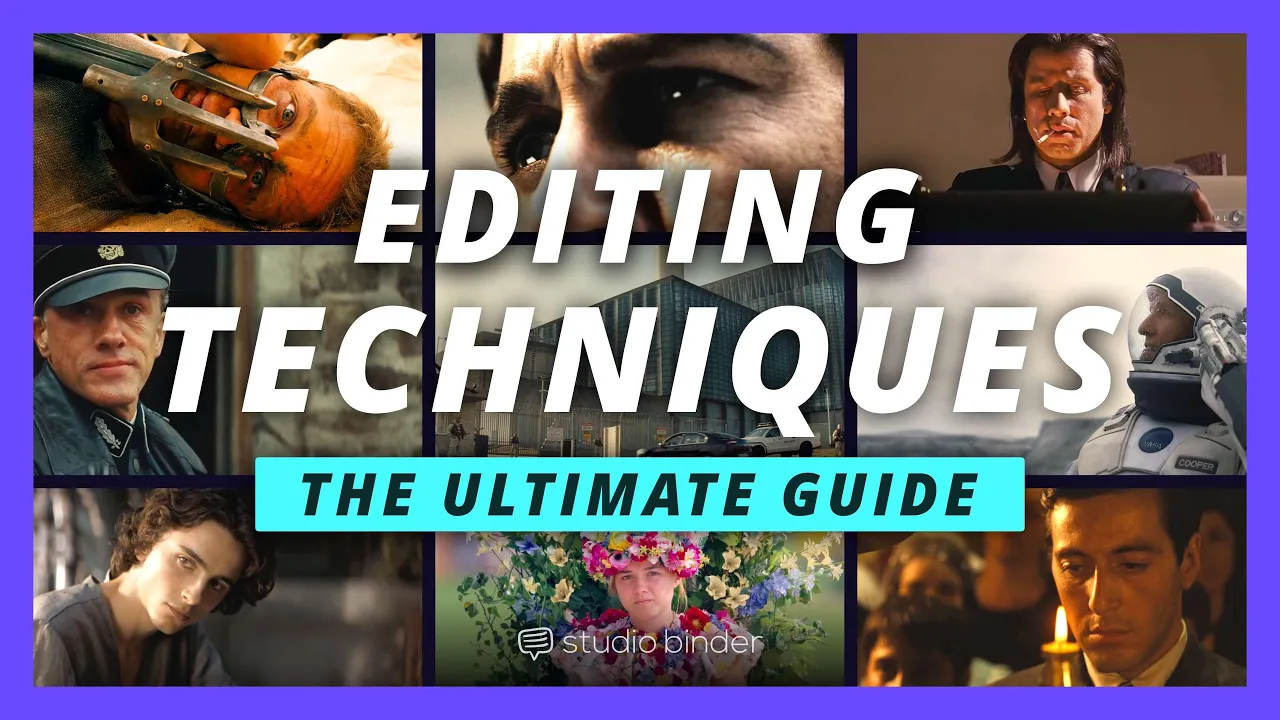
[Music] films are made up of sequences sequences are made up of scenes and scenes are made up of shots in previous episodes we covered camera lenses frame rates discombobulate and scene transitions [Music] today we're going to look at another angle of editing by examining different ways we can cut within the scene this is episode 10 of the shot list editing techniques almost all of an editor's work comes down to three choices what to show when to cut and what to cut to what the the cut itself is the most basic way to move from shot
to shot and when an editor cuts away from the main action it's referred to as a cutaway [Music] give famed editor walter merch laid out his rule of six a list to prioritize criteria when deciding on each cut how we pace a scene can affect emotion style and tone is your scene mournful and contemplative hold on shots for longer hello darkness my old friend i've come to talk with you again is your scene filled with frantic action rapid cutting might be an order deciding what to cut to is equally important an editor might use a
cutaway to indicate what's on a character's mind [Music] or cut to what a character is looking at no matter the reason every edit should be thoughtful and purposeful for a detailed explanation on the rule of six you'll find a link to our blog in the description this brings us to our first editing fundamental eyeline an eyeline match is when an editor cuts to the object of a character's attention [Music] if a character notices something we cut to what they see the second shot is often a literal pov shot or from that character's general perspective this
is such common practice that we can build intrigue by either waiting to reveal what they see fran doyle back to the ranger now or by not showing it at all we happy vincent we happy yeah we happy either way it's the characters eyes that motivate the cut consider this moment from 300. choose your next words carefully leonidas they may be your last as king as king leonidas debates whether to submit to xerxes control watch how his eyes guide the edit with each glance we cut to his land his citizens his wife and in this process
we are invited to think like leonidas will he sacrifices people's freedom or not a common form of the isline match is the shot reverse shot when we cut between a shot of subject a and a shot of subject b in a reverse angle that is often a similar angle and composition the most common use of this can be found in conversation scenes to maintain scene geography and clarity inserts are also often prompted by eyeline matches an insert is a shot of a detail within a scene usually in order to emphasize a specific prop or element
in tenet the protagonist looks off camera and we cut to this insert an example of simple and direct visual language the eyeline match is a great way to connect the dots between what the character sees thinks or feels impressive very nice it can also create and release tension depending on what we see and when we see it [Music] [Music] george george hi george what's going on instead of cutting between two objects in the same scene our next technique cuts between separate scenes cross cutting cross-cutting is when an editor cuts between two or more scenes happening
in different locations usually at the same time the baptism sequence from the godfather alternates between michael renouncing evil michael francis ritzy do you renounce satan and his men following michael's orders to execute his rivals by crosscutting these scenes it creates an ironic juxtaposition that elevates the entire sequence in all his works [Music] [Applause] i do announce them but cross-cutting can also be an effective way to combine multi-layered action as well in rogue one the last third of the entire film is a massive sequence comprised of three distinct battlefronts the combat on the beach the dogfight
in space and the covert operation to steal the death star plans [Music] in fact each of these fronts split into additional subplots but by alternating between these scenes the crosscutting helps keep the plot and action constantly moving forward and the audience invested in each group's progress crosscutting can create parallels between separate scenes that wouldn't be there otherwise and weave multiple planes of action in one now let's look at a technique which is designed to keep the audience's attention fixed to a specific part of the frame itrace itrace is when an editor cuts between two or
more shots that focus on the same area of the frame this allows the viewer's eyes and attention to stay focused without having to scan the frame after each cut welcome school [Music] itrace can also be used through blocking and camera movement guiding a viewer's eye within a shot [Applause] but let's look at how editors can achieve a similar effect itrace is ideal for action scenes which tend to move quickly mad max fury road makes heavy use of this technique here's dp john seal explaining this decision compositionally whatever was the center point of that shot had
to be in the center of frame in the faster cutting that he's got your eye won't have to shift on an anamorphic frame to find the next subject when you've only got 1.8 seconds of time to do that all we would hear all the time on the comms was george saying put the crosshairs on her nose put the cross hairs on her nose and that is basically the whole film some shots in the film are less than a second long using eye trace the composition and editing of these scenes helps the viewer process even the
most chaotic action our next type of cut also helps smooth over a transition split edits while a hard cut changes both audio and video at the same time [Music] a split edit changes either the sound or image before the other this is either a j cut or an l cut they get their names from what they look like in an editing timeline a j-cut is when audio from a shot begins to play before we see it excuse me is that your car in the lot yeah that's a nice ride thanks man connie's off hey jordan
belfort nice to meet you for an l cut the audio from a shot plays after we've already cut away happy birthday hey bonnie we'll get you back to your daddy in a day or two don't be sad oh that's good you're not sad are you happy paw paw no paw that's okay too the technique is often used during dialogue scenes allowing editors to create a more natural conversation control the rhythm of dialogue as well as catching reaction shots of someone listening you know what animal jokes well i only got the chance to say one because
we only did one show tell me it's corny don't be that way tell me no you wouldn't like it and i'd be embarrassed you've been you told like 50 million people and you can't tell me i promise i won't laugh but there are more creative ways to use a j or l cut for example when characters outline a plan like in mission impossible rogue nation so why hasn't lane just sent someone to steal it oh he has he sent me and i can tell you it's impossible to reach the terminal you'll need to pass the
main gate we use an l cut to show the security measures they mention and open three separate combination locks well that's easy we just impersonate the agent who stole the ledger in the first place i get to wear a mask this makes their plan more clear to the audience especially when it eventually goes wrong okay i don't get to wear a mask seeing the plan in action is more visually interesting than simply hearing it and additional j and l cuts within their dialogue ensures the sequence moves swiftly but what if we want to make a
cut more noticeable not less intellectual montage [Music] intellectual montage puts seemingly unrelated images together in order to create a certain feeling or idea this type of montage makes use of the kuleshov effect which refers to creating meaning out of a cinematic juxtaposition we take this man's expression to mean different things based on the image intercut with him in this scene from lucy as her boyfriend tries to convince her to deliver a briefcase i can't deliver the case myself i had a little falling out with the guy it's nothing major but if it's you problem solve
we get this shot look you can even see the reception from here two separate scenes combine to create a single idea she is walking into a trap i'm here for uh mr jane as the scene plays out we get another series of juxtaposing imagery is being stalked unaware of just how much danger she is in in don't look up intellectual montage is used to emphasize the global scale of an impending disaster a comet is going to wipe out life on earth [Music] we're all 100 for sure gonna die but randall and kate's warning is falling
on deaf ears then we get this series of shots [Music] [Applause] you're gonna die you're gonna die isolated these shots would have a neutral connotation but placed in this context we are asked to make the connections ourselves from massive cityscapes to microscopic organisms everything will be affected by the impending disaster by using intellectual montage director adam mckay is able to visually reiterate larger themes in the film this experimental technique is a great way to evoke emotion and meaning out of shots that individually wouldn't have them moving on to our final technique cut on action [Music]
cutting on action refers to cutting during a character or object's movement when the out point of shot a corresponds directly to the in point of shot b it creates a more seamless transition [Music] this technique can be used for simple actions like taking a drink or shaking hands most editors working in any genre will use cutting on action to create smoother cuts that feel more natural to the audience and it is often found in fight scenes because it lends itself to fast-paced rhythm and quick movement like the fight between neo and morpheus in the matrix
resurrections a very common cut on action in fight sequences is to cut on impact this gives each punch and kick extra force notice how the cuts in this fight are placed in the middle of one character's move punching in from a wide to a dramatic close-up by cutting on action throughout this scene director lana wachowski is able to keep up the pace strengthen the stunts and create a more epic feeling to the fight [Music] so these are the six essential ways editors use the cut but we haven't covered everything there are also freeze frames invisible
cuts subliminal frames [Music] double cuts [Music] and check the description for our video dedicated to jump cuts be sure to tell us any techniques we haven't mentioned in the comments hit subscribe and click the bell to stay up to date on all our filmmaking videos until next time get chopping [Applause] [Music] [Applause] [Music] you
![Ultimate Guide to Camera Movement — Every Camera Movement Technique Explained [The Shot List Ep6]](https://img.youtube.com/vi/IiyBo-qLDeM/maxresdefault.jpg)
![Ultimate Guide to Film Composition & Framing — Key Elements Explained [Shot List Ep. 11]](https://img.youtube.com/vi/hUmZldt0DTg/maxresdefault.jpg)
![The Pre-Production Process in Film Explained [Stages of Filmmaking, Ep 2]](https://img.youtube.com/vi/U6I1tMgjW-I/maxresdefault.jpg)
![Camera Gear: Every Type of Camera Rig Explained [The Shot List, Ep 5]](https://img.youtube.com/vi/heJ9hWNb10g/maxresdefault.jpg)
![Ultimate Guide to Camera Lenses — Every Type of Camera Lens Explained [Shot List Ep. 7]](https://img.youtube.com/vi/uSsIqR3DuK8/maxresdefault.jpg)
![The History of Animation — Types of Animation Styles Explained [Shot List Ep. 14]](https://img.youtube.com/vi/LmyRZR8MaJI/maxresdefault.jpg)
![Ultimate Guide to Scene Transitions – Every Editing Transition Explained [The Shot List, Ep 9]](https://img.youtube.com/vi/TKXBAaQB03U/maxresdefault.jpg)
![Post-Production Explained — Each Step of the Post-Production Process [Stages of Filmmaking, Ep 4]](https://img.youtube.com/vi/qKPHNWEV5_o/maxresdefault.jpg)