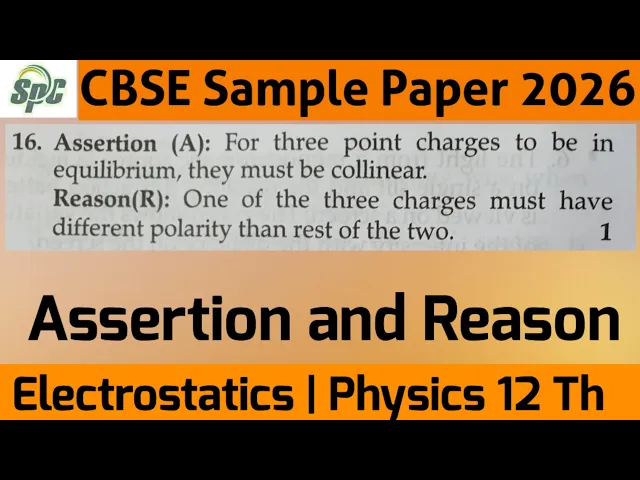
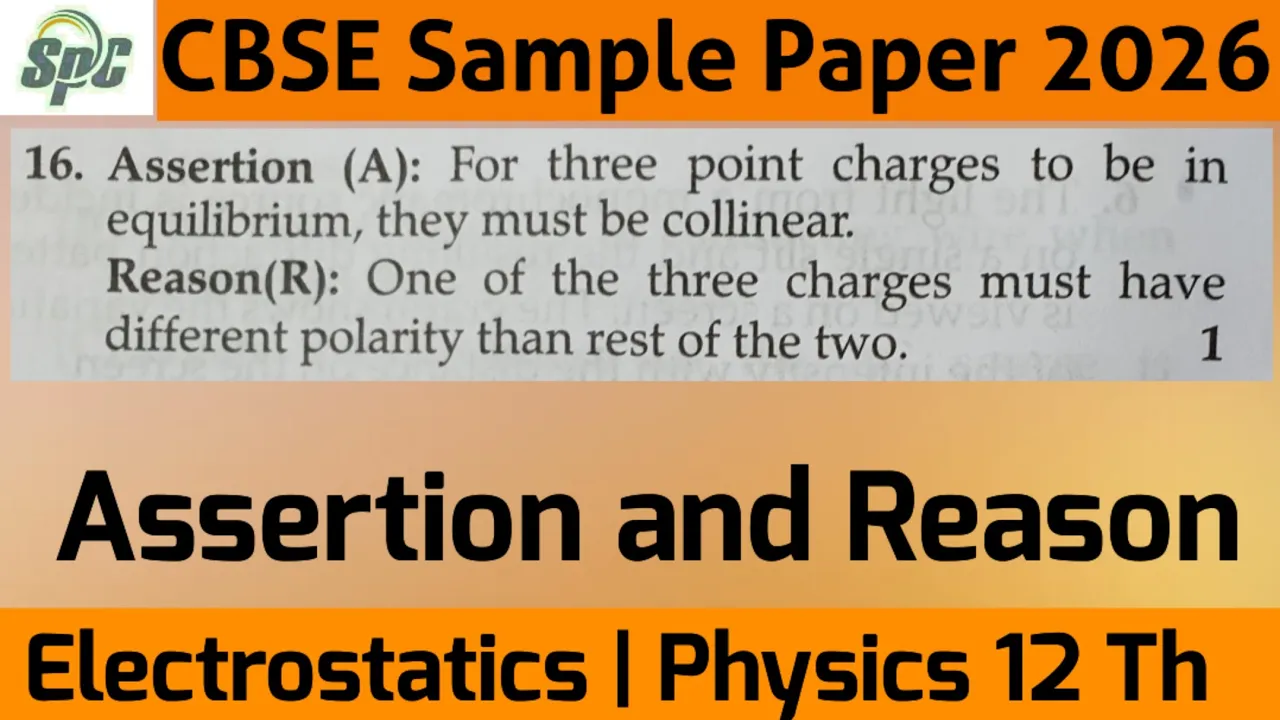
Hello DI Students, Welcome back to my channel Physics SPC CBSE Sample Paper 2026 Question No. 16 Assumption for the three point charges to be in equilibrium they must be collinear. Reason is given.
One of the three charges must have different polarity than the rest of the two. See how do you understand? So first I am writing something .
Pay attention to that. Then I will come back to this question. See if I will also explain three charges, let me write it down first.
Three charged particles are in equilibrium are in equilibrium only under electrostatic forces, then it is possible only. Pay attention to this, it is possible only. Number one the three charges must be collinear, I will explain it now, first understand that they are collinear.
Number two the three charges must not be of the same sign and third the three charges must not be of the same magnitude. If these three conditions hold, then the charges can be in equilibrium. Three charges, three charged particles, can be in equilibrium.
Let's discuss them one by one. For example, if we say that three charges must not be of the same sign. For example, if we take three charges of the same sign, for example, q1, q2, and q3, I've taken them all of the same sign, plus or minus.
Right? So, when this charge applies a force on this charge, this charge will repel it with a force F1. And this charge will apply a force on this charge.
Firstly, I have to keep them collinear . This is what we have to check, right? So, we have kept them collinear.
Let's write all three in the same line. So that's called collinearity. Now, q3 is applying a force on q1.
It will repel here. Q2 will also repel. Is the net force on this entire charge, q1, zero?
So, the net force is not zero. So, the entire system here isn't in equilibrium, son. If you say, "Sir, take a plus q.
" Take a + q here too, and place a q in the middle. Only one charge can be in equilibrium. This charge will exert a force on this one.
If placed at the midpoint, this one will exert a force on this one. This one will exert a force on this one. Both will be equal.
Sir, the net force will be zero. But only this one charge is in equilibrium at rest. If you look at this one, this one will exert a force on this one, and this one will exert a force on this one.
The net force is then not zero. So, the entire system is being talked about here in equilibrium. Three point charges to be in equilibrium.
That's what I said, three point charges to be in equilibrium. So, if all three charges are of the same sign, they won't be in equilibrium. For one thing, if all three are of the same sign, they won't be in equilibrium.
Secondly, what should you take for all three charges? Whether you consider it in 2D or 3D, there's no possibility in either. There's no possibility with three charges.
If you consider it in anything? In 2D, in 3D. For example, you considered a triangle.
Q1, Q2, and Q3 weren't linearly arranged. You considered them nonlinearly . Right?
They weren't arranged in a single line. So, look, this one is plus, this one is also plus, and this one is also plus. So, this one will exert a force on this one.
It will repel this one. This one will exert a force on this one. It will repel this one.
And the net result of these two will come towards this side. Like this, the net force won't be zero. The net force is zero.
There's no one to balance this. The net force . Even if you make one minus, even if you make one plus one minus, it still won't happen.
Imagine if you make this one minus, this one plus one, and this one plus one. Then this one will exert a force on this one, it will attract. This one will exert a force on this one, this one will also attract this one.
Now if you see the resultant of these two, it will come towards this side. And there is no one to balance this force. Right?
So the net force is not zero on this charged particle also. So they cannot be in equilibrium. If it is non-linear then they cannot be.
Right? So now what are the conditions of equilibrium? Like I said that three charged particles are in equilibrium only under electrostatic force, then it is possible only if the three charges must be collinear.
Meaning they must be collinear. Only then can they be in equilibrium. The three charges must not be of the same sign.
All three should not have the same sign. Only then can they be collinear. They can be in equilibrium.
The three charges must not be of the same magnitude. All three of them must be of the same magnitude, still I am writing your not equilibrium, they should not be of the same magnitude, they should not be of the same sign and similar collinears should be arranged in the same line, only then equilibrium is possible, like for example, let me explain further, can you give any such example sir in which they are also collinear, should I write all these conditions and After that it comes into equilibrium, yes, we can explain it with an example, just understand it like if we take one q charge which is positive and take one 4q charge which is also positive and take one minus 4q/9, I have taken this example, I have taken some other separation, I have taken this one d/3 and this one separation 2d/3 and this total separation is d. Now you check it.
These are kept in the same line and the net force on all the charges is zero. They are also collinear. They are not of the same magnitude and not of the same sign.
All of them are collinear. The net force on this is zero. The net force on every particle is zero.
Try it. If this charge applies force on this, it will attract like this. Now how many forces is it attracting?
So Coulomb's law is k q * 4q / 9 and the separation is d / 3. If we square it, it will be d² / 9. So, 9 is subtracted from 9, it gives k 4q² / 9 and d².
This force is so good. If he applied this much force on this, then this much force will be applied on this as well. Both of your forces become this much.
This force was applied by him, and if he applies it on this by this, then see, this is plus or minus, so it will repel towards this side. Look at the value of this force between this and this, then k multiplied by both the charges will be 4q². And look at the separation of this and this, d = d².
So, see, this force and this force are equal in magnitude. So is the net force on this one zero or not? Yes sir, it is absolutely.
Now let's talk about it. So, this is what it is applying on this one. And its value is exactly this.
Whatever it applies on this one, see, this is plus or minus, so it will attract like this . Now, considering the force between these two, this force and this force will be equal. This one and this one are equal.
This one applied this. This one applied this. So, how much will it be?
Let's see. k is the multiplication of both charges, k = 4q and 4q, right? By 9, divide this 9 by its square, then if you square it, then it becomes 4d² / 9, so see, four will be subtracted from four, nine will be subtracted from nine, how much will it come out, kq 4q² / d², this is the force that it will apply on this, how much will it apply, see, because of this it will apply this much on this and it will repel towards this side, how much is this also coming towards this side, k 4q² / 9, so the two forces that are being applied on this, this one has applied this much and this one is applying this much and both the forces are equal and opposite, so see, the net force on this one is also zero, and is your net force zero on this one too, is it yours or is it not, then the net force on all three is zero, see, I have explained an example only, but this is possible only when all the three charges look carefully, brother, what condition have I written, if the three charged particles are in equilibrium, only under the electrostatic force, then it is possible only when these three conditions are possible, only then three Charges can be in equilibrium .
What's the first possibility? What's the first condition? Three charges must be collinear.
So, think about it this way. Tell me, for three point charges to be in equilibrium, they must be collinear. So, isn't this true, son?
Because you can make three charges collinear like this, they aren't collinear. If they aren't arranged in a line, they can't be in equilibrium. Right?
So, this is true. One of the three charges must have a different polarity than the other two. That's also correct.
Make one of the three charges opposite in sign. Like, I've also used this example. So, these two are for plus and one for minus.
Right? That means they shouldn't have the same sign. All three are correct.
So, this is its correct explanation. This is also true, and this is also its correct explanation. Brother, even if all three of these charges were of the same sign, they would still not be in equilibrium.
He is writing NOT. Three charges must not be of the same sign. So, one of them must be different.
Only then can they be collinear. When is collinearity possible? Pay attention to the three charges being collinear .
They should not be of the same sign and should not be of the same magnitude. Right? Even if you take charges of the same magnitude, qqq, it will still not be possible because it will repel it.
Even if you take the opposite charges with a minus sign, one plus one minus will not be possible. If you take q of one plus one. Take three of the same magnitude.
one + q one + q, take q of the minus one in between. Place it anywhere . Right?
Adjust it anywhere. You cannot make the net force zero on all three. You can check it.
The net force will not be zero on all three. It will be zero on one of them. So, it doesn't exist until these three conditions are satisfied .
If we check this according to all three conditions, both are true. And this reason is also the correct explanation of this assertion. Isn't it?
So, you can say this here, son, and you can also say that it's not the correct explanation because only here It's just polarity. It's not about magnitude, but it should be different . This should also be mentioned: three charges must not be of the same magnitude.
It's just about polarity, but it shouldn't be of the same polarity. Isn't it? He used this word .
Now there's a lot of confusion here. Isn't it? One confusion is this.
It's true that the polarity should be different. But it should also be written in the reason that the magnitude should also be different. Tell me, tell me.
Three charges must not be of the same magnitude. That's why if you look at it, if you check its explanation, you'll see this too. The one that the CBSE board has given.
Both assertion and reason are true, but reason is not the correct explanation of the assertion. The reason for this could be that it mentions polarity but doesn't say anything about magnitude, that three charges must not be of the same magnitude. This should also have been mentioned.
It should have said that the charges of all three should be different, their signs should be different, their polarities should be different, and their magnitudes should also be different. These words should have been used. If they had used these words, it would have been the correct explanation .
That's why I think the answer should be B, brother. Both assertion and reason are true, but reason is not the correct explanation of assertion. Isn't it?
You'll see this in many places, which is the true explanation. But think for yourself. The information is incomplete.
They used this line in the explanation, but they didn't use this. Where is it? Tell me, where is it written in it?
Magnitudes shouldn't be related to equilibrium, right? I hope you understand this question. It 's a very tricky question.
A very tricky question, isn't it? But it's true that both are true. Isn't it?
Both are true. One of the three charges must have a different polarity than the other two. Only then can it be collinear.
Son, one condition is written in it. One condition is already written, this one. This one should have been written as well.
Right? Then it would have been collinear. Now you see, keep reading as you like and be happy.