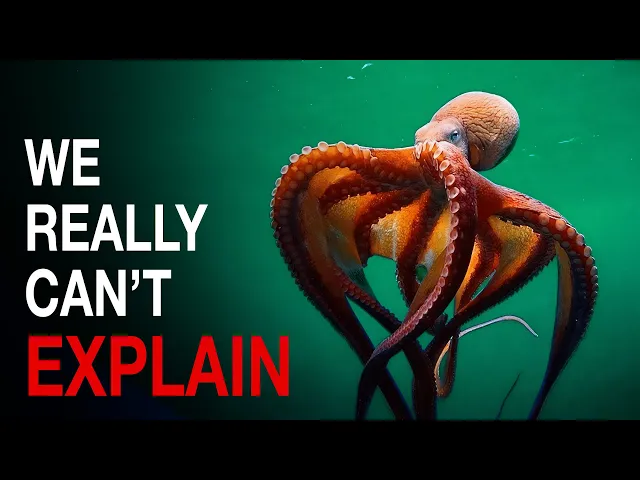
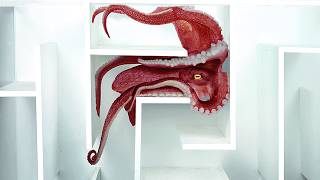
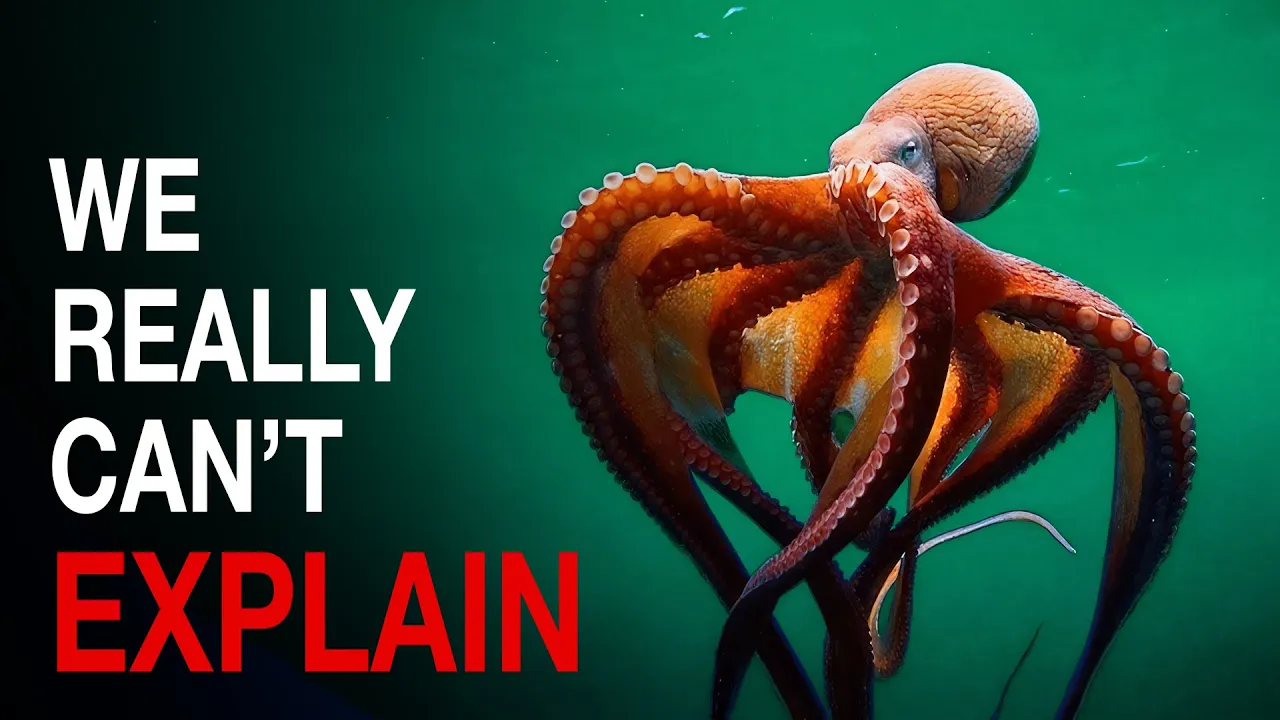
Octopuses are weird. They can unscrew jars, solve puzzles, open locks, and escape sealed tanks. Not out of panic, but out of curiosity.
They've been seen walking on two arms like land creatures, collecting shells and rocks for [music] shelter, even stealing cameras from divers. They can copy other animals, flatten themselves like a flounder, spread their arms like a lion fish, or slither like a sea snake to scare off predators. Well, a few days ago, I just saw this clip of an octopus carrying coconut shells across the ocean floor.
At first, it looks almost comical, but what it's doing is far from random. This octopus is preparing for something that hasn't happened yet. When danger comes, it fits itself inside [music] the shells, closing them together like a portable shelter.
To scientists, that single act [music] is extraordinary. It shows foresight, the ability to imagine the future [music] and plan for it. Now, some scientists debate whether this counts as true [music] tool use, a behavior once thought to exist only in humans, apes, and a few birds, or [music] just really clever shelter seeeking behavior.
But here's what's undeniable. This creature is planning ahead. It's doing something uncomfortable now for a benefit until later.
That's foresight. That's a kind of intelligence we thought required Well, us. And that's where the mystery begins.
Because this animal isn't a mammal or a bird. It's a mollisk, a relative of clams and snails. Softbodied, solitary, short-lived.
Yet somehow capable of complex, adaptable intelligence. This small act, an octopus carrying pieces of the ocean to build its own shelter, forces us to question everything we thought we knew about evolution and what it truly means to be intelligent. And this is just the beginning of how weird octopuses get.
They've been filmed bouncing pill bottles like toys, jetting water at lights to turn them off for fun, unscrewing jars from the inside, and escaping from tanks to hunt in neighboring aquariums before returning home by morning. One octopus in New Zealand became so notorious for breaking out to eat sharks that the aquarium had to install motion sensors. But here's the thing that should absolutely blow your mind.
Intelligence evolved twice on Earth. Once on our branch of the tree of life and once completely independently in sephopods. And the octopus.
The octopus is the strangest proof of that split. Because if you've ever heard the phrase intelligence requires society, you'd expect smart animals to be social. Dolphins, elephants, crows, [music] primates, they all live in complex groups.
But octopuses, they're loners, solitary hunters who spend most of their lives avoiding each other except to mate. So, how did a creature with no friends, no family structures, and arms that can literally think for themselves become one of the most intelligent invertebrates on the planet? To understand just how bizarre octopuses really are, we need to examine their nervous system.
And I mean really examine it. Because what we find there challenges every assumption we have about how intelligence [music] is supposed to work. Humans and other vertebrates possess centralized nervous systems.
[music] The brain serves as the primary processing center with the spinal cord [music] distributing commands to the peripheral nervous system. It's a hierarchical structure, one central authority coordinating all movement, sensation, and response. The octopus nervous system follows an entirely different blueprint.
[music] An octopus possesses hundreds of millions of neurons, a number comparable to a dog. But the distribution of those neurons is unlike anything [music] in the vertebrate world. Roughly 2/3 of them exist outside the brain.
They're distributed [music] throughout the eight arms, organized into clusters called ganglia. Each arm contains what can only be described as a localized processing center capable of executing complex behaviors independently. This isn't simply the brain delegating tasks to [music] the periphery.
This is genuine autonomy. Researchers have demonstrated that a severed octopus arm, and yes, they regenerate, will continue to respond to stimuli, explore its surroundings, and recoil from unpleasant textures. The arm processes sensory information, and executes motor responses without any input from the central [music] brain.
And when you consider the octopus's hunting strategy, this architecture makes profound sense. Octopuses squeeze into crevices, [music] probe inside holes, reach beneath rocks, often into [music] spaces where the eyes cannot observe. Those arms need to make rapid decisions about what constitutes prey, what poses danger, and what is merely substrate.
Routing every sensory input through the central brain for processing would introduce delays that could mean the difference between catching food [music] and becoming food. So the central brain appears to handle executive functions, strategy, navigation, memory, while the arms manage tactical operations. But the sophistication goes deeper than simple touch.
Each arm is covered in suckers, and each sucker is densely packed with chemo receptors. [music] An octopus doesn't just feel objects, it tastes them simultaneously. Every surface contact provides both tactile and chemical information.
The arms are constantly sampling the chemical composition of their environment, creating a sensory map that has no equivalent in human experience. And their visual system presents its own fascinating story. Octopuses possess camera type eyes, lens, iris, retina, the same fundamental architecture as vertebrate eyes.
This represents one of the most striking examples of convergent evolution. Two lineages separated by 600 million years arriving at nearly identical solutions to the problem of image formation. But there's a critical difference in the implementation.
Vertebrate eyes have a structural flaw. The optic nerve passes through the retina creating a blind spot where no photo receptors exist. This is a consequence of how our eyes developed during evolution with the neural wiring ending up on the wrong side of the light detecting cells.
[music] Octopus eyes avoided this error entirely. Their photo receptors face toward the light source [music] and the neural wiring attaches behind the retina. The result is a seamless visual field with no blind spot.
It's engineering that would make a human designer envious. They also possess the ability to detect polarized light, the directional oscillation of light waves, something entirely outside human perception. This capability allows them to detect transparent prey like jellyfish, perceive contrast in environments where color differences are minimal, and possibly even communicate through polarized skin patterns invisible to most predators.
Which brings us to perhaps the most perplexing aspect of octopus vision. The strong evidence suggests they are functionally colorblind. This seems impossible.
How can an animal that modulates its body color with extraordinary precision lack color vision? The current scientific thinking points toward an elegant solution. Their skin might perceive color independently of their eyes.
Research has identified light sensitive proteins called opsins distributed throughout octopus skin. the same photopigments that detect light in their retinas. This suggests the possibility that octopus skin can respond to [music] light and possibly color directly without neural processing through the brain.
They may not need to visually observe the substrate they're camouflaging against. Their skin might detect it directly and respond accordingly. This represents a fundamentally different model of perception.
We construct a visual representation of our environment through our eyes and interpret it in our brain. Whales echolocate through water, building acoustic maps of their surroundings through sound. Octopuses appear to perceive through distributed sensation, taste, touch, possibly even direct photo reception through skin.
Intelligence, it turns out, isn't constrained to one sensory modality or one processing architecture. It emerges wherever complex problems require [music] sophisticated solutions. The camouflage capabilities of octopuses have captivated observers for centuries, but the mechanisms underlying this ability are far more [music] sophisticated than most people realize.
And critically, they operate through principles entirely different from other colorchanging animals. Consider the chameleon. Often cited as the pinnacle of colorchanging ability, chameleons modulate their appearance by adjusting the spacing of nano crystal latises within specialized skin cells called iritaphores.
[music] This structural reorganization alters which wavelengths of light are reflected, changing the animals perceived color. The process takes several seconds to complete, and research indicates chameleons employ color change primarily for social signaling and thermmorreulation rather than camouflage. Octopuses operate through an entirely [music] different system, one built on muscular control rather than structural modification.
The octopus integumentary system contains three distinct [music] types of chromataphor organs arranged in layers. At the surface lie the chromataphor's proper [music] elastic sacks containing pigment granules red, yellow, brown or black depending on the specific cell. Each chromataphor is surrounded by 15 to 25 radial muscles.
When these muscles contract, the sack expands displaying the pigment. When they relax, elastic properties of the sack cause it to contract, hiding the color. [music] Beneath the chromataphor layer sit the iridaphors, cells containing plates of reflective proteins that generate iridescent blues and greens [music] through structural coloration.
Deeper still are the lucapors which scatter light to produce white tones. But color alone doesn't create convincing camouflage. Texture [music] matters equally.
Underneath the chromataphor system lies a network of muscles called pilli that can raise portions of the skin into [music] three-dimensional structures. spikes, ridges, branching protrusions, allowing the octopus to mimic [music] not just the color, but the physical texture of coral, rock, or algae. This raises a genuinely unresolved question.
What is the subjective experience of controlling this system? When an octopus matches a coral reef, is it making conscious decisions about color and texture, or is this a reflexive response, sensory input triggering automatic motor [music] output? The evidence suggests something between pure reflex [music] and deliberate choice.
Octopuses can learn to produce specific [music] patterns in response to training, suggesting some degree of voluntary control. Yet the speed and complexity of pattern generation implies significant automatic [music] processing. The truth likely involves [music] both highle decisions about which general pattern to employ with low-level execution handled automatically by distributed neural [music] networks.
We're observing intelligence that doesn't map neatly onto our categories of conscious versus unconscious action. And that ambiguity is itself instructive. Beyond the [music] coconut carrying behavior we opened with, octopuses demonstrate a remarkable range of cognitive abilities that extend well into territory we typically reserve [music] for vertebrates.
Laboratory studies have documented sophisticated problem solving across multiple contexts. Octopuses [music] readily learn to open screw cap jars, manipulate childproof containers, and navigate multi-step [music] puzzles. They demonstrate individual recognition of human caretakers, responding positively to some individuals [music] and negatively to others based on prior interactions.
This requires memory not just of events, but [music] of the specific identities associated with those events. One particularly interesting study demonstrated observational learning. When naive octopuses observed trained individuals solving a novel problem, opening a container to access food, the observers solved the same problem significantly faster than control animals without observation opportunity.
This suggests octopuses can extract relevant information from watching con specifics, [music] an ability typically associated with social species. [music] And then there's play behavior. Play is evolutionarily puzzling [music] because it provides no immediate survival benefit.
It consumes energy, [music] requires time that could be spent foraging, and in some cases increases predation [music] risk. Yet play behavior appears consistently in animals we recognize as intelligent. Citations, corvids, parrots, [music] carnivores, primates.
Octopuses in captivity have been observed repeatedly manipulating objects in ways [music] that serve no apparent purpose beyond the manipulation itself. Multiple aquariums have reported octopuses escaping their enclosures at night to hunt in neighboring tanks, then returning before [music] morning, suggesting not just problem-solving ability, but spatial memory and [music] what can only be described as planning complex multi-stage excursions. Taken together, these behaviors provide [music] compelling evidence for complex cognition.
And this brings us [music] back to the central paradox. Octopuses are largely solitary animals. They don't live in social groups.
[music] They don't cooperate to hunt. They don't raise their young. In fact, females die shortly after their eggs hatch.
So, how did this intelligence evolve? The answer appears to lie in ecological complexity rather than social complexity. Octopuses are softbodied predators in environments filled with both prey and predators.
[music] They're generalist hunters tackling a diverse array of prey species. Crabs requiring shell cracking, fish requiring speed, by valves requiring persistence, each demanding different [music] strategies. They inhabit structurally complex environments.
[music] Coral reefs, rocky coastlines, kelp forests. These habitats [music] require sophisticated spatial memory and three-dimensional navigation. They also contain numerous predators, sharks, eels, dolphins, against which a soft body provides no protection.
Survival requires [music] evasion, concealment, and the ability to rapidly assess threat. In other words, their environment presented a vast array of problems. And when the environment is sufficiently complex, intelligence emerges as a solution even in the absence of [music] social pressures.
Intelligence is a term we define through our own cognitive architecture. We design tests [music] that privilege the abilities humans possess. Verbal reasoning, abstract symbolism, [music] long-term planning with delayed gratification, complex social cooperation.
When animals [music] perform well on these metrics, we call them intelligent. When they don't, we often conclude they lack cognitive sophistication. [music] The octopus reveals the profound limitations of this framework.
Comparing neuron counts illustrates [music] this clearly. Humans possess approximately 86 billion neurons. Octopuses have hundreds of millions, a substantial number, but nowhere near human levels.
Octopus neurons are distributed across a decentralized network optimized for problems humans have never encountered. Coordinating eight [music] semi-autonomous appendages, processing chemotactile information from roughly 2,000 independently operating suckers, [music] generating coordinated color changes across thousands of chromataphores in [music] milliseconds. Their cognitive architecture is adapted for their ecological niche just as ours is adapted [music] for ours.
Neither is objectively superior. They're optimized for different problems. This has profound implications for how we think about intelligence [music] beyond Earth.
For decades, the search for extraterrestrial intelligence has largely assumed alien minds would resemble ours in fundamental ways. social, technological, communicative through symbolic language. We've built our detection strategies [music] around finding radio signals, mathematical patterns, evidence of large-scale engineering.
But if intelligence can evolve in such radically different forms on our own planet in a lineage that diverged from us 600 [music] million years ago, what might alien intelligence actually look like? Perhaps the universe contains minds more similar to octopuses than to humans. Intelligent in ways we might not recognize as cognition at all.
There's a concept [music] in ethology called Vvelt. The perceptual world unique to each organism. A tick's envelured [music] [music] [music] by language and symbolic thought.
An octopus's omvelt is something we can barely conceptualize. A world experienced through [music] distributed gustation, polarized light perception, autonomous limb sensation. [music] A world where the boundary between self and environment becomes permeable because your body constantly mimics your surroundings at a muscular level.
That's not just a different form of intelligence. That's potentially a different form of consciousness. So, did the octopus [music] break the rules of evolution?
Not exactly. What it did was demonstrate that the rules we thought existed were actually assumptions based on our own evolutionary history. Evolution doesn't operate according to rules we can easily articulate.
It operates through constraint, variation, and selection across deep time. Within those parameters, life finds solutions that often defy our predictions. Precisely because our predictions are based on the limited sample of Earth's current biodiversity.