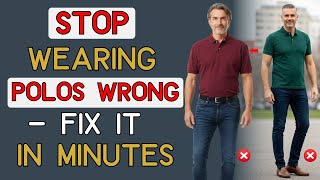
The polo shirt is the most dangerous garment in your closet. It can either make you look like a billionaire on a yacht or a retired grandpa who is officially given up. Most men over 50 are unknowingly wearing a uniform of old age, baggy fabric, wilted collars, and sleeves that hang like wet rags.
But the difference between looking invisible and looking like a man of status comes down to exactly 3 in of fabric. Today, I'm giving you a master class in visual engineering. [music] We aren't just talking about clothes.
We're talking about reclaiming your silhouette. We will break down the golden ratio of fit, the secret to making your arms look stronger, and the truth about that collar. If you want to stop being the old guy in the baggy shirt and start being the most sophisticated man in the room, this is for you.
This is the end of the grandpa uniform. Let's get [music] to work. Fit is 80% of the battle.
You can spend $500 on a luxury silk cotton polo from the finest boutique in Italy, but if the fit is off, you will still look like you are wearing a handme-down from your grandson. For the mature man, fit is not just about size. It is about visual engineering.
As we age, our bodies change, and the off the rack sizing that worked in our 20s no longer serves us. The most common mistake I see men over 50 make is what I call the comfort trap. You go to the store, you feel a bit of a midsection, and your instinct tells you to size up.
You think, "If I buy an extra large, I'll have room to breathe, and [music] the fabric will hide my belly. " But this is a mathematical error. Excess fabric does not hide bulk.
It creates it. When you wear a shirt that is too wide, you aren't hiding your shape. [music] You are simply becoming a large shapeless rectangle.
You look shorter, wider, [music] and older. To master the golden ratio, we must look at the three anchor points. The shoulders, the torso, and the [music] length.
First, the shoulders. This is the most critical anchor point of any garment. [music] The shoulder seam, where the sleeve attaches to the body of the shirt, must sit exactly where your shoulder bone ends and your arm begins.
This is called the acchromian bone. [music] If that seam drops even half an inch down your arm, it creates a sloping effect. Visually, this tells the world that your posture is collapsing.
It makes you look tired. However, when that seam is perfectly aligned, [music] it squares off your frame. It creates a sharp horizontal line that suggests strength and alertness.
Even if you have sloped shoulders due to age, a perfectly placed seam acts like a structural beam holding your silhouette together. Second, let us look at the torso. We need to move away from the idea of baggy and move toward the concept of the skim.
A perfect polo should glide over your chest and stomach without clinging, but also without billowing. There is a simple pinch test you can use in the fitting room. Once the shirt is on, try to pinch the fabric at the side of your waist.
You should be able to grasp about 1 to 2 in of fabric. If you can grab a whole handful, the shirt is too wide and needs to be tapered. If you can't grab anything, it's too tight and will emphasize every lump and bump.
By having a slight taper through the waist, you create the illusion of a Vshape, the universal symbol of fitness and youth, even if your V isn't as sharp as it used to be. Finally, [music] we have the length. This is where most grandpa outfits go wrong.
A polo shirt is a casual garment, meaning it is often worn untucked. If your polo shirt covers your entire backside and hangs down to your mid thigh, [music] you have destroyed your proportions. Why?
Because you have artificially shortened your legs. When your legs look short, you look shorter and heavier. The golden ratio for length is very simple.
The hem of the shirt should end at the midpoint of your fly. This length allows you to move freely without showing your skin when you reach up, but it keeps your leg line long and lean. [music] Remember, gentlemen, you are not a shapeless mass.
You are a man of stature. When you respect the golden ratio of fit, you are telling the world that you are still in control. You are not just putting on clothes.
You are building a frame. If you get the shoulders, the torso, and the length right, you have already won 80% of the style war. If the fit of the torso is the foundation of a good polo, then the sleeves are the finishing touch that determines your level of vitality.
Most men over 50 completely overlook this detail. Yet, it is the single most important factor in whether you look like an athlete in his prime or a man who has given up on his physique. As we cross the age of 50, our bodies undergo a natural process called sarcopenia, a gradual loss of muscle mass.
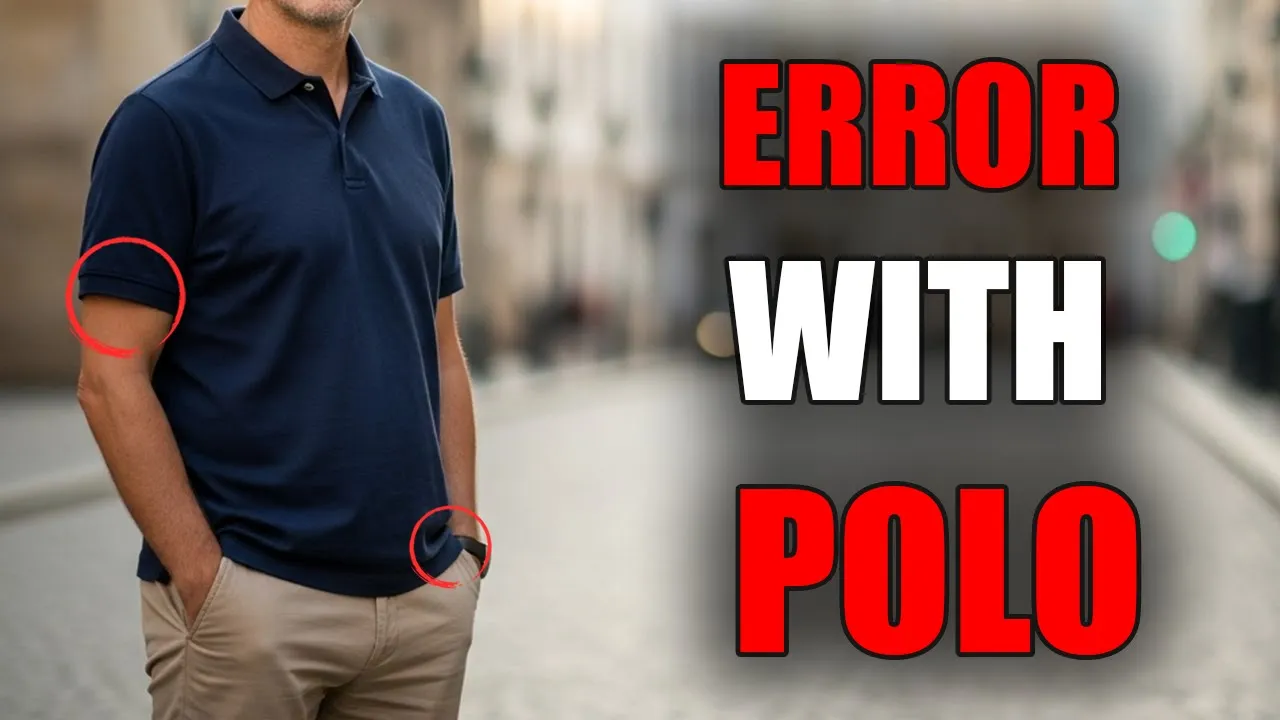
Even for those of us who stay active, the skin around the triceps and biceps tends to lose some of its youthful elasticity. This is a reality of life. However, the grandpa uniform ignores [music] this reality by offering what I call wizard sleeves.
These are sleeves that are cut excessively wide and hang down almost to the elbow. When you wear a sleeve that is too long and too wide, you create a massive hollow space between the fabric and your arm. Visually, this is a disaster.
[music] The eye sees the vast amount of fabric and subconsciously assumes that the arm inside must be thin, frail, and weak. It emphasizes the loss of muscle tone rather than masking it. To fix this, we use the golden ratio of the arm.
First, let's talk about length. The absolute rule for a modern sophisticated polo is that the sleeve must end at the midpoint of your bicep. Why is this specific point so important?
Because it exposes the lower half of your bicep and the curve of your tricep. By showing that extra two or bay in of skin, you are creating an optical illusion of strength. You are displaying the peak of [music] the muscle which makes your entire arm look more toned and energetic.
When the sleeve hangs down to the elbow, it swallows the arm and makes your upper body look collapsed. If your current shirts are too long, a tailor can easily shorten them for a few dollars. It is the best money you will ever spend on a casual shirt.
Second, we must address width. This is where the two finger rule comes into play. Once you have the shirt on, try to slide your fingers into the sleeve opening.
You should be able to fit two fingers between your skin and the fabric comfortably. If you can fit your entire hand in there, the sleeve is too wide and is flaring out like a bell. This bell effect is what makes you look like you're wearing a handme-down.
On the other hand, if you can't even fit one finger, the shirt is too tight [music] and you look like you are trying too hard to relive your glory days in your 20s. You want a gentle hug around the arm. The secret weapon for a mature man is the ribbed cuff.
When you are shopping for a polo, look for sleeves that have a band of elasticized ribbed fabric at the edge. This is a hallmark of old money style. The ribbed cuff provides a slight tension that keeps the sleeve in place against your arm.
More importantly, it creates a sharp horizontal line that separates your shoulder from your arm. This visual separation makes your shoulders look broader and your bicep look more defined. It's a small detail that provides a massive boost in perceived fitness.
Finally, we have to talk about the shoulderto-se. When the sleeve is fitted correctly to your bicep, it creates a Vshape from your shoulder down to your elbow. This Vtaper is the universal symbol of masculine health.
Even if you haven't been to the gym in months, a fitted sleeve creates the appearance of a structured frame. It pulls the fabric tight across your chest, making you stand taller and look more confident. Gentlemen, do not let your sleeves drown [music] you.
You are a man of experience and power. Your clothing should reflect that. By mastering the length and width of your sleeves, you are reclaiming your silhouette.
You are telling the world that you are still in the game. In the next section, we're going to talk about the part of the shirt that actually frames your face, the architecture of the collar. Now we come to the most critical part of the garment.
The part that sits closest to your face. In the world of portraiture, a frame can either elevate a masterpiece or make it look cheap. In men's wear, your collar is the frame for your face.
As we age, our jawline often loses some of its sharpness, and our neck might not be as lean as it once was. A well ststructured collar provides the vertical lines and the scaffolding needed to counteract these changes. However, the most common sight on men over 50 is what I call the wilted lettuce collar.
This is a collar that has lost its sole. It's curled at the edges. It's flat.
It's asymmetrical [music] and it's collapsed under the weight of its own fabric. When your collar collapses, your whole face looks tired. It drags the viewer's eyes downward.
emphasizing age and lack of attention to detail. To fix this, we need to understand the architecture of the collar. First, let's look at construction.
There are generally two types of polo collars. The ribbed collar and the self-fabric collar. The ribbed collar is made of a separate thicker piece of knitted elastic fabric.
These are classic, but they are the most prone to curling. If you choose a ribbed collar, look for one that has a bit of weight to it. The self-fabric collar, also called a shirt style collar, is made from the same material as the body of the shirt.
These often have an internal lining or interlinining that gives them a crisp, sharp structure, similar to a formal dress shirt. For a man over 50, I almost always recommend the self-fabric collar. It provides a more architectural, sophisticated look that frames the jawline much more effectively than a flimsy knit.
Second, we must discuss the button rule. A polo shirt usually has a placket with two or three buttons. How you use these buttons dictates the entire vibe of your outfit.
If you button every single button to the top, you risk looking stiff or like you're trying to hide something. [music] It can make your neck look shorter. However, if you leave all the buttons undone, the collar will inevitably spllay open and fall flat against your shoulders, losing all its height.
The sweet spot for the mature man is usually to leave the top button undone and fasten the second one. This creates a perfect Vshape at the neck. This V is a powerful visual tool.
It draws the eye upward toward your face and creates the illusion of a longer, leaner neck. It adds a touch of spitzatura, [music] that effortless Italian elegance without looking messy. But how do we keep the collar from collapsing during [music] the day?
This is where maintenance comes in. Most men ruin their collars in the laundry. Never ever dry your polo shirts in a high heat dryer.
The heat destroys the fibers and causes the collar to curl. Instead, wash them on a cold cycle and lay them flat to dry. While the shirt is still damp, use your fingers to shape the collar into its proper position.
If you want to take it a step further, the old money way, give the collar a quick press with an iron and a tiny bit of spray starch. It takes 30 seconds, but it ensures that your collar stays upright and sharp for the next 12 hours. There are even plastic collar stays or adhesive collar supports you can buy for a few dollars that stick to the underside of the collar to keep it from flying away.
Think of it this way. When you stand in front of a mirror, your collar should stand at attention. It should have enough height to touch the back of your neck and enough structure to stay off your collar bones.
When your collar is sharp, [music] your jawline looks sharper. When your collar is standing, you look like you are standing taller. It is the difference between looking like a man who is dressed [music] and a man who is tailored.
In the next section, we're going to discuss the hidden element that ties everything together. The physics of fabric and color. We have built the structure with fit and collar architecture.
But now we need to talk about the skin of the shirt. This is where most men over 50 unknowingly sabotage themselves. I call this the physics of fabric.
When you are a younger man, you can get away with wearing almost anything. But as we age, our skin loses some of its luster and our bodies lose some of their rigidity. The fabric you choose is what compensates for these changes.
The biggest mistake in the modern market is the obsession with performance fabrics. You see them everywhere. Polyester blends designed for the golf course.
While they are great for wicking sweat, they are a disaster for style. Synthetic fabrics are often too thin and have [music] a clingy nature. Because they lack weight, they don't drape.
They stick. They will find every curve of your midsection or the slight rounding of your shoulders and highlight them for the world to see. Furthermore, these fabrics have a plastic-like sheen that reflects light in a cheap way, which instantly devalues your entire look.
If you want to project authority, you need to look for PK cotton. You can identify it by its textured waffle-like weave. This isn't just a design choice.
It's a structural one. Because PK is a heavier, more substantial knit, it acts like a subtle piece of armor. It has memory, meaning it holds its own shape instead of taking the shape of your body.
It skims over your torso, creating a clean, straight line from your armpit to your waist. [music] It provides the visual weight that a mature man needs to look grounded and sophisticated. However, if you want to reach that old money level of luxury, you must seek out mercerized cotton.
This is cotton that has undergone a treatment to smooth the fibers and increase their ability to hold dye. The result is a fabric with a deep silk-like luster, not a cheap polyester shine, but a rich matte glow. Mercerized cotton is stronger, holds its shape longer, and most importantly, it retains its color.
A mercerized navy polo will stay a deep, commanding navy for years, whereas a standard cotton shirt will start looking dusty and tired after five washes. This brings us to the power of color. Most men over 50 retreat into safety colors, light [music] gray, pale tan, and light blue.
They think they are being subtle, but they are actually washing themselves out. As our hair turns gray or white, our skin often loses some of its natural contrast. To look vibrant and healthy, you need to reintroduce that contrast through your clothing.
Navy blue remains the undisputed king for a reason. It provides a sharp contrast against gray hair and instantly slims the silhouette. But don't stop there.
Consider forest green, deep burgundy, or chocolate brown. These are what I call substantial colors. They project stability and wisdom.
A deep forest green polo doesn't just look good, it looks expensive [music] because it's a color rarely found in cheap mass market stores. These tones provide a dark frame for your face, which makes your jawline look more defined and your eyes look brighter. When you choose a highquality fabric in a deep, rich color, you aren't just getting dressed.
You are choosing how the world perceives your energy. [music] You are choosing a fabric that respects your body and a color that commands the room. [music] So, you have the perfect polo.
The fit is sharp, the sleeves hug your arms, and the collar stands [music] proud. But how do you actually wear it without falling back into the grandpa territory? This is where your styling choices either anchor your look in modern elegance or drag it down to the retirement home.
The first question every man asks is to tuck or not to tuck. There is a lot of bad advice on the internet about this. Here is the mature man's rule.
If the polo has a straight hem and is the correct length, ending at the mid-fly, you can wear it untucked for a relaxed Mediterranean vibe. However, [music] if you are wearing your polo under a blazer or a sports jacket, you must tuck it in. A trailing polo hem peeking out from under a tailored jacket looks messy and disjointed.
Tucking in your polo instantly raises the formality [music] score of your outfit. If you're worried about your midsection, remember what we discussed in the previous master class. Use a high-rise trouser to smooth out your silhouette.
A tucked polo into a well-fitted pair of trousers is the ultimate power move for a casual Saturday. Speaking of trousers, let's talk about the bottom half. The fastest way to ruin a highquality polo is to pair it with cargo shorts or baggy pleated [music] khakis.
If your pants are shapeless, your shirt will look shapeless, too. For a look that screams old money, [music] pair your polo with slim straight chinos in navy, olive, or charcoal. If it's a formal event, try a pair of linen or tropical wool trousers.
The contrast between the knitted texture of the polo and the crisp weave of the trousers creates a visual depth that simple cotton on cotton cannot match. And please pay attention to your footwear. Do not wear your gym sneakers with a styled polo.
You want to lean into the leisure heritage of the shirt. Leather loafers, suede driving shoes, or clean, minimal white leather sneakers are your best friends here. These choices tell the world that you didn't just throw something on, you curated a look.
Lastly, [music] consider the third layer. A polo shirt is the perfect base for a lightweight unlined blazer or a Harrington jacket. Because the polo has its own collar, it stands up beautifully against the collar of your jacket, creating a layered, intellectual look.
This is the professor at the weekend aesthetic. Approachable yet clearly a man of substance. When you master how to anchor the polo with the rest of your wardrobe, you stop being a man wearing a shirt, [music] and you start being a man with a signature style.
Gentlemen, we have covered a lot today. We've dissected the geometry of your shoulders, the physics of your sleeves, the architecture of your collar, [music] and the importance of fabric weight. It might seem like a lot of detail for just a shirt, [music] but as we know, in the world of mature style, details are everything.
When you turn 50, you have a choice. You can either fade into the background in baggy, [music] shapeless clothes, or you can use your experience to dress with more intention than the men half your age. Reclaiming the polo shirt is about more than just looking good.
It's about signaling that you are still attentive, still sharp, and still very much in your prime. You [music] are not past it. You are just getting started, and you have the wardrobe to prove it.
Take a look at your closet today. Be ruthless. If you have those oversized, thin, synthetic polos with the curled collars, get rid of them.
They aren't serving you. Invest in three highquality heavy PK or mercerized cotton polos in navy, forest [music] green, or white. Get the fit right.
Fix the sleeves and I promise you the way people look at you and respect you will change overnight. If you found this deep dive helpful, hit that like button and subscribe to Mature Elegance. [music] We are here to ensure that as you age, you only become more visible, more commanding, and more stylish.
Now, before you go, I have a challenge for you. Many of you are still clinging to one specific color because it feels safe, but it's actually the color that's making you look the most tired. I'm talking [music] about beige.
In the next video, I'm going to explain exactly why you need to stop wearing beige and what power colors you should be replacing it with to instantly brighten your face and sharpen your image. You don't want to miss that one. Until next time, stand tall, dress well, and stay sharp.





![5 Colors That Make Older Men Look Younger and Attractive at Any Age.[Age gap relationships]](https://img.youtube.com/vi/IPDyZbE2gMA/mqdefault.jpg)