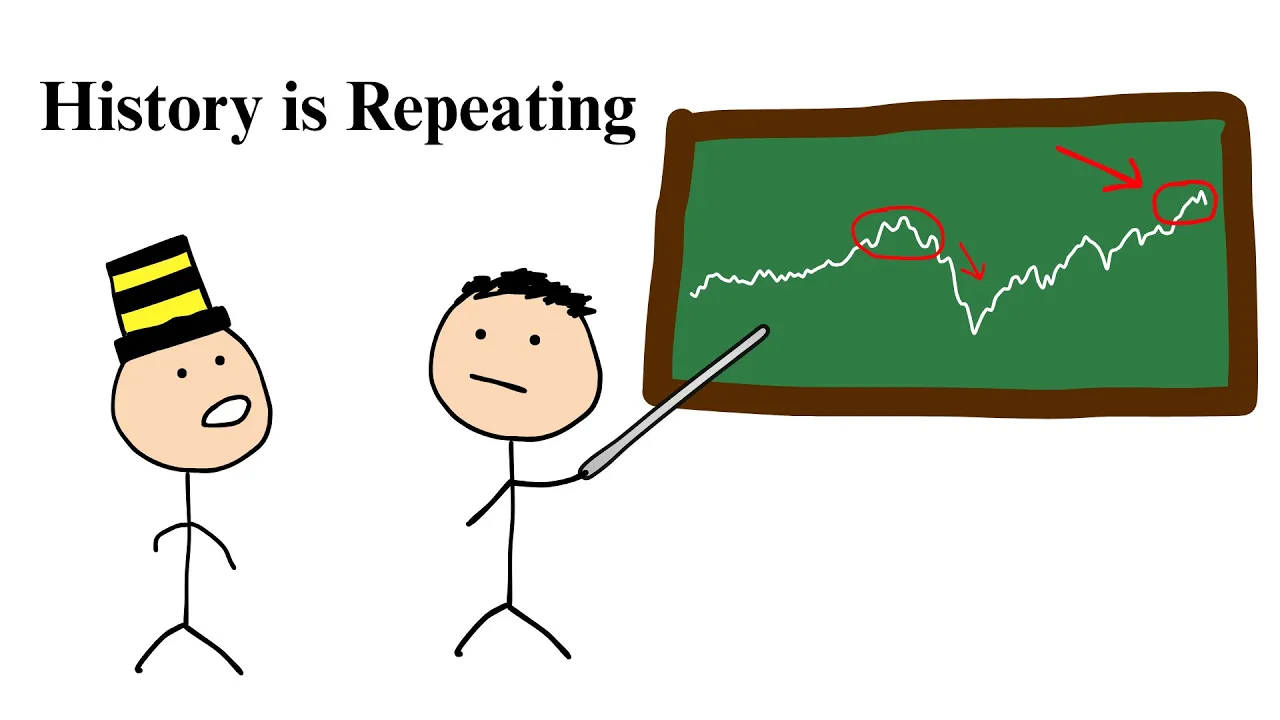
It's no secret that history repeats itself. And when it comes to the stock market, investors will do whatever mental gymnastics they need to convince themselves that this time it's different. In fact, legendary investor Sir John Templeton, who averaged 15% annual growth for 38 years, called those the four most expensive words in the English language.
And he's right because nothing empties a brokerage account faster than blind optimism dressed up as financial genius. Which brings us to Jesse Livermore. Jesse Livermore, who is considered a pioneer of speculative trading in the markets, was the basis for the main character in the best-selling book reminiscences of a stock operator and is most wellknown for making his fortunes by shorting markets during crashes.
Once said, "There's nothing new in Wall Street. There can't be because speculation is as old as the hills. Whatever happens in the stock market today has happened before and will happen again.
And there's a stock market bubble that nobody talks about anymore. It's a bubble that looks disturbingly similar to the current state of the market. I'm not talking about the dot bubble of the early 2000s or the 2008 financial crisis.
I'm talking about a bubble you probably have never heard of. It was a bubble that when it popped, the damage was ugly. The market crashed 50%.
Many of the world's largest companies lost 60 to 80% of their value. Inflation surged from 3 to 11%. And the market didn't fully recover for 8 years.
I'm talking about the nifty50 bubble of the early 1970s. [Music] The story starts in the late 1960s. The United States has just ridden a 20-year economic sugar high following World War II.
Factories were booming. Suburbs were popping up out of nowhere like acne on a teenager. And Americans thought the country was invincible.
Because in the late60s, people had money. They had confidence. And most importantly, they had blind optimism.
And why wouldn't they? The United States had just beaten Germany in World War II, dropped a man on the moon, allegedly, and most importantly, invented the etch of sketch. Life was good.
And in the middle of all this optimism was the stock market. From the end of World War II in 1945 all the way to 1970, the United States stock market had gained over 350%. This unprecedented bull run led to a new strategy in investing becoming popularized.
It was known as investing in one decision stocks. The concept was simple. Invest in companies so powerful and so dominant that you only had one decision to make when it came to investing in them.
Buy these stocks became known as the Nifty50. The Nifty50 wasn't comprised of penny stocks or emerging tech companies, but it was comprised of blue chip companies that generated stable cash flows. It was companies like Coca-Cola, American Express, McDonald's, and various other household names.
Investors saw these companies as bulletproof. And because of this, the idea of ever selling any of these stocks was considered crazy. [Music] Here's the thing about investing.
If something sounds like a no-brainer investment with zero downside, it's almost always a financial grenade with the pin already pulled. And that was exactly the case here. By the early 1970s, the Nifty50 stocks weren't just expensive.
They were priced like gravity didn't affect Wall Street. The average PE ratio for the overall market at the time was a humble 15. respectable, normal, the kind of number you could bring home to your parents.
But the never sell mentality around the nifty50 turned their valuations into numbers you only see in a fairy tale. Coca-Cola was trading at 46 times earnings, Xerox 49 times earnings, McDonald's 86 times earnings, Polaroid 90 times earnings, and the list just keeps going. On average, the Nifty50 stocks were trading at a jaw-dropping 42 times earnings.
And it doesn't stop there. At the peak, the top five Nifty50 stocks made up around a quarter of the entire market. And collectively, the entire Nifty50 group made up roughly 45% of the total United States stock market.
[Music] Then came 1973 to 1974. The dominoes fell one by one and reality came in and slapped everyone across the face. Oil prices quadrupled.
Inflation jumped to over 11%. Unemployment doubled from 4 1/2% to 9%. And President Nixon effectively ended the gold standard for good.
This led to the stock market plunging 50% between 1973 and 1974, which marked the worst bare market since the Great Depression. And when the economy falls apart, overpriced stocks don't just correct, they get obliterated. In the Nifty50, Coca-Cola shares fell over 60%.
McDonald's shares fell over 70%. And worst of all, Polaroid shares collapsed more than 90%. The so-called one decision stocks turned into one big financial obituary.
And here's the real gut punch. The damage wasn't quick. This wasn't a cute little V-shaped recovery like we saw after the pandemic.
It took the market 8 years until 1981 to crawl back to the same level it had been at before the bubble popped. This was the reality of the Nifty50 collapse. Investors who thought they were buying eternal growth stocks ended up trapped in financial purgatory for the better part of a decade.
[Music] Now, if you're looking at the current state of the market and getting a slight sense of deja vu, you're not alone. In fact, Mark Twain once said, "History does not repeat itself. " But it does rhyme.
And while not identical, today's stock market undeniably rhymes with the one back in 1972. And back in 1972, the Nifty50 made up nearly 45% of the total United States stock market. Meaning with every dollar invested into a stock market index fund, investors were making a bet that these nifty50 companies would somehow grow into these ridiculous price tags slapped on them.
And if you fast forward to today, the movie has the same plot, just with shinier special effects. The United States tech giants, better known as the Magnificent 7, now make up around 36% of the entire S&P 500. That's right, seven companies.
Microsoft, Apple, Google, Amazon, Meta, Tesla, and Nvidia carry the weight of the entire stock market. If that feels eerily familiar to the level of concentration we saw with the Nifty50 companies, it's because it is. Yes, the Magnificent 7 companies are innovative, and yes, they dominate their industries, but so did Xerox.
So did Polaroid, and so did Avon products back in 1972. The Magnificent 7 have become the modern echo of the one decision stocks that dominated back in 1972. When it comes to the Mag 7, investors are acting as if there's only one decision to make when it comes to investing in them.
So, what about the valuations of these modern-day tech giants? Surely, they're priced fairly, right? Well, not at all.
Let's just say they're also priced like gravity doesn't affect them. Google and Meta trade at 28 times earnings. Amazon 35 times earnings, Apple 37 times earnings, Microsoft trades at 38 times earnings, Nvidia 50 times earnings, and Tesla 247 times earnings.
Are these solid companies? Absolutely. Are they overpriced, overweighted, and woripped as if they're bulletproof?
Also, yes. And just like in 1972, investors are telling themselves the exact same bedtime story. These companies are untouchable and will grow forever.
All we're missing is a couple of macroeconomic dominoes to fall and we're right back where we were. Warren Buffett summed it up best. What we learn from history is that people don't learn from history.
So here we are once again staring at a topheavy market, pretending valuations don't matter and whispering the four most expensive words in the English language. This time it's different.