in order for a B cell to be activated the antigen must Crosslink The receptors as this antigen is doing here note that two antigen binding receptors two B cell receptors are being bound by a single antigen this is called cross-linking and it allows for this B cell to actually recognize this as a well-bound antigen that it should potentially respond to so let's blow this up so you can see here that the two B cell receptors are bound to the same antigen this is called crosslinking this sends a signal to the side chains remember IG alpha
beta for both the B cell receptors so there are multiple B cell receptors on the cell surface and you get signaling through these side chains through a series of protein tyrosine kinases that basically leads to Signal propagation to the nucleus and it's basically the signal that tells the B cell hey you found antigen do something there is an alternative way for B cells to become activated and that's actually using a complement component so one of the fragments of the C3 molecule is c3d c3d can actually also bind directly to pathogens as it's doing here remember
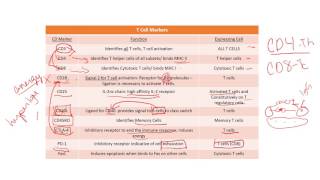
earlier when I was talking about CD markers and I mentioned that cd21 is one of the markers of B cells well that's because cd21 is actually the complement receptor 2 now you would think that that means it's specific for complement 2 but no it's actually specific for c3d it was the second complement receptor found and it is specific for c3d so when c3d lines a pathogen as it's doing here complement receptor 2 or cd21 on the surface of B cells can bind to it in this case cd21 is serving as that second signal that cross
linking signal to tell the B cell hey you found antigen do something at this point our naive B cell has cross-link antigen and has become activated activated T and B cells begin to massively proliferate in a process known as clonal expansion which basically means that this clone of B cell with the exact same antigen receptor is going to expand many many many times over to make a lot of copies of itself that all have the exact same antigen um specificity now in a separate video I talk about a concept known as sematic hypermutation sematic hypermutation
actually occurs at this stage in the lymph node so when these cells are replicating specifically B cells not t- cells when B cells replicate this quickly mistakes can be made in the DNA coding region that makes up the an antigen binding site now this is the one part that it's okay to have mutations in because it just UPS the variability of antigen receptors that could potentially be positive for different antigens and occasionally we'll make antigen receptors through this process of sematic hypermutation that have a higher affinity for the antigen than the original Mother cell had
and this goes into a process that we'll talk about in a second separate video known as Affinity maturation so I have a separate video that talks about both sematic hypermutation and Affinity maturation which you can check out but they both occur at this stage right after the B cell has become active so for now let's keep it simple and say that we're our B cell is perfect it's not going to make any mistakes so all of these B cells have the exact same antigen specificity as this B cell now the cell needs to differentiate so
it's gotten a really great strong activation signal so the goal of B cells is to become a plasma cell plasma cells are specialized antibod secreting B cells and the first antibody that is ever made anytime we begin an immune response is IGM why because the B cell the naive B cell is already making IGM it uses IGM as its B cell receptor so all it needs to do is undergo alternative splicing to turn that membrane bound IG into a secreted IGM remember IG has five chains that are held together by a single J chain so
you've got five IG monomers held together by a single J chain B cells can differentiate into IGM secreting plasma cells in the absence of t- cell help they can do this just by strong activation and some cyto kindes available in the micro environment that's one of the reasons IGM is the first antibody that is made in any given immune response this is also important because there are plenty of antigens out there that te- cells won't ever see for instance if this is a bacterium it's possible that it has lipopolysaccharide on its surface well lipopolysaccharide isn't
a peptide which means a te- cell is never going to see it because tea cells only respond to peptides so all of these antigens that tea cells can't see like lipids carbohydrates nucleic acids um glya glycolipids sugars all of these things are called tea independent antigens T independent antigens will only ever make IGM antibody responses because they will never have T Cell help and without t- cell help you cannot switch to any of the other types of antibodies you can't make IGG IGA or IG without te- cell help so if you can't be seen by
a te- cell C you're going to only make an IGM antibody response T independent actually stands for thymus independent but t- cell independent works just as well and I find easier to remember another important point about t independent antigens is that t- cell help is actually really important for establishing the memory pool so T independent antigens we don't typically have a memory response to them because IGM isn't really conducive to creating memory cells which that means you can't differentiate them later into IGM secreting plasma cells we'll talk about this more when we talk about memory
so what if we want to differentiate into an IGA IGG or IG secreting plasma plasma cell how exactly are we going to get that done well the answer is obviously we're going to need some T Cell help the t- cells and the B cells are going to need to interact in such a way that it provides a signal from the t- cell to our D cell that says hey you know what would be really good for this particular antigen some IGA because it's likely to be found at a mucosal surface so I'm going to give
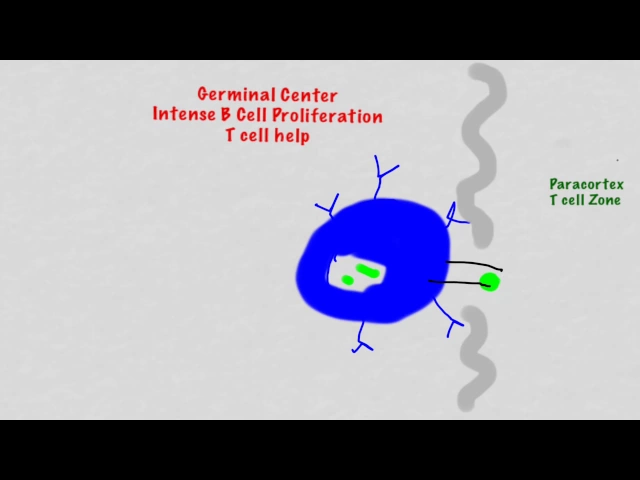
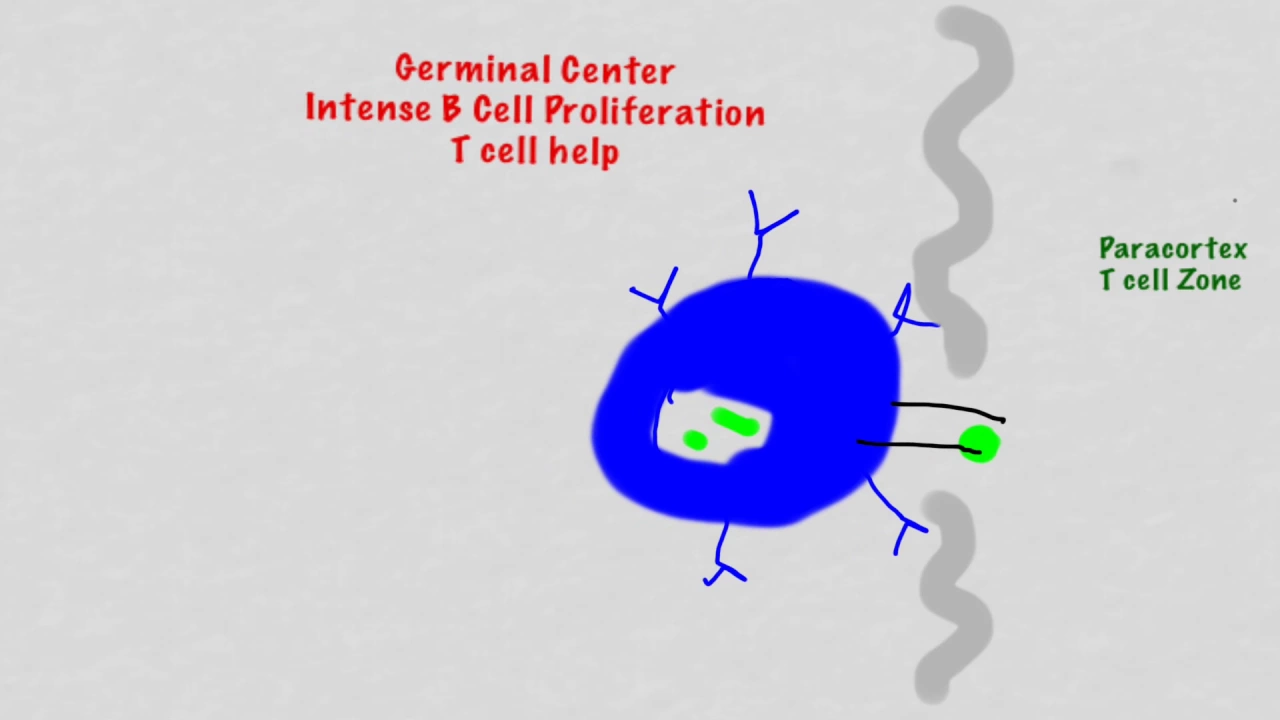
you some directions for that or actually we're going to need IGG for this one it's pretty inflammatory so how exactly do we make that work okay so first let's reor Orient ourselves to the lymph node because all of this is happening in the lymph node remember that so T cells and B cells cells will come in through the apit lymphatic vessel then through high endothelial venules the te- cells wind up here in the paracortex which is the t- cell Zone and the B cells wind up out here in the outer cortex where they form these
little follicles now remember our B cell over here actually encountered antigen in the B cell zone so it's in its follicle it's encountered antigen and now it wants to maybe differentiate into a different type of antibody secreting plasma cell so it's going to start moving through the lymph node so it'll go from the primary follicle to the secondary follicle and then at the secondary follicle it's going to get even closer to this paracortex area of the t- cell zone so close that it could actually theoretically interact with te- cells that are linning the t- cell
Zone and that's exactly what's going to happen all right so let's blow this up a little bit you have your B cell here that is now presenting antigen in the context of mhc2 and it's going to move closer to the paracortex to the t- cell Zone it's not going to cross into the t- cell Zone but it's going to kind of reach across and within that zone there are t- cells that can come in and kind of interact with the B cells that are Reaching Across to see if the B cells are presenting their antigen
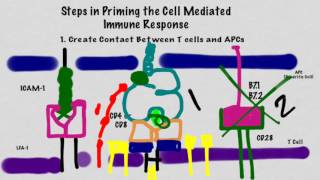
of interest and in this case let's say the b cell and the T cell get lucky and they see that this B cell is presenting an antigen that this t- cell likes now remember if this is the first time this T cell has seen its antigen the B cell is going to need to provide co- stimulation in the form of B7 and cd28 that's no problem though the B cell can easily now once the t- cell is activated it will upregulate expression of cd40 Lian which will ligate cd40 on the surface of the B cell
this is incredibly important for class switching once this interaction happens the B cell will be able to express on its surface certain cyto receptors that will work for cyto kindes that this te- cell will produce the combination of the cyto kindes that the t- cell produces and the cd40 cd40 liand interaction will lead to the correct signals this B cell needs to know whether or not it should become an IGA IG or IG secreting plasma cell so it's the combination of both the cd40 cd40 liand interaction and the cyto kindes that are produced in the
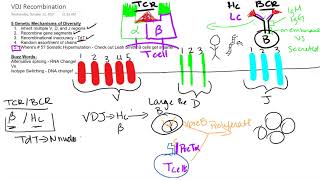
micro environment and by the te cell that has already been activated class switching occurs when an enzyme known as activation induced deaminase or Aid is turned on as a result of cd40 cd40 liand signaling Aid is able to form breaks in the DNA removing intervening DNA sequences between the recombined vdj Exon and coding the V domain and one of the new heavy chain genes that will lead to ig IG or IGG expression so once Aid Works to kind of loop out that intervening DNA you go from having IGM expression to IGG expression there are some
patients who lack cd40 liand expression on their te- cells these patients suffer from a rare disorder known as Hyper IGM syndrome cd40 Lian is normally required for class switching and also the generation of memory B cells and generating the germinal center follicles where all of the proliferation of B cells takes place the patients that have hyper IGM syndrome are unable to class switch from IGM to any of these other classes so they have a fully normal compl of mature b cells these B cells all have B cell receptors that are functional but they can't really
form memory B cells and they also can only make IG because they can't class switch so unfortunately the result is that these patients typically develop severe recurrent respiratory tract infections because without the ability to class switch you don't make IGA which is really important important for guid guarding and protecting our mucosal areas um in particular many of these infections can lead to severe pneumonias and can be life-threatening so in review our naive B cell that has a fully mature receptor is cross-lined by an antigen this occurs in the lymph node typically by soluble antigens that
have kind of percolated their way into the outer cortex where the B cells hang out at that point the cell becomes activated and it can clonally expand if the cell does not receive any t- cell help it will create a t independent antigen response it will differentiate into an IGM plasma cell that is capable of secreting IGM antibody if at this point it does get t- cell help then it can undergo class switching these are the T dependent antigens so they're peptides this can happen because the B cell has moved toward the paracortex where the
te- cells hang out or additionally there are t folicular helper cells that actually reside within the follicle of the lymph node these were not really discussed in this video but are discussed in your course note during this massive amplification this clonal expansion especially with tendent antigens you can get sematic hypermutation which can influence the antigen binding sites of the B cells that are produced and therefore the antibodies that the plasma cells will secrete when there's te- help te- cell help at this stage you get your T dependent antigen response which will lead to plasma cells
that are capable of secreting IGG IGA or IG and although I don't mention it igd because it's very rarely secreted these antibodies are the antibodies that you'll expect to see depending on the types of cyto kindes that are secreted from the cyto from the CD4 positive t- cell in the context of cd40 and cd40 liand interaction