Hello, I'm Terry Fisher. This is the sixth of 12 lectures on copyright. I'll be examining today the mechanics of copyright, in other words, the way in which the machinery of the copyright system works in practice.
As usual, I'll devote most of my attention to how the US Copyright system works. Indeed, of the 12 lectures in this series, this is the one that pays especially close attention to the idiosyncrasies of the law in the United States. However, I will identify along the way some respects in which the copyright systems of other countries differ.
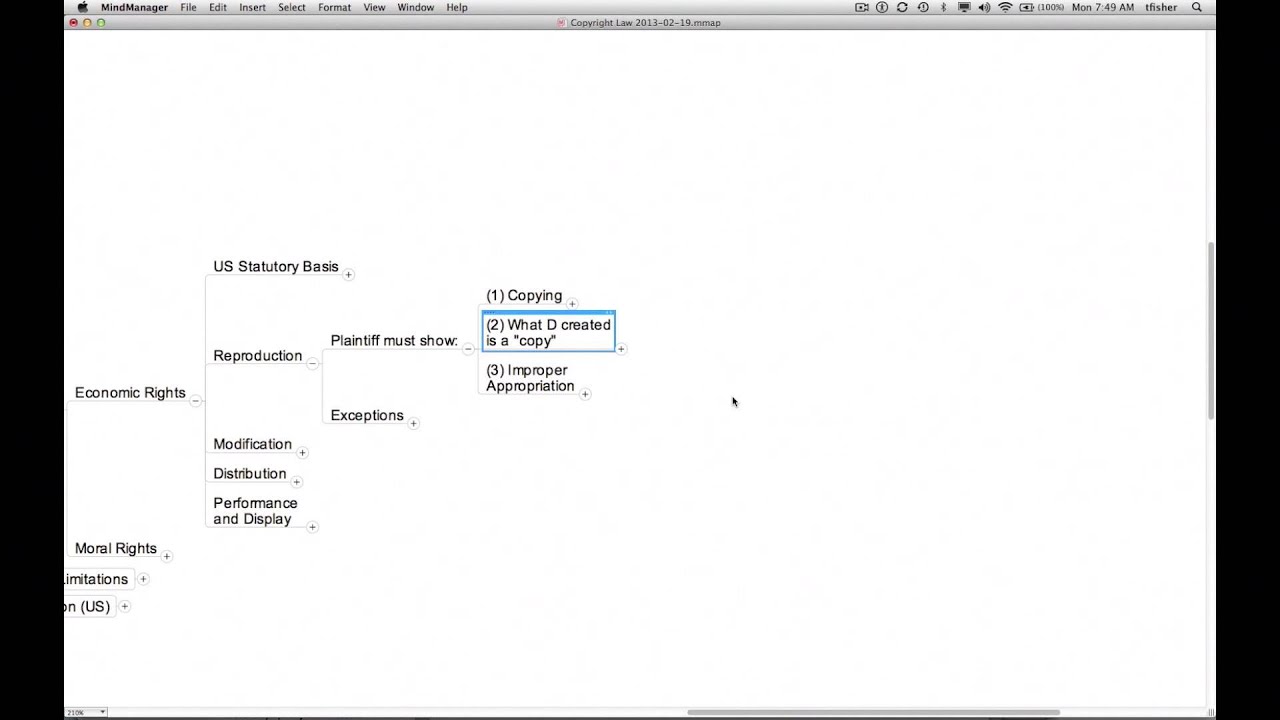
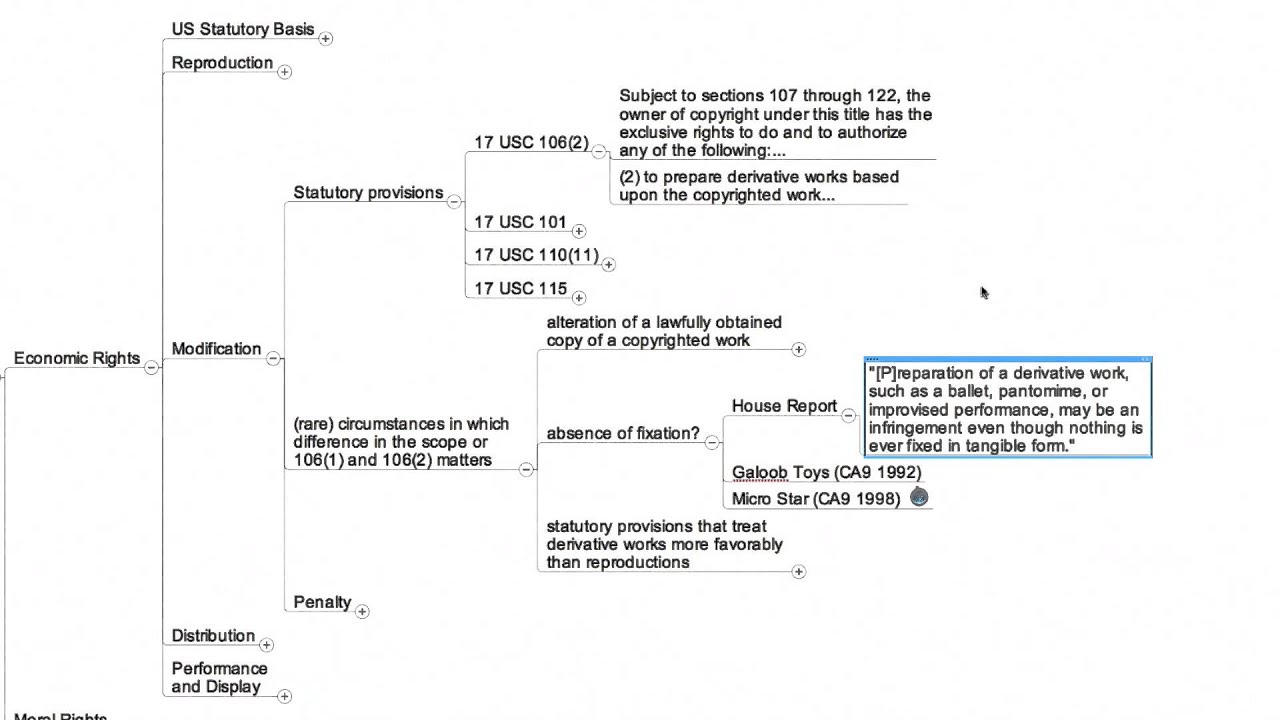
And more importantly, I will emphasize the broad policy questions implicated by the US rules, policy questions that are pertinent to all countries. Also as usual, I will be supplementing my presentation with various audiovisual materials, which are best seen by watching the lecture on a computer or a device with a reasonably large screen. One source of those supplementary materials will be a map of copyright law, the current version of which can be downloaded from my home page, the address of which is tfisher.
org. The machinery of the copyright system is intricate, surprisingly so. I will not attempt today to catalog all its details.
Instead, I will concentrate on three important dimensions of this machine-- first, the roles played by formalities; second, the rules governing how long copyrights last, and third, the aspects of the system that attempt to protect vulnerable artists and their families from exploitation. We'll begin with formalities. Until quite recently, the United States, unlike most countries in the world, extended copyright protection only to authors who had complied with some administrative requirements known as formalities.
These administrative requirements were not especially burdensome, but they were important. Indeed, failure to observe them could result in permanent forfeiture of one's copyright. In the late 20th century, most of these formal requirements were eliminated, not all at once, but in stages.
The result is, that since 1989, the copyright system of the United States has been, in this respect, very similar to the copyright systems in most other countries. During this segment of the lecture, I will describe how those formal requirements once worked and the process by which they were largely, although-- as we'll see-- not completely abandoned. A threshold question-- if these formalities have been more or less eliminated, why do we need to discuss them?
There are two answers to that question. First, as you'll soon see, many of the copyrights that remain commercially valuable in the United States were born during eras in which the formalities were still in force, and the abolition of the formalities was not retroactive. As a result, the legal status today of many copyrighted works depends upon the capacity of the putative owner to demonstrate that the formal requirements were once upon a time appropriately observed.
In short, the formalities still matter in practice. The second reason is that, as you will also see, many scholars today believe that the abolition of formalities was a mistake and that the copyright system did function and would function much better if at least some formalities were reinstated. Indeed, these scholars argue, all countries should revive some variant of the model that once existed in the United States.
Examining the history of formalities in the United States will help us to assess that important policy argument. With those two considerations in mind, let's turn to the law. The slide on your screen summarizes the changing status in US law of the three most important formalities.
I hasten to add that this chart is not comprehensive. It focuses on, as I say, the most important requirements. If you're hungry for more information on the subject, follow the branch of the map that summarizes the history of formalities.
You'll find they are linked to an excellent article by Professor Jane Ginsburg. On pages 13 and 14 of her article, you'll find a chart that contains much more detail than the one on your screen. So with that cautionary note, let's focus on the main themes.
To make sense of this field, you need to differentiate three eras in the legal history of copyright in the United States-- the period between 1909 and the end of 1977; the period between January 1, 1978 and February 28, 1989; and the period between March 1, 1989 and the present. The first of these eras was governed by the 1909 version of the Federal Copyright Statute. The event that separated the first from the second era was a comprehensive reform of that statute, which was adopted in 1976 but only became effective at the start of 1978.
The event that separated the second from the third era was the effective date of the statute, that as we have seen earlier, altered US law enough to enable the United States to join the Berne Convention. We could, of course, look farther back in time than 1909. But no copyrights governed by pre-1909 statutes are still alive today, so we won't.
During the first of these eras, there were three main formalities. Most important, and for authors, the most dangerous was the notice requirement. When you first published your work, you had to notify the world that you were claiming copyright in it, or you forfeited your rights.
The statute was quite precise concerning the content and placement of that notice. For example, if you published a novel, you had to place the notice on the title page or the following page. You had to use the word copyright or any abbreviation thereof, such as the now famous c within a circle.
And you had to indicate the date of the publication. Here, for example, is the second page of an edition of Gone with the Wind by Margaret Mitchell, a very popular novel that we will discuss later in this course. The crucial material is indicated here.
You might wonder, why is the copyright asserted by McMillan rather than by Mitchell? And what's the purpose of the language highlighted on your screen? We'll address those issues shortly.
Now back to the chart-- as I say, if you published your work without appropriate notice, you no longer enjoyed copyright protection. This requirement corresponded to and reinforced the distinction, during the era governed by the 1909 statute, between state and federal copyright protection. Here's how that distinction worked in practice.
When you first created your work-- let's assume it's a novel-- you acquired a copyright but not a copyright recognized and enforced by federal statutory law. Rather, you enjoyed a copyright recognized and enforced by state common law. If you never published your novel, that common law protection would last indefinitely.
But if you published your novel, your common law protection evaporated. From that point forward, you got copyright protection under federal law, if at all. This is the moment when the notice requirement took hold.
If you published the novel without the requisite notice, you forfeited federal protection permanently. As a result, the novel fell into the public domain, the set of materials that anyone can use freely. The metaphor of falling is interesting.
Why didn't the novel rise into the public domain? There are various possible explanations for this terminology-- perhaps because the public domain was thought of as debased, perhaps because it was analogized to the Lockian untilled field, perhaps because it was thought of as a reservoir, like water, of raw materials. Not clear, but almost certainly, the metaphor of falling had, and still has, power.
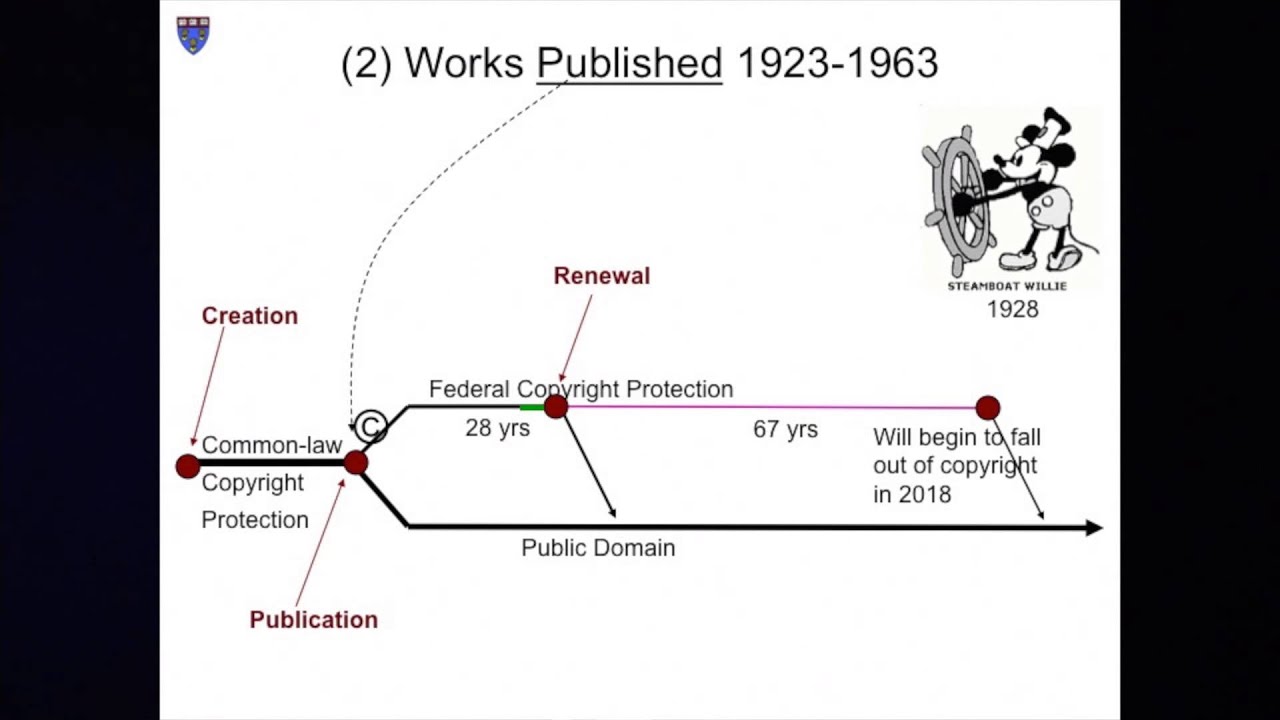
Back to our story-- if by contrast, you or your publisher attached to all copies of the published book the requisite notice, then you did acquire federal copyright protection, but it did not last forever. Rather, it lasted for an initial term of 28 years. When that term ended, the novel again fell into the public domain, unless you, or as we'll see, a member of your family renewed the copyright, in which case, it would enjoy protection for a second 28-year term, whereupon it would finally and permanently fall to the public domain.
Thereafter, anyone could use it, copy it, publish it, read it aloud in a public park, and so forth. For the most part, the system worked just fine for sophisticated novelists, like Margaret Mitchell, and publishers, like McMillan. They were aware of the statutory requirements, and complying with them was not hard.
But less sophisticated players or the creators of less-conventional works sometimes neglected the notice requirement, and as a result, lost copyright protection permanently. The courts, sympathetic to the plight of these unsophisticated players, begin to tinker with this legal regime, in order to reduce the frequency of forfeitures. They couldn't, of course, ignore the statutory requirement altogether.
Instead, they began to construe the term, quote, "publication," close quote, in a way that helped 90% of authors. They were able to do so because the statute itself did not to find the term publication, but left that up to the courts. Seizing that opportunity, the courts differentiated two kinds of publication-- so-called limited publication, which would not trigger the notice requirement, and so-called general publication, which did.
The courts then defined general publication narrowly, to exclude lots of things we would actually associate with the term publication. For example, they held that making and distributing a sound recording of a musical composition did not result in publication of the composition and that giving a public lecture did not result in publication of the lecture, unless you passed out unrestricted copies of the text to your audience. Here's an important and illustrative case, the outcome of which hinged on this counterintuitive definition of publication.
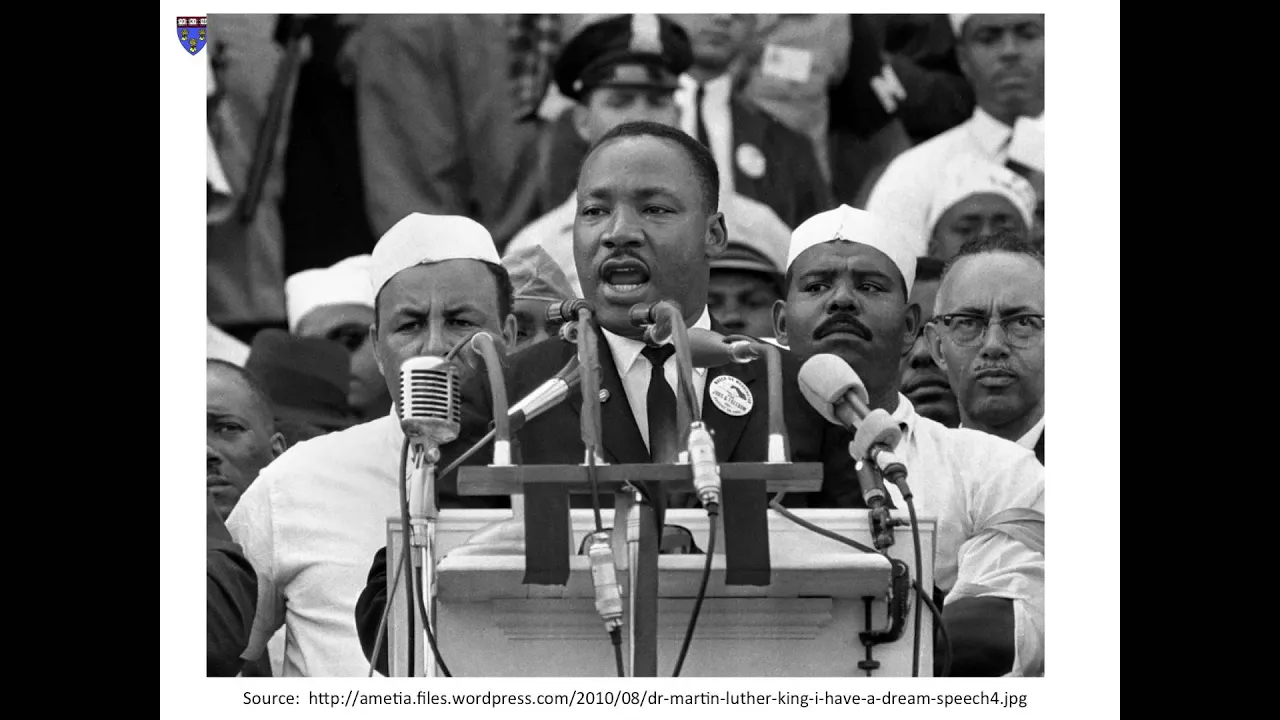
On August 28, 1963, the Southern Christian Leadership Conference organized a march in Washington, DC in support of the civil rights movement. Roughly 200,000 people gathered on the mall at the center of the city. The march culminated with a speech by Dr Martin Luther King Jr, the founder and president of the Leadership Conference.
The latter portions of his speech contained some of the most moving and justly famous lines in US political history. Here are a few. "I have a dream that my four children will one day live in a nation where they will not be judged by the color of their skin, but by the content of their character.
I have a dream that one day the state of Alabama, whose governor's lips are presently dripping with the words of interposition and nullification, will be transformed into a situation where little black boys and black girls will be able to join hands with little white boys and white girls and walk together as sisters and brothers. " As I say, roughly 200,000 people heard this speech live, and millions more saw it on television. Roughly a month afterward, it apparently occurred to King, or his advisers, that he ought to enjoy a copyright in the speech and that other people should have to pay him, if they wished to sell copies the speech.
So on September 30, 1963, King filed for copyright registration and duly received a certificate of registration on October 2. He then initiated an infringement suit against unauthorized seller and prevailed. It's probably occurred to you that there's an important policy issue lurking here.
Should political speeches be subject to copyright protection? In the United States, so long as their authors are not officials of the federal government, they are protected by copyright. And Dr King and his estate have enforced their copyrights in his speeches and letters fiercely.
I leave to you the question of whether giving King and his estate this power makes sense on the basis of any of the theories of copyright we've considered thus far in this lecture series. But our primary concern today is not with that important policy issue, but with of question of formalities. For decades, no one seems to have challenged King's copyright in the "I Have a Dram" speech.
Then, in 1994, CBS produced a documentary series on 20th century US history. One segment of one episode in that series focused on the March on Washington. In it, CBS showed roughly 60% of King's speech.
CBS did not, before making the film, ask permission and did not pay the customary license fee. CBS's estate predictably brought suit against CBS. CBS's main line of defense was that King, and subsequently his estate, lacked copyright protection, because King had published the speech in August of 1963 without the statutorily required notice.
There's no question that King had not given any kind of copyright notice when he delivered the speech on the mall. So the only issue, at least during the preliminary round of litigation, was whether making the speech before a nationwide audience constituted publication. The trial court concluded, yes, and thus that King had forfeited copyright protection.
But the Court of Appeals for the 11th Circuit concluded, no. A general publication, the court ruled, occurs only in two situations-- first, when tangible copies of a work are distributed to the general public in such a manner as to allow the public to exercise dominion and control over those copies; and second, when the work is exhibited and displayed in a way that invites unrestricted copying by the general public, for example, by publicly displaying a sculpture without any restrictions on the freedom of viewers to photograph it. At the stage of the litigation in which this issue arose, CBS had not yet established that King had done either of those things when he delivered the speech.
So he did not forfeit his copyright in it. So CBS, as a result, had to obtain a license from King's estate, if CBS wished to broadcast it. This case illustrates a couple things-- on one hand, the crucial importance during this first year of the notice requirement; and on the other hand, the willingness of some courts in borderline cases to construe the term publication in a way that avoided forfeiture.
So that's the first of the three main formalities that governed US copyright law until 1978. After that date, the requirement was softened considerably. Between 1978 and 1989, failure to attach notices to copies at the time of registration was not fatal, so long as you made an effort to cure the problem within five years.
In 1989, the notice requirement was eliminated as a precondition for copyright protection. Although, as we'll see in the 12th lecture, a failure to attach appropriate notices may limit the amount of statutory damages you can collect from infringers. Remember, however, that these changes were not retroactive.
So in the King case, the fact that the CBS documentary was not made until the 1990s did not mean that the notice requirement was irrelevant. Because the speech was made and published in 1963, the 1909 statutory requirements still applied and continue to apply today to pre-1978 works. The second of the three formalities is also illustrated by the King case.
Registering your work with the Copyright Office was not a prerequisite to copyright protection. But you could not bring an infringement suit prior to registration, nor could you renew the copyright. That's the reason King sought and obtained registration before filing his initial suit.
In 1978, the renewal system, as we'll see, disappeared. But registration remained necessary if you wanted to bring a lawsuit. An additional incentive for registration was added, namely that you couldn't recover statutory damages or attorney's fees for infringements that began prior to registration.
In 1989, registration ceased to be a precondition for initiating a lawsuit with respect to works first published outside the United States. But it's still remained so for so-called US works. The softest and least important of the formalities was the requirement that authors deposit two copies of their works with the Library of Congress within three months of publication, basically, in order to help the library build its collection.
Failure to comply exposed you to escalating fines. If after being notified by the Copyright Office you still refuse to comply, you could forfeit your copyright, although this seems to have been rare. Forfeiture was eliminated as a sanction in 1978, and that regime continues to the present.
So that, in brief, was how the US system of formalities worked and how it has been radically cut back. As we've seen, the system had two unfortunate effects. First, it sometimes resulted in inattentive authors losing their copyright protection altogether.
Second, it tended to benefit sophisticated parties and institutions and to disadvantage authors and others less aware of the rules of the game. However, in its heyday, the system of formalities also had two important beneficial social functions. First, the registration requirement facilitated socially beneficial licenses and assignments.
Suppose you encountered a copyrighted work and wanted to use it for some purpose. For example, you came upon a sound recording you wanted to include in a film or an article you wanted to include in an anthology. If the copyright in the recording or article has been properly registered, you were more likely to be able to locate the copyright owner and thus obtain a license than if had not been registered.
Viewed from this angle, however, the system was far from perfect, because as we've seen, lots of work still in there first term had not been the subject of litigation and thus were still unregistered. And yet, the copyrights in them were valid. The second of the two beneficial social functions was advanced more effectively by this regime.
The notice requirement had the effect that many works, specifically all works published without the proper notice, fell into the public domain. Arguably, this was desirable, both by increasing the set of materials from which future authors could draw freely and by giving all authors an easy way of dedicating their works to the public. If you didn't want to assert a copyright, all you had to do was publish your work without a copyright notice.
Some evidence that these functions were indeed being advanced can be gleaned from data compiled by Chris Sprigman in his pioneering article on copyright formalities. The slide in front of you, taken from Sprigman's article, shows the number of copyright registrations each year, from 1909 through the end of the century. As you can see, it begins at about $100,000 per year and peaks at around 600,000.
That might seem like a large number. But it's a tiny percentage of the set of potentially copyrightable works. Another feature of the system reinforced this effect.
As you'll recall, the original 1909 regime did not give authors a copyright lasting 56 years, but rather gave them an initial term of 28 years plus an option to renew for another 28 years. If they failed to exercise that option, their works fell into the public domain. And most authors did indeed fail, as this chart, also from Sprigman, demonstrates.
It shows the fraction of works originally registered that were renewed when the time came for renewal arrived. As you can see, that percentage begins around 5% and rises to only around 20%. In other words, the large majority of registered works were not renewed and thus went out of copyright after only 28 years, thus contributing to the public domain reservoir.
The general principle underlying the system is that copyright was an opt-in regime. If you wanted a copyright, you had to affirmatively acquire and keep it. If you didn't, you lost it.
By contrast, the current US regime and the copyright regimes in virtually all other countries is an opt-out system. Copyright protection, as we've seen, arises automatically. If you don't want a copyright in one of your works, you have to act affirmatively to give it up, and it's not easy to do so.
Graphically, this difference can be characterized as follows. This, as you now know, is the original 1909 system. By contrast, this is how things work today.
As soon as you create a work-- more specifically, as soon as you fix it in a tangible medium of expression-- federal copyright protection automatically arises. You don't need to wait until publication. And protection lasts not for 20 years or even 56 years, but for your lifetime plus an additional 70 years.
Somewhere along this timeline, you or your heirs or devisees may publish the work. And as we'll see, publication has some important legal effects, particularly if it's a work for hire. But publication does not alter the existence of the copyright.
When the term expires, the work will, as usual, fall into the public domain. But that won't be until long after you're dead. Before then, it's possible to give up your copyright by dedicating to to the public domain.
But that, as I say, is hard and rare. The result, as I've indicated previously, is that billions of creative works throughout the world are now subject to copyright protection. But the absence of an effective registration system often makes it difficult to locate the owners of those copyrights and thus to obtain permission to make otherwise proscribed uses of those works.
The result is needless impediments to cumulative or derivative artistic progress. What might be done to alleviate this problem, without, of course, corroding the rights of the artists and authors who do want and depend upon copyright? There at least three possibilities.
First, and most radically, we might repudiate the provision of the Berne Convention that forbids making compliance with formalities a condition of acquiring or exercising copyrights and then, country by country, reinstate systems of formalities. That might well be socially desirable, but it's very unlikely. Second, we might increase the incentives for voluntarily complying with formalities, in particular for registering one's copyrights.
As I've said, there already exists some incentives for registration. For example, registered copyrights enjoy a modest presumption of validity. And as we've seen in the United States, statutory damages are not available when unregistered copyrights are infringed.
But we might amplify the benefits of registration, perhaps by further increasing the remedies available to the owners of registered works. Alternatively, we might make a failure to register more costly, perhaps by expanding the set of exceptions and limitations applicable to unregistered works. But in so doing, we'd need to be mindful of the constraints imposed by the so-called three-step test contained in the Berne Convention and the TRIPS Agreement, which I discussed in the first lecture.
The third of the three possible responses would be to provide a mechanism that makes it easier for authors and artists to donate some or all of their entitlements to the public-- to make, in other words, a credible and enforceable announcement to the world that they will retain and exercise only some of the rights that the copyright system automatically confers upon them. That's basically the idea behind Creative Commons, the brainchild of Larry Lessig. Creative Commons makes available to copyright owners a set of standardized licenses that they can grant to the public at large by attaching appropriate notices to copies of their creations.
As we saw in the King case, attaching a copyright notice to copies of one's work was once essential, if one wanted copyright protection. The Creative Commons notices do the opposite. They signal to the world that the copyright owner wishes to give up some or all of the rights he or she acquires automatically.
The following short video from Creative Commons itself shows how these notices work. [BEGIN VIDEO PLAYBACK] When you share your creativity, you're enabling people anywhere to use it, learn from it, and be inspired by it. Take the teacher, who shapes young minds with work and wisdom from around the globe; and the artist, who breeds beauty out of bits and pieces she finds online; and the writer, whose stories use ideas and images crafted by people he's never even met.
These people know that when you share your creative wealth, you can accomplish great things. They and millions of other people all around the planet are working together to build a richer, better, more vibrant culture, using Creative Commons. To understand Creative Commons, you need to know a little bit about how copyright works.
Did you know that when you create something, anything from a photograph to a song to a drawing to a film to a story, you automatically own and all rights reserved copyright to that creativity. It's true. Copyright protects your creativity against uses you don't consent to.
But sometimes full copyright is to restrictive. What about when you want all those millions and millions of people out there to use your work without the hassle of coming to you for permission? What if you want your work to be freely shared, reused, and built upon by the rest of the world?
Luckily, there's an answer-- Creative Commons. We provide free copyright licenses you can use to tell people exactly which parts of your copyright you're happy to give to the public. It's easy.
It only takes a minute. And it's totally free. Just come on our website and answer a few quick questions like-- will you allow commercial uses of your work?
And will you allow your work to be modified? Based on your answers, we'll give you a license that clearly communicates what people can and can't do with your creativity. You don't give up your copyright.
You refine it, so it works better for you. Welcome to a new world where collaboration rules. It didn't even exist just a few years ago.
But now there are millions and millions of songs, pictures, videos, and written works available to share, reuse, and remix, all for free. Want to work together? Then join the commons-- Creative Commons.
[MUSIC PLAYING] [END PLAYBACK] If you're persuaded by this video and follow the narrator's instructions to go to the Creative Commons website, you will find there six main licensing options which give you and other authors of a variety of sets of rights that you and they may decide to retain or surrender. In addition to the six licenses listed on your screen, Creative Commons makes available to copyright owners a standardized notice known as CC0, that they can employ to give up all of their rights-- in other words, as I've said, to donate their works to the public domain. An important footnote-- as you know by now, in some countries, authors enjoy some non-waivable moral rights, in other words, entitlements that they cannot give up.
In those countries, use of the CC0 label may not be fully effective or at least not permanent. That troubling possibility has not yet been tested. But this label, CC0, provides authors an easy way to give up as many rights as they can.
In terms of our schematic characterization of the copyright system, here's what CC0 enables. The current regime, as you'll recall, works like this. CC makes it easier for copyright owners to opt out of some more or all of their rights, in other words, to do this.
That advantage of Creative Commons, as compared to the other two ways of tempering the unfortunate side effects of our current lack of formalities, is that it in no way undermines the right of copyright owners who want to retain all of their rights. It is this optional feature that prompted Jack Valenti, the former head of the Motion Picture Association of America and a staunch defender of copyright, to endorse Creative Commons. [BEGIN VIDEO PLAYBACK] I'm glad to be here via this video.
I wish I could be there in person. But I wanted to say just few words about Larry Lessig's concept of Creative Commons. I'm attracted to it for the following reasons.
First, Larry makes it clear that he is respectful of and supports copyright-- copyrighted material that artists create. And he believes it ought to be protected. But he also says, and I agree, that there are those people who have copyrighted material who may want to give up part of their copyright or all of it, to put on the Creative Commons and let other people view it or hear it or whatever.
And I have no problem with that. I think that's part of the free and society in this country, that if you want other people to have your material you have created free of charge with your permission, wonderful. And I find that to be a salutary kind of thing.
But I think it's also important, as Larry staunchly believes, that those people who have copyrighted material-- whether it be in a book or a television program or home video or music or movie or computer software-- and who want it protected, so that they can make sure that it can move through the various venues where that material is brought to the public and given to consumers at fair and reasonable prices. [END PLAYBACK] The disadvantage of Creative Commons is that the majority of copyright owners do not and will not use it, either because they were unaware of it, don't understand it, or simply don't want to give up any rights. Creative Commons thus mitigates the troubling impact of our lack of formalities, but certainly doesn't eliminate them.
What else might we do without sacrificing the clear benefits of our current regime? I'll leave that to your imagination and deliberation.
![1 A.M Study Session 📚 [lofi hip hop]](https://img.youtube.com/vi/lTRiuFIWV54/maxresdefault.jpg)

![Afternoon Jazz 🎷 [jazz lofi]](https://img.youtube.com/vi/-R0UYHS8A_A/maxresdefault.jpg)