Day 10 Imagine that a boxer gets into the ring for a fight, but his opponent never shows up. What’s he supposed to do? With everyone watching, he’d look kinda silly if he just stood there.
But with good showmanship and clever image management he could maybe emphasize his walkover victory with some celebratory air punches and maybe a display of manly force. Well, that seems to be what a large portion of the US Navy is engaged in in the Caribbean, on October 25th, 1962. This is TimeGhost with The Cuban Missile Crisis.
I’m Indy Neidell Today, the US enforcement of its blockade of Cuba continues despite the fact that the Soviets seem to have turned back all their ships, but we know that four Soviet submarines are still on their way to Cuba. Yesterday, the US administration noted that the Russians were respecting the blockade, although the military had noticed already two days ago. Soviet leader Nikita Khrushchev wrote to US President John F.
Kennedy with a forceful rebuke of the US blockade, and the US preparations to confront the Soviets at the United Nations continued. This confrontation is incredibly important for the Americans, as they need the rest of the world to have no doubt whatsoever that the Soviets have installed both mid and intermediate range ballistic missiles on Cuba. Up until now the USSR have neither denied, nor confirmed this, and while most US allies believe it, the world public might not, and the Eastern Bloc countries stand with the Soviets.
All over the world, protests against the blockade have been erupting. In Eastern Europe, Europe, and Latin America, the Soviets have mobilized their Communist connections to besiege US embassies and demand an end to the blockade. This is no mere exercise in grandstanding.
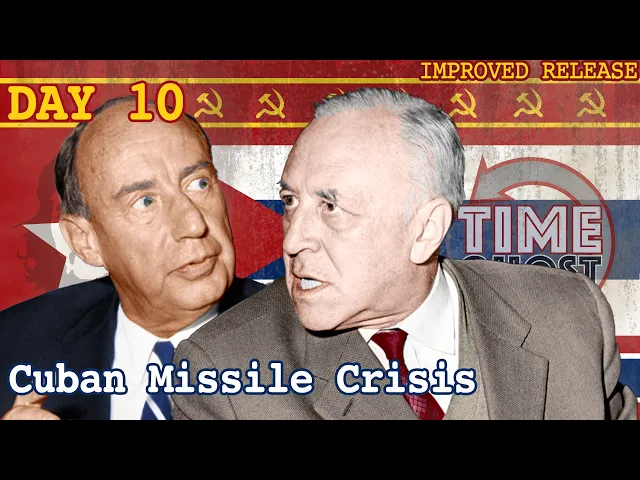
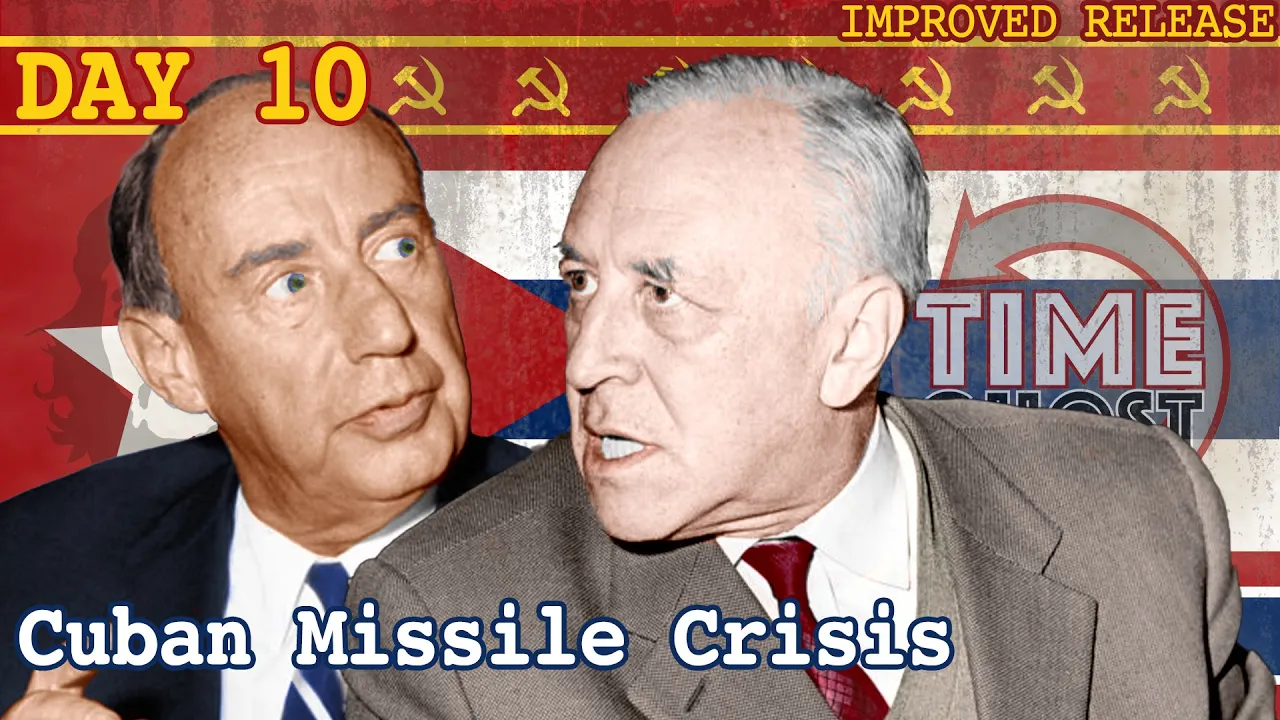
Now, remember that the US ambassador to the UN, Adlai Stevenson, has so far been the only person in the American administration to vocally oppose all forceful actions to resolve the crisis, including the blockade. His preferred course of action would be negotiating the closure of US foreign military bases and removing the American missiles in Turkey and Italy in exchange for the Soviets leaving Cuba. Today, he must confront the Soviets in open session at the UN in front of the TV cameras of the entire world.
Unlike the Navy, Stevenson will most certainly meet his opponent, USSR Ambassador to the UN Valerian Zorin, in the ring. Zorin is a formidable opponent - he is sharp and he is gifted in rhetoric. He’s also something of a sad figure, which we won’t find out until after his death two decades from now.
He didn’t really want to be diplomat at all, actually. His real passion is music and he deeply regrets only being an amateur, and also never being a published poet. Anyhow, there is grave doubt by many on EXCOMM, the US committee dealing with the crisis, that Stevenson is really up to the task.
Loads of pressure has been brought to bear on President Kennedy to bring in someone else. Instead, Kennedy has stood by Stevenson and called in their mutual friend and presidential advisor John J. McCloy as moral support for good old Adlai.
Stevenson has promised to stand his ground, but it doesn’t look great when he starts off in his traditional diplomatic and conciliatory tone. My government is most anxious to effect a peaceful resolution of this affair. We continue to hope that the Soviet Union will work with us to diminish the -- not only the new danger which has suddenly shadowed the peace, but all of the conflicts that divide the world.
He vacillates a bit more, but then picks up speed. The argument in its essence of the Soviet Union is that it was not the Soviet Union which created this threat to peace by secretly installing these weapons in Cuba, but that it was the United States which created this crisis by discovering and reporting these installations. This is the first time, I confess, that I have ever heard it said that the crime is not the burglar but the discovery of the burglar -- and that the threat is not the clandestine missiles in Cuba but their discovery and the limited measures taken to quarantine further infection.
His arguments get stronger and stronger, and then he goes off script and delivers what he has promised the President. And, finally, the other day, Mr Zorin, I remind you that you didn't deny the existence of these weapons. Instead, we heard that they had suddenly become defensive weapons.
But today -- again, if I heard you correctly -- you now say they don't exist, or that we haven’t proved they exist, with another fine flood of rhetorical scorn. All right sir, let me ask you one simple question. Do you, Ambassador Zorin, deny that the U.
S. S. R has placed and is placing medium and intermediate range missiles and sites in Cuba?
Yes or no? Don't wait for the translation: yes or no? ZORIN [statement in Russian followed by English translation through a United Nations Interpreter]: I am not in an American courtroom, sir, and therefore I do not wish to answer a question that is put to me in the fashion in which a prosecutor does.
In due course, sir, you will have your reply. Do not worry. You are in the court of world opinion right now and you can answer yes or no.
You have denied that they exist. I want to know if you -- if this -- if I've understood you correctly. ZORIN [statement in Russian followed by English translation through a United Nations Interpreter] Sir, will you please continue your statement.
You will have your answer in due course. ** Mr Stevenson, would you continue your statement please? You will receive the answer in due course.
I am prepared to wait for my answer until hell freezes over, if that's your decision. . .
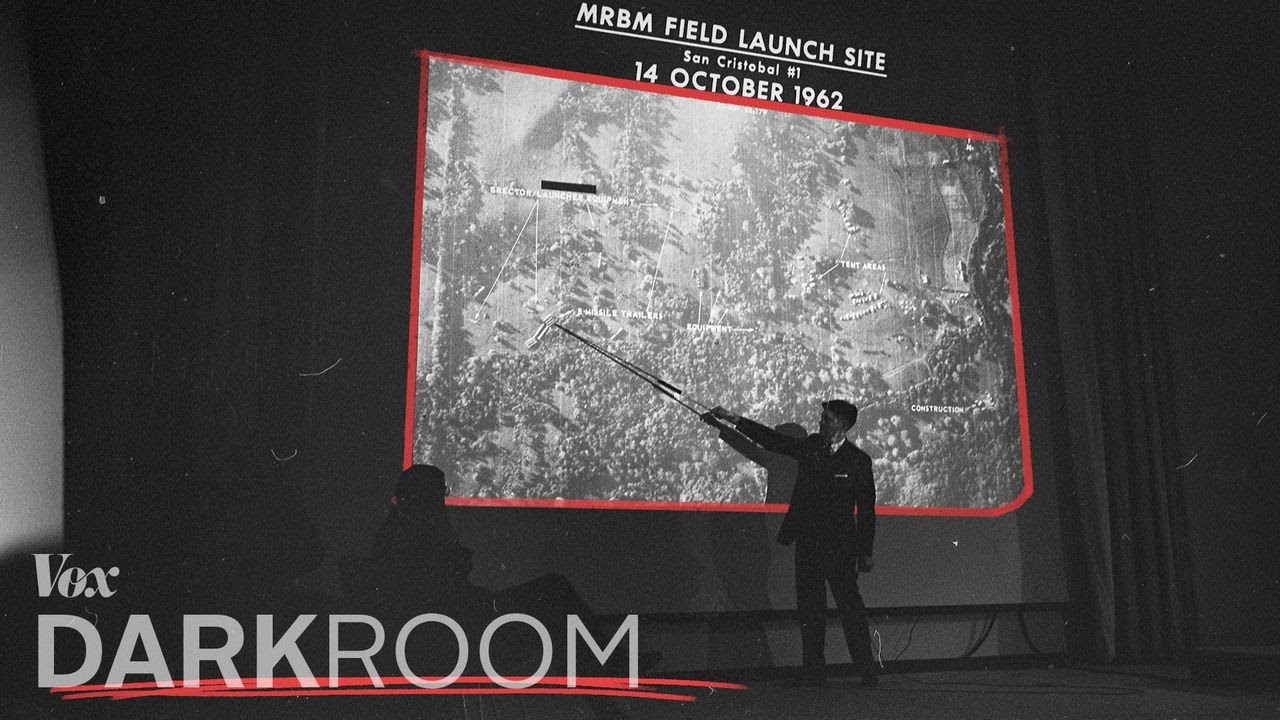
. And I'm also prepared to present the evidence in this room. Stevenson then shows the photographs of the missile sites, most importantly the low altitude shots taken two days ago.
He explains to the council in detail what they are looking at, and asks again if Zorin denies the existence of Soviet nuclear missiles on Cuba in view of this irrefutable proof. Zorin once again obfuscates. Stevenson sums up.
I have not had a direct answer to my question. The representative of the Soviet Union says that the official answer of the U. S.
S. R. was the Tass statement that they don’t need to locate missiles in Cuba.
Well, I agree -- they don’t need to. But the question is, have they missiles in Cuba -- and that question remains unanswered. I knew it would be.
Stevenson has stood his ground and made the USSR look like the bad guys - in the roughly one hour that his presentation lasts he has done more than influence world politics on a historical level, he has also made television history. Ever since, this moment has been replayed again and again as an iconic moment of the Cold War. Meanwhile, Khrushchev has already decided to throw in the towel.
Hours before the confrontation in the UN, the Soviet Presidium has met to discuss the crisis again. During the night they have received another direct letter from President Kennedy imploring them to not do anything rash and to initiate negotiations. Khrushchev opens the meeting with a concession of defeat.
He says: “The further course of events is proceeding in the following way. The Americans say that the missile installations in Cuba must be dismantled. Perhaps this will need to be done.
This is not capitulation on our part. Because if we fire, they will also fire. There is no doubt that the Americans became frightened, this is clear.
Kennedy was sleeping with a wooden knife. ” Mikoyan asks “Why with a wooden one? ” Referring to the pre-toilet paper way of cleaning oneself with a wooden stick, he replies: "When a man goes bear hunting for the first time, he takes with him a wooden knife so that it will be easier to clean his trousers.
” Now, at this moment Nikita Khrushchev has sealed his political fate. His jest is the beginning of a long row of attempts to pitch the now failed Operation Anadyr as a success because it scared the Americans. In fact, he had used some of his last political clout to sell the idea in the first place.
It will take another two years for the rest of the men in the room to oust him and seize power, but in 1964 they will. However, although the presidium agrees unanimously and starts drafting a letter to Kennedy offering to withdraw the missiles if the US promises to not invade Cuba, the crisis is not over by a long shot. Like I’ve said many times in this series, when you let out the leash on the dogs of war it risks slipping out of your hand, and that is what is happens right now.
Around Cuba, the US navy is circling looking for something to do, or at least someone to intercept. They want to stop and board two tankers, but since the Soviets look like they’re respecting the blockade on arms deliveries, the White House is uncertain. Within the military and the EXCOMM, people now begin to worry that it will look like they’re not enforcing the blockade if they don’t board some vessel, even one that they know that they’ll let through, but on the other hand they don’t want to provoke the Soviets.
Have we got any other ships we can board now? There will . .
. Non-Soviet ships, there are many. But in order to allow Admiral Dennison to lay on a plan for doing that, we should give the instructions, and do so very promptly.
I think that would be highly desirable. Now, why don’t you do that right now. Finally, in order to not provoke the USSR while the prospect of negotiations at the UN are on the table, they decide to let the tankers through and go after a Lebanese freighter, the Marcula instead.
Only one problem- the Navy has lost track of it, pursuing a number of other ships they think might be it. Well, at 2245 Eastern Time they find the Marcula again and stop it. Tomorrow morning, it becomes the first ship to be boarded and searched by the US navy during the blockade.
Today, though, the administration is not really certain what to tell the public about the blockade and if and how it’s working. I’d be very careful about putting out as a general impression that most of them are going back because if we do pick up one, it will put the bee on us for being . .
Warmongers. Well, we’re caught with one crowd or the other. [Unclear, amid several people speaking] I just don’t want a sense of euphoria to get around.
That message of Khrushchev is much tougher than that. I thought the statement last night was pretty good. They’ve altered their course.
We don’t know the significance of it. You don’t have to make any additional statement. They meet in the late afternoon again to discuss what to do next.
Robert Kennedy seems to be back to the idea of air strikes, this time as a way to move the confrontation from the Soviets to the Cubans. And ultimately, we might decide that it would be better, rather than have the confrontation with the Russians at sea, that it might be better to have knocked out their missile base, as the first step. I don’t know, it might—you know that’s more with the Cubans than with them.
And we go look through and we tell them [the Soviets] to get out of that vicinity in ten minutes, and then we go through and knock [out] the base. While they continue discussing this, USSR Ambassador to the US Dobrynin messages the Kremlin in Moscow that he overheard a conversation between journalists that an invasion of Cuba is imminent. Khrushchev is still drafting his letter.
The surveillance flights over Cuba are being increased. Four nuclear-armed submarines are playing cat and mouse with the US Navy somewhere in the western Atlantic. On Cuba itself, Fidel Castro is preparing his armed forces to ‘shove the Yankees back into the ocean’ if they invade, or at least shoot down some of those planes that keep on invading Cuban air space.
The crisis is still growing and growing. See you on day eleven when war growers ever closer. Don’t forget to subscribe and please support us at patreon.
com or tg. tv so that we can make more awesome history like this. Good night and good luck.