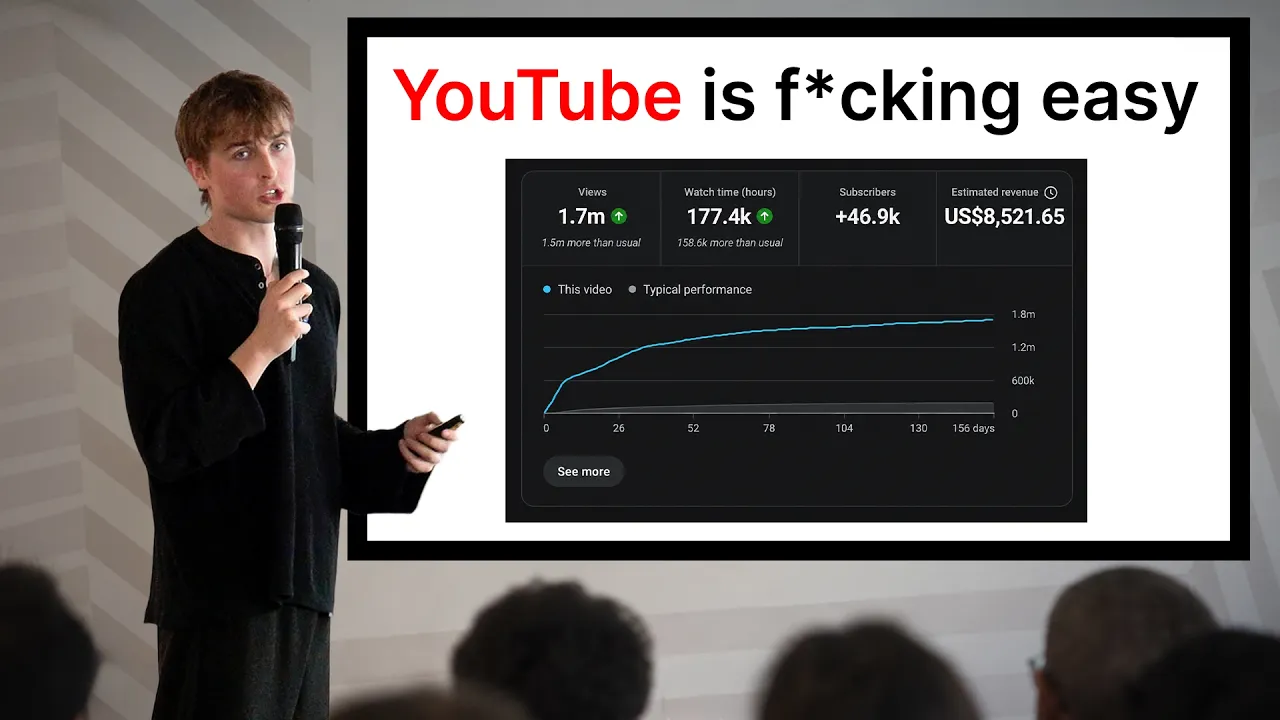
I'm going to be talking about how I build $100,000 plus per month YouTube channels as soon as possible whenever I have to start over so that you can do the same. Now, you should probably listen to me to be quite honest. And the reason why, if you don't know me, my name is Jake Trenda. I sold my first YouTube channel at 10, made my fair share of bad videos, bottle flip challenge, and my mom falling on the floor there. Finally, one works to a degree, and this was where I started to fall in love with
YouTube and the process of making videos, double down on it. So, even doubling down at the age of 10 years old. 12 years later, I run over 100 different YouTube channels, one of which is Gary Vee. So, recently we've took over his YouTube channel, and we've 10x his average views in less than a month. He's done a million long-form views in the past 90 days when previously he was averaging like 10, 20,000 views a video. Jeremy Haynes, we just recently started with him. We literally just started, and already we have his most popular YouTube video
there produced on his channel lifetime. Ali Abdaal, I'm taking over his strategy as well to help him blow up his channel. ManyChat, their recent video just hit 100,000 plus views in 9 days. Instantly AI, a million dollars annual recurring revenue added from YouTube. Zero to 8K subs, multiple viral videos. And some of our best results are actually starting from complete zero with no existing brand, no nothing. And so, Glenn Coco, they made a million dollars back from their first 6 months, from the first 12 videos. Their first video made them $100,000 in the first 30
days. And then their first 12 videos, million dollars in 6 months. Tessa, she went from zero to 50K net profit from YouTube in her first month from about four or five videos, 14 new clients. You can see the screenshot there. And she got 1 million long-form views in 90 days as a doctor. So, super boring business, and it just goes to show that you can see success with YouTube no matter the niche. And then, Sam, zero to 40K a month from YouTube. Someone went from zero to pretty much 100K subscribers in a few months. You
get the point. And also, I built my YouTube agency to $500,000 a month at 21 years old. Thank you. So, here's exactly what I'm going to be walking you through. First, how to get killer video ideas that your buyers actually want to watch, and you can know for a fact that they want to watch. How to package them to destroy your competition, how to make videos so good they beg you to buy, how to keep hitting green winner after winner using data. And also, in turn, build the number one YouTube channel in your niche and
grow your business. So, step one, finding video ideas your buyers already want to watch. Now, most business owners start here. They know their target market, they know their problems, and then they just make something useful, and YouTube will just find the right people. That's what they assume. That sounds logical, and it is also how you spend a week making a useful video that nobody watches. Knowing your audience matters, but it does not prove that they will choose the subject on YouTube. So, you need evidence that they will actually watch these videos before you even press
record. This is Dr. Shawn, and I'm going to tell this through an example. So, he's like a doctor that helps people lose visceral fat. And he was getting roughly 1,000 long-form views a day, and then it went to more than 100,000 views a day, and that happened in less than a month. So, this is what he was posting beforehand. So, he was just kind of picking whatever videos he wanted. Three eating strategies that will transform your health. Some of my favorite things. He was making videos around what he thought people needed, and what he thought
his target market wanted, just based on knowing his market and who he worked with. It wasn't that the information was necessarily bad, but the subjects and wording were being chosen on a whim. He wasn't really thinking about that and doing his diligence. So, we stopped guessing, and we searched the exact problems in his market people already cared about. So, for example, you know, we basically generated a list using AI of what are the different things that people might potentially search for in his niche, and then we actually went and did our diligence on YouTube to
figure out is there actually demand around this? And so, we found genuine standout outliers like this one here, how to destroy visceral belly fat. This video got 4.4 million views. So, we now knew that there was demand around the topic of visceral fat. And then we opened the channel, and we kept following the evidence. After finding channels that had successful examples, we then actually followed that evidence deeper to basically create a demand map within the niche to understand what are all the things that the target market wants specifically on YouTube. The same demand kept showing
up. Visceral fat. People wanted to lose it and they wanted to lose it fast. And before we even touched the title, thumbnail, or recording, we knew the subject and language already had demand on YouTube. So, you have to validate that first before you make a video. Then we made this video here, how to lose visceral fat so fast it feels like cheating, 795,000 views. And this video single-handedly broke that email marketing system, according to them. So, the topic, to be clear, did not do all the work, and I am going to get into this in
a bit, but it did mean that we were not gambling on whether anybody cared in the first place before we actually went to the effort of making a really good video. So, this is what you want to ask is what evidence says that people that I want as customers are already choosing to watch this subject on YouTube. If you can't answer that question, then you need to find that out. Something that happens quite often in a lot of these more boring niches where you might be doing something super valuable, but people don't really care is
what if people need something that they do not value yet. I don't know if you've read the book Breakthrough Advertising, but very good book. In this book, they discuss a concept called levels of awareness. And in different markets, people within that market are within different levels of awareness. Some are problem aware, some are solution aware, and you have to know where your market is at and where they are at on YouTube. Because if you assume that they want your mechanism, then you might capture nobody, no matter how valuable it is. People can want the outcome
without understanding the mechanism. And so, this is an example of Tessa Diamond. You can see she was getting like 12K views beforehand, but actually this was like 1K views. It just got a ton of traffic after we started working with her. A couple of the recent videos, hundreds of thousands of views. Now, her audience is women who want to get into better shape, lose fat, better health. But, her mechanism was insulin. That's all she talks about. She's an insulin doctor. She's an expert in insulin. And fat loss was the outcome that they already wanted. And
so, what we did was we identified insulin as the mechanism that they needed to understand. So, we made insulin relevant to fat loss. Even though she just wanted to speak about insulin, she didn't really care about speaking about fat loss, that was the outcome that they wanted. They were solution aware, not problem aware. And so, we positioned it around the outcome. The broad design gives the idea demand and then the unfamiliar mechanism gives them a new reason to care. When you basically use a mechanism that is boring or unknown, but you position it around the
outcome, it actually can make the idea stronger rather than weaker because it's like a unique mechanism, right? It differentiates it from all the other videos around fat loss. And so this was the video that we made. If you don't understand insulin, you don't understand fat loss. The reason why we picked this specific title was because this was a format that was working really well on YouTube, which I'm going to get into in a moment about title format and all that juicy stuff. But this if you don't understand X, basically X being something that the viewer
doesn't care about, you don't understand Y, which is the ultimate thing they care about. It drives curiosity, gets them to click, 230,000 views. It's actually more than this now. And so she got 1 million long-form views, 30,000 subscribers, and then, you know, you saw the result as well beforehand. There it is. So 14 clients, more than $50,000 net profit in the first month even after paying us. Now, to be clear though, like this was only part, this was probably like 30% of the decision was choosing to make a video around insulin and then positioning the
outcome as fat loss. The exact wording came from a proven YouTube format and I'm going to show you how to find that in the next section. So if direct demand exists, you want to build around it. If it does not, then change the subject or bridge it to something that people already want. So how do we actually find what has demand on YouTube? This is where I'm going to get into some algorithmic source. This is what you want to do yourself if you're doing YouTube yourself single-handedly, you want to go through this process to figure
out what people want or you can pass this off to a virtual assistant or AI. So depth-first search, don't let the computer science language make it sound more complicated than it actually is. It's an algorithm which is just a simple set of step-by-step instructions to achieve a goal. And depth-first search is used specifically to explore a huge amount of connected information in a given data set. It's what web crawlers and these sort of things use. And so it basically makes sure that if you're going to explore your niche on YouTube, you don't miss a single
corner so that you know all the successful channels, all the topics with demand, but also when you research the broader space of YouTube, you're finding all of the different things that are working. A couple definitions that I'm going to go over. A node in the context of depth-first search is simply one thing that you explore. And so, this could be a search term, a video, a channel, or a recommendation. The root node is where it starts. And in our case, that is the niche that we want to understand and explore and find outliers in these
out successful videos within. And then you have the stack, which I'll also explain. So, this is a list of useful things that you found, but you haven't explored yet. So, basically, this is the way it works visually. So, you start off with your niche and within that, you will have a list of different things to search within your niche. The way that you get this list is simply by saying to Claude or ChatGPT, "Give me a core seed list of keywords for this niche." And what it's going to do, if you say productivity, it's going
to be like productivity tips, systems, calendar schedule, and all these things. It basically gives you all the things that you need to search in order to explore the entirety of the niche. And then what happens is you start with the first search term. So, these search terms get pushed onto the stack and you start with the first search term in the stack. Then, when you search that search term, you get a set of videos. And all these videos, some of them are going to have hundreds of thousands of views. They're going to be outlier videos
that have performed outstandingly well. Those get pushed to the stack. Then you go to the first video and you explore the channel from that first video. You get a video that's performed outstandingly well from a search term. You then find and go to the channel. And then in that channel, there's a set of more outstanding videos. And as you're going through this process, you're recording all of this in a research database of just videos that have performed outstandingly well in that channel, in that niche. Finally, once you've gone through the channel and you've seen all
of the standout videos that you want to take note of, you then go back one step and you go back to that video that you were previously on. You look at the recommendations. You follow that process all the way through. And you basically continue through this process where you've explored the entirety of a search term, you've found all the successful videos, all the successful channels. And then, once the search term is exhausted, you go back, you repeat the same for the next search term. And then you just iterate through this very long and tiresome process,
which is why you yourselves business owners shouldn't be doing it. You should delegate this to an assistant or AI. And this is how you explore the entirety of a niche and find all of the videos that are performing outstandingly well. Do that enough and you'll have a very clear idea of what works on YouTube. So, you start with the language that your market uses to describe the problem. So, for example, lose visceral fat. And then you find a video that generally outperformed on its own channel like this one here that I showed previously. You open
the channel and then you find all the successful videos on that channel following useful recommendations. When a branch stops producing useful information, go back and then take the next one. Repeat until you understand the niche, not just one competitor. You should have a full full overview of the entire niche. The reason why we want to do this is because more visibility over what works on YouTube and what doesn't. It allows you to make better decisions. And YouTube is just a game of decisions. What are the right videos to make? What's the right thumbnails to use?
What are the right titles, video structure, etc. As I said, VA can run the search process and AI can expand the search and organize the evidence. And now you know what people want, they can still choose somebody else's video. So, you've identified what should I make videos around in the first place? And that's how you can direct your focus to something that can provide value and actually attract customers. But then it's about figuring out, how do I actually package that? How do I get my video clicked on over everybody else's? Demand creates the opportunity and
packaging, title, thumbnail, hook, structure decides how much of it that you actually capture. So, this is the second step is packaging the video idea so people actually choose your video. People already want the subject, that does not mean they will choose your video. They can only click one video at a time. The title and thumbnail will make one promise together and a format, which you might have heard of title formats, people talk about this a lot, is a proven way of framing that specific promise. And with this, what a lot of people get wrong is
they just see a video that's worked and they're like, oh yeah, let me just copy that and twist it to my niche. Do not just copy the words. You need to actually work out why people wanted to click in the first place. So, for example, this is a format that's working very well on YouTube. You might have seen it if you watch a lot of YouTube, which is is like how to get this result so fast it feels like cheating. The likes of Alex Hormozi have used it. Many of the top YouTubers have used it.
And the reason why this works is because a result that they already want faster than they could have possibly expected, and it feels like this unfair advantage, right? It feels like cheating. So, it's like, "Ooh, like if I click on this video, then I'm going to get some sauce." And so, that's what we did for Shawn. His audience already wanted to lose visceral fat, and ideally they would [ __ ] delete it. They're actually health-conscious, and they want to lose visceral fat. They want that [ __ ] gone. And so, that's why that format specifically
meshed well with that topic. So, you have to understand if you find a formula that works really well, you have to understand why it actually works with that particular audience, with the way their behaviors are, their psychographics, the way they think, the intent behind the view, so that if you're going to plan on transferring it to your niche, you actually understand that it will work well with your audience. What a lot of people do is they'll see a format like $1 versus $10,000 thing from Mr. Beast. And then, they'll take that and apply to a
business audience, where it makes complete no sense. But, the actual viewing behaviors of those viewers are completely different. So, you have validated demand, and then you have a proven reason to click, and you have one specific promise. And the thumbnail is what gets processed first. So, this is the first thing to pay attention to, because if they cannot recognize the problem and outcome quickly, and they cannot understand that the video is actually for them within a single instance, they may not even read the title, because YouTube's a winner-take-all platform. People have short attention spans. There's
20 different videos on their feed at once. Only one of those gets clicked on. And so, if you can't grab their attention straight away, they're going to go somewhere else. So, for example, with Dr. Shawn, the thumbnail makes the transformation look obvious. We've got red highlight block behind the white text, which is proven to work on YouTube. You might have even seen that a lot, where people have the red block behind the white text. It's gone from Diary of a CEO. They were the ones who innovated this, and then everybody just copied it. But, also
logically, red on a dark background, and then the white contrasts a lot. Then, we have the visual transformation, so it grabs their attention in a single instance. They know that's for them. And also, his audience is predominantly male, which is why we used a male body. And then, we have Shawn in medical scrubs, which subconsciously, within a single instance proves authority because they know he's a doctor. They make the connection straight away. So, this is all intentional. And he luckily also just looks like he'd be a doctor. So, the thumbnail makes the transformation obvious, and
then the title is what qualifies the exact problem and promise. A thumbnail can look good and still give the right person no reason to click. And so, what you want to do is there's free tools that you can use for this, but you can actually simulate what your thumbnail will look like against other videos that are being posted on YouTube right now so that you can judge the packaging beside the videos it will actually compete against. Packaging is so important to the degree which if you're taking YouTube seriously, you should literally ask your friends, you
should put your packaging up against these other videos, and just ask them to tell you honestly, like does it actually stand out against these other videos? Would you click on this cuz it's so important. If you lose that winner-take-all game of not getting clicked on, then you cooked. So, Tessa used a different proven format. She used the if you don't understand X, you don't understand Y. Y is the result that they already want, and then X is the thing that they did not realize was, you know, stopping them basically, but they didn't actually care about
previously. And that's where we got that idea from. So, ask the question, do the title and thumbnail give the right viewer a clear reason to choose this video over all of the others on their feed in a single given instance? If it doesn't do that, you need to revise your thumbnail. The moment they click, this is getting into the hook now, you've made them a promise. And so, this is where we actually get into making videos that YouTube keeps on pushing. They click because of this promise of how to lose visceral fat so fast it
feels like cheating. And so, before they click, they're thinking, you know, which video should I watch? After they click, they're thinking, should I keep watching this one? So, the opening of the video has to make them feel like they chose the right video. Am I getting what I clicked for? Can this person actually deliver it? Is the rest worth my time? Promise, proof, plan. That's what answers all three of those questions. Homozie uses this framework, but also just logically this answers all of those questions and keeps them watching. So, first you want to reaffirm exactly
what they clicked for. This is the promise. This is meeting the expectation the moment they click so that they know that you're planning on giving them what they actually clicked for. So, they hang around for a bit longer. The next thing they're thinking is, why should I listen to you on this given thing? So, you give them the best possible reason to trust you. This is the part that most people miss out is they're going to be like, I'm going to give you this thing and then you don't tell them why they should actually listen
to them. And so, you want to basically figure out what is your unfair edge that you can say and establish yourself as an authority around that given topic more than anybody else. You have to nail the statement. I actually encourage you to spend time nailing the statement so that you can use it throughout every single video. And then, you want to show them where the video is going. So, this is different from the promise because if you're doing the full course video, for example, you can say that you're going to teach them everything they need
to know about Facebook ads. But, to actually get them to mentally commit to watching a 2-hour plus video, it has to be crystal clear that they're really going to get everything that they need to know. Like, they need to have the confidence that you're actually going to give them everything. And so, the way that you do this is, you know, this is going to be the only Facebook ads video that you ever need to watch. And the reason why I'm qualified to tell you this is because I spend $100 million on Facebook ads every single
month across my clients like Tai Lopez. And in this video, I'm going to be going through absolutely everything. I'm going to be telling you how to set up your campaigns, how to actually navigate around the ads manager, how to come up with your creative strategy and find winning proven ads. And then, you're just listing through all these things to where logically like, okay, this is actually everything I need to know. Expectation is met. I'm convinced that they're actually going to give me that thing. That is so important. Also, for podcasts as well, this is why
spoiler intros are really important because you have to like really make it clear in their mind of what they're going to get through that 1-hour 2-hour plus video. It's also important for shorter videos as well. Speaking on this in terms of meeting expectations when they click on the video. So, this is one of our clients, Glenn Coco. Those top two videos were the two videos before we started with them. This one here got 2K views, like that one there close has got 2K views, but that was actually because of the video that popped off afterwards.
The other one got like 300 views. Most of this came from external traffic anyway. Terrible titles, terrible thumbnails. Bottom one got 300,000 views. That was the first video made $100,000 plus back in the first 30 days. And they went from zero to a million dollars in the first 6 months from YouTube from the first 12 videos. So, these videos work. Start from zero, get the first sale, show the entire process. That was basically the expectation that was set in this one. Speed running cold calls from zero dollars to first sale, brackets I show everything, right?
And this is very raw thumbnail. Gives this feeling that he is really going to show everything cuz he's just going to like posted this video completely raw. And so, we have to meet this expectation. If it was a polished 50-minute summary video, that would not have satisfied the viewers' expectation. And if I had like all these fancy edits and so on they would have been like, wait, what? What the [ __ ] is this? This is not what I clicked for. And so, editing can remove friction from the process, but it cannot rescue a weak
idea or empty video. The goal of every video is viewer satisfaction, not retention, you know, none of this [ __ ] not click-through rate. That [ __ ] doesn't matter. They're noisy metrics. The thing you're optimizing for is viewer satisfaction, which is simply based on what the viewer has actually clicked for and their expectation coming into this. What is the best possible video that I can make, and how can I blow their expectations away? Cuz what a lot of people do is they'll set this expectation, they'll not meet it to its fullest because of the
reasons that I just mentioned in terms of not meeting them at the right awareness level and making a video that they didn't actually promise, and then it under-delivers, the videos don't perform. Instead, you want to set the expectation in the title and thumbnail, and you want to blow past that expectation in accordance with the expectation that you actually set. So, if viewer satisfaction is the goal, right people click, they watch, and they feel satisfied, and then YouTube tests it with more people like them. That's the loop that they go through, and that's why viewer satisfaction
is so important. If the right viewers click on the video because the title and thumbnail are positioned correctly, and on average, the right viewers are also very satisfied, and hopefully more satisfied with the experience of watching your video than your competitions, YouTube's going to look at that and be like, holy [ __ ] this audience likes this video the most. Let's push it to more of the people who are this audience. And this audience is your target market. And it goes through that flywheel. This is why it's a winner-take-all platform. If your video gets clicked
on more than your competitions, and they watch it and are satisfied with it more than your competitions, that video is going to become the staple for your target market on the YouTube home feed and in YouTube search. This is what makes YouTube a winner-take-all platform. The video that wins on the click and the watch can take most of the attention. This is where we get into turning the right viewers into customers. So, at this point, you kind of know how to do the research process to figure out what your target market actually demands topic-wise. Then,
you apply that same research process in order to find what's working on YouTube in the terms of title formats, thumbnail formats as well, even video structures, right? Certain videos have certain distinct structures that are also working. So, you find all this information of what's working across YouTube right now, and then you look at your niche and you're like, "Nobody's doing this in my niche." This is often the case because most people in business-related niches suck at YouTube, and that's why our clients win so consistently. And so, at that point, you know how to make the
video right, and also you know how to hook them in, and viewer satisfaction, that's the goal. So, now you should be able to make a good video, and now it's about actually converting those. So, views are cool, but views alone do not grow your business. And so, the next job is turning the right viewers into customers, and this is where most call to actions [ __ ] it up. Value, value, value, run and pitch. That's how people do it, right? They're giving so much value, and then it's like, "And by the way, if you want
us to run your ads for you, you can click the link in the description, and we'll do this and that and this and that." Or, "And by the way, if you want to join my free newsletter, which nobody gives a [ __ ] about, then sign up." And then nobody does it, and then the video flops. The action should feel like it's the most useful next step. This is where we turn call to actions instead of being a take, instead a give, and the viewer is like thanking you for it. And even if they know
it's a call to action, they don't give a [ __ ] Watch me sell a service in 10 hours. This is a video we made for our client Instantly AI, made hundreds of thousands of dollars. In this video, the whole thing was like, "We're going to create this business and offer from scratch, and then we're going to sell it within 10 hours." And so, the business existed, we created that, and now it needed a client, right? This is the part of the video that we're at. But the challenge, we only gave us 10 hours, and
content couldn't distribute fast enough, and ads needed more time and money to learn. Cold email though, we could create a conversation immediately. We could send thousands of emails today and if we send enough through pure mathematics, we could reach enough people and have enough people be interested based on like the industry standards of response rate and all these things in order to get boost calls and then close a deal if we just run the numbers. The problem was is that normal domains still needed time to warm up. If you know cold email, it takes 2
weeks to warm up your domains. But, Instantly's pre-warmed domains remove the exact constraint. The funny thing is with this video is Instantly came to me and they were like, "We just launched this new feature, pre-warmed domains, and we need to make a video, a feature video is what they said, launching this feature." And I was like, "We're not doing that. That'll burn the channel. Let me try to figure out a video in which we can package this in." So, this video idea that ended up just being a viral YouTube video that everybody loves came from
them wanting to make a video that just promoted the feature. And so, people literally called this the best advertisement of all time, right? Wow, did not realize I was watching that until 14:49. Well done. 360 likes on that comment. This video was well done. Clearly, this was an ad going to be yourself, but I didn't realize that's what it was going to be until the product cropped up. Well said, Hook, my friend. I've never ever seen hundreds of people compliment the fact that the video is an ad and it do organically well. The question you
want to ask when promoting your thing, whether it be a software, whether it be your service, is would an unbiased expert still include it because it makes the video more useful. People make videos all the time that promote softwares and products. They do it all the time and the video never suffers because of it because it's the energy behind the way in which it's done and it's the way which it's communicated. Like, I will promote YouTube tools and extensions that I don't use all these public YouTube tools. I use the free extensions for some things,
but like I'll position their products because I actually use it. And so, it comes across in a way where it's never going to nerf the video and stop it from succeeding because like I was just going to mention it anyway. So, that's the question you should ask. And if the answer is no, then you don't force it in, simple as that. Now, sometimes the offer cannot naturally become the tool. So, if you're selling a service or a coaching program, there's nothing you can really do there cuz it's not you can't position a product cuz the
product's like your service. And so, the way that you do this is you extend the lesson with something that the viewer can use. And so, you kind of like create the product for the viewer that is that natural embed in the video. So, for example, Sam, he teaches people how to make better ads, Facebook ads. And so, one of the videos we made was this one here, the best Facebook ads strategy for 2026. They understood the strategy that we gave them. And what they needed and what they wanted next was proven ads to study. Because
they knew the strategy, but it's like, "Okay, like part of the strategy is finding winning ads and da da da da da. How do I actually do that?" And so, we just gave them our creative library that we kept continuously up to date, almost like a little mini SaaS, really, and completely for free. And that was just a lead magnet. It was an opt-in. But the viewer wanted it so bad, they literally clicked on the video for ad creative strategy. Who the [ __ ] is not going to get an ad creative library when that
is what they want if they're a serious viewer. And then, they opt in, it redirects them into the funnel. If they don't buy, we've got their email, we hammer them with emails, they buy eventually. The viewer gets something useful, and the opt-in is what moves them into the funnel. The video does not have to make the whole sale, it just has to make the next useful step obvious. There's another guy, I don't know if you know Ryan Dice, but I actually fell into this trap or ecosystem. He like helps businesses scale through systems. And he
started his YouTube channel and started taking it seriously. One of his first videos was how I run a $10 million plus per year business with only 1 hour per week. And it was basically talking about the concept of having a company scorecard, where you have your KPIs and you have owners for those KPIs and you track it weekly. And that's what he was going to in the video. And the lead magnet was simply just the Google Sheets scorecard. And I fell in the funnel and I paid him like 16K. So, there you go. It works.
Step five, use the data to know what to double down on. So, once a video is live, it becomes evidence for what you should make next, good or bad, whether you should double down on it or whether you shouldn't. And so, this is the first video that we made for Gary V quite recently. As I said, his channel was averaging like 10,000, 20,000 views a video. He was having like AI generated thumbnails and stuff. And so, this is the first video we made for him, got 300,000 views. So, already it was like 10, 20Xing his
average views. And so, once we did that, first video that we did for Gary got 10x his previous average. This was a proven format on YouTube, which was the new rules of this thing. Neil Patel did it for new rules of SEO, it was done in new rules of YouTube, we did it for LinkedIn, new rules of LinkedIn, got like 70k views in the LinkedIn niche. And then from that, we were like, gap in the market, hasn't been done for social media, but it's been proven for other social media niches, but nobody's done it for
broad social media, and Gary Vee is the social media guy. So we did it for him. He did own the social media space, right? That was his whole thing, and he called it very early, so he was a perfect guy to do this for. And the video matched what the audience wanted from him, because that was what his audience was based around. And so we doubled down on this with brutally honest advice about social media in 7 minutes, which was another format that worked very well. We did brutally honest advice about web design in 7
minutes, which got 230,000 views, and that obviously worked in other niches. We got that idea from somebody else as well. And it just kept working. If I saw social media in 2026, I'd do this. This one was actually not performing as well as the others, but it was still like a 10x plus outlier on his channel. The next question was not how to make the same video again, right? All these videos are social media related. It was what was the reason why the video actually worked? Cool, social media was the topic, we used these proven
formats to package it, but like, why did this keep working for Gary? And so basically, what we identified that we hadn't properly leaned into yet was, yes, Gary's great at social media, which is why these videos worked, but we hadn't even really leaned into the fact that this Gary's basically been talking about this shift from social media to interest media recently. We saw it was resonating really well on short-form content with his audience. So this is where you're even looking at the data outside of YouTube, of just what's macro trending. And so we saw something
like, we're not in social media anymore, we're in interest media, right? And people love that [ __ ] So we wanted to make a video centered around that whole narrative, and we needed to find the best way to package it. I invented this format on YouTube based off of these formats like the new rules of, or this thing has changed, but nobody even realizes. There's all these formats that are like shift-related formats, and I just tried to think of like, what is a way that I can make my own one of these formats and be
first to market with it, while still copying the same underlying psychology as to why these formats worked, which are these shift videos. And I I landed on this the new era of this thing has just begun. I first actually did this with a client, Tommy Clark, who's in the LinkedIn niche, and that was an outlier for him, did quite well. Obviously, LinkedIn niche is a small niche. I think he got like 20,000 30,000 views, so nothing crazy, but lots of customers. And then somebody took it to the startup niche. It was like the new era
of startups or funding has just begun or something like that. Startup funding or startups has just begun. That got hundreds of thousands of views. And then everybody started copying it. Again, how do we do it on social media? The new era of match the interest media. That's where we basically did this next video. The subject was already working. Gary's new thesis of interest media. And a format that gave it urgency, and that's where we made this video recently, which is actually at over 400,000 views now. This was recently posted, by the way, so it shows
that this is very much being used in real time. It's probably going to hit 500k views very soon. Previously, it was averaging like 10k views. And the thumbnail format, though, we took from another shift's format, which was this thing is about to change forever and nobody even realizes, which was originally done by Callaway with social media is about to change forever and nobody even realizes. So, we took that the mail format and did it in this way, but combined it with our new title format and kind of like combined them. Doubling down means preserving why
it worked, and then finding a genuinely new or better way to use the same signal. And in that case, you saw it did better than all of the other videos, right? It was like the fourth time we did it, but that one is now doing better. And now, you know, we'll continue to get more and more and more better ones cuz we're finding what's working and finding our pockets in the niche. Views, leads, qualified calls, customers, revenue, that's the funnel. Every upload should make the next decision better, right? So, every time you upload, you want
to basically diagnose the funnel. If you've got proper tracking set up, you'll be able to see how many views you're getting, how many leads you're getting, how many qualified calls you're getting, how many customers you're getting, how many revenue you're getting. You've got to be able to have that data so that after every upload and after a set of uploads, after a month of doing YouTube, you're able to look back and identify where the bottleneck is. Run a bottleneck analysis and figure out was it the fact I didn't get enough traffic in the first place.
Was it the fact that from the number of views that I did get in the traffic that I did get, I didn't convert many of those views and therefore either I gave a poor call to action that might have turned views away, I might have gave it too hard or I didn't give a call to action at all or my funnel just sucks. And then you see you're basically diagnosing where the drop-off happened so that you can fix that, iterate through that cycle and you know you just iterate through this tight feedback loop to be
able to optimize your YouTube funnel. A few quick things as well to quickly fire off just like some spit some facts. Your highest viewed video can be one of your least valuable, right? Because an off-topic hit can attract thousands of people who ignore every video that you publish next. You actually want to be very careful about this because one thing that you don't want to do is make videos that are like individual campaigns that attract different audiences to your channel where if you attract a viewer through one video but they don't resonate with the other
videos that you're making, it can actually really hurt your channel especially as it grows. This is what a lot of YouTube channels do wrong. Like big channels, they'll be popping and then their views go low and it's because they're making all these random videos that they're all interested in but there's not one underlying viewer that's interested in all of them. And so obviously that shows low viewer satisfaction across videos and it kind of tanks your videos. So you want to be very careful. Your YouTube channel is one overall campaign if you think of it in
the sense of ads. The videos are individual campaigns. One viral video might be a clue when you're doing research but you still need repeated evidence before you build around it. You need to see enough data to understand what was the reason why these videos succeeded because a lot of people will just see an outlier video and be like, "Oh cool title. Let me just take it." But they might have missed the 100 plus other videos that used that same format that failed. When you find a viral video, cool that's signal but you need to do
more diligence to actually figure out if this is something to take. A result can have more than one cause. So when you're finding videos that have performed outstandingly well and you're thinking of taking the title, spend more time to understand why did that video actually work. For example, there's a format which is I have this much amount of experience and learned this. So for example, I made 300 YouTube videos and learned this. I sent 10 million cold emails and learned this. I made 5000 cold calls and learned this. That is a format that works on
YouTube and those two latter videos that I mentioned are videos that we did because of the format that I made three YouTube videos to learn this. That video got 500,000 views. When we took that format, the title was cool, but one of the biggest parts as to why it succeeded was the execution format, which was that there was 20 to 40 points in the given video. If we had not taken the 20 to 40 points that was from that structure, and we just copied the title, the video could have flopped. And so, it's important to
consider not just the title, but the thumbnail, the video structure, the way in which the video is delivered. Do they use a whiteboard? Is it a raw video? Do they have some sort of unique execution style that you take note of. Make sure you find that out, because all of that is signal and it helps you make better decisions. A full script can make a strong expert worse on camera as well. You need to figure out which ideas require exact wording and exact planning versus a short structure with room to think. You shouldn't be scripting
out a screen recording video. You shouldn't be scripting out a challenge video. Talking head videos that might tap into a bit more of an entertainment audience, or might require a bit more entertainment and soothing of that part of the brain, those usually require more scripting out, because this is where you need to like make sure the copy is tight and retention matters more in those instances, where you know, you have an open loop and you transition between points smoothly, so you don't have drops off in retention, all that sort of stuff. And what most editing
gurus call retention is just decoration, especially for us in the room, because we target more sophisticated audiences that care less about this stuff. If a visual does not clarify, prove, or help the viewer follow the video and get the lesson and actually have a better educational experience, it's just movement and you don't need it. Specificity always charges you in reach. If you're going to be specific, it's going to make you get less views, but you should pay that price when the right person feels more understood. So, you should always go as broad as you can
and make an interesting title and thumbnail and claim to the market as you possibly can, as long as you're not sacrificing resonance with the core target market. So, what I mean by that is you always want to go as broad as possible, but if you start to make a title and thumbnail that makes it less clear to the actual true people that you want that it's for them or not, you shouldn't make that trade, because then you're going to attract less of the target market that you want. The viewer satisfaction is going to be lower
on average with the average viewer, and therefore the video is going to get pushed less. But often times you do want to think about how can I attract the core target market in its full, whilst also attracting that broader market without sacrificing resonance with the core target market. So for example, if you don't understand insulin, you don't understand fat loss, the people who are interested in insulin, they're going to click on that video cuz like holy [ __ ] nobody's making videos about insulin and fat loss. That's exactly what I wanted. But also the broader
market is interested in the fat loss and the insulin is the unique mechanisms they're interested in it, too. If you only research winners, you can prove any bad idea. Don't just look at the positive data for formats, because then you have positivity bias. You have a bias towards the positive data. You want to also look at the negative examples as well and not be blind to that. You need to full holistic overview of, okay, if I'm going to do this format, 80% of the videos succeeded and they were all five to 10x outliers. There were
these few videos that didn't succeed that used the format, but two of them were pretty crap videos, and the one of them, mhm, that's just risk at the end of the day, but I'm going to take that bet. You need the full overview so that you can make the best decision. Positive shows that idea can work. Negative evidence shows when and why it fails, so that you can understand what pitfalls to avoid with that specific format. I made 300 YouTube videos and then this that format works really well when people copy the 20 to 40
point structure. Oh, this video didn't work with it, but they just did a simple three to five point listical and that was why it didn't succeed. So then you can understand the rules of the structure that you need to follow and have those guardrails. Pre-published research is still a hypothesis. The market gets the final vote at the end of the day. You can do as much due diligence as you want on formats. And that's what you need to do, but nothing is guaranteed. You need to actually look at the post performance and see how the
video does and then factor that in your decision making next. Better decisions need better information and better interpretation. So if you're going to make better decisions on what videos to make, what titles and thumbnails to use, how to structure the video, etc., etc., everything downstream, what editing style to use, the only way you get there is through better information and better interpretation of that information. Find the information, do the YouTube research, get the visibility, and learn how to interpret that data properly so you can actually transfer it to your specific application correctly. And this is
a big reason why my clients win so consistently, right? Like I've got over 100 YouTube channels, so I see across these channels what gets clicked, what gets watched, what creates the leads, what becomes revenue because we have the tracking. And it also allows me to have a full internal YouTube research team to where we're doing hundreds of hours of YouTube research a week. I've got my own internal AI tools around how I actually research, which are literally running as we speak on our AI systems back home. And so, I'm able to continuously have this visibility
over what's working on YouTube more than anybody else. So, when I step into a niche, I just know what works better than anybody else because I have more visibility and I have more information. More channels equals more evidence, which makes better decisions, better results, and then that in turn gives me more evidence again cuz I get more clients, and then it's just a monopoly basically, and it's GG. You're not going to compete. So, yeah, I'm not starting blind when I enter a niche. The person with the best information and the ability to interpret it will
make the best decisions. And then those decisions need to be executed properly each week. So, once you've got the decisions lined up, you don't want to [ __ ] them up, so you need a competent editor, you need competent people to actually execute those decisions. And that is how you become the number one YouTube channel in your niche. >> [applause] [applause]