[Music] so you probably recognize that in this course we don't talk about individual viruses that's the course is taught by process because that's the best way I think to learn virology but last time and today we're talking about individual viruses and the reason is because these are important infections last time we talked about HIV and AIDS and I've done that Throughout this course because it's always been an issue today we're going to talk about ebola viruses which I didn't address in any previous year of this course but I think this year they have risen to
prominence for reasons you can probably guess and in these lectures when we talk about specific viruses it puts together everything you know we've gone through the Infectious cycle so whenever I talk about HIV or Biv virus every step of the cycle should be Familiar to you not just structure the reproductive cycle but pathogenesis now when we talk about vmia and immune responses and so forth it should make sense to you if it doesn't then I haven't done my job this year okay so we'll talk today about ebola viruses Monday will be our last lecture we're
going to talk about using viruses as vectors now I want you to look at this this quote here does anyone know who Glenn Beck is he a character right so what the hell is Glenn Beck doing talking about mutation rates of Ebola virus and aerosol transmission he didn't take my virology course in fact he didn't take any virology course he's just shooting off his mouth to get publicity I'm going to come back to this issue and show you why glenbeck and all the others who said this is wrong you're in the wrong Room yeah after
you took this class last year all right so today these are the questions what did he say another time another time oh yeah really uh I want to get to these questions today what are Ebola viruses where do they come from how do they replicate how they cause disease and can we prevent infection these are things we've talked about all year so these all should make a lot of sense to you all right the story starts in 1967 some monkeys are shipped to a laboratory uh in marberg Germany uh and these are monkeys that are
going to be used for experiments and in the process of working with these animals a number of laboratory workers get sick they develop what's called a hemorrhagic fever it's a disease with high fever and bleeding both internally uh and externally and this were acquired from African green monkeys that had been Imported from Uganda all right so here's the outbreak in 1967 uh 32 cases of infection 23% mortality so that was the first time we'd seen uh this kind of disease and then subsequently over the years you can see from the 70s ' 80s 90s through
to the present there have been various outbreaks of the same virus this has been called marberg virus in the same family as Ebola viruses uh with different case uh what they have on this Chart isn't quite right this is percent mortality but it really should be case fatality ratio because they're looking at the total number of diagnosed cases um the the number of deaths in the total number of diagnosed cases we don't know the total number of infections which would be the mortality percentage you can see this is quite a lethal virus and there have
been some substantial outbreaks uh in parts of Africa there was even a few cases in there was One case in 2014 in Uganda during the Ebola virus outbreak okay so this was a lab acquired infection from apparently from monkeys imported from Uganda uh the next outbreaks of hemorrhagic fever which resembled these were in 1976 they were in two separate locations at the same time the the DRC Democratic Republic of the Congo and Sudan there were quite a few cases in both of these outbreaks and that's again the case Mor ality ratio 88% 53% so in
other words of 53% of the people diagnosed with this infection died uh here's um DRC and this is where the the outbreak in the DRC occurred the the DRC operate wasn't clear where the first case was the index case is the first case that begins an epidemic this wasn't identified but in Sudan the index case was in among Cotton Factory workers and there's some thought that they had contact with the forest animals the infection was spread in this Outbreak by the use of contaminated needles so these individuals went to hospitals for care and the needles
they use are contaminated they're not sterilized properly they're not disposable and the infection also spread among the families of these workers they would go home and bring the infection spread among the families among friends and so forth so this turned out to be a similar virus to the mar outbreak but it was different enough so It was called Ebola virus and this was named after a small River in the northwest of the DRC shown by this red dot you can't see the river there but there's a river called the Ebola River and that's where this
virus gets its name from and this uh it turns out that these two outbreaks in DRC and Sudan they're both caused by Ebola viruses but they were two different strains and they were called zir Ebola virus and Sudan Ebola virus and these are different Outbreaks of these two viruses over the year uh the Zer is often abbreviated as zebov and here's the first outbreak in 1976 and you can see over the years quite a few others in different countries and different involving different numbers of people with various case fatality ratios and here on the bottom
is Sudani virus again first outbreak in 1976 but then being observed in other countries as well this is the way we call these viruses by the Way the country of origin and Ebola virus one word the only time you can use Ebola space virus is to designate this particular virus since it was the first one isolated but you'll see all the time in the Press Ebola space virus which really if you're talking about Sudan isn't correct next strain to be identified there are five different Ebola viruses is called bundo Ebola virus there was an outbreak
in Western Uganda in 2007 the Town bundo it's right here in the Red Dot 149 cases 37 deaths this is as far as we know the only epidemic or outbreak caused by this particular uh virus Bundy buio the next one uh was isolated in 1994 from an individual who was dissecting a chimpanzee that had died this was a chimp that was part of a colony where other members in the colony had developed a hemorrhagic fever so this is now 1994 we understand what a viral hemorrhagic fever is like and it Looked a lot like human
hemorrhagic fever so they were doing necropsy on these chimpanzees and this individual got sick while performing this uh necropsy and this was an animal from the Thai Forest Park uh which is in Ivory Coast or k Devo right here uh that individual recovered so we have one case of infection with this virus and then um a year later in Liberia a single individual was shown to Be sah positive for this virus in the absence of disease so these are the only two known infections uh with which is what is now called Ivory Coast Ebola virus
and finally perhaps the most famous uh infections initiated in the US um this came to rest Virginia Which many of you may know as a Tex are you from Ron no I thought you raised your hand you are next to it okay so Reston is a tech Capital lots of it people and companies there but um in in 1989 there was a primate facility there shown here in this picture and they had gotten a shipment of monkeys cinus macak or maaka fasicularis right there uh from the Philippines these are going to be used for research
and during the transport a lot of these animals died and once they reached the lab a lot of them continued to die much more than you would expect and studying these animals they Isolated a new Ebola virus so they were looking at samples from these animals in the electron microscope and they saw the very typical filamentous viruses that I'll show you in a moment and they freaked out because here it is rest in Virginia an affluent Suburban oh my gosh we have Ebola virus right here so uh this went through the the the monkeys and
and killed quite a number of them in addition four humans who worked in this primate facility sah converted they Didn't get sick but when they took serum from them afterwards they had antibodies to this virus so apparently they had become infected um and these are the only known people that have been infected with this virus over time there were subsequently a number of other outbreaks of this virus in different places Italy Texas in the Philippines again from importation of monkeys from the Philippines so the monkeys are contaminated with the virus And they infect people none
of these people have died it's not it's not clear if this is really an apathogenic virus or not with four infections it's really hard to tell right um You will read in the news people saying that resin is an apathogenic ebola virus but I don't think you can reach that conclusion with only four known uh human infections in 2009 this is this was found in pigs on Pig farms in the Philippines so this appears to be the origin of the virus somewhere in the Philippines we don't know what the reservoir is it's never been identified
it's clearly not pigs that are grown for food um and there haven't been any recent infections with this virus so that's Reston Ebola virus and this summarizes the outbreaks that we've just gone through in a very brief manner starting uh this is now Ebola virus we're going to leave the mar Ber viruses behind we're not going to talk about those today but from the first uh outbreak uh in in the 70s through the present you can see outbreaks of different sizes the numbers indicate the number of infections some are a few some are hundreds but
really less than 2,000 total infections of course until last year when the count as of yesterday in Guinea Sierra Leon in Liberia is over 26,000 confirmed cases you can see here there was a big gap in In the middle here where we didn't have infections for many years uh and then the infections returned and again these are in various parts of Africa I'll show you a map in a moment uh where these are taking place so of course this latest outbreak has galvanized World attention to this virus it has made everyone realize that a virus
in Africa is really everyone's problem and as a consequence a lot of people are watching Ebola viruses now so these are the places in The world where we've we've seen uh these viruses in fact of course the main numbers are in Africa uh and parts of central Africa shown here on the right DRC uh Republic of the Congo Gabon Sudan Uganda with various different Ebola viruses shown here in different colors and of course the latest outbreak Guinea Sierra Leon in Liberia the one virus isolate from Thai Forest uh then we have imported cases in the
US these are all Reston importations And red shown here we have had subsequently other importations of Ebola we'll talk about in a bit another importation of rest done in Italy and here's the Philippines where the virus uh was found on pig farms and also in one monkey facility yeah right but it seems here that from what you're saying that it does stay and that finding for example the rest in strain like all the way over other places as well so each of these Outbreaks is a reintroduction of the virus into people all right so all
the human outbreaks in Africa start with a single introduction from an animal it spreads among people and then it dies out it always Fizzles out it never continues and then when there's another outbreak it's another spill over so it's like a totally different virus then right well like not well it's not to different it's actually similar but yes you can see nucleotide Sequence differences in the in the virus that comes out in in two years for example so it's not exactly the same virus there are different sources but it you know for the most part
we could say it's zir or Sudan Ebola virus that's infecting these people by sequencing The genome the Reston is again multiple uh introductions from monkeys into people and the virus itself is in in pig farms so that's the characteristic of this infection actually that it is a classic Zunos as we talked about them it's a deadend infection in people it may spread for a while but it always Fizzles out now these are bsl4 pathogens biosafety level four now in starting uh in the 70s we realized that to work on some viruses you need High containment
facilities uh because the virus May kill at high rates uh it spreads from person to person and we don't have any vaccines or antivirals so if you worked on it in a regular lab And get infected there's nothing we can do so Laboratories are built which are basically concrete bunkers within a larger building and they're sealed the air flow is filtered and to work in them you have to use these suits um which in which are the air is filtered you have air delivered through this red tube and it goes in there you have double
gloves and so forth so I had the opportunity to visit one of these in Boston there's a dl4 that was just constructed it's not Yet open but it should be opening soon we made a 1-hour documentary where we went through this whole facility and saw how it worked we went behind the scenes and looked at all the equipment so this is how we study Ebola viruses and other highly lethal viruses they're very expensive to maintain but you can get a lot of information from them and a lot of the work I'm going to tell you
about today challenges of animals for example to test vaccines that have to be done in These kinds of facilities you can't work with Ebola virus you know up in my lab at at Columbia so just remember that when we go through work that it all is very difficult to do as they said to me in this facility nothing happens quickly in a bsl4 uh it's it's very slow and it's very uh methodical you can't even go into one on your own you have to take someone with you because if you pass out By the time
someone came in from the outside they wouldn't be able to uh rescue you so it's quite an interesting way to work so here's a phenetic tree of the Ebola viruses and marberg viruses these are two Genera within the family fovity they're called filo viruses because they look threadlike they have an unusual filamentous morphology one genus marberg virus has a single type of virus Lake Victoria marberg virus and these are Different strains isolated from the different outbreaks they are clearly filo viruses like Ebola viruses but they're distinct they have slightly different disease patterns and uh so
there separate genus here are the Ebola virus genus and this comprises the viruses we've talked about zier bndo Ivory Coast Sudan and Reston and you can see by this alignment for example that Ivory Coast and bundo have a common ancestor not too far from it and it's Quite interesting that Sudan and and Reston are the most similar despite the fact that Reston appears to have originated uh in the Philippines all right so that's the family this is how we call them rest in Ebola virus Sudan Ebola virus uh and so forth so that's what the
virus looks like we've seen this before and this is actually a picture drawn to scale of all many of the viruses that we've talked about in this course uh here is a A Vaccinia or V Vara virus that small pox virus right there herpes virus we've talked about rabies measles uh HIV SARS influenza adov virus and Rota virus and finally papilomas hep C Hepatitis B Hep a and polio and parvo viruses the smallest ones that we've talked about so the Ebola viruses are quite long they're they can be up to a th000 nanometers in length
their diameter though 80 nanometers is on the order of many of these other viruses um so in in diameter They're not huge but they are long and of course this slide doesn't include the giant viruses that we've talked about the Mimi viruses the Pandora viruses which are over, 1500 can be over 1500 uh nanometers in length so they would obscure this entire slide all right so that gives you an idea of the size and in fact under the right conditions you can actually see these on the light microscope so these are negative Stranded RNA viruses
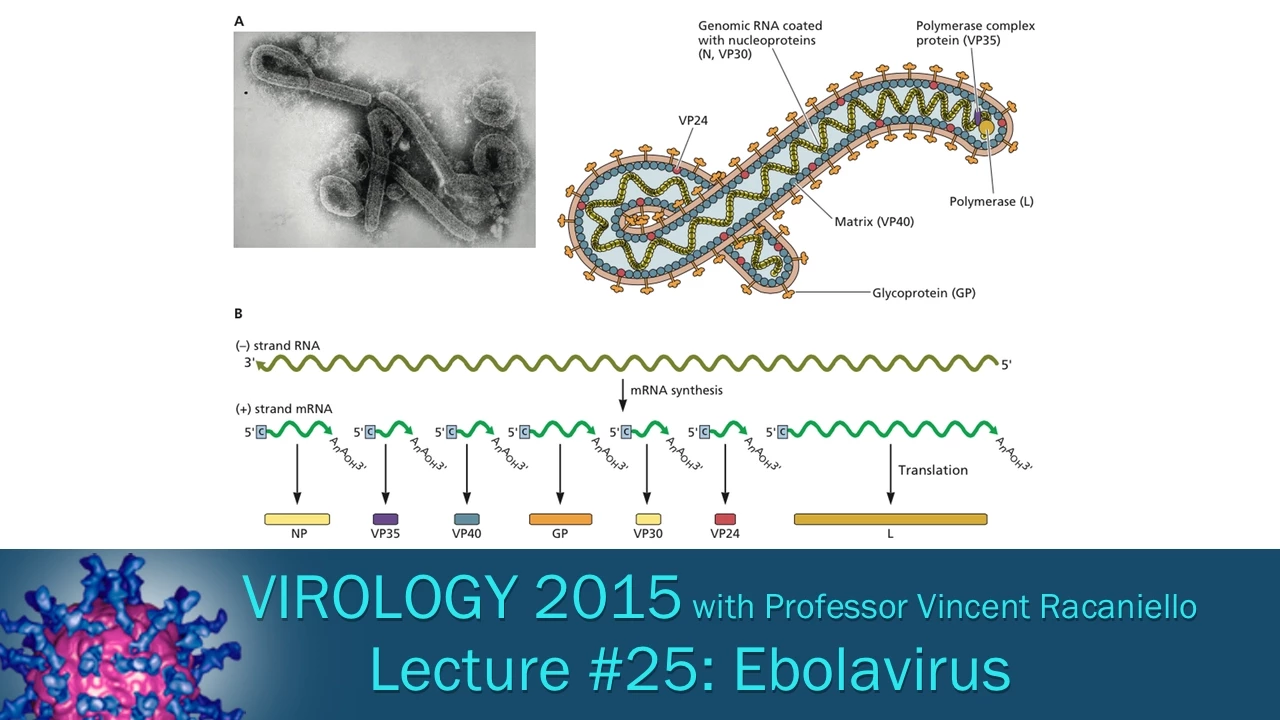
now immediately a number of things should pop into your head when I tell you it's negative Stranded the first is that the RNA in the virus particle is going to be coated with a protein and it's going to bring in the enzyme to the to the cell with it right it's going to bring in an RNA poase because the negative strand cannot be translated on its own so here in this diagram in the upper right there is our Negative Strand and RNA coated uh with proteins um there are two different ones that coat the RNA
the NP and the vp30 protein uh then at one end of the particle here you can see the polymerase the larger protein and then there's a second protein associated with it that's required for RNA synthesis so the RNA takes up most of the filamentous virus particle you can see in this electron micrograph the typical filamentous shape this is unusual for an animal virus but There are bacterial viruses that are filamentous like this and they often Bend back on themselves and and make these unusual shapes that you can see here so the virus is um it's
got its negative strand RNA complex with protein and then it's in an envelope particle where the of course is derived from the host cell it has glycoprotein in it that is mediates attachment to the host cell and beneath the membrane is a series of proteins the main protein is the Matrix Protein or vp40 as it's called the blue one and then interpers there's a more rare protein called vp24 both of these make this structural layer below the membrane and give the particles some rigidity so here on the bottom is the negative stranded RNA um it's
quite long over 177,000 bases in length and it includes 1 2 3 4 5 6 seven mrnas Each of which give rise to a protein so the strategy for decoding this genome is to make sub genomic mrnas There are other strategies that could be used but this is a typical one for negative strand viruses with a long uh negative strand a single negative strand in the particle so when this particle when this RNA gets into a cell it is decoded into individual mrnas which are capped and polyadenylated and each of those give rise to a
different protein so here for example we have the nuclear protein which is one of the proteins coding the RNA uh vp35 which is a part of the polymerase complex but also has another function many of these Ebola virus proteins are multifunctional they have a function in the virus particle but they they have another function which typically is antagonizing the immune response so vp35 while part of the RNA synthesis Machinery is also an interferon antagonist I'll tell you how that works in a moment uh VP 40 is encoded by this MRNA that's the Matrix protein that
lines beneath the membrane that's also an interferon antagonist here's the glycoprotein MRNA the glycoprotein of course is the protein in the membrane that's Alo also a uh interferon antagonist here's vp30 uh which is part of the nuclear protein along with NP uh this is required for RNA synthesis and finally vp24 which is the other protein beneath the membrane also an interferon Antagonist so we have one two three four proteins in this relatively simple genome that are dedicated to antagonizing inter Furon so this is possibly one of the reasons why these viruses are so pathogenic and
how they overwhelm the host so effectively is because they encode so many proteins that antagonize the immune response all right and finally we have the polymerase here the L protein is the RNA dependent RNA polymerase of the virus it's the largest protein of course it has to be brought in with the virus particle so that the negative strand genome can be copied to form mrnas so here we have a replication cycle of Ebola viruses and many aspects of this we've actually talked about a little before here's on the left we start with attachment of the
virus particles to cell surface receptors we actually don't Know what the receptor on the cell surface is for Ebola virus nevertheless it's taken up into the endocytic pathway and in the endom the endosome it binds to a fusion protein called npc1 which is a cholesterol transporter and that gets the nuclear capsid into the cytoplasm so it's a fusion step now we're looking at just the nuclear capsid the RNA protein complex it's in the v and the membrane is gone we have nuclear caps at negative Stranded RNA which is in the cytoplasm and that on its
own can make mrnas because it has a polymerase part as part of it so mrnas can be made they can be translated ated by host cell ribosomes to make the various viral proteins and of course some of these proteins will go on the vp35 for example and L protein will go on and replicate The genome through a full length plus stranded intermediate so you get lots of new nuclear capsids uh the glycoprotein will Be shipped up to the plasma membrane via the uh vesicular transport pathway uh VP 40 the main Matrix protein that will be
underneath the viral membrane get transported on vesicles uh to the plasma membrane and eventually uh new virus particles formed by budding the nucleo capsids that are first formed seem to bind to lipid rafts and these are the sites of assembly of new virus particles by budding now all this so all this happens In the cytoplasm one of the characteristics of um infection in a cell is is the development of what are called inclusion formations and these are sites of assembly probably of nucle capsids and you can see in the cytoplasm of an infected cell lots
of nuclear capsids ready to uh to butt out okay so that's the Infectious cycle it should all make perfect sense to you because again you know all the fundamentals of this from what we've Talked about so far I was lucky to get an electron micrograph from a scientist at Rocky Mountain Labs which is an NIH facility in Hamilton Montana very beautiful place small town they have this laboratory there which has a bsl4 facility and they have gotten um they've studied Ebola viruses as well as many other viruses as well this is in a Cell infected
with an isolate from Mali it's it's the current strain from the current outbreak and a couple of interesting Things you can see here virus particles budding right from the cell surface so here's the infected cell on the left you can see mitochondria for example in here and various vesicles so here are virus particles budding uh there are a few completed particles like this one here with the looped end uh and these up here have already buted off uh the other thing I wanted to point out to you is you can see in the infected cell
all the nucleo capsid so these streaky looking Long things these are viral nuclear capsids that's RNA plus the proteins so the the NP the N protein the polymerase Etc all of that assembled together makes these nuclear capsids in the cytoplasm and they're migrating toward W the plasma membrane so that they can acquire a membrane do you think that these nuclear capsids are just diffusing towards the membrane no right they're probably moving on microtubules and and being Actively transported nothing diffuses around in a Cell you can also see intracellular vacul such as this one maybe this
is actually just a junction between two cells where there's some virus particles that have come out and are stuck between the two cells and here you can see some more nuclear capsids in the other cell so quite an interesting um replication cycle now as I said a number of these proteins four antagonize immune responses and the focus is on Innate immune responses particularly the interferons and the interferon stimulated proteins so this is a slide which we saw along time ago when it was still cold uh and this has to do with the N Nate immune
response and here we're looking at at a cell with interferon receptors receptors for type one and type two uh interferons and you remember when a virus infection is sensed either by sensing RNA or protein the cell produces Interferons uh these bind to interferon receptors and they initiate a signaling pathway a phosphorilation Cascade uh that ends up uh sending activated transcription proteins into the nucleus and then the transcription of various cyto and interferon stimul ated genes and these interferon stimulated genes are the ones with antiviral activities right so two proteins of Ebola virus vp24 and vp40
which have other functional roles in the virus These also have antagonistic activities against this pathway so for example vp40 antagonizes Jack one Jack one is a protein kindas that when interferon binds to its receptor initiates this signaling Cascade to turn on is G synthesis so vp40 inhibits that by binding to this kinas and inhibiting it from phosphor the next protein down in the Cascade so in other words in the presence of vp40 you can't make isgs very Effectively uh the the target of of Jack is is a stat protein Stat one and two these get
phosphorated they dimerize and go in the nucleus vp24 another structural protein of the virus binds to Stat one and inhibits its Lo its translocation into the nucleus so Stat one ends up staying in the cytoplasm it can't go in the nucleus where it would be activating uh a number of genes that are needed for an efficient interferon response okay so two uh antagonisms at The level of Downstream interferon effects the synthesis of isgs and cyto kindes you may remember also this slide this is a picture of how viral rnas are sensed as foreign by two
cytoplasmic proteins rigi and mda5 again they sit in the cytoplasm they recognize either double stranded RNA or single stranded RNA with a five Prime phosphate these are types of molecules that we don't see in uninfected cells so they're signatures for viral Infections and rig ey in mda5 when they detect these molecules they also initiate a phosphorilation Cascade which is is very complicated eventually ends up sending again transcription proteins into the nucleus irf3 or ANF Capa B and that turns on the synthesis of cyto kindes the ones that cause inflammation and so forth yeah um in
obesity in obese people you do see double strand rnas that Actually in obese people you see double stranded rnas yeah do you know anything about that Dr Silverstein I know nothing of that so this is Dr Silverstein my colleague who used to teach this course with me and he stopped a couple years ago we he used to come to every lecture and I and if I got questions I couldn't ask I would ask him so I don't know about that but I'll I'll look into it what would be the source of these doubl stranded rnas
yeah I didn't really T That yeah and what the effect would be to turn on interfer on and this would be bad so you know there's a connection between certain um kinds of obesity and adenovirus infections which also generate double stranded RNA so that could be part of it as well okay so um vp35 another Ebola virus protein binds double stranded RNA actually the structure of vp35 bound to double stranded RNA has been solved showing Exactly how this sequesters it and of course you bind double stranded RNA and it can't activate rig ey MDA in
this case and that will also block uh the interferon response so um it's another way that the virus is antagonizing innate immunity and finally you may remember uh we talked about tetherin tetherin is a cell protein shown here bound to the plasma membrane it's an interferon induced antiviral protein and it's shown Here holding h IV particles to the plasma membrane so here the HIV particles are forming by budding uh but they attach to tetherin and that holds the virus particles from moving away this is a an antiviral defense not just for HIV but for Ebola
virus and other envelope viruses the HIV genome encodes an antagonist uh we talked about vpu is a protein of hiv1 that antagonizes tetherin which allows the virus to Replicate the Ebola virus glyco protein antagonizes tetherin allowing the virus particles to form so these are just four different mechanisms of immune antagonism again they're very specific and they no doubt uh result in uh the virus being more virent in fact you can take away some of these proteins or alter them and the virus has reduced virulence okay so that's just a little bit of overview on how
this virus replicates now let's talk about how you Get infected with these viruses so as I said it's a classic zunos the virus comes from some animal Reservoir and infects people there's typically an index case and sometimes we have evidence that that index case in other words the index case starts an epidemic that index has contact with an animal of some kind we sometimes we have documentation of that but not always and typically it's contact with bush meat in these parts of Africa where uh these Outbreaks occur people hunt wild game to eat they they
hunt monkeys of various sorts uh if they find dead chimpanzees in the forest they will consume it they also hunt bats and we think these are some of the sources of Ebola virus so the index case the virus spills over from an animal Reservoir into people uh it incubates in that index case and then it spreads to other people by close contact uh with infected fluids we'll talk a little bit about about that in a Moment but the chains of infection are quite short when you do uh case tracing you can go into an epidemic
find an infected individual and figure out who he or she has infected it's called tracing the chain of transmission it's not very long for Ebola virus there maybe three uh Transmissions at the maximum index number one and number two it doesn't go on and on and on as say influenza virus so short chains of transmission so this is interruptable And in many of the previous previous outbreaks we've been very good at interrupting the chain of transmission the reproductive index for this virus is about two so that's the number of people who are uh who one
sick person will infect on the average right just an average number because obviously some people can be super spreaders and infect more people other people can infect less but these are some examples of R note values I've mentioned this a Few times in this course so for example the most contagious virus that we've talked about his measles virus an R note of about 15 or 18 so one measles virus infected person on average infects 15 to 18 others here we have MPS which is 10 SARS is four HIV is four Ebola is two and hepatitis
C viruses too and to spread effectively you got to be more than one if you're one or less you're never going to spread in a population are is depending on the type of Population absolutely absolutely this can vary um in different popul obviously the Ebola populations have been limited but you know measles and HIV this is a global average but if you look in individual areas it can it can have a range yeah so where is the virus coming from marberg virus has been isolated from this bat rousettus aegypticus um the actual infectious virus has
been isolated in cell culture Okay so this looks like for that vir for that virus anyway that a bat or some species of bats in the forest are the reservoir species as far as we can tell uh the virus doesn't affect the bats uh and then it can get into monkey so remember the the outbreak in marberg was by importing monkeys from Uganda so somehow those monkeys were infected from the bat probably and then it infects the people or you could get direct uh infection from a bat there are a couple Of instances of marberg
infection where people go into caves where bats live and they they get infected as well so for marberg it looks pretty good that uh some kind of bat is is the reservoir species from where it spills over then into other animals it's not so clearcut for Ebola viruses so for Zer the first strain identifyed the one where we have the most information pieces of viral RNA have Been found in bats by pmer Chain Reaction no one's got infectious virus from a bat all right and they've also found antibodies in bats but we're only talking about
a few uh isolations there're three different species of tree roosting bats not cave dwelling bats uh where we get pieces of RNA and antibodies but again we don't get infectious virus so you could be skeptical and say we don't really know It's got to be somewhere out there but we're not quite sure because I think the gold standard is to have infectious virus people I know who work on this and actually go and Sample they say you know it's very hard to collect bats and get virus from them it's easier to do PCR so I
I respect that I understand that but I think until we have virus it's going to be a little bit up in the air so assume that bats are harboring Ebola viruses in addition to Marburg we know that these Animals can be infected and they're probably deadend host humans of course we have outbreaks gorillas and chimpanzees are clearly infected we do uh find animals in the woods chimpanzees for sure gorillas are suspected to be infected um it's very difficult to find gorilla carcasses after they die in the woods they're cleared very quickly so um it's I
don't think anyone has any virus from any of these animals uh but in fact in part the gorilla reduction in Population in Africa is thought to be in part by infections with ebola viruses so there is an animal Reservoir possibly a bat it seems to then spill over periodically to humans maybe via chimps or gorillas or even directly from bats because again bush meat involves getting bats gorillas and chimpanzees among other monkeys so here's a picture that kind of summarizes this idea the idea is that the reservoir are are bat species maybe multiple Species of
bats and these viruses are maintained in the bats at a certain level we don't know if they're always there so we don't have really good population studies of these virus es and bats this is something that needs to be done we don't know if it's constantly present or if there are periodic um resurgences of the virus in bats you know we don't have an outbreak constantly of Ebola in Africa it's Periodic so it could be one hypothesis is that the bat populations periodically are start to replicate the virus on what trigger we don't know and
then it spills over into people so we need to really do a lot more work on the bats we don't know how it's spread among bats as well but again periodically the idea is that from bats it can go into uh non-human species like chimps and gorillas and maybe other animals out there that we don't know about um these these Individuals can pass the virus among themselves so that's the red arrow so chimps can pass it to other chimps as we saw for SIV gorillas can pass it to other gorillas and so forth and there
there's most likely some spread between these animals as well and then the humans intervene at some point they may be infected from these other mammals or they can get virus directly from a bat so this is the idea at the moment it's by no means proven although you might Read stories saying that this is proven the bat is the reservoir I think we need to do a lot more work before we really nail this down so here are two examples of outbreaks where we do know uh the origin or the the index case and we
we have a good idea of how infection started so gabone 1996 Zer Ebola virus 37 cases um this in this case it was initiated by eating a a dead chimpanzee that a number of Individuals found in the woods they are hunting for food they found this dead chimp they ate it and 18 people who were involved in butchering the animal became ill and then they infected their family members and and that spread uh the infection and this one in gabone in in 19 967 again Zer 60 cases the index case was a hunter uh who
lived in a forest Camp so he didn't claim to have hunted any animals but a dead chimp was found nearby nearby his camp and there was Ebola virus in that chimp so the possibility was that somehow he got infected uh either via the chimp or a bat that had infected the chimp so these are examples of where we know uh that there was some kind of contact with an infected animal we don't have this for every case uh by by any means this is a early epidemiological tracing of the current outbreak which as you know
emerged in Guinea here uh in this red area and then spread to Sierra Leon and Liberia and these are countries that had never had outbreaks of Ebola virus before and this uh actually began in December of 2013 is that 2013 yes 2013 this was a 2-year-old child who uh got sick and 4 days after getting sick died right there we don't know how this child acquired infection it may likely have been bush meat I mean I heard some rumors but you I don't see anything concrete impressed so this is December 2013 uh this child then
passed it on to his sister his mother his grandmother a nurse and a village Midwife and then they the Midwife passed it to other people a number of these individuals so the sister of um the grandmother here passed it to other families uh healthc care members and you can see the Chain of Infection they actually traced this 20 or so cases initially it started in this Village gadoo and then eventually spread uh to Other neighboring Villages as well so it all began with a single spillover and from that spillover from an animal presumably it went
through this chain of transmission from person to person mainly family members and health care workers who were treating uh the sick individuals and from here it then spread throughout all three countries part of the problem was this was not recognized in December as Ebola virus it was thought to be malaria or something else And it was actually months wasn't until March of 2014 that uh the who received notification from these countries that they had an ebola virus outbreak and so by then you can see here we have February March um February January by then the
virus had spread extensively and that's why this outbreak in part uh was so difficult to contain Because by the time we picked it up it had spread Extensively these countries had zero experience in dealing with Ebola virus outbreaks a lot of other countries Uganda DRC Etc had lots of experience by now they knew how to contain an outbreak but these these countries didn't and that's why this got to be so big 26,000 infections now this is a map of Africa showing the range of the bats the three bat species that have been found positive for
Ebola virus RNA and have had antibodies in them this is their Geographic range and the map is colored uh indicating the risk for infection depending on the range of these animals so red is is the highest risk uh and blue is the least risk so you can see much of Africa these animals don't live these bats don't live there and so there's very little risk but there are pockets of risk areas throughout the country but here in central Africa uh especially DRC in neighboring countries there's a lot of risk and you can see The countries
in Western Africa as well uh where these bats are known to inhabit are high risk also uh on the top is the population of each of these countries you see DRC has the highest population the the others are substantially smaller in the same article where this comes from they also look at the amount of travel in and out of these countries there's lots of air travel from into all of these at risk countries so you know the possibility of of global spread is Is much greater than we thought now this of course assumes that those
three bats are the only species and it may be that there are other reservoirs as well that we don't know about but you can see that at least from this approximation these are the areas that have to be uh Vigilant it might make sense to immunize the people in these at risk areas at some point when we have a vaccine but you know we have millions of people here uh and someone will have to pay for this Vaccine it's not yet licensed yet but this is a viable option at some point to prevent uh these
infections how does it get transmitted so remember it comes from an animal to a human a human consumes meat they presumably contaminate themselves by by um you know dressing the carcass or or preparing it and the virus gets into a cut or a mucous membrane but then it goes from person to person and the way we think that happens Is by contact with infected blood or body fluid so there's lots of virus in the blood other fluids that have been shown to have virus include urine saliva sweat feces vomit breast milk and semen and this
is from someone who's either sick very sick or has died if you're not sick if you're just incubating the virus uh we don't know of any example of transmission from an individual like that so any of these body fluids can transmit infection you can also have Transmission by contact with contaminated objects there's been some outbreaks where contaminated blankets or bed clothes have been associated with infection needles and syringes are a big one in hospitals where they use glass syringes and and reusable needles they don't autoclave them properly and they transmit infection many chains of infection
have been traced through such contaminated material it's not transmitted by insects it is not Transmitted by water or food or longdistance aerosols so I bring back this picture which we looked at before of aerosol transmission remember when you talk or speak or sneeze or cough you make droplets of different sizes you make really really small droplets that can go long distances you know up to 150 or so feet and that's what we call aerosol transmission the respiratory viruses like influenza and measles get Transmitted this way that is not the way Ebola virus is transmitted it
doesn't have the capacity to go long distance in small drops we don't know why it could be that the the virus isn't stable enough or there isn't enough virus but it doesn't it doesn't happen that way uh the way it works is either by contact or by short distance Aerosoles so for example if you're right in front of a patient with ebola and they sneeze or cough in your face or Within a few feet they could transmit it by big droplets that's not what we consider to be the classical aerosol transmission but it can happen
some uh ER physician was telling me when you intubate a patient you generate an aerosol and if that patient has Ebola and you're not protected you can be infected so you can get short range infections by these big droplets even huge droplets like would be generated in vomiting uh but not longdistance aerosol Transmission now this became an issue in this current outbreak here's a oped in the time September well September 11th maybe he did that on purpose but uh this is Michael ome who is a epidemiologist preparedness U type of person he's at the University
of Minnesota so he wants uh the world to be prep prepared for pandemics so he wrote this oped saying that virologists are afraid to talk about the possibility that Ebola virus could mutate to become transmissible Through the air and his argument was the virus hyper evolution is unprecedented there's been more Transmission in this past outbreak than we ever saw before and all it takes is a few mutations and breathing would put one at risk of Contracting Ebola infections could spread quickly like flu so I read this and I was pretty much pissed off because he
is just scaring people most of what he says is wrong here um he we have no idea what mutations it would take he Says almost with certainty certain mutations occurred we have no idea if you need one or 50 and we would have no idea about its transmissibility so I wrote a response to this which uh you should take a look at I'll show it to you in a minute unfortunately the Press picked this up so here's time magazine the Ebola virus is mutating say scientists uh scientists would like to study whether it had become
more contagious so all of a Sudden this was dominating headlines this idea that the virus is mutating and it's going to become aerosolized right um so I think he did a disservice by by talking about this because it's it's so remote as to be highly unlikely and why do I say that this is you can go read this my my whole article but basically the virus is always mutating like all viruses do like I've taught you in this course but whether the mutation gives rise to Something that will change the virus phenotypically we don't know
ome was saying just because it's mutating during this big transmission through the population means by definition it's going to change but that's not necessarily going to happen the other thing is in all the years we've been looking at viruses 100 years or so of studying viruses we have never seen a virus change the way it's transmitted okay We find none of the amino acid Replacements lead to identifiable functional changes they have minimal effect on protein structure being neither stabilizing nor destabilizing not found in regions associated with known functions tend to Cluster in poorly constrained regions
disordered regions of the protein we find no evidence that the difference between the current and previous outbreaks is due to evolutionary changes associated with Transmission instead epidemiological factors are likely to be responsible for the unprecedented threat so everybody wants to blame the virus the virus is mutating it's going to go Airborne it's going to get more virulent but in fact it's really about the population that the virus is in the end and this was virulent because of the particular factors uh that were involved that I've already told you about so I think this and other
studies really put to rest This idea of aerosol transmission now in the laboratory you can get Ebola to transmit by an aerosol I don't know if you've seen one of these this is a nebulizer so if you have to inhale a drug you put it in here and you put the mask on your face and you turn it on it it makes a Mist it's an aerosol if you held up this this nebulizer it would go all over makes very small droplets right so if you put Ebola virus into this machine And then put the
mask on the face of a primate guess what the primate gets infected you're infecting the primate by aerosol you're dumping tons of virus right into uh the respiratory tract so no one's tried to make create an aerosol in a room and see if the primates are infected that's a pretty dangerous experiment that probably no one wants to propose but some other things have been done first of all if you if you so you can infect maacs artificially by an Aerosol but it's short range you're putting the mask right on their face if you inoculate MAAC
intramuscularly uh you can find virus in oral and nasal swabs but if you put those animals in a room with other caged animals they don't transmit to to animals housed in separate cages so it doesn't look like they generate an aerosol that can transmit and another experiment they infected pigs through the nose with Zer Ebola virus then they put them in a room Uh they were on the pigs were on the floor running around and in the room were cages with maacs and all the maacs got infected so you'll see this quoted by a lot
of sources saying this is evidence that Ebola virus spreads by aerosol but this experimental design tells you nothing let's look at how this experiment was done so here's a room with pigs and here are the cages up here that actually you can't see them they're high up and the air flow was designed to Move the air from the bottom to the top so they infect the pigs uh they they get virus in them and then these maacs all got infected every night someone comes into this room and mops the floor well because the pigs are
all over the floor right so someone mops the floor guess what happens when you mop the floor you're making an aerosol if there's any virus in the feces or urine you're going to bring it all up so this Is really not a conclusive experiment uh because of the way it's designed all it says is that these pigs can make virus they probably shed it in urine and feces and then it gets popped up into the air but whether they ex exhale it in their breath and transmit it we have no idea from this experiment okay
enough about aerosol transmission uh let's talk about the disease we can make conclusions about how the disease Uh proceeds by observations in humans we have non-human primates that we infect we have rodents of various sorts guinea pigs mice and hamsters the rodent experiments require you to passage the virus and adapt it to the rodent so it will infect them and these have a little less weight I think in terms of of what's going on uh it enters through mucosal surfaces in people breaks or abrasions in the skin uh parental contaminated needles and the virus is
in A lot of body fluids uh and that's why you can get it in this way so you know for a while there was a big discussion can you get Ebola virus if it lands on your skin and I said no unless you have a cut remember the outer layer of skin is dead but most of us do have cuts on our hands or elsewhere and so it can get in uh via these Cuts there's an incubation period of 2 to 21 days during which you are not contagious you you don't need to be Quarantined
and you have a set of early symptoms fever headache muscle pain diarrhea vomiting and stomach pain so these are early sympt symptoms where if a person came from West Africa and they start displaying these symptoms boom they go into isolation and then at the peak illness rash Hemorrhage convulsions uh severe disturbances and metabolism and you have a a defect in your blood uh coagulation system and that's part of the reason why you you have a rash and a Lot of bleeding the clinical Fe features of this infection show that every system in your body is
infected you have systemic effects GI gastrointestinal problems nausea vomiting diarrhea you have respiratory symptoms you have problems with the blood system not just um um coagulation problems but bleeding in the eyes and so forth and then you have neurological problems as well so whether the virus is Replicating everywhere isn't necessarily needed to do this but the cyto kindes and so forth that are produced could account for some of these symptoms so here is a MAAC that has been infected um with Ebola virus and one of the some of the manifestations are what we call hemorrhagic
you have bleeding and and you have bleeding under the skin that gives you these rashes or bruises they're called P right you can see that here in different parts of the animal Bruising at the elbow and then you get if you inject these animals to take blood or give them anything the venie puncture sites never heal they keep oozing because of the defect in blood clotting you can also get hemorrhaging internally in mucosal tissues here for example is a hemorrhage um in the intestine uh and I believe this is stomach as well so the animals
uh this is what we see also in people what we think is the virus uh enters and Initially replicates in immune cells monocytes macrofagos and dendritic cells this replication in these cells of course disperses the virus to other places it establishes a vmia and that delivers virus to virtually every organ and in many organs you have necrosis of the cells that make up the organ like liver and adrenal and kidney and so forth the cells are destroyed by virus replication and immune responses most likely and that's why you have these Multi-stem failures as a consequence
lots of chemokines and cyto are produced nitric oxide these are all toxic you get loss of dendritic cell function because of the virus replicating in it lymphocytes apotos as well so you have an overall decrease in immune function and this is probably part of the reason uh why the infection is so lethal you have a very substantial vmia this is a Time course of people who were Infected with Ebola virus these were uh healthcare workers who were known to be infected on this day and they took blood samples from them at different times after infection
and the black bars are the tighters in the blood of people who who died event eventually and the white bars are people who lived so you can see very right off the bat if you have a lot of virus this is associated with a fatal outcome but you can see um here is the Day post onet of symptoms so as soon as You have symptoms you have a rather low amount of virus but it goes up pretty quickly so probably before this time during the incubation period you simply don't have enough virus uh to transmit
to others as I said the virus replicates in lots of tissues and causes necrosis in them it replicates in lots of different cell types it has a broad cell tropism all these cells here are sites of replication uh it destroys the liver you Get elevated liver enzymes in the blood this leads to shock which is characteristic of infection and massive uh lymy death many cyto kindes and so forth are produced during the course of the infection especially by infection of macr phases and monocytes this causes an immune imbalance and contributes to uh the disease and
as I said you have impaired vascular and coagulation systems we think that the virus May Replicate in the endothelial cells so here are some blood vessels and as I told you a while ago they're composed of endothelial cells that make the vessel proper we think the virus is replicating in them and making the vessels permeable and hence some of the bleeding seen with it uh there's also um abnormalities in the clotting program probably as a consequence of um certain tissues that make clotting factors being infected and destroyed so that's why we get the rash Which
is reflective of bleeding um internal bleeding and Hemorrhage as well however most of this most most of the um permeability leads to fluid loss and shock not you don't die because you're losing blood you die because of fluid loss so if you are infected uh there are no antivirals there are no vaccines yet the only thing we can do is give you supportive care and this consists of intravenous fluids oxygen and infection control and we had some experience with Um treating patients here in the US so we learned quite a bit in Africa the case
fatality ratio is 30 to 90% over the history of this infection we don't know how many inapparent infections there are there there's some evidence that people can get infected uh but they don't get sick so that could bring this down substantially this is of course people get sick they go to the hospital they live or they die that number is biased to the very sick people but um Treating really brings this down in the US we've had very good luck with the few patients that we've treated I wanted to share you this little piece from
the Doctor Who treated the first two cases in Atlanta so these were two uh hos healthc care workers who were working in Africa they got infected so they were brought to uh Amory and treated and they survived it's a very interesting interview in a Scientific American and they asked him what sort of lessons and He said you know we're not being critical but they have a lack of infrastructure and testing that everyone in our society takes for granted like being able to do a blood count uh you couldn't do simple things in these hospitals what
we found in general is the amount of fluid they lost through diarrhea and vomiting they have a lot of electrolyte normalities so replacing that with standard fluids without monitoring will not do a good job of Replacing things like sodium and potassium so they said you have to know exactly what's low in these individuals so if you can't measure it which is the problem in Africa you have to take this into account uh so they also have a lot of fluid in their tissues the damage to the liver uh you you uh no longer makes enough
protein proteins in the blood are very low so you have to pay attention to this so the take-home measures is very interesting if you have the diagnostic Methods here you can monitor the patients and and give them what they need and they survive we only lost one patient uh in in Texas and he probably was diagnosed too late was too far into the infection so I think if we can apply this to African outbreak this is one of the things we're trying to do we can get more people to survive in the US these are
the infections we had uh the Liberian man who went to Dallas so he he went to the ER with a fever and they said he had flu and they sent him home so that was a big mistake because those two days that he was home probably killed him so he died but he infected two healthc care workers in Dallas and they eventually recovered they were cared for properly then here in New York a doctor at the emergency room room in Columbia he had been working in Guinea returned to New York he got sick with ebola
he recovered as well so he was treated at bellev so Again not a lot of cases but I think we have learned the right way to to care for these individuals without antivirals just supportive therapy this can make a big impact on the The lethality of infection and finally I want to end up with some possible therapies that are being developed and may be deployed eventually uh we talked about this in the vaccines lecture this is a monoclonal antibody or a mixture of monoclonals called Zmap uh which was given to those first two healthcare workers
who got infected in Africa came back to the us we don't know if it helped them or not but it's a mixture of three monoclonals that are directed against the glycoprotein remember the glycoprotein is in the membrane of the virus uh these uh mice were immunized with virus like particles that means they look like viruses but they're not infectious and monoclonals were identified that block infection They were built into a human antibody scaffold and the antibodies are produced in tobacco plants these are the three antibodies binding to the glycoprotein these protected in the lab non-human
primates from infection they were very effective at doing that they're currently in Phase 2 studies which means they're being tested for efficacy uh in Liberia but of course now the disease has gone way down so it's not clear at all whether we're going to Get good information about this we have a couple of vaccines that are being tested I want to just tell you a little bit about them they're quite interesting uh there are two vaccines that use other viruses as carriers of Ebola virus information we're using adenoviruses and pox viruses and we put bits
of the viral Ebola virus genome into these other viruses and then use these as immunogens so the first one is an adenovirus vaccine and what they have What they have used here is a chimpanzee adov virus so there are lots of human adenoviruses that we all get so we have lots of antibodies against human adenoviruses so if you give a vaccine using an adenovirus background it doesn't work well because of our antibodies but few of us have antibodies against chimpanzee adov viruses so uh they built the Ebola virus glycoprotein into a chimpanzee adenovirus backbone uh
and here they give 10 to the 11th pfu as An Imogen of this virus and then they challenge intramuscularly uh with ebola virus and you get with 10 to the 11th pfu 50% of the animals survive uh none of them survive if you give them 10 to the 10th so this isn't very good because 10 to the 11th is a huge amount of particles so then they went into a prime boost scenario where you give two injections and if you just give two injections of the same serotype of chimpanze adino Virus uh you only get
33% protection so you go in once 10 10 10 10 if you you wait a couple weeks boost and you challenge with ebola 33% protection they then said well maybe you the the animals are making antibodies to Chimp adov virus so let's go in with a different cotype so they go in with first adenovirus type 3 and then type 63 which will not be neutralized by antibodies to type 3 um again 25% protection not really very good So the the last thing they tried first boost adenovirus type 3 and then this is a vaccinia virus
Vector a totally different virus this is modified vaccinia and carara this is a derivative of the vaccine that's used for small poox so you immunize first with adov virus then with the vaccinia virus and here you get 100% protection and this is durable this lasts uh for months so this uh vaccine is now in in um it's either either phase one has been completed I Think I have it on a chart coming up or we're going into phase two so this one looks pretty promising the other approach that's that's going into people as well is
to use vascular stomatitis as a vector bssv related to rabies virus it's a bullet-shaped virus with a negative strand genome what you do is you take out the vsv glycoprotein Gene and you substitute the Ebola virus Gene into this virus and you can construct this by Transection of cells by by recombinant plasmids the the point is you get a virus out that is all uh vsv except the glycoprotein is Ebola virus and then you inoculate these uh into your animals and you see if it gives protectant so that result is shown here on the next
slide uh this is a vaccine being developed in Canada with a company so these uh animals have been vaccinated those are the diamonds uh with that vsv re combinant and then They're challenged with a th000 pfu intranasally and and this is the survival so all of these animals survive and if you just give the animals Vector alone without Ebola glycoprotein just give them vsv with no Ebola glycoprotein they all die so this looks very protective as well and this is also uh been put into people and the last one I want to tell you about
is one that was just published it's called interesting this is one which is a Ebola virus whole Virus vaccine they take Ebola virus and they delete the vp30 gene from The genome they actually put in a substitute Gene green fluorescent protein so they can trct the virus so vp30 is a protein that's associated with the nucleocapsid okay so this is essential for infectivity so they basically take RNA they delete the vp30 Gene and then they take the RNA and they put it into cells that produce Vp30 so now you make particles the Genome of these
particles lacks the vp30 gene right so you grow the virus in cells that produce vp30 you have vp30 in the particle but that virus does not make new particles in a Cell because it doesn't have vp30 so you can infect cells with this vp30 deleted virus it is antigenic but it doesn't replicate and it's not infectious in fact you don't have to work with this virus under bs4 conditions because it can't infect Cells so this has been used to immunize cinus maacs uh here we're immunizing intramuscularly and then challenging intramuscularly with just a thousand F
Focus units of uh Ebola virus not very much so these are animals that didn't get any vaccine these the graph shows you virus replication in red a lot of virus present up to 10 to the E uh 50% tissue culture infectious doses in all four animals and none of these animals survive so these were not immunized so They died uh here are animals that got one dose of this vaccine 10 to the 7th Focus units uh four out of four survived one of them developed a transient vmia and if you give two doses uh all
the animals survive and you get no vmia so again this is a vsv sorry this is a Ebola virus vaccine lacking that single Gene which makes it non-infectious but it's clearly immunogenic so this is not replicating but it's getting into cells it's it's generating an immune Response so at the moment these are the vaccines that are being tested the chimpanzee adino virus uh just completed a phase one both at NIH and in other countries in Mali Switzerland the vsv that I told you about is in is just uh finished phase one these are all done
at very diff at different sites so phase one is just a safety test to make sure that the vaccine is safe doesn't have bad side effects uh here is the um here is another version of the ad26 vaccinia Which is also in Phase One um recombinant protein which I didn't talk about is in phase one uh another phase two study of the chimpan adov virus um is is ongoing in all these countries and you can see others are these phase three are obviously planned um March 2015 were past that I'm not sure that any of
these have gone forward because um there's not much infection anymore so if you don't have people being infected it's very difficult to test the efficacy of the Vaccine and it's really not worth to uh spend the money on doing that unless you can get an efficacy result we Al we already know that these are safe and people the real question is whether uh they are protective or not so that's a very tough uh nut to crack how do you test these vaccines we have a few antivirals that are being tested uh there's one which is
an RNA polymerase inhibitor for influenza it's it's licensed for flu in some countries seems To have some activity against Ebola it's in a phase two study in Guinea at the moment a small interfering RNA is in a fe phase two this is directed against the viral genome so it would prevent infection and then a nucleoside analog which has some broad spectrum activity is in Phase One in the UK so you can see there's lots of activity all of a sudden stimulated by this uh late outbreak so if we learned anything from this I think the
biggest thing we learned is that Every infectious disease is everybody's problem there aren't diseases restricted to one place or another because people travel and diseases spread people were very afraid of Ebola spreading globally the interesting thing is that these vaccines and antivirals have been ready for some time the US Military and the military of other countries actually developed them in case of a biot terrorism attack using Ebola virus but they never got into the human clinical Trials and of course what stimulated that now is the outbreak in Africa so I think this tells us we
need to be ready for the viruses that we think are lethal and are likely to spread we should have been ready for Ebola a long time ago but the individuals who make decisions about what's going to be developed felt it would never be a global problem so predicting is always difficult right I think you need to be ready and the interesting question of course is which Viruses which other viruses do we need to be ready for besides Ebola NEPA Hendra Ms SARS Aven influenza I mean there are lots of them out there the way I
see it lots of jobs for [Music] virologists