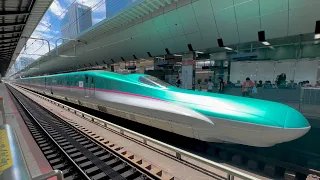
Imagine traveling on the ground [music] but moving faster than a Cessna aircraft flying at full throttle. You look out the window and the landscape is nothing but a blur of green and gray. On April 21st, [music] 2015, on a test track in Yamanashi, Japan, a [music] train shattered our understanding of ground transport.
It didn't just break [music] a record, it obliterated it. The speedometer hit 603 kmh. That is 375 mph.
[music] This isn't science fiction. It is the SC Mag Lev, the L0 series. It is the fastest train [music] ever built.
But the most surprising thing isn't just how fast it goes. It's that to reach these speeds, it had to stop being a train entirely. [music] Today we're looking at the engineering miracle that learned how to [music] fly on the ground.
Right here in Simple Things, Surprising Histories. To understand why the SC Mag Lev exists, we first have to look at the problem with traditional trains. Japan invented the modern high-speed railway in 1964 with the Shinkansen or bullet train.
It was a marvel, but engineers quickly discovered a wall they couldn't break. Friction. When you run steel wheels on steel rails at extreme speeds, physics fights back.
The vibration becomes dangerous. The noise becomes deafening. And the wear and tear on the tracks is immense.
Engineers realized that if they wanted to go faster than 350 or 400 km hour, they couldn't just build a better engine, they needed to eliminate the track contact altogether. They needed magnetic levitation or mag lev. Now mag lev have existed before like the transrapid in Shanghai.
But Japanese engineers wanted to go faster and safer than anyone else. They developed a unique technology called superconducting magnetic levitation or SC mag lev. So how does it work?
The SC stands for superconducting. Inside the train there are magnets cooled by liquid helium and nitrogen to temperatures approaching absolute zero about -269°. At this temperature, electrical resistance disappears, creating magnetic fields that are incredibly powerful and efficient.
These magnets interact with coils inside a U-shaped concrete track. But here is the fascinating twist that separates the SC Mag Lev from other magnetic trains. It has wheels.
Unlike other mag levs that float from the very start, the SC Mag Lev drives like a normal train on rubber tires until it reaches about 150 kmh, 93 mph. Only then, once the magnetic force is strong enough, do the wheels retract like the landing gear of an airplane. The train lifts 10 cm, about 4 in, into the air.
It is literally flying, held in the center of the concrete channel by invisible magnetic walls because there is no friction. The only thing slowing it down is the air itself. This technology is currently being built into the Chuo Shincen line.
The goal is to connect Tokyo to Nagoya and eventually Osaka. But traveling at 600 km hour requires a track that is almost perfectly straight. You can't take sharp turns at that speed.
Because Japan is mountainous, this led to an incredible engineering decision. 86% of the track is underground. When this line opens, it will shrink the country.
The trip from Tokyo to Nagoya, which currently takes 90 minutes, will be cut to just 40 minutes. It essentially turns two massive cities into a single commuter zone. It creates a megalopous of over 60 million people connected by a vehicle that floats on a cushion of physics.
The SC Mag Lev is more than just a fast train. It's a reminder that sometimes the only way to move forward is to rethink the very basics of how we move. By removing friction, we didn't just gain speed, we gained a glimpse into the future of human connection.
If you enjoyed this flight through history and engineering, please hit that like button. It really helps the channel. What simple thing with a surprising history should we cover next?
Let me know in the comments below. Thanks for watching.