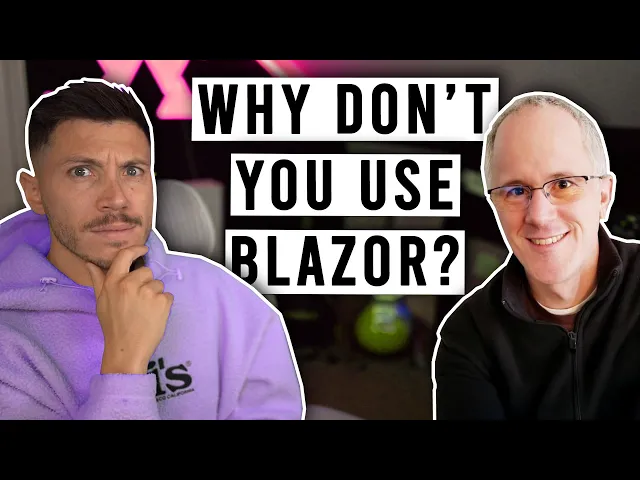
Hello everybody I'm Nick and in this video you're going to see an uncut 1hour discussion between me and Dan Roth the principal program manager of Blazer who saw my previous video on my worries about Blazer and wanted to have a chat about it to clear some things out now I asked some really really hard questions and I got some really really interesting answers like this one react definitely is sort of my natural inclination to go So if you're interested in Blazer and its future you don't want to miss out on that now on D train
we just actually released the Deep live on Blazer course we were preparing for a very long time a followup to the getting started course so how appropriate give the first 200 of you a 20% discount code on that and the getting started course by clicking the link description down below or using the discount code launch 20 at checkout now just enjoy this chat so yeah Dan welcome To this video obviously you saw the video I made a while ago about Blazer and the criticisms and you said let's talk about it so I'm very happy to
have you here um first in case anyone lives under Rock and they don't know who you are uh who are you and what are you doing um Nick it's great to be here first of all it's it's a pleasure uh I'm I'm Daniel Roth I'm the principal product manager for asp.net core and and Blazer on the net team so I work on our Uh Prim primarily on our web UI stack so anything that produces HTML like you know draws user interfaces in in a browser I I work specifically on those areas I also help manage
the uh the broader asp.net core vision and direction I see so first and foremost congratulations on the net 9 release like it's out finally every every year like a like clockwork in November um do you on that point and I wasn't originally planning to ask this question But I tend to ask it to anyone working at Microsoft whether that's cop.net or any product um we've seen you know cancellations and features in C shop and maybe something in net is being pushed later do you feel in in any way restrict to hit that deadline and do
you think it's a good thing to have it or a bad thing to have it I mean it is a deadline so yeah you're absolutely uh time bound on each release so you know it's definitely a Restriction I mean that's kind of the the game of engineering and shipping software is uh there are dates and uh there are resource constraints and so you got to do what you can with with what you have um so yeah we and I I think the year Cadence is long enough that we can still do very significant uh uh
things and we you know deliver you large mey features in those those time frames it does create this um with a a date driven release there is always this Problem of things that need to go longer like if you want to have a an effort that expands multiple releases you know getting into that mindset I think can be a little bit harder because everyone's sort of thinking in one year chunks like what can we do in a year uh but we do those those things as well I think the the runtime team in particular and
the C team are have have many long lead efforts that they're working on and and that will carry over multiple years um So I I think it's a good Cadence it's it's long enough that you can do big things um it's short enough that we have you know a regular Cadence of of features and it's a it's interesting dial right I know some people sometimes feel overwhelmed with how much features we ship on that on that yearly Cadence and wish we went even a little slower than than that um but at the same time you
get uh a nice I know it's a platform so you get this float of of value every Year that just you just acrew by by building onnet whether that's performance or language features or new apis so I I I think it's pretty close to to the right balance we get lots we get feedback occasionally about adjusting it but it's I think it's not too far off at least of what would be optimal can you say anything to people saying that I'm not going to use n because it's an STS release and we only should use
LTS because that's the stable version and STS is the unstable preview version of net because I see it all the time ni I feel like we should make t-shirts like the LTS team or the STS team that's right I mean they they both exist for for a reason right we have them both because we know there are customers and and and users that need those different different time frames I mean I would definitely favor the the stay on the latest if you can like if you can get the the latest greatest features and and Performance
improvements and all that value um then you should the level of agility you need to have is to be a able to update your apps to the latest net platform about once a year now there are definitely customers that I talk to that that just don't have that agility available to them and it's not it's not because they don't necessarily want to it's just because of either you know processes or environments that they deal with that are just hard for them to roll Out releases at that Cadence you know I've talked to to to Big
customers that uh like have this approval process to get a new technology and it has to be on a a list that their architect group has signed off on and every time a new thought platform version comes out they have to go through that process and that can take longer than the you know moving on to the latest STS would would allow them to do but if you can move on to the latest I absolutely would we care deeply About backwards compatibility you know gone are the days of like net core one two and three
where things were like breaking with every release like we the idea is you should be able to update your TFM to the latest.net version update your packages and that should be it if it's not it then that's probably unintended regression that you should let us know about and we will try to get that addressed in a in a in a patch release so as we can um if you have the Organizational agility to do it you absolutely should would be my recommendation U but we understand that some people need that that longer support cycle or
that uh you know slower Cadence so they can manage the the releases and we get that that's that's that's totally fine you shouldn't feel bad if you're on the you know team LTS but there is no difference in quality and like between STS LTS I see it a lot there's absolutely no difference in Quality it is kind of interesting right like you would um you would think that there would be some adjustment maybe in the like types of things that we do in each release that like oh uh LTS releases were kind of like polish
up the features that we introduced in STS releases because you're going to support that longer you're going to support for three years the reality is at least from what I've seen in Microsoft that's that's definitely not the case like we We shove as much value into each release as we can possibly get get away with cuz you know that year Cadence comes around and that's your opportunity to have impact to help your customers to deliver deliver value so yeah there's not even really a a difference in scope like we we every year we we think
and and and and talk about what can we do that would be the most impactful thing for for our users to help them also for us like most of Microsoft's backends is all built on Net so we're the platform for our company um we need to deliver value to those partner teams as well you know Bing and yeah exchange and Dynamics all all these big big systems so there's there's a lot of pressure to deliver value each each release and that's that's how it ends up being yeah it's funny you mentioned [ __ ] because
I I was talking to some Engineers that's not NDA uh I'm just talking to myself now and they were Mentioning how Bing when first you know chbt and all that Bing search and everything came out the AI driven stuff they were in like Net 7 preview 3 they were using preview versions before the the ga was out because they really wanted like to get the most out of the vision so if if B can do it you guys can do it really tight collaborations with a lot of our internal partner teams to um you know
all the way up and down the Stack like the the lowle runtime the ace core team dealing with these uh huge services like services that serve like billions of requests per day um tuning the stack adjusting things to to to meet their needs and I mean yeah the the results of the that I feel like is definitely not NDA like you can just go onto the donet blog and search for these user stories um the ones that are based on Microsoft teams and there's tons of them of like hey we just saved like Gajillion cores
by moving to net 678 or whatever version it was um because of that that tight uh um um cooperation and that then Acres value hopefully to the rest of the uh the ecosystem you know you you get all the benefits of running your app on the same platform that all these huge services are are running okay so let's move into some Blazer questions because we want to answer what people are asking and obviously you've seen my video I've mentioned some Criticisms so enough with the enough with the Icebreaker stuff uh yeah I gotta say that
you know the criticisms we really appreciate like the I think you're not I don't think you've been alone like there have been several videos that have come out on YouTube people saying you know what do you think about Blazer what it's future and actually was really looking forward to have the opportunity to to chat about a common concern like some of these Questions are I think concerns that a lot of people have yeah like back in the day when I made that first video like four years ago the backlash for a small Channel at the
time was insane and I'm like people were like oh you you took it you took it down because you're like an MVP I'm like no I took it down because at the time I just couldn't take the the you know all of my videos were 99% cry 99% ratio and now I had like negative comments for the first time God forbid We criticize something Microsoft did so but I think we only grow if we criticize things so last year Blazer in net com had like an entire video dedicated to it like 55 minutes long this
year it was part of the as net core 9 and Blazer conversation but it only took 17 minutes of the entire thing so the keynote not the keyot just just the long video that you did later separate to the yeah of the a core overview yeah is there and Actually Maui Maui stuff were were a bit more this year but what do you think about that and and why was there less objectively less chat about blazer because even if you count how many times it was mentioned I think it was 33 last year and and
four seven this year well I think it's it's it's it's it's no secret that the scope of what we did in blazer for doet 8 was very large in fact it was kind of kind of bursting at the seams like we we Did this effort to take blazer from being what was you know intended to be a doet uh option for client side web development you know instead of having to write uh as an alternative to writing JavaScript you could now build your apps uh the client side logic in Blazer Blazer server Blazer web assembly
and on at8 WE expanded that and stretched it to be a full stack web UI framework like we added static server side rendering support so you can just do this the same Patterns that we've done for you know decades yeah with asp.net to send a request and render some HTML you can now do that with just uh Blazer components uh then enabling you to take all the different render modes you know the Blazer server pattern the Blazer web assembly pattern and mix them in one consistent Blazer web app that was a lot of work uh
and it was a it was a big moment for for Blazer so there was a lot of attention that was drawn to that in That particular release uh in net 9 I mean that that do net 8 release was like was so heavy that there was even some like um carryover like there were I think fairly number of of patches that came out afterwards to like you know fix things up and we and we knew that that was actually uh intentional like we we had surfaced that up our management trange like you know we're probably
going to have to like there's a lot to stuff into this release we're probably Going to have to keep working on this stuff in into the early Dot N Cycle which will eat into uh you know doet 9 time and then even in doet 9 we're we'll probably focus on quality and fundamentals of that new new pattern of the Blazer web app full stack web UI um patterns so don knif for Blazer was was more focused on those quality issues you know addressing gaps in what we had had just shipped so in terms of messaging
it wasn't like there was a ton that was new It was more just like let's make what we just shipped uh better and more more polished um so that's one reason why there's you know less Blazer content in inet comp is because well mostly the the feature set we did was there were still new features but it wasn't as transformative as what we were trying to do in in Don and 8 and I think some a lot of people appreciated that they're like oh thank you like a breath of fresh air I just had to
finally got my blazer Server app changed into a Blazer web app and that took some some work and there's nothing hugely disruptive that happened in d n that I have to to to adjust to I mean technically you didn't have to even adjust do that adjustment we still support the old Blazer server and Blazer web assembly patterns as is back in P um the other reasons I think also are the competing messages that you're you're dealing with obviously Microsoft is Allin on AI right now so that's kind of The the Mandate is like let's do
AI off huge huge messages around co-pilot and how do you how do you take net how do you take your Blazer app and actually build intelligent apps with it how do I use the open AI Services um to add these really cool functionalities to to your application so like I know uh I think it was it was Tim Anderson right that did a video recently also about the donet comp and his take on it I think that's Ed Ed Anderson is it oh sorry Ste Cory and Ederson but yeah oh my bad yes Ed sorry
Ed um I know he uh like one of the things he he talked about was like what Steve Sanderson presented in his uh his session was uh you know he was showing a AI features I mean the the everything that that Steve showed was was in a Blazer app like he was building a Blazer application but using thei feature so it was still Blazer and actually blaz Blazer interweaved throughout NETCOM the uh demo apps that you saw like eShop Is is is Blazer um it just was more of the like obvious technological uh uh framework
choice for the UI layer that you're using while you're trying to demo these these other features um so yeah it was uh it was a more scoped release for for Blazer and since then the the messaging then adjusted accordingly the other big message that Donn of course was Aspire which is a whole another interesting topic in of itself I I uh I I kind of wish I tried to do this in my Session to try and help people understand that Aspire really is just awesome tooling for anyone doing AET core uh I think and we
we did a lot of aspire messaging and I think it almost makes it feel like it's a separate thing almost like a separate product separate framework that you have to migrate to but actually one thing I love about Aspire is how it it adds all this functionality uh Dev experience you the dashboard the the how easy it is to get Your whole app up and running handle the service Discovery these are all bler and AET core concerns um that I hope that every uh AET core developer is looking at taking advantage of because they it
is it is really really nice so that that was the other big message was Aspire and building production ready cloud ready applications along with AI Blazer was more of a it was more of an incremental release for us in that in that sense I mean we've been Blazer's now been around For five years like we shipped blazer for the first time in 2019 uh so it's been a while it's it's a mature framework at this point um there's still Lots we plan to do with blazer but it was not the it wasn't the main headline
message that this. comp and that was very intentional yeah I understand so I have a few questions here I want to ask I'm going to start with one that you're probably not going to answer and I understand if you don't but I'm going to ask it anyway um we know at least I know that Microsoft is tracking usage of different products you know if I ask a PM under NDA the right PM under NDA and under a few drinks uh what's the percentage of like fop developers or or VB developers I'm going to get an
answer what's the percentage that you see of everyone using net using Blazer if you can answer that I understand if you Can't uh so we have I'll do my best to to we generally don't so the the the official policies we generally don't share adoption numbers other than like the the broad. net adoption numbers um Blazer is used by you know several hundred thousand monthly users so that kind of yeah kind of hand wave around ballpark about where what you're looking at um for all of a core we're looking at um I have to I
Have to go check it's over a million million plus yeah I don't remember if we've in the two million range and this is monthly like people use it every single month and that includes like API web stuff and everything not just web stuff the whole as course anyone who's using like our web SDK they might be doing MVC they might be doing signal R they might be using grpc that's the whole as core uh framework usage so that's about where we're looking at the Um the the year-over-year growth of Blazer is is very high you
know double digits uh percentages in terms of how many people using Blazer every year so we're very happy with its uh it its growth rate um yeah that's about about about what we're looking at with with blazer grow so it's it's an important part of the stack um it's it is newer than like other like MVC like we still have quite a lot of NBC users there are more NBC users than than Blazer users um I'm pretty sure there's even more uh web form users than than Blazer users like you know one of the interesting
things about net right is is is we ship a technology and I know people get really upset if something actually does get obsoleted and and and and dropped but the reality is at least I think we we do that very rarely like we have all these fairly uh old very mature uhet technologies that we continue to support and we have lots of People that that that still use them and I know they get very nervous if anyone uh if there's any signal anything at all that suggests that maybe the technology they're working on might might
go away or is this is this new thing going to replace my the thing I'm currently using and the answer almost always is no no we're going to continue to support that like that's still there we we know you're using those Technologies and we'll continue to support support you on Them Blazer is the newest web UI offering and the most flexible and and we think the most productive one that we we've shipped so far for net users um but all the other ones that we have they're still there and people use them and we support
you and you get the you know various benefits of the net platform improvements as as well you get the new C features you get the performance improvements you get access to all the new apis so and that's about What we're looking at right now for for Blazer adoption yeah two things on on that um the the last one which I haven't thought about is many people tend to want to use technologies that other the people are using already that there's a big enough Community I like to play a lot of games I'm mostly playing uh
multiplayer online games you don't want to play a game that nobody else is playing because you just feel like what is my achievement like compared to to Nobody because if you're the only you're the best and the worst at the same time um so I understand the you know the whole numbers thing uh the other thing is many people compare Blazer and and a fear fear that it's going to go towards the the silver light uh Direction which you know without civil light we would have net core people don't understand it and without without TI
we wouldn't have Aspire so sometimes something have to die for something else to be born Because it just makes more sense but Microsoft in general is not Google when it comes to killing products I think you know you mentioned web forms I started with web forms back in 2015 and I'll be honest like looking back almost 10 years later web in many ways was ahead of its time because we see this if you if you take a look at the web because system we see this idea come back and back and back and people say
oh wow nextjs or what ever invented these new things like We had it it was a bit you know view State and all that but we kind of had it already um and it keeps coming back so what do you think about the oh Microsoft will just kill Blazer C like 2.0 and all that I this I I I think I've given up about there ever being a time when I no longer get to ask the silver light question this is It's the gift that just will'll always keep giving yeah silver silver light you know
um right like I said Laser's already Been around for five years I don't remember actually how long silver light's full lifespan was but like like if you're still wondering if Blazer is going to stop being developed after it's been being developed for 5 years like that's already a fairly old like as far as Frameworks go it's been around for a while so no we have no plans to to stop investing in Blazer in fact we it is our primary and recommended webui solution when building on onnet and that's how we Invest in it and it's
it's the fastest growing part of our uh webui framework so we will you know continue to to to push on that um the support Cycles like if you're really worried about support Cycles like always remember that Blazer is part of asp.net core like it's it's part it's as much a part of asp.net core as MVC or minimal apis or signal R is it's it literally ships in the shared framework alongside those other Technologies which in then turn then Chips with the net platform so Blazer support cycle is the same aset it's part of the the
donet platform um with donet 8 you get a three-year support cycle so that goes through what was it like the 2026 I think is when that one ends and then Don at 9 to Shi so that will take you through mid 2025 we are working on our plans for uh do Net 10 there will of course be new blazer improvements in in Net 10 and that will take you through 2028 right so I think 20 yeah 2025 is When Don Nintendo ship and then it'll be another three years after that so you get you'll have
you have here's more of Blazer coming already committed and I expect many more after that um so support it's it's with us this stay um we we do use it U we have customers that are very important customers that that are using it um it's integrated into various other technology offerings as well like we use it in Aspire the the the the Aspire dashboard is built with Blazer which then is now also being hosted as part of like Azure container apps as providing a dashboard experience for on Azure um if you're build building Microsoft teams
apps um the the teams toolkit for uh the net one is based on Blazer and uses uh the Blazer model for for building teams apps so it's pretty integrated into into what we do so I think if if there's one one concern or one worry that people have is like oh this Blazer going to go away there is no No plan no world where that that happens there is no Silverlight moment for for Blazer in any known known future um it's kind of funny actually with silverite that um in some sense Blaze I mean I
know people talk about silver light because Blazer kind of looks like it a little bit right like it's like oh it's net kind in a browser silverite was.net in a browser that's similar and silverite died you know remember the technology differences there though like Silverite was a plug-in a proprietary plugin into browsers that enabled all that to happen there were industry motions that made that no longer really tenable like you weren't going to be doing that on a phone um like an iPhone anytime time soon so that was kind of a a dead end approach
Blazer is based completely on open web standards so it's just it's effectively just a web app using fancy web uh platform Tech like web assembly and websockets and those Types of things but all standardized Tech so you're you're betting really on the uh the longevity of the web platform in that regard uh and ironically uh in some sense Blazer was the thing that resurrected silver light like there's an open source project called open silver which is a silver light Port onto the same runtime that we use uh for for Blazer the net web assembly runtime
that gives you a silver light experience uh in using that same technology stack so If you know if you're a big silver light fan I get you could go check out the open silver project and still get your silver light app working on top of that uh that standardized web stack so um yeah no Blazer has a long and bright future ahead of it I is is what we what we believe you had it here and a billion other places uh the the thing you mentioned about I'm sure people will still ask and that's fine
that's Yeah the other thing you you mentioned and again I didn't have a question for this but since you mentioned it um you mentioned support cycles and the fact that that Blazer is part of that 18 month to to 36 my math is no ma 36 month um support period Aspire people I don't think people understand Aspire is not part of that Aspire support ends the moment a new minor version is released of the so if if net 9.1 as asire thing is released The old one is out of support immediately Aspire is uh yeah
is an out of band released from the rest of the net platform it so so Aspire doesn't actually ship directly excuse me inet so yeah it doesn't uh get subsumed by that broader support policy actually I'm glad you know the details of the exact Spire support policy because I didn't actually know them off the top of my head but they're they're kind of in the the mode right now of um you know they need They're moving fast like they're trying to deliver value quickly like they're they are not on the yearly release cycle either like
they're doing Dot releases throughout the year to try and get functionality out as as quickly as they they they can at the same time like remember Aspire is not itself an application model Aspire is Dev tooling and patterns I mean there are apis that that that come with this spire and there's functionality there But it's really um you know curing value to generally your aset core applications so the you know what what what it is is also a little bit different like it's you know in some some sense like if you think of like our
SDK releases like donet SDK releases actually do come out um in more intervals during out the uh throughout the year it's a runtime that actually snaps to that uh yearly release Cadence every time you get a new Visual Studio release for example there's a on SDK update that comes and that comes with you know new tooling and improvements uh for your development process spire's kind of kind of like that both in its release Cadence and also in the flavor of functionality that that you're you're getting out of it um yeah so it's it's a it's
a speedboat vehicle right now I mean as it matures I'm I wouldn't be surprised if that you know adjusts as things generally addressed as Technologies get more uh You know further along in their maturity cycle but you know we'll see how it goes they're taking it one release at a time one of the biggest points since the beginning was that Blazer wasn't something that Microsoft invented internally and used internally to expose externally in the same way that react became what it is and in many ways angular as well was there do you really think a
problem to be solved with blazer when it Came out I don't know if I said Aspire before I mean Blazer and yeah do you think that it's fair criticism that maybe the reason why I react actually to cough is because Facebook is using it and was using it since its Inception there definitely was a problem that Blazer was targeted to solve it wasn't the problem of like oh Microsoft needs a new webui framework for building you know site X or or web application y um the problem that Blazer was intended To to solve was just
the the the cost and the additional burden of having to bridge multiple developer ecosystems when you're trying to build a web application net has always been very strong server side like we have you know excellent runtime super fast super perform and highly tuned for running on in your server environments and and also we have pretty pretty good client uh uh story as well when it comes to Native clients like you know think Windows Desktop applications we've been doing that with net for forever um where we didn't have any story is well what if I want
to run something actually on the the the web platform like in in a browser well there wasn't any way to do that for for years and years and years like JavaScript is the native language of the the web platform so you know we we we've played around with uh uh with asp.net and aset core shipping various bits of of JavaScript stuff you know JQuery back in the day knockoutjs you know Steve sanderson's project I think was in their our templates for a while and trying to just keep up with whatever the latest hotness was and
putting that in our templates and saying well you could you could use this because there's no donet option for what you would do on the the the client for for web when web assembly came came into being and you know other modern web web Tech like like websockets that enabled this this Opportunity to allow you to build your your web application full stack using a CP and.net model and and I know some people say well you could you could do that with JavaScript you could take your JavaScript to the to the server and I think
that's fair that I think it's very analogous actually to um the situation that we same same type of problem that we were trying to to solve with blazer if you're a JavaScript Dev and you know JavaScript and your your writing code That runs in a browser it's very appealing to say oh I can use JavaScript also to write my server pieces I mean is that going to the most optimal thing to do on the server in many cases no like it'll maybe be slower and and maybe the development experience might might not be scale up
as well as other Technologies on the on the server stack but man if if you if it's good enough it saves you ton of time and ton of like ramp up like I I know folks like like You and and we have lots of people like this on our team are are are are polyglot devs like can I can absorb multiple developer ecosystems like almost for breakfast right I today I'm going to go learn go or tomorrow I'm going to learn learn rust but I think there is a a real heavy actually expense for many
developers to actually ramp up on a new language on a new developer ecosystem and particularly if if it's beyond just like um you know simple just I can do some basic stuff with the language like being really proficient and deep in a stack like like I can write a little JavaScript but I would not consider myself like a great JavaScript Dev like I don't know the latest you know uh JavaScript tool chain JavaScript Frameworks best practices performance uh all these these concerns take take time to ramp up a your for for many developers if you
can shortcut that if you can take the skill set that you Already have the tool belt you've already familiar with and use that to to build your entire web application for a lot of people that saves them a lot of time a lot of money a lot of resources um and I know one of the things that you raised in that that uh that video was you know is is blazer for for large organizations or is it for for small organizations I think it's was in the original video right when you were you know a
younger a younger self and that Was that was an interesting uh discussion like I I think it's not so much about the size of the organization it's actually about it's more about the team and what resources that that team has um Blazer really adds value and solves problems when you need to do more with with less like I can't I can't afford on my team to go hire a separate front-end uh JavaScript development team I don't I don't I don't have that resources I don't have I don't have that Money I've got net devs I
want to use net for my servers so can I can I just use that also on the front end and have and be able to use my existing resources to build that app when you have teams like that are in that situation Blazer really seems to resonate a lot of the uh startups like smaller uh companies actually find a lot of value in Blazer by doing that if um if you look at a lot of our published customer stories on the donet website for Blazer a lot of them Are these sort of smaller startup companies
that are are in that that mode and even at Microsoft the teams that often end up using uh Blazer are also in a similar boat they're not like office you know or or Dynamics where they've got these huge orgs and they can spin up a giant JavaScript development team to to build out their their front ends they're they tend to be smaller groups that have some specific need and their or doesn't have the JavaScript Resources set up and so they just build it all in Blazer and they they love it they get they're able to
do more uh quickly so that's that's the problem that I feel Blazer is trying to solve is um how can I build my web app with tool chain that I know and do it uh do it faster uh uh do it with less less resources it seems that Microsoft's Obsession to a degree is that net needs to be able to do everything that everything else is doing It needs to do ml it needs to do mobile it needs to do now Blazer within reactive applications it needs to do everything I personally believe that if you're
trying to be a generalist you can't be perfect at anything is Microsoft okay with that because I I and to be quite Frank I think the only things that Microsoft is perfect at is the API based web stack I think that having seen tons of other things is unmatched you see stories time And time again even in other ecosystems with react native by the way when you could do like mobile apps with react native the your company scales you actually need that fine tune control that the native application can give you So eventually you graduate
to something better the API stuff doesn't have anything better to graduate to I think in many I think in many ways Maui and Blazer do as well as ml.net what do you think about this Narrative I I I think it's definitely fair that there are parts of the net stack that are H more uh uh I don't know what's the right word have have have have more strengths than than than than others that's I think that's that's fair I still think I for the the generalist argument I I totally buy I mean it's true that
if you try to do too much and you don't if you're not able to invest enough in each area then It will things will will suffer and you know you we got have whole debate whether or not that's happened with the the theet platform at the same time I think there is also tons of value if you you can be generalist and do things very very well um and that's why we we've tried for a breath approach with net there are definitely areas of the net platform that we invest in uh we have more what's
the right word we we uh get a lot more attention I guess others Legal legal is calling they they want you to be careful with your words we love all of our doet developers but we are business and you know our our business is is is is primarily a cloud-based business so the closer we get to the server the more the managers and the people who are counting the the pennies uh care about what's what's happening so server obviously is very close to to our cloud and so there's a lot of effort and a lot
of emphasis that That gets put on when we need the net server Side Story to be amazing and it's got to be fast and good and we want people to use it and um and help people take advantage of our of our Cloud offerings and that's that I mean we're a company that's that's that's part of uh of what we do but everything the other Technologies like uh you know as you move towards client like I those ACR to that that value proposition as well like if you're if you are building your Client with with.net
well what's what are you more more likely to do then on the server you're probably more likely to to do that with donet as well and that then you're probably more likely than to to use uh look at Microsoft as an opportunity for your for your Cloud offering I mean donet runs in any Cloud you can use donet wherever you you'd like um but we try to make sure that using net to build your client application with your server application In in in Azure and in our Cloud offerings is going to be really really great
um so that that I think that kind of affects how uh we invest across the the the platform and yeah I mean have we stretched ourselves on that in some cases maybe uh I don't know I think we're like with Maui there was a lot of emphasis on Maui in in this. net comp and I think part of the reasons for that was that you know We've we're now partnering with with some key players in the community to help us make Maui even even more compelling offering like we have the the partnership now with sync
Fusion to help us um you know improve the Maui platform and get more buil-in components that you can can just use for free in in in Maui so we we we invest in all the different parts and it I think they're all compelling in their in their own ways I wouldn't say that each offering is going To be the perfect offering for every scenario and that I think is the the key uh distinction like even Blazer would I say Blazer is the perfect offering for for every web app that you ever would want to build
no like absolutely not there are types of web apps that Blazer is fantastic for and there are other types of web apps where we we should probably have a conversation say well that might not be the best uh scenario for for Blazer and we could we could Talk about what those those trade-offs are but I think a lot of the Technologies and net are kind of like that like they acrew value together as a platform um some of them are yeah they're not going to be the the most optimal solution for that particular scenario but
there are absolutely scenarios where that using that net offering for that scenario is the right thing to do like it's the cheapest thing it's the most productive thing It's the uh it has the most synergies with the rest of the stack that it that it Acres value together I don't if that makes sense yeah no it makes perfect sense I want to touch on the spreading yourselves too thin and on the we need to make money points for different reasons but when I was interviewing for Microsoft back in 2018 or something or 177 I was
interviewing with the cosmos DB Team at the time and it was a job opening and then I think for that quarter the cosmos Deb team didn't make money and they said oh we're not we're not hiring anymore and we're moving some people internally uh and that gave me sort of an Insight of how resources are allocated differently based on Revenue now this might have changed but even last year if I'm not correct or like 18 months ago I knew people from Maui who were moving to Azure and then move back to Maui because again quarter
to quarter money related things why do I say all this well it's it's on the spreading yourself too thin thing but also how many people from Microsoft are working on Blazer like actively by actively I mean 35 hours a week yeah like we I got that question quite quite a bit I and you know I think in in general I think people find that uh The size of the various net teams is is I think people have this Envision sometimes that there are hundreds of people working on every single technology in net and that's it's
actually it is much more um targeted in the resourcing than you might sometimes expect even for like you know all of ASM core is not actually that that yeah and and I know I know by the way because I speak a lot but I want people to understand like what's Happening yeah yeah so for for Blazer itself like the and this is the component model like uh the the the Blazer framework piece of the stack it's about there I think there's now six uh individual devs that work on on that are part of the the
Blazer team there's a de Dev lead and I I I manage it on the PM side um and then there are the thing where makes it a little squishy on how to how to count it is like the Blazer then Builds on a whole bunch of other Stuff that is then owned by other teams so like Blazer server is built on top of signal R and there's a separate team that that handles you know signal r like a couple devs that work on the signal R part of the stack um there's the the web assembly
parts of the stack as well from from the the the runtime the the bugging support for Blazer web assembly gets owned by the uh the domate debugging team so there's a you know Dev over there so depending how you count it There's so there's more devs that get thrown into the stack but the actual framework itself I think is is six Engineers plus then of course all the help and and support that we get from our community like donet is an open source project and we um we have contributors that help us out with the
uh implementation we'd love to have have more so if your organization is interested in uh you know contributing more to to Net in any part whether it's Blazer Ace Mick or like please please reach out to us but yeah it's it's a it's a fairly tight Squad like it's not not a lot of people yeah um which is impressive by the way for the scale of the product they've built like it's insci I should also mention that the like Steve Sanderson is also is the you know grandfather of of Blazer right Steve is the uh
is also architect on the the Blazer project so I guess you would add him in as as well as an additional One he's not in that original six devs sorry Steve didn't mean to forget you okay think people take you for granted yeah I can take this many ways but I want to just go a bit back into because you mentioned clients right people are asking who is using Blazer like give me a comp I can point to a billion companies using react angular view next whatever who the hell is using Blazer that people know
and I know you you've demoed like Um what's the lawyer learning app that can play like yeah yeah yeah and okay but some because the reason why I say this is because I was working at Asos in 2017 which is a clothing brand here in the UK and we were one of the biggest if not one of the two biggest users of Cosmos DB I was heavily involved at the time time um and the other one was jet 2 I think it's jet 2 or was it jet or Walmart I think Walmart uh mive Sorry
did those two companies I can't remember if they were I think I can't exactly remember I think it's it was Walmart um but jet was somewhere in the name I can't remember why in any case massive companies and bl and the cosmos DB people were just like yeah look there we can do like a billion they're not Italians sorry I'm doing accent they were doing like a billion uh baskets for our cloth clothes and so on so look what Cosmos DB can do who you can point to And say that's what Blazer can do um
so we do publish Blazer customer stories like you can go to theet customers page and I I felt bad about this cuz I know I know I think you went looking through the Blazer homepage like where are the customers put it there just put it there I don't want I I immediately went to GitHub to our like website page is like please add a link to the laser customer stories from the homepage um that was a Miss on our on Our part I apologize for that the but there is a net customers page which has
all the customer stories across the stack you know Maui and Blazer a m cor and so forth and there is a a set of Blazer customer stories there like GE is there for they use blazer for um what it the flight pulse application it's like a an application that's uh gets makes real time data about the flights ail available to the the pilots um the actual flight pulse Client app I think Is like a native um Native mobile application but the the backend system that that manages what data those those pilot sees that's all done
with with blazer there are various um like startups on there like uh the the uh the postage I think is the the name of the the company that that it's actually a company that handles um uh end of life concerns for like people like uh if worried about how can I transition uh important information and documents to My my surviving Generations uh that's a a company that handles those those types of concerns they built their their offering in in Blazer you mentioned the Aspen publishing we showed that at. netc um yeah there there's a bunch
that are that are there um one that's fun recently actually is uh and I hesitate a little bit to say this but but uh uh Coca-Cola um used blazer for as part of their uh uh crate real man application which is this um like AI powered Santa Claus yeah um where you go and talk to Santa and he asks you some questions about like your Christmas Memories uh and then uh we'll create you a custom snow globe based on what what you tell him uh and that app is is is done with with blazer you
can know go check it out and look at its uh uh look at it in the dev tools um so yeah there are big companies absolutely that are that are using Blazer you tend to see it though the line of business side like on the Like the Coca-Cola example is almost more of the exceptional case the on the U many of these companies are using Blazer behind the scenes for line of business applications infrastructure you know admin administrative portals that type of stuff which is very similar to how Microsoft uses Blazer like um we use
Blazer internally for a bunch of very business critical applications but they tend to be for line of business things that you know don't don't demo Particularly well like the the Bing team uses it for its um experimental platform for how they manage like which features they're they're flighting onto the the site and testing uh that's all built with blazer the Xbox team uses uh blazer for managing a bunch of their testing infrastructure um the there's I think our field actually uses blazer for their like uh compensation management portal which is obviously not something that we're
going to like you know put on the Yeah no go public go on um the other one oh the our identity team uses blazer for a lot of the like management of our employment uh employee identities that's done with with blazer as well but that where where internally at Microsoft where we uh currently don't use Blazer very much is like the big public facing like products like off uh Microsoft 365 like the office web apps those don't use Blazer those use those are based on on react and a lot of the Other Pro big uh
property Nam teams is built on react and some of that is um um historic historical in in in in in reasons like bler just didn't exist when a lot of those products were were being built they and they needed a uh as as like office was making its Journey to the web they needed something I think initially they were using um like a c to JavaScript transpiler I think it was script sharp is the name of the technology it rings the bell yeah Yeah this is this is old stuff and and they tried that for
a while cuz they were a net shop like the backend systems were with net um but I think that wasn't really something that wasn't it wasn't supported by like the net team it was a kind of a separate uh separate project and they eventually decided no we need something a little bit more industry strength for for our needs this is office U and they ended up going react and that that definitely did create some Momentum inside of Microsoft like once I have a big organization like uh like office that's building on react and building out
the engineering infrastructure around that and establishing patterns about how what works well and how this can be done though it there's a lot of value in in picking up those uh those uh investments from from other teams so a lot of teams kind of piggyback on the react Investments that have been done by other Big big products so there's some inertia there that that also like uh um you know Blazer deals with internally at Microsoft but for smaller teams that don't have that type of organizational structure they they absolutely do use Blazer and we have
several thousand developers inside of Microsoft that are working with blazer every month outside of aspire what's the most high-profile thing Microsoft is using Blazer on externally so public Facing I know I talked to the InTune team and they said that they have a piece of their application that is user facing that is built with blazer um I don't think it was very much though like it was a like certainly wouldn't say like oh yeah InTune is built on it's like some small part of the the broader offering um part of the net website is built
on Blazer but that's really product offering that's just us you know using our own our own Tech um the Aspired dashboard going public on uh on ACA was is is the most recent thing that I can think of as well so yeah like I like for for public facing U Blazer usage of Microsoft very little like it's not it's not used very much in that regard and part of that is also the um technology fit like laser works really well for uh you know internal line of business uh where you're not trying to hit the
scale of millions of concurrent Users and you need to Target like 75% or more of all the world's devices like you know think think office they need to be able to run on anything like like like any device that you can throw at it they need to be able be there and that puts certain constraints on what you do as a web platform you need to then really like optimize like for products that really need to be fully optimized on the web platform in terms of download size and runtime performance You probably should use JavaScript
and there's that when we talk about um what you should do for your front end with asit core we try to position things that way like yeah there's Blazer and we recommend Blazer if you can use it if it meets your scenarios you should use it but front and there there are tons of as core developers that use frontend JavaScript with their net backends and there are lots of good reasons to do that one of them being that if you Really need a fully optimized solution um for download size runtime performance then you should probably
do do JavaScript Blazer is going to be uh a hard cell if you need to hit you know 75% of all devices on on the planet just because it has a little overhead right it's not it's not intended to be the fully optimized thing it's tended to be the productive and uh easy to use build fast thing um it's very similar analogous I think to like when you use When do you use node on the server like is node going to be the like the fastest thing on your server stack or you're going to get
the best cogs you know cost of operations yeah on your server with no no but if if you're already doing JavaScript and you have a JavaScript team it's probably the most cost- effective uh thing in terms of developing your your app it's also interesting because that's on the server so the server as long as you make a Stateless application you slap it behind the load balancer it it's going to be more expensive to run but it will scale right fundamentally you can't really do that with blazer like yeah you can scale the back end in
Sigler R in Azure and all that but the front and stuff doesn't scale like the server so it um it will hit a there will hit a threshold where like you know the user experience here is no longer meeting my requirements like I if I you Need your app to load in X number of milliseconds on on any kind of device you don't even to run code on the on in the browser on the client in Blazer you have to bring down the donet web assembly runtime there's like a you know a megabyte of of
overhead in download size just to be able to to have that pleasure um for some apps that's totally fine they're like I don't care like i' I've got you know all this data that I'm going to be downloading anyway I'm doing a a type of application where someone's sitting in a desktop machine and they're going to be using the app all day they're going to load it once and never load it again you download that that do at runtime cash it and then you're good to go and and that works great but if you're doing
like a consumer facing thing where that uh like download and And loadtime Delay will actually affect your business then you know BL is probably not going to be the The the best option there um so yeah yeah definitely a concern um but for many apps I think you'd be surprised does work work fine like even the the Blazer server model where it's a stateful programming model that's you know leveraging your server resources to even run the user interface it's it's much heavier on the server in that regard than using ja front end JavaScript certainly um
when we did early tests load tests with blazer Server uh we found that you could take like a you know reasonably sized VM like not a beast like just a normal VM on Azure and pretty easily handle uh like 20,000 concurrent users on a single VM and most a lot of apps out there aren't even close to that level of scale like many many customers I talk to like I'm going to have a few hundred concurrent users or a few thousand concurrent users even if you get into the tens of thousands using the Blazer server
model Will actually work just fine if you're doing like a large scale um software as a service thing like you know you're going to have hundreds of thousands of current users and your business model is um um based on what your cost structure on the server is going to be then yeah you don't don't don't use don't use the server model for that and it's not just that it's in many ways it's latency as well because you have to scale your application to so many different regions To have a low because it's that interaction with
the server every time I think many people don't understand yeah this will work if you do a demo and you deploy in like EU North and you're based in Europe and it's going you're not going to notice anything but the Australia person or the America person they're going to have a bad time even a button hover needs to have that hop um the way I understand it right is absolutely con yeah so so you have to There and there yep yeah you you uh you need to be you want to position your servers close to
wherever your end users are going to be with a Blazer server style application um yeah and so and if you have in general if you have a a a UI pattern that requires low latency like think like a I don't know like a drawing app right where you need to like as I move the mouse I need the pixels to draw pretty fast uh using the server side rendering uh capabilities is probably Again not what you'd want to do but for people doing like forms over data and those types of applications it's fine and and
people like it's actually interesting to look at what the distribution of our Blazer users is like you know how many people use the web assembly stuff versus the server stuff and the server it's it's pretty close it's actually not skewed super strong one way or the other but the Blazer server and the serers side rendering Capabilities of Blazer are definitely the more popular ones yeah uh it's about 60 40ish I would expect it do you see any growth in one over the other or any decrease in usage in one over the other they're both growing
um and we are for Net 10 the current thinking for like early planning in in Net 10 is that we're going to um do some some pretty significant investments in the server side um the like right one of the Problems you have with blazer server is the uh um how do you manage the state like you you yeah right now the state for your Blazer server app is just held in memory uh you user connects to the to the website that we set up this thing called a circuit which manages all the state for for
them and then if that state gets lost for whatever reason well there's nothing in Blazer that will try to persist it and rehydrate it again so that the user get back gets back to Whatever they're they're doing imagine you have like a you know multi-stage form or whatever and they're like halfway through and then someone deploys something to the server that causes it to restart well you can get that user to reconnect with 9 we we improve the reconnection experience uh in theet 9 release but nothing will um hold on to whatever they were doing
in the in those forms and and rehydrated again they'll be back at the beginning unless you did Something in your app to to to save that state and and reload it in 10 we want to try and create a model like a declarative uh State handling model that will P help help you persist things and and manage that problem better how would investing more in the server how would that work sorry to how would that work because the the reason why I discovered this is was playing with blazer uh through a Spire bra Sera and
I do this thing many people I think don't know This but on on Aspire you can do dot with replicas and put a number in how many replicas of your application you want to have whatever you're running so if you're running a a web browser you can say web API do this project dowith replicas 5 and you're going to get five instances of application it gives you a single URL but then it's rerouted to one of the five instances I don't know if that's news to you it's it's I I I haven't seen it documented
anywhere I Just randomly found it and and didn't know that EI and if one them is is killed it's going to be rerouted to an alive one or if you restart it so I was doing that and then I killed one and my state was gone and I'm like how do I just fix this need uh that's interesting because like you do with the Blazer server apps you generally first of all need session Affinity yeah like uh like uh in this case you're actually killing the the the Circuit entirely but um or re like re
if you were just like to reconnect you want to make sure you're going back to the same server so that you get back to a state if you lost the state like you you killed it and it's gone and then you you Rec connect to a new server instance like it will be the the app will detect like oh that's not the same circuit I was at before and inet 8 and earlier it would just fail actually like the the the user interface would just sit there And say sorry like feel free to refresh the
browser if you'd like um in nine we will at least refresh the browser establish a new circuit again and get you started from from scratch assist the state you in your application code today you have to write stuff that says like hey when the circuit is uh starting up like go check to see if I have any state that I should should load for this and and um during the the application flow you need to decide are there like Persistence points that you want to add to like save the state so that you can reload
it later redis or anything you put in redis you could put you could try to save it on the client like you could put in local storage like those there's various places where you could put the state um Steve Sanderson wrote a a circuit persister sample a while back that's available on his uh uh G GitHub account that you can go look at as as one approach for how you might might do This but it's very manual today like it's the Blazer doesn't help you with any of this problem it becomes a problem for the
app developer to go solve in 10 we're hope to create a model around around this problem that makes it much easier to manage okay I have a few questions that go on the wrong path and sort of wrap this up the the first one is if you were starting a business today that is planning to have millions of users potentially tens of thousands of Concurrent users what's the stack you're using on the back and the front end and you can include database if you want but mostly well I mean of course I use net on
the back end like there's no no no question on on that one um whether I end up using a frontend JavaScript framework or Blazer will depend on the nature of the app and the types of clients that I'm trying to Target if I'm trying to Target consumer web and need and I want to go as broad as I possibly can I'm Going to probably push on the the the JavaScript front and go with the JavaScript stack doing like a B2B type of thing where the I feel uh confident about the the the environment and the
devices that are being going to consume the application I would uh I generally recommend starting with blazer like from server and then moving towards the client as as you need to I would start with blazer static server side rendering for anything that really doesn't require Interactivity you know you're just going to render a page it's static there's no reason to have anything happening with websockets or web assembly where I then need interactivity I'm going to add in uh interactive server rendering to to have islands of of uh of interactions to to enable that and for
certainly at the beginning stages of my startup I probably would just do that anyway because I know I'm not going to have very many users at the start and it'll Enable me to move fast and get functionality out the door as quickly as I can and as the load becomes heavier I would start to to flip those things to push them to the to the client like move them down to to to web assembly have them use the users's CPU and memory and and resources um there's also the the auto render mode like uh which
I know we we talked a lot about in in 8 which is this thing where you can kind of do a mixture of both right you start with the Interactive server rendering with the websocket connection if you don't have the daet web assembly runtime downloaded and cached and then once it is it it gets downloaded and cached in the background and then you can flip to use it uh once it's available for like a future render of that that component I would only move to that if I'm like in a position where I I I
need to move stuff to the client but I need the loadtime performance of my application to be Faster like I'm sensitive yeah to the loadtime performance and I would I would try to leverage that but that is honestly the it's the most complicated of the Blazer setup so that's my kind of Last Resort I'm going to have to think about both the concerns of Blazer server and Blazer web assembly when I'm using that mode so I would only go to that if I really needed to to optimize more and then once you're in that boat
you also might want to start thinking about well If I'm so so low Time Performance sensitive maybe I should be doing JavaScript just so I can really you know shake things down and get it really get really small so that's that's how I would think about it if you're were to choose obviously something outside of Blazer what would you pick I don't uh what's what's the new hotness these days Dan I want I want one down his choice uh like like I am like I said I Am not a a great JavaScript developer I I
would probably what would be some and by the wayp typescript is cool by the way so you can you can work with t oh I would definitely use strong typing because I'm a strong I've been doing strong type development my my entire life I would take advantage of typescript uh around it and and I be very tempted to try out some of the fancy new things like spelt and spel kid I'm the same I See velt I see view I I'm like just react he like you have everything here and more I the only hurdle
is you have to learn a language which is not as good as C shop but it's not that different at least in my opinion like you said I'm polyglot I I keep learning languages to see what cop is ripping off from other languages basically uh so yeah yeah but on the heard sorry I had heard the angular release like angular 19 actually Was very PR compelling the angular sort of having a a Resurgence um type of moment is that is that have you found that as well I I I haven't researched it enough but everything
seems to be having an A and the thing is they tend to be Reinventing something that Microsoft did a years ago with a different name and people hate it because it's Microsoft you see it all the time it's have you um have you you played around how how much have you Played around with uh the like server side rendering capabilities in like like do you do you use I we said react but react is a pretty thin thing you can go anywhere what would what would what would Nick say for like well yeah react that's
that's nice thing but you also going to need like would you use like server components would you would you look at next I would I would look at next nextjs yeah I I think with a lot of the getting Into this sorry for to interrupt getting into this especially if you are not necessarily someone who who wants to be in the bleeding edge and you pick up things easily just see where the market is going and start with that get familiar with it see what the problems are in this ecosystem and I can guarantee you
that there's something else that was created yesterday trying to fix it if you want to use that do but what I found is eventually I think like Web development is eventually consistent meaning eventually everyone has the same features it's just a different flavor of it and it's happening with with blazer as well by the way it's like there's a lot of Osmosis happening but there was a point you made when we mentioned like picking technologist and and mentioning react which is you'd have a better time hiring as well like in London I don't know how
it is in the US but in London if you search for Blazer On indeed which is like an aggregator of jobs you find 18 jobs for react you find like thousands it's crazy and and I think it goes back to the thing of you probably don't get hired as a Blazer developer you get hired as an MVC developer as a doet developer in general and the company just happens to have something small internally that they use blazer for and then that's how you use Blazer that concerns I mean Blazer is certainly earlier in its cycle
than a Lot of the and the JavaScript ecosystem also in general to be fair is you like it's the largest development ecosystem that that that's out there and so there's a lot of people doing doing front-end JavaScript learning learning JavaScript easily uh sorry early JavaScript it's kind of unfair because they got this sort of Monopoly on the the browser which is the most uh um breadth uh platform available as well so they do have that um but there's I I There's still plenty of net developers out there and plenty of net jobs is I think
it's just uh you know I I do I do understand the concern about like where should I spend my time and learning to pick the career that I that I want to do and I I would absolutely look at what where the market trends are what what technologies are are looking like they're going to have a good future and you know everyone needs to plan for the longevity of their of Their career um donet has been around for many decades and I expect we'll continue to be around for for many decades so you can think
you can feel good about it as a as an investment but it's not the only option yeah certainly others so what is next for Blazer Net 10 well we talked a little bit about that so uh we're we're definitely looking at how can we improve interactive server rendering how can we help with State persistance um that will Be a big part of of what we do and that will I think acre to a number of different problems um like how you Flow State from the server to the to the client when you need to do
that um today we have like apis around um persisting component state for during pre-rendering like often you in in Blazer you'll pre-render your components from the server which is effectively a a static server side rendering and then that gets HTML down to the to the browser as Quickly as you can you get pixels on the screen but then we set up whatever interactivity model you picked whether that's the Blazer Server websocket Connection based thing or the web assembly Bas based thing and often you want to flow the state from the from the server to to
the client as part of doing that you don't want to have to get the data again when you set things up for for interactivity and we have apis today that'll help you do that but they're Imperative in in nature so like the the work that we do for State persistence Blazer server in general I think will also simplify you how how you Flow State around with like a more declarative Style style model um so we'll be looking in in that space um I think we'll also look at uh improvements to just uh the static server
side rendering uh uh support in general we shipped that for you first version with with donet 8 a lot of the the concerns with that model Are around like well how do you deal with forms and posting and binding the data you all the model binding stuff that if you've been doing MVC and razor Pages like you're probably very very familiar with we had to you know add all that that stuff to to Blazer so you could do those things too and I think there's still some gaps there that we want to address like um
you know binding to collections and things like that are still a little a little rough around the Edges in in Blazer server side rendering so there's some gaps in the serers side rendering space that we'll want to deal with um there's some performance improvements that uh we want continue like we we did a bunch of work around static Assets in in net 9 to like during build and publish time we can identify all the static assets that uh are part of your AIT core app it's not even really a Blazer specific uh concern like if
you have JavaScript files CSS files You can identify those and then optimize them as as part of the build um like fingerprint them with unique hashes based off of their content um uh pre pre- compress them so that they're smaller and then do very aggressive caching of those files once they're being being served I think we'll want to continue some of that work in uh Net 10 uh to specifically optimize some like how Blazer apps load like doing some pre-loading tricks where we uh instead Of letting things sort of cascade through a series of requests
and and downloads like aggressively saying up front like hey I know I'm going to eventually need if I'm loading Blazer web.js I'm know I'm going to need net. JS so let's go ahead and get that going as well and sort of collapse the the waterfall of downloads so that'll be know a nice load time time Improvement um on the web assembly side um we want to have some more tooling around uh how You do um Diagnostics um like if you want to do memory profiling and those types of things for your for your web assembly
applications we don't have a great tool chain right now for for for doing that uh so we're definitely uh investigating what we can do there um I think one of the big open questions is is uh multi-threading I know uh yeah Blazer Community is going to be uh you look looking at that one closely multi-threading is a feature that we've Wanted to do for years I think at this point like at least at least three three releases I think we' we we tried and had to to push it out um we're going to try again
in 10 it's not committed yet um the uh part of part of the I guess I should say I I missed actually the top priority that we have to deal with in 10 which is the the broader security push at at Microsoft the secure future initiative yeah um all all across the company uh Teams are are looking at how can we make sure that our infrastructure and our how we do things and how the features that we ship to our customers are as secure as possible so that will also be a main a major thrust
in in net1 um doing the just working on security some of that will result I think in some nice security features for for end users you know improvements to authentication we're talking about like supporting pasy and and webn in the the identity stack That we ship for as core um surfacing those authentication options in um the open API specs that we that we now support and generating so there'll be a big security push that we'll have to deal with um in in 10 so whether multi-threading fits in we're still discussing there are some uh tricky
problems with multi-threading I I know people are probably rolling their eyes and saying Dan you keep saying you're gonna do this but we don't get it out The door um we'll see we'll see how far we get yeah it's like the discriminated unions of uh of Blazer let's see who does it first uh last question favorite language outside programming language outside of the Microsoft languages language um probably python I nothing exciting like I'm not I am not like a exotic uh You'd be you'd be the top demographic on GitHub according to the to the new
I know state of developers I wanted to get something done quick and dirty yeah python seems to be the great great thing and also because of its Affinity to the AI space right now like I find the AI Technologies really cool really compelling and so being able to to to play in that space would be would be really fun um so yeah probably would Look at look at python um just because it's fun to play around and my my kid you know a lot a lot of Education I think python has has really found its
place in teaching kids how to how to code both of my kids took they took my my older son took a c course in in high school um but uh they started out like learning coding Concepts in in Python so it's fun also to be able to talk to the younger generation about uh you know just basic coding by speaking speaking Their language that they're they're using I see I me I know there's go and R and cot they're all interesting to me but um yeah I'm more of a cotlin person myself it's just feels
like because I was doing Java before codling came out and then I did C shop and I came back to Java and I'm like wow they fixed Java by making it C shop basically it's it's brilliant it's brilliant well they did a good job that is all I had for today thank you so much for for joining me in This like I hope I wasn't too annoying not at all these are great questions questions I'm sure that many many people have and so I'm happy to to talk about if if you have these questions feel
free to come to us on GitHub as well like open these questions on the GitHub discussions you can meet us there or reach out to us on social media um yeah you don't need to worry is what I hope the the message here yeah people think that Microsoft is just Sitting in this Ivory Tower and they're not responding even like on which I think this was was more challenging that than what usually is when you talk to other people but the moment the video came out Dan reached out and like okay let's do something about
this let's do it in the net Channel I'm like no let's just I want the views come over and let's do it here um and yeah thank you so so much for joining I really really appreciate it And my pleasure as always keep coding