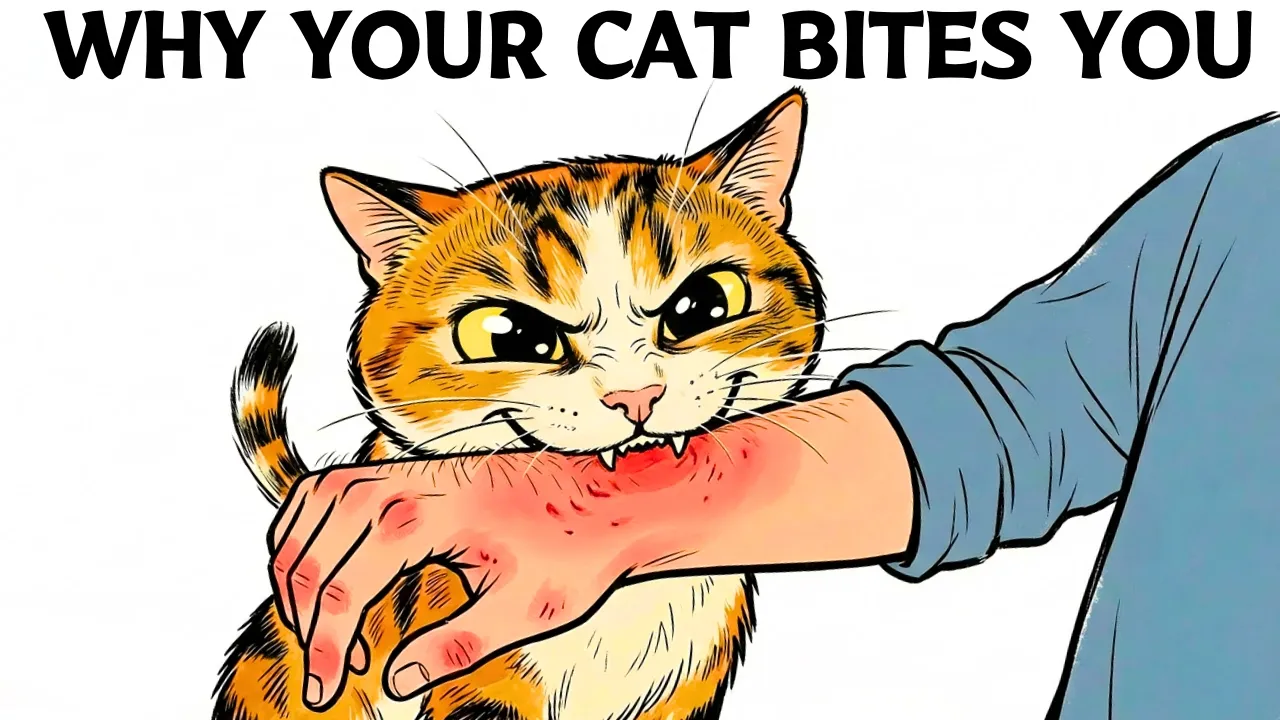
When your cat suddenly bites you, do you actually know what they're trying to say? Most people assume it means anger or aggression, but that is often the exact opposite of what is really happening. >> [music] >> In many cases, a sudden bite is your cat's way of reacting to something deeper.
And if you miss the reason behind it, you could make the problem much worse without realizing it. >> [music] >> Let's start with what that bite really means. One, when you pet them and they snap.
Have you ever been petting your cat? Everything seems perfect and out of nowhere they just turn and bite you. It feels personal.
Like one second they loved it, and the next second they punished you for it. But here's the thing, your [music] cat didn't snap. You just missed the moment they asked you to stop.
Cats have a sensory threshold for physical contact, and every cat's limit is different. What feels like a calm, relaxing session to you can slowly build into something overwhelming for them. Researchers at the University of Lincoln found that cats show clear signs of overstimulation well before they ever bite.
But most of those signs are so subtle that the average owner reads them as contentment. A tail that starts twitching [music] at the tip. Ears that flatten just slightly.
A body that tenses under your hand even though they haven't moved. These are not signs of a cat enjoying the moment. These are warnings.
And when those warnings get ignored, the bite is their last resort. >> [music] >> The fix is simpler than you think. Pay attention to the first 3 minutes.
If their body shifts even slightly, stop. Let them walk away. You'll actually build more trust by ending the session early than by pushing through it.
>> [music] >> And here's something that might surprise you. Not every bite means your cat wants space. There's one type of bite that means the exact opposite.
And when you find out what it really says about how your cat feels about you, it might just change the way you see every bite they've ever given you. I'll uncover that at the end. Two, they think your hand is a toy.
Why does your cat attack your hand like it's prey when you were just trying to play with them? You [music] wave your fingers, they pounce, you laugh, and then one day the bite actually hurts. But here's what nobody tells you.
You didn't just play with your cat, you trained them to hunt you. When cats are kittens, everything is a game. And if your hand is the thing that moves, wiggles, and reacts, their brain locks onto it as a target.
It's not aggression, it's learned behavior. A study published in the Journal of Veterinary Behavior found that cats who were regularly played with using hands instead of toys were significantly more likely to bite during non-play interactions as adults. You basically taught them that skin is fair game.
And the worst part is how most people respond. They pull their hand away fast, which to a cat looks exactly like fleeing prey. So the chase instinct kicks in even harder.
You're not correcting the behavior, you're making it more exciting for them. The shift is easy, but it has to be consistent. Stop using your hands entirely during play.
Use a wand toy, a feather, something that puts distance between your skin and their teeth. If they go for your hand anyway, freeze completely. Don't pull away, don't react.
A target that doesn't move stops being [music] interesting. Within a few weeks most cats completely rewire that impulse. And hey, if this is already changing the way you read your cat's behavior, hit like and subscribe.
It helps us reach more cat owners who want to actually understand what their cat is telling them. >> [music] >> Three, something in their body hurts. What if your cat bit you not because they were annoyed, but because they were in pain?
This is the one that breaks most owners' hearts once they finally realize it. Because by the time they figure it out, they've usually been scolding a cat that was trying to protect itself. Cats are masters at hiding discomfort.
It's not stubbornness, it's survival instinct. In the wild, showing pain makes you a target. So your cat [music] will eat normally, walk normally, and act normally until someone touches the spot that hurts.
And that's when the bite comes. Not because they're aggressive, because you just pressed on something they've been quietly dealing with alone. Arthritis, dental infections, urinary issues, even hidden injuries from a jump that landed wrong.
These are things that won't always show up in your cat's daily behavior. But the moment your hand finds that area, their reaction is immediate and sharp. A cat that has never bitten you in their life will bite without hesitation if the pain is bad enough.
Here's what to watch for. If the biting is new, if it only happens when you touch a specific area, or if your cat suddenly flinches in spots they used [music] to enjoy being scratched, don't assume it's attitude. Book a vet visit.
You might catch something early that would have gone unnoticed for months. Because sometimes a single bite is the only warning they'll ever give you. Four, they're scared and you don't see it.
Have you ever reached for your cat and they bit you so fast it didn't even feel like a decision? No warning, no build-up, just pure reaction. That wasn't aggression, that was [music] fear.
And the difference matters more than most people realize. A scared cat doesn't think, they react. Their brain flips into survival mode, and in that moment, you're not their owner.
You're a threat that needs to go away. It doesn't matter that you were just trying to pick them up or move them off the counter. What matters is what their body told them in that split second.
>> [music] >> And their body said danger. You'll usually see the signs right alongside the bite. A hunched back, >> [music] >> ears pinned flat, hissing, dilated eyes, sometimes even fur standing on end.
>> [music] >> These aren't signs of a mean cat. These are signs of a cat that feels cornered. And when a cat feels cornered, biting is the fastest way to create distance between them and whatever scared them.
Loud noises, sudden movements, unfamiliar people, even a new piece of furniture in the wrong spot can trigger this. A study in the Journal of Applied Animal Behavior Science found that cats in unpredictable environments showed significantly higher rates of fear-based biting, even toward owners they'd bonded with for years. The worst thing you can do in this moment is chase them, corner them, or try to comfort them by picking them up.
Give them an escape route. Let them hide. Once they feel safe again, they'll come back on their own terms.
Fear bites aren't personal. They're proof your cat is overwhelmed, not angry. [music] Five, it's actually a love bite in disguise.
Remember at the beginning when I said there's one type of bite that means the exact opposite of everything we've talked about? This is the one. And once you understand it, you'll never look at your cat the same way again.
Some bites aren't warnings. They're not pain, [music] they're not fear, they're not frustration, they're affection. Your cat is literally saying I love you with their teeth.
And if you've ever been sitting there, >> [music] >> your cat purring in your lap, gently nibbling on your finger, and you didn't know what to make of it, now you do. These are called love bites, and behaviorists believe they come from early kittenhood. When kittens groom each other, they use gentle nips as part of the bonding process.
It's how they show trust and closeness within their social group. So when your adult cat does it to you, they're not treating you like a human, they're treating you like family. You can tell a love bite apart from every other bite on this list by how it feels.
It's soft. There's no tension in their body. Their ears are relaxed.
Their eyes might even be half closed. They're not trying to escape or send a warning. They're settling in.
It's the most vulnerable version of your cat you'll ever see. The biggest mistake you can make with a love bite is overreacting. If you pull away, yelp, or scold them, you're rejecting the closest thing your cat knows to saying you're my person.
So next time it happens, just let it be. Stay still, keep your breathing calm, and know that in that quiet little moment, your cat chose you.