There is a feeling every ambitious person knows. You read something important, it clicks, but then days later when you have to remember it under pressure, you go completely blank. For those who are new here, as CEO, board member, investor, I get to spend time in boardrooms of billion-dollar companies, and I see this pattern everywhere, over and over again.
The people who keep pulling ahead are not the ones with the most information. They're the deep thinkers who can remember it, connect it, and use it better than everyone else. So, in this video, I want to show you how to learn fast and make it last in the AI era.
A four-step system that helps you educate yourself like a genius. So, let's get started. The most dangerous solution in learning is this perception of instant clarity.
I remember when I was working on Wall Street, I got on a call with one of the largest hedge fund clients, and I was [music] nervous. I had sent them a very dense spreadsheet with a model on what the future stock price could look like for a very large public company. [music] So, we were having a conversation about the model, and he suddenly asked me my opinion on a specific issue that was not about the model, and I remember going completely blank.
An entire minute passed, [music] and I just completely froze. And then he said on the phone, "Hello, what's going on? " And I panicked, and I just hung up.
Now, I had built the model, I had read all the data, I felt like I got it, but I hadn't mastered the story yet. I couldn't explain it to him. I had learned the musical notes, but I had not learned how to make music with them.
That experience has a name [music] in cognitive science, the fluency illusion, followed by retrieval failure. When answers come easily and instantly, your brain signals that you have learned. You haven't.
You've only recognized it. Recognizing and remembering are not cousins. They are completely different mental events.
And AI has made this even worse. An instant answer feels like instant clarity. A polished explanation feels like mastery, but it's just an illusion.
Borrowed fluency, no foundation. The smoother the experience, by the way, the more convincing the illusion. All the way back in the 1880s, Hermann Ebbinghaus ran memory experiments for years to understand why and how we forget.
And he saw that forgetting follows a brutal curve. Roughly 70% of what we learn disappears within 24 hours, tomorrow morning. But that doesn't mean your brain is broken, though.
[music] It's doing exactly what it's supposed to do, what it's designed to do. Discard what is not repeated, so you can survive. Forgetting is not a flaw, it's the default feature.
And that why you need a better framework, a system. I call it TRAP. Four moves that work with how memory is actually built.
Test it, retain it, associate it, perform it. T R A P, TRAP. A page full of notes is not yet music.
Notes are what you recognize. Music is what you play on your own. So, let's get to step one.
This is how you break the fluency illusion. The first move in our framework, TRAP, is T for test. [music] Robert Bjork at UCLA spent decades studying what creates durable memory.
His finding was deeply counterintuitive. When learning feels easy, very little durable memory is being built. Ease and retention often move in opposite directions.
I thought that was fascinating. Bjork called these >> [music] >> desirable difficulties. The harder your brain has to work to pull the idea out, the stronger the memory becomes afterward.
And a study published in Psychological Science tested [music] this directly. Two groups were given reading material. One group was tested on it, and the other was asked just to read it again.
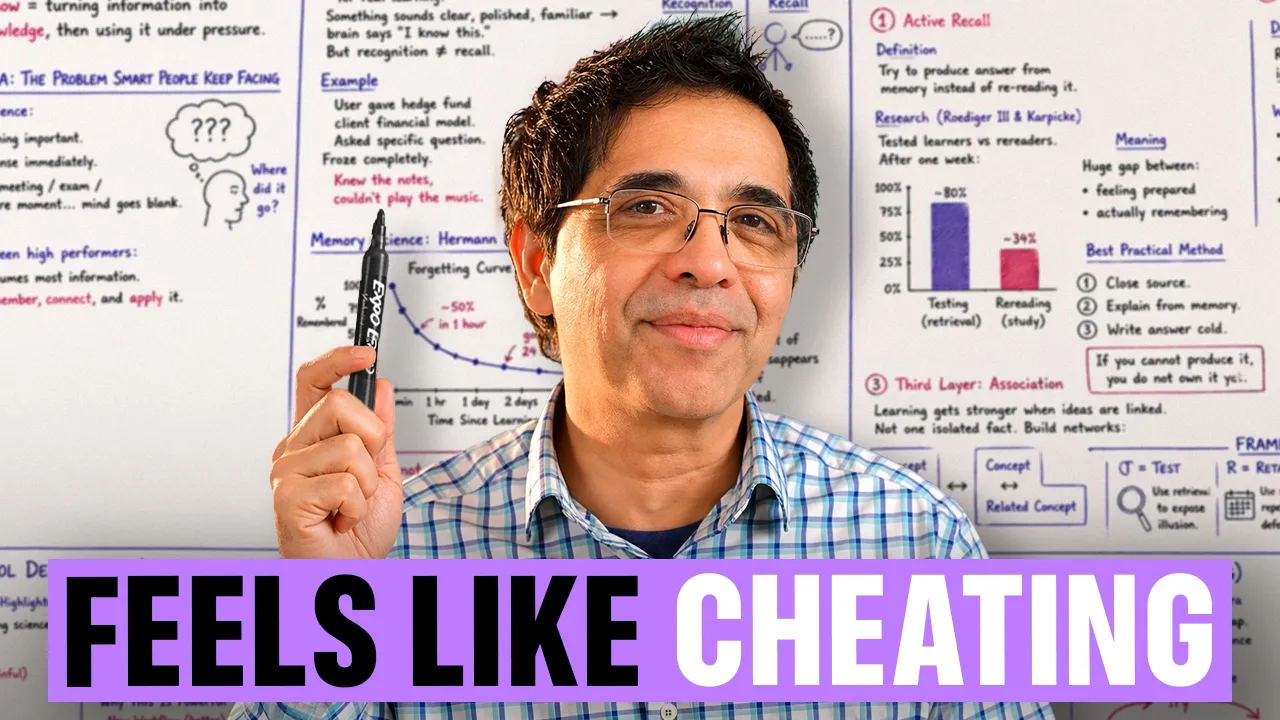
Same material, same time invested. One week later, the testing group retained 80% of it. The group that just read it again, 34%.
And that tells you that testing is not just about grades and scorecards. It is one of the most powerful learning mechanism we have. So, what's the action item here?
You don't need a complex process. [music] Just close the source, look away. Say it back cold.
Say it to the wall. I do it all the time. >> [music] >> If you can't, you don't own it yet.
If you can, it's yours. So, testing is not just how you check your memory, it's how you build it. And now, let's go to the second step.
Getting it right today means nothing if it's gone tomorrow. About a month ago, I got an email from Martin Schneider. He's an MIT grad and a founder CEO of a company called Remnote.
And he had spent years thinking about one deceptively hard problem. How to help people remember what they learn. Now, when we got on the Zoom call, we ended up geeking out about this one question.
Why do some people forget things so fast, even when they understood them yesterday? And he made one point that really stuck with me. The timing is the whole game.
Review too soon, and the brain does not have to work hard. So, nothing durable gets built. Wait too long, and you're rebuilding from rubble.
Almost nobody hits that window well just by instinct alone. This is why we cram before presentations and exams. It is the seductive trade-off, right?
Testing [music] tells you whether you understood it. Retaining decides whether it survived the test of time. So, when Martin showed me what his team had built, I wanted to share here for two reasons.
>> [music] >> First, this is an MIT startup focused on exactly the problem most of us never solve. Space repetition, active recall, AI-based learning. And second, I personally [music] became a fan of Martin and [clears throat] what his team was building.
And that's why this video is sponsored by Remnote. Let's say I want to learn something everyone deals with, sleep. Specifically, why sleep deprivation destroys [clears throat] your ability to think clearly.
So, I open Remnote and I start a note. I type the question, "What happens to the brain after 24 hours without [music] sleep? " Now, I hit the equal sign twice.
Either you can write the answer or the AI suggest the answer. The important thing is that now it's a flashcard. Making a flashcard this way helps you clarify that concept in your head.
Now, the real test. I close the source, I try to answer cold. Okay, I got this one wrong.
Remnote shows me exactly where the gap is and corrects it immediately. This is where I learn. Now, what if I want to go deeper?
I can upload a PDF and turn the whole thing into a cycle where I learn, test, learn, test. You can use AI to explain any line that you highlighted in the PDF. Or, you can make a card for you to remember it later.
The idea is to teach yourself a little bit and test yourself on it. And you can grade yourself. The system tracks exactly which topics I have mastered and which one still need work.
In the background, [music] Remnote is tracking this activity to decide when I should see this card again. This is very cool. The tool automatically schedules when you need to do your next practice on the specific card or concept.
You don't have to remember to remember. The timing [music] is handled by the tool. This is how you fight that forgetting curve.
>> [music] >> And now, what if I wanted to connect this to something I already know? I remember I had already made a flashcard on a concept called cortisol. [music] So, I type the at sign and search for cortisol.
One keystroke and this [music] card is now wired to another note I have on stress response. It's not a lone fact anymore. It's part of a web.
This is what Martin and his team built. What I like about this is that this tool and AI help you do the hard work of getting things into [music] your brain in a way that you understand them deeply. And it speeds your journey to mastery.
The base app is free. There's a link below that you can use to try the pro version free for a month and see if you [music] like it. Now, are there other tools for learning fast and making it last?
Sure. My team uses Notion to [music] store insights. They swear on it.
I use Notebook LM to go deep. RemNote is where you go to actually remember them. The moment you learn something worth retaining, schedule [music] when you're going to come back to it.
That's the best way to make sure you keep it. Memory is not a filing cabinet. It's a web.
Research [music] published in Science shows that new learning becomes far more durable when it's connected to what you already know. Every connection you build is one more road back to that concept. And that's why when two people study the same material, one sounds very fluid and the other one freezes because one built a connected web.
The other one built an isolated list of facts. This is one of the most trickiest challenges [music] that I see in our productivity culture today. So many of us spend more time designing and organizing our digital system, pages, folders, views, tags, databases, and so little time actually connecting ideas in our head.
But a graveyard of ideas is still a graveyard. And this is why smart people still get exposed in meetings. Because if you cannot make these connections between insights in private, you cannot retrieve them in public.
[music] Because when you're under pressure, you haven't built any path back to those insights. So every time you learn something worth keeping, ask one question. What does this remind me of?
For instance, I once struggled with the idea of opportunity cost. So I connected it to a dinner menu. Every time I order a dish, I'm deciding not to eat everything else.
Well, that's opportunity cost. After that, it never left. Chess grandmasters know this.
Cognitive studies estimate they internalize between 50,000 and 100,000 board patterns. [music] Now, they're not memorizing isolated positions. Instead, they're compressing thousands of experiences into [music] connected patterns.
Now, they can draw from them instantly. So what's the action item? Every time you learn something worth keeping, ask one question.
What does this connect to that I already know? >> [music] >> One link, one analogy, one related concept, that is how isolated facts become a usable network. The power is not in storage, it's in the linkage.
What wires together is what fires together under pressure. In our AI era, this distinction will matter the most. There is a principle at MIT that shaped how I think about this.
Every January, MIT pauses all formal classes for a month. It's called the IAP or independent activities period. >> [music] >> There's only one rule.
Build something real. You can partner with any student from any department across the [music] campus and build whatever you want as long as it's related to what you've learned. And most of us feel like we don't know enough to build anything, but we all end up building something by the end of that month.
In today's age with AI, fluency and intelligence are flowing free now. What is not free is the human experience, the judgment that comes from having built something, trying, failing, rebuilding. This is why this fourth move is so critical.
You know, when I was in my 20s, I felt completely unformed. [music] I could not focus. I could not learn.
I failed every test that I took. >> [music] >> I could not retain what I learned. I did not know how to build a mind that could actually hold on to things.
>> [music] >> And building that capacity took a long time, painfully long if you ask [music] me. It hurt me in school. It hurt me in my career.
Nine failures for every single success. >> [music] >> Now, sure, in the end it all worked out fabulously, but I can tell you this much. The mind does get built over time because our mind is not fixed as a photograph.
It's a sculpture. >> [music] >> You can shape it, strengthen it one breath at a time. In the year 1500, there was a single [music] rejected block of marble.
It was sitting there, abandoned, ignored by all sculptors because it was defective and worthless. No one paid any attention. But a 26-year-old artist saw something different.
He had no power tools, no technology. The artist [music] spent 3 years on that piece of rock and build a 17-ft statue that is still considered one of the greatest masterpieces carved by human hands. >> [music] >> Michelangelo's David.
Information on its own is like that block of marble with no sculptor, but it's up to you to [music] carve it into anything you want. The value is never in the stone. It's in the hands that choose to shape [music] it.
Also, we live in a world with so many awesome tools around us, so use them. You can get a free month of RemNote Pro. By the way, RemNote team created a quick 1-minute test on TRAP, [music] which is the framework we covered.
You can go to remnote. com/trap >> [music] >> and apply the method we learned in this video. And if you pass the test, you'll get two free months of RemNote Pro, and it'll help you remember the lessons for the rest of your life.
There is an exclusive link below for that as well. I will see you next week. Thank you.
And I love you.