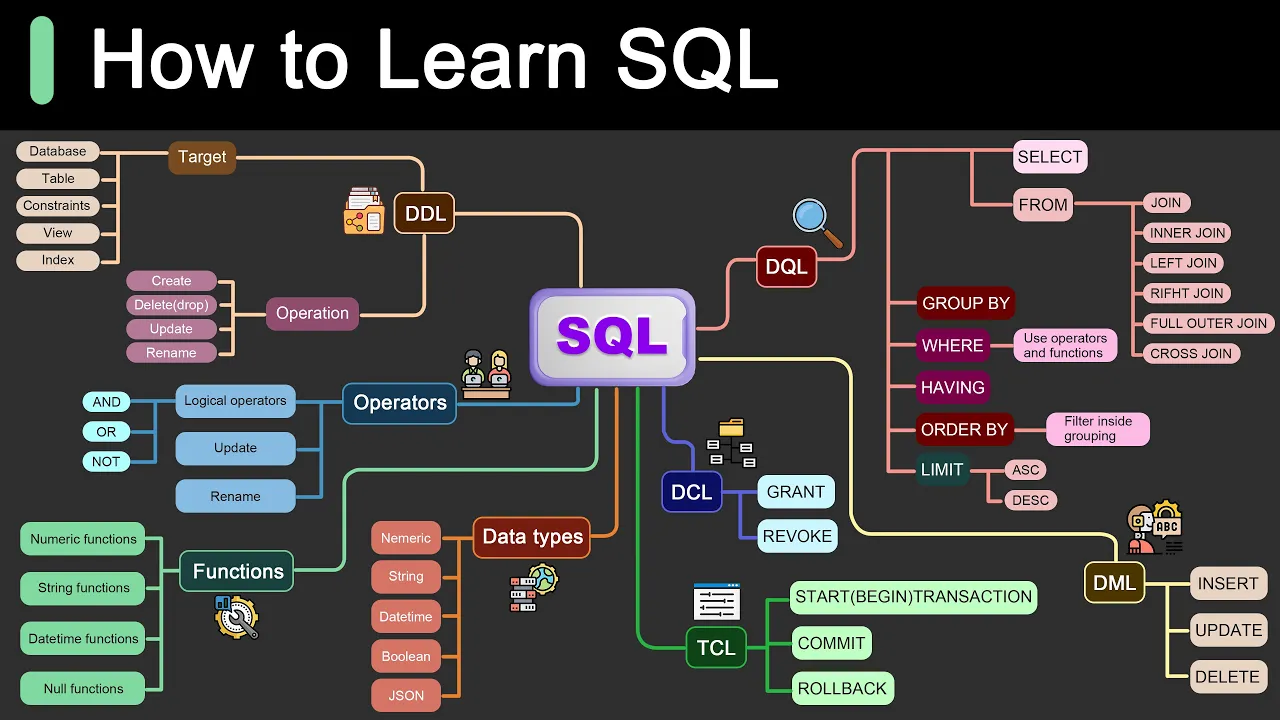
SQL, or Structured Query Language, is the standard language for interacting with relational databases. Its versatility makes it an essential tool across industries. For example, an e-commerce company might use SQL to analyze sales data, identify trends, and make data-driven decisions to optimize its business strategy.
Popular relational database management systems that use SQL include MySQL, PostgreSQL, Oracle, and SQL Server. In this video, we'll explore the key concepts and techniques you need to know to work effectively with SQL. At the core of SQL are databases, which store and organize data.
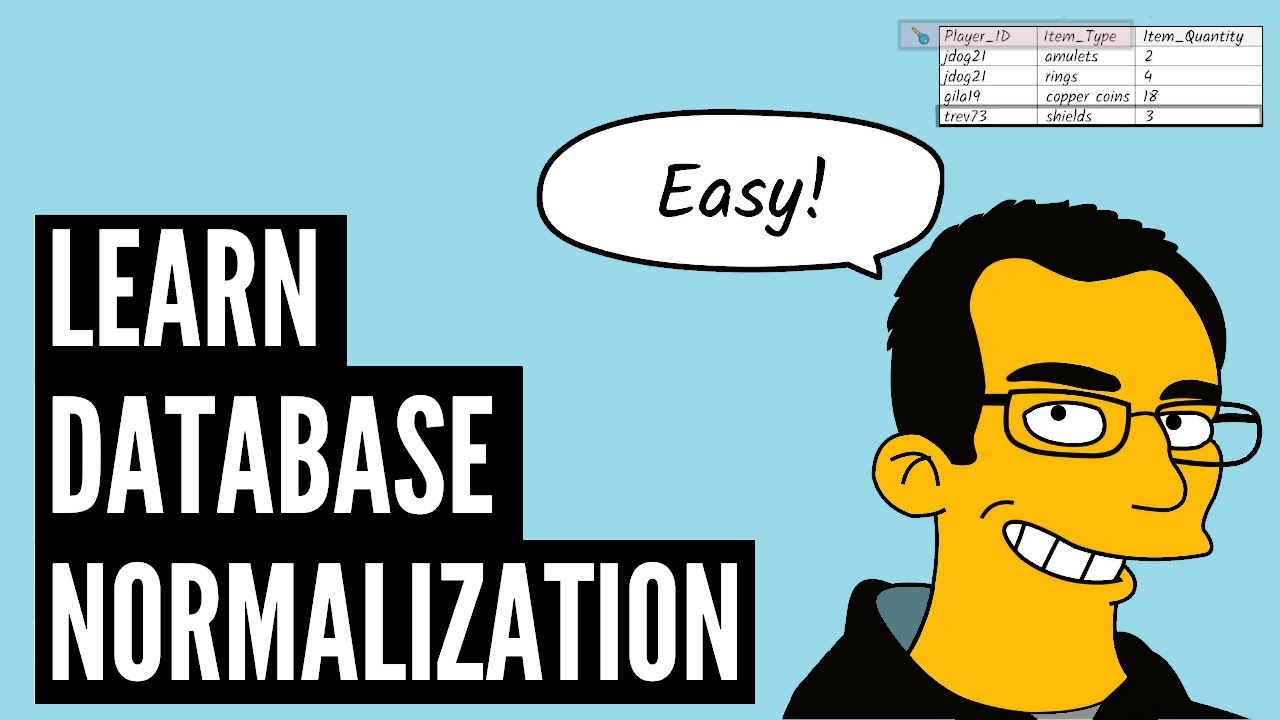
Within a database, data is structured into tables, with columns defining data fields and rows representing individual records. Effective database design involves normalization, a process of organizing data to minimize redundancy and dependency. To maintain data integrity, tables utilize constraints.
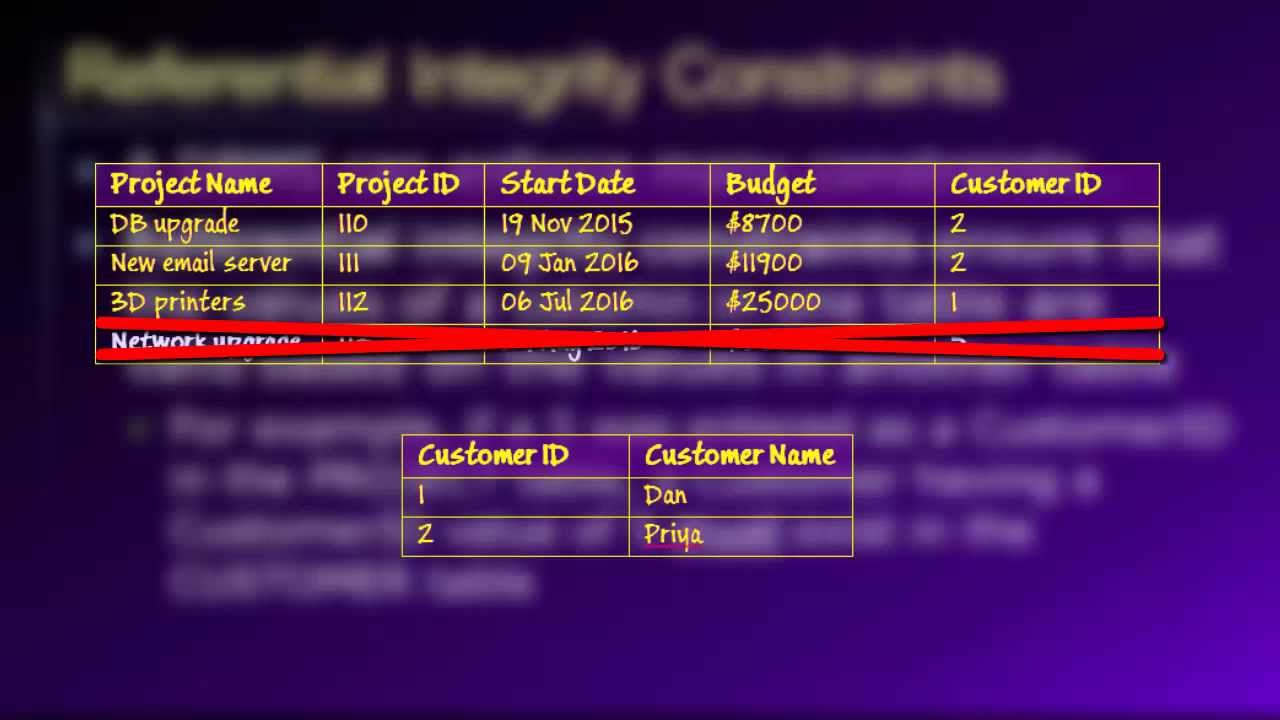
Primary keys uniquely identify each row, while foreign keys establish relationships between tables. For instance, a "products" table might have a primary key, "product_id," and an "orders" table could use "product_id" as a foreign key to link each order to a specific product. Other constraints include UNIQUE, which ensures no duplicate values; CHECK, which enforces conditions on data; and DEFAULT, which specifies a default value for a column.
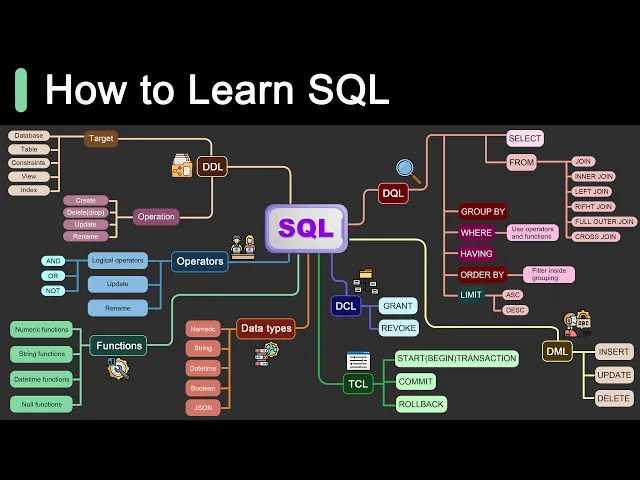
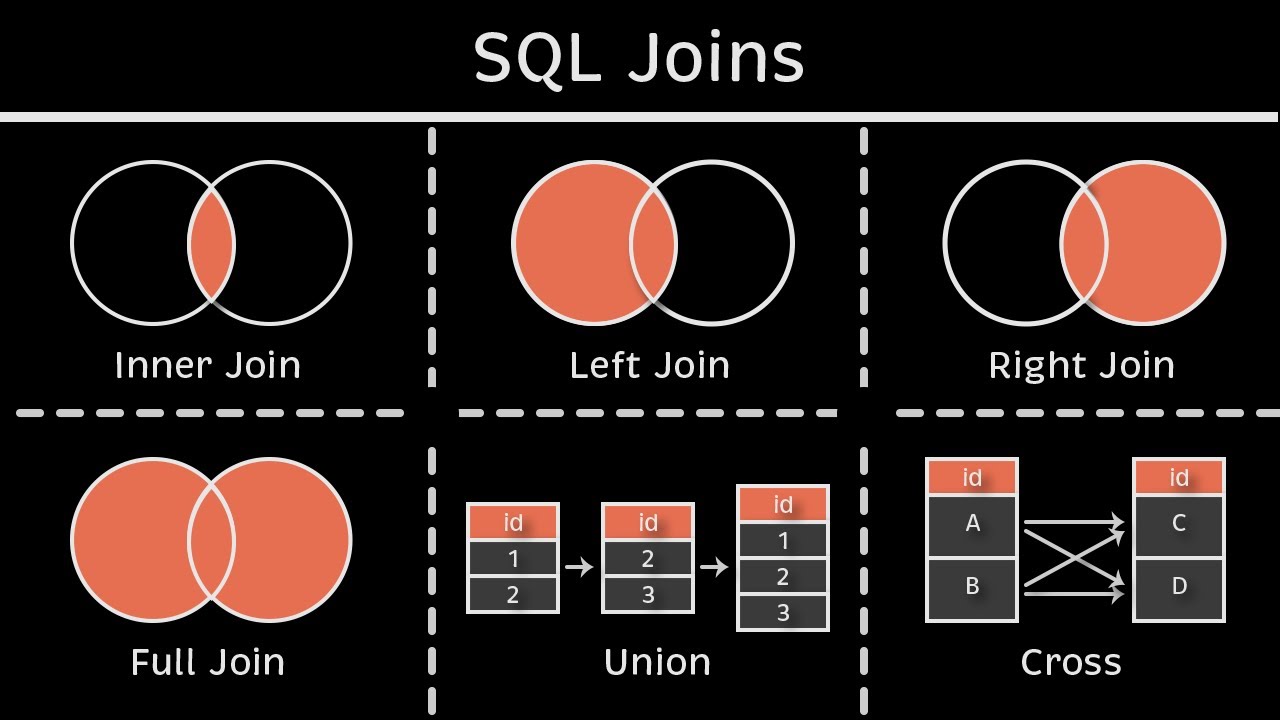
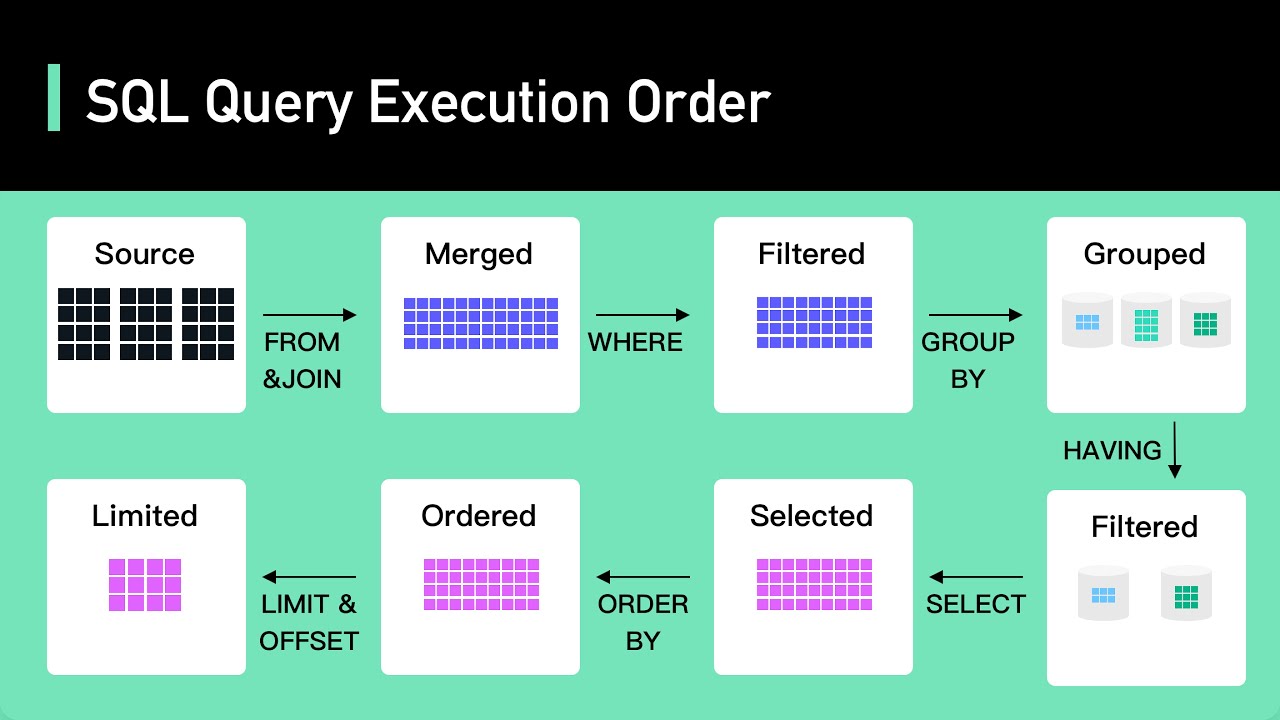
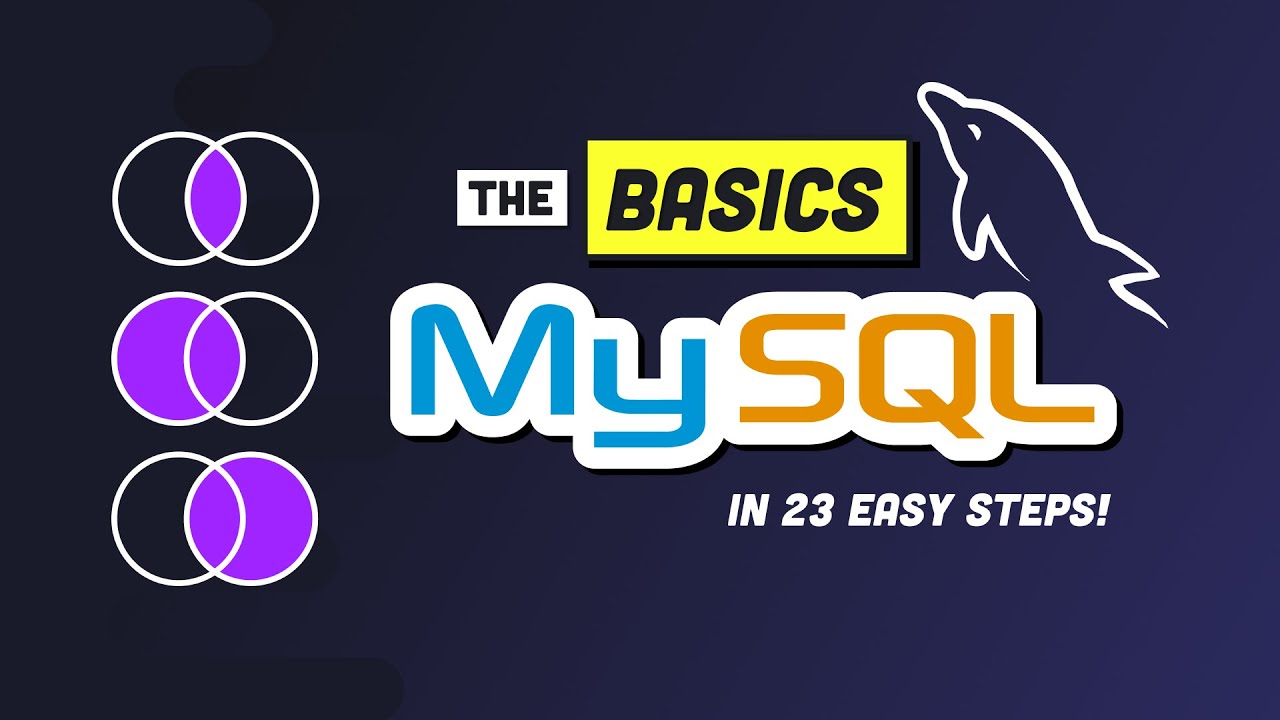
SQL provides a range of operations to interact with data. The SELECT statement retrieves data from one or more tables, allowing filtering, sorting, and joining. JOIN operations combine data from related tables, with different types like INNER JOIN, LEFT JOIN, RIGHT JOIN, and FULL OUTER JOIN.
For example, an INNER JOIN on the "customers" and "orders" tables would return all customers with their associated orders, excluding customers without orders and orders without a customer. To manipulate data, we use INSERT to add new records, UPDATE to modify existing data and DELETE to remove records. These operations can be combined with subqueries, which are nested queries within another SQL statement.
For instance, you could use a subquery in an UPDATE statement to change values based on conditions from another table. SQL supports various operators and functions for filtering and transforming data. Logical operators (AND, OR, NOT) allow compound filter conditions, while numeric operators handle arithmetic operations.
String operators enable pattern matching and concatenation. Functions offer powerful data analysis and manipulation capabilities. Numeric functions perform calculations like SUM, AVG, and ROUND.
String functions manipulate text, such as CONCAT for combining strings or SUBSTRING for extracting characters. Date and time functions handle operations on temporal data, like GETDATE for the current date/time or DATEADD for modifying dates. Aggregate functions (COUNT, MIN, MAX, etc.
) summarize data across multiple rows. T hey are often used with GROUP BY and HAVING clauses for advanced analysis. For example, you could use COUNT and GROUP BY to get the number of orders per customer and HAVING to filter only customers with more than 10 orders.
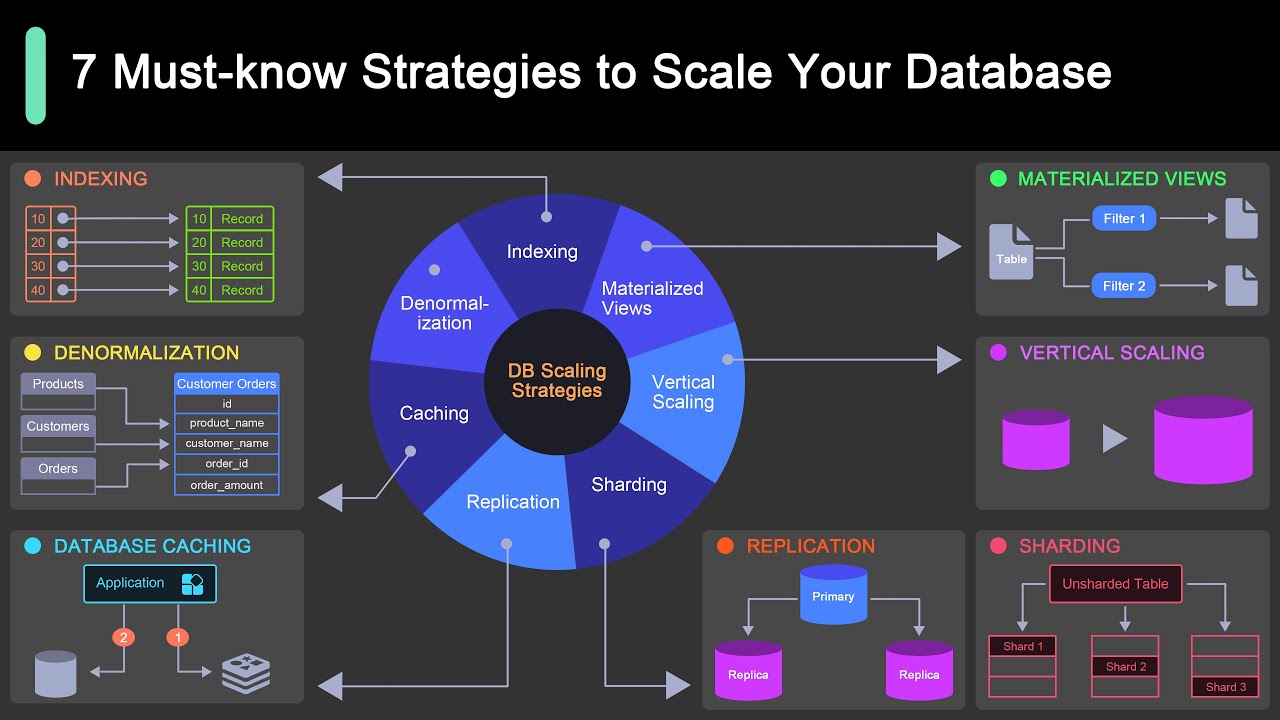
When creating tables, columns are defined with specific data types to optimize storage and performance. Key types include numeric (INT, DECIMAL), string (VARCHAR, TEXT), date/time (DATE, TIMESTAMP), and boolean (BIT). Indexes are crucial for optimizing query performance, especially on large tables.
Indexes allow faster queries by creating a searchable structure, similar to an index in a book. However, they also introduce overhead for insert, update, and delete operations. Beyond data manipulation (DML), SQL includes sub-languages for other tasks.
The data definition language (DDL) handles table structure with statements like CREATE TABLE and ALTER TABLE. The data control language (DCL) manages access permissions using GRANT and REVOKE. The transaction control language (TCL) handles transaction management with COMMIT, ROLLBACK, and SAVEPOINT, ensuring data integrity through ACID properties.
SQL is a powerful language for working with relational databases. The best way to learn is through hands-on practice with real-world datasets. Explore SQL tutorials and online practice platforms, and experiment with sample databases.
As you advance, dive into topics like query optimization, database normalization, and transaction management. With SQL in your toolkit, you'll be equipped to tackle complex data challenges and drive data-informed decision-making in your projects. If you like our videos, you might like our system design newsletter as well.
It covers topics and trends in large-scale system design. Trusted by 500,000 readers. Subscribe at blog.
bytebytego. com.