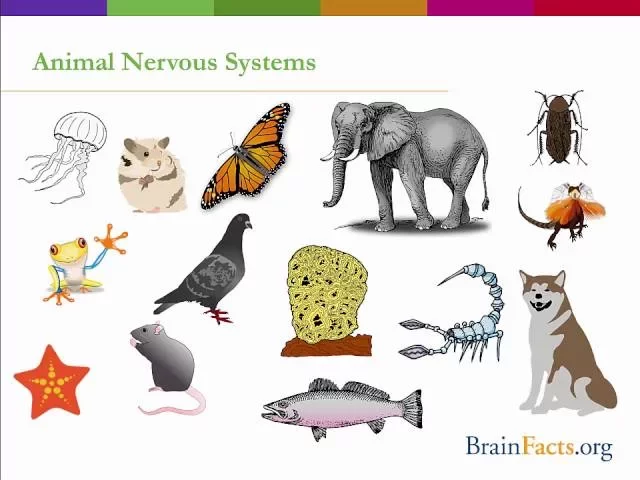
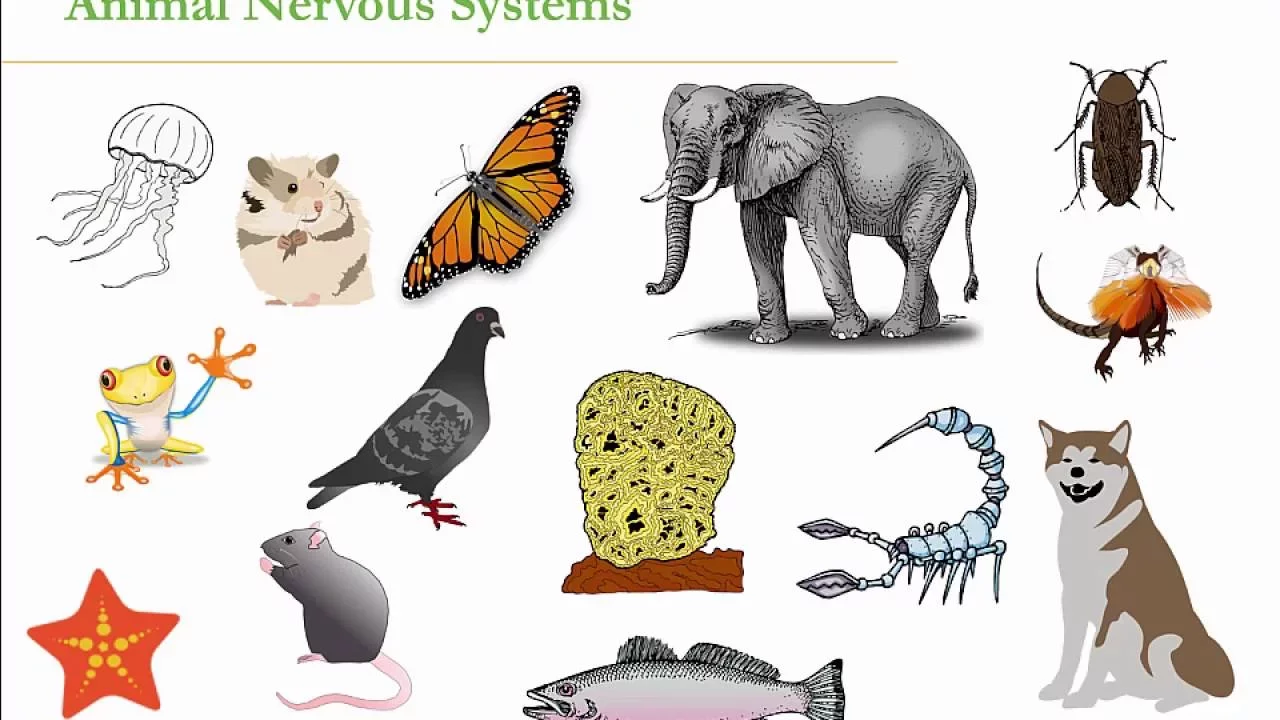
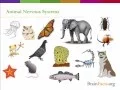
hello and welcome to brainfacts.org into the animal brain portion of the brain Awareness Week online webinar the full webinar was part of brain Awareness Week an International Event to celebrate Neuroscience in the brain check out the other portions of the presentation to learn about human brain anatomy and function and to try some fun Neuroscience activities at home I am Nick Hobbs a postdoctoral research associate in the Neuroscience program at Michigan State University first a little test look at this picture can you determine which of these pictures doesn't belong if you guessed the sea sponge you'd
be correct but now the tough question why is the sponge the odd man out here contrary to what many people think the sponge is not a plant it's an invertebrate animal but it is the only animal that does not have a nervous system the sponge can sense and react to changes in its environment but it does so without the use of neurons all other Critters in the animal kingdom possess some form of nervous tissue whether a nerve net or a highly complex brain the nervous system provides a means for an animal to interact with its
environment whether it is finding food attracting mates or avoiding predators let's take a brief Journey Through the diversity of the nervous system the following is a simplified phylogenetic tree showing the relationship among several major animal groups and should not be considered complete also note that this tree takes into account the whole organism not only the nervous systems which is where we are going to focus as mentioned sponges are the only species in the animal kingdom that do not have some sort of nervous tissue this red line then is going to indicate the development of a
nervous system next let's examine the way the nervous system is organized in some invertebrate species first we have the cnidarians which includes jellyfish these animals have a simple nerve net which is structured exactly as it sounds neurons are distributed around the body in a net-like fashion and are responsible for both sensation and motor function which is unlike higher level systems that have neurons dedicated specifically to sensory input and others dedicated specifically to motor output another group of invertebrates is the nematodes or roundworms which include sea elegans an organism whose entire connectome the neurons and all
their connections has been determined there are 302 neurons and about 7 000 Connections in the C elegans nervous system neurons have been divided by action sensory motor or interneuron and scientists are continuing to examine neural circuits associated with specific behaviors system of a microscopic worm may seem strange but learning more about basic circuits and connections can give insights into mechanisms used by our much more complex human brain which can improve our understanding of neuronal processes and improve research techniques which can then lead to the discovery of Novel therapies for neurological diseases while it may seem
relatively simple the nervous system of the starfish is surprisingly complex consisting of a central nerve ring and Radial nerves branching onto each of the arms even without having any well-defined sensory organs starfish are sensitive to touch light temperature orientation and chemicals allowing the starfish to detect odor sources the presence of the central nerve ring allows for more complex behaviors than a neural net throughout the body we've looked at some nervous system organization in invertebrates now let's examine diversity within vertebrates this red line indicates the development of a spinal cord and vertebrae vertebrates include animals from
the Lamprey or jawless fish all the way up to mammals as you can see here the overall structure of the vertebrate brain is highly conserved unlike the invertebrates which had drastic differences in organization these models show structural similarities and differences among the different species at the bottom of the brain is the medulla which regulates numerous autonomic functions such as breathing and heart rate and as such is highly conserved pink region is the cerebellum which as we saw with humans plays an important role in motor control and balance the midbrain depicted in blue is associated with
vision hearing and and some motor functions and non-mammalian species the midbrain is the dominant region for visual processing in mammals there remains an evolutionarily old visual system in the midbrain but primary control of visual processing is located in the occipital lobe in the cerebrum the midbrain is also the region that contains the dopamine neurons that degrade in Parkinson's disease in humans each species has a cerebrum and areas like the hypothalamus and Thalamus which are shown in yellow although the general overall structure remains conserved with invertebrates it is pretty easy to see that there are significant
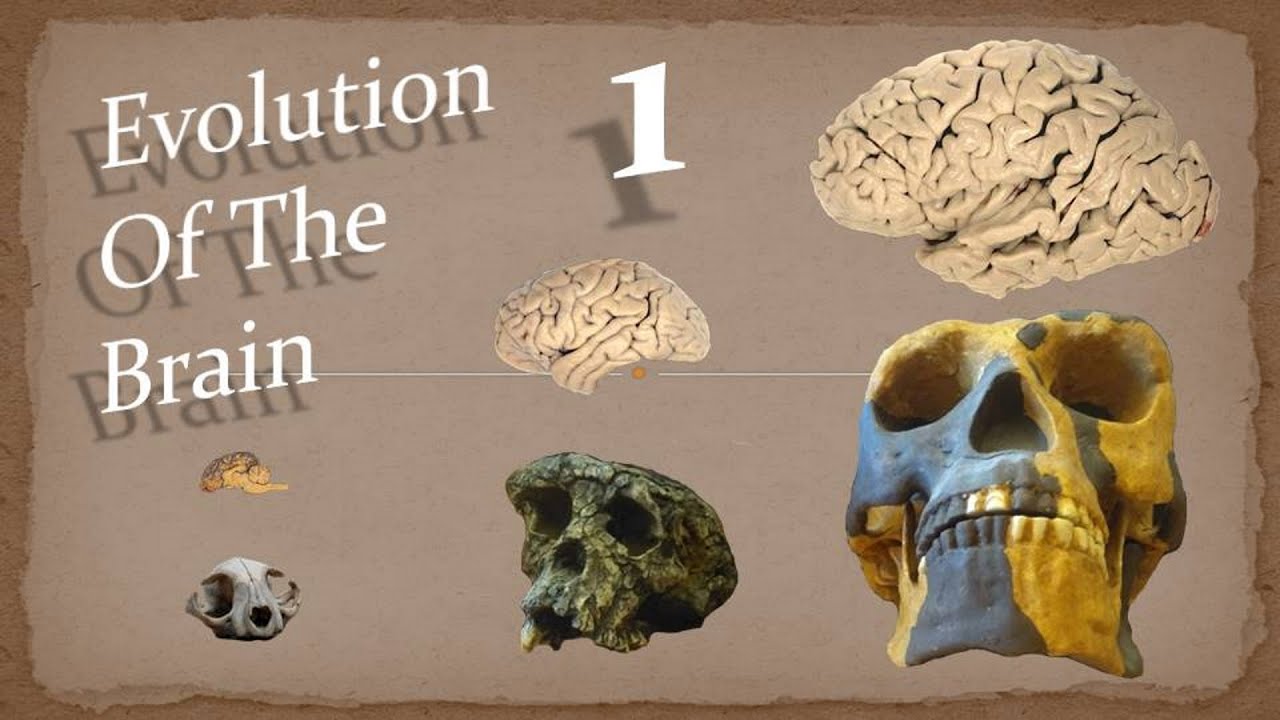
differences between the brains as well one of the most obvious differences is that of brain shape take for example the alligator compared to the pigeon you can see the olfactory bulbs in the alligator brain are located quite a distance from the rest of the cerebrum the olfactory bulbs are able to project out because of the skull shape of the alligator with its long snout the pigeon on the other hand has a very compact brain similar to the small round head of the bird scientists use endocast a mold of the inside of the skull to study
the brain of extinct animals like the dinosaurs and human ancestors skull shape can give us insights about brain structure another shape difference can be seen by comparing primates to rodents and is the orientation of the cerebellum and spinal cord in relation to the cerebrum in rodents the cerebellum is behind the cerebrum whereas in primates it has shifted to be more underneath the cerebrum this shows how the brain has adapted to bipedal movement in primates looking at specific brain regions we continue to see species differences on the left is the Lamprey larva and on the right
a Pidgin notice the Striking differences in the pink region which is the cerebellum so why would these two animals have such different structures let's recall that the cerebellum is important for motor coordination and balance a lamprey larva is a filter feeder living burrowed in the river floor as such they do not require much motor activity to survive pigeons are a completely different story flying is a complex motor skill requiring a great deal of coordination across many muscles therefore this species has developed a cerebellum that takes up a large portion of overall brain size as this
example shows brain structure is linked to brain function continuing with that concept we can see the size of the olfactory bulb differs greatly between species as well here we compare a rodent and a primate both mammals but quite different in behavior and as we see structure the gray squirrel on the left has a larger olfactory bulb which is used for processing odors and pheromones chemical signals used by animals to communicate the squirrel monkey on the other hand has a very small olfactory bulb primates including humans use a combination of visual and auditory stimuli to find
food in maids and avoid Predators whereas rodents like the squirrel rely heavily on olfactory signaling as such primates have a much smaller olfactory bulb but a more developed occipital and temporal lobe but as we see olfactory bulb size also varies between mammals many people wonder if there's a specific brain characteristic that is correlated with intelligence the first possibility would be brain size but if that were the case humans would be less intelligent than Elephants or whales this isn't the case but when brain size is compared relative to body size humans come out on top until
you add in a primate like the marmoset so what characteristic is most closely related to intelligence cerebral cortex cell number seems to be a contender so how is it that humans can fit three times as many neurons in the cerebral cortex compared to elephants in a brain that is a quarter of the volume the answer is cortex folding as animals increase the neuron number and therefore volume of their cerebrum they are limited by the size of their skulls as such selection has favored the folding of the cerebrum to increase surface area giving more space to
the outer regions of the cortex where the neuron cell bodies lie as we see here the dog has a much higher level of cerebral folding compared to the rabbit we can see a similar trend for two aquatic mammals the manatee and the dolphin and both comparisons the animals with the higher degree of cerebral folding are associated with a greater level of intelligence thank you for watching the animal brains portion of our brain Awareness Week online webinar