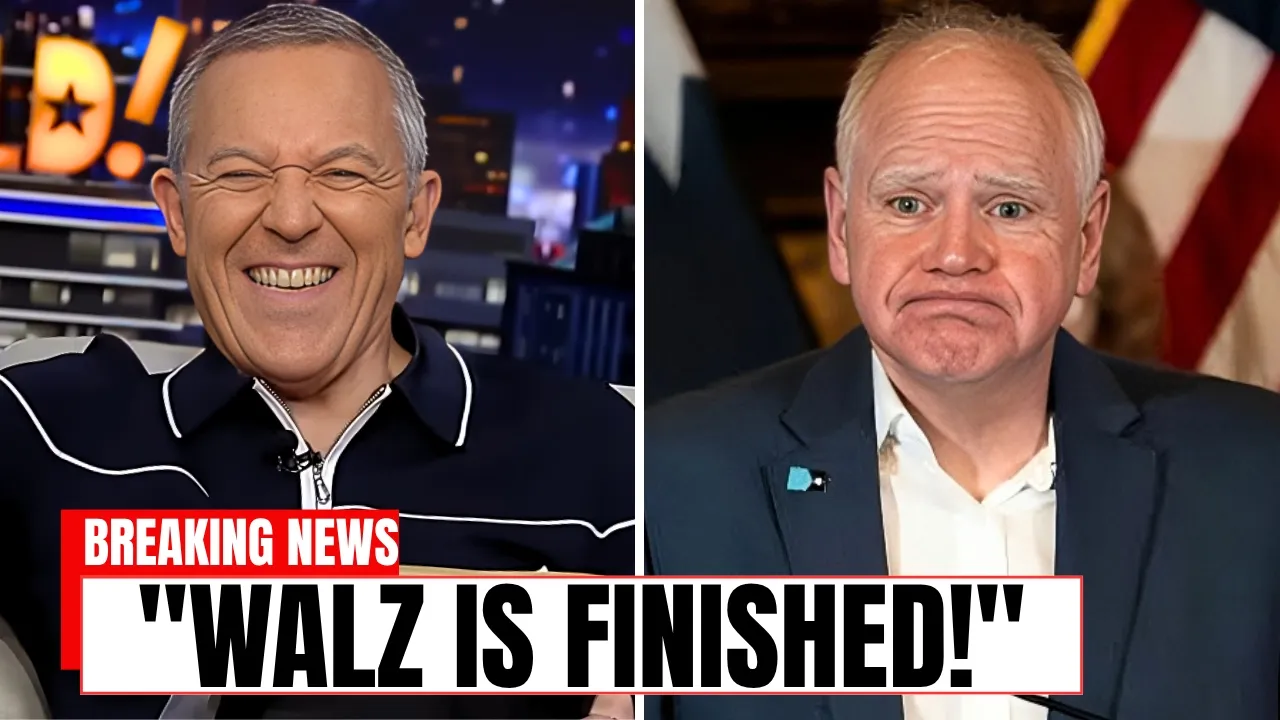
Meanwhile, Comma's VP, Tim Waltz, is being accused of lying about his rank, which is called stolen valor. But in Waltz's defense, in Minneapolis, stealing is legal. But misrepresenting your past for political gain, I don't see that as a problem, said one woman.
He looks like the founder of a law firm specializing in personal injury. He looks like the guy at church who remarries one month after his wife mysteriously passes away. What happens when Greg Gutfeld takes aim at Tim Walls and decides subtlety is no longer an option?
You get a political roast focused on Walls's record, his public image, Minnesota controversies and the growing questions surrounding his leadership. But just when viewers thought Gutfeld had taken the joke as far as it could go, he found an even sharper angle. But that stupid racist claim was enough to turn clowns like Walts into cowards.
And talk about bad timing. Waltz was in charge as his state imported people from low trust societies where no shared values exist. I mean, why would Muslims, which most of these Somali are, move to a country where strip clubs outnumber mosques, and where the average temperature of their home country is 88 December but minus 17 in Minneapolis.
There's nothing here for them except American taxpayer dollars. Greg Gutfeld has a knack for turning political arguments into something that feels less like a serious policy debate and more like watching your funniest friend stumble across a politician's most embarrassing photo. Tim Wolves has found himself on the receiving end of that treatment more than once.
And when Gutfeld makes walls the punchline, he usually doesn't need to raise his voice. He just spots the contradiction, adds a little sarcasm, and lets the audience take it from there. I speak of former VP nominee Tim Waltz.
He joined Bato or at a Texas town hall last night, and the estrogen levels were enough to give Chuck Norris menstrual cramps. I wonder is our strength, our diversity? That's what makes this matchup so entertaining.
Walls can step into the conversation expecting a serious political debate only to realize Gutfeld has basically brought an entire comedy writer room with him. Do you mind if you clear something up for me cuz I'm a little confused? Yes.
So this guy got credit for not raping more kids. Yes. But he was in prison.
Yeah. He was in prison for like 12 years maybe. But he got out early.
He even didn't even serve that amount of time. He served like a couple years. That's insane.
It is. That Yeah. Again, I agree with you, Kennedy.
I think this is far more than even a 9010ish. And I just feel like Tim Waltz was using these idioms. Yeah.
Where like it's just totally implied that you're not talking. And that's where the trouble starts for Walls. Gutfeld doesn't usually attack him by acting like every political disagreement is some massive scandal.
Instead, he takes what Walls says, the image he presents, and the political persona he has built, then twists it just enough to make the whole package feel awkward and pretty hilarious. He joined the state's board of pardons in granting one to two Lu Vang and illegal. Of course, in the glowing coverage of Waltz's compassion, the press ignored that between that seems like a key fact to leave out, right?
I mean, that's the only thing you need to know about Bang, other than how long he bleeds out after you cut his balls off. But after the Trump White House caught wind of this, they deported him, which Waltz then criticized. I mean, did that really make us any s?
It's basically political standup with the research department, which is a dangerous combination when the target already provides plenty of material. Gutfeld has mocked Walls over everything from his political rhetoric to controversies in Minnesota, including issues critics say reflect poorly on his leadership. He's even joked about Walls's anger by comparing it to the cancellation of Gilmore Girls.
That line says a lot about Gutfeld's style. A serious political argument suddenly feels like a late night comedy routine with the governor unknowingly becoming the main character. And Walls gives comedians plenty to work with.
the folksy Midwestern image, former teacher persona, progressive politics, and growing national profile. Once a politician becomes nationally recognizable, everything can become material. The speeches, the slogans, the expressions, and even the attempt to sound completely ordinary.
[applause] Politico lingers on candidates fingers and defend Waltz's wide eyes as they claim beards are for bad guys. Tyler, speaking of beards, and I mean the one on your face, not the one that you hate. Hacket Politico writes this piece on the body language from the debate claiming that it speaks volumes.
Yeah, it says that Waltz lost, but they they one of them at Politico says is like Waltz's wide eyes showed his passion and emotional and Gutfeld understands that better than most. He doesn't need a 10-minute lecture on policy. His style is simple.
Take something serious, find the ridiculous angle, and let the audience see it. That's why his Walls jokes can hit so well. Take the word weird, which became a common part of Walls's attacks on political opponents.
Gutfeld has flipped that label around, turning it back into the joke. And that's one of the oldest rules of political comedy. If you call someone weird, you've just handed a comedian plenty of material.
Walls isn't the only politician Gutfeld has targeted, but his public persona gives Gutfeld several different angles to work with, and that makes him an especially useful comedy target. Oh. Uh, wait.
You lost cuz you weren't woke enough. That's like telling Joy Behar he's not eating enough Doritos. That's like Jasmine Crockett saying, "I got to black this up.
" That's like Bud Light saying, "Hey, you know what? We could use more Dylan Mulvaney. " [laughter] But even Kla's not that clueless and that's saying something.
Waltz also seemed to doubt the validity of the last election and future ones. They've released analyses of election data out of Clark County, Nevada. There's the wholesome Midwestern image.
the progressive politician, the outspoken Trump critic, and the governor who has faced questions about his record. That gives Gutfeld plenty of angles so he never has to repeat the same joke. That's where the comedy really works.
Politicians can spend years building an image of being relatable, tough, or in touch with ordinary Americans only for a comedian to find one contradiction and start pulling at the loose thread. Gutfeld does exactly that with Walls. Whenever Walls gets caught up in another political controversy, Gutfeld can turn a serious discussion about leadership and accountability into something that feels more like a political blooper reel.
That make us any safer? Did that make the children that are left behind any more stable? We can't all be judged by our worst day.
And I want to be very clear, these are horrific crimes. They they often are. By just picking them up and taking them out with no due process, it just seems unfair.
First, Tim, the answers to all those questions is a resounding yes, which is more proof Kla picked you because you're the only person dumber than she is. Waltz is Waltz is too stupid to know. Questions aren't rhetorical.
That's important because Gutfeld's strongest jokes usually start with something real, a statement, controversy, policy dispute, or political contradiction. He takes something audiences already recognize and twists it into satire. Fox has featured Gutfeld and his panel criticizing walls over Minnesota controversies, including questions about government oversight and alleged fraud.
Gutfeld uses those issues to question leadership while turning the whole situation into comedy. And that's where his style really works. Something goes wrong, the cameras arrive, officials start explaining, and somehow responsibility seems to disappear.
For a comedian, that's almost too easy to resist. Waltz still a giant turd. You got to look back about being on the debate stage with him and thinking, man, you really maybe gave this person a little too much of the benefit of the doubt.
Uh, and we're we're a little bit, you know, the the part the assuming good faith was maybe a mistake with JD Vance. Look, I'll own it. But Tim, you've been around this long enough know when you're on a ticket, you take your orders.
Look, I have agency on that. Meaning, I could have in this, but I am a good team player out of him now if I could. And I would call that out.
I mean, that's just different in verbal. Guteld can take that familiar political pattern and turn it into comedy because audiences have seen it before. Politicians often get creative when explaining why a problem somehow isn't a responsibility.
That's why his treatment of walls feels less like traditional political commentary and more like a running comedy routine. He isn't just trying to win an argument, he's making the argument itself look absurd. Facts and policies can be debated all day.
But once the audience starts laughing at how a politician communicates, the battle changes. Now the politician isn't just defending a position. He's trying to defeat a punchline.
And that's a much harder fight. That humans would widen their eyes to convey that danger is close. What emotion are you getting from that?
Sorry. [laughter] That was every [laughter] [applause] [cheering] [applause] first of all, Tim Waltz very much looked burdened by what has not been [laughter] and what will never be. It he had that face like a cop pulled him over and he just realized he had That's where Gutfeld understands the power of satire.
His show mixes politics, comedy, and pop culture, giving him room to approach political figures from unexpected angles. A serious statement about walls can suddenly turn into a joke about television, celebrities, or some completely random comparison. That unpredictability is part of the appeal.
You know the setup, but you never know where the punchline is going. And underneath the sarcasm is a simple strategy. Sometimes audiences don't need another person explaining what they already believe.
They just want someone to spot the ridiculous part of a political situation and make them laugh. Captain Jazz Hands drops out. Jamie, as the Somali fraud scandal grows in his state, the Minnesota governor announced today he will not run for a third term.
Pause for this s. I can't give a political campaign my all. Every minute that I spend defending my own political interest would be a minute I can't spend defending the people of Minnesota against the criminals who pray on our generosity and the cynics who want to pray on our differences.
So, I've decided to step out of this race. I did not run for this job. That's where gutfeld sarcasm becomes especially effective.
Instead of simply saying Walls's image feels carefully crafted, he can exaggerate it into a joke about a politician assembled from spare parts of a Midwestern lifestyle commercial. He can take a political statement, push the contradiction further, and let the absurdity make the point. And once the joke sticks, audiences may forget the exact words, but remember the image and the punchline.
That's the gutfeld effect. He doesn't just comment on political moments. He turns them into jokes people remember.
And Walls gives him plenty to work with. He's nationally recognizable, outspoken, and politically controversial. For a comedian, that's basically an endless supply of material.
People misreading Tim's odd greeting. The man of the hour, Tim Waltz, brings us our second video of the day. And he's got a very weird way of greeting his wife of 30 years.
Roll it. I want to see this in slow motion. You'll see uh Waltz extends his hand to his wife.
She grabs it. They shake. He pulls her close and then goes in for that nonfriction hug.
All the while still Walls is trying to win the political argument while Gutfeld is trying to make that argument look ridiculous. And if Gutfeld succeeds, he doesn't need to convince everyone that Walls is wrong. He just needs the audience to remember the joke.
That's because memorable comedy often lasts longer than policy speeches, statistics, and talking points. And Walls's carefully built image gives Gutfeld plenty to work with. Relatable, direct, Midwestern, and politically outspoken.
Gutfeld's strategy is basically to walk into that polished image, find the loose thread, and start pulling. Every carefully chosen phrase, emotional reaction, or attempt to seem relatable can become another joke.