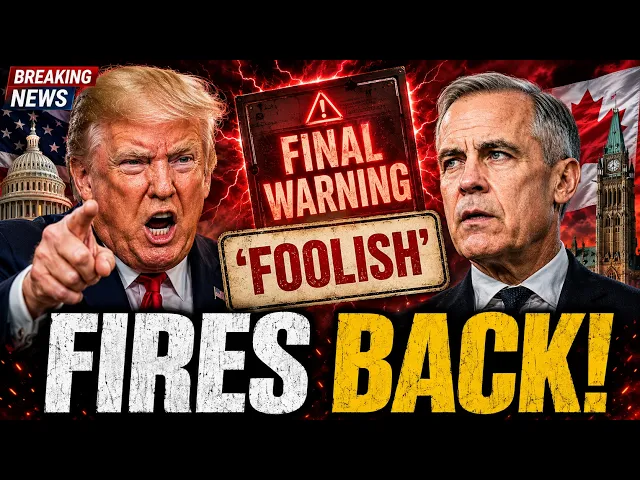
At 10:06 in the morning on Sunday, hours after 50% tariffs on Canadian goods officially took effect, President Trump posted something on Truth Social that had nothing to do with steel or dairy or lumber. He wrote that Canada wants the benefits of being a state without being one, and that its farmers had been charging America massive tariffs for years, adding in his own words, "No more. " It's the kind of post that sounds on its surface like a president mocking a smaller neighbor for daring to push back.
But here's the twist. Almost nobody covering this story from the outside expected. In the 48 hours since that post went up, the word getting used most aggressively to describe this entire trade war hasn't been coming from Ottawa.
It's been coming from inside the United States itself, from sitting American governors, from a sitting United States senator, describing the specific escalation, Trump's own trade war, using exactly the kind of language you'd expect Canada to be on the receiving end of. Before I walk you through exactly what actually broke down in these negotiations, what Carney is now revealing for the first time about why and why the backlash to this specific moment is coming from inside Trump's own country as much as from across the border. Subscribe to the channel because the real story here is not the one the headlines are running with.
Let's rebuild exactly where this stands because a lot has happened extremely fast and the details genuinely matter. This is the same collapse we've been tracking. A deal that both governments described as very close as recently as Thursday completely fell apart by Friday night.
50% tariffs on $20 billion worth of Canadian goods took effect at midnight, hitting everything from dairy products and wine to cement, furniture, clothing, and hockey equipment. Canadian Prime Minister Mark Carney responded by suspending trade negotiations entirely and announcing that Canada would retaliate dollar for dollar with its own tariffs targeting American steel, dairy, appliances, agricultural equipment, pulp, and paper, and electronics set to take effect on September 8th. That much was already public knowledge within hours of the collapse.
What's changed since then, and what makes this specific moment worth a dedicated breakdown of its own, is that both sides have now started filling in details they hadn't shared publicly before. And those details paint a considerably more specific and considerably more explosive picture of what actually killed this deal than the vague accusations of unfairness we'd heard over the weekend. Let's start with Carney's own explanation because he was noticeably more specific speaking to reporters after the collapse than he had been in his initial written statement.
According to Carney, the negotiations broke down because the United States introduced new demands in the final stretch that went considerably further than tariff rates on steel or lumber. He described these new American asks as touching Canada's other trading relationships entirely, meaning Washington was reportedly seeking some form of say over who else Canada does business with internationally, not just how the two countries trade with each other directly. Carney also said the new demands extended into Canada's auto sector specifically, and in a detail that's arguably the most politically explosive piece of this entire story, into protections for Canadian culture and the French language.
Carney's own verdict on all of that, delivered plainly to reporters, was blunt. In short, he said they asked too much and they offered too little. And when asked to characterize what this entire moment actually represented, he didn't reach for economic language at all.
It's a power play, he said. It becomes a question of sovereignty. Sit with that phrase for a second because it's doing a lot of work and it marks a genuine escalation in how this dispute is being framed publicly.
Up until this point, this entire 18-monthlong trade conflict had largely been discussed by both governments in the language of tariffs, quotas, and market access, a fight over dollars and percentages. Carney explicitly reframing the breakdown as a question of sovereignty rather than simply a disagreement over trade terms changes the entire emotional and political register of this dispute. A tariff dispute is something two allied governments negotiate their way through over months or years.
A sovereignty dispute is something considerably harder to walk back from without one side feeling like it's conceded something more fundamental than a percentage point on a steel tariff. British Columbia's premier David Eie added a specific detail that helps explain exactly what Carney meant by a say in Canada's other trading relationships. Speaking to reporters in Vancouver, AB said one of the deal breakakers the American side put on the table was a demand for input into who Canada trades with more broadly alongside a continued failure to resolve the punitive tariffs still sitting on Canadian logs and timber products specifically an issue that's been a persistent sore point for British Columbia's forestry sector throughout this entire trade war.
Eie didn't mince words about how his provincial government interpreted Ottawa's decision to walk away from that specific set of demands. He said he fully supports the federal government standing up to what he called a bully and told reporters his province is already identifying ways it can help inflict economic pain back on Canada's largest trading partner. He added a line that's since been repeated widely across Canadian coverage of this story, that Canada's politeness should never be mistaken for weakness, and that Canadians didn't ask for this fight, but would keep fighting for as long as it takes.
Now, here's the American side of this exact same set of facts. Because just like every previous round of this saga, Washington's account doesn't match Ottawa's account in any meaningful way. Speaking on Fox and Friends the morning after the collapse, US trade representative Jameson Greer offered a considerably softer, more paternal framing of what had actually happened.
He said the American interest throughout these negotiations had simply been protecting American workers and American supply chains and that the United States had been offering to, in his words, bring the Canadians along on that path, specifically by cutting tariffs on steel, autos, and lumber, sectors he explicitly acknowledged are sensitive for Canada. Greer's characterization of Canada's decision to walk away was pointed. He said Canada had always had the best deal available to any major trading partner of the United States and would have had an even better deal on the table.
But in his words, they didn't want it. Notice what's completely absent from Greer's public account. No mention on the American side of any demand for input into Canada's other trading relationships.
No mention of demands touching Canadian cultural protections or the French language. Greer's version of events describes a fairly conventional trade negotiation over tariff percentages in a handful of sensitive industrial sectors, one where candly inexplicably chose not to accept generous American terms. Carney's version describes something considerably more sweeping, an American attempt to extract concessions over Canadian sovereignty and cultural policy that had nothing to do with tariff schedules at all.
Those two accounts are not simply differently worded descriptions of the same underlying facts. They're describing what sound like two entirely different negotiations. And until one government releases something closer to the actual proposed terms from that Thursday meeting, there's no way for anyone outside that room to fully reconcile them.
Now, let's get to the part of this story that genuinely caught a lot of people off guard because it's happening entirely inside the United States, largely independent of anything Ottawa has said or done. In the hours immediately following the tariffs taking effect and continuing through Trump's early morning truth social post about Canada wanting the benefits of statehood, a wave of criticism started coming directly from American state governors and at least one sitting United States senator. Criticism aimed not at Canada but squarely at the Trump administration's own handling of this entire dispute.
Maine's governor, Janet Mills, put it about as directly as it can be put. Maine, she said, has had enough of this unending trade whiplash. And then she used the exact word that should stop you in your tracks given the framing around this entire story.
She described the president's latest escalation as his foolish trade war with Canada, warning that it would create more uncertainty for Maine businesses, push costs even higher for Maine families, and further strain a relationship her state depends on. Read that again. The governor of an American state describing her own president's trade war with Canada as foolish in a state that shares one of the longest and most economically intertwined borders with Canada anywhere in the country.
She wasn't alone. Michigan's Governor Gretchen Whitmer framed the tariffs in the plainest possible economic terms for her own constituents, stating that these tariffs act as a tax hike on Michigan families and businesses, directly raising prices at the grocery store and at the gas pump. California's Governor Gavin Nuomo was characteristically blunt on social media, calling Canada America's closest ally and a critical trading partner in asking in language that circulated widely what exactly the country thought it was doing by hitting that ally with 50% tariffs.
And Senate Minority Leader Chuck Schumer weighed in directly, too, stating that Trump had just slapped another bill on hardworking American families already dealing with rising costs, calling the entire situation with Canada nonsense that should never have been allowed to reach this point and insisting it needed to end immediately. Even inside Trump's own party, there were signs of real unease. Maine's Republican Senator Susan Collins flagged the impact on her state directly, describing what she called the on again, offagain nature of these trade talks between the United States and Canada as a source of serious strain for her constituents without going nearly as far as Mills foolish framing, but still publicly acknowledging the pain this specific dispute is causing inside a Republican held state.
This is the genuine reversal sitting at the heart of this entire moment. And it's worth being precise about it rather than letting the more dramatic version of events run unchecked. The narrative being pushed in a lot of headline coverage frames this as Trump delivering a final warning to a foolish, overmatched Canada.
What's actually happening, verified across multiple independent statements from sitting American officials, is closer to the opposite. It's not Trump calling Canada foolish for fighting back. It's American governors, Democratic, and at least implicitly some Republican concern, too.
calling Trump's own trade war against one of the country's closest allies foolish, reckless, and economically self-destructive for the very American communities these officials are supposed to be representing. If anyone got shocked by developments over this specific weekend based on the verified public record, it looks considerably more like segments of Washington itself getting shocked by their own president's escalation than it does Washington being shocked by anything Carney actually said or did. That's not to say Carney's response wasn't significant in its own right, because it genuinely was, just not necessarily in the way the more dramatic framing suggests.
What made Carney's reaction notable wasn't a single explosive soundbite designed to go viral. It was the calm, deliberate reframing of the entire dispute away from tariffs and toward sovereignty combined with immediate visible solidarity from provincial leaders like EIE who didn't hesitate to use words like bully in describing the American negotiating posture and who immediately signaled his own province was ready to identify additional pressure points against the United States independent of whatever Ottawa does federally. That kind of rapid, unified, multi-level response, federal government and provincial government speaking in the same register within hours of each other, is not the reaction of a government caught flat-footed by an escalation.
It's the reaction of a government that had clearly already prepared for exactly this outcome and was ready to execute a coordinated public message the moment talks actually fell apart. Let's talk about Trump's truth social post itself a bit more because the specific insult he chose is worth understanding in its broader context rather than treating it as an isolated one-off remark. This is not the first time Trump has floated the idea of Canada functioning as something closer to an American state than a fully sovereign independent country.
Earlier this year, in a social media post about invasive Asian karp threatening the Great Lakes, Trump referred to Carney directly as the future governor of Dana Canada, reviving an insult he'd previously aimed at Carney's predecessor, Justin Trudeau, during an earlier phase of the same broader trade conflict. Understood in that context, Sunday's Early Morning Post isn't really a new escalation in substance so much as a continuation of a running rhetorical theme Trump has returned to repeatedly throughout this entire relationship. one that consistently frames Canadian sovereignty itself, not just Canadian trade policy, as something up for debate or mockery.
Given that Carney has now explicitly reframed this entire negotiation breakdown around exactly that question, whether this dispute is fundamentally about trade or fundamentally about sovereignty, Trump's choice to lead with a joke about Canadian statehood at 1:00 in the morning, hours after the collapse, reads less like an isolated jab and more like him walking directly into the exact framing Carney had just handed him. Let's talk about what all of this actually means for the people caught in the middle of it. Because that part of the story hasn't changed even as the political rhetoric has escalated.
According to reporting from Canadian Business coverage of the collapse, Canadian business leaders have been left in what's been described as a precarious state of limbo with the sudden collapse of talks eliminating whatever hope remained for an end to the uncertainty that has, in the words of industry representatives, paralyzed investment decisions for months. Dennis Darby, chief executive of the Canadian Manufacturers and Exporters Industry Group and a member of Carney's own Advisory Committee on Canada US Economic Relations, noted that the latest round of American tariffs primarily targets Canada's manufacturing sector specifically and suggested that Carney's own language throughout this collapse signaled a genuinely firmer, more resolute posture than Ottawa had previously shown throughout this 18-month conflict. That firmer posture cuts both ways politically, and it's worth being honest that Carney isn't walking away from this moment with universal support inside Canada either.
Some domestic critics have accused him of prioritizing narrower political considerations, particularly around Quebec's dairy sector and the broader supply management system, over securing a faster resolution that might have spared other industries, including manufacturing and auto workers, from bearing the brunt of this specific round of tariffs. Others appointed to Carney's own campaign promises from the last election, arguing he pledged to secure a comprehensive deal that has so far failed to materialize across nearly a year and a half of on andoff negotiations. That criticism doesn't erase the genuine crossber solidarity we're also seeing from provincial leaders and even some sympathetic voices inside the United States.
But it's worth acknowledging honestly rather than presenting Carney's handling of this entire saga as universally celebrated back home because it clearly isn't. Now, let's talk about why the specific demands Carney is describing a say in Canada's broader trading relationships and conditions touching Canadian culture and the French language would actually be considered such serious deal breakers. Because understanding that context matters for grasping why this collapsed as dramatically and as suddenly as it did.
Canada has spent decades cultivating trade and diplomatic relationships well beyond its relationship with the United States, with the European Union, with countries across Asia, and more controversially given current geopolitical tensions with China. Any American demand for influence or input over those relationships would represent an entirely different category of ask than a tariff rate on steel. Effectively asking Canada to subordinate its broader foreign and trade policy autonomy to American preferences as a condition of resolving what had until that point been framed purely as a bilateral tariff dispute.
And on the cultural and language protection front, Canada has a decadesl long, deeply entrenched, legal and political framework specifically designed to protect French language rights and cultural institutions, most visibly, but not exclusively centered in Quebec. Protections that sit close to the core of how a modern Canadian federalism and national identity are structured. Any perceived American attempt to weaken or condition those protections as part of a trade negotiation would almost certainly generate exactly the kind of sovereignty focused political backlash we're now seeing Carney lean into explicitly.
I want to be careful here about how confidently I present Carney's specific characterization of these demands because as of this recording, we're relying entirely on the Canadian side's own account of what the American negotiators actually proposed. The Trump administration through Greer's public comments has not confirmed that these specific asks, sovereignty related input into Canada's other trade relationships or conditions touching cultural and language protections were ever actually on the table in the way Carney is describing them. Greer's own public framing describes a considerably narrower negotiation focused specifically on tariff rates in sensitive industrial sectors.
That's a genuine unresolved factual dispute between the two governments, not simply a difference in tone or emphasis. And until one side or the other releases documentation that actually settles it, it remains an open question whether Carney's sovereignty framing accurately reflects what was proposed or represents a strategic reframing of a more conventional trade dispute into a more politically potent nationalistic language specifically designed to rally domestic support behind a harder negotiating line going forward. Both of those possibilities are worth taking seriously and honestly they aren't even mutually exclusive.
It's entirely possible that American negotiators did raise broader asks touching Canada's other trading relationships or cultural protections, perhaps his opening positions or leverage points rather than genuine final demands. And that Carney's team chose to elevate and emphasize those specific asks publicly precisely because sovereignty language generates far more domestic political consolidation and far more sympathetic international attention than a dry dispute over steel tariff percentages ever could. Let's talk about what to actually watch going forward.
because that's what's going to clarify a lot of this uncertainty over the coming days and weeks. Watch whether the Trump administration offers any direct response to Carney's specific sovereignty related claims, the demand for input into Canada's broader trading relationships and the asks touching cultural and language protections because a direct denial, a direct confirmation or continued silence on those specific points will tell you a great deal about how much weight to actually place on Carney's version of event offense. Watch whether additional American governors from either party join Mills, Whitmer, Newsome, and Collins in publicly criticizing this specific round of tariffs.
Because a genuinely broad bipartisan coalition of state level American officials pushing back against their own president's trade policy would represent real unusual domestic political pressure on the White House to find some kind of resolution before September 8th arrives. and watch whether Canada's provincial unity, EB's immediate vocal solidarity alongside whatever Quebec and Ontario say in the coming days actually holds together as a coordinated front or whether the same domestic political fractures already being voiced by some of Carney's critics start to widen once the real economic pain of these 50% tariffs starts showing up in specific communities and specific industries. There's a broader pattern worth naming here as we close this chapter of the story out because it connects directly to something we've now seen repeat across multiple rounds of this exact same relationship.
Every time this dispute has escalated, both governments have reached almost immediately for the most politically potent framing available to their own domestic audience rather than the most precise, verifiable account of what actually happened in the negotiating room. Trump reaches for insults about Canadian statehood and complaints about farmers being cheated. Carney reaches for sovereignty and dignity.
Both framings might contain real genuine substance underneath them. Both framings are also unmistakably engineered for maximum resonance with each leader's own domestic political base, which is precisely why an outside observer trying to understand what's actually true here has to hold some real skepticism toward both accounts simultaneously rather than simply picking whichever version sounds more compelling or more sympathetic and running with it as settled fact. What isn't in dispute, regardless of which government's account of the actual negotiating demands turns out to be more accurate, is the real immediate bipartisan discomfort this specific escalation has generated inside the United States itself.
A Democratic governor in Maine calling her own president's trade war foolish. A Democratic governor in Michigan describing these tariffs as a direct tax hike on her own state's families. A Democratic senator from New York demanding this entire situation end immediately.
and a Republican senator from Maine publicly acknowledging the strain this ongoing whiplash is placing on her own constituents. That is not the picture of a country united behind an assertive trade posture against a smaller, supposedly foolish neighbor. That's the picture of a domestic political coalition already showing real visible cracks less than 48 hours after this specific round of tariffs actually took effect.
So where does this leave things right now? 50% American tariffs remain in effect on 20 billion of Canadian goods. Canada's own retaliatory tariffs focused on steel, dairy, appliances, agricultural equipment, pulp and paper, and electronics remain scheduled to begin September 8th.
Trump is publicly mocking Canadian sovereignty in early morning social media posts, continuing a rhetorical pattern that stretches back months. And Carney has explicitly reframed this entire dispute for the first time this directly as a fight over sovereignty rather than simply a fight over trade terms. a reframing that both raises the political stakes of any eventual resolution and makes a quick face- saving return to the negotiating table considerably harder for either side to manage gracefully.
Meanwhile, inside the United States itself, a genuinely bipartisan chorus of governors and at least one senator are publicly describing this specific trade war, using exactly the kind of language foolish, reckless, unnecessary that the more sensational headlines seem to assume only Canadians would be using about their own predicament right now. whether that domestic American pressure actually translates into any meaningful change in the Trump administration's posture before September 8th arrives or whether both governments simply continue talking past each other in increasingly nationalistic sovereignty tinged language while the actual economic damage accumulates on both sides of the border is genuinely not something anyone can predict with confidence today. What we can say based on everything that's actually been said on the record by officials in both countries over these past 48 hours is that the simple story of Trump delivering a stern final warning to adjacent, overmatched Canada doesn't hold up particularly well against the actual verified public record.
The record shows a Canadian prime minister explicitly, calmly refraraming this fight around national sovereignty. It shows American governors from Trump's own country publicly using the word foolish to describe his handling of this exact relationship. and it shows two governments that once again cannot agree on the basic facts of what was actually proposed in the room before everything fell apart.
Subscribe if you want to find out which version of this story holds up. Once more, details finally surface. Because based on the pattern we've watched play out again and again throughout this entire 18-month relationship, the full truth here is almost certainly still sitting somewhere between what both sides are currently willing to admit in Quick.