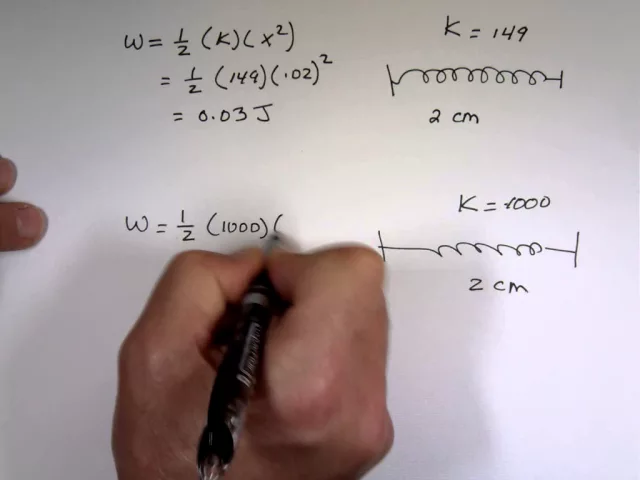
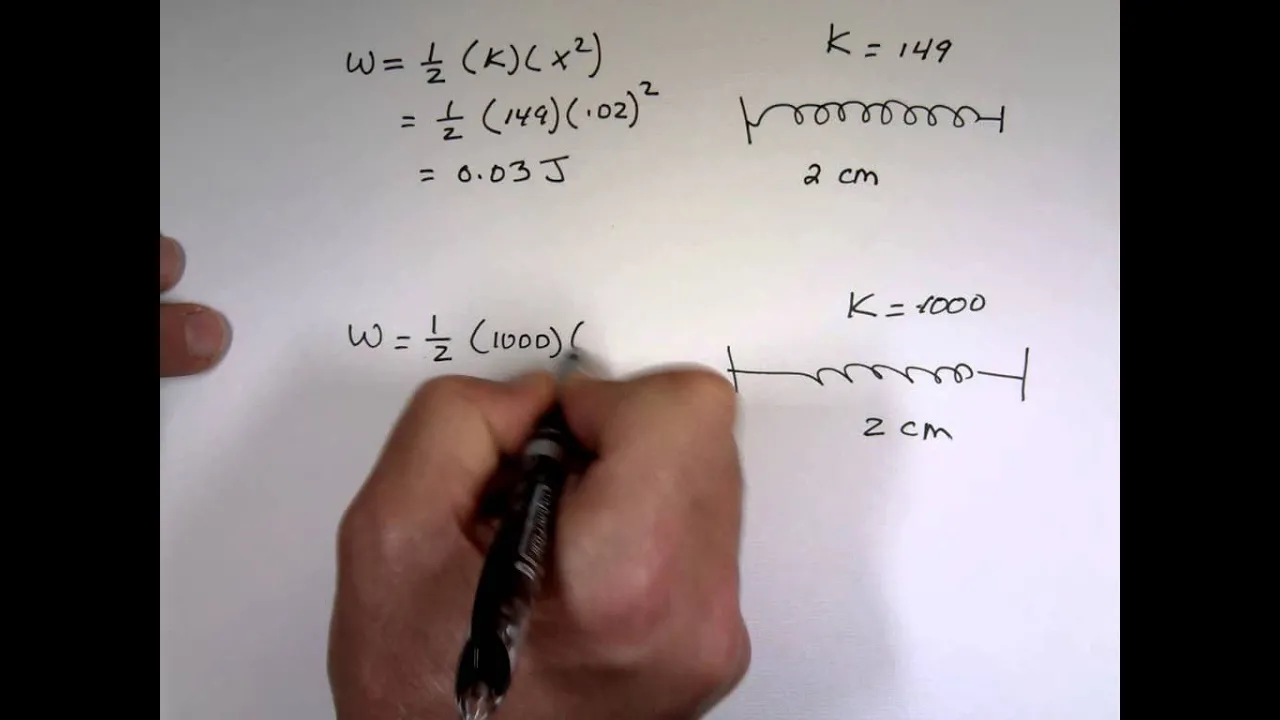
variable force going to be talking about here probably is when you have a spring when you have a spring the force on that is always changing it depends by how much you stretch it the more you stretch it the larger the force when you go back with it that first have to decrease decrease decrease decrease so the force is always changing here it's not a constant value well we know the force of a strength a spring I mean it's K times X we put minus that minus indicates the direction but the value of that that's really K times X and it's always the direction always backward always reverse reverse to it reverse that means if you push on it the direction is going to be backward to the force if you stretch it if I pull in this direction the force will be in that direction if I compress it the force will be in this direction is always backward to the direction you stretch it or you compress it that's what the minus sign indicates so but the value of the force is K times X well if you graph that if you graph K times X that's a straight line it will look something like this this is the force K times X so if I stretch that spring by a value of X this is X here at distance X you stretchable X then if you find the right value for that when this is equals X you plug it in and this height is really K times X well the work is really this area the size of that area and highlight that for the pencil here if I was to highlight this area what is that very equal to we know the area equals with 1/2 base times height isn't it for triangle now base here is what as X and my height is with KX when we do the equation that's one-half KX squared that's the area happens to be the work done by a spring so the work done by the spring is calculated by Goins 1/2 K times x squared that's how much energy in that spring there so when you compress a spring 2 centimeters we know what cares will tell you how much energy in it the spring we give the lab yes to recalculate cure and I'm doing a mental block I have no ideas and remember what care for it nobody got K for that one one forty one forty nine okay 149 care for the spring there yes I compress that by two centimeters then the amount of energy in that the work will be done if I'd release if I make a toy out of it like a bow and arrow or whatever or a BB gun you compress it there how much energy is going to be one half times K which is I'll just put the equation first that'd be one half kill is 149 and x squared X is what point zero two mirrors that's two centimeters squared I got 0. 03 jewels that's how much work is required to compress it so when you release that if it's a gun when you release that that's how much energy is going to be is going to push whatever object you have there forward that string that's not a large value of kier so if it's like an arrow that it's not going to go that far with it on the other hand if I pick another one with a large value of care really one of those hard spring K equals a thousand and I compress that to centimetres again or stretch it to centimeters how much energy stored in it it's 1/2 K which is a thousand times point zero two squared that's 0. 2 joules I'm not talking about compressing it very much just two here two centimetres normally with these toys you compress them like five six seven centimeters so decent amount there you saw that with a projectile when you compress that went down about four or five centimeters and that thing went up in the air about ten feet eight feet you know you get a stronger care for that you can fire it up to the sixth floor you can put a hole in the ceiling towel okay let's take another example on this let's say we have a block attached to a spring this is the wall here we attach a spring to the wall and now we attach a block of work to it let's assume this block has a mass of one point five kilogram and it's moving in this direction has an initial velocity of 22 meters per second well if this is moving what's going to happen it's going to compress the string keep going to what what will happen to that story you're going to see the spring girl at this and the block stops moving now keep moving moving moving till stops right since we have a fine velocity with zero and the question is if care for the spring if k for the spring is 475 Newton premier find the compression of this ring find how much the compression of this spring basically about how much this spring is going to compress assuming there's no friction because if there's a friction we lose some of the energy so we're making that assumption here no fiction let's look at the two stories here let's look at the block of the wood has an initial velocity of wit 22 has found velocity of zero and let's look at this spring here it was like this and now it's like this compressed and what's that distance D that's what we're looking for we know K for this spring is 475 well let's see how much energy on the block of wood that was lost because it slowed down stopped negative energy here the energy of the block Hill called B it's 1/2 and V found squared minus 1/2 MV initial squared the change in kinetic energy the mass of that is 1.
5 found velocity is 0 squared 1. 5 times the initial velocity 22 and you squared and it says the amount of energy is negative 360 3 joules negative because you're slowing down well why would you slow down what makes you slow down there's another spring pushing back on you so what is the amount of energy or work done by the spring the spring is wet 1/2 K times x squared so it's 1/2 carries with 475 and x2 the distance that is compressed which is d squared and that's equal to two 37. 5 d squared anyway we know about these two numbers if there is no friction is the reason this like to slow down because this one is pushing on it so whatever this one lost this one gained so these two numbers must equal to each other the negative here indicator is at you're lost there the value of that energy is 363 joules that's the value of it that negative means you lost it is equal to 2 3 7.
5 d squared or if you want to be technical with this that should be a negative because you're pushing this one is go in the opposite direction and now we have d squared equals with 360 3/2 37. 5 d squared is 1 point 5 3 and if you take this square root of that one point two four years not centimeters meters us that's love compression that's because this one is moving 22 meters per second 22 miles per second that was moving it to almost 50 miles per hour that block of wood was fully cruising he wasn't like slow it's gonna compress it that's not a large value for K either it's gonna head is going to compress the whole thing now if I reduce the speed to 2. 2 meters per second he moved the decimal point one place here a bit should be 12 centimeters 0.