At around 600 BC, Greek philosopher Thales of Miletus documented a strange behavior regarding a certain gemstone. Thales noticed that when he rubbed this gemstone, it attracted various lightweight objects such as feathers and bits of straw. These observations impressed and greatly astounded Thales and led him to believe that this gemstone had a certain lifelike property to it.
He dubbed the name for this gemstone as electron, which is the Greek word for amber and is what the gemstone is known as today. Other ancient Greeks even went as far as to say that amber had a soul due to its strange ability and amber was a prized possession of the ancient Greeks for these reasons. Thales and the Greeks didn't, [music] in fact, discover a gemstone with a soul, but rather had the first documented instance of static electricity.
Static electricity is a phenomenon in which electrons either build up on or are lost from the surface of an insulative material when it is rubbed against something, causing these insulative materials to become negatively or positively charged and giving them the ability to attract oppositely charged objects. [music] Since Thales and fellow ancient Greeks had no idea of how amber's quirk worked or how to make use of it, not [music] much was done with this information other than the stone itself having some intrinsic value to it. So, how exactly did we go from superstitious [music] beliefs towards the gemstone to manipulating electricity to our will with machines?
The answer begins with a systematic study of this gemstone [music] in the late 16th and early 17th centuries, shortly after the beginning of the scientific revolution. The first major scientific revolution era discovery regarding electricity was made by English physicist William Gilbert. Born in 1544 in Colchester, England, he received his doctor in medicine from Cambridge at 25 years old.
Shortly thereafter, he practiced medicine in London and later traveled throughout all of Europe. In 1573, he was elected to the Royal College of Physicians and by 1600 he was elected [music] as its president. The very next year he was appointed as a personal physician to Queen Elizabeth I until her death in 1603 and continued to be the personal physician to the next appointed king James I thereafter.
As gifted a doctor Gilbert was, he was just as skilled as a physicist. His most significant work in physics was his 1600 publication of De Magnete, meaning on the magnet, where he showcased an incredible amount of discoveries regarding magnetic forces. Gilbert's interest in magnetism came from his interest in compass needles and he was one of the first to postulate that the Earth itself is a giant magnet.
Gilbert's discovery regarding electricity, however, came some 30 years before the publication of De Magnete. He decided to investigate amber just as Thales of Miletus did millennia before him, but he, however, took a systematic approach to it. He noticed very similar things to Thales, that when amber is rubbed gently with a cloth or fur in a dry location, the amber attracts light objects.
He expanded this characteristic to objects such as glass and crystal as well. Gilbert realized these objects attracted other objects in a very similar manner to how magnetic objects do, but since these objects he was studying were not magnetic, he made an important distinction between the two forces. Since the Greek word for amber was electron, he named all objects that behave similarly to amber as electrics and their attraction as the electric force.
Gilbert laid the foundations for modern-day terminology of electricity way back in the early 16th century and Gilbert's studies did not end there. He also learned that a thin layer of water disrupts electric phenomena, but a thin layer of oil does not. Gilbert also constructed a needle that closely resembled that of a compass, from which he took inspiration.
Dubbed a versorium, this needle was non-metallic and very lightweight. He would allow this needle to pivot in the same way a compass does and then would electrify nearby objects. Upon noticing that the needle pointed towards the electrified objects, Gilbert also laid the foundation of the modern term electric field.
At the beginning of the scientific revolution, William Gilbert took observations from Thales of Miletus and expanded them vastly and along with it coined many new terms and laid the foundation upon which others after him would build. The first major break laid upon the foundation set by Gilbert was done so by a German physicist named Otto von Guericke in 1650. Von Guericke cast a ball of sulfur in a glass mold and then mounted it on an axle and rotated it with a crank.
While the sulfur ball rotated, he would place his hand on the ball so that it would generate a lot of friction and therefore a lot of static electricity. Once he generated enough friction, the contraption generated sparks that lit up the dim room around the ball. Von Guericke was the first person to generate sparks and light from electricity.
Decades after experiments done by von Guericke, >> [music] >> English scientist Francis Hauksbee improved upon von Guericke's setup. In 1709, he constructed [music] a hollow glass sphere and evacuated the air from the inside with a vacuum crank. Upon mounting it on an axle, rotating it and placing his hand on it, he noted that the glass globe became filled with a light that was sufficient to read by.
20 years after Hauksbee, came an English scientist by the name of John Wood who discovered that these static charges can do much more than generate light [music] when rubbed. Wood realized that these charges can be carried by metal pieces hinting at the concept of conduction. This concept would be taken a step further 3 years after Wood's discovery by an English electrician who had revolutionize the entire perspective of electric charge and how it could be used going [music] from simple tricks to long distance conduction.
Stephen was born in 1666 in Canterbury, England. His father made a living by dying cloth, and Stephen carried on the family business while also pursuing a hobby in science. Gray had interests in many fields, from astronomy to chemistry and to biology and also to physics.
He even made his own microscope using a water droplet as a lens and also ground his own telescope lenses, which he used to measure eclipses, sunspots, and Jupiter's satellites. He dabbled in electrostatics through most of his life as well, but made little progress. In 1729 though, at the piping young age of 63, he made a significant breakthrough.
Gray had gotten his hands on a flint glass tube 3 ft long and 1 in in diameter. He would plug the ends of the tubes with corks to keep dust out and would perform experiments in which he rubbed the tube to test electric forces. One specific trait he noticed in doing his experiments though was that after he rubbed the tube, the objects that were attracted to it were also attracted to the corks on the ends.
Upon noticing this, he realized his breakthrough. The electric charge generated [music] from rubbing the tube had also electrified the corks at the ends and therefore electric charge can be transferred from one object to the next. Overcome with excitement, Gray tried everything he could get his hands on, from silver coins to twine to brick and even to a head of cabbage.
All had the same result. When connected to the tube, they all became electrified. >> [music] >> Immediately after this discovery, Gray had one question in mind.
How far can this electric transfer travel? He set out to answer this question, initially starting in his room, and was able to transfer electric charge from the tube [music] to an ivory ball across 18 ft of sticks and canes. Realizing he needed more space, he visited his friends John Godfrey and Granville Wheeler, who had much more money and therefore much more land to experiment [music] on.
Together, they successfully transmitted electricity 886 ft through a thread of twine. This was a monumental discovery indeed, but in performing this experiment, the three of them made two other significant discoveries simultaneously. See, to conduct [music] the electricity through the twine wire, they had to suspend it in air, which Gray and Godfrey did on Godfrey's estate [music] via more lines of twine that spanned vertically and were nailed to the ceiling.
When they did this, they noticed that there was no electric transfer to the ivory ball, and Gray was left stumped as to why. He visited Wheeler to ask about this issue, and Wheeler suggested that there was still electric transfer happening, but it was escaping through the nails in the ceiling rather than going to the ivory ball at the other end. To counter this problem, Gray changed the suspension lines from twine to silk, thinking that the silk would not transfer electricity because it was much thinner than the twine.
Upon trying again, the electric transfer to the ball was successful. During repeated tests of their long-distance electricity transfer, the silk threads eventually snapped due to the weight of the twine, and they replaced the silk with brass wire that was just as thin as the silk, thinking the charge would not escape through the thin [music] wire. However, it did, which led Gray to realize that the thickness of the wire isn't what determines electric transfer, but rather the material itself.
This led to Gray elevating Gilbert's theory of electricity to a new level. He eventually proposed replacing electrics and non-electrics with conductors and insulators. Objects, such as metal, conduct electricity, while objects as silk are good insulators.
By 1730, a century and a half after Gilbert's original theory of electrics, humanity had moved from simple electrostatics to conducting electricity across long distances. Three years after Gray, Godfrey and Wheeler's monumental discoveries, French chemist Charles François de Cisternay du Fay was building upon the recent experiments when he noticed something crucial. Some charged items attract one another while others repel one another.
This led him to propose the idea that there are two types of electrical charge, which he labeled as vitreous and resinous. He also discovered that all objects, solid and liquid, could be electrified if first placed on glass stands. This was an important discovery as it contradicted Gilbert's proposal that water dissipates electric charge.
Charles even realized that in some instances, moisture assisted the passage of current and thread. Also, he noted that the objects that were easily electrified by friction were the worst conductors or [music] best insulators. And so, at this point in history, we know that not only can electric charge be produced by friction, but it can also be transmitted through wires across long distances.
We also know that there are two types of electric charge and that light charges repel while opposites attract. The next step [music] was finding a way to store this charge for ease of access and the first instance of this came independently by two men. A German scientist and cleric named Ewald Georg von Kleist in October 1745 and a Dutch professor and medical doctor named Pieter van Musschenbroek in January 1746.
Von Kleist's invention actually happened accidentally. He had set up a medicine bottle and filled it with a fluid and had sealed it with a cork. He had then hammered a nail into the cork so that it penetrated it fully and touched the liquid inside.
Now, von Kleist had also recently constructed a machine capable of conducting electricity and decided to connect it to his contraption. Once he did, he noted a pencil of fire surrounding the nail that persisted while he walked 60 paces around his room holding the bottle. After walking for a bit, he took it upon himself to touch the nail and consequently received a massive shock that stunned both his hand and arm all the way up to his shoulder.
Overcome with awe, Von Kleist wrote to several colleagues about his contraption, claiming that the liquid inside the bottle had stored electrical energy for some time. None of his colleagues could replicate the setup successfully though, and a few months later, Van Musschenbroek announced his invention of a very similar contraption. >> [music] >> Van Musschenbroek's contraption was presented to the Academy of Sciences in Paris in April and was demonstrated in such a clear and concise way that it was easily replicable by many.
So, Von Kleist was the first, but Van Musschenbroek was the one who made an easy to replicate model. The contraption was eventually named the Leyden jar after the University of Leyden, where Van Musschenbroek had invented it, and was the first ever capacitor. By the 1750s, electricity was one of the most popular topics of science on the planet.
>> [music] >> Everyone wanted to get their hands on it and make a contribution in some way or another. In trying to find new ways to experiment with electricity, a few turned their attention to a new frontier, the sky. This movement was spearheaded by American polymath [music] Benjamin Franklin.
Franklin became interested in electricity in the 1740s after seeing demonstrations with static electricity by a lecturer named Archibald Spencer. After a few short years conducting his own experiments with static electricity, Franklin proposed a new idea about the nature of electricity. Franklin took a bold approach and went against Du Fay's idea of vitreous and resinous electricity.
Instead of two different types of electricity, Franklin hypothesized that [music] they are one in the same. He compared electricity to a fluid in his hypothesis, since at the time electrical fluid was a popular theory, and claimed that the two seen types of electric fluid are actually the same fluid that manifests differently under different pressures. He proposed changing the names of vitreous and resinous electricity to positive and negative, respectively, an idea that stuck and remains to this day.
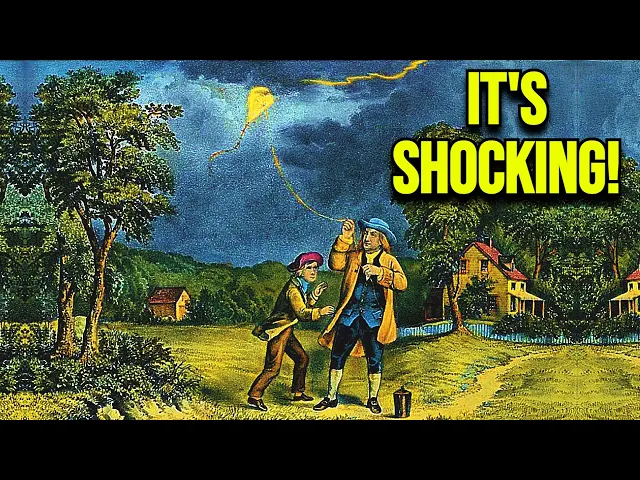
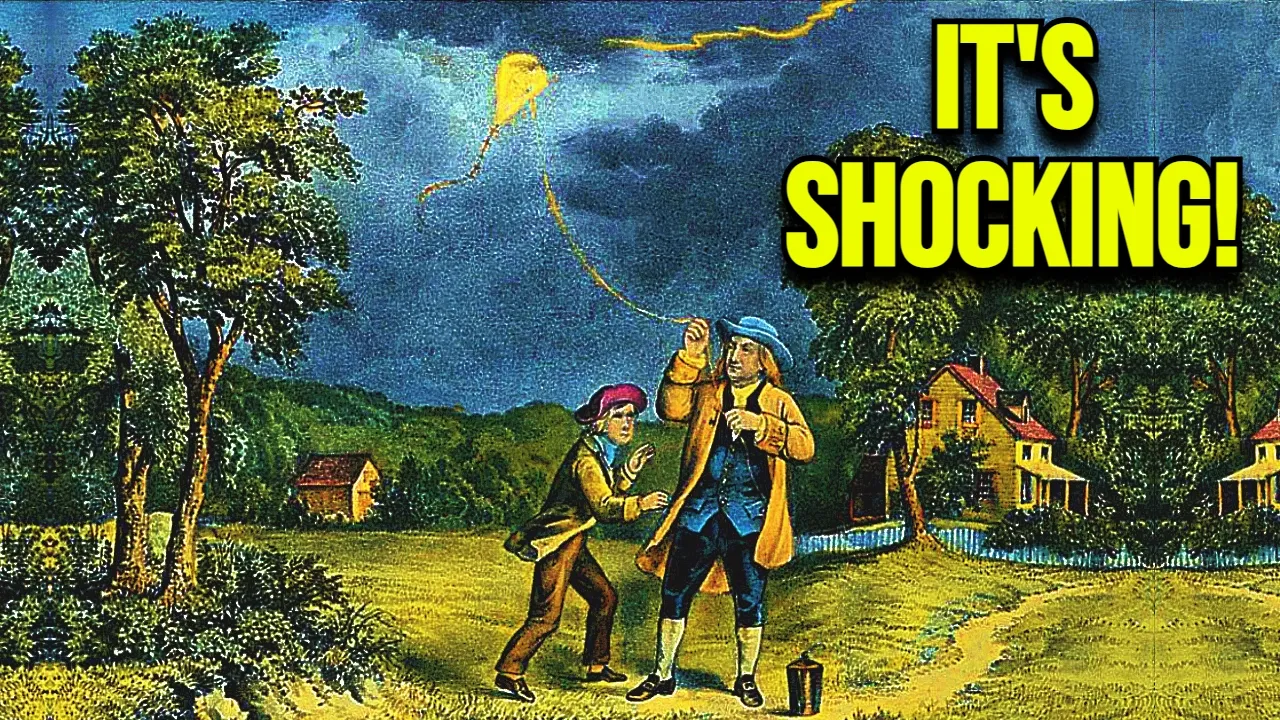
In 1752, Franklin made his most daring and most famous experiment, in which he proved that lightning is also electricity by flying a kite through stormy [music] weather. He proposed such an idea earlier in that year, albeit using a general conductor rather than a kite specifically. In May of that year, French physicist Thomas-François Dalibard brought his proposal to life, but with a 12-m long metal rod grounded by wine bottles instead of a kite.
Rather than getting struck by lightning, Dalibard was able to extract electric charge from a cloud, demonstrating that electricity in the clouds is the same as electricity generated by friction in the first ever lightning rod experiment. The very next month, Franklin himself performed his famous kite experiment. Again, he was not exactly standing outside with a kite and waiting to get struck by lightning.
His experiment was actually much safer than that. He took precautionary acts such as standing on an insulator and keeping himself under a dry surface to avoid electric shock. Franklin himself described the experiment in a letter to England, in which he provided instructions for its recreation.
When rain has wet the kite twine so that it conduct the electric fire freely, you will find it streams out plentifully from the key at the approach of your knuckle, and with this key a file or Leyden jar may be charged. And from electric fire thus obtained spirits may be kindled, [music] and all other electric experiments performed, which are usually done by the help of a rubber glass globe or tube, and therefore the sameness of the electrical manner with that of lightning completely [music] demonstrated. Franklin's lightning experiments eventually led him to invent the lightning rod, specifically one with a pointed tip, as he noted that it discharges silently and at a far greater distance [music] than a rod with a smooth tip.
After Franklin's contributions, electricity was understood as existing practically everywhere, as something that could be generated through friction and spanned across a long distance for a short period of time. The next step was to change that short period of time to a long period of time, and that wouldn't come until the turn of the 19th century. The two most influential scientists in the field of electricity that came directly after Franklin's time were Italian physicists Luigi Galvani and Alessandro Volta.
In fact, it was a scholarly dispute between the two that led to an invention that changed the world entirely. Galvani, on top of being a physicist, was also a prominent physician and was heavily interested in the anatomy of all kinds of animals. He experimented frequently on them and took a special interest in frogs.
Galvani's pivotal experiment came in 1786 when he touched a frog with a pair of scissors in the event of an electrical storm. The contact sparked a muscular contraction in the frog. Similarly, shortly after this experiment, there are records of someone in his lab touching the lumbar nerve of a skinned frog with a scalpel while an electrical machine was running, causing the legs of the frog to kick.
Galvani took these findings and formulated them into his theory of animal electricity. He believed that living tissue itself generates electricity and metals merely conduct it through friction. Upon hearing about this experiment and the conclusion made by Galvani, Volta fired back with his own theory.
He believed that this electrical stimulation was purely a natural phenomenon and not generated by animal tissue, and he set out to prove it. Throughout the 1790s, Volta experimented with many different pairs of metals and electrolytes, and by 1800, he had successfully made a contraption capable of storing electricity. His device, called the wet pile, consisted of alternating discs of zinc and silver.
These discs were separated by layers of paper and cloth, which were soaked in a solution of either salt or sodium hydroxide. This device was the first of its kind, as it was capable of powering electric circuits for extended periods of time, bridging that gap between current for short periods and current for long periods. In the end, Volta's pile acted in two key ways.
The first was as evidence that Galvani's frogs act merely as conductors of electricity, [music] not as generators, since the pile was able to produce electricity with nothing but metals and electrolytes. The second was as the first battery, which arguably is by far the more impactful result of Volta's ingenuity. The pile turned electricity from merely a laboratory experiment into a power source for experiments, and later on for developing technology.
There are many routes I could go from here in the development of electricity, but I'm mainly going to keep it short, as we're already pretty far into this video. If I could narrow it down to two more major contributions, it would probably be Ørsted's discovery that electricity and magnetism are part of the same electromagnetic force, and Faraday's discovery that changing magnetism induces current, which sparked the invention of the first generators. I've already covered Ørsted's discovery in another video, so I will provide a link here if you were interested in that.
Plus, I feel it would be a little bit criminal to make a video on electricity and not spend at least a little bit of time on Michael Faraday. In August of 1831, Faraday wrapped two coils of wire around opposite sides of an iron ring. These wires were insulated by cotton, so that they didn't contact the ring directly and transfer current to it.
One coil was connected to a battery, and the other to a galvanometer. A galvanometer is just a device that detects electric currents when electricity flows through a coil, generates a magnetic field, and deflects a needle with that magnetic field. Faraday turned on the battery to allow current to flow to the iron ring from the first wire.
And upon doing so, he noticed a deflection in the galvanometer as a result. However, this deflection was not only brief, but only happened when he turned the circuit on or off. The needle deflected neither when the current was steadily on nor when it was steadily off.
This led Faraday to conclude that when the circuit was flipped on and off, and therefore the magnetic field of the iron ring was changed, an electric current was produced causing the deflection of the galvanometer. Therefore, changing magnetic fields induces currents. Faraday's induction ring is credited as the first electric transformer, and he was only getting started.
In September that same year, he replicated his experiment, but instead attached the wires to a copper disc so that they made a sliding contact rather than wrapping them around a disc and insulating them. He then spun the copper disc continuously between the poles of a horseshoe magnet. This setup produced a continuous direct current and is widely regarded as the first ever generator.
To restrict Faraday's accomplishments to just these two instances is a massive understatement of Faraday's influence on the field. But for the sake of the story, they are the two most relevant. Every scientist mentioned in this video built off of the discoveries and inventions made by those before them, and each of them has made contributions that [music] cannot be understated in any way.
The understanding of electricity took many people and countless more experiments, and continued well past Faraday into the modern era thanks to scientists and pioneers ranging from Maxwell, Joule, Kelvin, Hertz, Tesla, Westinghouse, and many, many more. Perhaps I can cover them all in a future video, but for now, this is where my story ends. Between 1570 and 1830, a span of 260 years, electricity went from essentially nothing more than a scientific enigma to something that could be manipulated at will to produce strong currents [music] that would eventually power all of society.
If you enjoyed this video, please consider liking and subscribing. Click here if you want to see more scientific progress made during this time period. Thank you for watching, and I will see you in the next video.