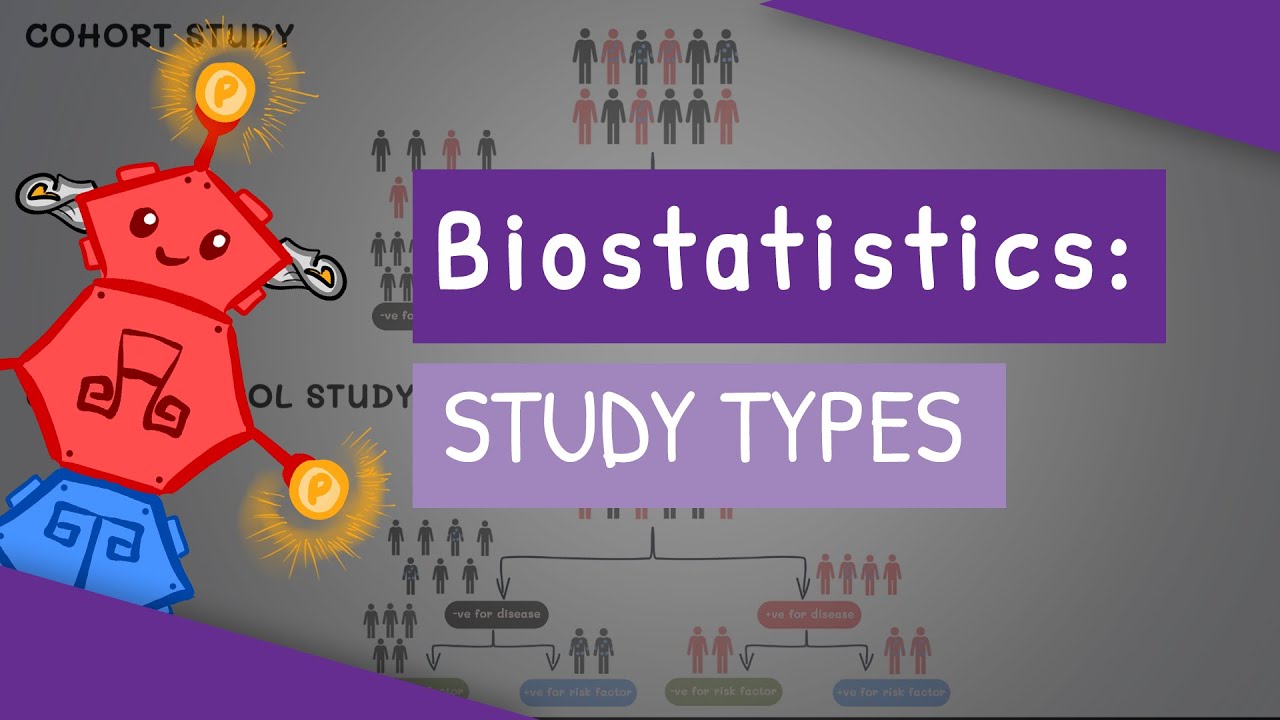
But remember kind of this basic, that first bullet. Kind of two types of research. It's observational versus this kind of experimental interventional.
So the observational, my goal is to observe and collect data on characteristics of interest without influencing the participant, the environment, or the disease course. I literally observing. I do not want to intervene in any way.
I want to see natural. Experimental is when you are -- the researcher, are deliberately influencing the course of events, at least you're hoping to, and investigating the effect of the intervention on some carefully selected population of subjects. I'll say observational is usually a carefully selected set of subjects, too.
When we do experimental subjects on humans, we call them clinical trials or clinal studies. Similarly, though, you know, a lot of this work, all of this applies to animals, it applies to a lot of different projects. So we're going to cover observational studies in detail next week, but the general idea here is that you may have case reports, which is literally the doctor writing down a set of information, like something looks weird, but I'm going to write it up in a structured manner so I can share it with other folks.
Several case reports make a case series. This kind of fundamental epidemiology 101. It's also because a pharmacist noticed something looked odd and started working on a set of case series and case reports that we discovered AIDS.
So you used to get -- CDC actually now publishes it more electronically, but you had Morbidity and Mortality Weekly Report. So when I was in school, every Friday we went to read this report, to see kind of what looked new and weird around the country. What we should have our eyes open for.
Those are usually case series. You still see them published today in a lot of journals. Cross-sectional prevalence surveys.
This is a snapshot picture. So this might be the National Health Interview Survey in the United States. Case control studies.
We'll talk a little bit about this, but usually you get a series of disease cases, and try to find some match controls, and figure out what's different between them. If you have a really rare disease, this is a very useful type of study to do, to try to figure out a list of reasons that you might have disease. Cohort studies that are longitudinal.
A lot of times -- so when we had major disasters, we will follow the healthcare workers, or the people that are cleaning up those disaster sites long-term to see if they have psychological issues, if they have respiratory-related issues, other problems that come up. Natural history studies. You may have a group of patients, and you're going to follow them, and see how they actually age.
You may see how their disease progresses. The NIH at the Clinical Center does quite a few of these. And then the ecological studies.
This is data that's on a population rather than an individual level. So like I said, we'll talk more about these next week. Then we have these kind of -- some groups call them quasi-experimental studies.
These are those one or single arm, nonrandomized, interventional studies. Dr Gallin talked about several of these actually if you think about his historical lecture. You don't have a control group.
They tend to be early in the investigation. Sometimes you may have a concurrent control group, so I may decide I'm going to bathe one side of the hall in my hospital, but not bathe the other side of the hall. I can do some weird, interesting things, but I'm not randomly choosing it.
I just kind of allocate it. Then you sometimes have things called historically controlled studies. So pediatric oncology we used to do these where patients that -- you know, we basically only had enough patients to put everybody on the therapy.
So we said, well, we'll use old patient information as kind of our control group. So that's kind of that early intervention-based research spectrum. So I talk about the sometimes it's interventional, sometimes not.
But that quasi-experimental, those pre-clinical studies, phase 0, those are early studies. But all of this is setting the foundation for trying to do what's a phase 1 study or those dose finding studies many times. You know, in this patient population, what's tolerable?
You know, and what might be sometimes we also look to see early efficacy there, or at least some change that says we might think we'll have efficacy down the line. Dig into these early and late phase 2 studies, again, we're looking a lot at safety like we are in phase 1, but we're starting to get a better idea of the dose. We're starting to get a better idea of how we should deliver a medication, or some type of medical product, or therapy.
We're trying to get an idea of who should be in these studies and not. Phase 3, or what we typically call pivotal trials. These are your major, large efficacy studies.
Phase 4, for me in the FDA world, is post market. So we've kind of decided there's efficacy, but if I put this out in the general population, do I still see safety and effectiveness? You also get into these dissemination and implementation studies.
Great. You think that if you make this change your hospital process that you will improve, you know, let's say it's rates of some type of hospital-acquired infection. You've done this at your very rigorous, focused hospital.
Is that going to work at the middle of nowhere hospital? Is it going to work in a really busy public hospital? Dissemination implementation is can I take all of the information about how to deliver a therapy, and how deliver an intervention, and actually do it everywhere in the real world.
You also then see comparative or cost effectiveness studies. So there's a large study done many years ago by the National Institute of Mental Health where they took several different therapies for people who had major depressive disorder. And they said, okay, we're putting them head to head.
That's a comparative study. But your ideal study, the problem that comes up, is that we have these ideals, right. Whenever anybody looks at your study design, they are going to say, "I expect to have a treatment and a control arm.
" What about all those studies that don't have a control arms? They expect you to have parallel groups, that you're going to have randomized people, to two different arms of a study, and you're going to watch these folks simultaneously. Well, sometimes that's not feasible.
They expect you to look for superiority. You know, drug A is better than drug B. Well, maybe, you know, drug A costs $30,000 a year and drug B costs 30 cents.
Maybe it's more accessible to use that or maybe there're a lot fewer side effects with drug B than drug A. Prospective. They expect you to be following people into the future.
If there are only 34 people in the world with your disease, you may not be able to follow them all prospectively in a randomized, parallel arm study. They expect to be double blinded and masked. Well, what if you're doing surgery versus non-surgical intervention.
We used to actually blind those studies, but you may not be able to blind them. Although, sometimes you may say, well, kind of what am I trying to look at? Do I want to control for all the risks of opening somebody up and the extra infections they may get from opening and closing them?
Or do I not? What is your exact question you want to answer? But if you're looking at a pill versus an IV in a pediatric population, you're probably not going to be able to give a fake IV.
And they expect a randomized study. A lot of studies can be randomized if you get inventive, and you're working in the right population, but not all studies can be randomized. If I want to look at long-term antiretroviral therapy in HIV patients, it's going to be really hard for me to run a randomized trial.
So we have these gold standards but sometimes we have to explain why we need to be a little bit bronze. Now the next two slides are a handful of studies from BMJ back in 2013 because it was actually easy to lift the information. You'll see actually I give a lot of examples from BMJ.
That's because you can access it publicly. It's open for anybody in the world so what I show you is something I want you all to be able to access. If there are articles that are not publicly available, we will put them up as part of the course information along with my slides.
So in BMJ, they had four articles in their research section this one week. Noninvasive versus evasive respiratory support, a systematic review meta-analysis. Another one was a multicenter randomized control trial that was blinded.
At least the researchers were blinded. You had a population-based cohort study and a large-scale survey. A lot of different research there.
Only one of those projects was actually randomized, double-blind, control trial. There's a lot of different types of research you can do that's meaningful. But as you're doing it, you still have to distinguish the observational studies from your randomized studies.
A lot of times we start doing these analyses of observational studies thinking that they were a controlled, randomized trial, but that tacit assumption of randomness is what makes a lot of other assumptions work in statistics land. So, you really have to do a lot of extra work when you're analyzing observational trial data. The idea is in a nonrandomized study you can only show associations.
You're never going to know all possible confounders. In a randomized studies, you can show association and causation. Now in a well-done nonadaptive randomization, so we'll get to that in a few weeks, the unknown confounder should not create problems.
If you are doing an adaptive trial, unknown confounders can cause a lot of problems. But in nonadaptive studies, nonadaptive randomizations, the general idea is that unknown confounders should not create problems. But again, always remember that your questions are going to come first.
So, as you're making all these changes, all these things that you're thinking about with your patients, and what's going to work, are you still answering the fundamental question of interest?