okay hi everybody I'm uh very excited today uh in an Ideal World I would have loved to actually be delivering this lecture with the uh video capability I know that Elon uh has stated that uh you know the video option for X spaces should be available soon uh I think that would be really helpful because then I can actually show some diagrams that are important to show uh as I try to explain some of these Concepts uh in in the meantime what I've done is if you go to uh the thread where I posted the
the alert that there'll be a uh an X spaces today I I posted three screenshots of three nomological networks of cumulative evidence that I constructed part of my 2017 paper let me just read for you the the title it's the title of the paper is on the method of evolutionary psychology and its applicability to Consumer research it's published in a journal of marketing research which was which is one of the truly uh top A+ journals in the field it's June 2017 Pages 464 to 477 and what I've done is shown you figures two three and
four and I'll get into all that so what are nomological networks of cumulative evidence we'll get into all that in a second and I some of you who follow my work have probably heard me talk about this and this is something that not only did I discuss in the paper that I just cited my 2017 paper but in chapter 7 of the parasitic mind uh the chapter is on how to seek truth I go into great detail about this epistemological tool and again it's I I can almost think of nothing that is more important epistemologically
than for me to lecture about this because it is a incredibly powerful technique for amassing evidence in support of a position that you are taking uh before I do that let me step back a bit so in science when we're or in in just generally when we're talking about truth we can break up truth into different uh classifications of Truth so for example a mathematical truth or an axiomatic truth is different from an empirical truth so uh mathematical proof or or truth would be you know uh 2+ 2 equals 4 is that a true statement
or not in axiomatic truth let's say when you talk about rational Choice Theory you might say if I prefer car a to car B and I prefer car B to car c it must be that I prefer car a to car c that's called the transitivity Axiom and therefore that has to be true in mathematical logic we talk about uh say AOG syllogism right so for example you know all all humans are whatever are all dogs are mammals humans are mammals therefore right so you can set up a if then set of premises and depending
on certain Boolean parameters Boolean operators the and operator the or operator you can determine whether that statement is true or false so in that case it's a it's a binary system where given a set of premises does the conclusion follow so there are all sorts of ways by which we can establish whether something is true axiomatically true logically true mathematically true but today what I'd like to talk about are empirical truth in other words this is where you have to amass empirical evidence that suggests that well there really seems to be an an abundance of
data that supports this position okay uh now the way that I came to think in this manner is in my evolutionary work where I'm trying to say argue for a particular position uh and demonstrating that let's say a phenomenon is indeed an evolutionary adaptation well how would I go about constructing an argument that makes it rather unassailable and incontrovertible that the position that I'm taking seems to be the veritical one and so Darwin himself self when he was amassing the evidence in support of the theory of evolution amassed data from a bewildering number of fields
so it wasn't as though you know he ran data with a study with butterflies and came to his conclusion there was paleontological Data there was comparative anatomical data there was ecology data there there was biodiversity data there was geology data there there was data from a broad range of disciplines all of which when triangulated made it quite apparent that you know he was espousing a theory that till today has not been falsified uh but of course he didn't call it nomological networks of cumulative evidence nomological networks of cumulative evidence the term nomological networks uh I
mean there are several contexts where it arises but in in when you're developing a psycho psychometric uh test let's say you want to measure a particular personality trait how do you go about ensuring that the the the scale that you've developed measures exactly what you're purporting that it measures and nothing else well there are several psychologists in the 50s Campbell and Fisk uh cronbach and me who argue that there are ways by which you can triangulate many sources of evidence so for example in the multitrade multi method approach you're exactly doing that you're you're using
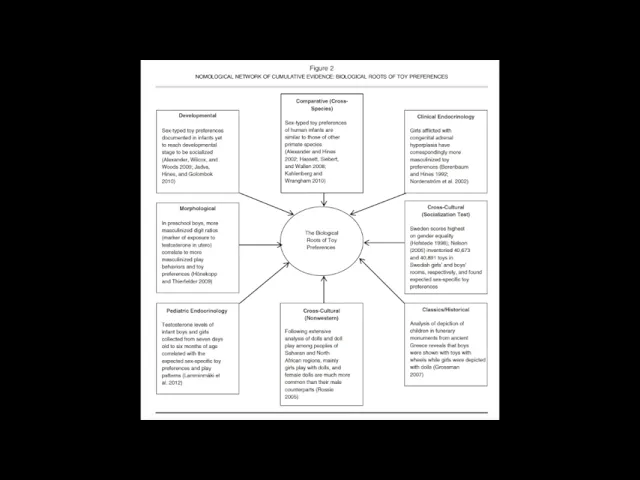
a triangulation of multiple measurements that demonstrate that that which you are stating you're measuring must be exactly that so you take this principle and now you want to apply it to all sorts of other things for example in the three figures that I've given you so hopefully if you're if you're able to access them they're as I said they're in the thread of the call for today's X spaces figure two is a nomological network of cumulative evidence arguing that the sex specificity of toy preferences have a biological root so if I wanted to demonstrate that
no it's not true that toy preferences are simply due to social construction how would I go about demonstrating that to you so if you look at that figure I've got data so if you look so in the in the the in the center of the figure there is the biological roots of toy preferences and now what I'm going to do is collect data from across cultures across species across time periods across methodologies across theoretical Frameworks all of which triangulate in demonstrating that the phenomenon that I'm reporting to hold true holds true for the exact reasons
that I'm saying it holds true so let's go through this and I'll I'll describe this example this is one that some of you may have heard me mention in the past and then I want to read something to you from chapter 7 uh in the parasitic mind so bear with me it might seem like I'm all over the place but it will all come together so social constructivists tell us that no no no the the reason why John likes to play with with blue trucks and Cindy likes to play with pink dolls is because you
know Mommy and Daddy are just promulgating the gender role sexist stereotypes but if only you were to reverse those then suddenly boys would want to play with little dolls and and and girls would want to play with uh uh you know with trucks and guns okay nothing could be further from the truth now how can I show you that okay so now I'm going to build you a nomological network that will make it incontrovertible that they are not due to social construction let's start so I can get you data from developmental psychology ology that demonstrates
that Sex Type Toy preferences are already documented in infants who are too young to yet be socialized in other words by definition their toy preferences could not have been due to social construction because they haven't reached the developmental stage that would allow them to be socialized so already just that piece of evidence is a is a death nail is a death blow to the constructivist argument but that's the beauty of a nomological network of cultive evidence I don't stop there so and by the way if you want the references to all of the studies that
I'm mentioning that's why I included those usually it would cost a lot of money by the way for you to go and and actually access that paper so all I've done is taken three screenshots uh you know to allow you to to follow the figures so first line of evidence comes from the velmental psychology next one comes from morphological studies so let me just read you what it what uh my figure says here in preschool boys more masculinized digit ratios bear with me I'll explain what that means uh correlate to more masculinized play behaviors and
toy preferences so there's something in in uh evolutionary theory that that's called the 2D 4D ratio this is the ratio of your index finger to your or ring finger now that's a sexually dimorphic trait meaning that in girls uh those two fingers are roughly the same length in boys the ring finger is much longer than the index finger so that's what we mean by a sexually dimorphic trait and the more you've been exposed to testosterone in utero the more that uh that difference between the the the 2D 4D is meaning that that morphological trait is
correlated to a endocrinological marker in this case testosterone and utero well it turns out that boys who've got more masculinized digit ratios are more likely to have masculinized play behaviors and toy preferences now that's a pretty incredible finding so right now I've given you data from developmental psychology I've given you data from morphological and endocrinological studies now let's go on to Pediatric Endocrinology okay so this is from medicine specifically from Pediatrics more specifically from Pediatric Endocrinology right there is a so let me just read it and then we I'll come back testosterone levels of infant
boys and girls collected from 7 days old to 6 months of age correlate with the expected sex specific toy preferences and play patterns now that's that's astonishing right so if you take testosterone levels of little boys and girls we're talking from who are 7even days old to six months of age the higher the testosterone level the more the sex specific you know so for example if it's if it's higher testosterone level then the play behavior is going to be in the toy preferences will be more masculinized let's keep going I can get you data from
around the world because you might say oh but those toy preferences are it's just a western construct okay well how about this I can get you non-western data so following extensive analysis of dolls and doll play among peoples of Saharan and North African regions mainly girls play with dolls and female dolls are much more common than their male counterpart this was done by a French Anthropologist and the number of uh non-western societies that we're studying is quite bewildering so it can't be due to it's a western construct so you see how I am tightening the
epistemological news around the social constructivist so far I've gotten you data from Developmental Psychology from morphology and endocrinology from Pediatric Endocrinology from nonwestern anthropological studies but let's keep going how about you say oh but you know that doesn't prove that it's biological that doesn't prove that's evolutionary okay well here we come here we come with cross species studies I can show you that veret monkeys reesus monkeys and chimpanzees our close primate cousins exhibit the same sex specific toy preferences that human infants exhibit or boy it's not looking good for the social scientist bullshitters is it
let's keep going oh but Professor sad that's this is a contemporary thing maybe in the past the the toy preferences were reversed Oh no I got data for you I can get you data from classics and from so by Classics it means uh ancient Greece analysis of depiction of children in ferary monuments from ancient Greece reveals that Bo were shown with toys with wheels while girls were depicted with dolls so now I've gotten you cross era data showing you that the exact same toy preferences occurred uh back then as they do today okay two more
sets of lines of evidence from Clinical Endocrinology you ready you're focused I should be charging you $5,000 for this lecture girls Afflicted with congenital adrenal hyperplasia which is an endocrinological disorder that masculinizes their morphology that masculinizes their behavioral patterns girls who suffer from congenital adrenal hyperplasia are more likely to exhibit toy preferences that are akin to those of come on let me hear you say it of boys meaning that once there's an endocrinological malady that masculinizes the behaviors of little girls suddenly their toy preferences switch and finally I'm going to get you crosscultural data to
test the socialization argument for toy preferences so Sweden by the way scores the highest on gender equality meaning that Sweden is the country that is of of the countries that have been studied this is from hofstead of all the countries that have been studied I think it's uh roughly 50 or 51 or 52 countries Sweden is the one that has sort of the most gender neutral or the most non-gender role specialization scores because Sweden has gone through a a social engineering experiment where for many decades they've tried to eradicate those gender roles right because you
know they're so Progressive in Sweden well so Sweden has had 40 50 years to eradicate if it's due to socialization that why boys prefer certain toys and girls prefer certain other toys then after 40 or 50 years of reverse socialization we should see that the toy preferences in Sweden might not be akin to what's been found anywhere else well you're ready for this Nelson in 2005 inventor 4,673 and 40,8 191 toys in Swedish girls' and boys's rooms respectively and found the exact same sex specific toy preferences this is not running a study with with uh
40 undergrads in your uh undergraduate class these are in the 40,000 of actual toys that little boys and little girls play Within Sweden and the exact same pattern sex specific pattern was found even though Sweden has gone through a massive gender role eradication program for 4050 years so look how many data I've gotten you developmental data from psychology morphological data endocrinological data pediatric endocrinological data crosscultural anthropological data comparative data across species clinical endocrinological data cross-cultural data from Sweden to rule out the socialization argument and finally Classics data historic data from 2,000 plus years ago from
ancient Greece so what have I done I've I've amassed data across cultures across time periods across species across methodologies across dependent measures across theoretical Frameworks across procedures all of which point to the exact same conclusion That's The Power of normic networks now how do you construct such a network that's that's the hard part because what you have to do here this is not this is not some uh literature review on steroids as I explain in the parasitic mind a literature review is much more narrow okay a literature review in a scientific study is basically summarizing
what's been done in the very narrow area that you are studying by people in the past so for example if I'm studying uh does coffee consumption alleviate asthma symptoms okay well I'd like to do a study but there there have been other people that have done those studies and you know some have found this some have found that and so the literature review in this case is very narrow it is looking at what has been previously done on the specific relationship between coffee consumption and Asthma okay now so that's one type of sort of review
if you want the classic literature review now how is that different from a meta analysis some of you have heard that term in science a meta analysis is where you take a whole bunch of studies that have been done on that exact topic and you want to know so what's the bottom line what is the net effect if we were to take a snapshot of all those studies can we conclude anything so let's say 40 Studies have been done on the link between coffee consumption and uh asthma symptoms 20 have found that it alleviates asthma
consumption uh symptoms 10 Studies have found the orisinal relationship and other 10 Studies have found the other way how can we put all those studies together and come up with one final metric well that's what a metaanalysis does a metaanalysis takes a bunch of studies using some inclusion or exclusion criteria to say whether the all these studies are you know comparing Apples to Apples or whether you can't compare them so for example if some of the studies are being done on kids who are less than 10 years old while other studies are being done on
adults well maybe you don't want to mix those two sets of studies because the respiratory system of a 10-year-old might be different from that of an adult and so therefore I want to only restrict my meta analysis to adults so a metaanalysis is a statistical means of aggregating many studies together so that we could come up with one final net effect does drinking coffee alleviate asthma symptoms okay and it's a very very powerful tool to use but both literature review and both metaanalysis are nothing compared to what I'm proposing here when I'm talking about nomological
networks of cumulative evidence because nomological networks of cumulative evidence require a complete Ely uh uh different if you like uh thought process you have to say to yourself what would be the entire universe of possible data that I could amass to convince my most my staunchest detractor and that's why you start thinking okay well can I get data from across disciplines can I get data uh that rules out socialization can I get data AC across species can I get data across cultures and so on so it's a way of thinking that doesn't come uh naturally
it doesn't it's not easy to just come up with what should be the boxes that you include in the normic network okay and so one of the things that I'm thinking of doing next is is there a way to automatize that process so that you can kind of create and I I have another paper that I published in 2012 20 where whereby I argue can we create if you like a Wikipedia of nomological networks like a repository of nomological networks you want to know what is the the Adaptive argument for uh you know menstrual cycle
effects in in women well I can build you a nomological network that will you know argue whatever point I'm trying to argue okay so that will be an incredibly powerful uh epistemology to have right now you have to manually right so I have to sit there and say okay how can I construct such a nomological network so what I've done in the three diagrams that I shared with you guys is I've given you a nomological network for the biological roots of toy preferences which I just went through in great details I've also given you a
nomological network this is figure three of so men's evolved preference for the hourglass figure in women in other words if you look around the world men tend to prefer as their preferred body shape of a woman the hourglass figure and so if I wanted to prove to you that that hourglass figure is not due to social construction it's not because we learned it in in Vogue magazine it's actually the exact opposite it exists in this form in Vogue magazine because it caters to men's evolved preferences and so if I wanted to demonstrate to you the
evolutionary and biological roots of the Adaptive reason for the hourglass figure how would I go about doing that and uh you know what let me let me actually go through it I'm I'm going to go through that figure in details you ready so I can get you medical data that demonstrates that the hourglass figure has been shown to be a reliable cue of fertility and health which is a a very direct evolutionary argument right in other words uh a a woman that has the body of a male swimmer simply doesn't have the right uh fertility
cues uh that you would typically be Desiring as a man right in other words there are fertility related reasons and health related reasons why we are attracted to the hourglass figure So when you say these these hips look like they can bear a child healthily well that's exactly what the evidence suggests so I can get you medical data that suggest that that this this link holds true evolutionarily speaking I can get you theoretical data that demonstrates that sexual selection yields M mate mate preferences that confer reproductive advant Vantage so for example sexual selection basically is
the mechanism that explains why species evolve certain traits uh not for survival reasons but for mating Advantage reasons right so the peacock taale did not evolve because it confers a survival advantage to the peacock but rather because it signals hey I've got this big tail I'm still around despite the fact that it makes it harder for me to avoid Predators than this is an honest signal of my my uh phenotypic quality so you should choose me as a likely mate right and so so these morphological preferences evolve precisely via the mechanism of sexual selection so
that's theoretical argument stemming from evolutionary theory as to why men and women have eached evolved preference for certain traits all other things equal women are not attracted to a man that has a p shaped body they're attracted to men that look like male Olympic swimmers and there is a reason for that an evolutionary reason and no culture has ever been found where that doesn't hold true okay let's go on uh I can get you psychological data so The Hourglass pensent has been elicited via multiple methods paper and pencil tasks eye tracking brain Imaging and multiple
stimuli including photos of cosmetic surgeries and line drives in other words I can show you a wide range of types of stimuli and men will always elicit or exhibit the preference to the hourglass figure I can show you data cross-temporal data from an analysis of Playboy Centerfolds and Miss America winners spanning several decades that suggest that the same hourglass figure is always depicted now the weight of the women might change right so for example I've often been asked well how come but the rubenesque painting the women were much more rotund than the thinner models of
today that's true but what you don't realize is that's not what matters what matters is that both the fin model and the heavier rubenesque uh woman depicted in the paintings are exhibiting the hour gosp figure uh I can get you crosscultural data showing you that the hour goas figure has been established in widely different racial populations and cultures in other words it's not African-Americans that love hourglass figure but not Japanese people irrespective of the race of the the the women that are being evaluated and irrespective of the race of the men who are doing the
evaluating you have the universal preference for the hour Hour Glass figure I can get you data now look at this one crosscultural and cross-temporal the hourglass figure has been found in an analysis of 286 Egyptian African Greek Roman and Indian sculptures and statuettes going back several Millennia and 155 prehistoric Jan figurines meaning that across different art Traditions spanning several millennia the depiction of female beauty is always depicted with the hourglass figure I can get you data as this is actually one of my studies that I published in 2008 where I did a Content analysis across
48 countries looking at the measurements that women advertise when they advertise themselves as online escorts all over the Internet and guess what that's exactly what you find across the 48 societies it's the hourglass figure so the the hourglass figure is basically a waste of hip ratio of 68 to 72 and that's exactly what I found in that study also women who have the hourglass figure end up receiving higher paid fees in other words there is a price premium on you know going with an escort who has the hour class figure I can also now this
is the one that blows people's mind I think I might have mentioned that study uh in one of my earlier Joe Rogan episodes you ready for this this is mind-blowing can genitally Blind Men exhibit The Hourglass preference via touch did you hear what I just said so one of the things that the social constructivist will argue is oh you can't rule out that men all over the world across all time periods just by Magic were all coincidentally taught to prefer the hourglass figure well you see I apparently learned to be attracted to a body type
that Beyonce has and to be attracted to her more than I'm attracted to a lawn mower because that's what I saw in Hollywood media images if only Hollywood media images had told me to be attracted to trees or squirrels or lawnmowers that's what I've been that I would have been attracted to no no no con genitally Blind Men meaning we are taking a population for our study that by definition rules out the socialization possibility they've never seen media images they've never seen rap videos they've never seen Hollywood images yet haptically through touch they prefer the
mannequin the that exhibits the hourglass figure so look how many data I've gotten you I've gotten you Medical Data I've gotten you Global online escort data I've gotten you data from several Millennia across many different art Traditions across cultures I've gotten you data from Blind Men I've gotten you psychological data I've gotten you data from Playboy Centerfolds and from Miss America winners I've gotten you data from across races around the world across ethnic groups and at all points to the hourglass figure that's the power of building nomological networks one of the reasons why I don't
get cancelled is precisely because when I take positions I've done my homework therefore when I come prepared with a gigantic bazooka called I've already built my nomological network of cultive evidence for whatever it is that I'm arguing therefore if you want to debate me good luck to you because I can assure you that you haven't built your nomological network for your position that's why I can walk into rooms with hostile audience members and believe me they shut their mouth and put their head down why because I've done my homework now when I don't know what
I'm talking about if you ask me as I've explained before hey what is the net effect on the legalization of cannabis in Canada you know what I'm going to say hey that's a great question but it's above my pay grade I don't really know the answer to that what I'm effectively telling you is I haven't built the requisite nomological Network that would allow me to answer you in an incontrovertible manner so one of the beauties of knowing how to build these nomological networks is that you end up having epistemic humility because I know what I
know and I know what I don't know and so I'm very well calibrated and therefore so you can't catch me in you know in Hal truths and lies and trying to wing it and try to phoning phoning it in because I exactly know what I know and what I don't know okay I won't go through the third one here I I added a third one this is one where I a third nomological network where I demonstrate the biological and EV evolutionary roots of loss aversion loss is a uh uh cognitive bias whereby for a given
amount of let's say money people are much more uh worried about losing $100 than about gaining $100 in other words the pain of losing is about two times greater uh that's an estimate than than the the the the the pleasure of gaining an equivalent amount other words we tend to be risk seekers in our desires to mitigate minimize losses and we are more risk averse when it comes to the and that's to the to the gain region of the curve that's precisely what conman and fki did in their prospect theory right uh remember conoman won
the Nobel Prize in 2002 in economics for his work the only reason that his partner tki didn't win it with him is because regrettably had passed away in 1996 so you can't get it posthumously and so I wanted to demonstrate in this third nomological network that loss aversion is something that is baked into our evolutionary DNA in other words that cognitive bias doesn't just arise through magic or socialization or learning there are very clear biological and evolutionary reasons why the loss aversion bias exists and I provide developmental data genomic analysis data behavioral genetics data crosscultural
data theoretical data mathematical modeling data neuroscientific data and comparative data across species to make my point so hopefully you're starting to understand the power the epistemological power that you gain in building these nomological Networks it it it basically turns you into a world champion debater because you can go into any setting with the most hostile people and as long as the nomological network that you've buil uh is tight now by the way of course there's a very important uh point to be made here in in building your nomological network you have to be an honest
purveyor of the data that you are amassing right if some in in if in the process of building your nomological network you come across data that does not support your position that has to be built into the network so that the totality of the data might still support overwhelmingly your position but you certainly should not be selective right so you don't you don't look for all of the evidence that supports your position and somehow ignore that which doesn't support it but but if your position is one that is truly veridical then it should be a
no-brainer in other words all of the triangulation of lines of evidence should be in support of your data but now I'm going to end today by something that I raised in so in chapter seven of uh the parasitic mind the the chapter is titled how to seek truth nomological networks of cumulative evidence but then as I start that chapter I give people a somewhat pessimistic warning and let me read you that passage so this starts on page 141 and I'm going to read on to page 142 let me just read it straight out and then
I'll link it back to the discussion on nomological networks okay so this is at the at the bottom of page 141 along with two of his co-authors Leon festinger the pioneer of the theory of cognitive dissonance reminded us more than six decades ago about the difficulty of getting someone to change his mind and so now I'm going to read you a quote you ready this quote is absolutely unbelievable so here we go so this is from Leon festinger at Al a man with a conviction is a hard man to change tell him you disagree and
he turns away show him facts or figures and he questions your sources appeal to logic and he fails to see your point we have all experienced the futility of trying to change a strong conviction especially if the convinced person has some investment in his belief we are familiar with the variety of ingenious defenses with which people protect their convictions managing to keep them unscathed through the most devastating attacks but man's resourcefulness goes beyond simply protecting a belief suppose an individual believes something with his whole heart suppose further he has a commitment to disbelief that he
has taken irrevocable actions because of it finally suppose that he is presented with evidence unequivocal and undeniable evidence that his belief is wrong what will happen the EV the individual will frequently emerge not only unshaken but even more more convinced of the truth of his beliefs than ever before indeed he may even show a new fervor about convincing and converting other people to his view close quote I I hope you understand why I let off with that quote in the chapter on seeking truth because I'm offering a mind vaccine I'm offering an epistemological tool to
demonstrate that a position is true but that only applies if your interlocutor is open to listening honestly to your evidence if they're not if they go la la la I don't want to hear it or if any amount of evidence will be you know the person will be unshakable in their willingness to alter their position then no amount of evidence no nomological network that I could ever build you can change your opinion right so this is why if I can go on I'm going to read another sec oh by the way before I go on
if some of you might remember that I was recently asked on a podcast that was hosted by a uh British host what is the singular most surprising evidence or piece you know phenomenon in human behavior that I have found in my 30 plus years as a behavioral scientist as as an evolutionary psychologist uh and as a professor and I I stopped for a minute I thought and then I said well it's probably the inability of most people to change their opinions irrespective of the amount of evidence that I show them so that's exactly what we're
talking about here so now let me now why is that you may okay so I've given you the epistemological Mind vaccine it's called nomological networks of cumul evidence but I've also told you that most people are unwilling to be honest uh inter pocketers when it comes to that process so why is that so so here I'm going to read you just one one more paragraph on page 142 of the parasitic Mine by the way I highly recommend if you haven't bought a copy to do so I highly recommend that you gift it to other people
this is not because I stand to make $3 of royalties from your purchase it's because it really is the Mind vaccine for the lunacy I mean that's why the book has been so successful so uh more than anything I want people to be able to think properly and uh with allo modesty my book is that mind vaccine so hurry and order your copy so let me just read one more paragraph So more Rec now the paragraph basically here that I'm reading is to offer an evolutionary explanation for why most people are not willing to be
honest purveyors of the truth so more recently dance sperber and Yugo Meier by the way who's been on my show developed their argumentative theory of reasoning which speaks to the fact that it might be difficult for people to alter their opinions even when faced with contrary evidence they posit that our reasoning faculties did not necessarily evolve to seek truth but rather to convince ourselves and others in a battle of wits given the apparent innate p for most people to engage in motivated reasoning meaning biased information processing to protect one's beliefs attitudes or ideological positions Is
it feasible to expect people to seek an objective truth as an optimistic realist I'd like to think so so basically what I wanted to do there is say look I have given you the epistemological Mind vaccine in seeking truth and in building unassailable arguments but but that mind vaccine only works as long as your opponent is willing to be an honest interlocutor and if yes then you can flip them you could convince them if no then no amount of Mind vaccines could ever you know alter their positions so there you have it folks so to
summarize nomological networks of cumulative evidence are not just a big literature review they're much more than that they're not a meta anal aners they're much more than that they are basically an epistemological tool that says what would be all possible data in the universe that I can collect and present to you to demonstrate the veracity of my position of my argument and if you're able to do that my goodness do you have an unbelievable epistemological weapon in your toolbox so there you have it folks I hope you enjoyed it maybe maybe my next X spaces
will be to turn this nomological network of cumulative evidence to not to to other context by the way you don't need to apply this only for evolutionary arguments right the three examples that I gave you for nomological networks were the sex specificity of toy preferences The evolutionary roots of the hourglass figure preference and The evolutionary biological roots of loss aversion but it doesn't have to be only for you know evolutionary phenomena so in the next xes maybe what I'll be doing is demonstrating how you can build a nomological network of cumulative evidence to answer the
question is religion x a peaceful one and I'll leave it to you to decide what x might be which religion I might turn my Weaponry toward there you have it folks I discuss all this as I said in chapter 7 of the parastic mind uh I hope you've enjoyed this if you have please consider supporting my work in one of several ways of course buy the parastic Mind bu the sad truth about happiness which is a fantastic and optimistic and positive and fun book subscribe to my exclusive content it literally I just spend right now
45 minutes if you were taking this course with me you'd be spending thousands of dollars to take it you've gotten it for free don't be a social parasite reciprocate reciprocity is a darwinian mechanism you take something I give something in return so do the right thing support not just me anybody who you love what they're doing don't just free ride support their work they're providing you their time their expertise their knowledge their wisdom their humor uh that should be monetized so please consider doing so thank thank you so much for your attention uh I will
be posting this subsequently on my platforms so in case someone you know missed this they can certainly just listen to it on uh on X or they can go to my YouTube channel or my podcast and listen to it probably tomorrow have a great evening everybody thank you so much for your attention and I hope uh it was time well spent cheers everybody