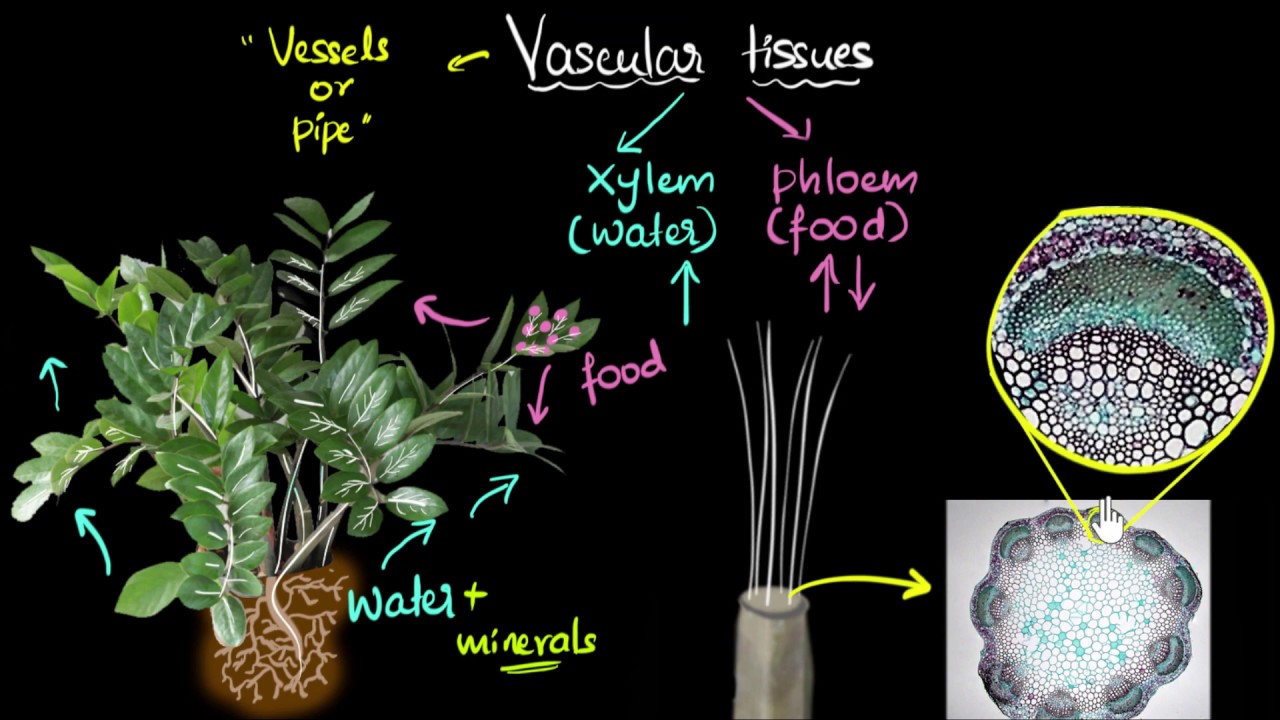
in this video we'll discuss the standard level content regarding transport in plants which is part of b3.2 on just transport in general not all plants have vascular tissue right specially designed tissue um aimed at transporting things but the plants who do have a specialized tube called a xylm and this zym we need to associate with the movement of water okay so the xylm carries water from what I say roots to choots it only goes in this upward Direction and it relies on two basic forces that relate back to those special properties of water so we
have cohesion which is water attracted to other water molecules and adhesion which is water highly attracted to the sides of the xylem so the way that transpiration works is that water is going to evaporate through the sto of the leaves and then because of cohesion it's going to be highly attracted to the water molecules behind it and it's going to pull those water molecules up in a single continuous column now it does all this without the use of energy but you know gravity is really kind of like pushing things in the opposite direction so because
water is also um highly adhesive to the sides of the xylm that again helps to pull water up against the force of gravity due to that sucking or pulling or tension created by the evaporation through those stamata and we can think of that as what we call a transpirational pull it is literally a pulling Force happening from the um evaporation through those holes called stamata so in thinking what the xylem has to be able to do we need to get water moving upwards through this structural feature right so what kind of adaptations might a xylem
have well the xylem is made out of dead Hollow cells and that's going to be very important for the maintenance of a continuous water column so if this is a water molecule and it's evaporating then it needs to be able to pull the water molecules up beneath it and that relies on cohesion cohesion only works if they are in contact with each other so the fact that that xylem is hollow and made out of dead cells allows all those water molecules to maintain contact a continuous column cohesion works now this xylem is going to be
under a lot of pressure it's going to need a lot of structural support and that's where we get this lignan um coming in and being very useful so Lian is a polysaccharide and I can see it it's in these like Rings um that line the outside of the xylem so these Z ligan Rings that's that's what gets thicker every year so we can kind of see those rings on a tree but in general this ligant is here to help provide structural support and prevent the collapse of the xylem the xylem is also going to have
these like pits um along the outside so if I had to draw those in that might look like something like this okay so there's little pits here along the outside of the xylem and that's really great for water to be able to pass through as we'll learn about later water needs to be able to move between the xylem and the other tube of the plant which is the flum so we need some pits in order for that water to be able to pass in and out now we have to be able to look at micrographs
um and be able to find things like the xylem and the flum so let's kind of deconstruct what we're being asked to do here distribution of tissues means where are these different features in the trans transverse section of the stem okay well if I'm thinking about a plant mind you this is going to look quite bad here's the stem here's maybe some roots and here's I don't know a couple of leaves wow this is as bad as I thought it would be okay if I'm looking at the stem a transverse section means I'm taking a
cut out of the side like this that's the transverse section and then I'm going to flip it over on its side so kind of like taking a slice out of the middle of a loaf of bread so I'm just looking at a section of the stem and I'm looking at a dous plant well plants in general can be classified in lots of different ways one of the ways you might hear them referred to as monocots and dcot it's just two different groups of plants don't worry we only have to know how dcot alonis plant tissue
is arranged well anyways when I take a cross-section uh a transverse cross-section and then I lay it on its side I'm going to get a picture like this and what I'm going to notice is that all along the outside arranged in this like ring um we'll see these things these are called vascular bundles okay so your vascular system is like your arteries veins and capillaries a plant's vascular system is going to be made up of two tubes okay one of which is the xylem that's what we just talked about and the xylem you're going to
notice is always going to be the part of the vascular bundle that's closest towards the center of the plant so are you noticing in this picture that each of these vascular bundles tends to have two regions we have a region closer towards the outside and then a region closer towards the inside well this region closer towards the inside is the xylm and that other bit of tissue closer towards the outside of each vascular bundle is the flum okay so this is what we are being asked to do here is a can we find a vascular
bundle and then within a vascular bundle do we understand that the xylm is going to be more towards the center and the flum is going to be more closer to the periphery that's all this means now as you can see there are other things in here this very inside portion here is called the pith okay and then surrounding these vascular bundles is an area known as the cortex okay and then all along the outside here we have this region called the epidermis so dermis means skin Epi on the outside that's the epidermis so let's just
be clear on what each of these features does okay the xylem is there for transporting water that's what we've been talking about the phum is there to transport sugar or other like organic molecules that the plant is producing the epidermis is there for like protection waterproofing keeping things within that stem the cortex this is where photosynthesis is going to happen it also supports those vascular bundles but in general we'll find um lots of different cell types there and then the pith doesn't really have a function person say it provides bulk to that stem okay but
here are the distribution of tissues within a stem now in a root we're going to find many of the same features just in a slightly different Arrangement so all along the outside here we have the epidermis okay we have the xylm which is all the way in the center and it's conveniently kind of like in this x shape and we have the flm okay which is located near the xylm we're always going to find them together but a little bit closer to the periphery and we have the cortex right in here and in general these
are going to have like the same function the only thing that I would point out is that on the epidermis we would see these little root hairs these are there to increase the surface area for water absorption but the same basic layout here between the stem and the roots or I should say the same structural features um but because in a different part of the plant they may have um a slightly different Arrangement so some things to look out for here with transport in plants
![B3.2 HL Transport in Animals [IB Biology HL]](https://img.youtube.com/vi/tkv0Z_SUdv4/maxresdefault.jpg)
![B4.1 Adaptations to the Environment [IB Biology SL/HL]](https://img.youtube.com/vi/dcr6HKLvRiM/maxresdefault.jpg)


![B3.2 Transport in Animals [IB Biology SL/HL]](https://img.youtube.com/vi/wgBvMkybdyo/maxresdefault.jpg)
![B3.1 Gas Exchange in Plants [IB Biology SL/HL]](https://img.youtube.com/vi/M3Q2JHoX_hc/maxresdefault.jpg)
![B3.1 Gas Exchange in Animals [IB Biology SL/HL]](https://img.youtube.com/vi/1OqMFq43spw/maxresdefault.jpg)
![B3.3 HL Muscles Structure [IB Biology HL]](https://img.youtube.com/vi/wT6WhBTy7Hg/maxresdefault.jpg)


![B3.2 HL Transport in Plants [IB Biology HL]](https://img.youtube.com/vi/iWLxi9Xh35E/maxresdefault.jpg)