well fabulous and Thank You Jessica I am very excited about being with everybody tonight and as Jessica said I'm Pam goth art another professional learning coordinator for social stage school service and Nystrom education so thank you all so much for being with us I'm really excited about the topic tonight I'm very big on assessment I think that assessments are a major component that we use not only as teachers but as administrators and leaders in the field of social studies now we can debate the idea whether or not grades are a good idea but I do
think assessments are a good idea so let's get started if we can sometimes when I move that over it doesn't start right away let me get that going okay so our Jin districts this afternoon and it's words are a little bit about what assessments are don't want to use them go look at by the formative and summative assessments and then we're also going to do just a little bit on the difference between traditional versus authentic assessments and then I want to kind of wind down the webinar with really talking about the c3 framework the teacher
is looking at dimension four where it talks about baby getting results and technique inform to action I'd really like you guys to be participatory tonight so if you would in your chat section there I'd love to know like what what are some things that you came to this session wanting to know about tonight for assessments we had way more than a full slate of people register for tonight I've got a lot of people that weren't able to get in so it's a hot topic but why why is assessment a hot topic what is it that
you had in mind for tonight or are there any particular questions or thoughts that you have going into our session for the saving using that chat feature on the right hand side of your screen there I'd love to hear some of your questions or thoughts oh okay good question okay we've got some good things here looking at difference between using traditional test using something more alternative or authentic and then as anyone chosen the power standards from the d4 in the c3 that's a great question and Eric I'd love to hear what you're doing with the
c3 they are with with your school let's see we're gonna and start into this but please go ahead and keep posting I'd love to hear from you to see what you're thinking about assessments as well so I'm gonna start with scan like what are assessments and why are we really talking about these tonight and I want to differentiate between assessments and grades grades are another topic altogether I really like to look at assessments and assessments or measures there ways that we look at students learning and measure somehow what that learning has accomplished or to what
degree students have will learn have learned something assessments to me are evidence of student learning it's the it's the proof that students have learned something and I put it like this so what if you went to your physician or surgeon and your surgeon has never had to prove to anyone that they really know how to conduct a surgery would you be okay with that and I'm thinking I would not be okay with that like I want my surgeon to approve to someone either through some type of authentic assessment maybe where they're doing a surgery with
someone right there as well as some type of pen and paper assessment to to indicate to me that yeah they know how to do surgery so I would want something some type of assessment there so if I want some type of assessment I'm gonna start with formative assessments informative assessments should drive your teaching and and they're not where you start you start with that backward design model of starting with where is it you want students to get to and I want to get them over here to this big circle down here on my line at
the bottom I want to get them to this big circle that's gonna be my summative assessment but to get them to that summative assessment I have several formative assessments that I want to do along the way that's going to help me gauge whether or not they're getting it we say that is teachers did they get it did they understand or comprehend what the study was for that particular or less than her unit and so that's wearing to start with tonight is our formative assessments and the formative assessments drive our teaching because they drive whether or
not we maybe forward or whether we need to back up and reteach something and also this all summative assessments can be formative but not all formative assessments can be summative and what are your thoughts on that do you think that's a true statement that summative assessments can also be formative what do you think okay okay yes anybody else want to chime in what do you think can summative assessments also be formative good good thanks for the answers sir I appreciate that you guys thanks so much so I'm going to start with just going over a
few a few types of forms of assessments and these are things that are trying to come and I'm gonna say chain twelve because tonight's webinar really is k12 but I'm gonna say these are just some of the ones that we can look at close reading activities sometimes it's monitoring students it's walking around the room it's listening to what they're saying watching what they're doing those are formative assessments and those are the things you do so many times in a day quick writes quizzes not my favorite but I drew it up on the list quizzes I
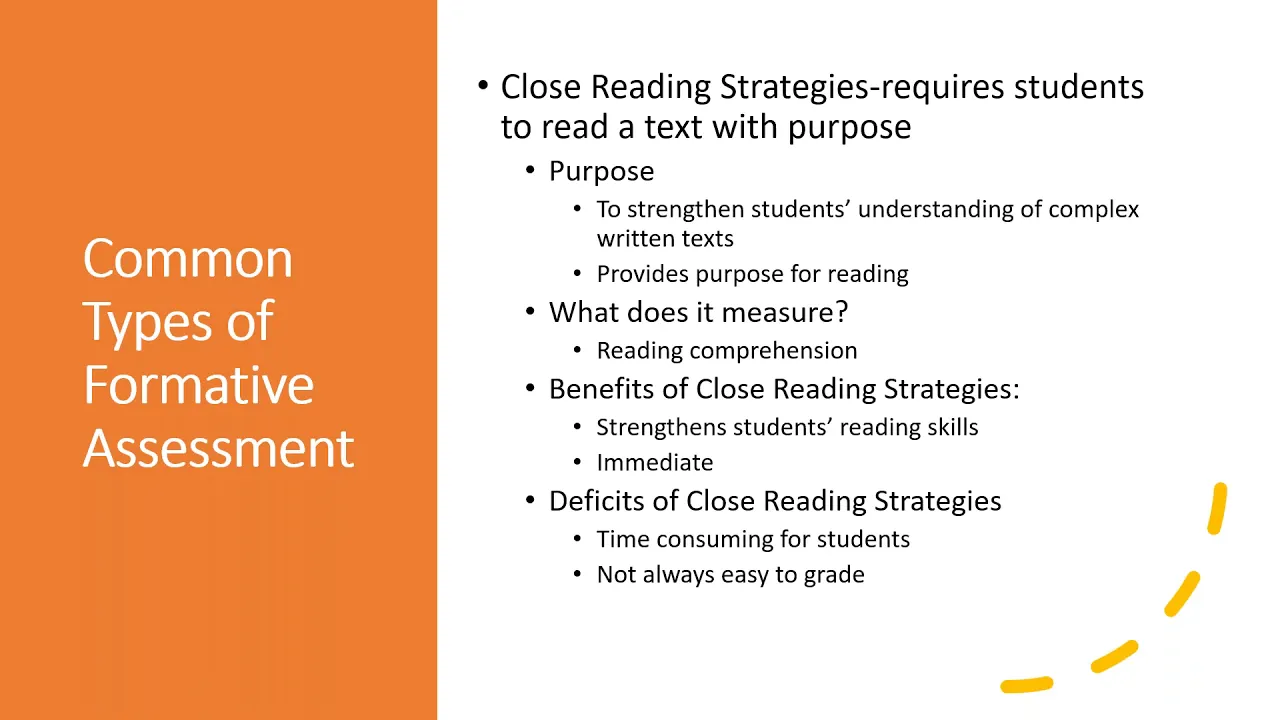
don't personally like them but you know we're all different hand gestures and I mean that in the nine sister why is that helped me anything ugly like a thumbs up thumbs down did they get it exit slips these are all types of formative assessments and so we break these down a little bit look at a close reading strategy for instance a close reading strategy requires students to read a text with some type of purpose now that I'm going to tell you I love I love that students read with a purpose I think it really helps
on so many fronts so a purpose for a close reading activity might be to strengthen their understanding of complex text or for me it just provides a purpose for their reading which in vertically also strengthens their understanding for the reading of complex sex it measures comprehension and I'm sure it measures other things too so these aren't just like you know all answers but they're just some kind of a shorter two bits of answers what are the benefits of close reading strategies and students reading skills and their immediate if you guys use active class which I
absolutely love one of my favorite reading activities in active classroom it's called power basics and they're short chunks of reading always followed by either multiple choice or true false or some kind of little quick assessment that just says hey I got this yes I can answer these questions I like that because it's so immediate the deficits of using a close reading strategy is that for one thing it can be time-consuming because we're asking the students to actually slow down and read for comprehension we're not reading for fluency today so that's can be a deficit it's
also positive and sometimes they're not easy to write you know there are some things we do with a close reading where they circled is underlined that question marks here and you know we're having them use all these different things within a text sometimes that can get a little murky if we're actually trying to put a grade on it so benefits and deficits too close reading strategies I'm personally I'm a fan of them quick writes and that's also baby coastin said oh I love food writes me too I love it I love when kids have an
opportunity to write a quick response to a question that kind of sums up the day's activities I think that there are purposeful and that they give students a good opportunity one to practice their writing skills putting down on paper what they're thinking and two again is that comprehension of content what did they actually learn today Thomas Mann American War jot it down and they're giving me that little quick write it it measures their thinking so it doesn't always measure understanding but it certainly measures your thinking about something and it's nice because it can be quick
it can be a mini assessment that's leading towards that summative assessment maybe at the end of a segment they're going to write like a five paragraph DBQ if they're using these quick writes along the way then that's helping to prepare them and get them ready for for that DBQ the deficit for the quick write it sometimes it can be a little more time-consuming degrade I mean you know let's just face it for a high school teacher and I'm out there my classes I used to have around 32 a class I have three of them a
day and ninety students to grade so every night if I went home as a quick write you know that's gonna take some time but it's it's a balance between what works for your students what helps them to really be productive and efficient and get out of learning what they need another one that I really like is exit slips some type of way of summarizing the main points from the day it might be like okay today we so in spanish-american war give me four things that you learn today well sometimes and this is just my own
personal experience I've seen teachers use exit slips mores and accountability feature rather than an academic sometimes they do it just to say like hey I've collected these at the end of the day everybody turned it in everybody gets some kind of you know nominal grade for having done something I'm not a fan of that but again you know we're all different we all come from different aspects to that k12 spectrum also purposeful they help students to determine what the big ideas of the day were yes kind of like you can't have students take notes on
things when they don't really understand what the big ideas are they have to learn those things so the exit slip can be a way to get students to hone those skills a little bit to stifle stifles not stifle let's trifle animate but to kind of sift through all that we've done in a day and come up with those things that really were the the takeaways it measures the rate at which students are able to recognize the big ideas and it helps to determine their ability to determine what those important ideas of the day are typically
they're quick degrade or easy to review if you're not writing them of course the deficit is that they are going to lack depth of sanding thumbs-up thumbs-down and dumb sideways okay have to be totally honest here I use these in my trainings a lot of the time and as I was writing this I got to thinking maybe I shouldn't use that anymore because it really doesn't tell you a lot but I would say just to teachers you know we're in here we're learning about active classroom how do you feel about being able to assign an
activity to your students do you feel like you can do that give me a thumbs up if you can't give me a thumbs down and if you're not sure give me a thumb side ways you know that really doesn't tell me what they know it tells me what they think they know so I started rethinking this when I'm like oh and kind of thinking now I don't know if I should do that what do you guys think do you like thumbs up thumbs down or is that kind of one that just really maybe doesn't measure
enough force even you use what do you think is it worth using or not what do you think I'm seeing some post Oh Jennifer you don't like it either really okay Jessi could do we have any other posts that we need to take a look at it at the moment I've seen quite a few coming through you that I needed unmute myself as well I can't don't like it we're getting some on this for the thumbs-up thumbs-down but I know there's been a lot of posts in there Jessica could you just take a look and
see if I need to answer anything I cannot as if we can see him we cannot see you right now we should just be able to see the chat feature he also mentions that world history project a big history project creation of digital portfolios has been helpful Oh a lot of portfolios good one yes exit slips I like what Brittany just said oh you have them do a thumbs-up thumbs-down but you have them do it where it's not real visible to everybody that's pretty cool yeah yeah I like that let me know if there's anything
that we need to answer or or whatever as we go along okay yeah right now I think very good I don't do any good so in terms of using our formative assessment I would like to say this as a former social studies supervisor going out and watching teachers I would watch teachers use formative assessment multiple multiple times in a day the thing was at the end of the day I'd say so what what are you doing with all the formative assessment information you calendar today and I would get like these blank stares and it's like
okay we we've all been taught to use formative assessment but it's what you do with it that really matters so if we're gathering it and collecting in we're storing it in buckets and we get done at the end of the day and we don't do anything with it it was a little pointless race to do all the formative assessments the formative assessments are really the things that help us know if we need to reteach something or move on and sometimes with social studies that can be tricky because sometimes we're working on skills it take a
long time to develop me you can at least be a guide for isn't help us along the way so as we think about foreign so we're also going to move in then to summative assessments now summative assessments can be formative but if not all formative can be summed for instance we've studied a unit on States and we've finished the unit maybe on the state of Maine and we do some type of formative assessment summative assessment maybe it's data fourth grade notebook that we're all familiar with that has all the stuff glued into it we made
comments on it and that's our summative assessment could that also be a formative assessment of what is - might be doing in a bigger picture of now moving from state history to u.s. history I think we can think about summative assessments that way although I do believe that we have to have some type of sort of summative assessment some way that kind of wraps up a unit of study a chapter a topic a theme it kind of at least ties it together and says oK we've kind of talked about this done this and now we
have assessed it not that we're gonna leave it and not ever touch it again but that we're gonna at least kind of move on from that point some of these assessments are culminating activities a variety of culminating activities can be used it can be the end of the chapter tests or an interview net test project based assessment I love project-based performance-based and product based assessment I like things that are more authentic in nature again I'm telling you a lot of what I like it is completely up to you guys what you guys like we're all
different document based questions I love using document based questions open-ended questions standardized testing oh I said that dirty word standardized testing standardized testing is a form of summative assessment oftentimes administered by our state departments sometimes by our school districts individually but primarily by state departments and typically we don't think of standardized testing as a form of summative assessment we think of it as just that one big test that we've all got to get through in order to be able to get back to teaching in our classrooms but it really is a summative assessment of what
students have learned up to that point whether it's some reading or math or some type of critical thinking or whatever it is we're using so summative assessments can be in a variety of formats per unit or a chapter test we use as a lot to measure students learning of a particular set of content or skills they're typically speaking easy to grade and they do reflect students learning and in terms of limitations sometimes they're limited to the scope of the content skills that are actually tested and they're not always rigorous sometimes they have portions that are
rigorous but in general a unit test or a chapter test in and of itself is not a rigorous document portions of it are project-based dot project based assessments tend to be more real world based or real problem-based again your own project problem performance product all of those kind of collectively can be in there together but they are in some way a way that students apply what they've learned to a real-world situation whatever that might be the benefits are it's very in-depth typically rigorous the other side of that is they're limiting in that there are time
consuming to grade and sometimes they're very time-consuming to plan so trade-offs we always have trade-offs right but project-based and we would say in that one performance based product based problem values - all of those if any of you are active classroom users this is where we think about a zombie based geography or the historians apprentice or document debating the documents in fact one of my favorite activities in active classroom is based on dbq's is called debate in two documents I love it dbq's are designed to have some type of culminating question that's at the end
of students reviewing some primary sources and the number of primary sources can differ but it's some collection of primary sources typically they're rigorous and typically it gives you a good level of understanding as to what the students really know the downside to that would be again takes time to grade again looking at trade-offs between all of these different types of assessment and then we get into traditional versus authentic or alternative traditional refers typically a pen and paper like difficult tests we think a standardized test unit tests chapter tests typically they are most weiss items vocabulary
items generally they do have a mix of other questions within that range in critical thinking questions to open-ended questions and then authentic or alternative assessments typically refer to those things that are more real world design project-based problem-based gbq type questions range in that more authentic area of assessments and then that kind of leads us up to the c3 framework I don't want you guys to tell me just you know we're all on here together it doesn't matter who does and who doesn't tell me if you know about a c3 framework why do you know what
it is where it came from and B's in your classroom just give me a yes or no even that'll be great let me just do what you guys think do you know about the c3 framework okay okay let's see what else do you know about it do you know where it comes from do you know how to use it okay definitely got some mixed reactions here okay good to know good to know so this comes from the National Council for social studies it's from in CSS org I have the website on there just so you
guys can look at it later if you'd like but there are four dimensions to the c3 framework and if you look at the different dimensions of the framework what you're actually doing it's not only are you conducting the teaching in these but you're also viewing the opportunity for formative assessment as you work up to dimension four where you have your kind of culminating activities and your summative assessments so let's take a look at dimension one dimension one is all about developing questions and planning inquiries and the c3 framework is about having an inquiry and students
being involved in the inquiry to get to that opportunity to deliver some type of summative evaluation so I put some examples up here for you dimension one is about developing questions particularly compelling questions so I pulled from our second grade program for non-citizens and one of the questions is what does it take to make a state from fifth grade I looked at how did the English colonies grow and you notice in both of those the teacher is asking the questions I like them though - in middle school world in in high school and put it
on the student to ask the questions and we can do this either way at any of the grade levels for middle school I pulled from one of our curriculum asked I believe Jenna kerchner right this way I'm not sure exactly but said you'd have students brain brainstorm the meaning of revolution what does it take to be a revolution and they explained to the students that they're gonna be studying about scientific ideas and political revolutions and have them work with a partner to develop questions they want to know about revolutions and then the idea be to
hang these around the room and these are going to be your guiding questions then throughout your stay that you're doing here on the Scientific Revolution enlightenment the political revolutions in the period for highschool US history we're using an atlas of US history on the spanish-american war and it says using the overseas Empire amount write down what you notice and wonder about the math and then what you're gonna do Sherwood take those things that you wonder about the map and you're going to make them into more compelling questions and again I think those around the room
the students are more invested they've written the questions that they want to learn about during your study of the spanish-american war so this is to mention one of your secret framework where you or the students are asking questions are designing the inquiry that you want to learn about dimension two of the c3 framework I'm not spending a lot of time on dimension two or three but dimension two is about applying your disciplinary tools and here you can see like one of the standards here says create news of chronological sequence of related events to compare development
that happened at the same time I think a timeline would being great you see or you could use a timeline where maybe even the students draw images for the different periods and things that are going on but dimension two of your c3 framework it's about applying the Disciplinary tools and concepts of history geography economics and civics we're applying all of those lens to what we're studying in the social studies and dimension three is now looking at the sources by the primary and secondary in the evaluating sources judging the sources on their credibility and and their
usefulness and going through as students collecting the information from multiple sources and using that information to help make judgments and analysis about what it is you're studying so you can see dimension one two and three students are doing students are studying the inquiry students are using the different the social studies and students are evaluating the sources and using evidence to to get to the summative assessment so all of these are formative to this point and then they get to two dimension for the c3 framework we're really talking about having students communicate their conclusions or take
informed action and I love this idea of informed action because we don't want to just take action we wanted to take in for action what does that mean what does it look like well it means maybe constructing arguments with recent Wow who woulda thought that was right we want students to actually construct an argument using reason or using evidence from what they've learned here we're strengthened constructing explanations whether it's at the grade 2 level and if I didn't really said it earlier these are from the seed framework and these are your dimension 4 standards so
this is for k2 students 3 3 5 students 6 8 and 9 12 that's our grade bands with using the c3 but they're constructing explanations think about in what form of summative assessment did your students best construct an explanation or how could they best summarize an argument defend a position how could they best do that what manner of summative assessment might you do to let them express that learning through defending a position and then it's about critiquing arguments critiquing explanations explaining problems and taking or working towards some type of solution draw a disciplinary concept to
it drawing on disciplinary concepts to explain the challenges people have faced and opportunities they've created in addressing local regional and global problems at various times wow that's like today we're all recording scene right so that's like what could they do how could they address this they're looking at real-world problems in working towards solutions and taking action how does students take action well maybe one way they take action is maybe they write the head of their Emergency Management Agency in your state and give them suggestions from a fifth grader on how to deal with our Cove
in nineteen or maybe it's even not only the classroom but even beyond the classroom they could also do things like presentations in class doing these summative by the c3 framework does not mean that every unit every chapter has to end in some type of big thing of going outside the classroom to your legislators but it does mean that students need you have a variety of ways through which they communicate their learning to you whether it's writing whether it's in a presentation they stand up and deliver in class or a project they put on a project
board they need opportunities or ways to give to you that evidence that proof of their learning in a summative format and here are just a couple of examples of the d4 that I've put up for you this is from a second-grade project out of young citizens and each chapter in young citizens ends with a chapter test and this chapter project you can do one or both this one is having them make movie posters and you can see here a little bit about that but this is another way that students can communicate their learning and another
way is this is from a high school assessment document based assessment of US history the debate over American imperialism and the students are going to be answering a DBQ so they're gonna be answering in a five paragraph response but however we want to have those summative assessments delivered we need to provide opportunity for students to deliver that through a variety of methods and if we're using your traditional test be sure that we're including something on it that is open-ended or ways for students to express their critical thinking about what it is they've learned so assessments
assessments provide for us the evidence that student learning has occurred they're helping us determine if we reached our goal with our students formative assessments help us to connect the dots along the way to make sure that the students get to the science of assessment they're successful let me say this you shouldn't give a summative assessment and then getting grades at the surprise you if the graves on the summative assessments surprise you at how low they are something was amiss during the formative assessments along the way I used to have a a colleague and she would
just teach her heart out I mean she would come in the workroom all the time tell me I did this with my students and I did that with my students a and she was like oh well fireball and then as I got into another position I started observing her I was like oh my gosh like she teaches her heart out but she never stopped to measure whether or not students were getting what she was giving and it was always her giving it wasn't them like inquiry design and getting it for themselves she was giving it
she never measured whether or not they were getting it till the final assessment and then she'd be like you know I've taught this for three weeks and I don't understand my kids didn't understand it they didn't get any of it I'm thinking oh I now can tell you why they're not getting it you didn't do anything in the formative assessments to ensure that they were getting where you needed them to get you so there shouldn't be a disconnect when you get to summative the responses you get out of your students should not be surprising because
we should already know along the way how they're doing and if they're not doing well we should be backing up and and reteaching or giving more opportunities for practice along the way summative assessment just gives us a way to tie that has occurred during a unit chapter project of study I would love to talk to you guys more about assessment so please take a few moments give me a question give me a question post something here for us I'd love to share with you and hear from you what you guys know want to know want
to share about assessments whatever that is whether it's formative or summative or traditional or authentic feel free to share that I'm gonna take a look at some of the things you guys have been posting ah Eric thank you look at that Eric just shared his contact information with us please feel free to reach out to Eric Eric is in an international school there in South Korea great wouldn't it be great to connect your students to his students love light okay looks like a lot of comments on the c3 good as you exit today please take
a couple of seconds to complete that short evaluation for us okay anybody else let's oh I've got some really nice comments in here I loved it dad dairy huh men not pronounce that correctly but Darius said that using some assessments with writing always big I love that yeah you know I like to have gents really talk about things too before I get them to write I feel like if they talk about it then they're usually able to write it out a little bit better too okay if you have anything else you'd like to share please
do post it we do save our chat post and if there's anything in there that you guys had questions about that I missed I'll go back over that and make sure that I email you today or tomorrow with some kind of response to that other than that