This is a place with no people. Not even a trace of us. No civilizations, no technology, no cities.
Before us is a world no human ever [music] witnessed. A world with different laws and different rulers. This is Earth 66 million years ago.
And here, dinosaurs reign supreme. All kinds of them. Tiny and giant.
Predators and herbivores. They occupy every environment. Land, coastlines, and shallow waters.
This world is stable. It has existed [music] for millions of years, and it would have remained the same to this day if not for one event that no one was prepared for. What came after the dinosaurs?
The shallow waters of an ancient sea. The future Gulf of Mexico. 66 million years ago.
An ordinary day. Sunny, warm, humid. Ferns and conifer forests stretch to the horizon.
Along the coastal plain, a group of triceratops slowly wanders, tearing off low branches as they go. From the forest shadows, a Tyrannosaurus watches them, choosing its prey. Quetzalcoatlus occasionally glides above the plain, scanning for carrion and small dinosaurs.
This is a stable ecosystem and only one thing does not fit into this picture. High in the sky, there's something strange like a dim star, but it's moving and growing brighter until its light outshines the sun itself. And it will not pass by because this is a killer asteroid.
It's 10 km across, larger than Mount Everest. Its speed [music] is 20 km per second. The impact site is a shallow warm sea near the Yucatan Peninsula.
The collision lasts only fractions of a second, but the energy released is equivalent to billions of atomic bombs. At the point of impact, the sea instantly evaporates. The seabed is no barrier for this cosmic [music] monster, either.
It literally collapses under the blow, nearly reaching the mantle. Rock is hurled outward, forming a colossal bowl in the earth, 100 km in diameter and 30 [music] km deep. The impact raises a tsunami in the sea, unlike anything the planet has ever seen.
It crashes onto the coastal plain. The 5-ton Triceratopses don't stand a chance. A massive wall of water surges toward them.
There is nowhere to run. It's impossible to escape. The colossal mass of water sweeps up the herd.
Multi-ton dinosaur bodies, once the seemingly unshakeable masters of this land, are swirled in a raging whirlpool. The coastal valley turns into a gigantic concrete mixer. And this torrent is not just water.
It is a deadly mixture of sharp rock fragments, [music] centuries-old conifer trees torn out by the roots, and pieces of coral reefs. The Tyrannosaurus that tried to flee toward higher ground also vanishes beneath this mass in a split second. Five minutes after the impact.
[music] This basin, the future Chicxulub crater, is hot and unstable immediately after the impact. Melted material and rock debris settle inside it. But this is the floor of an ancient sea, and the water is already returning.
20 minutes after the impact. The water begins its return as if a gigantic dam has collapsed. It is a muddy torrent carrying sand, stones, and fragments of the seabed.
The crater fills, but the terrible cataclysm continues to spread. Even a thousand kilometers from the impact site, a shockwave races across the land, flattening forests and easily toppling multi-ton sauropods. Behind it comes a monstrous wind, howling, blinding with thick dust, hurling branches and tree debris.
Dinosaurs scream in terror. Their cries drowned out by the roar. They fall, try to rise, fall again.
The wind breaks their necks and tears off their skin. There is nowhere to run. The ground is no longer support.
It is a trap. The impact triggers powerful earthquakes. Inside the vast bowl, the water sloshes back and forth, like in a bathtub when you push it.
Waves lift bottom sediments and drop them again, layer by layer. Thus, the ocean documents this terrible day in the geological record. Two hours after the impact, water has completely returned to the crater, but it's no longer the same.
It is filled with the bodies of dead animals, plants, immense amounts of mud and charcoal. Where did it come from? From fires.
They ignite around the impact site, along the coasts of the future Gulf of Mexico, in areas of today's Belize and northern Guatemala. Ash and charred fragments are carried into the water and, together with the tsunami, return to the crater. 24 hours after the impact, the crater is filled.
It no longer boils, but it remains hot. The water is murky and heavy. While the water is sloshing inside the giant bowl, the ejected [music] red-hot debris fell back to Earth.
They spread fires in a wide band across the entire globe. Within a day, >> [music] >> North America is burning. Central Asia, East Asia, Australia, India, parts of Africa, South America.
>> [music] >> The planet is ablaze. This day marks the beginning of the Danian Stage, a period that will test all life on Earth. Darkness lies ahead.
Cold, hunger for millions of species. This is the end. Dust and sulfur rise into the atmosphere.
In a matter of weeks, Earth is covered by a global dust veil and engulfed in fires. The planet is plunged into prolonged twilight for several years. Relatively few organisms die from the immediate impact itself, [music] mostly those near the epicenter, from the shock wave, heat, [music] and tsunami.
But the subsequent global extinction of entire species from the impact's aftermath continues for decades. Plants are the first to die. In such twilight, photosynthesis is nearly impossible.
Fern and conifer forests rapidly thin out. Along with the plants, the insects that depend on them disappear. Ancient bees can no longer find flowers.
Beetles that feed on decaying vegetation also starve. Caterpillars lose their host plants. Their life cycles are cut short.
Large herbivores weaken and die next. Food is tough and nutrient poor. Animals grow poorly, [music] fall ill more often, and reproduce less.
Predators hold on longer. Some even gain a temporary advantage. After all, prey is slow and vulnerable.
Herbivorous Triceratops and Ankylosaurus cross paths by chance in this chaos. A Tyrannosaurus appears. It doesn't even bother to hide.
Before, this would have been a fight to the death. Now, the herbivorous giants can barely hold their heads up. The T-Rex approaches.
Triceratops tries to lower its horns. Ankylosaurus raises its tail club, but no longer has the strength to swing it. Yet, this feast is short-lived.
When the herds of large herbivores vanish, the predators vanish as well. The same happens in the oceans. Microscopic algae disappear, and with them, the entire food chain.
Marine giants like Mosasaurus lose their usual prey and rapidly go extinct. The world is literally starving. And yet, it is not empty.
In the planet's new version, those who can do without light survive. Decomposition now becomes [music] the source of energy. Dead organic matter, remnants of the former world.
About 4. 4 [music] million years have passed. This is the Selandian stage, 61.
6 million years ago. The first stage of life after the impact. [music] The climate remains cool and unstable, and ecosystems are fragile.
Life runs on minimal energy. Fern spores lie dormant in the soil for years, >> [music] >> waiting out the catastrophe. They are the first to germinate.
Then, fungi spread across the planet, [music] creating a nutrient-rich layer. And immediately after them, come cockroaches, flies, >> [music] >> beetles, ants, and termites. Freshwater bodies are full of life, as well.
Amphibians, [music] frogs, and salamanders live here. >> [music] >> They don't need forests or abundance. Moisture and shelter are enough.
Champsosaurus also persists, [music] a semi-aquatic predator resembling a crocodile. It doesn't chase prey, it waits. Its slow metabolism allows [music] it to go without food for weeks.
Fish of the genus Lepisosteus [music] also live here, long-snouted and spotted gars. They rely on a swim bladder, which functions like a primitive lung. When oxygen runs low in the water, they simply rise to the surface and gulp air.
The oceans are not empty, either. Small bony fish, as well as the ancestors of modern sharks and rays, survive. They feed on carrion and small prey, endure long periods without eating, and reproduce in large numbers.
[music] Even corals do not disappear completely. Those living in deeper waters survive. And this is what a day in the new world looks like, 10 years after the impact.
The cataclysms have subsided. The shock waves are gone. The tsunamis have retreated.
The fires have burned out. But the planet is in no hurry to return to the past. The sky remains hazy in places.
On land, there are only sparse thickets, rotting trunks, and patches of exposed damp soil. The world is much quieter. In one such place, beneath the roots of a dead tree, a small animal, Protungulatum, cautiously emerges.
It searches [music] for insects, seeds, scraps of carrion. It eats rarely and slowly. An armored fish of the genus Lepisosteus glides slowly along the surface of the shallows.
It rises for air, taking a risk, because in the murky river, a Champsosaurus lies motionless. It can lie and wait like [music] this for days. And when the fish passes by, >> [music] >> it snatches it with a single sudden lunge.
At night, the world does not sleep either. In the darkness, those who have always lived without [music] bright light, cockroaches, become active. This is truly their golden age.
After all, the world is littered with dead organic matter. Millions of years pass. Humidity continues to rise and temperatures increase.
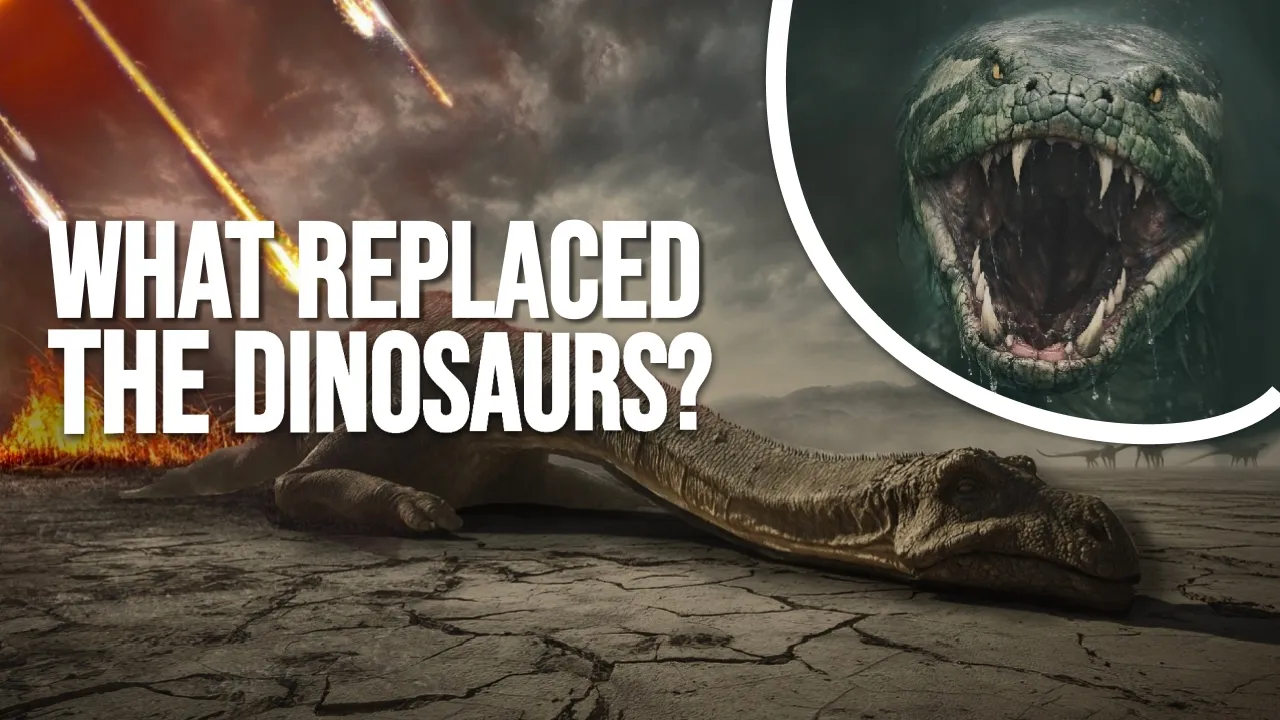
This is the beginning of the Thanetian age, 59 million years ago. The planet [music] has almost recovered. The new world gives rise to Titanoboa, a giant snake, a sign that ecosystems are once again rich in energy.
Its prey consists of those very small animals that survived the catastrophe. [music] It symbolizes the return of the giants, but [music] in a different world. This time, without dinosaurs.