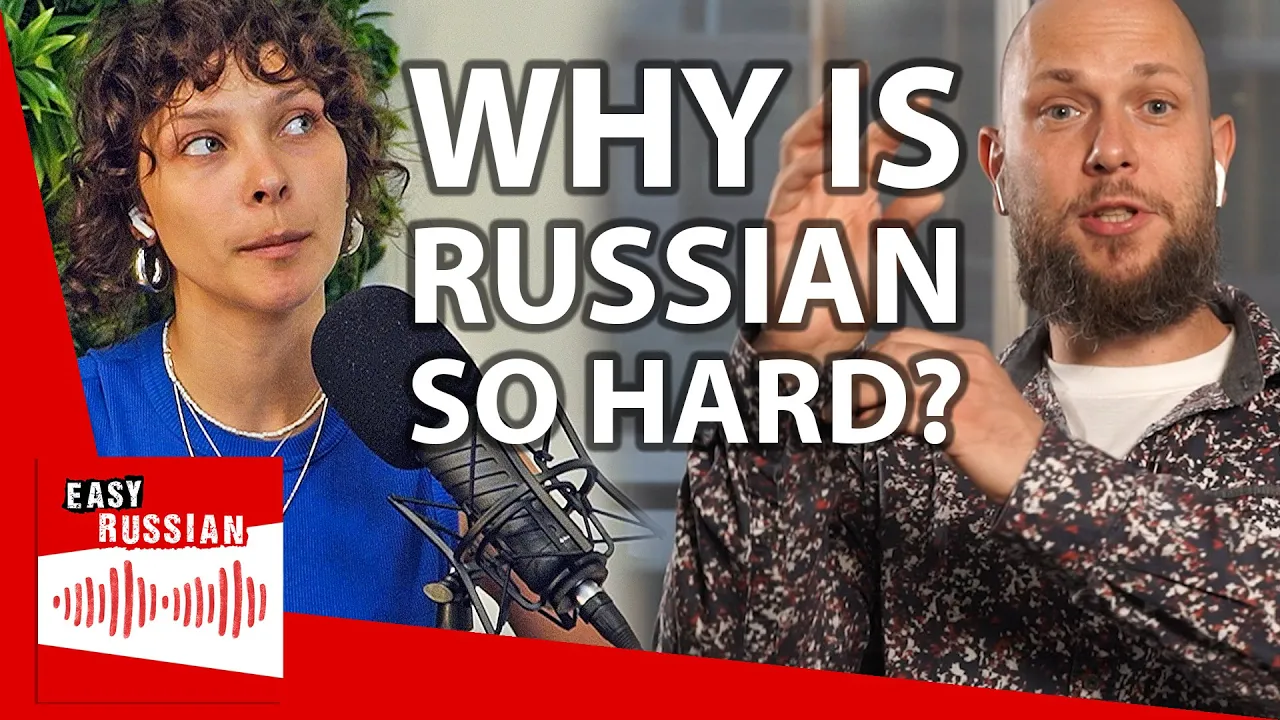
Hi everyone, I'm Marina! Hi, I'm Nikita! We host the Easy Russian podcast from Easy Languages, a podcast for those who learn Russian no matter what.
And today, in video format, we have a sudden topic even for ourselves , proposed by our colleague, these are the difficulties of the Russian language that native Russian speakers themselves face. (That is, we). That is, we.
Yes, absolutely right. Well, I remember a wonderful case when I encountered the most, probably, legendary mistake in the Russian language, the mistake of stress in the word "call". I was taking care of a girl, I must have been, I think, fourteen years old at school.
I really liked her. I followed her home. Well, this whole, so to speak, classic set of courtship from a teenager.
And somewhere, almost at the most crucial moment, as it seemed to me, with a possible kiss, I said something with the emphasis "call". And she corrected me. One of the most burning shameful moments in my life, which I will remember forever.
It took me, it seems to me, literally five minutes after that, to learn the correct stress once and for all: "call", "call", "let's call". Do you have similar memories, Marina? "Calls / calls" - this is generally often the most common mistake indeed.
About "ringing" and "calling" I can't remember a situation like yours, but I probably remember something about "shut/shut" or "put on" and "put on". "Drss" and "put on". Yes.
To be honest, the truth does not come to mind right now, no situation directly similar to yours. But I have noticed the following peculiarity in myself lately : due to the fact that I write a lot in Google Doc or in Word, or in notes on an iPhone or in Google search, anywhere on the Internet and on a computer and phone. There, I have auto-correction turned on everywhere, and I noticed that after quite a long time with this auto-correction, the conditional "T9", I began to make much more grammatical errors than I did before, because my Russian language has always been good, and at the university I also studied it diligently all four years.
Because I am a journalist, I need to be able to write well on it. This is my main professional tool. Here.
But this T9, this auto-correction, auto-correct on the iPhone, of course, played its role, and I began to notice that I was making some stupid mistakes, for example, about “ts” and “ts”. Every time I accidentally made this mistake, I sent a message and then I reread it and I’m like, “God, how could I do this? It’s super some kind of basic .
. . basic thing.
” Therefore, in this sense, I am such a "grammar Nazi", but also regarding myself. And what about you . .
. Listen, such a question, what infuriates you in the mistakes of other people most of all straight? So grammatical?
This is a very good topic. I totally agree with you on autocorrect. In the same way, I am spoiled by autocorrect and any auto-correction.
Yes, confidence in writing the Russian language is slowly disappearing. You know, almost nothing infuriates today. The only thing is.
. . you mentioned a very good detail in your story now: you are re-reading your messages.
So, as I noticed, not all of my pen pals show the same delicate etiquette. Probably what irritates me the most so far is when people don't reread their messages, and not even because of spelling or punctuation errors, but mainly because sometimes it turns out to be completely meaningless. And people send me this message.
I'm happy to imagine how it happens. They must be in a hurry, running, I don't know, they have a lot of things to do. They send me some kind of message important to me, in which I can not understand anything.
This is probably the only thing that annoys me today. Once upon a time, when I was young, of course, I was a snob in this sense of the language. Of course, I always corrected people who were wrong with great pleasure and arrogance.
But this, like many other not very pleasant traits characteristic of young people, slowly disappeared in me over time. Today I even like to hear unusual stress or some unusual variants of the norm or even not the norm of words that I meet in different regions especially. Yes.
Or now I am in Latvia. It is clear that there is a lot of Russian here, but here the Russian language has a local flavor, yes, with some kind of local refraction. And to listen to how there were some obvious changes in Russian words under the influence of the proximity to the Latvian language, it is simply interesting for me today.
That is, when I hear some unusual word, I am so happy, I try to remember even this unusual form of pronunciation. So now, probably, nothing irritates. Although, if we already talked about correspondence, I also remembered what annoys me - this is probably not exactly about the Russian language, but about any language, in general, about written correspondence in social networks or instant messengers.
This is when a person writes some detailed thought in a series of short messages. That is, he writes something like: "I think", "it is necessary after all" - this is the next message - "although" there is something like that. You.
. . you're sitting, just shaking with some.
. . mixture of indignation and anticipation.
What will this person tell you now? And then somewhere in the middle, he can even disappear for five minutes. Well, it would seem, take and write the whole thought, I don’t know, in three sentences or even in two paragraphs, if you want to say a lot of things.
By the way, I also sin with this, to be honest. I wanted to ask myself about spelling. In Russian, the spelling is quite difficult for us as native speakers, too, to be honest, because a lot of things are written differently than they sound.
Now I'm trying to remember some examples, such. Well, for example, "eucalyptus". Even the word "life", which was recently mentioned in examples with the letter "s" in our video.
Yes, well, "zhyyyyzn. " What is this word? Or "sun".
Oh, by the way, "life" is a very good example when you say it, this "life" is like "s", but you write it with "and". And these are things that, probably, you just need to remember. I mean, you can't really explain it.
"Zhi shi write with the letter I," by the way, that's the rule. Yes, here it just matters, as you say, with what is heard and how it is written, the same regional coefficient. Well, we all know that the Moscow pronunciation is shakish.
And the Moscow pronunciation became the literary norm, also due to the fact that the central television and radio were located in Moscow. It is considered a classic of the Russian language. If you take it, I'm just trying to remember who we have there especially strongly?
Kostroma, probably some, I'm afraid, now, unfortunately, make a mistake. I can only say that the Rostovites are more hacking, and the Tambovites are hacking [fricative "g"]. But I am sure of this, because my relatives are partly from Tambov, and here I will definitely not lie.
And, by the way, my grandmother, who is from Tambov, she is a teacher of Russian language and literature. And every summer, when I came to her for a month or even a month and a half, she sat me down at the table and taught me the Russian language, so for a long time I really knew it very, very well. I'll just correct you that the word "sadila" is not very true in Russian.
Rather, it "planted" or "seated". Did I say "sit at the table"? (Yes).
Here you see how it works. "Sadila"! Although now you said it, and I'm like this: "Что?
! Я сказала "садила"? !
Я думаю, что это немножко пришло к нам из норм украинского языка, скорее всего. Поэтому это даже не то, чтобы ошибка, а скорее твоя наслушенность и насмотренность всем потоком новостей, которые мы наблюдаем. Нет, вообще-то, если бы я подумала, я бы сказала, "сажала за стол".
То есть я бы "садила" не сказала, я бы сказала "садилась". Оканье. Есть такое понятие "оканье" в русском языке, То есть некоторые регионы России якобы окают, то есть с выраженным.
. . с выраженным звуком "о" произносят слова.
В то время как на самом деле это, конечно же, ошибка - оканья в чистом виде нет, это люди, которые просто читают так, как пишется. А наше московское "аканье" как раз-таки существует. Ну знаменитый пример, например, слово "корова", да, "карова".
Оно пишется через "О", то есть, по сути, его надо бы почитать как "корова". И есть регионы, где именно так читают, но это считается ошибкой, потому что правильное, значит, произношение "карова". А ещё каждый раз, когда я редактирую расшифровку к нашему подкасту, я постоянно попадаюсь на ошибку автоматического расшифровщика, то есть того, который преобразует звук речи в текст.
If I say "of which," pay attention, it sounds through "A". And this confuses the decoder absolutely automatically, because it is such and such, it offers a variety of refined options for non-existent words to me, while it is really just "about which". That is, the Moscow pronunciation is "and which.
" Well, listen, I just wanted to add about the school and . . .
the norms of language schools and the norms of the literary Russian language. There are two schools: St. Petersburg and Moscow, and yes, Moscow, as you said, is considered to be a kind of standard.
And the standard here is, like the example with the cow, that you don’t go into either “a” or “o”, it is something in between “a” and “o”. It's like a middle ground between these sounds. "Cow".
I didn’t seem to dip, didn’t look, but everything became clear, yes. But about Moscow, I want to say that Muscovites really sing, and we don’t notice, but often I sometimes even catch myself on this, that I can talk, talk, and then like this: “Maaaskvaaa”. Maaskvichi.
Now I'm parodying myself, but it's real, like, "I'm from Maaaskwa. " Yes, they often left me such comments under the video, yes, "maaaaaskviiiichiiii" again they came to tell us something here. Well, what to do.
I remember I had a funny situation with this. I went for an internship in Prague a few years ago, and there was a very cool girl with whom we became friends. She is from Belarus, from Minsk.
She speaks Russian, Belarusian too, but Russian is her main language. In Belarus, in principle, they speak Russian a lot . And at some point we sit with her, chatting in the evening, and she's like: "God, how I missed your Moscow accent, like this.
. . " Like, "How I missed good Russian, the Moscow accent.
" I'm like, "What do you mean? What Moscow accent? " At that moment, I realized that you can understand that you are from Moscow really by accent.
It was we who sat there in our Moscow and were like: "Ha, we don't have an accent! " No, it's an accent, it's like everyone has it. Which side are you looking at.
And this is absolutely normal. And I just . .
. "Narmalnaaa", do you hear, right? No, no, of course I can't hear.
I speak the same way. Yes. "Raaaazgowaaarivayu.
" The kittens have gathered. Ah, horror. Meow!
Today we have a cheasy podcast like this. My friends! Unfortunately, due to my distraction, the very best the end of our podcast was not recorded - my camera turned off.
So do not be surprised, with the help of the magic of editing and such inserts, I will supplement our release a little. Firstly, I want to immediately remind you of what exactly you get if you become our paid subscriber. Most of all, of course, I am proud of our interactive transcript.
What it is? It's like a normal transcript of everything we say with Marina. But at the same time, when you listen to our podcast, exactly those words that we are pronouncing at that moment are highlighted in yellow right in this transcript .
And if you press another button next to it, you will also see the translation into English of what we are saying. It helps a lot. It turns out that before you is something like a bilingual book, where you can read both the original and the translation into English.
So I don't think you'll have any problem understanding exactly what we're talking about on our podcast. Be that as it may, I encourage you to subscribe to us, support us and listen to our podcasts with us. Thank you for your support!
Let me tell you about spelling. What you mentioned. I have a tricky question for you, so to speak.
This is a very easy test question. How much did you read as a child? Yes very.
I read a lot as a child, I repeat, because my grandmother is a teacher of Russian and literature. Well, I loved to read. How much did you learn the rules of the Russian language?
Rules . . .
yes, but I taught them much more at the university, but I just remember. I hear doubts. I taught them, yes, but still, it seems to me, I taught them at the university, and there it was some new level of directly studying these rules.
Of course, it is such an amazing, very simple phenomenon. The fact is that all people who read a lot in childhood practically did not need the rules of the Russian language in order not to make spelling mistakes. It's just trained visual memory.
In fact, absolutely so. That is why, despite the frequent differences in the sound and spelling of a word, for most, probably, people, this is not a problem. They just memorized how it's spelled.
This is such a magic. And the rules that we then begin to learn at the university . .
. So I began to study at the Literary Institute some time ago, and there the teacher and I had a lot of funny situations on this topic. At some point, he simply called me to the board after a long bickering and said that he would now destroy my innate literacy with ten examples.
This is, of course, a joke. He didn't mean to offend me. (Nightmare!
) And he really . . .
I, unfortunately, did not remember these examples, but he very easily puzzled me, because he himself is a very well-read person, an old professor who saw hundreds and thousands of goldfinches like me. And he perfectly understands what's going on. That is what he explained to me.
Yes, of course, a well-read person, especially if he read a lot in childhood, and children have a phenomenal memory, including visual memory, they write almost unmistakably in any language, including Russian, of course. But there are a number of situations, there are quite a lot of them, where this photo-visual memory will not help you in any way. That's how he put me in a puddle.
Therefore, in general, it is very important here, apparently, to read, read, read and look at this text. But just the autocorrect, which you mentioned, discourages this innate talent from us, which I am very sorry about. We said about stress: "cottage cheese" or "cottage cheese"?
Hummus or Hummus? "Anime" or "Anime"? "Salmon" caviar or "salmon"?
I can easily give you answers to all these questions, but these will be the answers of my personal norm simply, and not the present norm. (Come on! ) Well, probably "anime", perhaps.
What is your personal standard? And now I'll tell you. "Salmon" or "salmon".
"Salmon" caviar. Wrong! "Salmon"!
That's right for me, I'm authoritarian enough for that! So what else did we have? "cottage cheese" or "cottage cheese"?
Both norms were. . .
were acceptable, as far as I remember. But personally, I say "cottage cheese". I say "cottage cheese" and "cottage cheese" too, by the way.
It depends. But here you mentioned about coffee, the changed kind of words. "Coffee" has always been and will remain masculine!
Coffee is not! Coffee is it! Remember this!
I hasten to upset you that (No! ) the neuter gender "coffee" has been normalized for several years now, yes. No, I.
. . No, no, no, I deny it!
This is illiterate! This is not smart! This is illiterate!
I know it's normalized, but that's illiterate. No one should say that coffee is because it's wrong, friends! You can say "cottage cheese" or "cottage cheese", but coffee is a man!
I agree with you absolutely. For me, this is also unacceptable. And also this type, by the way .
. . Speaking of this normalization.
"Agreement". Lord, if you ever hear someone say "agreement", do not communicate with him in Russian anymore . "Contract"!
But there is also the famous word "oil pipeline", which I deliberately pronounce incorrectly, because it is necessary to say "oil pipeline". But I would not be surprised if today this word is already normalized in both forms. How could we forget the most legendary example for journalists, especially for court journalists or lawyers and advocates or public defenders?
This is the word "convicted", Which is so often used by judges, escorts, prosecutors, and so on. Oh nightmare! It just got bad.
"Convicted". Convicted! Whereas, of course, the correct stress is "condemned", because in Russian words with the letter "ё" are always stressed on the letter "ё".
By the way, I also wanted to say about checking yourself for "dressing" and . . .
"dressing" and "putting on. " "To hope. " "Put on".
. . it's very easy to check.
"Drss". . .
now. . .
wait. . .
Did you forget the name? Wait, no. .
. putting on. .
. "putting" something on something, putting clothes on yourself or putting socks on a lamp. Why not?
And "dress" someone or dress in something. "Put on clothes, put on Hope. " I mean, you can't.
. . No, you can, but it would be wrong to say, for example, "I'm wearing socks.
" You "put on" socks. Well, you can, if you dress up a sock, maybe you have a sock with eyes, a mouth, ears. On the hand is this one with which .
. . "Talk to the sock!
" "Hello! " If you have a sock that you dress up, then yes, maybe. And if not, then you can't.
No, I can still remember a wonderful incident, also from my youth, when I watched the film "Radio Wave", such a very touching movie. And it was probably one of the first video cassettes that was at my disposal with good dubbing. Not these legendary one-voiced pirate translations are nasal, although now, of course, I miss them, they had their own charm, but such a full-fledged artistic dubbing with good Russian speech.
And there, at some point, one character says to his friend: "Wow! Look, I found an old radio. Let's turn it on?
" ("Turn it on? ") I already hung up and paused. I had to rewind.
I didn't believe my ears. Then I ran to the dictionary. Yes, yes, that's how it turned out, not "turn on", as I said before, music, but "turn on".
Yes, absolutely right. This is the correct stress in this word. That's what I've been studying for probably a week.
Why don't you know? Well, because that's the right accent. "Include".
You don't say "turn on" do you? I do not speak. But I say "turn on".
And why "turn on" then? If you say "turn on", then "turn on", "turn on", "turn on", "turn on" and so on. There are many more subtle, of course, traps.
Or how I relearned how to pronounce the word "providing. " Well, because the word "providing" is even easier to pronounce. This is the wrong accent.
When you say "providing", you pronounce all the letters, all the sounds in this word. And if you put the emphasis on "providing", then suddenly the last syllable is eaten up. From the word "provide".
Yes. You seem to be relearning "from Russian to French", Well, as if it were very strange. Yes, there is such a feeling.
Although it's interesting, it seems to be your native language. Ah, many brilliant feelings, of course, are caused by the native language. Well?
Listen and read, read and listen. And to be in an environment with this language. This is really the most important thing.
Well, watch movies in this language, listen to podcasts in good Russian. I do this sometimes really to remember in general, people speak good, correct Russian, because when you live in a country where your native language is not spoken, you lose some part of your vocabulary , I guess. But it's not like you're losing it.
He goes into the background. You always have it, but this vocabulary of yours, phrases, something else - they do not develop. Books in this case, of course, will help, but still, I think it's more important to take it by ear.
Do you have any offhand example of native Russian speakers that you would recommend? Well, maybe even, probably, dead people, if we are talking about records. So do you have any standard of the Russian language that sounds?
This is an interesting question. For some reason, Maya Kristalinskaya appeared in my head right now . Yes OK.
Very good. I remembered Naum Kleiman for some reason right off the bat, well, I just really like his enveloping voice, yes. Maya Kristalinskaya is a singer, by the way.
Perhaps Leonid Parfenov is sometimes very nice to me, although . . .
Definitely, yes. Leonid Parfenov. Yes.
I can’t guarantee that this is a reference pronunciation, but it is definitely practically a reference living Russian speech. I propose to agree that there is no standard pronunciation, and it is absolutely normal and in any language, especially in Russian, there should be a place for any pronunciation variant, any variant of the norm and any accent, as we call it. Because the accent.
. . well, it's like it doesn't really exist.
To call something an accent is to say automatically that as I speak it is better than what you say. That is, I'm taller than you and better. But that's not the case.
That is, we speak a Rostov accent, but for Rostovites we have a Moscow accent, and their pronunciation is correct. Therefore, I propose to agree that any options are good, as long as you learn the language and try to improve in it. That is, we reject, for example, the example of "Pygmalion" or, if we take the film, "My Fair Lady", where, therefore, high English was a tool for transforming the whole personality.
Nts, I actually actually really reject. I reject. .
. I don't reject. I don't like this concept, it's very snobbish.
But it's undeniable that language really has a big impact on your thinking and worldview. This is true. Then I propose to agree on a peaceful compromise.
Let each one develop his own language and torment others less by pestering his tongue. This is true. I agree with you, Nikita.
Good way out. Well, here you can’t do without one more thing that we offer to our paid subscribers. You get access to our Discord channel.
In this channel, we discuss everything related to filming, our life, our plans for the future, we receive news from you as well. Your opinions about our releases, suggestions for topics, your wishes and much, much, much more. The most important thing is live and real communication, which, for example, I really miss.
It's very cool when I can talk to you online. So subscribe to us and come chat on Discord. Well, we can say goodbye to that.
All for now, see you soon! Bye everyone!