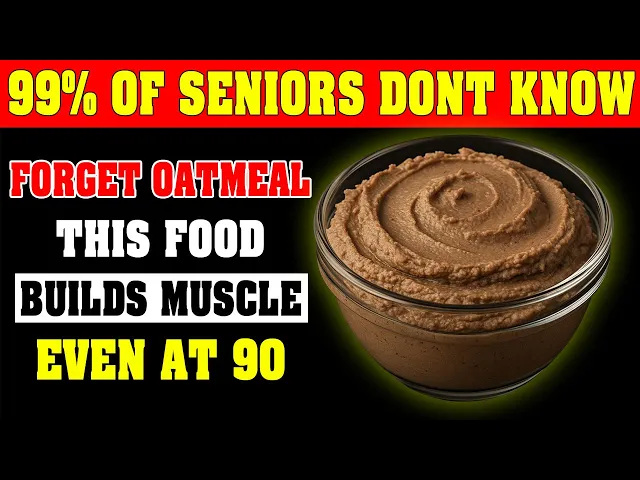
Have you been starting your mornings with a steaming bowl of oatmeal, believing it's the ultimate healthy breakfast after 60? You're not alone. In the United States, millions of seniors reach for oats every day, trusting that it will fuel their bodies and keep their hearts strong.
But here's a hard truth nobody wants to say out loud. While oatmeal is comforting and full of fiber, it's not the muscle builder you think it is. In fact, relying on it as your primary breakfast can quietly leave your muscles underfed and your strength slipping away year after year.
If you've noticed that climbing stairs feels harder, carrying groceries feels heavier, or your legs just don't respond the way they used to, you might be facing something called sarcopenia, the gradual loss of muscle mass that creeps in after 60. Doctors estimate that older adults lose up to 1% of their muscle every single year if they don't get enough of the right nutrients. Oats alone simply don't supply the complete protein and critical amino acids needed to fight back.
That's why so many well-meaning seniors are unknowingly watching their strength decline despite eating healthy. But what if your very first meal of the day could flip that script? Imagine replacing that beige bowl with a food so powerful it can rebuild lost muscle fibers, spark energy, and even reverse years of weakness without pills, powders, or fat diets.
This isn't a gimmick. It's a time-tested, science-backed food hiding in plain sight. And in the next few minutes, you're going to discover exactly what it is, how it works, and how to make it part of your routine starting tomorrow morning.
Stay tuned because by the end of this video, you'll know why it's time to forget oatmeal and embrace a breakfast that actually builds muscle and kills sarcopenia after 60. Food number one, mature soybeans. The plant protein that acts like meat.
You've probably been told that oatmeal gives you steady energy, but when it comes to building muscle after 60, fiber alone won't do the job. What your muscles are starving for is complete protein with a hefty dose of leucine, the trigger amino acid that flips your body's muscle building switch back on. And no plant on Earth does this better than the humble mature soybean.
Once these beans reach full maturity and are cooked, every 100 gram delivers about 21 gram of protein, more than four eggs, more than almost any other vegetable, and right up there with lean cuts of meat. But it's not just the quantity. Soybeans supply all nine essential amino acids in a balance remarkably close to human needs.
That's why researchers often call soy the plant that acts like meat. In a landmark 2012 randomized trial published in the Journal of Nutrition, older adults who consumed soy protein daily gained muscle comparable to those using whey protein. Clear proof you don't need animal products to fight sarcopenia.
Adding mature soybeans to your breakfast is easier than you think. You can soak and cook them ahead of time, then stir them into a warm porridge with a splash of soy milk, or toss them into a savory morning salad with diced vegetables, olive oil, and a squeeze of lemon. Unlike oatmeal, which mainly gives you carbs and fiber, this bowl delivers highquality protein, iron, magnesium, and isoflavones that protect your joints and bones at the same time.
And here's the best part. Soy protein digests slowly, giving your muscles a steady supply of amino acids through the morning. That means less midm morning fatigue, better recovery after light exercise, and a stronger base to fight the creeping loss of muscle.
It's like replacing an empty fire with real logs instead of paper. The energy and structure last. If swapping out your oatmeal for soybeans sounds unusual, stick with me.
In the next section, you'll discover another surprising breakfast food that not only fuels your muscles, but also calms inflammation and protects your heart at the same time. It might already be sitting in your pantry, just waiting to become your new morning powerhouse. Food number two, lentils with chia seeds.
Most people think of lentils as something you eat for lunch or dinner, not breakfast. But paired with chia seeds, this humble legume becomes a morning powerhouse that outshines oatmeal in every way that matters. for muscles after 60.
Cooked lentils deliver 9 g of protein per 100 g, plus slow digesting complex carbohydrates and a wealth of minerals like iron, magnesium, and potassium. On their own, lentils already help stabilize blood sugar and give lasting energy. But when you sprinkle in chia seeds, you're adding plant-based omega-3 fatty acids, extra protein, and soluble fiber that soothes inflammation in the gut.
This matters more than most people realize. Chronic low-grade inflammation and poor absorption quietly sabotage your muscle building efforts, even if you're eating enough protein on paper. The lentil chia duo tackles both problems at once, feeding your muscles and calming the internal fire that erodess them.
A 2021 study in nutrients found that older adults who increased their intake of omega-3 rich seeds while eating moderate amounts of legumes saw measurable improvements in muscle strength and walking speed compared to a control group. The mechanism, better amino acid utilization, improved circulation, and reduced oxidative stress in muscle tissue. In simpler words, your breakfast isn't just filling you up.
It's actively helping your muscles repair and grow. You can prepare this combo quickly. Cook red or green lentils until soft, mash lightly, and stir in a spoonful of soaked chia seeds.
Add a pinch of turmeric and black pepper for extra anti-inflammatory power. If you prefer sweet flavors, blend lentils with banana, cinnamon, and chia to create a creamy breakfast pudding. Either way, you're getting a high protein, high-fiber, omega-3 infused meal.
And the beauty is how affordable and versatile this is. A bag of lentils and a jar of chia seeds cost less than a box of fancy cereal, but deliver exponentially more muscle-saving nutrients. That's why more nutritionists are calling this pairing the new porridge.
for active seniors. If you thought lentils and chia were a twist, wait until you see the next breakfast food. It's a familiar favorite that when combined the right way, delivers a onetwo punch of fast and slow proteins to keep your muscles rebuilding all morning long.
Food number three, eggs. Greek yogurt. It's something you've probably eaten at some point, but never realized how powerful it can be when combined correctly.
We're talking about eggs paired with Greek yogurt, a duo that gives your muscles both an immediate jolt of amino acids and a steady stream of protein for hours afterward. Compared to oatmeal, which is mostly carbs, this combo is like switching from a trickle to a waterfall of muscle nutrition. One large egg delivers about 6 to 7 g of high quality protein along with leucine, vitamin B12, and choline, all vital for nerve and muscle function.
Greek yogurt, especially the unsweetened strained type, adds 10 gram or more of caseinrich protein per 100 gram, plus probiotics that improve gut health and nutrient absorption. When you eat them together, you're giving your body a fast protein, the egg, and a slow protein, the yogurt, which researchers at Mastri University found can extend muscle protein synthesis for up to 4 hours after a meal. In other words, your muscles don't just get fed and then left hungry.
They're continuously supplied with the building blocks they need. Preparing this breakfast is simple. Boil or poach two eggs and serve them with a generous scoop of plain Greek yogurt.
Add fresh berries or a drizzle of honey for taste. Sprinkle a pinch of cinnamon for blood sugar control or stir in chopped nuts for extra crunch. You can even make a savory version.
Whisk eggs into an omelette and have it with a side of cucumber dill Greek yogurt for a Mediterranean twist. Either way, you're packing in more highquality protein before 9:00 a. m.
than oatmeal could give you in an entire day. This isn't just about numbers. Eggs and Greek yogurt supply vitamin D, selenium, calcium, and probiotics.
Nutrients that protect your bones, improve muscle contraction, and keep your immune system resilient. For older adults, that's like reinforcing the scaffolding while also adding bricks to the structure. If you're still holding on to your oatmeal spoon, keep watching.
In the next section, we'll reveal a breakfast that goes even further. A creamy spoonable food that feels like dessert, but works like a muscle rebuilding supplement. Food number four, cottage cheese or quark with almonds.
If eggs with Greek yogurt gave your muscles a one-two punch of fast and slow protein, this next food feels almost like dessert, but works like a muscle building supplement. We're talking about cottage cheese, or its European cousin, Quark, topped with a handful of almonds. Together, they create a creamy, satisfying breakfast that far outperforms oatmeal for anyone trying to hold on to strength after 60.
One cup of low-fat cottage cheese gives you around 25 to 28 gram of caseinrich protein, which digests slowly and keeps your muscles supplied with amino acids well into the morning. Cork is similar, a strained, thick dairy product popular in Europe with about the same protein profile, but an even creamier texture. Unlike oatmeal, which is mostly carbohydrate, this duo offers almost pure highquality protein with minimal sugar.
Add almonds and you're bringing in vitamin E, magnesium, and healthy fats. Nutrients that support nerve function, reduce oxidative stress, and improve muscle contraction. Studies show that seniors with higher intakes of vitamin E and magnesium not only maintain stronger grips, but also recover faster from exercise.
Scoop half a cup to a cup of cottage cheese or quark into a bowl. Top with a small handful of raw or lightly toasted almonds and add berries or cinnamon for flavor. For a savory twist, mix in chopped herbs and diced cucumber.
Drzzle with olive oil and eat it with whole grain toast. Unlike oatmeal, which gives you a quick spike of carbs and then leaves you hungry, this creamy bowl fuels your muscles, protects your joints, and keeps you full until lunch. And there's a hidden bonus.
Quin protein in cottage cheese has been shown to reduce muscle breakdown during periods of fasting or sleep, which is why many athletes eat it before bed. For seniors, having it at breakfast means your starting the day by actively preventing muscle loss rather than passively hoping fiber will do the job. If you're intrigued by a breakfast that tastes like a treat but builds like a supplement, stay tuned.
Food number five, smoked salmon or sardines. Omega-3 power for muscle and mind. Up to now, our breakfast swaps have been plant-based or dairybased.
But your muscles and your brain also thrive on nutrients that plants simply can't provide in high enough amounts. This next food swims instead of grows. By adding smoked salmon or sardines to your morning routine, you're feeding your body the kind of protein and healthy fats that oatmeal will never deliver.
and you're doing it in a way that's fast, savory, and surprisingly affordable. A 100 gram serving of salmon or sardines gives you 20 to 25 g of complete protein along with 23 g of EPA and DHA omega-3 fatty acids, the anti-inflammatory fats your muscles and joints crave. These omega-3s improve blood flow to muscle tissue, reduce exercise induced soreness, and even boost the effectiveness of resistance training in older adults.
In a 2019 randomized trial published in the American Journal of Clinical Nutrition, seniors who consumed fish rich in omega-3s twice a week, built more lean mass, and improved grip strength compared to a control group on the same exercise plan. In other words, the fish didn't just protect their hearts, it helped rebuild their muscles. Preparing this breakfast couldn't be simpler.
Lay a few slices of smoked salmon on whole grain bread or christryen. Pea bread. Add cucumber or arugula.
Drzzle with lemon or olive oil. For sardines, open a can packed in water or olive oil. Mash lightly with a fork and spread over toast or mix into scrambled eggs.
Either option gives you a dense dose of highquality protein, omega-3s, vitamin D, and heem iron, a form of iron your body absorbs far more easily than the plant-based kind in oatmeal or spinach. That heem iron is critical for transporting oxygen to your muscles, so they can actually use the protein you're eating. And because both salmon and sardines are rich in vitamin B12 and selenium, they also support nerve health and protect against age- related cognitive decline.
For older adults, that's like giving your entire neuromuscular system an upgrade first thing in the morning. If you think swapping your morning oats for fish sounds odd, remember in many coastal cultures, fish for breakfast is the norm, and rates of age related frailty are lower. With smoked salmon or sardines, you're simply borrowing a tradition that's been keeping people strong for centuries.
In the next section, you'll discover a breakfast food that doesn't swim or sprout. It comes from a humble but nutrient-dense organ that athletes have prized for decades. It's rich in creatine, B vitamins, and iron in a way no grain can match, and it might just be the most powerful secret weapon against sarcopenia hiding in your kitchen.
Food number six, beef liver pate. Up to now, we've looked at beans, seeds, dairy, and fish. But there's one old-fashioned food that athletes, soldiers, and doctors once swore by, but most modern kitchens have forgotten.
Beef liver. Served as a smooth pate on whole grain toast, it makes a rich, savory breakfast that supplies nutrients no bowl of oatmeal could ever hope to match. A modest 100 gram portion of beef liver contains over 25 gram of complete protein, plus an extraordinary concentration of micronutrients.
Vitamin B12 at more than 3,000% of your daily needs, hem iron, zinc, copper, selenium, and creatine. The same compound bodybuilders buy in tubs to power their workouts. These nutrients work together to improve oxygen transport, energy production, and muscle protein synthesis.
Without them, especially B12 and iron, older adults often feel weak, lightaded, and fatigued even when they're eating enough calories. Oatmeal, by contrast, is almost devoid of these critical building blocks. Science has been quietly backing up what traditional cultures already knew.
A 2020 review in Frontiers in Nutrition highlighted organ meats like liver as nutritional powerhouses for aging populations, citing their role in preventing anemia, supporting mitochondrial function, and supplying co-actors for muscle repair. Creatine, abundant in beef liver, has been shown to help older adults maintain lean mass and improve functional strength even without intense exercise. Making beef liver pate at home is simpler than it sounds.
Lightly sauté sliced liver with onions and herbs. Blend until smooth with a knob of butter or olive oil and chill. Spread a thin layer on toast or crackers for breakfast alongside a few slices of tomato or cucumber.
If you prefer convenience, buy high quality pate from a trusted butcher. Even a small serving once or twice a week can replenish stores that decades of grain. a based breakfasts have left empty.
And unlike supplements, you're getting these nutrients in their natural, highly absorbable forms, bundled with protein your muscles can immediately use. This is especially important for seniors whose digestive efficiency has declined. Pills may pass through, but real food nourishes.
If you're ready to take your breakfast from beige to bold, beef liver pate might be your secret weapon. In the next section, we'll look at a modern plantpowered drink you can whip up in minutes. One that combines multiple muscles saving ingredients into a single glass to kickstart your day.
Food number seven, plant protein smoothie with fruits. We've moved from beans to dairy to fish to organ meats, but not every morning gives you time to cook. Some days you need something you can blend, sip, and go.
That's where a plant protein smoothie with fruits comes in. Done right, it can pack more complete protein and muscle saving co-actors into one glass than oatmeal could in an entire bowl. A well-designed smoothie starts with a base of plant protein powder, often from peas, soy, hemp, or a blend, delivering 20, 30 g of complete protein per scoop.
Add a spoon of nut or seed butter like almond, pumpkin seed, or tahini, and you're layering in magnesium, zinc, and healthy fats for joint and nerve support. Blend with fruits such as berries or banana to supply vitamin C and polyphenols that fight oxidative stress and boost collagen formation. The result, a drink that not only fuels your muscles but also protects your connective tissue, circulation, and energy systems at the same time.
A 2022 study in nutrients found that older adults who consumed plant-based protein shakes enriched with antioxidants and omega-3s improved their muscle mass and walking speed over 12 weeks compared to controls. The combination of complete amino acids plus bioactive plant compounds created a synergistic effect that oatmeal on its own could never match. You can customize your smoothie endlessly.
For a creamy texture, use unsweetened soy milk or Greek yogurt as a base. For extra collagen support, add a sprinkle of vitamin C rich fruit like kiwi or strawberries. For joint health, toss in a pinch of turmeric and black pepper.
Everything goes into a blender and takes less than 2 minutes. Faster than cooking oatmeal, but with exponentially more benefits. This isn't just convenience food.
It's strategic nourishment. You're getting high quality protein, anti-inflammatory fats, gut friendly fib, and antioxidants in one go in a form that's easy to digest even for sensitive stomachs. That means better absorption and more building blocks actually reaching your muscles, not just your gut.
If you thought a smoothie couldn't compete with real food, think again. For many seniors, it's the easiest way to hit their protein and micronutrient targets before the day even starts. And because it's drinkable, it's perfect for those with dental issues or reduced appetite.
You've just walked through a completely different way of thinking about breakfast after 60. For years, oatmeal has been the default healthy choice. But as you've seen, fiber alone isn't enough to stop sarcopenia.
Your muscles are hungry for complete proteins, leucine, omega-3s, creatine, vitamins, and minerals. And you can get all of them from ordinary foods that fit easily into your morning routine. I'd love to hear from you.
Which of these breakfasts excites you most? Which one will you try first tomorrow morning? Share your thoughts in the comments so others can be inspired, too.
And if you found this video helpful, please give it a like and subscribe to our channel. It helps us reach more people over 60 who want to stay strong, independent, and vibrant. Don't forget to hit the notification bell so you won't miss the next video where we'll dive into even more everyday foods that quietly rebuild your health from the inside out.
Until next time, take good care of your strength.