Have you ever noticed that when you walk down a hallway or a sidewalk, your eyes are increasingly fixed on the ground immediately in front of your feet, rather than looking at the horizon? It is a subtle shift, one that often happens unconsciously. Over years, we start scanning for uneven pavement, a rug that might slip, or a step that looks a little too high.
This change in visual focus is not merely a habit; it is a physiological symptom of a deeper change within your nervous system. There is a fascinating concept in gerontology known as the decline of proprioception. Simply put, this is your body's ability to sense where it is in space without you looking at it.
When we are young, sensors in our joints and muscles tell our brain exactly where our feet are. As we age, these signals fade, and our brain forces our eyes to take over the workload, leading to that downward gaze and a stiffening of the stride. However, what is truly compelling—and what gives us immense hope—is the concept of neuroplasticity.
We used to believe that once these neural pathways degraded, they were gone forever. Current medical understanding proves this is incorrect. Balance is not a fixed biological trait like eye color; it is a neurological skill, much like learning a language or playing an instrument, and the neural circuitry for balance can be reactivated and strengthened regardless of whether you are fifty, seventy, or eighty-five.
Before we delve into the specific protocols to reverse this decline, I would love to hear from you. It is incredibly encouraging to see a global community of seniors taking proactive steps for their health. Please take a moment to pause and leave a comment below telling me your age and which country or city you are tuning in from.
I make it a point to read and reply to these comments because your participation inspires others. If this is your first time here, please subscribe and share this information with anyone who might benefit from it. Now, let us look at how we assess and rebuild this critical system.
To understand where you stand biologically, we must first strip away the assumptions and test your stability objectively. In clinical settings, we often see patients who believe their balance is fine because they haven't fallen yet, but "not falling" is not the same as having good stability. We are going to conduct two diagnostic assessments.
Before you attempt these, safety is non-negotiable. As we age, our reaction times to a slip slow down. Therefore, position yourself in a corner of the room where you have walls on two sides, or place a sturdy chair with a high back on one side and a wall on the other.
If you ever feel lightheaded, sit down immediately; we are testing your muscles and nerves, not your bravery. The first assessment is known as the Tandem Stance. This test isolates your center of gravity and forces your brain to manage a very narrow base of support.
You will place one foot directly in front of the other, heel to toe, as if you are standing on a tightrope. Keep your arms out for balance, straighten your spine, and fix your gaze on a stationary point at eye level. We aim for a thirty-second hold.
What is happening here physiologically is a stress test of your lateral stability. If you feel your ankles twitching or your body swaying slightly, do not be alarmed. That is your proprioceptive system firing rapidly to correct your position.
These micro-adjustments are healthy. However, if you cannot hold this for at least ten seconds, it indicates that your brain is heavily reliant on a wide stance to maintain equilibrium, which is a significant risk factor for falls. If you found the Tandem Stance challenging, that gives us a baseline to work from, and you should proceed with caution.
If you managed it, we move to a more advanced diagnostic tool called the Flamingo Pose, or the single-leg stance. This is a critical indicator of longevity and functional independence. In geriatric medicine, the ability to stand on one leg is often correlated with brain health and reduced risk of stroke.
Stand near your wall or chair, ready to grab it if necessary, and lift one leg. It does not need to be high; just clear the floor. The goal here varies by age because, physiologically, our fast-twitch muscle fibers decrease as we get older.
For those between fifty and fifty-nine, we look for thirty seconds. In your sixties, twenty to twenty-five seconds is the target. For those in their seventies, fifteen seconds is excellent, and if you are over eighty, holding this for five to eight seconds places you in a superior tier of stability.
If you find yourself grabbing the wall immediately, it suggests that your deep stabilizer muscles have become dormant from lack of use. This brings us directly to the solution phase. We are going to engage in a series of exercises designed to wake up these specific muscle groups.
The first movement focuses on the hip flexors and core stability, which are the engines of your stride. Standing with your feet hip-width apart and your core muscles gently braced —imagine a natural corset tightening around your midsection —slowly lift one knee until your thigh is parallel to the floor. The critical medical component here is the speed of the descent.
Do not let gravity pull your foot down. Lower it slowly. This "eccentric" phase of the movement is where the most significant neuromuscular adaptation occurs.
You are teaching your brain to control the limb throughout its entire range of motion. If you shift your hips wildly to the side to lift the leg, you are compensating with your lower back. Imagine a string pulling you upward from the crown of your head to keep your pelvis level.
This control is what prevents you from stumbling when stepping off a curb or climbing stairs. The second exercise targets a muscle that is often the culprit in walking difficulties: the Gluteus Medius. This muscle sits on the side of your hip and prevents your pelvis from dropping when you lift the opposite leg.
When this muscle is weak, we develop a waddling gait, which is highly unstable. Standing sideways to your support, keep your leg straight and lift it out to the side. Pause for a second at the top.
That pause is vital; it eliminates momentum and forces the muscle fibers to contract fully. Return the leg slowly. You do not need to lift high—this is not a ballet audition.
If you lift too high, you will inevitably tilt your torso, which defeats the purpose. We are isolating the hip joint. By strengthening the Gluteus Medius, we are essentially securing the hinges of your body, ensuring that when you take a step, your foundation remains solid rather than collapsing inward.
We perform these repetitions slowly because slow movement recruits more muscle fibers and reduces the risk of joint strain. Moving down the kinetic chain, we must address the ankles and calves. In the medical community, the calf muscles are frequently referred to as the "second heart.
" This is not a metaphor; it is physiological fact. Your heart pumps blood down to your legs, but it relies on the contraction of your calf muscles to pump that venous blood back up against gravity. Weak calves can lead to fluid retention, swelling, and poor balance sensation.
To train this, stand facing your chair and perform smooth heel-to-toe rocks. Rise up onto your toes, engaging the calves, then lower down and gently rock back onto your heels, lifting your toes. This dual action strengthens the ankle complex in both directions.
When you lift your toes, you are engaging the tibialis anterior, a muscle crucial for preventing "foot drop," a common condition where the toes drag and cause tripping. Do not use momentum to rock back and forth; control the movement so that you feel the tension. You are simultaneously improving your balance and your vascular health.
Next, we must integrate the brain into our movement with a coordination exercise. Falls often occur not when we are walking in a straight line, but when we turn, pivot, or navigate a cluttered room. This requires the brain to calculate complex spatial geometry in real-time.
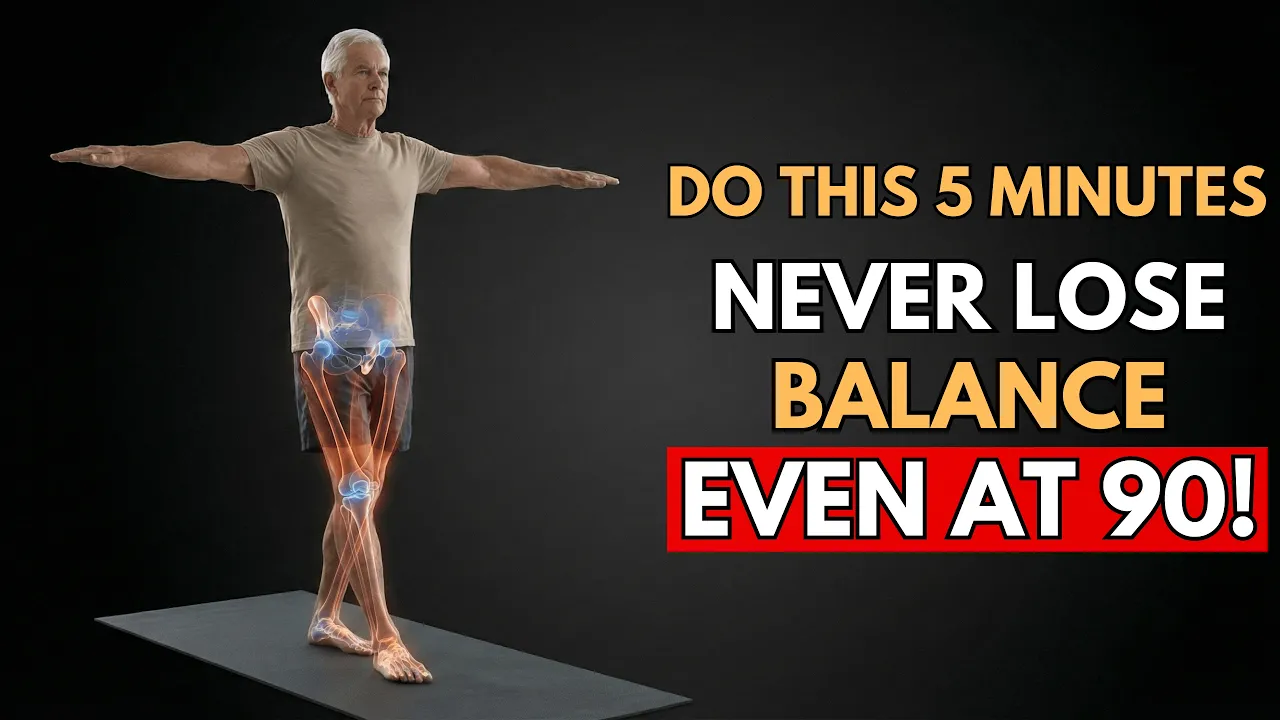
We use a "coordination cross" movement to train this. Standing on one leg, you will tap your other foot to the front, then to the side, and finally—and most importantly—cross it over the standing leg to tap on the opposite side. This crossover movement is essential.
It forces your brain to recognize where your limbs are relative to your centerline. It mimics the mechanics of turning in a tight kitchen or stepping around a pet. By practicing this controlled "tangling" of the legs, you are programming your nervous system to remain calm and stable during awkward movements in daily life.
Finally, we address the vestibular system, which is located in the inner ear. This system works with your vision and joint sensors to keep you upright. We can train it with a "Rocking the Boat" exercise.
Stand with a wide stance, feet firmly planted. Shift your weight smoothly from left to right, like a pendulum. Once you are comfortable and if—and only if—you are near a support and feel safe, try closing your eyes.
Immediately, you will feel a sense of instability. This is because you have removed visual input, forcing your vestibular system to work harder. It is a powerful way to recalibrate your internal gyroscope.
Consistently practicing these movements for just fifteen minutes a day can yield measurable improvements in a matter of weeks. You may notice your stride lengthening, a reduction in the fear of falling, and a general sense of physical lightness. This is your body responding to the demand you are placing on it.
Balance is a "use it or lose it" system, but it is also a "use it and improve it" system. Thank you for investing this time in your health; remember to listen to your body, proceed with patience, and celebrate the small victories in your stability.