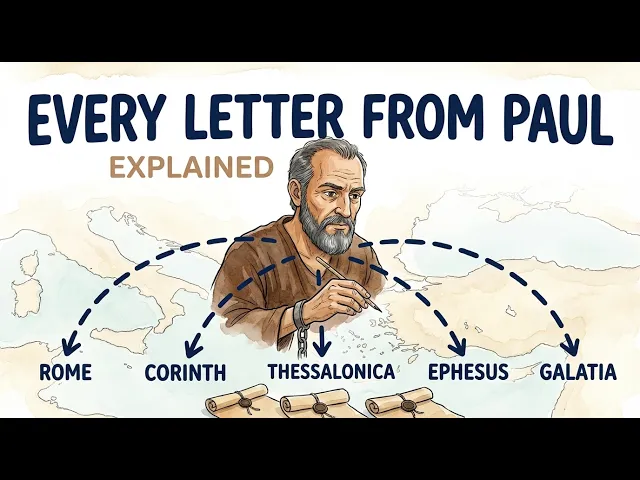
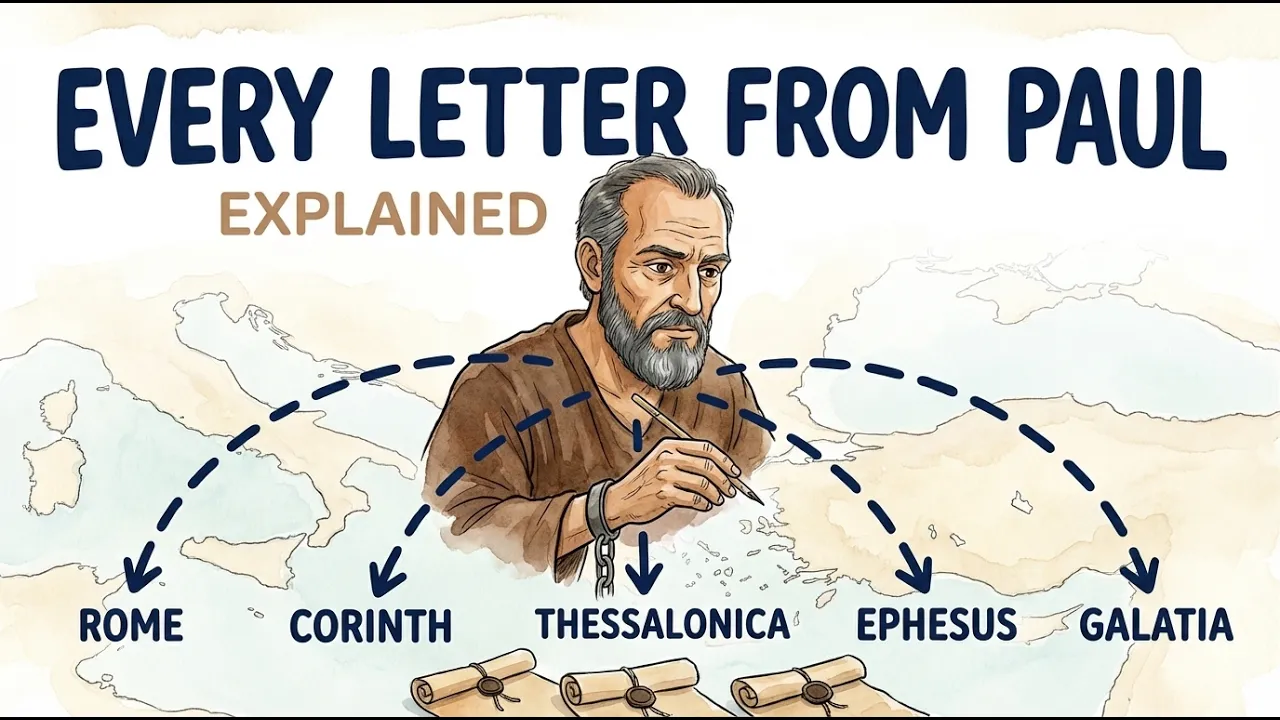
A man sits in a rented room in Rome, changed to a Roman soldier, and he picks up a pen. He is not writing a book. He is not composing theology for a seminary library. He is writing a letter to people he loves, people who are confused, people who are fighting, people who are drifting. And those letters scribbled on papyrus carried by hand across hundreds of miles of Roman roads and Mediterranean sea lanes would become the most influential collection of personal correspondence in the history of the world. 13 letters. That is what the New Testament attributes
to the Apostle Paul. 13 documents written over roughly 15 years from around AD49 to around AD67. And here is something most people never realize. They were not written in the order you find them in your Bible. Your Bible arranges them by length, longest to shortest, Romans first, Phileiman last. It would be like organizing someone's emails by word count instead of by date, you would lose the story completely. But if you read them in the order they were actually written, a completely different picture emerges. You can trace the arc of a man's life. You watch him
fight for the gospel when it is barely off the ground. You watch him build churches from nothing in some of the most morally chaotic cities in the ancient world. You sit with him in prison cells. You feel the betrayal when people he trusted walk away. And you stand behind him in a dark Roman dungeon as he writes his last words to the young man he loved like a son, asking him to bring a cloak because winter is coming and the stone floor is cold. That is what we are going to do. We are going to
walk through every single letter in the order Paul most likely wrote them. And we are going to see what each one was really about, why it mattered in that moment, and why it still speaks directly into your life right now. Let us start at the beginning. The first letter Paul ever wrote, or at least the earliest one we still have, is a letter written in anger. And it is the letter to the Galatians written around AD 48 or 49. And to understand why this letter burns the way it does, you need to know who is
writing it. This is a man who once hunted Christians for a living, who stood by approving as a mob stone Steven to death in Acts chapter 7, and who was struck down by a blinding light on the road to Damascus by the very Christ he was trying to destroy. That man is now writing to defend the gospel he once tried to wipe off the earth. Paul had just returned from his first missionary journey. He had traveled through the region of Galatia in modern-day central Turkey, preaching in cities like Pacidian, Antioch, Iconium, Lististra, and Derby. In
Lististra, a mob stoned him with rocks and dragged his body outside the city, leaving him for dead. Acts 14 19 and 20 tells us what happened next. Then Jews came from Antioch and Iconium, and having persuaded the multitudes, they stoned Paul and dragged him out of the city, supposing him to be dead. However, when the disciples gathered around him, he rose up and went into the city. The next day, he moved on to the next town and kept preaching. He planted churches in every city he visited. And then he went home to Antioch in Syria.
And then he got the news. Other teachers had come into those brand new churches and told the Gentile converts, the non-Jewish believers that faith in Jesus was not enough. You also had to be circumcised. You had to follow the ceremonial requirements of the law of Moses. You had to become Jewish first and then you could be Christian. These teachers are often called the Judaizers, meaning they were pushing Gentile believers to adopt Jewish customs as a condition for salvation. Think about what that means for a second. Paul had nearly died bringing these people the gospel and
now someone was telling them that what he brought them was incomplete. That grace needed a supplement. Paul's response is the angriest letter in the New Testament. Most of Paul's letters open with a warm thanksgiving. I thank God for you every time I remember you. Not this one. Paul opens Galatians with this. Chapter 1 6 and 7. I marvel that you are turning away so soon from him who called you in the grace of Christ to a different gospel which is not another. But there are some who trouble you and want to pervert the gospel of
Christ. No warm greeting, no small talk. He skips the pleasantries entirely and gets right to the point. And then he drops a line that still hits hard. Galatians 1:8. But even if we or an angel from heaven preach any other gospel to you than what we have preached to you, let him be accursed. He says it once and then he says it again in the very next verse just so nobody can say they missed it. The heart of Galatians is one of the most important arguments in the history of Christianity. Paul says in chapter 2:16,
"Knowing that a man is not justified by the works of the law, but by faith in Jesus Christ, even we have believed in Christ Jesus that we might be justified by faith in Christ and not by the works of the law. For by the works of the law, no flesh shall be justified." That word justified simply means declared righteous, accepted by God, not because of what you have done, but because of what Christ has done for you. And then Paul goes all the way back to Abraham, centuries before Moses, and shows that Abraham was counted
righteous because he believed God, not because he followed a set of ceremonial rules that had not even been given yet. Galatians 3:6. Just as Abraham believed God and it was accounted to him for righteousness, the ceremonial law, Paul argues, the rituals and sacrifices that were designed to teach Israel about the coming Messiah, like an illustration pointing to the real thing, those were added later as a guardian, a tutor to point people toward their need for a savior. Galatians 3:es 24 and 25. Therefore, the law was our tutor to bring us to Christ that we might
be justified by faith. But after faith has come, we are no longer under a tutor. Think of it like training wheels on a bike. They serve a purpose for a season. But once you learn to ride, you do not need them anymore. And the Bible itself makes a clear distinction between the two. The Ten Commandments were spoken by God directly with his own voice from Mount Si and written by his own finger on tablets of stone. Exodus 31:18. And when he had made an end of speaking with him on Mount Si, he gave Moses two
tablets of the testimony, tablets of stone written with the finger of God. But the ceremonial laws, the sacrifices, the feast regulations, those were written by Moses in a separate book and placed beside the ark, not inside it. Deuteronomy 31 26. Take this book of the law and put it beside the ark of the covenant of the Lord your God. One was permanent, carved in stone by God himself. The other was temporary, written on parchment by a man, pointing forward to something greater. The moral law, the character of God expressed in the Ten Commandments, still stands
because it reflects who God is. But the ceremonial system that was always pointing forward to Christ, found its fulfillment when he arrived. And then Paul writes one of the most radical sentences in all of ancient literature. Galatians 3 28. There is neither Jew nor Greek. There is neither slave nor free. There is neither male nor female. For you are all one in Christ Jesus. In a world that was rigidly divided by ethnicity, social class, and gender. Paul declares that in Christ, every dividing wall has come down. Not that differences vanish, but that they no longer
determine your standing before God. This is the letter that draws the line. Grace or performance, faith or ritual, freedom or chains, and Paul does not flinch. Now from Galatia, the story moves to Greece. Paul's second missionary journey takes him across the Aian Sea into Europe for the first time. and he arrives in the city of Thessalonica, a major port city in northern Greece, the capital of the Roman province of Macedonia. This is around AD50 or 51. Acts 17 tells us he preached in the synagogue there for three Sabbaths, and some Jews and a large number
of God-fearing Greeks believed, but jealous opponents stirred up a mob. Acts 17 6 and 7. But when they did not find them, they dragged Jason and some brethren to the rulers of the city, crying out. These who have turned the world upside down have come here too. Jason has harbored them, and these are all acting contrary to the decrees of Caesar, saying there is another king, Jesus. Paul had to flee the city at night. He had been there maybe a month. And now these brand new believers were on their own. He made it south to
Athens, then to Corenth. and from Corenth worried sick about the believers he had left behind. He sent his young associate Timothy back to Thessalonica to check on them. When Timothy returned with good news, Paul was so relieved he sat down and wrote what we now call First Thessalonians. It is one of the warmest, most affectionate letters Paul ever wrote. Chapter 2:8. So affectionately longing for you, we were well pleased to impart to you not only the gospel of God but also our own lives because you had become dear to us. This is not a theologian
writing a paper. This is a spiritual father who genuinely loves his children. But the Thessalonians had a question that was eating them alive. Some of their fellow believers had died since Paul left and they were terrified. They thought those who died would miss the second coming of Jesus. They were grieving not just because they lost people they loved but because they thought those people were gone from the promise forever. Paul's answer is one of the most well-known passages in the Bible. First Thessalonians 4 13-18. But I do not want you to be ignorant, brethren, concerning
those who have fallen asleep, lest you sorrow as others who have no hope. For if we believe that Jesus died and rose again, even so God will bring with him those who sleep in Jesus. For this we say to you by the word of the Lord, that we who are alive and remain until the coming of the Lord will by no means precede those who are asleep. For the Lord himself will descend from heaven with a shout, with the voice of an archangel, and with the trumpet of God, and the dead in Christ will rise
first. Then we who are alive and remain shall be caught up together with them in the clouds to meet the Lord in the air. And thus we shall always be with the Lord. Therefore, comfort one another with these words. The dead are not left behind. They are first in line. And notice how Paul ends that passage. Therefore, comfort one another with these words. This is not abstract theology. This is hope you can hold on to at a graveside. Shortly after that first letter, Paul had to write a second one because the church swung to the
other extreme. Some people took the teaching about Jesus coming back and ran wild with it. They quit their jobs. They stopped contributing. They were just sitting around waiting for the end. Why work if the world is about to end? Paul had to correct them. 2 Thessalonians 3 10. For even when we were with you, we commanded you this. If anyone will not work, neither shall he eat. Believing Jesus is coming back does not mean you stop being useful. It means you live with more purpose, not less. Hope is not passivity. Faith does not cancel responsibility.
And here is something worth sitting with for a moment. Imagine being a brand new believer, maybe 30 days old in the faith, and your teacher had to run for his life in the middle of the night. You have no Bible, no church building, no seminary. Just a few weeks of teaching and now you are on your own. That is Thessalonica. And the fact that those believers held on that Paul could write to them and say in chapter 1:8, for from you the word of the Lord has sounded forth, not only in Macedonia and Aaya, but
also in every place. That tells you something about what the Holy Spirit can do with a little bit of truth planted in honest soil. Now the story moves to one of the most important and most difficult churches Paul ever dealt with, Corenth. And his letters to this church written around AD 53-56 are two of the longest and most intense he ever wrote. If Galatia was where Paul fought for doctrine, Corinth is where he had to fight for basic human decency. Corinth was one of the wealthiest and most morally chaotic cities in the Roman Empire. It
sat on a narrow strip of land between two seas, a crossroads of trade routes connecting east and west. Sailors, merchants, and travelers from every corner of the empire passed through. The city had a temple to Aphrodite that, according to the ancient geographer Strao, employed a large number of temple servants in its rituals. The phrase to live like a Corinthian was slang in the ancient world for living without any moral limits. That is the city where Paul planted a church. He spent 18 months there on his second missionary journey. He worked as a tent maker during
the day and preached at night. He built something real and then he left and the church began to fracture almost immediately. First Corinthians reads like a pastor putting out fires one after another. The church has split into factions. Chapter 1 12. Now I say this that each of you says I am of Paul or I am of Apollos or I am of Cphus or I am of Christ. They are suing each other in pagan courts over petty disputes. A man in the congregation is sleeping with his stepmother and instead of addressing it, the church is
proud of how open-minded they are about it. Chapter 5 verse 1. It is actually reported that there is sexual immorality among you and such sexual immorality as is not even named among the Gentiles that a man has his father's wife. People are getting drunk at the communion table. The Lord's supper has turned into a dinner party where the rich eat well and the poor go hungry. They are arguing about spiritual gifts with some people treating their particular gift like a trophy and looking down on everyone else. Every chapter is a different fire and Paul addresses
every single one. But right in the middle of a heated argument about spiritual gifts, Paul hits pause and he writes what many consider the greatest passage ever composed about love. 1 Corinthians 13:es 1-3. Though I speak with the tongues of men and of angels, but have not love, I have become sounding brass or a clanging symbol. And though I have the gift of prophecy and understand all mysteries and all knowledge, and though I have all faith so that I could remove mountains, but have not love, I am nothing. And though I bestow all my goods
to feed the poor, and though I give my body to be burned, but have not love, it profits me nothing. And then verses 4-8, love suffers long and is kind. Love does not envy. Love does not parade itself, is not puffed up, does not behave rudely, does not seek its own, is not provoked, thinks no evil, does not rejoice in iniquity, but rejoices in the truth, bears all things, believes all things, hopes all things, endures all things. Love never fails. Now, here is what most people miss. This is not romantic poetry for a wedding card.
In its original context, Paul is talking to a church that is ripping itself apart. He is telling them you can speak every language on earth and in heaven. You can give away everything you own. You can have faith that literally moves mountains. But if you do not have love, you are just noise, a clanging symbol. All volume, no music. Then in chapter 15, Paul delivers the most thorough defense of the resurrection in the entire New Testament. He names the witnesses. He builds the case step by step. And he makes the stakes clear. Chapter 15:es 17-
20. And if Christ is not risen, your faith is feudal. You are still in your sins. Then also those who have fallen asleep in Christ have perished. If in this life only we have hope in Christ, we are of all men the most pitiable. But now Christ is risen from the dead and has become the first fruits of those who have fallen asleep. That word first fruits comes from the harvest. The first fruits were the very first crop to come up out of the ground and they were the guarantee that the rest of the harvest
was coming. Paul is saying that Christ's resurrection is not just one event. It is the first crop. It is the proof that everyone who belongs to him will rise too. The resurrection is not an appendix to the gospel. It is the gospel. Now 2 Corinthians comes later and the mood has completely shifted between the two letters. Something deeply painful happened. Paul visited Corinth and was publicly humiliated by someone in the church. We do not know the exact details. He left hurt. He wrote what he calls a severe letter filled with tears which we no longer
have. By the time he sits down to write second Corinthians, some in the church have repented, but others are still attacking him. False teachers have arrived, calling themselves super apostles, acting as though they were more qualified and more spiritual than Paul, questioning his credentials, saying he is weak in person and only impressive on paper. And Paul's defense is unlike anything else in his writings. He does not list his miracles. He lists his scars. 2 Corinthians 11 24-28. from the Jews. Five times I received 40 stripes minus one. Three times I was beaten with rods. Once
I was stoned. Three times I was shipwrecked. A night and a day I have been in the deep. in journeys often, in perils of waters, in perils of robbers, in perils of my own countrymen, in perils of the Gentiles, in perils in the city, in perils in the wilderness, in perils in the sea, in perils among false brethren, in weariness and toil, in sleeplessness, often in hunger and thirst, in fastings, often in cold and nakedness. Besides the other things, what comes upon me daily? My deep concern for all the churches. That is his resume, not
power, pain. And at the very end, the thing that weighs on him most is not the beatings. It is his concern for the churches. And then he shares something he has apparently never shared publicly before. 2 Corinthians 12:es 7-10. And lest I should be exalted above measure by the abundance of the revelations, a thorn in the flesh was given to me, a messenger of Satan to buffet me, lest I be exalted above measure. Concerning this thing, I pleaded with the Lord three times that it might depart from me. And he said to me, "My grace
is sufficient for you, for my strength is made perfect in weakness. Therefore, most gladly I will rather boast in my infirmities that the power of Christ may rest upon me. Therefore, I take pleasure in infirmities, in reproaches, in needs, in persecutions, in distresses, for Christ's sake. For when I am weak, then I am strong. We do not know what that thorn was. Scholars have guessed everything from chronic eye disease to epilepsy to a persistent human enemy. But whatever it was, it tormented him. And he begged God three times to take it away. Three times. And
God's answer was not yes. God's answer was, "My grace is sufficient for you." Paul did not get the miracle he prayed for. He got something God considered better, the grace to endure it. That single answer has carried millions of people who prayed for healing and got endurance instead. Who prayed for the storm to stop and got the strength to walk through it. So, let us take a breath and look at where we have been. Four churches, four completely different problems. In Galatia, people were adding requirements to the gospel, and Paul told them, "Grace is enough."
In Thessalonica, people were grieving and confused about the dead. And Paul told them, "The dead in Christ rise first." In Corenth, people were tearing each other apart with pride and division. And Paul told them, "Without love, nothing else matters." And in his second letter to Corenth, Paul himself was broken open. And he learned that God's power shows up most clearly in weakness. four letters and the same Christ at the center of everyone. If this is helping you see these letters in a way you have not seen them before, help us get this to someone else.
Subscribe, leave a comment, share it with a friend. That is how more people find this. Thank you for being here. Corinth is behind him now, but something bigger is ahead. There is one church Paul has never visited, one city he has been longing to reach. Rome, the center of the world. And around AD57, before he gets there, he sends ahead the most carefully argued, theologically complete letter he will ever write. If Galatians is a street fight over grace, Romans is the full courtroom case. Paul is building an argument step by step, layer by layer from
the foundation up. And what makes this letter remarkable is that he is writing to a church he did not plant. He has never met most of these people. So, he cannot rely on personal relationships. He has to let the argument speak for itself. and it does. He starts with the bad news and he does not soften it. Romans chapters 1 through3. Every human being, Jew and Gentile, religious and irreligious, stands guilty before God. Romans 3 23. For all have sinned and fall short of the glory of God. Nobody gets a pass. The most moral person
you know is still short of God's standard. That is the diagnosis. Then he presents the cure. Romans 3:es 24 and 25 being justified freely by his grace through the redemption that is in Christ Jesus whom God set forth as a propitiation by his blood through faith. Justified meaning declared right with God freely meaning not earned not purchased by your performance given. Then he takes you deeper. Chapter 5 because of what Christ did we have peace with God. Romans 5:1. Therefore, having been justified by faith, we have peace with God through our Lord Jesus Christ. Chapter
6, sin is no longer your master. Romans 6:14, for sin shall not have dominion over you, for you are not under law, but under grace. And chapter 7, the internal war that every honest believer knows. Romans 7 18 and 19. For I know that in me, that is in my flesh, nothing good dwells. For to will is present with me, but how to perform what is good I do not find. For the good that I will to do, I do not do, but the evil I will not to do that I practice. If you have
ever felt that frustration, that gap between knowing the right thing and actually doing it, Paul felt it too. You are not broken. You are in the fight. And then chapter 8, many scholars consider Romans 8 the single greatest chapter in the Bible. It opens in verse one. There is therefore now no condemnation to those who are in Christ Jesus, who do not walk according to the flesh, but according to the spirit. No condemnation, not reduced condemnation, not you are forgiven for now, but we will see how you do. None. And it closes with a declaration
that reads like a mountain being planted in the middle of the ocean. Romans 8:es 38 and 39. For I am persuaded that neither death nor life, nor angels, nor principalities, nor powers, nor things present, nor things to come, nor height, nor depth, nor any other created thing, shall be able to separate us from the love of God, which is in Christ Jesus our Lord. Paul lists everything that might threaten you, death, life, supernatural powers, time itself, the deepest pit, and the highest height. And his conclusion is none of it is strong enough. But Romans is
not done. Chapters 9- 11 wrestle with the question that kept Paul up at night, what about Israel? If the gospel is for everyone now, has God abandoned the people he originally chose? Paul's answer is an emphatic no. Romans 11 29. For the gifts and the calling of God are irrevocable. That means God does not take back what he has promised. The olive tree, which is Paul's image for God's covenant people, has not been uprooted. New branches have been grafted in, meaning gentile believers have been brought into the same family. And the story is not over.
And then chapters 12-6 show what a life shaped by this gospel actually looks like dayto-day. Romans 12:es 1 and 2. I beseech you therefore, brethren, by the mercies of God, that you present your bodies a living sacrifice, holy, acceptable to God, which is your reasonable service. and do not be conformed to this world, but be transformed by the renewing of your mind, that you may prove what is that good and acceptable and perfect will of God. A living sacrifice means instead of bringing an animal to an altar, you bring yourself, your choices, your time, your
energy every day. And Romans 12 21, do not be overcome by evil, but overcome evil with good. Romans is the letter that changed the world, and that is not an exaggeration. Augustine of Hippo was reading Romans chapter 13 in a garden in Milan in AD 386 when he experienced his conversion. Martin Luther was studying Romans in 1515 when the idea that we are made right with God by faith alone broke open and the Protestant Reformation ignited. John Wesley was listening to someone read Luther's introduction to Romans on May 24th, 1738 when he felt his heart
strangely warmed and the Methodist movement was born. Three different centuries, three different men, the same letter, the same gospel, the same power. After all that writing, Paul finally boards a ship for Rome, but not the way he planned. He arrives in chains after being arrested in the temple in Jerusalem, spending two years in a Roman prison in Cesaria, appealing his case to Caesar as was his right as a Roman citizen, and surviving a shipwreck off the island of Malta, where the ship broke apart in the storm. Paul lands in Rome around AD60. Acts 28:30 and
31 tells us, "Then Paul dwelt two whole years in his own rented house and received all who came to him, preaching the kingdom of God and teaching the things which concerned the Lord Jesus Christ with all confidence, no one forbidding him." He was chained to a rotating guard of Roman soldiers, but allowed to receive visitors. And from that room, chained to those soldiers, he writes four letters that scholars call the prison epistles. Each one is different, and each one reveals something about Christ that the others do not. The first is the letter to the Ephesians,
and it is the most cosmic thing Paul ever wrote. It pulls the camera back further than any of his other letters. Ephesians 1:4. just as he chose us in him before the foundation of the world that we should be holy and without blame before him in love. Before there were galaxies or oceans or human beings drawing breath, God had a plan and you were in it, not as an afterthought, as a purpose. Ephesians 2:es 8-10. For by grace you have been saved through faith, and that not of yourselves. It is the gift of God, not
of works, lest anyone should boast. For we are his workmanship, created in Christ Jesus for good works, which God prepared beforehand that we should walk in them. Three things in that passage. It is by grace. It is through faith, and it is not from you. The gift and the ability to receive it both come from God. And notice verse 10. You are not saved by good works, but you are saved for good works. God already prepared the work for you to walk into. Then Paul moves from the heavenly to the daily. How married couples should
serve each other. How parents should raise their children. Ephesians 6:4. And you fathers do not provoke your children to wrath, but bring them up in the training and admonition of the Lord. And then the famous armor of God. Ephesians 6:es 13-17. Therefore take up the whole armor of God that you may be able to withstand in the evil day and having done all to stand. Stand therefore having girded your waist with truth having put on the breastplate of righteousness and having shaw your feet with the preparation of the gospel of peace. Above all, taking the
shield of faith with which you will be able to quench all the fiery darts of the wicked one. And take the helmet of salvation and the sword of the spirit which is the word of God. And here is the detail people miss. The imagery comes from the Roman soldier chained to Paul's wrist. Paul looked at the man guarding him and saw a sermon standing right next to him. The second prison letter is Philippians and the circumstances that produced it are almost impossible to believe. Philippi was the first church Paul planted on European soil. The first
convert there was a businesswoman named Lydia, a dealer in expensive purple cloth. The church that grew in Philippi became Paul's most generous and loyal supporters. They sent him financial help multiple times when no other church did. Philippians 4 15 and 16. Now you Philippians know also that in the beginning of the gospel when I departed from Macedonia, no church shared with me concerning giving and receiving, but you only. For even in Thessalonica, you sent aid once and again for my necessities. And now Paul writes to them from prison. And the word joy or rejoice appears
16 times in four short chapters. Philippians 4:4. Rejoice in the Lord always. Again I will say rejoice. This is not a man in a comfortable study telling you to cheer up. This is a prisoner chained to a guard facing possible execution telling other people to be joyful. The joy he is describing does not come from what is happening around you. It comes from who is holding you. Chapter 2 of Philippians contains what many scholars believe is an early hymn or poem about Christ that was already circulating in the churches. One of the earliest and most
profound statements about who Jesus is. Philippians 2:es 5-11. Let this mind be in you which was also in Christ Jesus. Who being in the form of God did not consider it robbery to be equal with God, but made himself of no reputation, taking the form of a bondervant, and coming in the likeness of men. and being found in appearance as a man, he humbled himself and became obedient to the point of death, even the death of the cross. Therefore, God also has highly exalted him and given him the name which is above every name, that
at the name of Jesus, every knee should bow of those in heaven and of those on earth and of those under the earth, and that every tongue should confess that Jesus Christ is Lord to the glory of God the Father. God became a servant. The one who owns everything chose to own nothing. The one who commands angels chose to wash feet and he went all the way down, not to a comfortable life, not to a quiet retirement, to a cross. And then God raised him to the highest place. That is the shape of the gospel.
Not power climbing up, but love coming down and God lifting it back up again. And then there is Philippians 4:13. One of the most quoted and most misunderstood verses in the Bible. I can do all things through Christ who strengthens me. In context, Paul is not talking about winning a competition or landing a promotion. Read the verse right before it. Verse 12. I know how to be a based and I know how to abound. Everywhere and in all things I have learned both to be full and to be hungry, both to abound and to suffer
need. The all things he can do is not about achievement. It is about endurance. Christ gives him the strength to handle abundance without arrogance and poverty without despair. The third prison letter goes to the church in Colasse and it is about one thing, the absolute supremacy of Jesus Christ. False teachers in Colasse were mixing Christianity with Greek philosophy, angel worship, and extreme self-denial practices. Things like harsh treatment of the body and strict food rules that had nothing to do with God's commands. They were telling believers they needed something more than Christ, more secret knowledge, more
rituals, more mystical experiences. Paul's response is one of the most majestic paragraphs in the New Testament. Colossians 1:es 15-17. He is the image of the invisible God, the firstborn over all creation. For by him all things were created that are in heaven and that are on earth, visible and invisible, whether thrones or dominions or principalities or powers. All things were created through him and for him. And he is before all things, and in him all things consist. That last phrase, in him all things consist, it means hold together. Physicists today talk about the fundamental forces
that keep atoms from flying apart, that keep the universe from dissolving into chaos. Paul writing from a rented room 2,000 years before quantum mechanics says, "The force holding everything together has a name, and the name is Jesus." And then Paul makes it practical. Colossians 2:es 8 and 9. Beware lest anyone cheat you through philosophy and empty deceit according to the tradition of men according to the basic principles of the world and not according to Christ. For in him dwells all the fullness of the Godhead bodily. If you have Christ, you have everything. Nobody needs to
sell you an upgrade. And then there is the fourth prison letter, Phileiman. Only 25 verses long. The shortest thing Paul ever wrote and possibly the most human. Here is the backstory. In the first century Roman Empire, slavery was everywhere. Historians estimate that slaves made up roughly a third of the population in the major cities. A slave had no legal rights. A runaway slave, if caught, could be beaten, branded on the forehead, or executed. There was no mercy built into the system. A man named Onimus was enslaved to a Christian named Phileiman in the city of
Colassi. At some point, Onimus apparently stole from his master and ran. He traveled over a thousand miles to Rome, probably hoping to disappear into the crowds of a city with over a million people. And there, somehow, in a city that massive, he ran into the Apostle Paul in prison. Paul shared the gospel with him. Onimus believed and he became genuinely useful to Paul, serving him faithfully during his imprisonment. But Paul knew that Onimus had unfinished business. He had to go back. So Paul does something extraordinary. He writes a personal letter to Phileiman and sends it
with Onimus. He does not command. He appeals. Verses 10- 12. I appeal to you for my son Onimus, whom I have begotten while in my chains, who once was unprofitable to you, but now is profitable to you and to me. I am sending him back. You therefore receive him, that is my own heart. He calls a runaway slave his son, his own heart. And then verses 15-18. For perhaps he departed for a while for this purpose, that you might receive him forever, no longer as a slave, but more than a slave, a beloved brother, especially
to me. But how much more to you, both in the flesh and in the Lord? If then you count me as a partner, receive him as you would me. But if he has wronged you or owes anything, put that on my account. Do you hear the echo in that? If he owes you anything, put it on my account. That is exactly what Christ does. He takes what we owe and says to the father, "Charge it to me." Paul is not just writing a favor for a friend. He is acting out the gospel in a real
relationship with real money and real consequences. And here is the detail that should stop you cold. There is a tradition based on the writings of Ignatius of Antioch around AD 107 that a man named Onimus eventually became the bishop of the church in Ephesus. If this is the same Onimus, and many scholars believe it is, then the runaway slave became a leader of one of the most important churches in the ancient world. From property to brother to shepherd of God's people. If this is giving you a new way to see these letters, help us reach
more people with it. Subscribe, drop a comment, share this with someone who needs it. That is how this grows. Thank you. Four letters from one prison cell. A letter about God's eternal plan. A letter about joy in chains. A letter about Christ holding the universe together. And a letter about a runaway slave becoming a brother. That is what Paul did while chained to a Roman soldier. But the chains eventually come off. After Paul's first Roman imprisonment, the evidence from his later letters suggests he was released sometime around AD 62 or 63. He traveled again. He
visited the island of Cree where he left his associate Titus to organize the churches there. He visited Ephesus where he stationed Timothy. He may have traveled as far west as Spain though we cannot confirm that with certainty. And during this period of freedom, he wrote three more letters. These are not addressed to churches. They are written to two young pastors doing the hard, often thankless work of leading God's people day by day. The first is his letter to Timothy known as one Timothy. Timothy had known Paul since he was a teenager. His mother Ununas and
his grandmother Lois were women of deep faith. Paul called Timothy my true son in the faith in 1 Timothy 1:2. Timothy had traveled with Paul for more than a decade through riots and shipwrecks and midnight escapes. He was not untested. But now Paul had given him the hardest assignment of his life. Lead the church in Ephesus. Ephesus was one of the largest cities in the Roman Empire, home to the famous temple of Artemis, one of the seven wonders of the ancient world. The church there was being torn apart by false teachers promoting strange doctrines. Paul
describes it in chapter 1:4. Neither give heed to fables and endless genealogies which caused disputes rather than godly edification which is in faith. Church leadership was disorganized. Wealthy members were throwing their weight around. Widows were being neglected. It was chaos and Timothy was young and he was on his own. Paul writes to give him a handbook. Who qualifies to be an elder. What a deacon should look like. How to handle accusations against leaders. how to manage the church's money without scandal, practical, gritty pastoral guidance. But in the middle of all these instructions, Paul reveals his
own heart. 1 Timothy 1:15. This is a faithful saying and worthy of all acceptance that Christ Jesus came into the world to save sinners of whom I am chief. Notice the tense, not I was the worst. I am present tense. After decades of ministry, after planting churches across the empire, after writing the letter to the Romans, Paul still sees himself as the chief recipient of grace. The longer he walks with Christ, the more aware he becomes of how much he needs him. That is not false humility. That is spiritual maturity. The letter to Titus covers
similar ground, but in a different setting. Paul had left Titus on the island of Cree to bring order to the churches there. And Cree was rough territory. Paul even quotes a philosopher named Epimenities who once wrote that his own countrymen were always liars, evil beasts, lazy glutton. And Paul in Titus 1:13 says bluntly, "This testimony is true." He does not sugarcoat the assignment. He respects Titus enough to tell him the truth. You are planting in hard ground. Do not be surprised when it is hard. But tucked inside this practical letter is one of the most
beautiful gospel summaries Paul ever wrote. Titus 3:es 4-7. But when the kindness and the love of God our Savior toward man appeared, not by works of righteousness which we have done, but according to his mercy, he saved us through the washing of regeneration and renewing of the Holy Spirit, whom he poured out on us abundantly through Jesus Christ our savior, that having been justified by his grace, we should become hes according to the hope of eternal life. Not because of what we did, because of who he is. And now we come to the last letter,
second Timothy. And this one is different from all the rest. The world has changed. The year is roughly AD66 or 67. The emperor Nero, who had been slowly unraveling for years, reached a breaking point in AD64 when a massive fire swept through Rome, destroying 10 of the city's 14 districts. The Roman historian Tacitus records that Nero blamed the Christians. A wave of persecution began that was unlike anything the church had faced before. Believers were arrested. Some were covered in animal skins and torn apart by dogs. Others were coated in pitch and set on fire as
human torches to light Nero's garden parties. Paul was arrested again, and this time it was nothing like before. His first imprisonment had been a rented house with visitors, conversations, and relative freedom. This second imprisonment was a dungeon. Tradition places him in what is known as the Mamortine prison in Rome. An underground chamber carved into stone beneath the city streets, so deep that prisoners were lowered in through a hole in the ceiling. 2 Timothy 2:9, for which I suffer trouble as an evildoer, even to the point of chains, but the word of God is not chained.
Even in chains, Paul reminds Timothy that the message cannot be locked up. His friend Onesiferus had to search hard just to find where they were keeping him. Chapter 1:es 16 and 17. The Lord grant mercy to the household of Onesiferus, for he often refreshed me and was not ashamed of my chain. But when he arrived in Rome, he sought me out very diligently and found me. Most of Paul's companions were gone. Some had been sent out on missions to other cities. Some had been arrested themselves. And some had simply walked away. 2 Timothy 4:10. For
Deus has forsaken me, having loved this present world, and has departed for Thessalonica. Only Luke, the physician and the author of the third gospel, was still with him. Chapter 4:1. Only Luke is with me. And from that dungeon, chained and cold and nearly alone, Paul picks up his pen one last time, and he writes to Timothy, the son of his heart. He reminds Timothy of the faith that was passed to him through his grandmother Lois and his mother Ununice. 2 Timothy 1:5. When I call to remembrance the genuine faith that is in you, which dwelt
first in your grandmother Lois and your mother Ununice, and I am persuaded is in you also. Then he tells him to fan into flame the gift of God. Chapter 1:es 6 and 7. Therefore, I remind you to stir up the gift of God which is in you through the laying on of my hands. For God has not given us a spirit of fear, but of power and of love and of a sound mind. He gives Timothy his most urgent charge. Chapter 4:es 1 and 2. I charge you therefore before God and the Lord Jesus Christ,
who will judge the living and the dead at his appearing in his kingdom. Preach the word. Be ready in season and out of season. Convince, rebuke, exhort with all longsuffering and teaching. In season means when people want to hear it. Out of season means when they do not preach it anyway. And then Paul writes his own farewell. 2 Timothy 4:es 6-8. For I am already being poured out as a drink offering and the time of my departure is at hand. In the Old Testament, a drink offering was wine poured out at the base of the
altar as an act of total surrender to God. Paul is saying, "My life is being poured out completely. There is nothing left to hold back. I have fought the good fight. I have finished the race. I have kept the faith. Finally, there is laid up for me the crown of righteousness, which the Lord, the righteous judge, will give to me on that day. And not to me only, but also to all who have loved his appearing. He does not say he won every battle. He says he fought the good fight. He does not say he
ran a perfect race. He says he finished it. He does not say he never doubted or struggled. He says he kept the faith. There is a difference between perfection and faithfulness. and Paul chose faithfulness. And then in the very last personal request we have from Paul's pen, chapter 4:13, bring the cloak that I left with Carpass at Trrowaz when you come and the books, especially the parchments. In verse 21, do your best to come before winter. A cold dungeon, an old man. Almost everyone has left. And he asks for two things. a coat because winter
is coming and the stone is cold and his books because even on the edge of death he wants to study. He wants to read. He wants to keep growing in the word even when the world has decided to throw him away. Church tradition supported by early writers like Clement of Rome and the historianius holds that Paul was beheaded in Rome under Nero likely around AD67 or 68. As a Roman citizen, he was granted execution by the sword rather than by crucifixion. Tradition says it happened on the road leading out of the city toward the port
of Austia. So there they are, 13 letters written across 15 years from cities and prison cells and rented rooms to churches in crisis and to young pastors barely holding things together. If you step back and look at them as a whole, you see something you cannot see when you read them one at a time. You see a man who started by fighting for a single idea that salvation comes by grace through faith in Jesus Christ and who then spent the rest of his life working out what that idea looks like when it touches every corner
of real human existence. Marriage, work, slavery, politics, grief, the pole of sin, community, forgiveness, how to die. So what do these letters say to you right now? First, the gospel meets you where you are, not where you should be. To the Galatians, grace meant freedom from religious performance. To the Corinthians, grace meant learning to stop tearing each other apart. To the Romans, grace meant a new standing before God that no failure can undo. To Fiman, grace meant looking at a runaway slave and seeing a brother. Same gospel, different lives, different problems, same answer. Wherever you
are right now, whatever mess you are standing in, the gospel does not wait for you to clean up first. It walks into the room as it is. Second, suffering is not evidence that God has forgotten you. It may be evidence that he trusts you. Paul's letters are soaked in pain, beatings, betrayal, loneliness, illness, chains, and he never once treats suffering as proof that the mission has failed. He treats it as the very place where God's power shows up most clearly. My strength is made perfect in weakness. That is not a bumper sticker. That is a
man who lived it for 30 years and wrote it down from a dungeon. And the third thing, the one that stays with me the most is this. Your last chapter does not have to be your worst chapter. Look at how Paul ends. He does not end on a stage. He does not end with a stadium full of people cheering his name. He ends in a cold cell, almost alone, asking for a coat and some books. And yet his final words are not bitter. They are not angry. They are not full of regret. I have fought
the good fight. I have finished the race. I have kept the faith. You do not have to finish strong by the world's definition. You do not have to finish with applause or numbers or influence. You just have to finish faithful. 13 letters written on papyrus carried by runners and sailors across the Roman Empire. They were not written for a bookshelf. They were written for people, real people with real problems in real cities who needed to hear that grace is real, that Christ is alive, that suffering has a purpose, and that nothing in all creation, not
death, not life, not angels, not demons, not the present, not the future, not any power, not height, not depth, not anything else that exists, can separate you from the love of God, which is in Christ Jesus our Lord. 2,000 years later, the ink has not faded and the power has not dimmed. If this opens something up for you, the biggest thing you can do is subscribe, leave a comment, and share this video with someone who needs it. That is genuinely how people find this content. We depend on you to spread the word. Please keep us
in your prayers. God bless you.