Scribe
Scribe

¿Te gusta? Haz que Scribe sea aún mejor dejando una reseña

Obtener Extensión para Chrome

Explorar

  • Videos Populares
  • Videos Recientes
  • Todos los Canales

Herramientas Gratuitas

  • Descargador de Subtítulos de Video
  • Generador de Marcas de Tiempo de Video
  • Resumidor de Videos
  • Contador de Palabras de Video
  • Analizador de Títulos de Video
  • Búsqueda de Transcripciones de Video
  • Analíticas de Video
  • Creador de Capítulos de Video
  • Generador de Cuestionarios de Video
  • Chat con Video

Producto

  • Precios
  • Blog
  • Obtener Extensión para Chrome

Developers

  • Transcript API
  • API Documentation

Legal

  • Términos
  • Privacidad
  • Soporte
  • Mapa del sitio

Derechos de autor © 2026. Hecho con ♥ por Scribe

— Si esto hizo tu vida más fácil (o al menos un poco menos caótica), ¡déjanos una reseña! Prometemos que nos alegrará el día. 😊

Related Videos

Key Exchange - CompTIA Security SY0-701 - 1.4

Video thumbnail
69.32k607 Palabras3m readGrade 11
Compartir
Channel
Professor Messer
As we've been discussing in our previous videos, we've talked about how important it is to have an encryption key that is only known by the person encrypting the data and the person decrypting the data. Well, this brings up a logistical challenge, especially when we need to encrypt a large amount of data across the internet: how do you share that encryption key between those two people without physically transferring that encryption key across an insecure medium like the internet? One way to do this is by exchanging the key out of band, which means we're not going to use the network.
That means we would need to find some other method to transfer that key from one place to the other. You can think back to the person with the suitcase that is handcuffed, and they hop on the train, go across the country, and hand that suitcase off to someone else. Now both sides of the conversation will have the same key.
You could, of course, accomplish the same thing by using a courier, calling someone on the telephone, or simply exchanging the key in person. But on the internet, we don't have the luxury of time; we need to be able to encrypt a single communication immediately in our browser. So, we would need to use some type of in-band key exchange, which means some type of information is going to be sent across the network.
Sometimes you can do this by using additional encryption mechanisms. For example, you could use asymmetric encryption to encrypt a symmetric key, send that asymmetrically encrypted key to a third party, and they can decrypt it to obtain the symmetric key. This allows us to securely transfer these encryption keys across the network, and it all occurs relatively quickly.
This is something that's commonly done with keys that may be used for a short period of time; for example, things like session keys are used on a temporary basis. We then remove those session keys and use a new session key for the next session. For example, a client could encrypt a random symmetric key that could be used for a session and encrypt it with a server's public key.
The client would then send that encrypted information to the server, and the server would use its private key to decrypt that session key. Since session keys tend to be ephemeral or temporary, we can use that session key, discard it, and then perform this process again to transfer a new session key between systems. There's also another way to create a symmetric key between two devices by using public key cryptography.
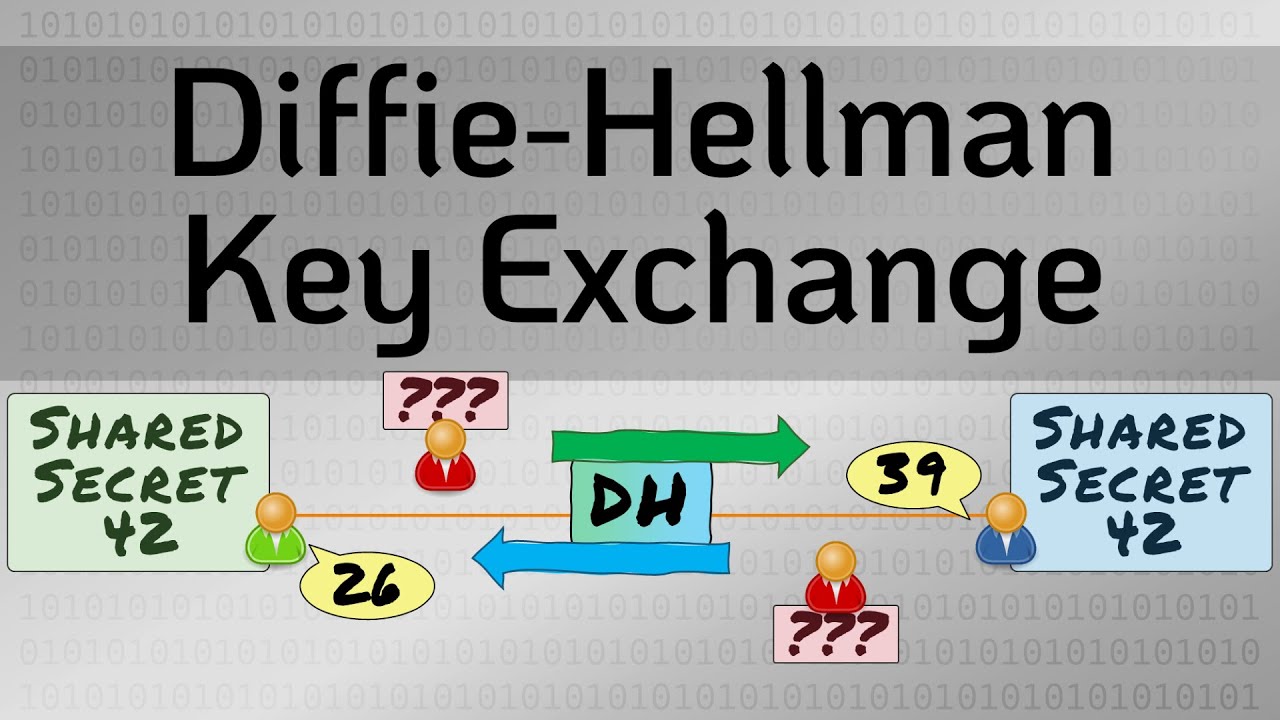
This is something that would allow us to create the same symmetric key on both sides of the conversation without sending the symmetric key across the network. Here's how this works: we would start with Bob's side. Bob obviously has a private key that no one has but Bob.
Alice also has a private key; her private key is only known to herself. We would then combine Bob's private key with Alice's public key. Alice's public key is obviously known to everyone, so Bob would easily have access to that information.
Conversely, Alice can combine her private key with Bob's public key, and since both Bob and Alice are using keys that are mathematically related, they create the same symmetric key from that algorithm. We refer to these as key exchange algorithms. We're not performing any type of encryption or hashing; we're instead building the same symmetric key on both sides of the conversation, even though we didn't send that symmetric key across the network.
Videos Relacionados
HTTPS, SSL, TLS & Certificate Authority Explained
43:29
HTTPS, SSL, TLS & Certificate Authority Ex...
Laith Academy
104,666 views
CompTIA Security+ Firewalls and Proxy Servers Performance Based Question
14:46
CompTIA Security+ Firewalls and Proxy Serv...
Cyberkraft
66,933 views
Encryption Technologies - CompTIA Security+ SY0-701 - 1.4
6:53
Encryption Technologies - CompTIA Security...
Professor Messer
74,083 views
Why Cybersecurity Training is a SCAM
10:37
Why Cybersecurity Training is a SCAM
Technical Institute of America
152,740 views
Public and Private Keys - Signatures & Key Exchanges - Cryptography - Practical TLS
12:33
Public and Private Keys - Signatures & Key...
Practical Networking
254,624 views
Security+ Certification SY0-701 50 Practice Questions
1:10:03
Security+ Certification SY0-701 50 Practic...
Technical Institute of America
128,301 views
Secret Key Exchange (Diffie-Hellman) - Computerphile
8:40
Secret Key Exchange (Diffie-Hellman) - Com...
Computerphile
961,321 views
Diffie-Hellman Key Exchange: How to Share a Secret
9:09
Diffie-Hellman Key Exchange: How to Share ...
Spanning Tree
148,075 views
Diffie-Hellman vs. RSA Encryption Algorithms: What's the Difference?
3:33
Diffie-Hellman vs. RSA Encryption Algorith...
Eye on Tech
38,372 views
Encrypting Data - CompTIA Security+ SY0-701 - 1.4
9:48
Encrypting Data - CompTIA Security+ SY0-70...
Professor Messer
84,887 views
Diffie-Hellman Key Exchange - the MAGIC that makes it possible - Cryptography - Practical TLS
6:56
Diffie-Hellman Key Exchange - the MAGIC th...
Practical Networking
62,979 views
CompTIA Security+ SY0-701 - DOMAIN 1 COMPLETE
1:58:25
CompTIA Security+ SY0-701 - DOMAIN 1 COMPLETE
Inside Cloud and Security
57,054 views
Hashing and Digital Signatures - CompTIA Security+ SY0-701 - 1.4
10:24
Hashing and Digital Signatures - CompTIA S...
Professor Messer
71,369 views
How SSH Works
8:54
How SSH Works
Mental Outlaw
534,036 views
Kerberos Authentication Explained | A deep dive
16:52
Kerberos Authentication Explained | A deep...
Destination Certification
341,803 views
Technical Change Management - CompTIA Security+ SY0-701 - 1.3
10:54
Technical Change Management - CompTIA Secu...
Professor Messer
87,699 views
Taking a Security+ 701 Practice Exam | Is the 701 Version Harder??
10:57
Taking a Security+ 701 Practice Exam | Is ...
Ben Truong
10,134 views
Tech Talk: What is Public Key Infrastructure (PKI)?
9:22
Tech Talk: What is Public Key Infrastructu...
IBM Technology
118,417 views
Diffie-hellman key exchange | Journey into cryptography | Computer Science | Khan Academy
2:19
Diffie-hellman key exchange | Journey into...
Khan Academy Labs
371,056 views