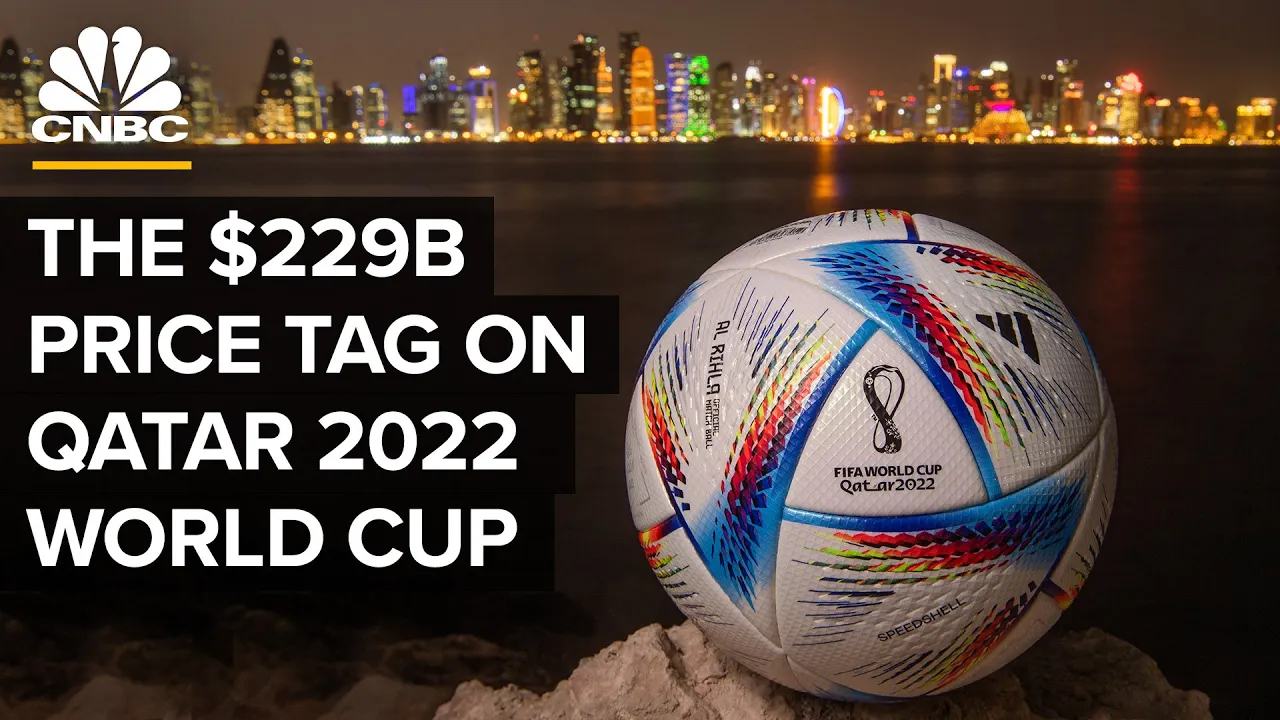
$229 billion. That's roughly the cost of the 2022 FIFA World Cup in Qatar, the most expensive World Cup ever. That's more than four times the combined budget of every World Cup since 1990.
The money goes to two things stadiums and infrastructure for Qatar. The country needed both, and it needed it fast. Hosting the World Cup draws massive exposure to the host country.
There's tourism, foreign trade, potential for new development and jobs. And this World Cup is expected to be the most watched ever. There's just one problem.
Some host countries don't have the necessary infrastructure or stadiums to support the world's largest soccer tournament and therefore leave the country in massive debt and constructions that serve little use after the fact. In Brasilia, they decide to build the the opening match stadium, which has to be 60,000 Stadium, by the way, is supposed to cost $300 million. It ended up costing $900 million plus.
The last time I looked, it was being used as a bus or bus depot place to store busses overnight. There are times where some of the stadiums were out in areas that seem to be pretty isolated or in areas where you could really see the vast socioeconomic differences. So does it pay to host the FIFA World Cup and is risking the burden of debt worth the hopes for economic gains?
Landing the bid to host the FIFA World Cup is a decade long process. A country has to submit a bid, listing the reasons why it makes financial sense for FIFA and how it may improve the sport's reach globally. This is Jim Kirkos, CEO of the New Jersey Meadowlands Regional Chamber of Commerce, and he was part of the 1994 and 2026 World Cup bidding process.
The bid process is very, very complicated and it's very intricate. There's lots of parts to it. FIFA has a bid spec booklet that every competing location has to has to meet or attempt to meet.
The organization scores proposals off two main categories infrastructure and commercial. Nine criteria are weighed by varying levels of importance, with stadiums being the most important requirements, such as number of stadiums, capacity, hotels, government support and transportation all play a vital role of who gets picked to be a host. Tax exemptions are another key consideration.
Local governments essentially turn stadiums and venues relating to the World Cup into tax free zones. That's so that FIFA and its sponsors don't have to pay taxes on the revenue generated during the tournament. So let's talk about where that tax free money goes.
The three main moneymakers are broadcasting ticketing and marketing revenue. That all goes to the federation. FIFA pays for prizes, ticketing and production.
The only money given out to host countries are agreed funds to cover operations for 2022. Fifa allocated $1. 7 billion to Qatar, which includes $440 million in total prize money for teams.
The revenue $4. 7 billion total. There's a net.
There are $3 billion. What happens with the net? Fifa takes about 10% of that for its operations.
They just keep organization going and pay salaries and so on. About 10% is kept and the rest is distributed to the roughly 200 world soccer federations around the world to help them develop their programs. Host countries rely on the economic impact derived from the tournament.
There are short term and long term, and it varies from country to country. Countries better positioned to host are typically the ones with short to do lists, meaning there's already a network of infrastructure in place that meets FIFA's strict requirements. Just take the 94 and 98 World Cup in the US and France, respectively since 1990.
They are the two countries that spent the least to host on the tournament. Both countries utilize preexisting stadiums and major cities that had existing hotels and strong transportation systems. A surge in tourism, hotel stays, job creation, and above average spending at local restaurants and businesses are all signs of short term economic impact.
1994 had a great impact on me. I was born in North Jersey to two Colombian parents in Colombia. They love their Football and their soccer.
At that time, I was a Colombia fan. I had the Valderrama wig. Carlos Valderrama is known for having this big curly hair.
So everybody had these wigs. So I was rooting for Colombia. This is Alejandro Bedoya, midfielder for the Philadelphia Union and a member of the U.
S. national team during the 2014 World Cup in Brazil. I just know how much I saw.
Even the local bakery bakeshop bakeries and cafes and bars were not really bars. I wasn't. I was only seven years old.
But the cafes, you know, we'd go to the local cafe and get some food, the Colombian food, and you would just see on the screen there or on the radio just blasting the games. And you just see how passionate the fans were. And I do know that we've learned tremendous amounts of things from doing events since 1994 about what it takes to be a great host and what it takes to get the most economic impact.
A lot of that just comes from being in a better position to to market the region, let the world know what's here and how they can participate with us when they come here. The short run spike in spending is caused by the fanfare, excitement and the mass influx of fans following their team from stadium to stadium. The evidence there says sometimes there's a very modest benefit.
Employment will increase in the hospitality sector or the tourism sector of the economy. Sometimes it doesn't happen. It will vary from city to city.
Even with existing infrastructure, hosting the cup does little in the long run. The U. S.
all positive gains in its GDP per capita consumption and exports. In 94, France witnessed its biggest gains in imports and exports when a host of the tournament in 1998. For countries who needed things like new stadiums, improvements to their transportation systems or infrastructure investments in the billions of dollars are needed to sustain over a million fans.
Some have yet to pay off. This is Mount Green Shea Stadium in Brasilia, Brazil. It was one of many state of the art stadiums built for the World Cup to hold over 60,000 plus fans.
I was able, fortunately enough, to play in the 2014 World Cup in Brazil and represent USA. I mean, the atmosphere around the stadium is amazing. And once you get in the stadiums, I mean, you just see these state of the art infrastructure that's been built and, you know, with all the modern amenities and all the modern technology and all that thing.
So, you know, obviously some of the stadiums and some of these countries, they are just built from the ground up. Brand new construction and the surrounding area might not be the best in 2014. The Brazilian government budgeted $300 million for the stadium.
It ended up costing nearly $1,000,000,000. Now it's used as a bus depot. This isn't unique to just Brazil.
Countries like South Africa, over half the money spent on hosting it went directly to costs associated with stadiums. They had allocated $225 million for stadiums. It ended up being $2 billion after hosting South Africa had trouble finding tenants to take over the stadiums.
They would cost millions of dollars in maintenance and operations alone each year. The South African government demolished two stadiums to save money. Only the US and France spent below $1 billion on stadiums.
Updating hotels and public transport can cost countries billions too. You end up building stadiums that are not needed and you end up with white elephants. So the money is not only involved with building them and creating exit ramps and on ramps to the highways or roads in order to get to them in parking lots around them.
It's not only that, but once they're built, they have to be maintained. If they're not maintained, they go to seed and they're tremendously wasteful. And in the meantime, while they're going to seed over a period of ten or 20 or 30 years, they're occupying valuable, scarce urban real estate.
You can't have great economic development into the future if you don't if you can't move people. And so mobility is really a big part of that infrastructure. Moving goods, moving people, connect, ability, walkability, all those things mean so much.
Brazil and Russia spent over $10 billion to host using the mega-event as justification for investing in this future for Russia. Its investment would reportedly bring in $31 billion over ten years, though economists are wary that that figure will ever come to fruition. For Brazil, the exuberant spending to host back to back mega events, the World Cup and Summer Olympics in 2014 and 2016 was an effort to showcase Brazil's transition to a now modernized economy on the world stage.
The government expected to spend a forecasted $3 billion on accommodations, food, transportation and entertainment. It hoped to open the country up to an influx of tourism, foreign trade, international development, and improve its geopolitical stance. For Brazil, the exponential cost of new roads, transit lines, stadiums and hotels only added to the mounting tensions between the Brazilian government and its people.
Construction pushed out locals from their homes, with estimates suggesting anywhere from 250000 to 1. 5 million people had to abandon their homes and only a few received compensation. The government has to borrow money.
When they borrow money, interest rates go up and it chokes off economic activity rather rather than helping economic economic activity. And the notion that because you host the World Cup and you're on the world stage, but being on the world stage for Rio, what happened is a lot of embarrassment is what happened. Funding for the World Cup's infrastructure reaches to $11.
6 billion. Nearly half of those proposed projects were never built. Protesters criticized both FIFA and the local government officials, advocating that funding would have been better allocated to the people rather than football stadiums.
For the 2022 World Cup. Qatar has spent over a decade preparing for the tournament, is estimated that expenditure is around $229 billion and $500 million were spent per week to speed up production. I expect people to travel to Qatar from all over the world and enjoy the game.
Sarah. You read about what's happening and is everything going to be ready in time? Is everything going to be up to the standards.
The country needed to build from scratch? It needed stadiums, roads, trains, renovated airports and hotels. At the same time, the country is planning to unveil Qatar's plans for 2030, hoping to become a leader in sustainable urban development, technology and innovation.
However, being on the world stage has also brought to light allegations of corruption with FIFA and human rights violations. In 2015, 41 FIFA officials were indicted on corruption charges stemming from bribery, racketeering, wire fraud and money laundering. Some reports include bribes from Qatar officials to land the 2022 World Cup.
In 2016. Amnesty International reported numerous human rights violations stemming from the pressure the country was under to meet the 2022 deadline. 1.
7 million migrant workers made up 90% of the total workforce in Qatar, virtually all of which lived in below par living and working conditions and were grossly underpaid. In the midst of his weary backdrop, Qatar is expecting over 1 million tourists, 5 billion people tuning in to the World Cup. And according to one report, as much as $17 billion added to the Qatari economy from the tournament.
While that seems like a lot. That's nearly 7% of the estimated $229 billion spent. At the end of the day, for many of these countries, hosting the FIFA World Cup is viewed as an honor.
Football is the most popular sport in the world, with over 5 billion fans worldwide. Countries like South Africa have seen some benefits years after hosting, though the country was hampered with debt and stadiums that have gone unused. The country has seen tourism steadily rising since hosting in 2010.
In 2026, the US and North America are looking to replicate its success from the 1994 World Cup. To date, the 94 World Cup has been viewed as the most successful World Cup, attracting the most fans ever for 2026. The tournament has expanded, meaning more fans from all over the world will be flocking to North America, spending big on the World Cup.
Stadiums are spread across 11 US cities, three cities in Mexico and two in Canada. East Rutherford, New Jersey, hosted the games back in 1994, and they're one of the few cities to host again in 2026. The overall cost of the 1994 games in the US were low.
Stadiums in many cities already have the infrastructure required an overwhelming number of stadiums used for NFL stadiums. Back in 94, although we didn't have as many soccer stadiums as we have today. We did have football stadiums, NFL's football stadiums, college football stadiums that pretty much with small modifications, could be used for the soccer matches.
Since 1990, there have been 25 new NFL stadiums built, all of which increase the number of fans it can hold in 94. East Rutherford had Giant stadium at the time. It held over 78,000 fans.
The newer MetLife Stadium, built in 2010, can house over 82,000. A relative to our economic impact, the state of New Jersey. During the process, when we were doing our bid and introducing New Jersey to everyone had hired an outside third party entity to do a basic or an initial economic impact.
And it was determined that World Cup coming here in 2026 would be in excess of $800 million. Since 1930, the World Cup has captivated billions of football fans. Fifa has been able to reinvest funds generated from the World Cup back into both men's and women's football committees worldwide.
And amid FIFA's controversies and whether or not it makes financial sense to host the tournament, fans from all over will continue to tune in with hopes and aspirations of their country winning the World Cup.