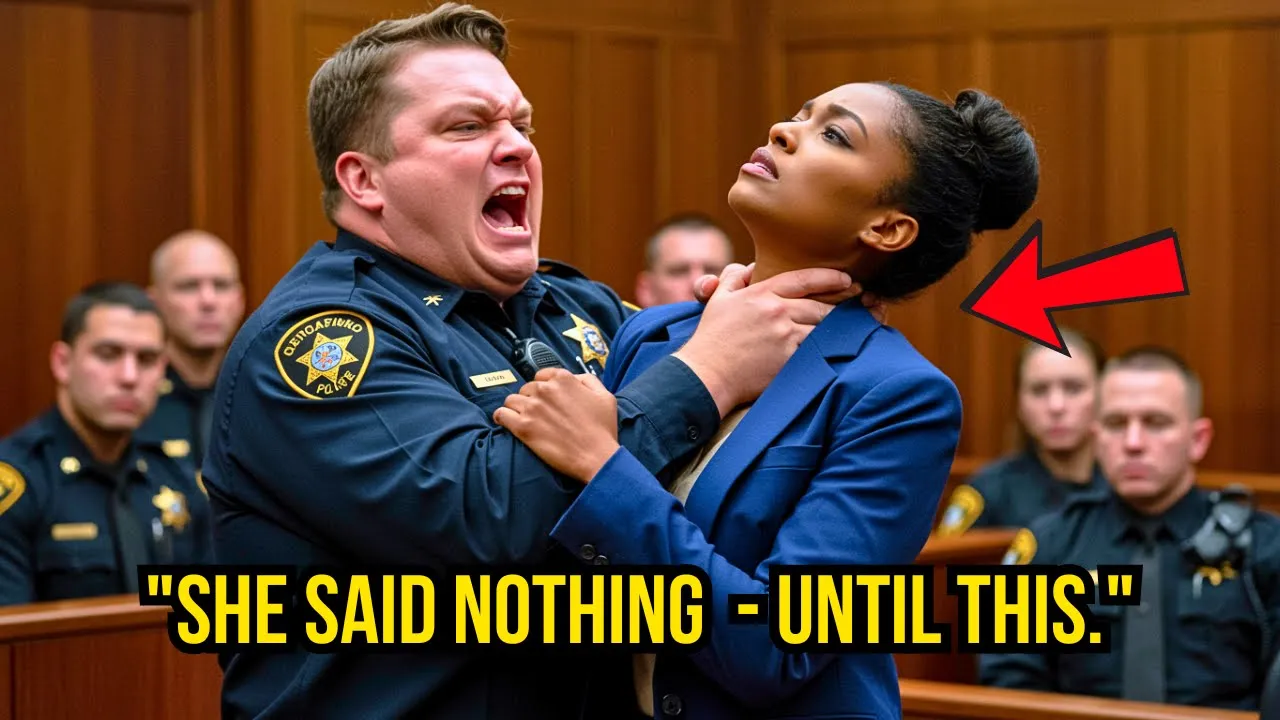
He slammed her against the wall. No warning, no questions, just the badge and the rage behind it. But what if the woman he grabbed was sent to fix the very system he thought he controlled?
He didn't know who she was. But by the time he found out, it was already too late and justice was already watching. If that first moment made your heart race or your blood boil, don't just keep it to yourself.
Tap like. Share this story with someone who still believes in accountability and subscribe to Mr Max, our stories to hear voices that don't get heard often enough. Now, come with me back to that courthouse hallway where silence ended and power got turned on its head.
They say justice is blind, but sometimes it's just looking the other way. That morning, the courthouse hallway was packed. People in cheap suits whispered prayers, heels clicking on tile.
It was one of those days when everything felt tense, like the walls themselves were waiting for something to break. And then it happened. Officer Grant Ellison stormed down the corridor like he owned the place.
Broad shoulders, tight jaw, eyes always scanning for someone to control. He didn't walk. He patrolled like this wasn't a place of law.
It was a battlefield. And to him, anyone not in uniform was a potential threat, especially if their skin wasn't white. A black woman stood near the benches, just observing, not speaking, not filming, just there, watching the courtroom doors, maybe waiting for someone inside.
She wore a dark gray blouse, simple pants, nothing flashy. Late 30s, maybe early 40s, calm, still. Grant barely glanced before snapping.
ID. She didn't move, just looked at him, quiet, steady. That kind of silence that doesn't mean fear.
It means she's measuring you. He didn't wait. With one hand, he yanked her bag off her shoulder.
With the other, he grabbed her wrist and twisted her toward the wall. The metal of the cuffs clicked loud, too loud for a place meant to hold dignity. She hit the wall with her shoulder first, then the side of her face, hard enough to draw a gasp from someone nearby, but no one stepped in.
Phones came out, fingers tapped red circles, but feet stayed frozen. Eyes darted away. The crowd did what crowds often do when injustice walks in wearing a badge.
They watched quietly. And she she never raised her voice, never said a word. She just turned her head slowly and looked him straight in the eye.
Not with fear, with clarity, with something deeper. Like she knew exactly what this was, like she had seen it before, maybe too many times to count. Grant stood over her, breathing heavy, knuckles white around the cuffs.
His face said control, but his body his body twitched just enough to show he wasn't as sure as he pretended to be. And somewhere just out of frame, a recording light blinked red. You could feel it in the air that this wasn't just another ugly moment.
This was a crack. And something or someone was about to break through. But before that, there was only silence.
The kind that wraps around you when something's gone too far and nobody knows what to do about it except her. She knew and what she did next would change everything. There's something cold about courouses.
Not just the marble floors or the air conditioning set a little too low. It's the kind of cold that seeps into your bones. The kind that doesn't come from temperature, but from silence, from posture, from power.
The benches are wooden, straightbacked, and unforgiving. They creek when you shift, but no one dares move too much. The walls are beige, bland, designed to neutralize emotion, to mute voices.
Everything in this place whispers one message, fall in line. The baiffs know their place. They open doors.
They nod to judges. They rarely make eye contact with anyone else. The clerks click away on their keyboards, eyes trained forward, as if looking up might implicate them in something they'd rather not see.
And the officers, they walk with a certain rhythm. Boots polished, belts heavy with gear, not for protection, but for presence. The weight of it all seems deliberate, like they're always just one step from control or confrontation.
Grant Ellison moved through this machine like a cog that believed it was the engine. He'd been here for years, long enough to know the rhythms, to read the unspoken rules, long enough to believe he could bend them when needed. He saw himself as a filter.
His job in his eyes wasn't just to keep order. It was to decide who belonged, who deserved to be inside the courtroom, who could sit quietly and wait, who looked like they might be trouble based on nothing more than skin tone, clothing, or posture. Grant didn't wait for cues from the judge.
He didn't ask the clerks. He certainly didn't ask the people he grabbed. He acted quick, sharp, loud, as if sound alone made him right.
He wasn't the only one like that, but he was one of the loudest, and no one had ever stopped him. They let him move like that because to them, he brought order. But order isn't the same as justice.
And everyone who's ever sat on one of those hard benches knows it. That day, after shoving the woman against the wall, Grant returned to his post like nothing had happened. He didn't file a report.
He didn't speak to the sergeant. He just stood near the courtroom door, arms folded, daring someone to question him. The woman, Naen, never said a word.
She picked up her bag, dusted off her sleeve, and calmly sat down again, eyes forward, lips pressed shut. It was the kind of silence that didn't come from fear. It came from knowing, from restraint, from choosing not to react yet.
And that silence, it carried more weight than any badge on his chest. People watched her, some out of curiosity, some out of shame. A few glanced at their phones, checking the clip they had just filmed.
No one deleted it. No one offered her water. No one said, "Are you okay?
" Because here in this place, things like that happen all the time. And folks have been trained to let them. It wasn't the first time someone got pushed without cause.
It wouldn't be the last. But this time, something felt different. It lingered.
Maybe it was the way she stared at Grant without blinking. Maybe it was the quiet dignity in how she sat. How she refused to touch the welt rising on her cheek.
Or maybe, just maybe, people could sense that the gears in the machine had just caught on something, something unexpected. She looked like a woman who came here for a reason. And whatever that reason was, she wasn't done.
Not yet. For a moment, no one moved. The hallway, once filled with footsteps and murmurss, went still, like someone had pulled the plug on all the noise.
Even the air felt heavier, like it didn't want to carry what was about to happen next. Nadine stood slowly, calmly, no rush, no panic. She brushed the crease off her sleeve with the back of her hand, adjusted her bag on her shoulder, then reached inside with a deliberate grace, like someone choosing every breath.
Grant watched her, confused, his stance stiffened, like he was bracing for another challenge. Another complaint. Another routine excuse from someone trying to act tougher than they looked.
But Nadine didn't argue. She opened her wallet, flipped it open, and held it out for everyone to see. A gold shield, police blue, a name in raised silver lettering.
Chief Naen Monroe, District 12 Police Department. For a second, it didn't register. Then it did.
A young officer down the hallway gasped, his mouth falling open like a door unlatched in a storm. A few feet away, a court clerk dropped a pen. It hit the floor with a click that felt too loud.
Inside the courtroom, the judge had been mid-sentence, but his voice caught. He paused, leaned back slightly in his chair, and glanced toward the hallway with narrowed eyes. Someone whispered, "No another.
She's the new chief. " But Nadine didn't need the noise. She looked directly at Grant, her voice even, measured, not loud, but impossible to ignore.
"I was sworn in yesterday," she said. "And I came here today to see how justice is applied in this building. " quietly, observationally, no announcements, no special treatment.
Then she let the silence speak. It hung there, pressing in from all sides until even the ceiling seemed to lean in closer. Grant didn't blink.
His hand loosened on the radio clipped to his chest. His jaw flexed, but no words came out. And for the first time, maybe in his whole career, he looked unsure.
Not just caught off guard, but exposed. And now, Nadine added, her voice soft as a breath. I've seen exactly what I came to see.
That was the blow. Not a scream, not a scene, just truth wrapped in composure, delivered with eyes that had seen too much to be shaken. Grant opened his mouth, then closed it again.
There was nothing to say, no protocol for this, no line from the handbook that could pull him out of it. And the people, they just watched. Phone still recording, eyes wide, breaths held.
Not because she raised her voice, but because she didn't have to. The sun wasn't even up yet. Nadine sat in her car, parked across the street from the courthouse, engine off, window half cracked.
A warm coffee cup rested on the dashboard, untouched. The kind of morning where everything is quiet, but your mind won't stop moving. She leaned back against the seat, eyes fixed on the building in front of her.
That old courthouse. Same stone steps, same faded brick, same cold glass doors, different reason for being here. She hadn't parked here in years.
Not since the day she was 17, holding her mother's hand, trying to understand why security guards were shouting at them like they'd done something wrong. Her mother hadn't raised her voice. She never did.
She wore a sleeveless blouse and a long skirt. Nothing fancy, nothing flashy. But a female officer stopped them at the entrance, glanced at her mother from head to toe, and said coldly, "You can't come in here dressed like that.
" Naen remembered the heat of her mother's skin as she squeezed her hand tighter. She remembered how the officer's words didn't sound like rules. They sounded like judgment and how no one around them, not one person, spoke up.
They had traveled two buses to get there. But they turned around just like that. That was the first time Naen learned that silence could be louder than anything else in the room.
She sighed now years later, running a finger along the rim of her coffee lid. It was strange coming back with the title chief pinned to her name. You'd think it would feel like a victory, but it didn't feel like a win.
It felt like weight. She reached over to the passenger seat and picked up a folder, thin, old, worn at the corners. Inside was a rejection letter, one she'd kept all these years.
It was from the academy, the first time she applied. Back then, she was fresh out of college, determined, sharp, fit. She passed every written exam, aced every physical test.
But during training, she filed a formal complaint after witnessing an instructor making racist comments toward another recruit. They called it insubordination. She called it the truth.
And the next week, she was out. No explanation, no apology, just an envelope. She could have walked away from law enforcement then, and she almost did.
But her mother her mother had just been diagnosed with breast cancer. And in one of those long nights between appointments and prayers, Nadine found something in an old keepsake box. A letter folded four times, ink fading at the edges.
Justice doesn't wear a badge, it said. It walks in your spine if you feel it there. Don't let anyone break it.
Her mother had written it years before after that humiliating day at the courthouse. Mine never showed the letter to anyone, not even the review board when she reapplied, but she carried it literally in her wallet right behind her ID. It wasn't a badge, it was a promise.
Now, in the quiet of this early morning, she unfolded that letter again, let the words settle over her one more time. She looked at her reflection in the rearview mirror, eyes older, wiser, but still carrying that same fire. She wasn't that girl holding her mother's hand anymore.
And she wasn't the cadet begging for fairness from a broken system. She was the one walking back into the building, not as a witness, not as a victim, but as the chief and justice, it was still in her spine. Steady, unshaken.
She closed the folder, slid it under her seat, and finally took a sip of her coffee. The bitterness was familiar, but this time it tasted like purpose. She opened the door, stepped out onto the street, and straightened her blazer.
No sirens, no spotlight, no announcement, just a quiet decision. Today, she wouldn't be silent. The door shut with a soft click.
No echo, no metal slam, just finality. They were alone. A narrow conference room tucked behind the administrative offices.
No cameras, no reporters, no lawyers, just beige walls, a wooden table, and the kind of quiet that feels like a storm waiting to start. Grant Ellison sat stiff in the chair across from her, arms crossed tight, jaw locked. He hadn't said a word since she summoned him, but his eyes, they burned like a man cornered and still trying to pretend he wasn't.
Naen placed a file on the table between them, thick, marked with a red tab. She didn't sit down. Not yet.
Before you say anything, she said calmly. I'd suggest you look through that. Grant didn't move.
Nadine flipped the folder open herself. One page, then another, then another. Inside, printed screenshots, body cam stills, incident reports with highlighted inconsistencies, internal memos that somehow disappeared before becoming formal complaints, names, dates, patterns.
You think no one was watching, she said, her tone level, not angry, just steady. But someone always is. A bystander, a victim, a young officer who's not as loyal to your silence as you thought.
Grant scoffed, a bitter sound. He reached for one of the papers, skimmed it with practiced arrogance. This is garbage, he muttered.
You dragged me in here to what? Make a point? Humiliate me again?
You already did that out there in front of the whole damn courthouse. He leaned forward, voice rising. You think I didn't see the look in your eyes?
Cuz this isn't about justice. This is personal. Naen finally sat.
She didn't flinch. She didn't fire back. She let his words settle, hang, fade.
Then she spoke quiet. Almost too quiet. You didn't just humiliate me, Officer Ellison.
You humiliated the badge. Grant blinked. Excuse me.
She leaned slightly closer, not aggressively, but with purpose. That uniform doesn't give you the right to grab, to shove, to profile. It gives you the responsibility to protect, to serve with restraint, with integrity.
You forgot that a long time ago. She paused, eyes fixed on his. And worse, you taught others to forget it, too.
Grant laughed, short, hollow. You've been chief for what, 2 days? And suddenly you're the moral compass of the entire department.
He pushed the file back toward her. This This is a witch hunt. Old cases, complaints from people who hate cops.
You think any of this holds up? Naen didn't answer immediately. She took a breath.
Let the silence do its job. Then she reached into her jacket and pulled out a flash drive. She placed it on top of the file.
"That's from the locker room camera," she said softly. You thought it was off. It wasn't.
That's you telling a rookie to handle the loud ones early. That's you laughing when a man with a stutter was cuffed before he could explain he was a witness, not a suspect. Grant's expression shifted, just a flicker.
But it was there. "You don't know what it's like out there," he snapped. "You walk in now with your title in your speeches.
" "Don't talk to me about what it's like," she interrupted, her voice still calm, but razor sharp. I was the one being watched while doing everything right. I was the one who had to memorize procedures twice as well because I knew I wouldn't get a second chance if I slipped.
She leaned back finally. The difference between you and me, Grant, is that I never used the badge as a shield. I carried it as a weight.
He shifted in his chair, suddenly smaller. For a moment, neither of them said anything. Then Naen stood, picked up the file, the flash drive, held them both in her hands.
This isn't about revenge, she said. It's about reckoning. She walked to the door, stopped just before turning the handle.
You built a career on fear, but that only works until someone stops being afraid of you. She turned her head slightly, just enough for him to see the side of her face. You've been the loudest voice in the room for years, Grant.
Let's see how you handle silence. And with that, she left him sitting there alone. No spotlight, no audience, just the sound of the air vent buzzing and the heavy, bitter taste of being truly seen.
It started with a clip just 23 seconds long. A shaky cell phone recording, grainy, slightly tilted. You could see the edge of a patrol car, a sidewalk, and a boy, maybe 15, maybe 16, standing with his hands half raised.
His backpack was already on the ground. His voice, though faint, was calm. I didn't do anything.
I was just Then came the shove. Officer Grant Ellison lunged forward, grabbing the boy by the collar and flinging him sideways. The kid hit the curb hard, shoulder first.
You could hear the snap even through the bad audio. The boy screamed once, then went silent. The clip froze on his face, twisted in pain, hand cradling his arm, legs too stunned to move.
It was the kind of footage that made people stop scrolling. And it was posted by Tessa Duval. She uploaded it without a caption, just the video and a date.
6 years ago, Crestwood County, my little brother. It didn't take long to spread. By noon, it was on every major feed.
Hashtags started stacking up. Justice for Jaylen. Stand with her.
He was just a boy. People remembered that name. Jaylen Duval, the kid who resisted arrest outside a library.
The news never showed the clip back then, just a mug shot, though he was never charged. The arm had healed crooked. And the family, they'd stayed quiet until now.
That evening, Tessa stood in front of a live camera. No fancy backdrop, just a brick wall behind her, a single mic in her hand, and the look of someone who had carried silence too long. Her voice didn't shake.
Not once. 6 years ago, my brother was hurt by Officer Grant Ellison. He wasn't a suspect.
He wasn't a threat. He was a teenager who had missed his bus and was sitting on the curb reading a comic book. That day, Grant broke his arm.
What he really broke was our trust. She looked directly into the lens. He never said sorry, never faced discipline, never even acknowledged it happened.
But I'm not here to ask for an apology. I'm here so no one else has to stay quiet like we did. She paused, letting that sink in.
If you think silence keeps you safe, it doesn't. It just delays the truth. The broadcast only lasted 2 minutes, but by morning it had more than 8 million views.
The comment sections overflowed. Why did it take this long? Where was internal affairs?
My son looks like Jallen. This could have been my kid. The pressure cooker cracked open and this time the steam wasn't staying in the room.
News anchors called it a breaking point. Activists called for Grant's resignation. Even officers in other districts began quietly unfollowing him on social media.
And everywhere the hashtagstand with her lit up the digital sky. Naen saw the clip around 5:30 a. m.
She was already awake. Couldn't sleep much lately. The email came from an old contact in the media bureau.
Just three words in the subject line. You need this. She watched it once, then again, then sat with her hands folded for a long time, staring out the window as the sun pushed its way into the sky.
She remembered that name, Jaylen Duval. She remembered the report. Back then, it had been framed as use of force in response to non-compliance.
But there had been no body cam footage, no investigation, just paperwork, a 15-year-old kid with a broken arm. Now, the silence around that file felt deafening. At 7:00 a.
m. , Naen walked into the precinct. There was a different kind of air in the room that morning.
Not fear, not anger, something quieter, heavier. The kind of quiet that comes when people know the wind has shifted, but haven't figured out which way it's blowing yet. Grant wasn't there.
He'd taken a sick day. But the murmurss followed him anyway. One officer leaned against the coffee counter, scrolling on her phone.
Another sat staring at his screen, unread emails piling up while the words Duval video trended on the ticker bar above. No one said it aloud, but everyone knew something had cracked. And this time, it wasn't going to be swept away with a memo or a retraining session.
Tessa didn't post again that day. She didn't need to. The video had spoken.
The silence had ended, and the ripple it sent out was just getting started. Grant Ellison stepped through the front doors of Crestwood Police Department on a Monday morning, expecting the usual nods, the usual, "Morning, sir. " Even the weightless privilege of being noticed.
But what met him was nothing. No one looked up. No one greeted him.
The door hissed shut behind him, sealing off a hallway thick with silence. Not the good kind, the kind that speaks. People saw him.
That was obvious, but their eyes just slid away like rain on glass, like he'd turned into part of the wall. Once Grant was the officer rookies looked up to, the one with the reputation for being tough but necessary. People used to say he gets things done.
Now, no one said anything, not even the ones who used to slap his back in the locker room or chuckle at his dry, mean humor. He passed the break room. The coffee machine buzzed softly.
A young officer poured herself a cup, glanced up, and turned her back. Not in a rush, just quietly, deliberately. One of those movements that cuts deeper than a shove.
In the main hallway, someone pinned a new flyer on the bulletin board. It fluttered slightly as Grant walked past. He didn't catch what it said.
He didn't need to. He opened his inbox. The subject line said it all.
Administrative leave. Effective immediately. No explanation, no signature, just an attached PDF with his name and badge number.
He stared at the screen for a moment longer than necessary, then leaned back in his chair and stared at the ceiling, blinking hard like maybe the lights had changed, and he just didn't catch it. After a moment, he did what he'd never thought he'd have to do. He typed an email.
Fast, heated, defensive. Subject: Urgent. Internal division.
Chief Monroe is tearing this department apart. The public is turning on us. She's feeding them a narrative that paints officers like me as villains.
If we don't stand up now, morale will collapse. We need leadership. We need action before it's too late.
He hit send, then sat back waiting for something. A reply came within 10 minutes from Naen Monroe herself. One sentence.
No, you tore it apart. I'm just cleaning up. That was it.
No greeting, no explanation, no room for debate. And later that afternoon, the email leaked. No one ever said how, but it showed up in the department group chat, then on a law enforcement subreddit, and finally in a local papers digital edition.
Not the whole thing. Just one line. She's tearing us apart.
Beneath the quote, an anonymous officer replied, "No, sir. We were already broken. She just turned on the lights.
That's when it really started. The unspoken shift. " Grant came back the next day to collect some things.
Nothing big, just a few files, his gym shoes, the mug with the chipped handle he used every shift. The station looked the same, but it didn't feel the same. It felt like he had become a stranger in a place he used to command.
He passed by a trainee, barely 20, fresh uniform, still stiff in the shoulders. The kid looked up, met Grant's eyes just for a second, then tugged his jacket across his chest, covering the Academy logo on his shirt, like he didn't want to be seen with it or with him. Grant froze for half a step.
That stung more than any headline. He turned down the hall toward the exit. One of the lieutenants was talking to two junior officers.
The moment they saw Grant, the conversation stalled, not with drama, just stopped. One officer tilted her head down, stared at her boots. The other gave a polite smile that didn't quite reach his eyes, then busied himself with his phone.
No one asked if he needed help. No one asked where he was going. No one asked anything.
It wasn't anger. It was worse. It was detachment.
He stopped near the locker room and looked back once, hoping, maybe foolishly, that someone would call his name, say something, even something sarcastic. But the silence stayed heavy, final. There was no hearing, no official verdict, no headlines screaming guilty.
But the sentence had already been served, not in court, in people. And the worst part, he understood it. He had spent years convincing himself he was holding the line, protecting the system.
But what he was really doing was hiding behind it. Now stripped of its cover, he was just a man. A man people once respected and now walked away from.
There are punishments you can see. suspensions, fines, writeups, and then there are the ones you can't. The ones that live in every empty hallway, every back turned, every conversation that dies when you walk into a room.
You don't need a courtroom to feel that kind of judgment. You just need a department full of people who've stopped believing you ever deserved the badge in the first place. The meeting room wasn't big, just enough for a long table, a pot of lukewarm coffee, and 20 folding chairs that creaked when people shifted.
But that morning, something in the air made it feel different. Lighter, still nervous, still cautious, but laced with something that hadn't lived there in a while. Possibility.
Nadine Monroe stood at the head of the table. No podium, no script, just her and a folder under her arm. and the kind of stillness that comes from choosing your words with care.
Across from her, officers, old and new, filled the seats. Some crossed arms, some took notes, a few just watched, waiting, measuring her. Not because they didn't trust her, but because they didn't yet know how much they could.
Nadine cleared her throat once, then began. Rebuilding starts with recognizing who we've lost. Not just the ones who left, but the ones we pushed out.
She paused, looked around the room. Today we begin with someone we never should have let go in the first place. She turned to the side, nodded toward the door, and in walked Leticia Taus.
The room shifted. Some heads snapped up, others blinked. A couple jaws, not dramatically, but noticeably, dropped.
Leticia walked in with her back straight, chin high, and the kind of calm power that doesn't demand a room's attention, it draws it. 6 years ago, she'd been one of the few female officers on the tactical team, respected by many, challenged by more. She'd led a hostage negotiation that made national news.
But what people remembered most was her demotion. The memo back then had been vague concerns about leadership tone and command presence. But everyone knew what it really meant.
She didn't lead like a man, and some men weren't ready to be led by her. That morning, she stood in front of them again, not as a cautionary tale, but as a beginning. Naen gestured toward her.
Officer Torres is being reinstated, effective immediately as deputy training lead. She'll oversee both field development and cultural reform across the district. Someone clapped, just one.
Then another joined in, and before long, the whole room slowly, steadily was applauding. Leticia held up her hand gently, and the sound died down. She stepped forward, her voice even strong.
I wasn't silent these past few years, she said. I was sidelined. But you didn't silence me.
You just made me wait longer to speak. A pause. Now that I'm back, I'm not asking to be heard.
I'm speaking so others know they can, too. That was it. No theatrics, no revenge, just a statement of return.
Nadine watched from her seat. And in that moment, she didn't look like a chief giving someone a second chance. She looked like a woman opening a door and holding it open for others to walk through.
After the meeting, the hallway buzzed with quiet energy. One of the rookies, still knew enough to fidget with his badge clip, whispered to another, "I didn't know she was that Leticia Taus. " The other nodded.
"Yeah, and she's our trainer now. You believe that? " And not in a mocking way, in a hopeful way, like maybe things were changing.
Later that week, Leticia ran her first session. It wasn't about tactics. It wasn't even about law.
It was about listening. She stood in front of a mixed group, young recruits, mid-career officers, and even two senior lieutenants who chose to sit in. She asked one question.
When was the last time someone listened to you? Not because of your badge, but because of your story. The room sat quiet for a while.
Then someone answered, then another, and slowly the silence began to break in the right direction. Naen, standing behind the glass window that overlooked the training room, folded her arms across her chest. She didn't smile, not exactly, but there was a warmth in her face, a kind of soft strength that said this.
This is what it's supposed to look like. She didn't need people to cheer for her. She didn't need banners or headlines.
She just needed this department to feel human again. And that started by bringing back the voices it had tried to forget. They would still face challenges.
Of course they would. Change didn't come easy. Trust didn't come fast.
But it had begun. Not with policies, not with press conferences, but with a simple truth. Justice starts with who you choose to stand beside.
And that morning, Naen Monroe stood beside the ones who had been left behind because they were the ones most ready to lead what comes next. The hallway felt longer that morning. Grant Ellison walked it alone.
His steps slow. Not from exhaustion, but from something heavier. Something he couldn't name yet.
Something that felt like walking through a version of his life that no longer belonged to him. When he reached the glass doors of what used to be his office, he tried his key card. The red light blinked.
Denied. He tried again. Same result.
The badge clipped to his belt. Same badge he wore through riots arrests and late night shifts. suddenly looked meaningless.
He stepped back, glanced around. No one met his eyes. A staff assistant passed behind him with a stack of folders, and didn't say a word.
An IT technician looked at her monitor like it held the secrets of the universe. Anything to avoid looking at him. Inside the office, through the glass, his desk sat untouched, but that the computer was dark.
His login had been revoked overnight. Files locked, drawers emptied, his name plate still clung to the door, but not for long. He knocked once.
No one answered. He waited. Then the door opened.
It wasn't security. It was Nadine. She stepped aside to let him in.
Not cold, not angry, just composed. Professional. A tone that said, "We both knew this day would come.
" Grant stepped inside. He looked at the shelves. Bear, his coffee mug gone.
The framed picture of his old team removed. His uniform jacket folded neatly in a box with his name printed in block letters on the lid. What is this?
" he asked, though he already knew. Nadine didn't answer right away. She sat behind the desk, opened a file, and clicked a pen.
The only sound in the room was the pen scratching against paper. She didn't lecture him, didn't raise her voice, didn't ask for his side of the story. She turned one page, drew a single line through a name.
His name effective today, she said softly. Your employment is terminated. Grant swallowed but still said nothing.
Nadine closed the folder, placed her pen on top, then looked him straight in the eye. No need for a trial, she said. The people already judged.
And she meant it. Not just the press, not just the online fury. She meant the cadets who stopped quoting him.
The lieutenants who stopped inviting him to briefings, the clerk who didn't look up when he walked past. They had spoken, not with words, but with distance. He looked around the office one last time, searching maybe for a glimpse of who he was or who he thought he was or who he believed others saw in him.
But the room gave nothing back. He picked up the box. It wasn't heavy, just a few things.
His badge, a watch, the old notebook he used to carry during field interviews. "That's it," he said more to himself than to her. "That's it," she replied.
No handcuffs, no court date, no spectacle. Just the end of a story he thought he'd always control. He stood there a moment longer as if waiting for someone, anyone to say something.
"You can go," Nadine said gently. "There's nothing left here for you. " And that was the part that broke him.
Not the firing, not the public fallout, but that sentence. Soft, final, inevitable. He nodded once, turned, opened the door.
No one looked up in the hallway. Not a single goodbye, not even a glance. The building didn't echo with his exit.
The walls didn't hold their breath. The badge didn't glow or fall. He was just gone.
And outside when he stepped into the morning light, he paused just for a second. Looked back at the station. Then down at the box in his hands, there was no anger in his face, just emptiness.
The kind that comes when a man realizes he wasn't feared anymore. He was forgotten. In the chief's office, Naiden sat alone for a moment longer.
She picked up the same pen, flipped to a clean page, and wrote the first line of a new personnel log. Not as a witness, not as a victim, but as the one who writes the minutes. Now the lobby was quiet.
Morning light spilled through the high windows, softening the sharp edges of stone and metal. Officers passed through with measured steps. Recruits lined up near the sign-in desk, straightening uniforms, adjusting their name tags.
nervous, focused. One of them, young, maybe 20, stood in front of the wooden plaque mounted above the entrance to the training wing. The handwriting was faded, but still strong.
Black ink, cursive, written on textured paper behind glass. He read it aloud, barely a whisper. Justice does not begin with power.
It begins with conscience. He didn't know who wrote it, but he stood a little taller after reading it. Behind him, Leticia Torres passed with a clipboard.
She gave him a glance, not of correction, but quiet recognition. The kind that says, "You're starting to understand. " Outside, Nadine Monroe stepped down the courthouse steps alone.
No cameras, no applause, no headlines, just the sound of her heels tapping against the stone, steady, certain, and though no one followed her, everyone who saw her walked a little straighter. Not because she ordered them to, but because something in her silence had spoken louder than a hundred speeches. The camera lingers for just a moment longer until the only sound left is the soft echoing rhythm of justice walking on its own two feet.
This story wasn't just about rank or power. It was about conscience and the quiet courage to stand for what's right. If this moved you, please like the video, share it with someone who needs to hear it, and subscribe to Mr Max Stories for more powerful human stories like this.
Your support helps us keep creating content that matters. Stories that speak truth, inspire change, and remind us we're not alone.