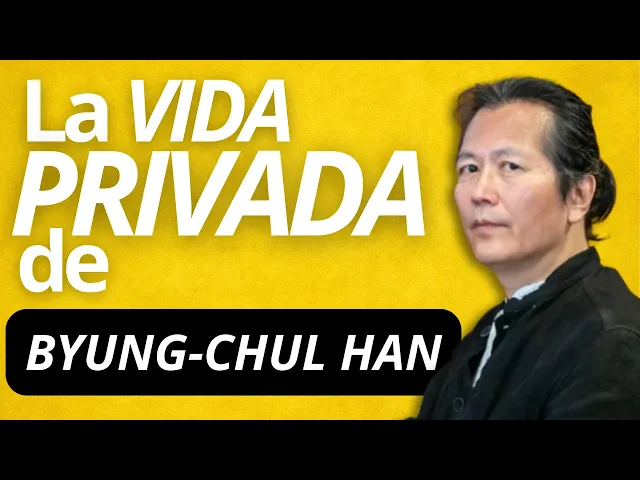
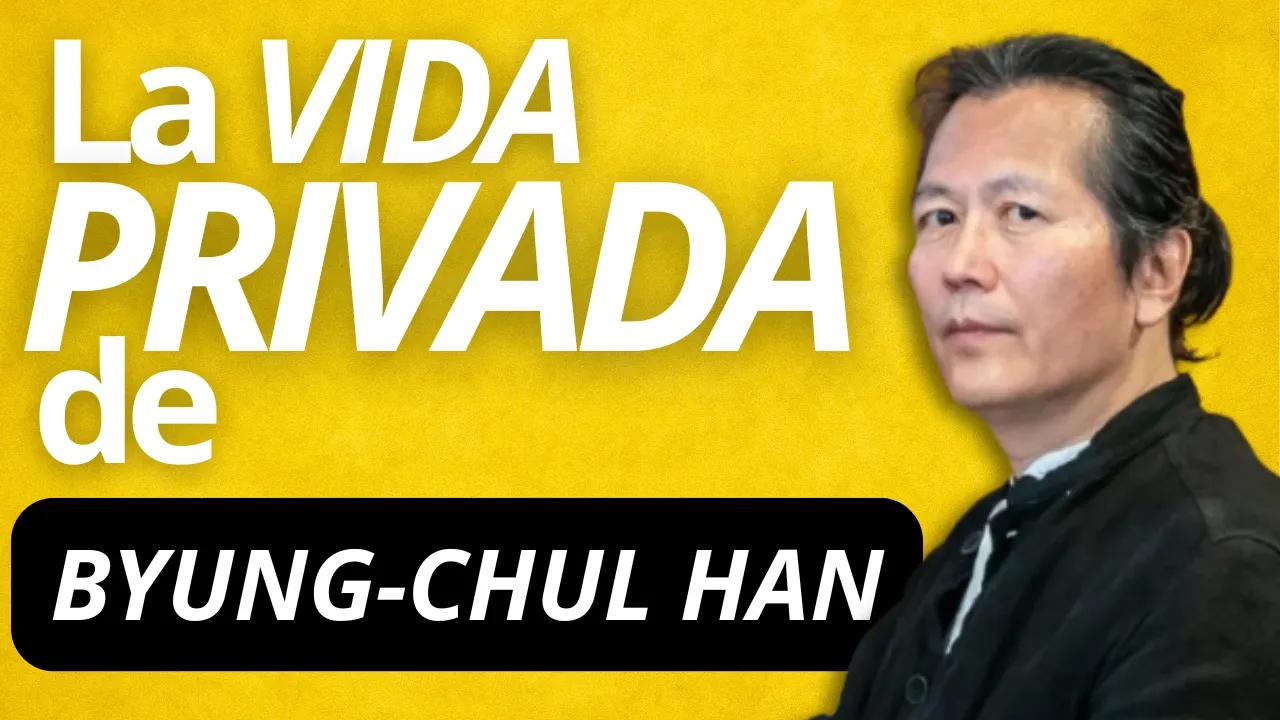
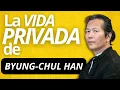
Byung-Chul Han is one of the most widely read philosophers today. We have all heard his name or read one of his books, but few of us know about his private life. In this video, I have compiled the most interesting curiosities about his way of life that he himself has revealed in various interviews and autobiographical books like "Praise of the Earth" or "The Tonality of Thought.
" The South Korean philosopher, living in Germany since the 70s, says he works mainly at night. He has a minimal schedule, spends a lot of time in his garden, plays the piano every day, and claims he can only write three lines in a day. He has also shared that when he arrived in Germany, he ate bread with jam because he barely had any money, that he taught himself piano, that he has no children, that he likes caper berries and Rioja Gran Reserva, and that he uses his mobile phone mainly to identify plants.
Han arrived in Germany at 22 years old. In South Korea, he had studied metallurgy, but he wanted to dedicate himself to German literature and ended up studying philosophy. To be able to leave, he deceived his parents.
He told them he would continue his technical studies, but his intention was actually something else. When he arrived in Göttingen, he barely knew any German and had financial problems. He himself has recounted that during that early period, he ate bread with jam because he had no money for anything else.
He also did not yet know Martin Heidegger, one of the philosophers who would later influence his thought the most. The decision to leave for Germany, curiously, was related to music. During his adolescence, he listened at home to records by Johann Sebastian Bach that his mother had brought.
The Chaconne for violin and the Goldberg Variations made a strong impression on him. Since then, Germany became a sort of spiritual homeland even before he had set foot there. Music continues to be an important part of his life.
In fact, Han taught himself how to play the piano and asserts that he needs to play it every day. Among his favorite composers are Schumann, Bach, and Brahms. In various interviews, he has spoken about several pianos he has had in his homes.
In 2015, he referred to two: a Steinway and a Fazioli. And he wanted to clarify, in the face of some controversy, that their possession does not mean he is a rich man. One of the most striking facts about his routine is precisely his way of working.
Han has defined himself as an extremely lazy man. He says he spends a lot of time in the garden. He plays the piano and only afterwards does he sit down to write.
He can write three sentences in a day, and those three sentences can end up becoming a book. His explanation is consistent with his philosophy. He says he doesn't see writing as a constant production and prefers to wait for ideas to appear rather than forcing them.
Han doesn't keep the usual schedule of a university professor, especially since he is now retired. He wakes up late in the afternoon and works mainly during the night. In several interviews, he has explained that he has very few appointments and hardly uses a conventional planner.
He also travels little, and one of the reasons he has given is simple. He wants to be able to play the piano every day. Gardening occupies a central place in his personal life, and in one of his best-known books, "Praise of the Earth," Han explained that he named his garden "B," which means secret garden in Korean.
He grows different species there, including hydrangeas, and spends much of his time there. He has also spoken about the relationship he established with his plants. Caring for them taught him, as he tells us, what it means to look after another living being.
Among the inhabitants of the garden, he is especially fond of butterflies, bees, and snails. Of the snails, he specifically appreciates their slowness. Not all the inhabitants of the garden are pleasant to him.
He has confessed his dislike for slugs, woodlice, and earthworms. He has also shared that an invasive variety of clover has even appeared in his worst nightmares. The image of Han being completely disconnected from the digital world is not accurate.
He has a smartphone, but he has explained that he does not use it regularly. One of its main functions is to identify the plants he finds in the garden. This fact is especially striking for a philosopher who has written extensively about the effects of digital technology .
Han has no children. In an interview, he was asked what name he would give a child. He replied "Namu," which means tree in Korean.
For a possible daughter , he mentioned "Navi," which means butterfly, and "Mison," related to the traditional Korean fan. The names also fit with the world that constantly appears in his conversations: trees, flowers, nature, and slowness. Han’s daily life also has some gastronomic peculiarities.
He has said that he does not like to cook and that he does not eat beef. Among his favorite dishes is fish soup. When he goes out to eat at a restaurant, he usually orders an unusual combination.
Two appetizers, skipping the main course offered on the menu. He has also spoken about his taste for caper berries. With alcohol, on the other hand, he maintains a moderate relationship.
He says he drinks little, but he has an exception. He claims that a Gran Reserva Rioja is the wine that best helps him sleep when he has trouble falling asleep. Another of his lesser-known hobbies is Italy.
Han has explained that he really likes the country and is learning Italian. He does so by using CDs. He also listens to music in physical formats.
In " Non-Things," he recounts his fondness for a jukebox he used to discover popular music from other decades. Although he has lived in Germany for decades, Han maintains an important relationship with South Korea. He has explained that he travels to his home country about once a year to visit his mother.
When he returns to the places where he spent his childhood, he speaks above all of the memories associated with the smells and spaces of that time . Among his favorite places to walk are cemeteries. In 2023, for example, he chose an old cemetery in Berlin as the location for an interview.
The choice is not too surprising for someone who has written so much about death and the need to accept the limits of existence. Much more unexpected is another detail. Han has acknowledged that he has a poor sense of direction.
When he gets lost in Berlin, he asks other people how to get to a street. What bothers him is encountering people who are wearing headphones and cannot answer him. Han grants few interviews and for years has maintained a very limited relationship with the media.
In 2025, when he spoke with the newspaper El País about his economic situation, he did so in part to correct the image that had been created of him as a wealthy philosopher surrounded by luxuries. He explained that his Berlin apartment had originally been government-subsidized housing and asserted that he is not a millionaire. He also had a house with a garden on the outskirts of Berlin that he put up for sale for € 850,000.
As he explained, he could no longer properly take care of the garden. Han considers it much more important to have time than to accumulate goods. In "Praise of the Earth," Han recounts that he was baptized in Korea with the name Alberto.
The Catholic Church was next to his house and, as he remembers it, he was born into the faith. He also says that he prayed the rosary every day. He also remembers a nun who decorated the altar with flowers and who would give a flower to Han and his sister.
He called her the flower nun. The curious thing is that, although in a 2020 interview with El País, when asked about the relationship between capitalism and religion, Han replied that he was not a believer, adding that he liked attending Catholic religious celebrations for the chants, the organ, the incense, and the rituals that allowed him to forget himself and experience a sense of community. But 3 years later, in 2023, his answer was different, stating, "Yes, I am Catholic .
" He explained that he went daily to a church near his house to pray, specifically going when mass ended and people were leaving the temple. He said that he does not even rule out becoming a priest. In fact, at a conference in Lisbon in 2023, he went much further.
He said that although he had not become a monk, but a philosopher, he leads a monastic life in general, and even claimed that, ultimately, he is more of a priest than a philosopher. And impressively, Pope Francis even cited Han in his encyclical, so we can say that Han's thinking has entered into the official reflection of the Church. In conclusion, knowing the man behind his books, it all fits together.
The garden, Bach, prayer, the nights of writing, his rejection of rushing, and even those three lines a day are part of the same idea he has repeated for years. Not everything in life has to produce, serve, or go faster. Han talks about slowness because he practices it.
He talks about contemplation because he needs it, and he defends time because he has decided to protect his own. In an era that pushes us to do more and more, he has chosen to do less and look more. And do you think Byung-Chul Han has really managed to live as he thinks , or is there fundamentally a contradiction in his way of life?
Thank you for watching this video. Don't forget to subscribe. And share it with someone it might inspire.