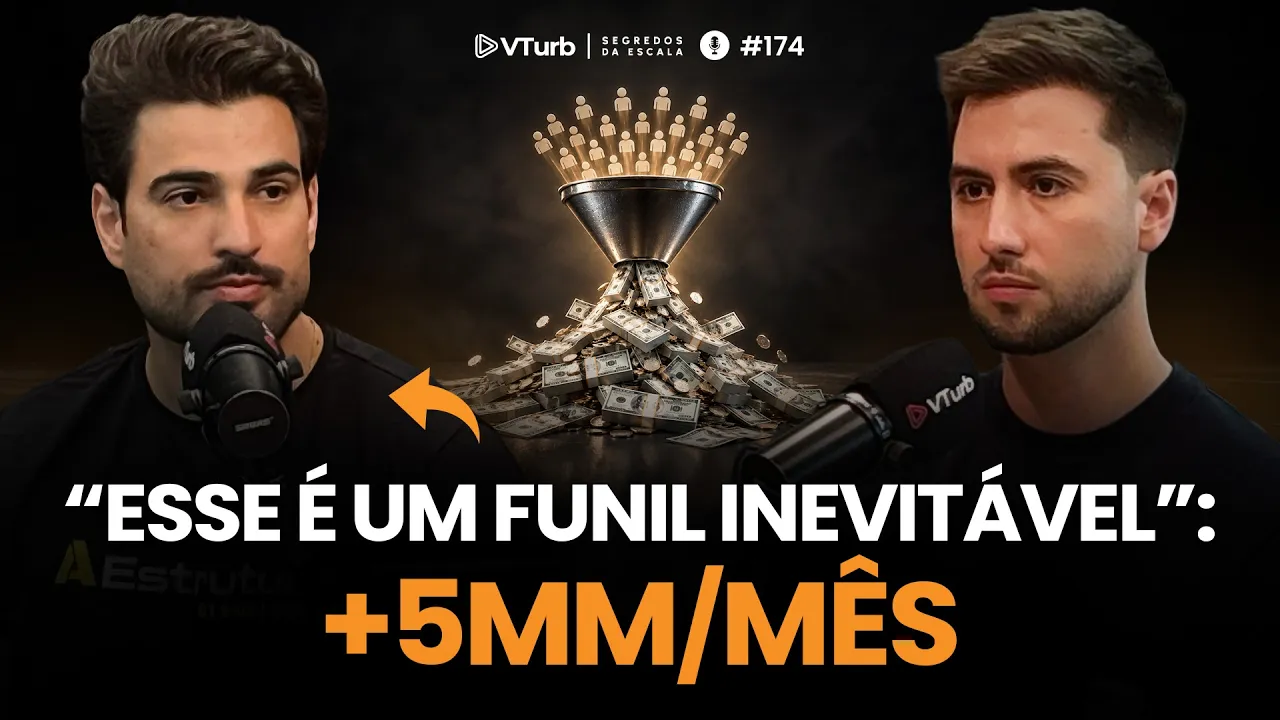
Man, this creative right here literally put a couple million in our own pockets. A react video of the guy talking about it. That's what we call authority anchoring Which is actually when someone bigger and highly influential in the entire space starts talking all about what you do The launch guys transitioning into direct response and using direct response strategies are gonna blow up, because they already know how to execute this part. What's holding them back in this process is that everything got way more expensive With a direct response funnel, you build a massive buyer base. That
way you can bring back those high-converting origin launches inside the process. Gustavo Lopes. He built his digital product business through launches, but ended up sitting Three months in the red. The turning point came when he discovered the power of VSL funnels for customer acquisition. Today, he makes multiple seven figures a month in profit by stacking different funnels in his business. In this setup you're running, where you have a VSL funnel, then launches, webinars, this and that—you might not have the biggest top-line revenue in the world, but your margins are insane So you guys net one,
two, three million a month. That's surreal. But what did you actually do when this expert was already running direct response and pulling in a certain amount of revenue? What did you tweak to push him 5X or 10X? What happened to give it that massive boost? And man, From one month to the next, we started making twenty thousand a day. So it was small tweaks like that that got us to twenty grand a day, and going from twenty to a hundred thousand was all about taking that leap, those twenty seconds of courage, putting real money into
paid traffic, and hitting that winning creative that just blew up Man, it's virtually impossible for any lead who bought my front-end product to not know about my other backend products and offers Because I'm gonna constantly bombard them with offers, and I don't have any issue doing that The real secret behind those seven figures in profit is exactly that. Without a shadow of a doubt. Today, I'm sitting down with Gustavo Lopes. Folks, Gustavo comes from the world of launches, but over the last two years he's been studying and applying direct response marketing, and he's already gotten
incredible results. In fact, his offer has already grossed over forty million reais just in 2026 alone. It's something completely surreal. And that's why I decided to bring him on, so he can tell you how he did it, so that you, watching from home, can pick up some tips and apply them to your own offer too. So man, we talked about a ton of stuff. Like, for example, what are all the types of funnels he uses, and why the VSL funnel is the most important of all... How he sells more expensive products, basically how he upsells
the people who bought the main offer from the VSL funnel. Also, why you shouldn't ditch launches just to do direct response. Actually, you need to run both in parallel. Why he considers direct response nothing more than an acquisition channel. And honestly, in my opinion, it's a great acquisition channel. And man, of course the podcast covers way more than that. It was an extremely long episode, over four hours of recording... I don't know how long it'll be once it's edited, but man, it was a lot. So, if you're interested in scaling your info products, I recommend
you watch this all the way to the end, because I think you're really gonna like it. And if you don't know this podcast, this is Scaling Secrets. Here, we bring in people who've already scaled their offers, who've already scaled their businesses, so that you, watching right now, can pick up one, two, maybe even three tips, if the episode's good, and go apply them in your own business to scale it too. And this podcast was created by VTurb. VTurb is a video hosting platform focused On increasing your VSL's conversion. So man, if you've got a VSL,
you're gonna boost your revenue by hosting it on VTurb. And to prove it, I left a video in the description called "Seven Easy Ways to Increase Your VSL's Conversion". If you've got a VSL, click the link, watch the video, and try applying everything today so you can boost your conversion and stop losing money. But okay, enough talking, let's kick off the podcast. So, here he is, Gustavo Lopes. Welcome to the VTurb podcast, man. Thank you man. I really appreciate it. It’s an honor to be here on the podcast. I’ve watched a lot of episodes since
the podcast first started. It’s an honor to be here. Thank you for the invitation and for having me here for this conversation. Man, the important thing wasn't you coming here. It was really just for Caio, because I wanna beat him at FIFA. Ahh, I get it. So, uh we’re here with all this anticipation Not because we’re recording a podcast... João’s over here saying, “Man, forget it... I’m gonna crush him...” Why? Because I found out João was really good at FIFA. And he texted me. And since I’m strategic, you know... I thought, “Man, if I’m not
good, I’m bringing my best player with me.” Better? Better than João? Definitely. Really, Caio? You're that good? It’s gonna be a good match. I said, “If I bring a good player and he can’t beat you, then my business partner is coming tomorrow to win. Somebody’s gotta beat João.” Nobody here is gonna win, man... Guys, get this on camera. I want everyone at Home to see this, okay? Look at this. Behind me, there are a bunch of VTurb plaques for 100 million plays and all that... but those are easy. This one is the hard part. Look
at this. This is the one that’s hard to get, okay? The VTurb FIFA trophy. This is the one. Man... I can't wait to see this game. Me too, man... And the truth is, like... There’s no way that... We put a video game in the office, and didn’t train Caio enough to beat you. There’s no way, man. Sure, but we’ve had a video game at my company for eight years. Wow, damn... And, playing FIFA since... But I trust my friends. Since Winning Eleven. Since way back then. But man, anyway... jokes aside, look how life works out,
right, man? You interviewed me on your podcast... When? In 2023, I think. In 2023, can I put it up on screen? Sure, man, of course. Hey, my podcast with Gustavo's about to show up on screen. Which I recorded back then, and now I'm the one interviewing you here. Crazy, right? And back then, there's a clip of you saying that was the craziest podcast you'd ever done. Wow. Yeah... And you know I tell people this all the time, right? I say, "Man, VTurb only started their podcast after João came on mine. He said, this thing's so
cool, let me make one too". Man, Look, I brought you here for a few reasons, okay? But the first one is... I'm seeing this huge wave of people in your market... The Info products market, starting to talk about VSL. And man, you're a client of mine, a big one... And you say something I find really interesting, something that's actually different from what people usually hear online. Which is what I believe too, right? That people implementing VSL funnels, especially the launch and info products crowd... It's not one or the other. Because I think the smart move
is doing both. And the people who follow the VTurb podcast... the ones really into our content, Go check out the other episodes I've done... you'll see I always say something like: What's gonna happen when the launch info product guy figures out he can use VSL as an acquisition channel? And it's wild, man. People are making so much money. It's insane. It’s getting crazy. And I really hammer this point too. Because I say, “Man, just like those of us who came from the launch space, let’s say... discovered the VSL funnel, direct response... And we plugged it
into the operation... made a ton of money... And when people discover... People in the launch space... When they discover the power of this... They’re gonna make a lot of money. And not just the launch crowd, let me actually correct that. The Direct Response crowd too. Obviously, you need a specialist. They'll realize they also need to pay attention to other funnels, and they'll make a lot of money too. Because here's the thing... Traffic is getting more and more expensive. So has attention. Attention got harder and more expensive to get. So, just having one funnel or another...
Man, it's tough to actually turn a profit that way. You might generate revenue, but, real profit... you need to think not just like a funnel, but like a company. Like... how do I build this out, how do I connect funnels so that, at the end of the day, on the bottom line, I actually walk away with a solid profit. And, man... The folks at home already know this. But I don't operate only in the info products market. I've got VTurb too. And as crazy as it sounds, I'm the most surprised by it. Because... I had
no idea we'd grow this much and go global. I've got clients that, I don't know if you'll believe this, folks... but clients making ten million reais a month. I've got clients hitting nine figures a month. Man... that's insane. Yeah And they profit a ton. But the average guy, like, I don't know, someone making ten million a month... well, not average, that's already pretty advanced... but that kind of person makes ten million, and his profit margin might only be ten percent. So he pockets one million. But with what you're doing, where you've got a VSL funnel,
a launch, a webinar, this and that... You guys don't have the biggest revenue out there. But the margin's absurd. So you're profiting one, two, three million reais a month... It's surreal. And that's the thing. If we only had the DR funnel, for example, we'd have a margin like that. Or even lower, to be completely honest with you. Because it depends on the scale, and whether you like it or not, you start bringing that down. If you don’t have other funnels to plug in, it doesn’t make sense to scale that much. For us, up to around
100,000 reais a day, roughly three million a month, we relied heavily on... on direct response, the VSL funnel. But we still hadn’t plugged in other funnels or gotten them running consistently. So we were pulling a ROAS of 2... ROAS of 2.1. So... That's still manageable, let's say... And when we started hitting 200, 300K a day... and just a note, that's 200K, up To 300K, from the direct response funnel alone. On VSL. On VSL, you know? That's the central funnel, outside of the others. And uh... once we started doing that, our ROAS dropped. So... Why was
that a strategy that... that happened naturally? It’s because I can lower the ROAS, but I have a really large number of people coming in. So then I plug in the other funnels, and... my final ROI actually works out. but, honestly, our margin is... Is way better than that ten percent. For sure, man. I've got a plan for us to follow here... it's in my head, okay? Because even at Lunch, you started telling me a bit about something. I said, "Dude, stop right there..." Yeah, it was actually funny. You said, "Man, I didn't think the story
was that cool." I said, "Stop talking, because I want to tell this on the podcast, and I need to be surprised". Cool. So I'm gonna stick to this plan, okay? And, everyone, my idea for today is to understand how Gustavo's whole thing works, this multiple funnel setup that generates seven figures in profit. Not revenue, profit, right? Actual money in your pocket, that you can pull out, buy your cars, whatever you want to buy. But before that, man... One of the reasons I brought you here is that you're a market leader... So, you teach other people
how to do this. The more you teach, the better it is for me. Because that helps VTurb grow too. And since you actually get results, you'll create good clients. Yeah. And I know you've got this event coming up... that's on your shirt right now. Called The Structure. And I'm gonna try to make it, alright folks? I told you I'd try. I don't know if it's gonna happen... Look, we're putting João's promise right here, on the podcast... That you're gonna make it. I'll try. Look, Nicole, let's see if it works out, alright? I think it will.
Because editing shouldn't take more than a month, you know? No. But... this episode should come out before the event. So that you, watching at home, can know about it. In case you also want to go, if you're an info product creator, or something like that. So, man, before we get into all of this structure thing, walk us through the event a bit, because I wanted to talk about that, since I think it'll help educate the people who are more interested And of course, later in the podcast, we can circle back to it... but explain what
this event of yours is about. So, here's the idea... Ever since we started getting results in the market, people started reaching out, trying to understand it. Because these are numbers That really grab attention. And I'll admit, two years ago, if I'd heard the numbers, and... the results we have today... I would've said, "Man, this guy's lying. This guy's a scam artist." And, once you actually get there... whether you like it or not, people find out. And they start asking questions, stuff like that... And I always joke that, the first time you actually start making that
kind of money, there's always this doubt, like... Was it just luck? The first thing that popped into my head was, "Man, is this gonna end? Is this actually gonna keep going?" So I held back a bit. Because people started saying, "Man, teach me... what are you doing?" and stuff like that. And I said, "Man, hold on, let me figure this out first..." And from there, you keep getting it right, keep doing it, keep building, so you're sharpening a strategy to really understand it wasn't luck. That you actually get the process. Why? We talk about the
funnel and throw out these numbers, but it's always worth being clear, there will be moments of instability... and that's exactly why you need a solid structure, with good funnels. So you don't see your revenue drop. Oh, that's why it's called Structure. Got it. Why? Because... it was only once we understood this game of plugging all these funnels, multiple funnels, into the operation... that even in moments where, like, CPM spiked, there was some kind of issue, whatever... we were still able to hold our revenue steady. And so, the first point was validating that it wasn't just
luck. The second point is... Is this actually replicable? So then we started doing mentorship. But it was in person, private. Just with the team. Over in Uberlândia? No, people would come to my house. Man, we went to Portugal, we went to the Amazon... Portugal? I went to the Amazon. To Manaus. Wow. To do mentorship. São Paulo, Belo Horizonte. We went to different places all over Brazil. And it was exactly two days. Two days, where we would... uh break down people's funnels, figure out the bottlenecks, and map out how the funnel should actually look. And then
we started validating this, and people got results. We had a mentee doing a 100K a day... We had one doing 200K a day... We also had one doing 30K a day, And it's worth mentioning that one too. Because the niche was smaller, since he was only making 3000 a day before. The guy went from 3 to 30. That's a great result. That's absurd. Right? So it's valid too. Because people get stuck on this idea of, "the 100K funnel, the 200K funnel," anyway... And I joke that every hour that goes by, they bump up the number
they claim we make too. I went to speak at an event, and they started introducing me as "the 200K a day guy." Then it became 300... and by the time I walked on stage, they said, "he does 500K a day." I was like, "whoa, hold on, everybody." so then we started replicating that. And we saw it worked. So, first point, we validated our hypothesis on whether it was luck or not. Then we replicated it to validate that. And we said, "alright man, now we're Talking. We can actually bring this to more people. Because we also
can't keep traveling forever." Man, I'm on flight 51 this year. Wow. That's 51 flights I've taken already. So... Wow, you've traveled more than me this year. It's a lot. Like, uhh... Man... To give you an idea, I just rented a new apartment now, that... Already burning through that DR money. You know... that's a crazy thing for me to even say, man. Why's that? Because in the beginning I didn't spend a dime, man. I didn't spend anything. Remember? I was freaked out about whether it would work or not. Like, "is this thing gonna fall apart or
what..." So that was something I had to work through with myself sometimes. Because I was scared of it. I don't know if you went through that when you started making real money... like, "is this actually gonna keep going?" Of course. And that's something nobody talks about. Which is, man, you have to work on your mindset. Because... it's something I think messes with a lot of people. And for a long time I kept the same lifestyle, man. Same place, same stuff.... And then, one day, I was going through a rough patch... working like crazy and all
that... and my therapist said, "Man, why don't you actually enjoy life? Let yourself enjoy it." And after that I changed. Do I think I overdid it a little? Yeah, I think I overdid it a little. But anyway, I rented an apartment, I didn't want to buy it. It's really close to the new office. And I've stayed there for... like... in a month I'm there maybe five days. I even thought, "was it even worth it?" Yeah... It was worth it. But anyway... the days I'm there, I actually enjoy it. Because we've been traveling a lot doing
this to validate it. Man, from macro niches down to micro niches, we've been validating this strategy, and we've been seeing results. And once we locked it in and said, "man, this is it," what do we do differently? What do we build? We build the team's structure. Yeah. So then we said, "let's put together an event to do this." And to be clear, it's not an event with a bunch of speakers, it's not a coaching event or whatever... man, it's a hands on event. It's the exact same two days we used to spend with those mentees,
except now we're spending it with a whole group, getting hands on, Structuring the funnel, building it out, and so on... And then... that all came together, and I'll admit the name actually started as a joke. You know Thiago Brava? Yeah. Who makes fun of the structure? Oh, right, yeah! He'll say, "oh, from the second division and all that." And I was like, "damn, that name's so good." That guy's hilarious. Because I was thinking, "man, I'm gonna teach these people in the digital market, because everyone's talking about the digital market crisis... everyone's playing in the second
division..." I said, "I'm gonna take everyone to the Champions League. It's just gonna be called "The Structure." And that's where the joke came from. It came together with that word we always used to say. And, man, let's do this Event, let's hold it in São Paulo. It's only gonna be a hundred people, because we can't make it too big, otherwise it's not really hands on anymore. Then we had to scramble to build out, both a SaaS piece, some AI tools to help people, and all the materials. Because it's different when it's just me and you.
Just with you, I can throw out a bunch of ideas and really keep up with you one on one. To keep up with a hundred people, I need way more support material. So that's what we're planning to put together. Cool, cool. Man... I really want to get into this structure for real... So the average info product creator watching this can actually make money. You know? And that's basically what I want to talk about. But I've got a question to ask you first. Sure. Man, you said you got into this market back in 2021, right? But
you only started applying direct response funnels, direct marketing... at the end of 2024. 2024. That's what you told me at lunch, right? That's right. Man... but I recorded that podcast with you back in 2023... I didn't even really know what it was about. Man, so... here's my question. Because, like... this VSL thing has been around for a long time. I've been doing this for twelve years. I started when I was twenty. Today I'm 32, so I literally started this business twelve years ago. And for me, it was something really obvious. I thought, "bro, I've got
two options. Option one, I make a ton of content, drop videos, that kind of thing... or option two... I didn't have that understanding you have today, of Layering things, of actually building a real business." But, since I was at the top of the funnel, and in my head I thought I only had to do one thing, so I figured, "I'll just do VSL." It worked great, I saw a lot of people make a lot of money, but man, you didn't get into this recently... it's been a while, right? Yeah... But I consider myself pretty new
to the DR market, honestly. In the DR market yeah, I'd say so. There's people who've been around forever. Yeah. Man, here's what I wanna understand... how was your journey learning this whole DR thing? You don't need to go too deep into it. Because I wanna get into something more technical... And then also explain this to me: why do you think the info product market, or launch market... which is where you come from... why did those people take so long to get into this, man? Because... This is something that's been happening in Brazil for a long
time. VTurb's been around for, like, four years... and it seems like only now, in 2026, that people are actually talking about it more. There's a lot of info product folks talking about it... I keep hearing podcast after podcast bring it up too. I find that delay really strange, you know? I don't know if people were just too lazy to try something else or what... I've got two answers. There are two reasons, actually. Reason number one, launches used to be easier. In the sense that buying data was easier. And also, People didn't have as much competition.
So, picture this, my first expert was actually my own sister... she started back in 2018 talking about family law. She was basically the only one talking about it. So she didn't need to grab that much attention. If someone wanted to learn, she was right there. And then, years went by... new experts started coming in. Traffic got more expensive... but honestly, people were actually making money with launches. So they got stuck on it. You know? And what I saw happen the most was: the expert who made money from 2018 to 2020. Then 2022 and 2023 rolls
around, and you're saying: "we gotta change the strategy, do it this way." And he's like: "no, but I already made a lot of money. It worked really well a while back." I joke that it's kind of like that song Called "Gabriela." It goes, "I was born this way, I grew up this way, Gabriela." That's the parallel I usually draw with that song. It's about people who never realized the market had changed. So, It took the launch market, the info-product space, let’s say... a while to pay attention to the VSL funnel. Because... It was actually easier
to get results in the launch market. And... on top of that... I can speak for myself, that... I think we just didn't have... Good people promoting this funnel... in the sense that... we always associated it with the black niches. You get it? It's because... Just plain old bias. Because of that PLR stuff there. Yeah, you know what I mean? It was a preconception... It was a bias I had, and I speak for myself, I think a lot of people had it too, that bias is just a concept before you fully understand something. Like looking at
this funnel and going, "no, VSL's just for the black niche or something like that." So it was really these two things coming together. There was this bias, this preconception against that kind of funnel... And there was also the fact that it was easier... or... well, it was just simpler to run launches and sell things back in those days. And now, with everything... Getting a bit more complex, a bit harder... I usually say it's about getting professional. The digital market, it... people think it moves a ton of money, right? But I always say this. And for
everyone listening, I’m in the digital marketing space... But I.. I always say that it’s still an immature market. It’s still in its infancy. A small market... Both in revenue, And in... time. "Ah, come on, aren't there people making 100, 200, half a billion?" In... this market? There are, sure. But when you go to the traditional market, that's, just a normal company, you know? Not even one of the big, big companies, let's say. So it's a market that's gotten more professional over the years. It's still a Fairly new market, still professionalizing. So it's only natural that
competition grows, and that we keep trying to understand this and professionalize it more and more. Right. That's why we always argue that it's not, it's not really about the funnel, it's about building the process, it's about the structure you're gonna create inside your operation, inside your company. And... it's not just: "let's run a launch, do a DR, do a webinar." Man, it's about how you fit all the ways of selling together, and how you sell more to that same customer. Yeah. So, man, could we maybe say... Correct me if I'm wrong.... Sure. But, I mean,
launches were pretty easy to pull off back then. And people were Making a lot of money... And people would look at VSL and see these launches from Thiago Finch, or from Kayky... And they'd think: "Ah, those guys are just selling e-books, it's all PLR and stuff." So people were kind of... comfortable with the situation they were in. Is that how you felt? Totally. Yeah, and that’s what I keep coming back to. It’s a preconception that you have to break down. And the challenge was that people were comfortable. It’s the same thing today. We advocate for
having a sales team as part of the structure. And you'll see more people start talking about it. And, the sales side... It's even older than the... the VSL funnel. You know? Man, having a salesperson inside your company is way older than that. So why don't people pay attention to it? Or they think sales teams are only for high ticket or something like that? Because it's comfortable. So, comfort creates... This... this plateau of funnels. Of sales structures. And when things get uncomfortable, when things start getting harder, people start doing other things. They start looking at the
sales side, looking at a VSL funnel, looking at all these other areas... Because things are getting harder and they realize, “Man, if I don’t start doing this, I’m gonna, I’m gonna go under. I’m gonna... go bankrupt.” You know what I mean? Yeah... And, man... I know you started doing VSL at the end of 2024, so we're talking about... a year and eight months or so, right? Yeah. And man, congrats. On your results. Thanks. At my best I did about... What I made with the DR funnel, right? It was 630 thousand, in Brazil. Except it was...
A physical product. It was a cosmetic, from Diatena. Which has a higher average order value. Now, with info products... I think the most I made was maybe 150, 200 thousand... That was back when... I had my own marketing agency and stuff. But I never got to numbers like, like yours. So, congrats. Thanks. But what I wanted to understand was when did you have that... man, how do I put this? That “lightbulb moment,” you know? Like back in the Enlightenment era in Italy... So you were like, “Oh, I’m gonna do a launch here and stuff.” And
then you realize, “Damn, man, I can actually have another funnel and use it for acquisition.” When did you have that realization that, like, for some reason is a revolution now? Well, it's basically what I just said. I always say: People get comfortable, and they only start looking around once things get uncomfortable. And... At the end of 2024, the expert came in... His name is Guilherme Cirilo. He came in and... man, he was doing launches and doing DR. But he’d only made, I don’t know, 450k in revenue in 2024. And then he ran into some problems,
so he reached out and said, “Man, I’d like you to take over my project.” And I thought: I was like, all right, this guy is good... He’s aggressive. You know? If I tell him to do six hours of live streaming, he’ll do six hours straight at his peak. So maybe it'll work. And then in the middle of that he said: "Man, actually... I've even got an evergreen funnel, where I run some, some videos, some VSLs, and all that." I said: "Man, I've heard about it and everything, but I'll be honest, I'm not the best at
this part, you're gonna have to teach me, you're gonna have to walk me through it." And so he started teaching me. And things really only clicked when... When... This is what happened: we had launches as something really strong inside our... Our uh... Agency. Let's put it that way. And what happened was what usually happens, Which is... the specialist... he backed out. Damn. So then... we were right there, man, really getting into the swing of things, And the specialist left. And up until then... I hadn't put the team in charge of that project. The DR project
was something that only the specialist and I were running. And toward the end of 2024, I took some time to study this. I asked him. I said, “Man...” Give me the info, how does this even work? And he said: "Man, this is VTurb... You set it up like this... this is your retention rate... and so on." I said: "Man, interesting... let's do the Black thing and let's... uh... The Black Friday? The Black Friday. And let’s set up this funnel, but hold on. And then in December, I started to understand it, little by little... We set
it up and made some tweaks. Just stuff I figured out myself. Hold on, man... I told you I'd interrupt you. No problem. Told you I'd interrupt you, right? And just a reminder, I'm gonna wreck you at FIFA, alright man? You'd better start training mentally, 'cause you're gonna get wrecked the second this podcast wraps up, man. Just a heads up. But back to the podcast... You know what that's called? Psychological pressure. The game's already started. Yeah. And he doesn't even know it. Guys, you know what the secret is? The secret is that I’m always talking about
this on the podcast, so by the time people get here, they’re already nervous. They show up nervous. He thinks he can through-ball with Triangle... Shoot with R1... So he already shows up kind of crazy. Man... So from what I understand, alright? You're gonna tell me now about how you Started running it and everything, and we'll circle back to that in a bit... Alright. Except... I thought it was really crazy... How quickly you learned. And I also didn't really get how you learned it. Because, your specialist, if he actually knew how to do the thing... He'd
be scaling like crazy himself. So he didn't know that much then, right? And you went and talked to him... He taught you, and you helped him scale... So, what happened there, man? You know when you asked me right before the podcast started... You said, “Man, what are you really good at?” And I said, “Man, I don’t know. I joke that I’m Pretty average at a lot of things...” And he... He already had some knowledge about... About VSLs... About the retention numbers he needed, about conversion... About the funnel, the upsell, upsell one. So he already had
that whole structure kind of already pieced together, rough around the edges. So what's the difference then? It's that, "the skill", let's say, of being average at everything, like I joke about, is: I can find the bottlenecks. So as he was walking me through it I started to get it. And I said: Man, this doesn't make sense. We spend so much just to get a guy onto a page... And only X% of them... actually watch the video? Or like, "how much am I even spending on this part here?" And I started doing the Math. And that's
actually still what we do today, inside the the mentorship. I always say: "Man, the funnel is just math." I know it's kind of boring when we talk about this, Everybody loves to say: "ah, VSL, this and that." Man... But the funnel... it's just math. So the first thing I did was stop and observe. I'd ask: how much do I cost? How much do I spend to bring people to my page? How many people start watching? Of those, how many reach my pitch? How much they convert? What's my average ticket? And that's how I started finding
things, like, man, this connect rate is trash... Let's fix this. So I started making adjustments. And that's when I started to Really understand it, and the process started to click. And that's when... okay, fine, we did 250K in January 2025, but... Man... For a guy who'd made 450K that year... Yeah, it was already... A huge gap making all these adjustments. Like: man, can't you see there's a bottleneck here? So... He's a good specialist... He's got... uh... he had, and still has, a basic understanding of the process. But the difference we made was in how we
adjusted the details. I see. And it's not like... Man, it wasn't the copy we changed. It wasn't even the creatives we changed. It was: "Man, how do I fix this, and where are we actually losing money?" That's why I always come back to this. I have a calculator, let's Call it that, a spreadsheet that I use... That I show people. I tell them: "Man, look at this right here..." "Which is easier? Getting a 5% conversion rate on a VSL, or bumping your CTR up by 0,5%? Because, if your CTR goes up, and you can't touch
your CPM... your CPC drops... and you can bring in more people... And that's how you fine-tune the whole funnel." That's basically what we started doing. But up until then... it wasn't really like... It was more like: "Man, let's just get this evergreen running." We didn't even call it a VSL funnel, it was just the evergreen. and that's when we started gaining traction. And, of course, Think about it... We were still nowhere near where our revenue is today. Like, what we used to make in a month, today we make in a single day... But it was
Already something I started to understand, which was: "Man, this is just math. All you have to do is analyze it and find the bottleneck." And figure out how easy it actually is to fix that bottleneck. I honestly can't say, because everyone's got their own bottlenecks, but it's mathematical. So you can actually see exactly where a tiny little adjustment is going to give you a huge result. And that's not always about changing the VSL itself. I mean, writing a VSL, you know, that's really not easy. Yeah. You know? Like... getting even a one percent bump in
VSL conversion, that's not an easy thing to do. But bumping your connect rate from 75 to 90, that's way easier. And that makes a massive difference in your conversion math. You know? Bumping your CTR up just a little bit makes a huge difference in the end. So that's what we started paying attention to, and that's when things really started clicking, back at the start of twenty twenty-five. You know what that is... First principles thinking. Have you ever heard of that? First principles? No. There's a book, guys, it's gonna pop up on screen, called The Book
of Elon. The Elon book. You know that Naval book? The white one, The Almanack of Naval Ravikant. Yeah. That Naval book.. the guy who actually wrote it wasn't Naval himself. It was a guy named Eric Jorgenson. He's the actual author of the book. He's the one who Wrote the whole book about Naval. It's a really good book, by the way. The Naval book's gonna show up on screen, in case you haven't read it yet. And this author, right, he kind of studies the person, and then he wrote a book just like the Naval one, except
about Elon Musk. It's called The Book of Elon, and it'll show up on screen too, a white book with red on it. And in it, he breaks down the way Elon Musk actually thinks, man. He thinks through this first principles approach. So he doesn't think by analogy, he doesn't go, "oh, other people are doing it this way, so I'm gonna do it too, the business works this way, so I'm... I'm gonna do it like that." He looks at the problem and thinks: "what's the actual physics behind this Problem? What's the one number here that, if
I change it, is gonna make this whole thing better?" And that's what lets you... You know... build completely new designs from scratch. That's exactly why he was able to build batteries that last way longer over at Tesla. That's why he used to say: "man, I could buy this rocket part for ten thousand dollars, but honestly, I can build this same thing in my own workshop for like 400 bucks." So... I noticed that, you told me you did exactly that... you actually did this first principles analysis, On the VSL funnel. And you kept saying math, man.
That's really interesting, because in direct response marketing... We've got three pillars: communication, which is what we actually say, psychology, which is the idea behind what we say, and the topic itself... And different topics get different conversion rates. And also, the most important part... Not the most important, actually... but what I mean is, it's also really important, and that's the math, man. If the math's not there, the funnel doesn't matter. Right. You could take your VSL... whoever's VSL on VTurb... and run that thing on a major TV network, in prime time. Man, your CPM's gonna be,
like... you're just not gonna get any ROI out of that. Now, take that exact same funnel and put it on a brand new traffic source that just launched yesterday, where nobody's advertising yet... the funnel could even be kind of messy, but it's still gonna tend to work out great, because the traffic's gonna be dirt cheap. So that whole math piece is really, really interesting. So I liked that you actually... that you did a first principles analysis on the VSL funnel. So your whole education on the VSL funnel, it came from these two variables right there:
this guy, your expert, who taught you... and also that first principles analysis, to help you understand what was actually going on. Is that about right? Exactly. And what happened was... Actually... going back and adding to what you just said. Math, for me, it's in a whole life process, so much so that we even explain it in the... in the whole offer thing. Yeah, and then João Tafuri... oh, actually, if you're watching this, his podcast episode's coming up soon... He talks a lot about offers. And I always joke around saying: "Man, math is in everything, even
an offer, it's basically just a big opportunity with low risk." It's like one minus the other. And then I need to get a big result out of it. And... the math is in the entire process. So that's the very first thing we looked at. Man, okay, so how does... how does this whole thing actually work? Obviously, from there, we start developing and actually understanding what's being done. Man... I didn't even know how to look at other people's VSLs... and honestly, even today, I'm not really the guy who studies that stuff. Especially because, like you just
said a second ago, it's really that thing where, like, I don't worry too much about what everyone else is doing. I worry about what I can actually build and develop right here. So much so that everyone kept talking about the 100K funnel. And man... one day, we... What do you mean, a 100K? The 100K-a-day funnel. Your VSL funnel? Yeah, everyone kept talking about this 100K funnel. So I was like, "okay," and we finally got there. So I looked at it and said: okay, but... Why stop at a 100K? So, I said: What's the gear I
need to turn to actually make more money? Obviously, in my head, it was, I mean, what happens is, I know that the more money I put into traffic, especially if it's just one single traffic source, the more expensive it's gonna get. It's a math thing... So, remember what I said? I can lower my ROAS If I have other sources of revenue. So going from a 100K to 200K or 300K was the same deal. It was purely math. Right. It's like: "okay, fine, I'm gonna lose a bit of profit here, but I'm gonna gain over here."
So I can let that whole process happen... And figure out exactly how much I can afford to give up. Actually, I was just talking to you about this over lunch: man, someone who today doesn't have a ROAS of... I’m gonna talk about refunds, because every market is gonna have its own numbers. But, someone who doesn’t have roughly a 1.56 ROAS on the front end... They’re just putting money in and watching it go right back out, putting money in and out. And once you factor in refunds, once you factor in taxes, ad Platform fees, the whole
process, forget it. If a guy doesn't have that number, he's straight up losing money. Does that mean having a 1.6 ROAS one day is bad? No. I have several other funnels running. So... I don't really worry about that. But I can only get to that point after doing the math on, like, how far I can actually go, you know? Got it. But I'll be honest with you, it took us a while before we actually started taking this funnel seriously. We were launch people. That's what we did. We were the launch guys. And we still are
the launch guys, honestly, we're still pulling off great launches. Seven figures. Multiple seven... I mean, this year we haven't hit multiple seven Figures yet, though. Got close, but we haven't done it yet. But only investing 40K or 50K in traffic. That's great, right? Not bad at all. Not bad at all. Yeah, that's cool. But why did it take so long? Because we just weren't paying that much attention to this funnel, you know? Like... we were still stuck in that comfort zone. That whole thing of "we're launch people, that's who we are"... "Let's run a launch,
let's do that..." And it took a while before we really understood all of this. It was the same kind of analysis, like: "man, let's actually understand this and go execute it?" Man... But what exactly did you do, right? Back at the end of 2024. Where, this specialist... He was making decent money, and he was already doing DR. He was pulling in some "X" amount... What did you actually do to take him to five X, ten X? What happened to cause that kind of boost? I don't know if you even remember what you changed... can you
tell me exactly what you did? Man, I remember there was this problem that, believe it or not, is more common than you'd think... it was a connect rate issue on the page. It's kind of crazy, honestly... a connect rate problem... and it was low. I remember we made a few adjustments, and the whole business... it started to actually survive. And I joke that I have more courage and a higher risk appetite... So, what’s the Problem when you’re starting to scale, which was the case for him? Or rather, when you start putting money into it? One
sale can make a huge difference. So look... If you're putting in five hundred a day, and your ticket price is two, three hundred... one single sale is huge. So sometimes, you're just gonna end up negative on a given day. And you need to be mentally prepared to understand why you can afford to go negative or not. Or how much of that's actually proportional to the business. So... that was another point I remember... he had this insecurity, like... he'd put budget in, and every once in a while there'd be a day that ran at a loss...
and that was because... it was the kind of loss where, if he'd just sold two more products that day, or even just one more, it would've already broken even, you know? Because he was still operating at a Pretty small scale. So that was another point where I sat down with him and said: "Man, I need you to trust me on this too. This is the same thing, it's the math." I told him: "Man, this right here, this is math." But I need the peace of mind to actually make this happen. So much so that at
the start of the project, I was handling all of the traffic myself. Because I came in doing not just the execution, but I also went back to being the traffic manager. I was handling all of that stuff myself. So... Not just with that, but with the investment too. I told him: Man, I'll cover this. And if this runs into any kind of problem... "If it goes wrong, that's fine, no problem." Why? Because I needed real Numbers to validate everything. So I remember it was a bunch of small adjustments here and there. And then I started
figuring out what a downsell actually was... man, there wasn't even a downsell in place. So I started thinking: "man, we could actually add a downsell here, we could tweak this part too." And that's how we kept validating everything, step by step. Where'd you learn all this? How'd you figure out this stuff? For that, I just started watching what the market was doing. You know? And that's when I started understanding what the market was actually doing. Was that at the start of 2024, or mid-year? We actually started running it at the beginning of 2025. Oh, 2025.
2025, that's right... And sometime around the middle of the year, that's when we Lost the specialist who was working with us, who was a really big deal, So... Was that mid-2025? Yeah, mid-2025. Mid-2025, I looked at it and thought: We're barely scraping by with this business. And you might say: "But didn't you do 250K in revenue?" Sure, but you have to realize it's a real company, and our ROAS was, like, 1.7. I actually still have the screenshot from that month, I think it was right at 1.7. And like I said: "There are refunds, there's a
whole operation going on," so the profit just wasn't enough to sustain a company. Obviously, I had other experts, you know? but then it got to a point where we actually lost this one expert. And I remember it was a massive moment of crisis inside our info-product division - 'cause, I mean, we lost our biggest expert, right? And like, we had originally planned to dedicate two or Three experts, then lost the biggest one, and ended up with just one... And you know, a partner wanted to leave as well, and everybody was kind of messed up, man,
there was honestly nothing we could do in that moment... Company falling apart. Yeah, falling apart, at least the info product side. And I said, "Man, I'm gonna shut this down, we've got other divisions in the group." But then I realized: "Okay, fine, this thing is crashing, but it's where I am, and it's just not working." And that was around June of 2025, If I remember correctly. That's when I sat down with my expert and said: Bro, look, here's the deal. I've literally got enough cash to keep this whole thing afloat until December, and that's it,
okay? Like... Six months of runway. Yeah, exactly. And that was it. And he said, "Bro, you're the one who has to Hold this up, 'cause things are ugly on my side right now." And I said, "Alright." and I remember we sat down properly, and I told him, "Look, my other expert just left, so now we're going all in on this thing right here, okay?" and, well, I really need to make this entire thing work, or else I'm just shutting down the education side for good, and that's it, it's done." And then I went: "Look, now
you've finally got my full attention, and we're gonna nail this, okay?". 'Cause, like, from January to around mid-year, like June, we'd built this funnel, but to be completely honest, we weren't really giving it much attention, you know? Yeah. So we were still doing launches and all that, and then I finally stopped and said, "Man, let's go back to the basic principles of the business. The math isn't adding up, but this thing has potential, we just have to actually Focus on it." That's when I said, "Alright, let's dive deep into this." and I mean, in fact,
back then I was running the traffic myself, even though I hadn't run traffic in a long time. And I like to joke that this guy was kind of the black sheep of the agency, man. 'Cause we didn't have a team, it was just me and him, you know? Yeah. He even ran traffic for a while in the middle of all that. Everything was kind of messy, you know? And on that moment, we sat down and said, "Look, from now on, either we make this work, or we're shutting down the info-product side." and that's what we
did. Then I started studying other people's funnels, you know? like, just trying to figure out, "Man, how do these guys actually do it? What about the downsell here? How does that work?" And as I kept looking, I was just like, "Oh, okay, so There's a whole market here." That's when I started studying for real —things like properly watching VTurb, you know? Like: "Man, how does this work? What are people talking about? What are they doing?" I started really paying attention to this market. And I remember when I sat down with him, I said, "Bro, here's
the deal, let's run the numbers: we need 3,000 in profit per day, right? That's what we need." And he still jokes about it to this day. He says, "Dude, we were basically one step away from sitting in the gutter." I mean, we were sitting in the office, but it had that vibe you know? So we were like: "okay, let's hit 3,000 in profit 'cause that's what we need to pay the bills, have a little left over, and keep things moving." And that's when, we started making these kind of adjustments, tweaking the price point, And figuring
things out, right? Like, man, we weren't even tracking our AOV... I mean, in fact, we just didn't know how to increase it, you know? I wasn't running tests. So picture this: I could see where the bottlenecks were, but I didn't have the experience yet to know what to adjust. Experience makes a huge difference, you know? I could tell, like: Man, the math here isn't adding up. But I didn't have enough market experience yet to say: "Man, I can raise my AOV simply by bumping my upsell up 100 bucks, or by getting a higher conversion rate."
Like, it's pure math, right? But I just didn't have the experience yet. That's when we started testing, trying things out, and getting organized. And then man, from one month to the next, we started doing 20K a day. What month was that? July? Yeah, July. July, 2025? Yep. That's when you hit that 20K-a-day mark? Yeah. I remember calling... well, we were testing, and then I just started testing everything, because honestly, I'm a freak when it comes to tests and data. And this is something I tell everyone: split test things, but you need a real reason why
you're testing, and you need absolute certainty in the result. Don't just test a bunch of random variables and say, "Oh, I think it was this." Man, be completely certain. And you know, there's a funny story I always tell, because up until then we were actually running on other platforms, and I was kind of realizing that I had some issues with checkout conversion, payments, and that kind of thing, you know? So I just said, "I'm gonna test a few more options." And I called the folks at Hubla and said, "Guys... I wanna test," but, like, I'd
already tried moving over there twice. And I was Honestly kind of embarrassed, 'cause, m, it hadn't worked out before. So I called them and said, "Look, here's the deal: I've got an evergreen funnel doing 20K a day. I'm not even gonna haggle over fees. I just wanna test the platform, but give me a rate that at least makes sense, 'cause I'm running these tests and I'm gonna validate it, okay?" m, and like, fifteen, maybe twenty days later, we were already doing 100K. And dude, once you hit 20K, things move really fast, right? Because you just
replicate, you know? The hardest part is getting to 15 or 20K a day in revenue. Yeah. After that, going from 20 to 100, man, you just replicate what you're doing... but what does replicating mean? Well, it's all in your math. And the math is simple. When we look at traffic, it's CPM and CTR, which give me My CPC. Like, how much am I spending for each click? And then I've got my connect rate, which is how many of the people who clicked actually landed on my page, right? And I've got my play rate, which is
how many people actually started watching, then one-minute retention, pitch retention, and conversion. and I mean, if you watch closely, you'll always find some part of this process that's working. Like, "Man, my CTR is really..." Working, or not working? Either way man, and once you hit 20K, you'll get it, since you're always comparing. Picture this: let's say you're doing 5K, then 5K again, then another 5K... so what should I adjust? Am I adjusting my creative? Am I adjusting my VSL? What exactly am I tweaking in this process, you know? And you'll realize that after you're done
adjusting, you'll simply start replicating. Oh, is it the creative that's working, because my CTR went up? Cool, replicate that creative. But now, where's the bottleneck? Man, my AOV went up. Okay, but why? Because I raised the price, or because I added another upsell? And then you replicate that process so it keeps flowing, right? So I always joke that going from five or 10K a day in revenue - and I'm talking revenue here, okay? - up to 20K is actually harder than going from 20 to 100, you know? And I remember the platform folks called me
and said, "Man, you promised me an evergreen doing 20K, and you're delivering one that's doing a 100K a day." I was like, "Crazy, right?" And they asked, "Seriously, what's going on?" And I said, "Well, we figured out the math." That was great for them, huh? Yeah, it was REALLY great for them. That's insane. And they'd actually given me a rate based on doing 20K, you know? So it was a really sweet deal for them. And, well, of course, we definitely took full advantage of the whole thing too. So then, right around m, June, July, August,
well, around August we started doing 100K a day, and we never really... August, that's month eight, right? Yeah... and we never stopped. Bro, let me see if I got this right, so, back in June of 2025, which is like a year and two months ago, well, at least from when we're actually recording this, right, guys? You had your main expert there, and he basically said, "I'm out," and he just left, for whatever reason, which is totally his business. And then... And honestly? I'm really grateful to him, man. Oh, no doubt, dude. If he hadn't dropped
me, man, I'd probably still be stuck doing launches. I might not have even looked at this. Like, it was a micro-niche, right? Yeah, totally, that's crazy, man! Some things are a blessing in disguise, right? I think there's a saying like that, or something along those lines. but okay, so at that point you only had six months of runway. And you had this other expert you weren't paying much attention to, who already had a VSL funnel running. And you said, "Man, I'm gonna focus on this guy." Right? And the very next month, in July, after you
started focusing on him, you were doing 20K a day, and by August you'd already scaled to 100K a day. Is that right? Yeah, exactly, man. Crazy, right? Totally. but let me ask you something, bro, about that specific period of time, okay? Actually, from what I understood, when you finally started Focusing on your expert who was doing direct response, you said you started looking at what the rest of the market was doing, so you could get some fresh ideas to apply to your own funnel, right? Exactly. Awesome. Man, I think having this, I mean, I call
it having your finger on the pulse of the market, you know? It's like keeping your hand right here, just feeling the actual heartbeat of the industry. And I think that's incredibly important, because you end up understanding exactly which strategies are working, the specific formats people are shooting, whether it's VSLs, creatives, angles, or mechanisms. You just get a much better sense of what's really going on. And once you've mapped out the market's level of sophistication, you can position your offer way better, whether that's breaking through that sophistication Level, bringing in a better mechanism, or, I don't
know, doing something else entirely. and there are tons of ways to do that. Like, we can obviously use a spy tool, or, maybe, let's say, we just go to a mastermind event, right? So, man, what exact strategy did you use to really get up to speed on the direct response market, like, the VSL market, considering you were strictly a launch guy before that? I mean, how did you actually get used to it and figure out what's going on in that whole world? First, I started watching the VTurb podcast. Very nice, bro. Man, one of the
very first masterminds I joined was Fernando Brasão's. He's actually been on the show already, and that's exactly when I met you. Man, that guy suffered on this podcast... Suffered? Why? Hold on, let me make a note that we're talking about Brasão. Mastermind, Brasão. Man, I wanna give a shout-out to Brasão and apologize, bro, for that episode, because he came on the show and started talking, and he just kept on going and going. It didn't record... Hang on, it was recording. But then, like, bro, the guy talked way too much. He talked for four hours, you
know? And a little over two hours in, the camera crashes, but we had no idea... Damn. And he kept talking... Bro, we lost his recording... Man, that sucked! He came back to record, and I had the episode in my head, so I redid it. I said, "Bro, I'm gonna ask you this and that." We put something together. It'll pop up on the screen, guys. Brasão's episode, for anyone who wants to show him some love. And that alone was awful, right? Then he asks me for a juice. So I give him the juice, he drinks it,
and all of a Sudden he goes like this: Did he throw up? The juice was spoiled, man. Oh no.. Completely spoiled. Man, you know what is worse? That sucked, bro! This stuff only happens to Brasão. Poor guy. It's because, like, he's such a nice guy, man, it's just the kind of thing that would happen to him. Dude, and he even brought me a watch as a gift, you know? Wow. He said, "João Campos, I brought you..." He calls me João Campos, right? "I brought you something cool." And he gave me this killer Boss watch. And
then I hand him spoiled juice. Man, so embarrassing. Sorry about that, Brasão. It turned out well. He came back and nailed it. He arrived at one PM and left at eight at night. I've never seen a guy dedicate himself so much to a podcast, but it had the most operational mess-ups. This one isn't going to crash though. You can relax, we're good. I think, right? Unless Will screws up. We'll just stay till eight then. No way, bro. You've gotta crush Caio at FIFA, right? I've got an appointment with that kid sitting over there. I'm going
to wipe that smile right off his face, bro. Uh-oh, Caio. The mind games are already starting... But anyway, man. But bro, you said you started watching the VTurb podcast to get up to speed. And you said you went to Brasão's mastermind, right? Right, so here's what happened: my first mastermind was his. There were people there running PLR, and people already running DR, you know? So I started messaging those people too, like, "Man, how do you do it? How do you see it? How Does the whole thing work?" And so on. Obviously, that's when I started
to, . I mean like, with some of them, I could actually pull some really useful stuff, because, you know, everyone's in a different market, right? So there were definitely things I could take, and other things where, well, there's just no way I could ever apply that, you know? and then I started to figure out who was running what, 'cause, I mean, these are just little bubbles... and in the start, you don't even know who's running what out there. Until you actually start going, "Oh, so-and-so runs a DR funnel, and this other guy runs a DR
funnel," and so on. In fact, at the very first event I went to, I was just like, "Man, this is really cool, I'm finally getting it now, it's a whole different bubble." and that's how it all started. And, well, to answer your question... and really tie it back to what actually made things blow up at the very start... I mean, it was literally the same VSL that I'd been running all along. If I'm not mistaken it was still the exact same one from back in, it was January of 2025. Man, I think we just made
a few little tweaks to it here and there, you know? I mean, to run that one in June, right? The 20K a day one? Yeah. And the biggest differentiator going from 20K to 100K was actually, believe it or not, man, our creatives. It wasn't a brand new VSL, you know? I believe it, man. And, like, I remember that while I was figuring out the market, well, I really hope Marçal never sues me, right? By the way, much love, Marçal, if you're listening. You mean Pablo? Yeah, Pablo... so here's what happened, man. I'd figured out what
was starting to Work, and I said, "Man, now I just need the traffic to get better. But I can't exactly lower my CPM, right?" I wish I could call up Zuckerberg and say, "Hey, Uncle Zuck, bring my CPM down a bit, alright?" but we can't, so we said, "Let's focus on creatives," and that's when it started clicking. And I remember calling my expert and saying, "We're gonna get rich." Because I was watching that "30 vs. 1" thing with Marçal, you know? And Marçal said something like: "Guys, you have to make money on the internet, just
go create a Shaw-pee account, or Amazon, or whatever, and start selling." And when I heard that, I said, "My friend, we have a business right here." I mean, I called him up, 'cause I was watching it live. So, I called him and said, "Dude, we are going to rip this clip and do a reaction video of us talking over it." Why? Because we teach people how to sell on Shaw-pee, right? And he was like, "Awesome, dude." And it was my business partner João, aka Tafuri, who will be here on the podcast... He recorded the react.
And man, that one single creative put a good few million in our pockets, and, I mean, it was literally just a react video of the guy talking, you know? and that's basically what we call authority anchoring, which is essentially when someone much bigger and super influential in the whole space is talking about exactly what you do. So they just naturally anchor it for you, right? So that was a game changer. of course, later on, we started figuring things out, and eventually the VSL really did need to be replaced, so we built new mechanisms and new
processes to be able to scale. But I remember it perfectly, like, that creative was number 241. Even To this day, since I'm still the guy running the traffic, I don't really remember what the actual copy said, but I know the numbers on every single creative, and, man, creative 241 made us a ton of money. And it really was an anchoring play, that's what got us to a 100K. After that, we kept adjusting, because landing winning creatives every single time is tough, right? And we started learning how to structure everything. and man, one thing I know
is that DR will slow down at some point, right? I mean, it won't crash or disappear, it'll just slow down, and you will be able to adjust. But in the meantime, you need other funnels running alongside it, just to give you some peace of mind, you know? Hey, let me interrupt the podcast real quick. Guys, if you could pick anyone in the digital market to be here on the Scaling Secrets podcast being interviewed By me, who would it be? Who would you love to see here opening up their numbers, their strategies, and the behind-the-scenes of
their operation? If you know who that person is, we've put together a super quick form, it's right here in the description, so you can recommend them to us. It only takes a minute to fill out. You just drop in the person's name, we'll look into them, see how we can make it work, and eventually, if it makes sense, we'll bring them here on the podcast to do the interview and create that content for you at home. So, guys, if there's someone you think is worth interviewing, head over to the description and drop their name, because
that helps us know what kind of content is worth creating for you, alright? Now, let's get back to the podcast. Man, I wanna talk about... and look guys, we'll get to the other funnels soon. Just hang tight, okay? I mean, in theory, Gustavo set aside the whole day to chat with us, so we're gonna be good. Don't worry. Yeah, hold your horses, guys... Relax, 'cause we're gonna cover everything, alright? It's gonna be awesome. but man, I didn't quite get... actually, I understood you made a tweak to that guy's VSL. What's his name, by the way,
can you say it? Guilherme Cirilo. His name is Cirilo? Yeah, his name's Guilherme Cirilo... but we just call him Cirilo, which is his last name, right? Cool, so Guilherme Cirilo... and he had a VSL, man, and it was just average, right? Like, you said you did 400K in revenue that year, right? Yeah, that in 2024. Yeah, so you were making, like, a little less than 40K per month. And then, the exact second you really dialed in, it just went boom — you got this massive boost right away. Like, you literally shifted your focus in June,
and by July you were already hitting 20K a day, right? I mean man, that's just an absolutely astronomical jump in overall performance, you know? And you told me one thing you did was improve your connect rate, which, man, is something you definitely have to work on. So, man, can you remember anything else that you did? I don't really know if it was just a traffic tweak, or if maybe you changed the VSL hook, the headline, the ticket price, or whatever. Honestly, I'm not sure if you even know exactly what you did to hit that initial
20K a day. But anyway man, I totally agree that going from zero to twenty is way harder Than scaling from twenty to a hundred, like, hands down, right? But I wanted to dig deeper into that first 20K-a-day result. Right, do you mean like, what actually changed? Yeah, what happened. Because, bro, I wanted to bring this up since I think info product people often think, "Oh, I'll just make some random video, call it a VSL, and run it." But like, that's gonna blow up in your face, right? I mean, odds are it won't go that well,
'cause there's a real science behind it. And I know you're not the copy guy. I'm gonna talk to João, your partner who handles the copy. His episode might even be out already, okay? It'll be right here on the screen. If not, it's coming soon. But anyway. Stay tuned guys, it's coming out soon. Yeah, something will pop up there. But anyway, I'd love for you to walk me through the adjustments, if there even were any, or if you were the one who made them. Because maybe, man, you didn't do anything and João got his hands dirty,
You know? You just ran traffic and said, "Whoa, conversions doubled, guys, do more of that." So tell me what happened to go from like 40K a month to 600K a month. Okay. Well, if you ask me what scaled us from 20 to 100, I know it was actually the creative. Going from, let's say, around two hundred K a month to six hundred K, I think things were honestly just so immature back then that there wasn't really one specific turning point. What do I actually mean by that? Well, the creative side of it is kind of
obvious, because we literally watched it scale pretty much overnight, you know? You might say: "Oh, Gustavo, but the other stuff happened overnight too." But the thing is, before that, the funnel was so basic, I mean, I mentioned connect rate here, but even with AOV, man, we tested a bunch of different price points, Especially for the upsells. And as we tested all that, we even tried running a low ticket offer in the mix, but in the end it was really just about validating what actually worked, right? Like, we actually plugged in another upsell. So just imagine
that, it's - All of that. Leading up to the 20k. Got it. You know? Like, what exactly did we tweak? There wasn't just one single tweak where we said, "Man, this was the exact thing that changed it all." At least not the way I see it, anyway. It all added up. Yeah, it was really just a bunch of small things adding up, you know? It's totally different from when we went from a hundred to two hundred, for example. That was purely the VSL. Because we kept fixing all the little bottlenecks, and at some point we
finally said, "Man, this VSL can't handle any more spend." So we actually had to completely change it. In that super early phase, we had a VSL that was running, and we split-tested a bunch of different leads on it, which obviously has to be done and is always worth emphasizing, but honestly, it was mostly just making small little tweaks throughout the entire process, you know? And remember that math I was talking about? It's like, we need to understand exactly what is working right here with the traffic. So let's isolate those winning creatives and just replicate them.
Every single week, ever since then, we just keep shooting new creatives. Yeah, let's tweak this one right here. Man, between the actual clicks and who really lands on the page, there's a huge drop-off. So let's fix the connect rate, which, believe it or not, still isn't that high for us today. So we fixed it. and back then, I think we were selling the Front-end at 197, but our upsell was priced lower. And that's when we started to understand our second bottleneck, which was our AOV, you know? And then we realized we could plug another product
right into the funnel, which ended up being our product launch offer. Why? Because I needed to raise the ticket price, but I couldn't sustain it just by jacking up the cost. So it was really just those small adjustments that got us up to the 20 k mark, and then going from 20 to 100 was just about taking the leap, having those 20 seconds of courage to dump money into traffic and, obviously, hitting a creative that actually worked, you know? Yeah, bro, like, that courage part is super important, right? Later on, I'm actually going to ask
you more about that... look man, speaking from your own personal experience, okay? Like, I don't Know what you're gonna say here, but back in the day, whenever I actually tested new VSLs, I would basically just put one together, let it run, and if it didn't perform well right away, then I wouldn't even really bother to try and optimize it that much, you know? And what did "performing well" mean? Man, I basically had a minimum ROAS I needed to hit, like, around 1.6, 1.8, and that was for info-products- Sorry, physical products actually... and if the VSL
didn't launch with a ROAS somewhere around there, like, if it launched with a ROAS of, let's say, 0.3, 0.5, man, the truth is I could never really fix that VSL and get it to that higher ROAS, you know? So after racking my brain over it for a while, I finally came to this conclusion... I mean, I launched a VSL to test it out, right? And it completely missed my minimum metrics. The effort it would actually take to try and Fix that thing would be way higher than just creating a whole brand-new VSL and testing it
all over again. So from what I'm gathering, your approach was: I had this VSL right here that had a decent ROAS. Like, do you remember what it was before you hit 20k a day? You said it was- One point seven. I mean, revenue, you mentioned like 200k, right? Yeah, we actually hit 250k in January, then it dropped, but it hovered around 200 and something. Yeah. I mean, per month. Got it. So your VSL was already performing, and only then did you start making tweaks to it, right? But man, now that you're mentoring a ton of
people, have you ever taken a completely trashed VSL—hitting a point five or point three ROAS in testing—tweaked something, and actually got it to perform? Or do you share my Conclusion that if it doesn't show signs of life right from the start, there's no point in touching it, 'cause it's like crap - the more you mess with it, the worse it stinks. look, that's actually a pretty funny point. Let's break this down, okay? So, first thing: yes, tweaking a VSL can absolutely change how it performs, alright? I mean especially, the whole lead process, you know? Like,
why do I need retention? It's pure math. How many people click through, how many keep watching those first few minutes. Simple as that. So, can you take a VSL, tweak the lead, and have it start performing? Absolutely yes - I've seen it happen... But here's the thing, and this is where our funnel analysis theory comes in, okay? 'Cause I look at the entire funnel, not just the VSL, you know? I mean, like, I once had this, like, a mentee who had a 1% conversion rate on their VSL. Do you think that's good or bad? if
that's based on traffic, for an info product, I'd say that's okay, man. Look man, 1% conversion, to me, theoretically, that's really low. I mean, mine is sitting at almost 3%, right? But, like, do you know what the real difference is? This guy had an incredibly high CP- sorry, CTR, and an extremely low CPM. So, what was the deal? His CPC was 70 cents... So, that guy scaled to 200K a day with a 1% conversion rate from his VSL, you know? And does that mean his VSL was trash? Absolutely not. But, if it was me... like,
if I had a 1% conversion rate on my VSL, man, I'd be bleeding money, You know? Like, I'd be so far in the red. But what exactly is the advantage this guy has? Well, he's got a super low CPM because, man, he's totally mainstream. The guy gets a high CTR because he makes incredibly good creatives. Am I going to scrap that VSL? No. Does that mean I'm never going to tweak that VSL at some point? Sure I will, but I always tweak the entire funnel first, right? So, what exactly was his issue? When he first
came to us, he was pulling in around 30 to 40 k a day. And what was his real problem? Average order value. So we simply plugged in upsell one and two, and that's how he was able to scale. But then on the flip side, if I come out and say, "Look, I have another mentee whose VSL converts at like four percent," people might actually look at that and say, "Wow, that's pretty amazing." But he doesn't scale that much, because his CPM is sitting at 220 bucks. And why is his CPM so high? Because he's operating
in a micro-niche. So you see, performance isn't strictly about the VSL alone, it's about the entire ecosystem, you know? So yes I've seen VSLs where you just changed a lead, tweaked a format, adjusted something small, and it suddenly starts performing again. But you always have to keep the whole ecosystem in mind, right? And man, look, why do I always say it's pure math? 'cause it's never just about its conversion rate, right? Like, there are a million different factors that might allow you to hit your first real scale and get those early results, with a VSL
that's kind of bad, you know? and by the same token, don't let the numbers fool you. Like, I imagine that if I had, let's say, a steady 4 or 5% conversion rate with my current CPC, dude, I would scale so much harder than I am right now, right? But honestly, man, it's just not possible, because, you know, you simply can't have the best of both worlds. So sometimes when we look at what makes a VSL good or bad, I always like to point this out. It's like, man, is everything else dialed in for your funnel?
Because sometimes, you'll have a VSL converting at 1%, but that's not what you need to fix. You'll make other adjustments first. In that case, for example, the guy was only running a front-end. It's never gonna work - 'cause the AOV is too low. So, we raised it, and he was able to scale. Obviously, will there come a time when you have to change the VSL, 'cause you Need to boost conversions? Yes, of course, but you always have to look at the scope of the whole funnel, you know? Like, what am I trying to achieve with
this funnel? Do I want to be profitable or not? Like, what do I need my conversion rate to be? Oh, I need 2%, I need 3%... that depends entirely on how much I'm spending to get people in there and the actual size of my audience, right? Absolutely. So why do I always emphasize this? 'cause whether a VSL is good or bad shouldn't rely on just one specific number. Like: "Oh, the perfect target is X percent conversion." Man, it really depends, right? It's kind of a crappy phrase we use in the digital market: "it depends." But
it's incredibly useful in this process. Yeah, but it's just the reality, Right? I mean, it might be a crappy phrase, but man, unfortunately - or fortunately - it's just the reality. And the faster people accept reality, the better, you know? Yeah, it's like that famous saying: Life isn't easy, and the sooner you understand that life isn't easy, the easier it actually becomes. Yeah, that's really interesting, man... but you mentioned that one of the exact things you did to hit that 20k a day, from what I gathered, was plugging upsells right into the funnel, right? Yeah.
But, not just adding an upsell. 'Cause we already had upsell one, so we added upsell two and we adjusted the pricing as well Why? Like I said before, a massive variable in this whole process is AOV. If I have a low AOV, I just can't scale, you know? So, that was definitely one of the key Variables. And then again, combining all the variables across the entire funnel. I mean, we just kept making those small tweaks inside it. And those little adjustments are what got us to the 20 k mark. And after 20, it's basically like
I said before - it's simply replicating what's working, you know? Man, look, if we could just somehow, I mean, regardless of whatever kind of funnel you guys have running at home, but if we could actually create an upsell with a hundred percent conversion rate and the ticket was, let's say, a million bucks, man, it wouldn't even matter anymore, literally any funnel you wanted would instantly scale on the front end, right? I mean like, it would just be absolutely insane, huh? Obviously, we don't live in that reality, so, what I usually recommend to people Like, I
have an upsell course called Upsell Secrets, which is available inside the VTurb Academy. For anyone who wants to check it out, a card or something like that will pop up on the screen, alright guys? But my recommendation is that your upsell should boost your front-end revenue by around 25 to 30%. Let's say, I sold a 100k. So, you need an extra 25k, maybe 30k, coming strictly from the upsell. Great benchmark. Tell me a little bit about your upsell numbers so the folks at home can understand what kind of benchmarks they should be looking at in
the market, and also, what's your top tip for creating a strong upsell? Well, look, this is something I've mentioned in a few places, and people always love hearing it, 'cause it was something we had to figure out ourselves. For the longest time it was sold like, I'm not sure how it was in the DR Market, but at least in the product launch space, it was heavily pushed that the upsell was simply the customer's next step. Like, "Oh, you sell them this product, and then you just sell them the very next logical step." But what's the
problem with selling the next step? It's that the person needs to first finish their journey. But what do you mean with next step? Like, a different product? Let's break it down. let's say... this actually happened, okay? So look, a mentee had a weight loss product. And his upsell was a stretch mark product. Why? Because after losing weight, most women struggle with stretch marks. So his logic was—and honestly, it's totally fine, I used to think the exact same way—he figured, "Man, if I'm selling a weight loss product, her very next problem is going to be stretch
marks, so I'll just sell her that exact next step." But what's the main issue With that? The main issue is that the person actually has to reach that next step first. So, I have to retain that person for a really long time for them to finally buy it and for it to actually be effective. Meaning, that direct upsell makes absolutely zero sense. Why? Because the person has to lose the weight before they can even do that... And I used to make this mistake when I talked about upsells. I would say: look, here's the deal, you're
going to teach the guy how to make money, and then what is he going to need next? He is eventually going to need like an accountant or something else along those lines. When I was explaining marketing specifically, I was literally explaining it wrong, or rather, it really just wasn't the best approach. So what exactly Is the right upsell then? It's basically either an accelerator or a connector, you know? The core promise is always exactly the same. Imagine my promise is that you'll make money. I can't have an upsell that says, "Oh, but after the guy
makes money, he'll need to know how to invest it." And unfortunately, some people really think that's what an upsell is, just the next step, you know? It's like, he learned how to make money, so now he has to learn how to invest. Then he learns how to invest... Or learn how to spend it, huh? Yeah, or how to spend it, exactly. The upsell is a Porsche. Yeah. So look, I actually thought like that for a long time. And then what did I realize? I figured out that an upsell is absolutely not the next step. An
upsell is an accelerator or a connector. And what do I mean by that? Like, let's say, I'm going to teach you how to make money. My upsell is something that will strictly accelerate your process of making money, or connect you directly to me. Upsell one generally work best as accelerators. Upsell two usually works best as a proximity offer. Why not the other way around? Well, because when you're selling to a completely cold audience, a proximity offer barely grabs any attention. For example, if I told the people watching our podcast right now, "Hey, if you comment
this, you'll win lunch with João Campos," they'd probably comment like crazy, because they already know you. But if I walked up to someone on the street who's not in the digital market, who's never seen you, and said, "Dude, you can have lunch with this guy," they'd be like, "no thanks." "Who is this skinny guy with glasses?" Exactly. And, like, that's the reason why a proximity offer just doesn't work as well when used as a direct first upsell, right? So where do I actually use proximity offers? Usually in ascension offers, or usually during launches. "But Gustavo,
don't you put proximity offers inside your funnel?" I do, but I expect a low conversion rate. The conversion I expect from my direct upsell? Twenty-five percent. That's conversion rate? Yep, conversion rate. And I've still got the other 75% to work with. For upsell two, what do I expect? Anywhere from five to 10%, okay? I've honestly never had a consistent 10%. Five I do hit consistently. And it occasionally fluctuates a bit higher. And why is it lower? It's natural, like, it's sitting further down the funnel. It's a connector, not an accelerator, you know? So that's a
massive differentiator when we actually look at upsells. I don't know If that's exactly what you teach inside your course, but just to add to that, and to give people total clarity here... you just need to understand that the funnel is exactly this. Because imagine this, and it's like I always say: man, you basically have to view your offer as your entire ecosystem, let's put it that way. It absolutely has to take them from point A to point B. And my products sit right in the middle, between point A and point B. If I become the
next step, I have to convince the guy that he needs to get from point A to point B, then from point B to point C, and then from C to D. Meaning, the cognitive friction in that person's mind is incredibly high. If I just say: "Man, I'm going to teach you how to make money, or I'm going to teach you how to lose weight, or I'm going to teach you how to get your relationship back, or I'm going to teach you personal development, or develop you Professionally, or whatever - these are my core objectives, right?
You can learn it through an info product, or learn by working with my team, or even have me or my team do it for you, or you can work closely with me in mentorships. But in all of these scenarios, the core promise is exactly the same. The offer itself is always driving them to the exact same end goal, right? And that's something I see people get wrong all the time, I mean, especially the folks in the product launch space. They started going, "Oh, I'll add some low tickets here and whatever." And then they always assume
this: I'll add an upsell, just grab some random product I have, and boom, that's my upsell, because it's more expensive. And I'm speaking for myself here, guys. If you already knew what I just told you, awesome. But me? I was the guy who believed that's how it worked. yeah. That the Upsell was just a loosely related product, that was probably the customer's next logical step, which simply costed more money. I didn't grasp this core relationship of an accelerator versus a connector. And I mean, upsells definitely convert and.... look, this is actual data from the platform
we use Hubla. Like, we are one of the highest converters of direct upsells on the entire platform. Because we built everything around this process, and obviously we run commercial sales and a whole bunch of other things, you know? Yeah, awesome, really good stuff, bro. Yeah, inside my course I actually... I mean, I'm pretty sure I teach exactly what you just said, just using different words. But, well, the core message, is essentially the exact same thing, you know? Oh, great. I was concerned I'd say all this and you'd turn around and go, "Well, Man, actually, I
disagree with all of that." And I'd be like, "Oh crap!" Oh, I totally agree with you. Especially because, bro, your results speak for themselves. Even if you were just winging it with some crazy idea and had no clue what you were doing. Because we all know there are people like that in the digital space, right? The guy's totally nuts, but he's doing something that works really well. Bro, that's worth studying, even if the guy has no idea what he's doing. But obviously, that's not your case. I think you know exactly what you're doing. And I
think it's funny, because at this mastermind I was at, people kept throwing out numbers left and right... It was actually Cadu's mastermind, he's been on the show too. Cadu Neiva, you know? Shout-out to Cadu, guys. His Instagram will pop up, well, not his Instagram, his episode will pop up on the screen. But since I said it, please, put his Instagram up there too, Thiago. Yeah, so I was at his mastermind, and I joked around and said... He's such a great guy, right? Man, he's the best... Look dude, I've traveled all over Brazil. For me, the
nicest people are you guys, the folks from Minas Gerais. But that said, in Teresina, people are incredibly friendly too. Man, the hospitality there is incredible. Yeah, it's insane. Yeah, it's a really great experience. The people there are just incredibly nice. Yeah. But anyway, I was at his mastermind, and I joked, "Guys, here's the thing, I know there are a lot of crazy people out there throwing numbers around." And I said, "Look, first, I've got the platform folks right here, and they won't let me lie. And I've also got the guy who handles..." I mean the
Guy who handles my finances is the same one who handles Cadu's, he does all the tracking, you know? So I said, "My finance guy is right here. Guys, there's absolutely no way I could fake these results." And like I told you, over time, the results prove themselves, right? As time goes by, you keep building experience. It's that experience thing I always joke about. I mean, this past weekend I was At a family party, and I have a great-uncle who's 101 years old. Wow! And he walks six kilometers every single day. That's amazing. And he's really
good at, checkers, you know? And then... man... He must be tough to beat, right? Probably like me at FIFA. I looked at that little old man and thought, "Dude..." He could barely hear, he's got hearing problems, it runs in the family, I've got it too. And he set up The checkerboard, man, and he was crushing everyone, dude. Just wiping the floor with everybody. And I'm watching, and modesty aside, checkers is something I've played a lot. So I thought, "Man..." and I always joke that it's all about predicting numbers, you know? Predicting the odds of what
the other guy's gonna do. So I looked at him and said, "I'm gonna crush this old man." And, well, then I walked over and said, "Let me play." And dude, guess what? He actually beat me two games in a row. Can you believe that? Wow. And then something just clicked when I started talking to him. Like, I asked, "How long have you been playing?" And he said, "Since I was 10." So he'd literally been playing checkers for 91 years, you know? and what lesson did I actually take from that? Nine decades of experience. Jeez. I
mean man, at The end of the day, no matter how smart you are or how much you know, experience is just absolutely huge, right? That's something I always try to point out. I say, "Dude, today's Gustavo isn't, like, way smarter than the guy from a year ago." I already knew how to run the numbers and all that. I just didn't have the hands-on experience I have today on how to properly tweak all the funnels. And I really think that's exactly what's keeping our operation generating revenue, keeping our business stable and solid in the market, which
is something we've seen happen a lot, you know, those crazy highs and lows inside this whole process. That's awesome, man... So, dude, we've covered a few things you did with the offer. first, for the connect rate, you went in and gave it a little tune-up. Then you plugged in upsell one and upsell two, with upsell one working as an Accelerator and the second one as a proximity offer, right? Exactly. is there anything else you did to give this offer that initial boost? I mean, like something the folks at home should really pay attention to and
maybe apply to their own VSL, so they can actually break through that multiple-six-figures-a-month barrier? Because I know you're doing way more than that today, right? But it's already a solid result for someone to hit, you know, the 500K range with a DR funnel. Well, what I can point out, when it comes to the offer side of things, so to speak... It's like we joked about earlier, I mean, the offer is really nothing more than my perceived benefit minus the Actual risk I'm taking. I always joke about this: man, why do people play the lottery? Like,
do you personally know anyone who actually won the jackpot, or any major lottery prize? Like, maybe hitting four numbers? No. The actual jackpot. Oh, no, I don't know anyone. Man, do you play the lottery? Not me, bro. Do you? Dude, on that massive New Year's draw, with those big office pools, I always join, 'cause I think: Man, if these guys win without me. But that's the point: It's a massive opportunity with low risk. Like, it costs barely over a buck, right? Yeah. So look, I just figure, man, if everybody else wins, I want to win
too, right? And then, I always end up joining one of those prize pools. Bro, my aunt literally almost had a heart attack over that lottery thing. Are you serious? Like, did she almost hit it? Bro, it was So close. She checked the first one, hit, and she goes, "Yay!" Checked the second, hit, she goes, "Yay!" Checked the third: "Oh my God!" Checked the fourth: "Holy crap!" But then she missed five and six. She got four out of six numbers... Ugh, so close! Yeah, four numbers. On that note, here's another story, Like, the cleaning lady at
our office... and I don't really know exactly how it works... So, forgive me if I get the story slightly wrong here, okay? But basically, you play this lotto on a certain day, like, a Tuesday or Wednesday. And she had her numbers, but on the day she was actually supposed to play, she didn't. She played the next day instead. Then the results for the day before came out... and her exact numbers hit. Like, she would've won if she'd actually played. Wow. She would've won something like five million bucks or so. It wasn't the Biggest prize, but
damn, five million changes a lot of lives, you know? Oh, no doubt about it. So yeah, that's basically what happened. But the moral of the story, especially for those of you guys listening who are just starting to learn about offers... And I'm not gonna sit here and break down how to build or structure a VSL and all that, because, I mean, João's gonna come on the show, and he can talk about it way more, alright? João, your business partner? Yeah, João, my business partner. Mostly because we really complement each other that way. I always joke
that everyone stays in their own lane. He studies that stuff, and I focus on the numbers and on understanding the business on a broader level, right? But something we've figured out that's really powerful, and we've been talking about it a lot, is what we affectionately call the Tiger and Mounjaro theory. T&M. Wait, what? Tiger and Mounjaro, T&M. Let me explain exactly what that is. We are in an era where artificial intelligence is stepping in to make everything so much easier, right? The general consumer profile has shifted massively. Think about it, when I first started doing
launches, people actually asked about the full course syllabus, the actual curriculum, you know? "Oh, how many lessons? How does it work? How is it laid out?" and so on. Nowadays, people care only about the results I deliver, not how many lessons there are. And I need to deliver that result in the easiest way possible, you know? So it's all about how close my offer is to Fortune Tiger - that slot app - and the Mounjaro. I mean, seriously, think about Mounjaro, man. Just imagine if, like, five years Ago I'd told you, "João, there's gonna be
a product where you just take one single shot from a pen, and people literally lose weight, with absolutely no exercise, and no diet." You'd probably turn around and say, "Damn dude, I'm gonna sell a whole ton of that." And today, they've actually gone out and delivered on that, right? Yeah. I'm not getting into the biology of what it actually does and all that. But man, that's Mounjaro's promise, and a lot of people are losing weight. Same thing with Fortune Tiger, that online slot game. If you look at it, man, it's a bunch of clicks with
the promise that you can make money with just one click. "Oh, but it's gambling." I'm not getting into that. But what's my point? Understanding consumer behavior is super important when you're building your VSL, and not just that, but the offer itself. It's about getting as close as possible To "you click, and it happens." Yeah. What do I mean? Like, how do I make it really sexy and attractive, you know? Obviously, some people watching might say, "Gustavo, but there's no way I can do that in a professional training market." Yes, you can. It might not be
"click, and it happens," but still. We joke about this when we explain it to our mentees: we're chasing the Holy Grail. Like, man, what would be even better than Mounjaro? Let's say, you drink this liquid, which is completely tasteless and basically like water - and you lose weight. That would be an even bigger Holy Grail than Mounjaro, for example, right? The ultimate would be thinking: I wanna lose weight - and boom. Yeah, exactly! It just happens. That's the Holy Grail. He thinks it, and it's Done. Then it's like, okay, can I actually pull that off?
Not really... So what's the closest option? Exactly. What's the closest I can get? You can't just think it, and there's no magic pen, but this thing here is really easy to do. Yeah, this one's really easy, and it gets this guy results. And I mean, people today want instant gratification, 'cause consumer behavior has changed. And I need to understand that - not so much to build the VSL, but to build the offer, which is the foundation of any VSL. Right. so, if I could leave just one takeaway for anyone out there who's like, "Man, I'm
just getting started, I'm just figuring things out..." - My biggest advice is: keep this in mind - how can I get my product closer to Fortune Tiger And Mounjaro, right? And how do I make it sexy? From there, we could get into the theories on the mechanism of the problem and the mechanism of the solution, but I think João is gonna break that down with you, 'cause he's way better at talking about it than I am. Yeah. But consumer behavior has definitely changed, and really understanding that is just super valuable when you're actually building your
offer, alright? I mean, once we finally understood that, it completely changed our results, not just in DR, but in launches, webinars, ascension offers, and basically the entire flow of the whole process, you know? Yeah. And that is extremely important. So, if I could pass one thing on, it's getting a solid understanding of where the general consumer profile is today. People Literally want a "click a button solution" - they want things instantly. That whole purely educational angle is dead. In fact, I brought this up recently, because people say, "Man, info products are dead, nobody's interested in
them anymore." And I say, "Dude, nobody was ever interested." In education, I mean. I said, "Nobody was ever interested in education itself." That never existed, man. The reality is that info-products exploded because they were a brand-new vehicle for getting a specific result. Before that, what did people have to do? Like - man, you're what? 32? 32. But I've got the face of a 26-year-old. Face of a 26-year-old, sure, you could pass... so, back when you were younger, what did everyone tell you? "Dude, you've literally gotta go to college." Right? Oh, totally, dude. Like, you have
to study. You have to do all this standard stuff. And that was it. Until info-products hit, the only way to get somewhere in life was: "Man, I have to learn a specific trade, or get a professional degree," something like that. The way to learn was going to college, going to a trade school, going to something in person. So, when info products came along, what were they? Kind of a shortcut, right? Yeah. That's what caused the boom. People never actually liked info products. They liked how much easier info products were compared to what was being sold
before. It's the same thing now. I mean, why is there this whole wave of SaaS, of building AI tools and all that? Because people don't want to learn, they want results, right? And those things are grabbing attention because they're actually easier than the previous wave, Which was education through video lessons. Video lessons will still be around, but understanding consumer behavior and adapting to it is way more powerful. And that goes for every field, man. We've done a lot of work in the legal space, and recently I was talking to some folks who said, "Man, I
watched your talk on this and applied it. That thing you said about the curriculum and lessons? I applied it in the legal niche by bringing in an AI tool and a whole process, and man, my sales exploded." And I said, "That's it, man, that's what people want. And there's no point fighting it. Like, "Oh, I want this. I think people want to buy this. I think this is what matters most." Man, the core premise of marketing, and it sounds like BS, but it's the most legit thing out there, is this: I need to sell what
people want, okay? No doubt. Can I Deliver what they need? Sure, and you definitely should do it, 'cause you have to create real transformation, or you won't have any LTV. But there's no point pushing something without asking: what does consumer behavior look like today? What the consumer behavior is, you know? And understanding this, frees you up and you stop being afraid of trends. Like, the info product wave, the funnel wave, the whatever wave. Dude, understand consumer behavior and be a real marketer, that's what I say. Because we were never real marketers. We surfed the wave
for a long time, but never truly understood the core consumer profile. Things like: what drives someone to buy, to come back for more, and exactly when they're ready for the purchase. Only the guys figuring this out are getting real results. And it's not rocket Science. It's actually basic, you know? Bro, I totally get what you're saying here. look, just trying to kind of simplify what you just laid out, right? But basically you're saying you transformed this guy's offer into what the entire direct response crowd calls an irresistible offer... theoretically speaking. and man, there's this guy,
right, Alex Hormozi, who I'm actually pretty sure you already know, right? Yep. He has a book that talks exactly about this, called "$100M Offers," which is popping up on screen - it's a purple book. And look how interesting this is, when you build a solid product, you end up getting recommended across the world. Here we are in Brazil talking about an American guy's book, because his stuff is that good. Shoutout to Hormozi. I actually bumped into him in Vegas, you know? The guy is huge, man. Like, massive. He's someone who really inspires me. He's awesome.
Obviously I heard of him before, but recently I started consuming a lot more of his content, and he's someone I'm really inspired by. Totally, bro. I look at his stuff and I'm like, "Damn." He was a guy I didn't really connect with that much, because, I think it's just because he was too hyped up. I don't know, dude. Yeah, and like, he posts these funny videos, wearing those skin-tight shirts, or going shirtless, right? I don't really know why, but I think I just didn't connect with his personality at first. But then I actually started listening
to what he was saying, and, dude: Damn! Like, he genuinely has some incredibly good content. And he does something truly unique to him: he combined three different types of Content. First is that startup methodology—like how to build a good product and think about leverage. Basically, Naval's content, right? And he mixed that with direct response—the old-school copywriters like Dan Kennedy and Gary Halbert. He says it himself: Learn sales from the direct response crowd, and building products from the startup guys. He basically fused those two worlds— He combined both, and that made who he is. Exactly, bro
- he's got that unique edge. And he also has this deep understanding of, kind of like philosophy, stoicism, that whole Anthony Robbins vibe. But anyway, yeah, Hormozi has this book, and in it he talks about the value equation, which has four main variables we can use to make any offer more irresistible. And two of those core variables are time delay and effort, right? So the faster the delivery of the offer and the lower the perceived effort, the Higher the value. That's why a gym membership costs way less than liposuction. Lipo is incredibly fast and requires
zero effort. The gym takes years, and the guy has to work his ass off in there every day lifting. So yeah, he has that book out, alright? For anyone who wants to dive into how to make an offer truly irresistible. But look, man... Yeah man, actually, I just wanted to add something to that real quick. like, do you know the whole backstory of our current core offer? I mean, back when we brought in the AI tools, and we were running a product launch- Hold on a second, bro. What do you mean you brought AI? Like,
to the offer you are running now? Exactly. We actually plugged AI into the front end, as well as upsell one and Upsell two. You mean the actual deliverables? Yeah, exactly. Got it. But I strictly need a highly effective deliverable so I can properly frame the offer and actually fulfill what I'm promising, you know? So, we were in the middle of a launch, and my expert was breaking down everything he was going to teach—just firing off point after point, going through every detail. And Tafuri always monitors the live chat, keeping track of the comments and feeding
them back to him, right? He's the one who handles the communication side. and then he said: "Man, there was this guy who commented," - I mean, he can tell the full story on his own podcast episode - but, anyway, the comment was something like: "This is really great... but I'm terrified I won't be able to apply it. and João really thought About that whole thing, you know? Like, he brought it up to me, we sat down and said: "What if we built an AI to apply this knowledge and do the work for them?" And man,
even nowadays, in our masterclasses, as we explain everything, people go: "Damn, this is awesome." Like, that exact same reaction, you know? But then, out of nowhere, we just drop this: "Guys, do you see all this stuff you just learned? You think it's interesting, huh? Well, you actually don't need to learn any of this. I have an AI tool that is going to create, and execute everything I just taught you. You literally won't have to study anything. And the crowd goes absolutely nuts. And that custom AI exists, we built it around our knowledge base, because the
customer was always thinking: "Man, this is way too much work I have to do just to launch." Imagine, we're selling physical products. Like, I have to write an offer, design the images, build an entire business, develop these assets. And the guy's like: "Look, this is really cool. But it's just way too much for me to learn today." We said: "Alright." Remember the T&M theory? Tiger and Mounjaro. So, how do I get as close to that as possible? Well, to get closer to that, the only way is if we literally did the selling for the guy.
Then, we thought: "Let's compile this knowledge, and build an AI tool the guy can just plug in." And man, today, the custom AI for upsell two... like, you just plug it in, it starts asking you questions, and within seconds, it hands you the product description, the name, the creatives—literally everything you need to drop straight into your store, you know? So, it was about continuously making the offer irresistible by actively listening to that specific feedback. Like, how do I make this process even more attractive? And of course, I understand about the subject, but that's product design,
man. But, man, I have to think about the product because there’s no point in making an offer like, “Drink water, and lose weight,” if I don’t actually have what I’m promising. I might make that first sale, but then I’ll get a bunch of refunds and have no LTV, which is where you actually make the money in the long run. So I always have to think about what the Holy Grail is, what I’m promising people, and how much of that I can realistically deliver with the offer I’m putting out there. Absolutely. Man, actually, just recently here
on the podcast, we had a guy named Alef. He’s Hanah Franklin’s husband, and the podcast we did with Alef is gonna show up on the screen so you guys can check it out, okay? Yeah, so you guys can watch it whenever you’re interested, because he said Something really crazy in that episode. He said, “Man, today...” And I was sitting there thinking, “Wow, direct response is really gonna take over a huge part of the launch market,” because he said that today he makes more money every single month than he made from his biggest launch, which honestly
blew my mind when I heard him say it. And before, he was only launching every three months. Now, every single month, he’s making, I think, three or four million, I’m not sure, which is more than he used to make from those launches. And he told me something about the whole idea of the offer that I found really interesting. He said, “Man, the offer I used to make was actually really bad. I was trying to make something super complete, give the person this huge, comprehensive course, but that wasn’t really what the person wanted.” And from There,
he started to understand much more about how to create an irresistible offer that actually gives people what they want. And then he talked about it on the podcast, saying that he created these viral, replicable formats, which are basically formats that people can copy and paste into their own content to help their Instagram go viral and grow their audience. I think that’s essentially his promise, helping people grow their presence and audience on Instagram. But then he said that, right? And when people hear something like that, they immediately think it has to be a scam. They’re like,
“No, but how could this possibly work?” And, man, that really comes down to the quality and skill of the specialist, their ability to actually generate the result and deliver something as close as possible to the “Tiger and Mounjaro” which is ultimately what Makes the promise believable. And look at what he said, man, because I actually thought this was really good. It was kind of a gut punch to people who think that way, right? He said, “Man, today my product is way better than the product I had before, because now it gets people results much faster.
All they have to do is basically copy and paste. So when I created an irresistible offer, not only did my conversion rate explode, but my success rate also increased a lot, because I forced myself to create a much better product.” How crazy is that, man? And that’s something we’ve also started thinking about, because we always have these “it depends” situations. I joke that I do this a lot, but the audience I usually talk to is more toward the bottom of the funnel. So I can get away with bringing up those “it depends” situations, but especially
when we’re Selling to a top-of-funnel audience, we kind of have to be much more direct, set clear rules, and tell people exactly what they need to do. And laying down the rules means you can’t give the person free will. Wait, what does “laying down the rules” mean? I still don’t know. It’s like saying, “This is how it is, period.” Got it. You know? So, for example, I would... Yeah, you have to do it this way. Yeah, and period. That's it, end of story. That’s it. For example, maybe he was trying to teach people something, and
I don’t know for sure, I’m just making a guess here, but I’m connecting that idea to what we’ve been understanding throughout this whole conversation and everything we’ve been discussing so far. He tried to create something really comprehensive, and maybe people ended up getting lost along the way. And when he focused on one specific thing and said, “Man, this is exactly how you’re gonna go viral,” people just followed that path. He didn’t give them the freedom to sit there and keep choosing between different options. He basically laid down the rule and said, “This is how you
do it, this is the way it works.” And people ended up getting much better results because of that, and I think that’s the most important point here. If we look at the example, I was there with Cadu, and Cadu is actually one of our mentees as well. And we were developing a product for him at the time. Then he turned to me and said, “Man, this is just more of the same, you know.” And I said, “Bro, let me tell you something, because I want you to understand this.” Everything we’re gonna teach on the internet
is basically more of the same. Nobody’s really reinventing the wheel in the process. A good mentor’s job is to take you from point A to point B. Because a little while before that, he was bragging about Duolingo, saying he’d gone 270 days without missing a day or something like that. And I said, “Man, let’s think about this for a second. Is the English you learn on Duolingo actually any different from the English your teacher was teaching you 20 years ago? It’s not. So what’s the difference, then, and why did Duolingo become so successful if they’re
teaching essentially the same thing?” Because it makes the person actually follow the path. The English is the same, the content is the same. So, when we’re talking about mentors, the main concern is this: the most important thing is getting the person to follow that path and actually reach the destination. How are you gonna do that? Usually, when we’re talking about a top-of-funnel audience, if I give people too many Different paths or too many options to choose from, they just can’t follow through and get the result. I need to give them just one. “Oh, but it
depends. Maybe there’s another...” No, there’s just one. I have to lay down the rule and say, “This is the path you’re gonna take, and this is what’s gonna make it work.” Then the person is gonna get started, follow the process, actually execute it, and get real results. Later on, they’ll understand that there are other paths they could take and other things they could try. But that first step is the important part. Remember, the mentor’s job is to take the person from point A to point B. If you give someone too many options, they might get
lost along the way. If you give them one option that can actually get them to point B, they’ll follow it and get better results. Maybe, I don’t know their project, but that could very Well be the line of thinking that happened with them. Basically, he had a really big product with a lot of different things in it. Then he focused on one thing and laid down the rule, in a good way, like, “Man, just do this and it’s gonna work.” And it actually started working, and people started getting better results throughout the process because he
gave them one clear direction to follow consistently. Yeah, that's awesome. Man, so, actually, I understand now. You plugged in up sales, you did that, and you made your offer irresistible. But when it comes to the offer itself, do you think this is a broader problem across the launch market? Do people tend to overthink their offers too much, instead of keeping things simple and giving people a clear reason to buy, rather than making the whole thing more complicated Than it needs to be? Totally. And I include myself in that, because I used to think that... But
didn’t Erico Rocha already teach this, man? The offer has to be irresistible and all that. Man, people don’t really understand what an offer actually is. Most of the launch market thinks an offer is basically the deliverables, and they end up confusing the two. For example, we were doing the exact same thing ourselves. I’d come to the team before a launch and say, “Guys, let’s get together and create our offer, okay?” And then we’d start thinking about what we could give people, like, “For the first 10 people, we could deliver this. For the first 20 people,
we could deliver this.” And then I’d joke about how we had a bonus, right? We were constantly confusing the bonuses and the things we were delivering with what the actual Offer was supposed to be. And this still isn’t clear in the launch market, because most people keep saying, “Oh, I know how to create an offer. It’s the bonus and whatever else that’s gonna do this.” Man, that’s not what an offer is. An offer is about transformation. It’s taking someone from point A to point B, and understanding what you’re actually gonna help that person achieve. And
people still don’t really understand that. And I say that from my own experience. Looking back, it’s crazy how much we still weren’t thinking about when we were building these offers. We’d say, “Man, let’s give the first 10 people a session with a specialist.” Then I’d call the specialist and ask, “Can I offer this?” And he’d say, “Sure, nobody asks for it anyway.” And I thought I was absolutely killing it. But, man, if nobody is asking for that shit, excuse my language, then Nobody actually wants it, you know? So what does that tell you about the
offer you’re creating and whether people actually care about it? That’s not even an actual offer or a decent bonus. That is crazy, but it is true. That’s crazy, seriously. Most people in the launch space think about offers the exact same way I used to. They think, “I’m gonna build an offer,” and that’s basically the whole process. But, man, that’s not what an offer really is. Today, when we talk about good deliverables and all that, we only mention them briefly, because I’ve already shown the person the transformation they’re gonna get, what their journey looks like, and
how I’m gonna take them from point A to point B. And that’s what needs to be really clear in my lead’s mind. How they’re actually gonna do it doesn’t matter that much to them. They don’t really care if they Think, “Wow, I’m gonna get this thing here.” What they care about is where they’re gonna end up, how they’re gonna get from point A to point B, and how quickly they can get there. They’re thinking about how much effort they’re gonna have to put in, how much it’s gonna wear them out, how much they’re gonna have
to pay, and how much time they’re gonna have to dedicate to it. “Now you’re gonna have 10 lessons, or you’re gonna get a bonus.” That’s how we used to think about an offer, as if the number of lessons or the bonuses were the offer itself. So, I believe Erico has been talking about this since the very beginning, but the market ended up interpreting what he was saying the wrong way. You know? Yeah. I get it. And that idea spread. And how, like, it worked, right, for many years. That's right. And there are probably still people
getting results with that approach. So People think, “Yeah, that’s it.” Nobody really wanted to change the way they were doing things until they eventually felt the pain of it stopping working. And now, for example, we’re getting into Black Friday season. And just look at how deeply ingrained this way of thinking is in the market. People start saying, “I’m gonna build my Black Friday offer.” But what is the Black Friday offer? They think it’s the deliverables they’re putting together, giving people lifetime access, adding this, adding that, or throwing in some kind of bonus. But no, remember,
they’re thinking about the deliverables, not the actual offer itself. What’s the transformation you’re really offering? But everyone in the market has gotten so used to thinking that the offer is exactly that. The market has gotten used to thinking the offer is the deliverables, the bonuses, all of that. “Ah, I’m gonna build my Black Friday offer." Man, your offer is what it is. You can build your strategy and decide what you’re gonna do, but your offer is about getting someone from point A to point B. That’s it. It’s about what you’re actually gonna make easier for
them. But I can’t change the offer just because I’m running a specific sales campaign, you know? The market has gotten so used to thinking this way that they’ve stopped thinking about what the offer really is. And really, man, what’s the actual transformation? Am I just stacking courses on top of each other? Am I just adding this or that? Man, that’s not gonna work. It’s not gonna keep going, and it’s not gonna be sustainable over time. People are gonna get left behind in the market because of this. Man, let me go back here for a second
so I can really understand how your funnel Is performing and how all of this is working, okay? You went in, brought in your expert, Cirilo, and you were already doing pretty well with the funnel. Then you thought, “Let’s give this thing a boost.” You changed some details, like the connect rate you mentioned, and one of the things I found especially impactful was the upsell, because that completely changes the math of the funnel. And then you also changed the offer itself. You probably changed the upsell offer first, or maybe you changed something else before that... Yeah,
first I changed the offer and the price of upsell one, and then I added upsell two. All of those changes had an impact on the average ticket, which is a really important point when you’re looking at the overall math and performance of the funnel. Definitely. Yeah, it doesn’t really scale, right? Yeah. In fact, recently we looked at and analyzed a project where, man, if you Took the average ticket out of the equation, the project was basically perfect. The connect rate was great, the play rate was great, the conversion was great, and retention all the way
through day 20 was, man, every single number was extremely strong and really impressive. When we looked at his average ticket, it was only 210 reais. And, man, at that point, it gets really tough to scale the business, you know? The numbers just make it a lot more complicated to keep scaling. Because his front-end ticket was 197, and the upsell was also 197. So, he had a relatively okay conversion rate, something that was acceptable, and all the other numbers were looking really good. But I said, “Man, this just doesn’t add up.” And that’s where this whole
process comes in, because it gave us the breathing room we needed to actually put more money into the business and keep Scaling. Your average ticket is one of the most important metrics you need to look at. Oh, sorry for interrupting the podcast here. Man, I just wanted to tell you that if you have a VSL, I put together a really simple video called “Seven Easy Ways to Increase the Conversion Rate of Your VSL.” This video is the first link in the description. And if you watch it, man, you’ll get a step-by-step guide on how to
increase your VSL conversion, make more money and generate more profit from it, without spending a single extra cent on traffic and without changing a single comma in your copy, just by optimizing your VSL. So if you have a VSL, I highly recommend that you watch the video in the description and actually apply what you learn. You won’t regret it. But now, let’s get back to the podcast. For you to go from 20 thousand a day in July 2025 to 100 thousand a day in August 2025, and just so everyone knows, this wasn’t something you only
did back then, you’re still doing it today, you told me there was a change in the material being used throughout the funnel that helped make that increase possible and significantly improve the overall performance. A change in the copy, in the persuasion, because you mentioned that there was a specific ad that played an important role, which you said was ad 241. So there was a point where you started making changes to the funnel. And you told me that was the difference between going from 20 thousand a day to 100 thousand a day, all because of that
one single creative. Man, tell me what else you did, if there was anything else you changed or worked on during that process along the way. Because from what I understand, you had already changed the offer, you had already changed the upsells, and you had also changed some operational details, like the connect rate and all that. But now, to go from 20 thousand a day to 100 thousand a day, you actually started changing the copy itself. I don’t know if you started testing VSL leads, testing different openings for the VSL, which is extremely important, guys, or
if you started testing more creatives and different approaches. Yeah, or if there was some other factor that you think was responsible for taking you from 20 thousand a day to 100 thousand a day. In my experience, man, a drastic fivefold increase in revenue like that probably means you changed something in the VSL persuasion, in the actual copy, whether it was in the creative or in the VSL itself. Tell me a little more about what you think were the main factors that actually drove that drastic increase, going from 20 thousand a day all the way to
100 thousand a day. Okay, the first point we need to address is regarding the adjustments made in the funnel. This was something everyone kept asking me: “How long do you think you can keep making this much money? Do you think it’s eventually gonna stop?” Man, that was a question I got over and over again. And I said, “Man, it’s gonna keep performing as long as we stay hungry, keep making adjustments, and keep innovating. As long as we keep doing that, as long as we keep improving and adapting, we’re gonna be able to keep it going
for a long time without slowing down.” I’ve been doing this for 12 years, man. I don’t run it anymore, guys, but I can Guarantee you that as long as you keep working on the funnel, it keeps getting better and evolving over time. There’s absolutely no doubt about it. And that’s a fact. What happens with a lot of people is they get comfortable once things start working, because there are moments when you really get everything right and, like I always joke, “Man, you wake up one day, watch a movie, and somehow you just made 100 thousand
dollars without even doing anything that day.” And, if you look at what happened on that specific day, that actually happened. Obviously, there was a whole process that led up to it, and there’s a whole process that comes after it. But that makes people get comfortable, and they stop testing new things. So the first point is: test. We never stop testing. So, for example, today we have a goal of getting 10 leads every month so we can Keep running tests and finding new opportunities. 10 leads per month? Per month. Damn! But is that currently? Currently. Back
then, that... Why is it 10 leads today? People ask, “Oh, but how many creatives are you guys testing?” Man, we produce anywhere from 50 to 100 creatives every week, depending on the week. “Do I really need to do that?” No, man. It’s because we put a lot of money into traffic. So why do I have to test 10? Because, how long do you think a VSL actually performs? It depends. Depends on what? It depends on how many views you’re getting and how much money you’re putting into the traffic. One thing is having a VSL last
three, four, or five months while spending 10 thousand on traffic. It’s Completely different when you’re putting 120 thousand into traffic, because everything moves much faster. So, at that time, we were already testing leads, around two or three leads every month. It wasn’t anything extreme because the investment was a little lower back then. Today we do 10. In the same way, today we record anywhere from 50 to 100 creatives every week, depending on what we’re testing. Obviously, they’re not all completely new creatives. Sometimes we replicate what’s already working, add different hooks, change the approach, and create
other variations. But why? Because of the volume of the investment. So the first point about testing is that we’re always testing, and we’re constantly running new tests and making adjustments. So, what do I actually see as the biggest difference with this particular funnel? So, the first point, when we talk about a funnel that went from putting 400 or 450 thousand in a year to 250 thousand, it was really about making some basic adjustments to the math of the funnel, like I mentioned and like you said, improving the connect rate, understanding the minimum flow we needed,
and making sure everything was moving properly through the funnel. To get up to 20, that’s when we started looking at the upsell and the average ticket, adding both of them into the funnel at that point. By the time we got to 20, the funnel was already relatively... Structured, let’s put it that way. From 20 to 100, what happened? We really doubled down on what was already working, which was the creative. So, obviously, I talk about 241 because it really was a creative that got a lot of attention, and I’d say that even today we’re still
making variations of it. Yeah, actually, one of the creatives from this week was like, “Look, 241 is making a comeback here.” But obviously, there were other creatives that came in different formats and approaches as well. All of that helped us really amplify what was already working and ultimately pushed the whole process all the way to 100 thousand a day. “Man, Gustavo, but from 100 thousand on...” Up to that point, had you already changed your copy, your VSL? You still hadn’t changed the entire copy yet. I was changing the leads and bringing in more of that
context and narrative around making things easier, talking more about my offer, the "Tiger and Mounjaro" theory, and all those other elements that were part of the messaging and helped us keep improving the funnel as we scaled. When I changed the VSL, that was when we hit 100 thousand and there really weren’t Any more adjustments we could make. So we looked at it and said, “Hmm, we have a problem here.” Then we completely changed the narrative of the VSL so we could start doing 200, 200-something thousand with the direct response funnel and take the funnel to
that next level, while continuing to scale the results without relying on the same adjustments. So, what did you guys change here? At this point, we had to change the entire VSL. So we changed the whole mechanism, the whole thing, and the entire structure of it. We kept testing leads, and we still test them today. In fact, this is the VSL we’re running right now, and I don’t even know what number this lead is anymore. So what’s different about it? Because people, man, they do the math, they look at the numbers, and I hope, and I
know, that everyone listening to us here is Smart enough to understand what’s happening and follow the logic behind it. The guy’s been watching two hours of this podcast, my friend. He's interested in developing. He knows something by now. And if you’re watching this right now, I hope you’ve already gone ahead and left a like on this video to support the podcast. Nice, man. And shared it with your friend, right? Because, man, this is knowledge that’s worth sharing. It’s not enough for us to keep developing and improving our own lives, it’s also good to bring the
people around. So go ahead and do that, don’t waste any time, but come right back here so we can keep going. Because when we talk about this, the guy’s been watching for two hours, he understands what we’re talking about. He says, “Okay, but 100 thousand a Day times 30, let’s say you’re making exactly 100 thousand reais every single day, without any variation.” That’s three million. But this guy told me we’ve already gotten as high as seven million in a single month. The average is around five million a month, you know? It’s just an average. January
was three million, then I had one month that hit seven million, but overall, we’re averaging somewhere around five to five and a half million reais per month, depending on the month and how the business performs. Man, the math doesn’t add up. I know it doesn’t add up. Why? Because in between all of that, we started really understanding the math behind the whole thing. We did a Black Friday at the end of 2025, and then we did another launch at the beginning of 2026, which helped us understand the numbers even better. We started understanding, man, what
this person’s buying profile looks like and how we can sell to them. We kept plugging multiple funnels into the process, building out different acquisition processes, and really understanding how all of those pieces worked together, until we were able to reach an average of five million per month. And that gives us a much stronger structure, because even when my direct response business gets hit, slows down, or takes a downturn, I still have other parts of the business working and generating revenue. So even when one side is affected, I have the structure in place to keep bringing
in money. Even when, man, I ran into some kind of problem, like the CPM suddenly exploding, or the creatives getting rejected, whatever might happen along the way, we wouldn’t take that much of a hit or suffer that much disruption within the Overall process... So, if I had to break it down into a timeline, that’s pretty much how it happened. The first step was structuring the basics, the minimum things within the process that people weren’t really looking at or paying attention to. Because when it comes to traffic, what am I actually going to look at? What
are the numbers that matter? Man, I’m going to look at my CPC, I’m going to look at my connect rate, I’m going to look at my conversion rate, and I’m going to look at my average ticket. Those are the four main pillars of the business. I looked at all of that, identified any significant bottleneck in the process, and I’d go ahead and fix it. After that, I’d move on to the offer. Remember, we already had a VSL that was at least converting reasonably well, so we already had something that was working. So when someone is
getting started, the first Thing they’re going to look at is the offer. And that’s when we started looking at the offer more closely, making adjustments to the average ticket, upsell one, upsell two. Then we started scaling, changing the VSL, and plugging even more funnels into the process. And the additional funnels weren’t necessarily something we waited to add until after everything else was already done, you know? We started working on those pretty much from the very beginning, specifically to help absorb the volume as things grew and give the overall operation more stability over time. But what
I’d say is the real differentiator, so to speak, is that we plugged in... today, we’re actually running the, Well, we have a pretty substantial amount of the structure in place, and when I open up one of my funnels for the audience, they’re like, “Oh, there it Is,” and then they go ahead and open the funnel right there. Yeah, but when I show the mental map, that’s when people really understand it. They look at it and go, “Damn, no wonder they’re making that much revenue.” Because, man, it’s not just something simple like, “Oh, there’s an upsell
here.” Everything is interconnected, from the sales team, to the webinar, to the launch, and throughout the entire process. All of that was built over time, with each piece being added and put into place as we went. Absolutely. And man, I definitely want to ask you about this next funnel that you implemented, okay? But before we get into that, for someone to reach a scale of 100 thousand a day, like you mentioned, to actually get to that level of daily revenue, He’s not always going to be able to maintain that level. Actually, not just Not always,
he probably won’t. It’ll likely drop at some point. Sometimes you hit something that works and it goes up to 200, and then it drops back down to 50. That’s something you can be certain of. If there’s one thing I can absolutely guarantee you, if you’re sitting at home and you have any doubts about this, man, it’s that this is going to happen. I even tell people, “Respect the conversion rate. If you’ve got something that works, my friend, scale that thing yesterday, because sooner or later, it’s going to drop.” So, man, I want to talk about
these other funnels, okay, the ones we can plug into this structure, like you mentioned. But before we get into that, man, I want you to tell me this: imagine there’s a guy who has reached 20 thousand a day, and eventually he’s moving toward 30 thousand a day, or something like that. So we’re talking about someone who’s more of a beginner, and I know what I’m about To say might sound arrogant, someone who’s only doing 20 thousand a day. I know it sounds kind of arrogant to put it that way, but, man, that’s the reality of
digital, at least among the more advanced people. But even that guy, let’s say someone who’s at more of an intermediate level, is already having a hard time just maintaining those results. So, before I get into these other funnels, man, what do you think is the basic structure they need to have in place to maintain the results they’re getting and prevent that drop-off, or at least reduce it as much as possible when things inevitably start to decline? Back in my day, man, I had a creative pipeline for testing creatives on a regular basis, and I had
a lead pipeline for testing leads frequently as well. Whenever something was working, I’d create different editing variations Around it. So what do you think is the minimum structure they need to have in place to maintain their results? Because there are definitely going to be people watching this who think, “Oh, okay, I just need to adjust this here, add this upsell, and whatever else.” It’s going to work, it’s going to produce results, but there’s also the guy who’s fighting just to keep from falling, like Thiago Brava says, right? Fighting just to stay in the division and
keep your position. And that’s actually a really good question, one where I’m going to have to give you the classic “it depends” answer. Unfortunately, guys, I’m talking specifically about the middle and bottom of the funnel here. It’s a mathematical calculation I always go through with every single mentee. There’s going to be instability, and that’s just a fact. It’s Going to happen at some point, no matter how well things are working. So what do you recommend? What’s the minimum structure you’d put in place to help reduce these fluctuations? First of all, you should never stop testing
leads, because you always need to keep testing and finding what works. How many leads should you be testing? Man, it depends. If I’m scaling at around 20 thousand a day? Man, three leads a month is already really solid. At that level, you can already make that work with your expert and keep the operation moving. Man, if you’re more scaled, increase that. “Oh, but I couldn’t do it this month.” Okay, man, then try every two months, but don’t ever stop testing. Because if a lead is performing like crazy right now, you can’t just let it drop
off before you test another one. You need to keep testing consistently, Otherwise you’re going to end up with much bigger fluctuations. The best time to fix a hole in the roof is when the sun is shining. Exactly. And the whole point is to maintain that structure. So, what do I actually need, man? I need this consistent volume of testing. For a player who’s doing around 15, 20 thousand a day, man, that level of testing volume is already really good. Beyond that, you’ve still got to keep testing creatives. “Oh, but I already hit my 2-4-1 over
there.” Dude, just because I hit that doesn’t mean I stopped testing other creatives. Those things are completely separate. It’s the 80/20 rule, and we apply that to the practical side of things as well. So, what do we do when it’s time to record? 80% of the time, we replicate what’s already working, while 20% goes into Testing new formats, new copy, and new ways of reaching people. Why? Because, one way or another, I need to find and hit on something else that works before the current one starts slowing down and losing performance. So, at the very
least, I need to have some level of consistency. And that brings me back to the math, because the problem isn’t that performance is going to drop. The drop itself is a certainty, just like you said. It’s going to happen sooner or later. The real problem is when you don’t know why it happened. And I always say the biggest problem people have is not knowing why something happened. What do I mean by why? Performance dropped, why did it happen? What did you do? “Ah, it dropped because I launched a new structure inside the business.” There are
things, guys, that just don’t have any logic to them. “Ah, it’s because I Launched a new structure with a new domain, and that ended up screwing things up.” Dude, it dropped? What exactly dropped? “Well, it dropped because my CPM suddenly exploded.” Does that make sense? I don’t know. But man, you changed this part, so go back. Go back to what it was before. I get that you made a change, but revert it first, and then figure out why the whole thing happened. Dude, it dropped because my CPM went up? Did it drop because my conversion
rate decreased? Did it drop because I’m not selling any upsells? Dude, what exactly is affecting the performance here? And this is actually one of our rules, something we still do to this day. We have a weekly meeting every single week to analyze all of this. We go through it and ask, “Man, how much did we invest? What’s the CPM looking like? What’s the CTR? What’s the CPC?” How many people are coming in? Connect rate, play rate, pitch retention, conversion rate, average ticket. We go through all of this every single week because if anything changes in
the business, we know exactly what’s going on. “What changed from last week to this week?” “Oh, man, my upsell conversion rate dropped.” Dude, did something happen? Man, my VSL conversion rate decreased. Did the VSL conversion drop because of the number of clicks, or maybe because your checkout isn’t converting as many credit card payments as it used to? You have to understand that the most important thing for you to have a structure that stays stable at that 15, 20 thousand level is understanding exactly what’s being varied, what’s changing, and what’s actually influencing The performance. Man... sometimes
it turned out to be the card approval rate. Other times, Pix payments increased. And then the upsell stopped converting, so the average ticket went down. Meanwhile, the guy was worried about his VSL, thinking maybe it was starting to stop working. Bro, but the overall conversion didn’t decrease, what went down was your upsell conversion. Why? Because you had more purchases coming in at this stage. So how do we adjust this part of the process? That’s the battle you’re going to face as you go from 20 thousand to 200, 300, 500, who knows how many thousand a
day. And it’s always the same calculation, you have to look at the numbers, figure out what happened, and understand exactly why it happened. Yeah, so that doesn’t change the fact that you still need to keep testing, keep Creating, and keep putting things out there. Dude, we test a lot, and we still test a ton even to this day. Creatives are a massive part of what we put into the whole process, and we’re constantly working on new ones. “Oh, but so-and-so is already scaling and he only has five creatives.” Man, so-and-so managed to scale with just
five creatives, and good for him, that’s his accomplishment. We scale by running a ton of creatives because, dude, I’m not the Pope. I don’t have some divine ability to know beforehand which creative is going to work and which one isn’t. So I have my expert record everything, and that’s it. Then the editing team gets absolutely crushed. Monday, funnel meeting. Tuesday, my expert records. Wednesday, the editing team edits everything. Thursday, I send it all over to traffic. And that’s what we do every single week, without fail. So when are we going to Stop getting these results?
The day we stop doing this, the day we stop doing the basics, looking at the numbers, and analyzing how things performed and exactly what happened, you know? I got it. Not only did I understand, man, I really liked your answer and thought it was a good one. So I’m gonna summarize what I understood here for everyone. Basically, what I understood is that one way to prevent your results from dropping is to have clear visibility into your conversion, so you can actually understand what’s happening and keep track of how the funnel is performing. We have that
built into the VTurb system, right? There’s this visibility that lets us quickly identify, “Man, did something drop? Is there some system having an issue?” Then a notification comes to us. So when we’re regularly looking at the funnel metrics, we can spot it and say, “Oh, something happened here, my ROI Dropped, something went wrong. What changed in my funnel overall?” And that actually gives us a way to notice these changes quickly. I have a question for you, man. Does it ever happen that everything else stays exactly the same and only the ROI drops? Like, let's say,
maybe the checkout conversion drops a little bit or something like that. That can’t really happen, right? But, for example, that has happened before. And now we’re getting into a more technical point, because some of what I’m saying is just my own assumption based on observations I’ve made. There have been times when I changed the ad account, and as a consequence, I noticed that the retention on my VSL actually decreased. So, yeah, that’s something that can happen, and it’s something we’ve actually seen happen more than once in our own experience. I’m sure that changes. And that
also affects my checkout conversion rate. Why? Because that audience is less qualified than the previous group, even though we’re using the exact same campaign format, the same VSL, and everything else is exactly the same. The audience can change, the quality can change, and that alone can affect the numbers. That’s just something that happens. For nothing to change? No, there’s no way nothing changes. It happens, for example, during periods when Pix usage starts increasing. We know that Pix can be somewhat counterproductive for our upsell, because it makes the one-click buy process less effective and works against
the way that upsell is supposed to perform. So there are going to be times when Pix usage increases throughout the process Even though you haven’t changed a single thing. These kinds of fluctuations are normal. You can literally leave everything exactly the same and still see something change. There will always be some kind of variation happening, man, even if it’s something as simple as the card approval rate on your checkout. But that changes, too. And nobody really pays attention to these little details. Every time I talk about this, maybe someone watching is going to hear me
say it and think, “There’s no way this guy seriously just said that his connect rate changed.” But these small changes can actually make a difference. And man... That one changes a lot. And it’s not just me. I’ve worked on several projects where the guys simply don’t pay attention to this. Yeah, it’s one of those details where I look at it and think, “Man,” and I’m not even going to judge, because I had that same problem too, you know? But anyway... That’s a big one. These are just small details that people never really notice. It’s like,
“Man, nothing even happened.” And there are always those desperate guys who reach out to us on WhatsApp saying, “Oh my God, I need to get on that call,” because we give them a few extra calls. “I need to get on that call because, man, I didn’t change anything. I already went through that same math you did, okay?” And I’m like, “Alright, let’s go through it.” So I start checking everything, and he goes, “Damn, I completely forgot to look at that.” And I told him, “Man, there’s just no way that absolutely nothing changed across all these
points and the results still dropped, you know? There are always things that can change that you simply have no control over. Something as simple as your CPM going up can affect the whole thing.” Man, unfortunately, there’s not much I can do about that. So what can I do? I can increase my CTR, you know, to try to balance things out? I can, you know? “Yeah, but I’ve already tested a bunch of things with my CTR, and I can’t get it any higher. I can’t get past 2.5. “I can’t get it any higher than that.” Man,
okay, then we need to make an adjustment somewhere else in the process, because there’s nothing I can do to change the CPM. “So what am I supposed to do? It’s easier, I’ve got a 2% VSL conversion rate. Honestly, that’s really good, man. It’s pretty hard for me to get a conversion rate higher than that.” Man, then I have to work on the average ticket. “How do I do that?” “How many Upsells do you have?” “I have one.” Add a second one, something that converts at 2, 3%, that increases the average ticket by 20, 30 reais
and makes up for the higher CPM. That’s why we always say: it’s the funnel as a whole. It’s not just the traffic funnel, it’s not just the VSL funnel. It’s the complete funnel. Yeah, the numbers all tie together. And it’s about figuring out what’s easier to change first. Because obviously, it’s really easy for someone to come along and say, “I’m gonna mentor you, João. Look, João, here’s what you need to do: you need to change your VSL. Your VSL needs to convert at 10%.” But that’s really easy to say. Yeah, every time I improve the
VSL conversion rate, every time I create stronger and better copy, that’s obviously going to generate better Results. But is that really the easiest path to take? That’s why we always like to look at the whole thing and make adjustments where they make the most sense. And you have to keep all of these numbers in mind, man. Awesome. Man, if I were operating my own business, you know, with my own info products and all that, I think one thing I’d definitely do is put some kind of AI agent in place. And when I say agent, I
really mean an actual agent that goes out there and takes action and gets things done. Recently, I’ve been using that Grok bot. I don’t know if you’ve heard of it, but, dude, it’s really good. You download it, and it’s from SpaceX, you know, Elon Musk’s company. You download it, create a little bot, and it has its own computer. You tell it, “Bro, do this, do that.” Then you give it an email. The one you showed me today? That one. That's good. Exactly that one. I’d set that up and say, “Bro, every day, send a request
to the Facebook API, another one to the VTurb API, and send me all the data.” Then every day, I’d receive an email with all the data nicely organized, along with his observations explaining what changed, what was different, and what I should pay attention to, including any important trends or unusual changes from the day before. Because I realized that observability, being able to see what’s happening throughout the funnel, is really important. The only problem is that it might be kind of tedious for someone to keep going in and pulling all that data Manually. I’d probably set
up that Grok thing. So how do you actually handle that today? Does someone put that report together for you? Do they go through all the different sources where you have your numbers? Like, they go into Ads Manager, VTurb, the checkout, and gather all that data for you. How did you set up this observability? Today we have a dashboard that integrates everything. It pulls the data from VTurb, Hubla, Facebook, and brings it all together into one flow for us. Nice. I’m pretty old-school, man. I joke that I’m kind of old-fashioned, even though I’m still in the
market, creating things, and keeping up with all this new technology while still doing things my own way every day. I always check it. So, for example, when I’m going through this on a day-to-day Basis, I look at this dashboard and try to understand, “Man, what was the discrepancy here? What exactly happened there, and where did things start to change?” When we have the meeting, I still pull all of this manually, man. Why? For two reasons. First, I know with 100% certainty that there weren’t any request errors or anything else that could have gone wrong or
affected the data along the way. And I also double-check that my dashboard is actually correct, so I know I can trust the numbers throughout the week. But manually pulling the data is still important. I joke that I still have that old-school way of doing things, man. I go into VTurb, update my little spreadsheets, check everything against the numbers, and then I’m like, “No, we’re good, everything matches up exactly.” That’s exactly what we can analyze. I’m actually finishing one right now where I put all these different analysis data points together, and it automatically tells me what
changed from the previous week, because it keeps storing and tracking all that information over time, so I can quickly see the main differences and understand what’s really happening. And especially, I’m building one with all the funnel analysis data from all the funnels I’ve worked on, so I can answer things like, “Man, what’s a good CPM?” Well, it depends. Depends on what, man? It depends on the market you’re operating in and the numbers you’re seeing. If you’re selling dwarf rabbits, your CPM is going to be one thing. If you’re selling a side-income offer, your CPM is
going to be completely different, generally speaking. So I’m compiling all of this data to understand the size of The niche, whether it’s a macro, medium, or micro niche, and based on that, what the average CPM looks like within each of those markets, so I can provide people with useful information and give them a solid baseline to compare their numbers against. Because even though we always say it depends and it’s not set in stone, man, there is still a baseline, you know? Someone says, “I sell side income, and my CPM is 300 reais.” Man, no, that
doesn’t make sense. You’re paying way too much. But if you’re selling something for doctors, like eye surgery or some specialized medical procedure, then I can understand having a CPM of 300 reais. That’s more plausible, you know? So bringing in an average for all of this is something I really want to finish developing. I already use it myself to enter these numbers and run the analysis, but now I’m finishing up compiling all The data so people can look at it themselves and say, “Let me get a baseline here. Okay, this looks good. My numbers are within
the range. I’m in a macro niche, my niche is medium-sized, or I’m working in a micro niche.” “Yeah, these rates here are looking pretty good,” because they’re variable, so to speak. Yeah. Nice, man, really good. So, let’s imagine someone already has a funnel that’s working and they’re able to maintain a minimum level of scale. So, when it comes to building out this whole structure, what would be the next step for them? Would they complement the funnel with launches? Or would it make more sense for them to implement the webinar model that you use as the
next step in their overall growth strategy? Is there something else they should be doing that I’m not thinking of? What Would you say is the next step for us to continue building out this highly profitable infoproduct sales structure, and take it to the next level from there? Awesome. Alright, now this is where the real game actually begins. Why? Because direct response, the VSL funnel with its first upsell and second upsell, is a really strong structure, and it can perform extremely well when it’s set up properly. But like I said, man, in practice, if you don’t
have a ROAS of around 1.5 or 1.6, depending on your refund rate, your taxes, your costs, and everything else involved, things can get complicated pretty quickly, and at the end of the day, there’s going to be very little left over for you. Okay, at a small scale, we can get a ROAS of 2, or even 2.5. A ROAS of three, I already think that’s a little unrealistic. And everything I’m talking About here is based on the average for the month. So here’s where the key insight comes in: which funnel... So, Gustavo, where does the profit
actually come from? Which funnel am I going to add? If I’m a launch guy, I’m already used to running launches and that’s what I know how to do. So what’s really beautiful about combining these two funnels? The problem with launches is that people got used to how things worked in the past, when the cost per lead was much cheaper, you could convert those leads more easily, there were fewer competing experts in the market, and things were much less competitive overall. The problem today is that things have become more difficult. It’s not that launches stopped working.
Launches are still working pretty much the same way they always have. What’s the difference? Man, everything has gotten more expensive, and getting people’s attention has become much harder. But with the DR funnel, you’re generating a lot of leads that, back when we were only doing launches, we were constantly debating about what exactly a hot lead was and how you could actually identify one. What exactly is a cold lead? When it came time to increase the traffic, people would say, “It’s going to be the hot lead, the cold lead, the warm lead,” and then all these
different theories started coming up. Today, a hot lead is simply someone who has already bought something from me. That’s it. Everyone else is cold. Why? How many people already follow you? People in the launch space would analyze that and say things like, “I have 50% of my audience as hot leads.” But where did You actually get that analysis from? “Oh, I asked the person how long they’d known me and how familiar they were with me.” And they said they’d known me for more than six months. “That’s a hot lead.” Man, have you ever asked yourself
why they’ve known you for six months and still haven’t bought anything? Just because someone has been following you for six months, a year, or even two years doesn’t necessarily mean they’re a hot lead who’s ready to buy. Maybe they’ve already purchased something, you know? And so we separated these processes. The first funnel I recommend to people, especially those who come from the launch model, is: “Man, plug in the DR funnel. Then the next funnel you’re going to add is the launch funnel, because that’s what you’re already familiar with and comfortable doing.” So what’s the big
difference between the two? You’ll have a volume of people who’ve already purchased something through your funnel, whether it’s the front-end, upsell one, or upsell two, depending on how you structure everything. And that person is genuinely a hot lead. They already know you, they’ve already paid you, and they’ve already opened their wallet for you. They’ve paid you, consumed your product, and already understand your offer, what you’re selling, and what you can deliver to them, so they’re much more likely to buy from you again in the future. You need to take them to another stimulus, to keep
engaging with you and your offers. What exactly is another stimulus? This person bought through a VSL. Remember, what’s one of the big differences between selling through a VSL and selling a low-ticket offer with an open page and everything else? I like to emphasize this point. Man, it all comes down to how much contact time I have with the person. Can I use a VSL to sell a 40 reais offer? I certainly can. There is nothing that says I can't. It doesn't violate the laws of physics, so it's possible. So it’s possible. But is it worth
it? Do I need to? No. It might work, but I don’t necessarily need it, because a 40 reais offer is really cheap and pretty much a no-brainer. The price itself already grabs your attention. But as I start moving into higher ticket prices, I need more contact time with the person, so maybe an open sales page isn’t going to work anymore, and that’s when I’ll bring in a VSL. Perfect. VSL. I go in there, I build the whole context, I create the right amount of curiosity, and I don’t reveal everything. That’s what we jokingly call the
VSL striptease. I show the person what I need to show, but I deliberately hold back the Rest. Alright. I’ve convinced this guy. Then I move them into the VSL for upsell one and upsell two. But what was this person’s contact time? They had the contact time from my VSL. From my front-end VSL, my first upsell VSL, and maybe even the second upsell. That was the total contact time. Our launch product might actually take them all the way through the second upsell. “Gustavo, but then why would this person still buy during the launch?” Man, because I
increased the amount of contact time I had with them. A launch is about relationship. It’s really about how much contact time this person had with me. Maybe they weren’t convinced by my second upsell VSL because they simply didn’t have enough contact time with me. The stimulus they received was different. Now I invite them to an event where I’ll have several more hours of contact with them, a different way of explaining the offer, and more time to clearly explain why my product is actually beneficial to them. And with that extra contact time and a different approach,
I can finally get them to understand the value and make the sale. In other words, someone coming from the launch model into DR will implement the DR funnel, and then the first thing they’ll do is plug their launch into the structure, using that launch as the next step. “Okay, Gustavo, but why would he do that?” Remember, everything in life has to have a reason behind it. He’s going to do that because he’s already used to running launches and that’s what he knows how to do. I already have the standard operating procedure for launches. A launch
framework. That one is easier. “Come on, Gustavo, the launch doesn’t Sell.” Man, I’m a DR guy, and I want to implement these multiple funnels you’re talking about. So what’s the first one I’m going to do? I’m going to create an ascension. I’m going to gather a certain number of leads, or rather, students from my front-end, and then sell them either my first upsell or my second upsell. “How long is this going to take? What’s this class going to be like?” Man, I’m going to invite them to a class where I’ll explain something in more detail.
I’ll break everything down for them, which means I get more contact time with this student, and then I make my offer again. “Ah, Gustavo, but they’ve already heard it.” Remember, they heard it in an upsell VSL that was maybe 10 or 15 minutes long. Some people even use five-minute VSLs. But it’s a completely different thing when that person spends an hour, an hour and a half, or even two hours with you, while you’re breaking everything down for Them. No doubt. And another thing is, this person hadn’t watched anything from your course before. Now they have.
So what’s the first point here? For someone who runs launches, man, plug in the funnel you’re already used to running. You’re going to plug in the launch, and you’ll see that it’s already going to give you a boost, especially when you think about what we talked about with the offer, making the product, or rather, making your offer more sexy and more appealing, closer to something like Tiger and Mounjaro. By combining that with this, taking that same concept we talked about, you’re going to bring it into your launch. You’re going to plug in the funnel you’re
already used to running. Now, for the DR guy who doesn’t run launches yet and says, “Man, I’m still struggling to create a CPL, create multiple CPLs, generate leads and do all that. I’m stuck There.” So what am I going to do? I’m going to create an ascension. How much time do I need? Well, how many leads are you bringing in? I need a minimum number of leads, because these first ascensions need to happen live. But why? Because I need to actually feel and understand my students response, so I need that interaction to happen live. “Ah,
I’m already scaled, Gustavo. I’m scaled, but I only have my DR funnel right now.” Okay, great. How many students are you getting every day? “I’m getting 50, 100, 150.” Man, if you’re bringing in that many students, you can apply this after just one week. Next week, you’re going to implement your ascension funnel. So what exactly are you going to invite them to? Man, you’re going to invite the lead to a class, where you can spend more time with them and continue the ascension process. I also use a few tactics like that. My niche is side
income, so I’ll do a laptop giveaway. Man, a laptop costs us around 2,500 to 3,000 reais, and the attendance I get just because I’m offering that giveaway is absolutely huge. So the cost of the laptop is tiny compared to what I’m going to make from that event. Yeah, that’s really good, that’s a great strategy. So, my niche is different. For example, we’ve already mentored people in content creation. I told them, “Man, don’t give away a laptop. Give away a phone instead. Even if you only do it once a month, that’s going to give you a
boost because it makes more sense for your audience.” For us, why is it a laptop? Because we tell people they can get started with their phone, but ideally, they should have a laptop. So I help with that by bringing it into their day-to-day life. Alright. I invited Them to this class. I can do it, and remember, if I’m operating at a larger scale, selling 50, 100, 150 courses, I can do it next week. In fact, I should be doing it next week. By bringing them into a class, I can create a whole context around a
giveaway, or some other kind of event like that. I bring in that context, create the class, and those first classes need to be live. Why? Because I need to actually feel the audience’s response and understand what I said that performed well, what parts of what I’m saying are actually converting, and what the lead is engaging with and responding to while they’re there with me in real time. And then I’m going to make the offer. Which product am I going to make the offer for? Man, you can offer either your first upsell or your second upsell.
“But I only have a first upsell.” Then which one are you going to make the offer for? The first upsell. You bring in that benefit, and you can choose whether or not to include a special condition or something along those lines. So what’s the important point here? You’re going to convert. Let’s say that right now we’re converting around 25%, and that’s the baseline we’re working with today. Maybe the person listening to us is converting 15 or 20% directly on the upsell. Remember, I still have another 80%, another 75%, of people who didn’t buy that product.
I bring those people into my class, and this is why the first ones need to be live, so I can understand the warming-up process, what I’m saying that the leads are engaging with, and what people are actually responding well to. And also so I can understand one really important point: how much time does my lead actually need between one stimulus and the next? Imagine I just finished... The person went through my front-end VSL, then they landed on my upsell VSL, and I converted my 20%. Now I need to understand how much time I should give
the remaining leads before bringing them into the next stimulus. There are 80% who didn’t convert there. If I make a call to a class a week later, I can track and analyze exactly how much time it took most of the students who bought the upsell during that sales action to have first purchased my front-end. Maybe for most of them it was seven days, maybe it was five days, or maybe it was only one day. That gives me a much better understanding of the ideal timing between one stimulus and the next. This person just needed a
different stimulus, along with more contact time with them. And that’s when I started to understand exactly where I should fit these different funnels into the process. Like, alright, from the moment we started Adding the ascension funnel, which is basically one single class with my pitch at the end, I started to understand the buying profile of my students, how they behave, and what actually gets them to make a purchase. And I started to understand that this student doesn’t actually need that much time to make a decision. He’s an impulsive buyer. He doesn’t need to spend a
lot of time going through my course, following the content, and seeing everything before he decides to buy. He just needs that stimulus. So what did we do? We went from doing these live ascensions to running a recorded webinar instead. In other words, today, when a student enters my funnel and makes a purchase, they get a reminder at 8:00 PM, letting them know that tomorrow they’re going to attend my recorded webinar class, where I can continue the ascension process without having to do it live every time. So I have the reminder today at 8:00 PM, another
one tomorrow morning, and then one right when the live starts, and after that, I make the pitch to them. So, if someone is already running a DR funnel but doesn’t do launches, the first funnel they’re going to plug in is the ascension funnel. If they’re doing these sessions live, they can create opportunities around a giveaway or something similar to generate a really high attendance rate, and then they can analyze how much time they actually need between one stimulus and the next before most people make a purchase. Oh, is it once a week? Man, most of
the people who bought had purchased my front-end product five to seven days earlier. They need more time inside my course before they’re ready to buy again. Great, then I’ll do it once a week. But if I analyze the numbers and see that most of my buyers are people who purchased yesterday or the day before, Then I’ll run the ascension every single day. Then I basically transition from what we call an ascension funnel to a daily webinar funnel. So does that mean I stop running the ascension funnel altogether? No. Why wouldn’t I stop doing the ascension
funnel? Because remember, in my case, most people end up buying within the last one or two days, and that’s exactly why I run the daily webinar. But that doesn’t mean there aren’t people who need more time, maybe a week or even 10 days of going through my course, consuming the content, and getting familiar with everything before they’re ready to make a decision. So I don’t stop doing that live ascension. I just add the daily webinar funnel and use it to reach the people who only needed a different stimulus. But I also keep running the ascension,
which today we do every two weeks, for people who need more time going through my course Before they’re ready to buy. If we look at it that way, man, then I’m basically reaching everyone in some way. No, we still have the launch funnel. For someone who already runs launches, the launch is the first funnel I plug into the structure. For someone who doesn’t run launches, I’m going to implement the live ascension funnel, figure out what the ideal buying window is, and then add a recorded webinar based on that timing. I’ll also continue running the live
ascension from time to time because it gives people a slightly different stimulus and creates another opportunity to make the offer. And then, after that, I’ll implement the launch funnel. For someone who already runs launches, you plug the launch in first, and then you gradually add these other two funnels. Why do we run launches? Even though I already have my daily webinar funnel and My biweekly ascension funnel running, why do I still keep the launch as part of my overall funnel strategy? There are actually a few different reasons for doing that. So, why do I continue
running the launch? My daily webinar is basically a class. It’s recorded, even though I don’t specifically tell the person that it’s recorded. I present it to them as if it were a live session. Then my ascension comes after 15 days. And my launch is another, completely different stimulus. Today, my CPL classes is.. Man, there’s a three- or four-hour window for each one. If I have three CPLs, I’m talking about 12 hours of contact time with my lead, which is a much greater amount of exposure. So I know there are leads who need a different stimulus
and more time with me before they’re ready to buy. It’s that kind of wave where today I’m learning from one expert, tomorrow I’m learning again, and then the next day I’m learning again, continuing to consume that content and learn from that expert over multiple days. It helps convince the lead. They went through my daily webinar, they went through my ascension, and they still haven’t bought. So I still bring them into my launch and give them a different stimulus every so often. That’s something we analyzed as well. Before that, we had a lead-generation period based on
the standard market practice, which was 21 days, or three weeks. Today we understand that the peak of sales happens around 14 days, somewhere between 10 and 14. That’s why we run the live ascension somewhere between 10 and 15 days, basically every two weeks. So why is it that today I only run my launch lead generation over a 15-day period? Because that’s the window where we’re Seeing the strongest sales activity, so it makes sense to concentrate the launch around that timing. Because I take advantage of that live ascension funnel all the way through the last day
where it’s still performing well. I give that process the full 15 days it needs, and during that same period, I’m also running a normal lead-generation process, bringing new people into the group and taking them through the entire process so everything can happen naturally and the launch is ready when the time comes. Today, when we look at our lead generation, anyone who’s a cold lead... What do we consider a cold lead? Man, basically everyone who hasn’t bought anything from us, you know what I mean? And we’re able to convert a lot of people from that audience.
So, could I run a good launch using only this lead Generation and the cold leads coming through it? Yeah, I could. Like everyone, or rather, like a lot of people still do. A good launch, meaning a launch where you can get a ROAS of three or four, yeah, I could absolutely do that. That’s actually what we used to have in the past as well. So what’s the big difference today? If I generate, I don’t know, somewhere around 25,000 to 30,000 leads specifically for a launch, what changes in the way I approach and monetize that audience?
About half of that, or even more than half, is made up of students who have already bought from me, which I don’t really even consider to be a new purchase, you know? It’s students and people coming from the IG build, because the traffic ends up bringing them into the funnel. So, if you really think about it, our last few Launches were practically organic, you could call them that. Why do I call them practically organic? “Gustavo, you just said you generate cold leads.” Man, we invest approximately 100,000 reais every single day into our evergreen funnel, so
that traffic is constantly bringing new people into the ecosystem. I run a launch while investing around 40,000 to 50,000 reais in traffic. So that amount is really small compared to what we’re already investing every day. But we generate between 1 and 1.5 million reais per launch. And that’s all because of this compounding effect from the VSL. It’s all because of that compounding effect. And that’s why I keep saying this, and you agree with me: people who come from the launch space and move into DR, using the DR model, are going to take off, because they
already know how to run this entire process. What’s hurting this process today is that everything has gotten more expensive. So, Back in the day, if you had a 1% conversion rate from your list on a launch, you could still make a ton of money. Why? Because the lead cost 1 real. The lead cost 50 centavos. Today, it’s 10 reais. So the guy can’t get the same ROAS he was getting before. But with the DR funnel, you’re building a massive customer base. That means you can bring those original launch funnels back into the process and start
using them again. On top of all that, you have the daily webinar happening, the biweekly ascension, and the launch. And since April of this year, we’ve also plugged a sales team into this process. Why? Because I realized that my lead is very immediate, meaning they tend to respond and make decisions much faster when there’s a direct sales approach involved. I have different stimuli throughout the entire process. I have the VSL and upsell stimulus, I have the stimulus from my daily webinar, and I also have my salespeople calling those leads and selling to them one-on-one. So
we’re able to combine all these different touchpoints and generate the results we’re getting today. Why do I joke, like I mentioned at the beginning, that this is actually the structure we use? Because when I open up the entire funnel and people look at it, they say, “Man, now I can see exactly why you guys are able to generate so much revenue.” It’s because everything connects together like a machine, with one part feeding into the next, and it’s a process where I need to have the entire foundation in place and make sure every single part of
that structure is performing properly. So that’s what makes the structure work. Everything is interconnected. You have the VSL funnel, upsell one, upsell two, then comes the daily webinar, the biweekly ascension, and the launch. And right in the middle of all of that, what do you have? The sales team, working as another part of the overall process. And now we’re also going to implement a high-ticket funnel, even for a macro niche. Obviously, when we talk about a high-ticket funnel for this particular niche, I’m talking about an offer somewhere in the 5,000 to 10,000 reais range. Yeah.
It’s not the same type of high-ticket offer you’d typically have in those micro niches within the overall process, but it’s still another funnel that we want to implement. I really think it’s gonna work. Someone’s gonna buy it. Because there’s a huge amount of volume there, right? We’re getting close to 100,000 students, man. There’s no way, you know what I mean? Someone’s gonna buy. Someone will, you know? And we have students with results who are already prepared to do this, and maybe we just haven’t actually sold it yet. Ah, but why haven’t we put this funnel
in place yet? And why do I like explaining this? Yeah, man, it has to be done step by step. Because if I try to implement everything we’ve talked about all at once, damn, I’m gonna be completely screwed. It complicates everything. I don’t have the manpower, I don’t have the numbers, I don’t have the strategy, and I still don’t have anything structured in place to actually make all of this work. You have to get one thing working first, then build on top of it. Get one working, plug in the next one, then plug in another One,
then another one, and little by little, you naturally start building the manpower and capacity you need to support the whole structure. So dude, that's the thing that I see as a huge game-changer right now, which is actually understanding the market and what we can really sell, right? Which is what I was telling you even during lunch. I said: "Man, today we don't just look at info products. I mean, how can I earn, and actually generate more revenue right inside this ecosystem of mine, you see? So, like, starting from: "Man, my student is going to need
someone who handles product distribution. so how do I build a partnership to profit from that process as well? My student needs, uh, he wants to invest in a consortium, he wants to buy something, he wants to do something, how do I run this whole, I mean, this Whole cycle and everything, obviously, at every single moment?" Why? Why didn't I offer High Ticket before? Man, because it's genuinely much harder to sell to them, you see? But now I have a massive volume. Why didn't I offer them something else back then? Dude, because they needed more contact
time and needed to start making money so I could sell that to them. So, yeah, architecting all of that is a necessary point, and that's what I always say gives us the solid structure so I don't need to worry at all, even during the bad moments of a VSL, during the bad times, which are definitely going to happen, and we've repeated this multiple times right here— .. So I can work so that for my month, right, I keep bringing in high revenue, I keep bringing in high profits right inside that process, you know? Nice, man.
And also, If you're enjoying this episode, if it gave you any kind of insight to make money, to scale your company, anyway, whatever it is, just look at the screenshot that's going to pop up on the screen right here. That's a guy, right, who liked the episode and he went ahead and shared this link in a WhatsApp group. So like, it costs him nothing to do that. He just found it cool, grabbed it, and shared it. And I'm asking you to do the exact same thing he's doing. Copy the link to this episode right here
and drop it in a WhatsApp group, show it to more people, right? To a friend, to a business partner, to any kind of person. That might seem super simple, right? And it actually is, it's 100% free, but that makes more people get to know our podcast here, and consequently it grows, and I'm Able to bring more and more people to generate content for you and help you grow your business even further. And like I said, right? It's 100% free, there's no cost for you to do this. The only thing you'll be doing is helping out
another entrepreneur, in the exact same way you're being helped by this episode here. So go ahead and do that, share it, so the VTurb podcast will grow more and more, and I can bring in more people to generate this free content here for you, alright? So let's get back to the episode. Man, I wanted to give a public shoutout right here to, Steve Jobs. Put his picture up on the screen there. Because, man, if he hadn't invented this whole iPad thing here, man, I wouldn't have been able to write down what you said. And then
I wouldn't have been able to ask. Because damn, you really talked a Lot, bro. I wrote down several questions here. My bad, I noticed I was rambling on, and I was like: "Holy shit!" Relax, man. As you keep going, I'll keep writing them down, right? So dude, we have four funnels right here, okay? that you, like, that you plug in depending on the person. which is the launch funnel, what you called ascension back then, which from what I understood is a live class. yeah, live. The recorded webinar funnel, and now there's also the sales team,
correct? Yes. Man, I want to ask a few questions here about each one of them, so we can get to understand a little bit more about what's going on and generate some cool content for the folks watching at home. Of course. So starting with the launch, right? . And I obviously don't want to get into launch details here, especially because I don't even know how to debate Much about that, and also because the podcast isn't really about this whole launch business— But in fact, if the guy does launches, the easiest thing for him is just
to do the launch he already knows how to do. Yes. And then you mentioned, right, that anyway, there's the whole thing, PLC, whatever, spending money to do lead generation, and this whole launch process that the launch folks are already used to. But then, I was left with a bit of a question: man, but since we're—since the launch, what is it that I actually see in a standard launch: The guy goes out there, content, content, content. What for? Just to drive people to the profile. Once we've drove the people in, then we'll use paid traffic right
there or other things to get them to register for the launch, and in the Launch we go ahead and do the PLCs and the pitch. But then, right, with the VSL, man, we're definitely going to have way more followers coming straight to the profile. and we're also going to have leads that are much more qualified, which are the buyer leads, right? and you mentioned here that, yeah, a big part, I think half of your leads, are launch buyers. Man, I wanted to understand this for people already doing launches or who are like: "Ah, I do
direct response, I have a webinar funnel." Bro, apply a launch. It's an extremely validated funnel, pretty much bread and butter for these people. For years it was like that, right? So there's no reason why you shouldn't do it if you come from direct response, it's a really cool funnel to Implement as well, right? Although the easiest one, without a doubt, is the webinar, which is closer to what you already do. I think a launch is a bit more work, but it's still really cool. But man, so one thing that really changes is those leads right
there, the hotter leads that are going to arrive at the launch. That's right. So my question is: yeah, what else actually changes, if anything changes at all? For example, one thing I thought of right here that I definitely think changes is the launch frequency. Since we're going to have way more leads being constantly nurtured right on the profile, I think—at least in my mind it's completely logical—that instead of launching every now and then, I can launch way more often, because I'll have more people on the profile. That's something that I think changes, I don't know.
So go ahead and tell me, man, what really changes, if anything changes at all, when we run a launch with this direct response funnel constantly feeding the profile being applied? Look, we can definitely do it, for example, instead of running a biweekly ascension live class, I could easily run a biweekly launch instead, you know? What's the problem with that? It puts a huge strain on my expert. Just imagine that today we set—we have a clear target of 10 leads, and over 50 to 100 new creatives per week, he already has a massive recording workload, and
the launch process itself is just extremely exhausting. I said: "Man, he ends up spending up to four full hours per PLC. If I have three, that's 12 hours total. Imagine every single 15 days taking a whole week away from the guy just to do this." So it's a very exhausting process for him. I could Do it, but I need him to stay minimally sane to carry out all the other tasks. So I stick to a....I mean, to a two-month timeframe, right, which was already a period that the launch community was pretty well accustomed to using,
you get it? That's their standard, 12 months. Yeah, that's their standard. and that's one—. but I could easily put it every 15 days instead. Yeah, obviously, maybe it would be a slightly smaller launch or something like that? Yes, but I could definitely accommodate it. But in practice, then, launch frequency isn't something you would tweak. It's not something I would actually tweak. Now, a very strong point that is indirect is the way, from the exact moment you understand about... Like, imagine that we put a VSL live, right? And then we have a platform called VTurb. I
don't know if you know it. I do. I've heard Of it. Oh, have you heard of it? Man, great platform, Brazilian by the way. The owner there is a really cool guy, you know? I'll introduce you to him later, ok? People say he's good at FIFA, right? Man, people say so, but I think they say he's gonna lose to some guy, so I... So put it on the screen who won, alright? Put it on the screen. Let's not even put the score so it doesn't look bad. Just put who won on the screen. Let me
show how many matches each one won. Bro, if I lose, it looks bad, right? But so far I haven't lost, bro. Hold on, no, let me—let's wait, let's wait and see. It's actually you, my friend. It's you, man. And so, we have this really good platform where I can run a complete analysis of how my VSL is performing, how my whole offer is being structured. A huge Upside to all of this is that it gives you actual detailed metrics to truly understand what's catching attention and what isn't catching your lead's attention at all. And one
thing that changed, at least for us, inside the launch after we started running direct response, was even the way we constructed the PLCs inside a launch, how we built the whole offer inside of, like, what's really catching the guy's attention right here? What is he actually seeing? What's working out? We brought that over to the process as well. That's an indirect win, so to speak. Because you validated the materials in DR and you can use the same concept, the same big ideas over in the launch. Yeah, over in the launch. So, for example, when we
bring a whole problem And solution mechanism into the VSL, we also brought that right into the PLC as well. What's the difference? I have a 50-minute VSL and I have a PLC that totals 12 hours all together. So just imagine the impact we can make. Get it? Dude just Imagine... Like, imagine a 12-hour VSL. That's crazy. How much social proof you can stack, how much you can engage, you can interact—it's simple, plus, it's live, there's interaction, there's a whole dynamic going on right there. That makes the launch extremely powerful, but it's, let's say it's an
indirect benefit, so to speak, because if you don't learn this direct response part right here, you won't be able to plug it in over there, but it's a very powerful win, man. inside, like, the way we look at launches today, in building the Narrative, in building the offer, right, it's completely and utterly different from before we started doing direct response, you get it? So I think yes, if I could even say like: "Man, look at what we do in DR and take it over to the launch," the guy will already get results. Like, look at
how we build offers in DR and take them over to the launch. The guy is already going to get results. Is he going to get the results I'd love everyone to get? No. Why? Because direct response continues to be, besides good techniques, besides understanding all of this here, it continues to be a massive source for acquiring new students. So the ideal scenario is for the guy to do DR, I mean, for the guy to do DR, understand DR, and bring that into the launch, which allows me to trigger different hooks. It's the same thing. Look,
as much as we always defend—let's defend this, that a VSL is not a class, it's not a lesson, obviously not, but it's a recorded piece of content. It lacks that direct head-to-head touch. The PLC gives me that, I have the live chat running right there and my expert, . and that depends on having a really good expert, right? Like, my expert can read the audience in real time and bring things up right on the spot, you get it? So I can achieve a much higher conversion rate with that specific stimulus. That was something that really
shifted our perspective, right inside that process. That's why for anyone doing launches who started doing DR, they will already develop further. For those who don't do it yet, which is the DR crowd, man, start with the Ascension, so you can get a little taste... of what it's like to create this live class. But instead of three classes, having lead acquisition, having the whole operation, man, we do a pocket version, we do it with just one class, just one class without lead capture. Meaning, I'm going to run an API broadcast right there to my database from
that period. I'll build anticipation right there inside the API, but I won't have lead generation with groups, with a whole complex launch infrastructure happening. Yeah, got it. So, yeah, he gets his foot in the door with the launch, so to speak. This ascension is kind of like stepping in, understanding, okay, now it's live, it works like this, we can scale this whole thing way further before moving over to the actual launch, get it? Nice. Man, I have a quick question here that I don't want you to go too deep into because I feel that if
we dive into it, that's easily another hour of podcast right there, it's gonna derail us too much. But you kind of started this whole process with your... I mean, with the offer from your expert where he was already doing VSLs with Cirilo, right? But here in the launch, we're gonna spend 12 hours with the person, so I assume the offer we're selling, it isn't the VSL offer. Yeah. It's the offer, it's some offer that we talked about, the Upsell one offer, Upsell two, or is it something else entirely that launch guy has, like, what can
you tell me about this launch offer itself? It's definitely a different thing altogether, right? Awesome. So, the launch offer, a launch is nothing more than building a relationship, right? Why do people say: "Oh, warm audience, this and that"? Man, it's because there was a deeper relationship with that person right there. There was taking them out on a date and all, that's why, after spending 12 hours together. You've already had date one, date two, then on date three he invites them over to, let's say, get intimate, you know? . So dude, what works really well in
launch offers? The whole closeness factor right there. "Hey, John, how's it going? I want to teach you X, Y, and Z." Man, just imagine me together with you. So, yeah, I spent 12 hours with you, you already know who I am. Remember, the guy who's going to grab lunch with you, he spent 12 hours listening to your podcast. He's already eager to grab lunch with you, it's way easier. What did we do? Remember when we adjusted the average order value back then? I shifted my launch product right over to my Upsell two, because it's a
product, it's ours, it's a community, that's nothing more than, what's the actual difference between our Upsell two and my front-end product? Man, the core video lessons are the same. So what's the real difference? Man, I have, live sessions, I have ongoing mentorship. I have a whole circle group with my community right there interacting and doing everything else. I offer way more personal connection across the board. I have dedicated support for them, I have a very close relationship built right in. I brought that exact same product right into my Upsell two. So for the launch folks,
like, can I actually bring my main launch Product right into my front-end? No, man, that's not it, you get it? Mainly because a launch product is usually this high-touch, close-access product, but you can definitely bring it into your Upsell two. When we were strategizing the funnel adjustments to bump up the average order value, I didn't try to invent another product for Upsell two. I said: "Man, let's plug it in. My launch price point is 997, but I sell it for 797 in my Upsell two. Why? Because this guy just paid 297 for my front-end, he
just paid 597 for my Upsell one, and he's going to pay another 797, which is cheaper than during the actual launch. But I integrated that whole thing seamlessly. A quick tip I always give: I have the Upsell, I run launches, I started doing Direct response, but I built my Upsell, my front-end, my Upsell one. Man, I need to raise my average order value, put your launch product in Upsell two. "Oh, but it's only going to convert at 1 or 2%." Man, put it in anyway. Why? These are usually higher price points, 797, 997, 1497. Man,
if you convert 1 or 2%, it significantly increases your average order value when we're talking about a front-end product ranging from 200 to 300 reais. You get it? It's basically as if I had sold almost three front-ends right there. So right off the bat, I elevate my average order value through that. "Oh, Gustavo, I've, I've never actually done a launch, and all that." Man, just imagine that your entire launch structure can be built right around the high-touch product you sell in your Upsell two. The core offer, Remember, is always going to be the exact same
thing. The ultimate transformation I'm delivering to you is always the exact same thing. It's always about me making things easier for you or bringing you closer to me. It's the same thing when we think about mentorship. Look, can you do a group mentorship? In a group setting? Yeah, you can. So how much can you charge for it? Oh, it's this much. Man, we had a student pay 100,000 reais to spend two days with us. Wow man! Yeah, seriously, man, can you believe it? Damn, I'm riding the hype train, right? Yeah, we had people paying 100,000
reais to spend two days. But what's the difference? Man, for two days, that person basically possessed my Soul, because those are extremely exhausting days for us, which is why we couldn't scale it that much, nor was that ever the actual intention, but man, for two whole days that person could ask me whatever they wanted, they could do whatever. But let me ask you, if I had pre-recorded it, they would have had the exact same knowledge I handed over during those two days. What's the real difference? Personal access. They were right there with me, they could
ask any question they wanted. They spent two whole days understanding every bit of how I think, this whole overarching process. So it's an access play. But what's my core offer? It's, man, I'm going to structure an entire funnel for you so you can generate high revenue and net at least 10,000 reais every single day. The offer remains the exact same. The offer is identical, what shifts are the Actual deliverables behind it... and that changes the product. And that concept, man, is what we carry across our entire operational model. It's what I was joking about earlier
today, like, even one of my mentees made fun of it the other day. He came up and said: "Man, this is super awesome, this is great. Do you guys have anyone to recommend for VSL editing? "For editing VSLs?" I said: "Man, we actually have our own company for.... For editing. "For editing." Then he goes: "Damn, a cross-sell, huh?" They make fun of it. I told him: "bro, I'm just practicing what I preach to you." You want me to do it for you? Cross-selling. Exactly. What can I do for you? I want in. Oh, you need
media buying? I have that too. Oh, you need a sales team? I have that as well. What is my Upsell? It's either an enabler or a shortcut. Look, man, you could go out there and hunt for someone to edit your VSL, to manage your traffic, to run your sales team, to do everything. You could definitely look for someone. But have you ever pictured my team doing all of it for you? Damn, it's way easier. Same thing with me executing it. Same thing with providing direct access. Man, on top of that, you'll have direct contact with
me whenever you need it. Then the guy goes: "Damn, another cross-sell." "No, it's not, man. I just apply what I teach you. Didn't I just teach you how to do this exact same thing? Aren't you doing this for your own students?" He goes: "Yeah, I am." I said: "Well, there you go, man." Then he laughed and said: "Holy crap, man, you guys really practice what you preach." I said: "Man, of course." That's the specific skill I see, like when we were talking before starting this podcast, you asked, you said: "Man, are you a genius at
something?" And I always say this, bro, I'm not naturally good at almost anything. What I'm really good at is persistence. My thing is, bro, if I set my mind on something, I will push all the way until it actually works out. But maybe my real superpower is this, it's looking at the big picture and figuring out: man, how do I look at the whole macro view of a business and how do I extract maximum profit throughout the entire process? Look, I do this here, I combine it with that, this other thing is required, it's a
real market need, so I keep stitching them together to make the process happen. And that's what we teach inside our methodology. It's like, man, understand how you can generate money, because LTV is the single most critical metric. That's why we're always thinking: man, how do we improve a product? How do we build it out? How do we execute it? Oh, do we have the absolute perfect product? No, because there's no such thing. We're always evolving it. We keep our eyes on the Holy Grail and chase after it, so to speak. Aiming for perfection and trying
to get closer to it. And try to get closer to them, you get it? We build solid offers around that, and yeah, we joke around at the office about the two camps: the "keep it running" crew and the "add more stuff" crew. Yeah, like bring them in and retain people. Then everybody just has to figure things out on their own. Obviously, there has to be communication between them, because, well, we can't promise something and then fail to deliver on it. But then you have the 'keep it running' crew who go: 'Man, how do we develop
this thing? Oh, we gotta go after an AI, we gotta go after this, we gotta go after that, you know? Man, so let's go, right? And that's how the company actually makes every single process happen, so to speak. Very good. and man, let me talk to you now, about this thing with the ascension class versus the webinar, okay? Dude, from what I understand, it's pretty much the same thing. I actually think it's the exact same content. yeah. The difference is that one is pre-recorded daily and the other happens biweekly or at a certain frequency. Is
that right or not? Yeah, it's very close. The classes really don't have that much of a difference. And obviously, the guy who watches... because imagine I can still test this out, you know? Here's an idea for anyone watching us: recording several webinars and setting them apart, for example. What's my main goal with putting this class live? It's the moment I run the giveaway, because inside my VSL I promise to give away a computer to my students every single month, so I actually need to run that giveaway. So I leverage that whole opportunity to drive people
to the class. You get it? You already sold the class inside the VSL itself. Right in the VSL. So the student comes in knowing there will be a laptop giveaway that month. And then I invite him to this class where I'm going to run the laptop giveaway, which I have to run anyway. Cool, but I save that giveaway for after My pitch. The guy has to stay there until 11 PM. Bro, I said I'd run the giveaway during the class, I never said at the start. you get it? So, it's like that's one reason we
do this, and... and I hit them at different times. Imagine that right there I caught the guy who actually bought today, and he watches my pre-recorded webinar tomorrow. After that, I don't invite him again right away. I only invite him again 15 days later. Could I do this webinar, this recorded ascension class? I really could. What's the exact main problem I run into with that? I'd have to record another one, but that's not a big deal, the real issue is I can't do the live giveaway. Right. You get it? And like it or not, even
though nowadays you can simulate the whole chat, the whole thing, man, being live really carries huge weight, you know? I mean, Answering that specific person right there, that whole dynamic, it's just super powerful. Even though you can fake it inside a pre-recorded webinar, it's just not the same thing at all. Why? Because the person you're addressing right there right now isn't the guy who's actually going to buy from you. Because it makes a massive difference for that lead when my expert says: 'Hey, so-and-so, man, your answer is this, this, and this. Here's exactly what you
need to do.' Man, that guy is almost 100% guaranteed to buy my product. If he could call out everyone's name, we'd probably sell to everybody, but that's pretty much impossible, otherwise he'd spend the entire time just reading names. But man, that stuff is insanely powerful. So, for those two main reasons. They are very similar classes, but I really need to have that gap every now and then, inviting that lead back so he doesn't go cold, because, you have the lead who buys on day one, but then you also have the lead who takes at least
a week before deciding to buy my upsell right away. So besides the daily run... I really need to hit him every 10 to 15 days, you get it? Can it be pre-recorded? It can. What's the problem we face? I need to give away the laptop. What's the other issue? Or rather, along with that problem, I bring the solution, which is: man, going live is extremely powerful, you know? Conversion is pretty good there. Yeah, And sometimes you might actually have an expert who isn't really all that great live. Look, there are plenty of great teachers out
there who just don't perform as well live. And that's totally fine, right? but that's really not my case. I have a guy who is amazing at it, so I take full advantage of that inside the whole process. But the classes themselves are very similar. Yeah, got it. Man, that's awesome. So the reason the ascension class happens that way, comes down to two main factors right there. First, live sessions tend to convert much higher. And second, you promised back in the VSL that you'd give away a laptop, so you have to host the giveaway and you
already use that to make the pitch and sell more. I get it 100%. Dude, you mentioned that... well, from what I gather, the whole process is: we host the live ascension class, and then we go ahead and gauge the audience's reaction, right? Yeah. And we tweak this live class based on how the audience responds, so that later we can record it and run it as an automated webinar. Yes. So from what I understand, that's the workflow. We start live, get feedback, and once everything is 100%, we record it. Exactly. like the way I used to
do that whole thing, man... because bizarrely enough, I actually ran a webinar for VTurb, can you even believe that? It was a webinar where I was... how did it go? I can't even remember anymore. I think it was 'How to revive a dead VSL that stopped selling' or Something along those lines. I remember the copy went something like: 'If your VSL stopped converting, you don't really need to throw it away, there are a few things you can do, register right here.' I was using a Russell Brunson methodology to get guys onto the webinar. On the
thank-you page after registration, I'd say: 'Hey, we're going to use a tool during the webinar, which is VTurb right here, so click down below and create your account.' Then during the webinar, I sold an info-product just to cover the ad spend to keep the whole machine running, and on that thank-you page, the guy would turn into a VTurb subscriber. Holy crap. Yeah, but man, that whole thing was such a mess. Like, it worked, but then at one point it kind of... actually, yeah, it worked at first, but I think it was mostly pent-up demand. Because
we're already so huge in Brazil that it's tough To scale purely with cold paid traffic. So almost everyone buying the info-product was already a customer of mine, so it stopped being worth the effort. But man, I ran that for a while, you know? And the way I used to do it... uh, by the way, I actually did those webinars live. I did it for four months straight, every Thursday at 7 PM, João would hop on: 'Hey everyone, what's up.' Then people in chat would go: 'This is recorded.' I'd reply: 'My friend, it's live, I'm right
here.' 'No way, say my name then.' I'd go: 'Your name is so-and-so,' and add: 'And right now this thing is happening.' Nobody believed I was actually there, but I really was, guys. Swear to God I was running those live webinars. And why did I do them live, man? Because I fell for that copy pitch of: 'Ah, you have to do it live to gather feedback and optimize.' So I said okay. And how did I go about improving my webinar? I'd always record it while doing it live. After the session ended, I had all the chat
logs, and I would review the messages people sent at every single minute of the webinar. So if I said something and someone typed in chat: 'Okay, but what about X?'—that's clearly an objection. So I'd run it on Thursday, and on Friday I'd rewatch the recording alongside the chat log, going minute by minute to see what was happening. Whenever an objection popped up, I'd jump into that exact minute of the deck and add a slide squashing that objection right there. Then, for instance, during the offer stack, I'd say: 'Look, you get six months of VTurb. On
top of that, you get this and that.' Then people in chat would ask: 'Okay, but what if I already have an account?' So I updated it to say: 'You get six months of VTurb, and if you already have an account, don't worry, I'll add it as account credit.' I remember starting with around 80 slides, and man, after three or four months, it was up to 250, you know? Swear to God, that webinar became super comprehensive. It was a killer webinar. So man, that was my exact process for refining the webinar. Check the chat, update the
slides, and keep iterating based on the objections customers threw at me. And it was wild, because even with the exact same webinar, conversion rates varied. I realized my energy, my cadence, how fast I paced the webinar—all of that directly impacted conversion. So the question I have for you is: do you have any other framework—I don't know if you actually did what I described or maybe some other thing I just didn't ask about—to improve this whole ascension class before recording it to turn into an Evergreen funnel? Because if webinars and classes are really such a massive
pillar for the funnel to boost our LTV, knowing how to optimize them is definitely crucial, right? I don't know if you handled this directly or if it was more of João's deal, but tell me: what did you guys actually do to really improve the webinar? Right. Yeah, look, we weren't quite as meticulous or detailed as you were, maybe, but we actually did something pretty much very similar to the stuff what you did. Every week or two—there were also some weeks where we missed, so it ended up becoming biweekly—we ran it live right there. So, ..
what did we start picking up on back then exactly? That whole performance factor you mentioned, it varies quite a bit. We evaluated high-level elements rather than minute details like you did, focusing on Specific things like: 'Man, this part felt a bit confusing right here. People started dropping off or getting lost a little, ' or just things like that. We analyzed it through that lens, let's say, until we actually hit a version that wasn't necessarily perfect, but was really, really good. And why was it good? Because it generated a solid conversion rate for us. Awesome, a
solid conversion rate compared to what? Because 'good' and 'bad' are relative terms, right? It all depends on what you're comparing it against. We achieved a great conversion rate compared to previous runs. Great, so I locked that one into my, into my core funnel structure. Now, remember that I actually still keep running those live ascension classes continuously, right? Sometimes I use these live runs to test whether that automated webinar is still Performing at its peak. I'll take a live ascension session and swap it in right there just to compare the performance metrics, you see? Sure, it
misses some of that live magic and all those dynamic factors, but it gives me a clear conversion baseline. I'm constantly refining it that way, making these live adjustments as we happen to go. Was it as surgical as your approach? I'll admit it really wasn't. We mostly focused on macro trends, like: 'Hey, there's a drop-off right here, or people are complaining a lot about this part or something.' We smoothed those bumps out, you get it? So, once the offer clicked and the expert's energy hit the mark, we'd just roll with it. Does that mean we stopped
testing altogether? Not at all, man. Even the pre-webinar indoctrination messages we send out get tweaked constantly. How Do we tweak them? Simple: everything we teach, we execute ourselves. Remember how we monitor overall funnel metrics to track different performance numbers? We apply that same granular approach inside every single asset. Here we were talking about the Direct Response funnel as a whole, but you have to realize every sub-funnel has its own dedicated metrics: what's our current webinar conversion rate? If we're generating 300 leads a day, 300 new students daily, how many are actually showing up? Are we
seeing a drop-off? What's the end conversion percentage? Where's the bottleneck? Like, 'Oh, conversion is low!' But is it low relative to live attendees or relative to total enrolled students? 'Oh no, it's relative to total students.' Well, then maybe not enough people are actually showing up. So we keep tweaking things as we go, even updating the anticipation copy along the way. So, It's a non-stop cycle of iteration and real split-testing. We might not dissect every single line of copy, but we constantly leverage those live sessions to run quick tests. If a new variation converts lower after
a couple of days, no big deal—it runs daily anyway, so losing just a day or two won't hurt us at all. Just a day or two. It happens. Now, what's the one issue we faced—or rather, thought we'd face with automated runs? It's that the original live recording features the laptop giveaway. But look, that specific winner already received his laptop, so he's not going to show up in the automated chat complaining he didn't get it. And I don't Explicitly broadcast in advance that I'm giving away a laptop on that specific automated run. But I drop the
recording in there to test it out. If I test it and see zero drop in conversion, great—the validated version remains king and we keep running it. That's the exact framework we follow continuously. Remember, everything—everything we've talked about so far regarding the Direct Response funnel, and the VSL funnel, every metric, consistency, and so on that we examine, we have to look across all of them. From a webinar to: 'Man, how many people am I actually getting into my class? What's the retention rate? What's my conversion rate? How much is my sales team converting the next day?
Then comes, comes another Funnel I have to analyze, right? It's like, man, how many people are actually responding to me? What's the pass-through rate to my sales rep? What's my sales rep's conversion rate? Does my rep need to offer discounts, or not? How am I going to analyze that, and where's the leakage? Oh, my sales team is selling a lot, but they're giving out massive discounts—how much margin am I losing on that? My sales team is converting, but they're closing on payment slips. How much revenue am I losing? All of these are deep-dive analyses we
perform on every single funnel. On the biweekly ascension funnel, on the webinar funnel, on the Direct Response funnel, on the launch funnel. Man, for launches, what was my show-up rate? All the metrics launch guys are already used to, so to speak, but they have their Specific KPIs. What's my show-up rate looking like? What's my drop-off rate between PLC one and PLC two? Those who bought—were they mostly existing students? Was it a cold audience? Was there a specific creative or not? How does that whole dynamic work? We run all of these analyses constantly, and that's the
absolute most critical part. That's why I keep saying, man, it's not a funnel that just runs on autopilot, you get it? Like, that whole thing doesn't exist. I'm never going to sell some pitch like: 'Oh, it's a completely automated funnel.' Automated? Look at the sheer amount of moving parts. Yeah. Look at the sheer amount of analytical work. Think about it: how many hours did we spend? One, two hours right here just talking about numbers and metrics that we Track in a Direct Response funnel. And inside all of these funnels, every single one has dedicated metrics
right there for us to audit, you know? So just imagine how accessible this whole model really is. But look, nobody makes the kind of revenue we make while sleeping, man. Without putting in the actual work, you know? So that's a philosophy we preach heavily. Then people ask: 'is it doable?' It is, man. Dude, netting 10,000 in daily profit. 10,000 in net profit equals 300,000 reais a month. It's totally doable in virtually any niche. 'Oh, only with Direct Response?' No, man, it's doable across info-products in general. I'm not saying only Direct Response or only—inside info-products, generating
that net profit every single month is real. Does that mean it's easy? No, man. It means you have real work to do, a legitimate business to run, but it is completely possible, right? What we come here to preach is: man, look at your business like a real enterprise, like an actual corporate entity, not like: 'Oh, I'm just a launch guy, or a perpetual guy, or a direct response guy.' No, man, look at it as a real company. And dude, get one thing clear: the absolute best acquisition funnel out there is inside the VSL funnel, okay?
Period. Everything else is—'Oh, but...' you know? Unless someone shows me insanely convincing numbers, because I've run everything from low-ticket to VSLs. Man, can I pull higher volume with low-ticket? Maybe. But man, the LTV conversion on a VSL funnel is significantly higher. Without a doubt. It's because the price point is higher, the lead is much more invested. the qualification is far superior. So looking at it as a real company means realizing there are multiple possibilities, but identifying: 'Okay, which one is actually best?' Man, I need a solid acquisition funnel because my traffic costs are high. 'Oh,
Gustavo, you call it an acquisition funnel, but does that mean you don't make a profit on the front-end?' I sure do, man, but let's be honest, it's small compared to the big picture. Compared to the whole ecosystem, it's really pretty modest, you know? Could I survive on just that? I could, but man, we really wouldn't be hitting the massive numbers we hit today without stacking this whole system together, you clearly see? Is it easy? No. But dude, life isn't easy either. And the sooner we accept that life isn't easy, the easier it actually becomes, man.
No doubt about it. Man, let me ask you about the.... like, about the operational specifics, of this whole ascension and webinar setup, right? And after that, I want to touch a bit on the sales team side. Alright. So, I imagine like the guy went ahead and bought the product. By the way, if the customer bought product one, the front-end, bought Upsell number one, and bought Upsell number two... Are you still going to invite him to anything else? No. He's pursued literally everything he could, right? Bought it all. And keeping that in mind... Where you roll
out high-ticket. Exactly So guys: he practices what he preaches, right? He's like, he's continuously stacking... and expanding his product suite. Yes. Got it. man... once, by the way, the ascension offers for the Upsell—from what I gather, they're basically the offer for Upsell number two, right? Which is that high-touch offer with community access, that whole dynamic. You don't pitch Upsell number one to that person anymore. I sell that through the dedicated sales team. Got it, so you... And I use it as price anchoring, in some of... I mean, in my ascension offer. for example: If you
grab my Upsell two product today, I'll give you Upsell one for free. oh, nice you get it? So I use it as leverage, like a bargaining chip, so to speak. It's worth this much, but you get it for free. Yeah, exactly. So I can be way more aggressive inside my pitch. Clever guy, huh? Pretty damn slick. We were, man! I joke that once a lead enters our orbit, we're going to make a sale. There's no way around it, we will close them, and we... Man, that's awesome. We go after these leads, man. We're like, 'Oh,
whatever...' Just hit 'em with a downsell, bundle it with the other offer, whatever it takes... man, I just need this guy to buy. yeah, Keep pushing. Man, so what does the overall workflow look like, based on what I understand? The info-producer goes out, builds his little VSL, runs it, optimizes it, runs split tests, gets a solid hook and lead, and manages to scale paid traffic. Then he sets up Upsell one and Upsell two, and from there he launches the ascension funnels. And within ascension, we have the live ascension class we discussed, the automated webinar, and
the traditional launch. Let's set launches aside for a second, since that's market standard and most people already know how to execute them. If anyone doesn't, man, Érico Rocha has over a decade's worth of content on that out there, it's extremely widely covered. In fact, the exact reason people are jumping on this Direct Response movement right now is, from what I gather, because traditional launches have gotten much harder to scale. So we have these two specific funnels: the live ascension class, where you host the live laptop giveaway, and the automated webinar. And we always start with
the live class first. Once the live class is dialed in and performing well, we convert that into an automated evergreen webinar to run on a daily cadence, because there are always leads who want to buy immediately. Exactly. There's even a core concept I noted down to bring up here, which comes directly from classic Direct Response marketing. It's not just copy or traffic theory, it's pure DR strategy, because I don't know if you know this, but there's a whole foundational framework behind Direct Response marketing itself. Really? Absolutely. For example, there's a book titled 'Overdeliver: Build a
Long-Term Business with Direct Response Marketing, which will pop up right here on the screen—written by Brian Kurtz, who originally founded a company, called Boardroom back in the day. You know Eugene Schwartz, author of 'Breakthrough Advertising'—have you ever actually heard of that? It's a copy book written by the guy who literally invented the levels of awareness and sophistication. It's this black book right here on the screen, guys. And this guy, Brian Kurtz, used to hire Eugene Schwartz. So anyone into copywriting knows just how mind-blowing that is. And crazy enough, man, something I never imagined would ever
happen—I actually recorded a podcast with him, and It's popping up right on the screen. So yeah, that's a cool nugget for the die-hard direct response nerds out there. But in direct response, there's this core concept called RFM, Where R stands for Recency, F stands for Frequency, and M stands for Monetary value. Basically, these are three very fundamental metrics we use to evaluate today just how hot a lead really is. So who's a top-tier lead? Someone who bought from you very recently, like yesterday. A lead who buys frequently, every single day, and a lead who spends
big money, buying only high-ticket offers. So who's the absolute best lead? The one buying every day, who bought yesterday, and spent ten grand on the transaction. That's your ultimate lead. What's the worst lead? The exact opposite. Recency: bought ten years ago. Frequency: bought just once. Monetary: bought a cheap $9.90 Low-ticket item. Obviously, a lead who buys expensive products every day and purchased yesterday is infinitely hotter than a lead who bought a budget product last year. That's precisely why this whole RFM framework exists. Based on that, it makes complete sense to me—it's totally obvious, like, 'Yeah,
I'm gonna plug in a webinar.' Man, does the webinar really have to be daily? To me, that's a total no-brainer, you know? Because the guy just bought yesterday, so he's an extremely recent lead. He's at his absolute hottest point to buy another offer right now, which is why upsells work so well. Because what is an upsell? It's a brand-new sale made instantly. The guy is right at the point of purchase, you pitch him, and close another deal. But I found it really interesting when you said that some people just won't buy right away and Need
a completely different kind of nudge. And giving that extra window for the ascension step, I thought that was fascinating, man, definitely not something I had heard before. So here's a takeaway for everyone watching at home. I think this combo is incredibly solid. Running an automated webinar, and I'd definitely recommend doing it daily at least, right, based purely on theory and books I've read... I applied this strategy a lot at my previous company, but I never split-tested stuff like, 'Oh, let's just run one webinar per month.' It was daily. Actually, wait, back at my company it
was weekly because I was foolish and hadn't implemented this exact framework properly at all yet. But to me, a daily model makes total sense. Except we also have this ascension play happening a bit later. man, given that it's the exact same offer, And given that it's, like, it's virtually the exact same product, or maybe the ascension push throws in an extra laptop or something like that, but I'd assume the daily webinar actually pulls in way more sales than the ascension push, right? Is that accurate? Or the ascension... I mean, what's the percentage breakdown between the
two? So like percentage-wise, they are actually pretty close. And here's the difference, But a single live ascension event still beats out multiple daily webinars. for sure, but, Man, when you look at terms of revenue? Definitely not. Because on a daily webinar, we actually pull in around 30k to 40k a day. On the ascension push, we generate 300k to 500k. So proportionally, 30k to 40k a day comes out to 300k to 400k every 10 to 15 days. Meaning financially, they're nearly identical. They end up that close, right? so dude, here's the key detail, obviously. Why is
one bringing in 30 to 40k and the other 300 to 500k? It's all about volume, man. I invite everyone who didn't buy during that 10-to-15-day window. So I'm working with a much larger pool of people in there right now. That's why we actually do it, because just imagine—I could build some crazy automated system That, invites a guy to attend a live webinar today, right, and then invites him back again two days later, and then again two days after that, you get it? But I, But first, I don't really believe in that, though it's just my
opinion since I haven't tested it, right? like, the prospect would get burned out... you know? I remember you asking me earlier: 'Man, but isn't it the exact same class, the same presentation, or super similar?' Right, but on average, this specific guy probably watched it maybe seven days ago, back when he had just made his initial purchase. Impulse buyers already bought right then and there, so I don't invite them to the Bi-weekly push, you know? Or rather, they might get the invite, but that's not my target buyer, right? The guy buying during ascension is someone who
maybe watched part of the training or missed it completely because he was busy. But notice I didn't re-invite him the very next day, right? A guy who buys today only gets invited to tomorrow's webinar. He won't get invited the day after tomorrow. Instead, he gets invited 10 to 15 days later for the live ascension push. So maybe the guy just couldn't make it the first time. Or maybe the guy really isn't the type of lead who buys one offer and then immediately grabs the next. There are some leads who just need to go through the
initial lessons, build up that bit more trust in the brand, and only then buy. What's the main goal of pooling all these leads together? Man, I'm going to hit this prospect one way or another. I'm going to give him a compelling reason to buy. The day after my webinar, my sales representative does the final check-in: 'Hey man, how's it going? What are your thoughts?' working through the entire closing script. If the prospect still doesn't end up buying, even after my sales team calls him directly, I go ahead and hit him with another push 15 days
later. And if this guy doesn't buy anything for two whole months, eventually I'll run a full launch, which dumps even more psychological buying pressure on him to get the sale. Meaning, man... it's pretty much literally impossible for any lead who bought my front-end offer to not know about my other back-end products and all My other offers, because I just constantly bombard them with those offers, and I have zero hesitation doing that at all, you know? Man, what's the 80/20, or, I mean, what are the most critical elements, right, that we need to actually get people
to show up to the automated webinar? As for the ascension side, I guess the, The laptop. The laptop really grabs people's attention, right? People hold out hoping to win the giveaway, so we've already successfully closed them on the front-end VSL side. But there's definitely an entire backend setup running with API broadcasts, and I don't know if you're also using WhatsApp groups or what. How Exactly does that whole webinar funnel work? And just to drop a quick note for everyone watching: the absolute undisputed king of webinars in the world is Jason Fladlien. He wrote the book
'One to Many', which is popping up on the screen right now. And amazingly enough, I actually interviewed him right here on Scaling Secrets! The interview with Jason will pop up on your screen as well. The guy is a total legend, just operating on another level. Do you know Iman Gadzhi? Jason is running Iman's webinars right now. Holy shit. And Iman is a VTurb client too, bizarrely. Seriously? Yeah. Crazy, right? When we talk about the ascension push, that giveaway incentive actually plays a massive role. It's super effective, obviously. And of course, there's a whole Pre-launch warm-up
campaign handled through APIs and everything else. When it comes to daily webinars, some people always ask: 'Man, do you invite the person on the exact same day that they buy?' We say: 'No, we actually do D+1 instead.' Meaning, if you buy today, the webinar isn't happening today; it's set for tomorrow. Precisely so I can run that short warm-up sequence without giving the buyer the wrong impression that I just sold him something and am immediately turning around trying to pitch him yet another offer. So I frame it as an exclusive free masterclass, but I go ahead
and start warming them up that same day. For example, if someone buys a product right now. At 8 PM that night, they get a message saying: 'Hey, by the way, I'm hosting an exclusive class tomorrow.' Then the next morning, right around lunch, they get Another one: 'Hey, the class is today, here is your invite.' And then another reminder pops up right when the session starts, so... All driven via WhatsApp API. yeah, WhatsApp API. like, no WhatsApp groups involved. In this case, in those ascension setups where I send them to the live event, to the actual
ascension itself, I go ahead and leverage these dedicated student groups. And what exactly is a student group? When someone buys my front-end offer, I ask them: 'Hey, want exclusive content?' I immediately invite them into a group, have them fill out a short survey to better understand their profile, and drop them right into the group. For those live ascension setups where I do it live, I always go ahead and use those groups. However, for daily webinars, I don't touch them at all. Why don't I use them? Because it would require way too much overly complex tracking
to monitor exactly which group every single lead is in at any given moment. Sometimes, if I just want to trigger a massive sales spike—say it's the very end of the month, the 31st, and I want to push harder to hit sales targets... I might occasionally use them, but it's really not standard protocol, you see? because in that way I don't totally fatigue the group by constantly spamming them with endless invites. So I reserve that group blast specifically for live ascension pushes. For the daily webinar funnel, I run everything through the official API, right? strictly through
the official API, because honestly, there's no other way like the official accounts are getting banned, so imagine if I tried doing it non-officially... Plus, our lead volume is massive, you know? So like.. There's no other way. In fact, during our last launch, something hilarious happened. We rented an API line, and the provider guy asked me: 'how exactly does this whole thing work? How many messages are you planning to send?' I said: 'Well, I calculated it, and it's about 89,000 people we're broadcasting to.' He goes: 'Whoa, what's the list quality like?' I hadn't explained the project
yet, so he said: 'Because someone just blasted a cold list here and got banned.' I told him: 'No brother, these are 89,000 paid students.' He looked at me and went... 'Man...' I said: 'Yeah brother, that's what we're broadcasting to.' Is it effective for all 89,000 people? Do we actually blast the entire list for every single launch? No, but we do send these highly, like strategic broadcasts, right, to pretty much everyone who already bought my front-end offer but hasn't picked up upsell two yet, in this specific case. but it's still a really huge volume of messages
we push out. We bake all that anticipation into the sequence. Do we get a high show-up rate? Yes, because of our audience profile. What is a high show-up rate? Man, if we're consistently pulling in about 300 to 400 front-end sales a day or so, we actually get a solid show-up rate of almost 50 to 50-plus percent. That is high. Super high, right? So if I sell 400 front-end units today... 200 go to the... 200 show up for the webinar. yeah. Ah, got it. Yeah, to the webinar, and then I convert around 40 of those. Extremely
high. Yeah. Legendary. Wait, hold on, it's not 40 percent. 40 actual buyers, so let's say I sell 400... So, around 20 percent. Yeah, I sell 400. 200 jump on the webinar, around 40 end up buying. So—That's 20 percent.Yeah, it fluctuates a bit, but it hovers around 20, 20-plus percent that I'm able to convert.Look at the insane amount of money people who aren't doing this are leaving on the table! Are you crazy, man? It's unreal. it's wild. Actually, man, I truly believe that the only reason you guys are making serious money is precisely because of that.
Without a doubt. From the people I talk to who run this kind of setup—not just a single funnel, but multiple interconnected funnels—that's the real secret to pulling in seven figures in net profit. 100%. That's why we've always doubled down on this message. Man, it's not about abandoning product launches to do direct response, or ditching direct response to go all-in on launches. It's about looking at your overall business structure and figuring out how to maximize revenue from every single person coming into your ecosystem. They're students now, so how do I sell to them? How do I
trigger that next purchase? Nice. Think about it, that 40k was basically pure profit. Out of that 40k, what are my actual expenses? Just taxes and WhatsApp API costs, which is an absolute drop in the bucket, you get it? So look at the sheer scale of that. And yeah, there was some pushback and debate when I first proposed running daily webinars.... people were like, "Dude, that's going to cannibalize our results." Tafuri even brought it up, Saying, "Look, we already run a bi-weekly ascension push that generates massive revenue; daily webinars are going to weaken it." But man,
it didn't cannibalize a thing. As crazy as it sounds, it didn't. And honestly, I'd much rather generate sales every single day than rely on taking one massive shot every 15 days hoping the numbers hit. It's the exact same logic with launches. Man, we go into a launch totally relaxed now, brother. There's none of that usual high-stakes launch tension anymore. Because before, man, imagine... Look, back when we only did product launches—and not even with this specific expert, whose launches were smaller like I mentioned—we used to put 200k, 300k on the line. Brother, when launch week arrived,
all you could think was, "Man, hold on... every single variable has to align perfectly, everything needs to..." It was pure chaos. Today, when launch week rolls around, we're just like, "Awesome, launch week is here, let's roll." Of course there's preparation and a solid strategy behind it, but we navigate the whole launch process in a super smooth state of mind. Case in point: we ran a launch earlier this year where we tested a higher price point at $1,500, whereas our standard price point is 997. Man, it wasn't a great launch; we barely scraped by to hit
seven figures. But man, I was completely calm. If I relied strictly on launches, I would've been panicking, thinking, "Man, I could have done 1.5 million and I barely hit 1 million." Brother, I was totally chill about it. We validated the concept, spent the ad budget, realized $1,500 isn't the right price point for our core audience, so we're dialing it back to a thousand. And that's completely fine. You move on, take The lesson, and keep rolling. Yeah. Because we aren't completely dependent on that single event. Obviously, revenue is revenue, and making more money is always great.
We were like, "Damn, it would've been awesome to pull in that extra cash..." But man, it's not something that sends us into a panic, you know? Because we have this robust system in place. By the same token, there were moments when our front-end VSL funnel experienced temporary dips. Man, how are we actually going to hit our sales target this month? And we'd just say, "Hey, let me plug in an extra ascension push real quick." Boom, 500k right there. So yeah, that's really and truly the whole point. Obviously, I'll say it again: this entire flywheel only
operates completely seamlessly like this in the First place because we have a front-end VSL funnel running non-stop, you know? Which fuels the whole ecosystem, right? Which is what fuels everything. If that front-end gets rocky... you know, just imagine the kind of peace of mind I actually have even if my VSL funnel suddenly takes a hit, let's say for example I lose an ad account, CPMs spike out of nowhere, or we literally just run into a temporary roadblock. Like, if I'm struggling to target the right leads or find winning creatives... so if something else goes wrong
there, what kind of safety net do I really have? Man, I can just launch an extra ascension push, move up our next launch date, or go ahead and structure a quick offer just to keep cash flowing. Great. But I can't start using that as a crutch. Why? .. Because those secondary funnels only convert because my core VSL funnel was already performing well. It took a Slight hit for whatever reason, but its baseline performance was solid. If I rely on backend offers as a crutch and fail to get my front-end VSL funnel back on track, all
those secondary revenue streams will eventually start decaying over time. You see? So like, it's not a crutch to justify sloppy execution; I mean, you really need this entire ecosystem hing smoothly, you know? It just gives you the operational cushion to maintain strong monthly profit margins during turbulence, but it definitely doesn't mean you can just let your core foundation collapse and expect everything else to stay golden. It just won't, man. Yeah. It really won't. But that's the exact philosophy we preach. You need to have all these distinct distribution layers, but by far, let's be real: these
secondary funnels are really where the actual high-margin Cash is made, and they only make serious money because the VSL funnel is properly dialed in, organized, and has everything running seamlessly. The whole infrastructure is, I mean, is fully built out, so to speak. Nice, bro. Man, I actually have one final question for you, though a few follow-ups might just pop up, so who knows? Like, it really depends on my own drive and skill set as a podcast host here, right? Hey, can I interrupt you real quick? Two quick observations: first, you're an incredible host. oh, thank
you. Because look, I host a podcast myself—you were actually a guest on my show, we had a blast— But man, you connect multiple concepts simultaneously so seamlessly, so props to you for that. And another thing: I used to watch your videos and see you Dropping, all these books, episodes, and all that. And to everyone listening right now: I honestly always thought he had a cheat sheet hidden inside his iPad. Man, he remembers every single detail right off the top of his head, brother. It's literally you talking and him going, "Man, by the way, there's this
book, the cover looks like this and that, we'll put it up on screen." And I'm sitting here watching him think, "Dude, none of that is written down." Man, you pull all of that strictly from memory. So that's insanely impressive, man. I was keeping an eye out for you guys, because maybe you, just like me, assumed João was sitting here peeking at notes on his iPad. No, man, he genuinely remembers all of it. I check notes, but while I remember books, I forget exact topics. I write stuff based on what guests share. Yeah. But man, the
sheer Amount of direct response marketing I've consumed... my goodness, it's insane. Back when I was studying engineering, I thought, "Man, to make serious money, all I have to do is apply the exact same rigor I used in engineering: just study." But instead of studying fluid mechanics, heat transfer, and all that crazy high-level math, I decided to study digital marketing. Building sales pages, studying copy line by line, and I essentially turned into a complete marketing nerd. I spent three straight years grinding. I doubt anyone studied direct response harder than I was—well, maybe not today, but I've
accumulated so much knowledge. I feel like an absolute veteran in this space by now. I don't doubt it at all, because I rarely see people studying the craft that deeply, like, There is actually one thing I studied even harder than marketing, brother. FIFA. Good old FIFA. Oh, I want to see that put to the test today! Put on screen who won, me or Caio? If I lose, it looks terrible. So brutal. But so far, I'm undefeated. That would be so... look at what's about to happen here! It hasn't happened yet. Yeah, and that's a piece
of info... why do I love sharing these behind-the-scenes moments with our audience? Because back when I was just a regular viewer tuning into Scaling Secrets, there were certain things I always wondered about, you know? And you know, one of the main golden rules João always enforces is: "Look, if this is a recorded episode and there's something you want edited out, just let us know." Just don't ask to remove something that we keep referencing later in the chat." . And I feel like the tables are about to turn on him, because he spent the entire podcast
claiming he was going to beat Caio. And man, if he loses... he spent the whole episode saying, "Put the final score on screen!" Man, if he loses, it's going to be hilarious because there's no way to edit those clips out. if I lose, I'll take it on the chin and say, "Man, I lost, he was better today." But that's not happening today. Though when it happens—and one day it will—some absolute legend is going to have to come sit in this chair and hand me a loss. It'll happen eventually. But right now, I'm still undefeated. There
was one guy who beat me in a single match, but we play best-of-three series, you know? But if you want to play a single match— Oh, look at that, breaking news! You want to play just one game? You can... there was actually a guy here this Year who claimed he beat me— I mean, who legit won was Braz, right? Braz's podcast episode will pop up on screen right here. Shoutout to Braz. So yeah, we played three matches: he won the first one, stolen 1-0 victory. Man, the guy was celebrating like crazy, you have no idea.
Then we played two more right after, and BOOM, I completely... You smashed him. Obliterated him. Yeah. And you guys will see. Right now, even as you're watching this, you already know the final score, BUT you know João can't hide these results right here if he loses, right guys? Look, just trust me—never bet against João in FIFA, alright? That's all I'm gonna say. Don't take that bet because it's gonna end badly for you. But man, let me ask you the theoretically last question of the podcast here. Sure. So, I pretty much fully get your entire funnel
setup by now, and because your Price points aren't ridiculously high, . and because you don't really run a specific funnel that goes directly to a sales call, right, like, literally running a mini-VSL straight to a call with a closer, I kind of assume your whole sales team actually focuses heavily on just that backend sales recovery, right? So basically: a prospect goes through the funnel, doesn't buy, and the sales team calls them. They watch the webinar or ascension event, don't buy, and the sales team steps in. So we might have reps who—I'm not saying your team
isn't skilled—but closers who aren't necessarily trained to pitch ultra-expensive 30k or 40k packages. Exactly. So I view your sales team as the grease that keeps all the other funnels running smoothly. The other funnels—the front-end VSL feeds everything, the webinars, Ascension pushes, and launches close the main sales. For those who didn't buy, that's when the sales team reaches out to contact the prospect and close the deal. Is that how it works? Yeah, that's exactly right. That's why at first I used to say we ran four or five funnels. Nowadays, I always say we run three. Why?
We have the front-end VSL funnel, right? like the ascension funnel—which combines both the daily automated webinar and the live ascension event—and then the launch funnel. So why don't I list the sales team as a standalone funnel? Because it really exists just to enhance the existing ecosystem. Enhance it how? It acts as a... I wouldn't strictly call it standard abandon-cart recovery, because if someone hears that, they might actually think, "Oh, so they just call people whose cards got declined?" No, it's really about reaching out to someone Who bought my front-end offer, maybe attended the webinar or
maybe missed it, and then following up directly, you know? And naturally, If a lead buys my front-end offer, on the very same day they buy, my sales team reaches out to pitch Optional Offer One. On the next day, they watch the training session. On Day 2, my team reaches out to pitch Optional Offer Two. Obviously, our top priority leads are always the ones who actually watched and showed up to the webinar. Why? Because that lead has already shown high intent—they bought the front-end product, showed interest in the webinar, but for some reason or another didn't
buy the upsell. But that certainly doesn't mean we ignore leads who skipped the webinar entirely—the ones who bought the front-end product and never even logged into the training at all. Not that I don't... uh... like, I mean, just so the audience really gets this concept: it's not simply a basic checkout recovery for canceled purchases or failed transactions; they very actively work within this continuous follow-up flow, right? And since we're dealing with lower price points overall, yeah, I don't actually need elite high-ticket closers. It's totally different... a sales rep handling high-ticket offers—someone selling a 30k, 40k,
or 50k package—that's a different skill set. Here, I'm talking price points from 600 to 1,000 reais. It's a lower barrier to entry. But initially, we actually brought in a slightly more experienced sales squad just to establish, a solid benchmark for us, because today our whole team operates strictly in-office, right? So I really needed to build out this in-house sales floor completely from scratch. It's not that I had to; I specifically chose to build an in-person sales team, but I needed a benchmark against reps with proven market experience. So I hired people who were used to
closing high-ticket offers to run this process. And honestly, it's much easier to recruit talent for this model than for traditional high-ticket sales, mainly because they aren't conducting video calls—they're making standard phone calls. So the candidate profile is just completely different, you get it? like, they don't even need to hop on a Zoom video call and deliver a structured slide pitch. They just need high resilience, because while we deal with massive lead volume, we also deal with plenty of unanswered calls and missed connections. They have to be dialing non-stop, explaining the offer, communicating value, and Converting
prospects. It's a bit of a different dynamic. I strongly believe, that this model is going to start spreading across the digital marketing space, because I'm already seeing top players making moves in this direction and asking us how we set it up, and stuff like that. And I think it's just, like how the VSL funnel became really essential for all those launch operators when market conditions got a lot tougher, the sales team functions the exact same way, right? An active sales team is a mechanism you can plug in at literally any time. Because it comes in,
uniting all of those funnels right inside the process, you know? You might ask, "Gustavo, why didn't you recommend building the sales team first?" Man, because, it forces most digital marketers way outside their comfort zone. So yeah, it's definitely better to save that piece for later. Is it leaving money on the table? Absolutely. Just like not running a high-ticket offer is money on the table for us right now that we haven't tapped into. So take it step by step when structuring it. So yeah, just to clarify: it's strictly for people who already purchased my front-end offer,
but it's not just for people who hit the checkout or something like that, let's say. Awesome man. Dude, so now I really get it now. I see how your entire business infrastructure operates, and how you generate so much net profit with digital products. well bro... I'm gonna repeat something I said near the beginning of the podcast: .like, I deal with tons of different industries, right? And by far, the industry pulling in the highest gross revenue is the US nutraceuticals market. Man, the gross numbers over there are unreal. People buy like crazy. But in terms of
pure net profit margin, I think the digital product creators in Brazil who are executing these multi-funnel architectures are seeing mind-blowing success. It's wild. So man, I really want to thank you for coming on and sharing all this valuable insight. This turned into roughly four and a half hours of raw content, who knows how long the final edit will be after we chop it up and everything, plus a couple of bathroom breaks. So what's your handle on Instagram again? at gustavo lopes dot os Guys, Gustavo's Instagram handle will pop up right there on the screen for
you Guys. Go ahead and give him a follow. In case you're looking to, you know, learn a bit more from him and see how his business operations work and, you know, how he actually manages to generate such massive profit margins with digital products. And man, I mentioned your event earlier, and like I always tell people, I love highlighting operators who share this kind of tactical knowledge, because man—I'm way too lazy to run masterminds and live events like you guys do, man, forget it! I just come here, host a podcast, play some FIFA, and call it
a day. That's my entire job. And obviously, I miss out on potential revenue doing that, but I don't really care; I prefer staying 100% focused on VTurb. So for the audience tuning in who enjoyed the episode and understood the strategy: obviously, spending four hours Watching us here isn't going to magically transform your business overnight. At your live event on October 1st and 2nd—it's a two-day event, right?—you have way more time to dive deep into all of this. And so dude, just give a final breakdown of the event so the audience knows if it's the right
fit for them before we officially wrap up the episode. Awesome, guys. First off, let me extend an open invitation to everyone. On October 1st and 2nd, we're hosting a live event in São Paulo. It's not going to be one of those generic conferences with dozens of keynote speakers or mindset coaches; it's a pure hands-on intensive where we're bringing everything we've implemented globally across our high-level masterminds directly right to the venue. Look, it's not an event for complete beginners starting from absolute scratch; it's built for established digital product operators. If you're already Running direct response funnels
and want to master ascension sequences, backend structures, and our full operational setup, it's going to be extremely valuable. If you come from a product launch background and want to diversify your funnels, it's equally valuable. It's a truly actionable, tactical event .. where we want people to leave with tangible shifts you can execute immediately and start looking at how you view your entire sales process differently, you see? Like you said, man, we spent around four hours exchanging ideas on various topics right here, but just imagine spending 16 hours over two full 8-hour days, systematically structuring your
entire backend sales process. Hopefully, you'll have it all mapped out even sooner. I'll ask the team to drop the link right here so you can register if seats are Still available. If not, feel free to send me a DM on Instagram and I'll personally respond to you guys. Also, I want to give a huge thank you to João for having me on the show. It's an absolute honor to finally be here and I always joke about, about how wild it is, how fast things actually change so much—you know that old cliché about 'overnight success' that
everyone laughs at, right? I joke that my 'overnight' took four long years of grinding behind the scenes before I could enjoy the daylight and experience amazing moments like this—sitting down with you, Like a guy who came on our podcast back in 2023 when we were making, I don't know, maybe two million a month—a year, I mean—or three, whatever, I don't even remember how much. And even back then, you were super humble, came on our show, hung out with us, and did the whole process. So, being invited back here—this right here is definitely a genuine honor
for me to be sitting here and chatting with your team and your audience, man. I really hope this episode raised awareness on just how huge and massive the opportunity in this digital industry still is, you know? Don't listen to any of those doomers telling you that 'digital products are dead' or whatever nonsense they're pushing—don't buy into that. But at the same time, don't listen to the gurus claiming it's fast, effortless money either. It takes serious work, but it's wildly profitable. Hope this gives you a reality check. And of course, I'll definitely always recommend VTurb as
our main partner. I Mean, honestly, without your platform, we couldn't actually run our operation, or do any of this entire work. That's pretty much it. Thank you so much, brother. Really appreciate it. Appreciate you, man. Huge congratulations on your massive growth since back then, brother! It's unreal. I still remember when you picked me up in... I was driving a Fiat Argo, man! Yeah, you had a... wait, it was an Argo? I thought it was a Palio! An Argo, man! Also made by Fiat, imagine that. What a crazy ride, man. an Argo! Now you pull in
more revenue in a month than you made in a full year. That's wild. Yeah, it's pretty mind-blowing, right? Man, it's incredible. People really respect the hustle, man. It's crazy how many people you meet who are just starting out, but they're sharp, and suddenly—BOOM—they blow up. It's crazy. Having been in this market for 12 years, I've seen that happen so many times. Yeah. Guys, Gustavo's Instagram handle is popping up on screen once again. If you want to attend his live event, follow his content, or get in touch with him, all his links are right there. Next
up, I'm going to record an episode with Gustavo's business partner, João, to cover the operational side of things—how to actually engineer high-converting ad creatives, build webinars, and structure everything step-by-step. He told me that episode is going to be another absolute goldmine, so stay tuned for that. A huge shoutout to everyone who tuned into this episode! If you made it all the way to the end, please remember to hit the like button and subscribe to the channel. It really helps the channel grow, which allows me to bring on World-class guests to deliver high-level, free content like
this for you guys. Dude, I paid for your hotel, your flight, I even paid for your lunch, right? all the junk I paid for everything It definitely didn't come cheap, that's for sure! It wasn't cheap at all! So dude, the absolute bare minimum you guys can do is hit that like button, okay? Leave a like! Subscribe to the channel—you should already be subscribed, because if you're not, you're not gonna make it in this market. You gotta subscribe! Hit the like button, and at the bare minimum, share this episode with 10 people you know in the
marketing space, because it doesn't cost you a single dime. Drop it in a WhatsApp group or whatever, show us some love if you can! If it's not Too much trouble, it really helps us grow the show. And man, you're the ultimate beneficiary of that, because as the channel expands, I get to bring on even bigger industry leaders to share their playbooks so you can make more money. But man, thank you so much for your time. Big hug to everyone watching at home. I'll see you next Tuesday at 5 PM, and take care! Hey guys, thank
you so much for tuning into another episode of Scaling Secrets! If you enjoyed this conversation, don't forget to like this video and subscribe to the VTurb channel so you get every new episode delivered straight to your feed. It means the world to us, and if you subscribe, I promise to keep bringing on the sharpest minds in the industry to drop pure value for you guys, alright? And if you're looking for more high-level episodes to binge right now, I'm leaving two recommended Scaling Secrets episodes right here on the screen. So click on one Of those videos
and check them out—they are well worth your time. Much love, and see you next time.